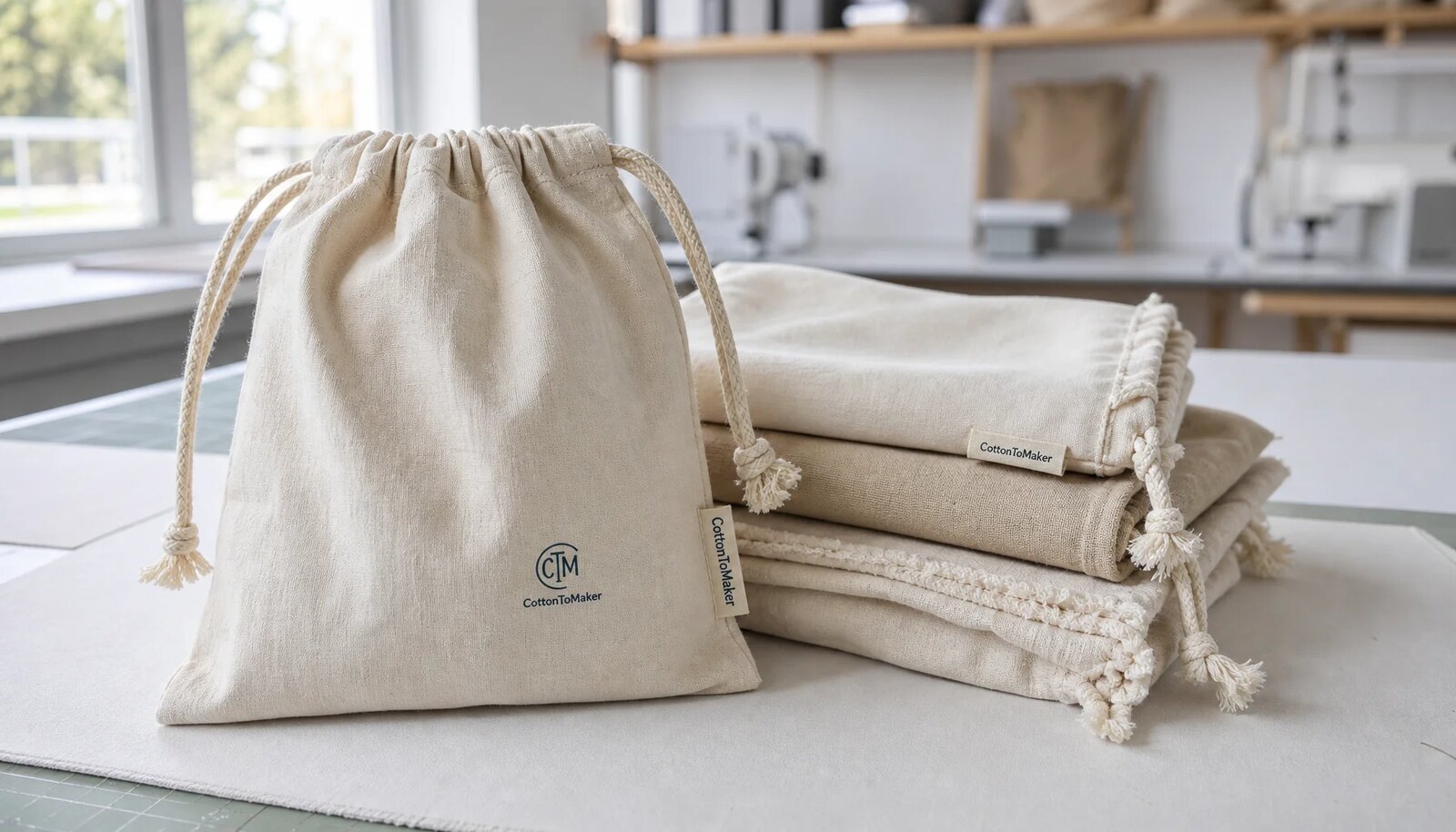
1. Start With the Vendor Use Case Before Artwork Approval
For wholesale cotton drawstring pouches for farmers market vendors, the first sourcing decision is not the logo. It is the job the pouch has to do on the market table, in a shopper's bag, and during replenishment. A pouch for soap bars, seed packet bundles, tea sachets, spice refills, candle accessories, jewelry cards, or a small promotional giveaway will need different fabric weight, closure strength, print placement, and packing. If procurement starts with a polished mockup instead of the real use case, the sample can look right while the bulk order still fails in daily handling.
Farmers market packaging also moves differently from standard retail packaging. Vendors may fill pouches by hand before the event, stack them flat for display, open and close them repeatedly, or use them as branded takeaway packaging. Some products are light but bulky. Others are small, dense, or awkwardly shaped. A pouch that works for dried lavender may be too weak for a jar, candle tin, or produce-adjacent refill item. The buyer should define the heaviest expected fill, how often the pouch will be reused, and whether the logo must remain visible when the pouch is tied.
That use case should be written into the RFQ before print proofing begins. When a pouch is flat, the logo may appear centered. Once it is filled, rounded, or cinched, the visible front panel becomes smaller and the fabric gathers under the drawcord channel. If the artwork sits too close to the top edge, it can fold into the closure. If it sits too low, the product shape can distort the design. The buyer should show the supplier the finished dimensions and the filled condition, so the proof is judged against actual use instead of a flat layout.
- Define the product category: soap, seeds, spices, herbs, jewelry, small gifts, produce-adjacent refills, or vendor giveaways.
- State the maximum fill weight and whether the contents are soft, hard-edged, rounded, oily, dusty, or fragile.
- Confirm whether the pouch is a single-use package, reusable customer pouch, table-display item, or branded event giveaway.
- Decide whether the logo must be visible when the pouch is flat, half full, fully filled, tied, stacked, or hanging.
- Share a filling photo or a dimensioned sketch so the supplier proofs placement against real pouch behavior.
2. Specify Size by Finished Dimensions and Usable Capacity
A common sourcing mistake is quoting cotton drawstring pouches by nominal size only. A buyer may ask for a 10 x 15 cm pouch and assume the entire area is usable, but finished capacity is reduced by seam allowance, drawcord channel height, bottom seam bulk, fabric shrinkage, and the way the pouch gathers when closed. For procurement, the important measurement is not only the flat rectangle. It is the finished width, finished height, usable body height below the channel, and internal capacity after sewing.
The supplier should clarify whether the quoted dimensions are cut size, finished flat size, or usable internal size. That matters when the pouch holds products that need a clean fit, such as soap bars, seed envelopes, small tins, sample bottles, or bundled retail kits. If the product barely fits the sample, normal production tolerance can make part of the bulk order too tight. A safer approach is to send the supplier the actual product dimensions or a fill-weight target and ask them to recommend a finished pouch size with margin.
Print proofing depends on the usable print zone as well. The safe print area is smaller than the front panel because the artwork needs clearance from the side seams, bottom seam, and drawcord channel. A logo placed too close to the channel can distort when the pouch is cinched. For heavier or rounded contents, the buyer may need more clearance because the fabric curves outward. The proof should show actual print size, centerline, distance from top channel, and distance from side seams.
- Ask suppliers to quote finished pouch width and height separately from cut size.
- Define drawcord channel height and body height below the channel, especially for small pouches.
- Test fit the actual product or a weight-equivalent dummy before approving bulk size.
- Require a marked print-safe zone with seam and cord-channel clearance shown on the proof.
- Set size tolerance by dimension, such as width, height, and opening, not only by a general percentage.
3. Choose Cotton GSM, Weave, and Finish for Print Stability
Fabric weight drives hand feel, durability, print quality, and landed cost. For many farmers market programs, 120-140 gsm cotton is practical for lighter goods, simple giveaways, small seed packets, or low-weight retail packaging. It keeps carton weight and unit cost lower while still giving a recognizable cotton feel. For more premium packaging, repeated handling, or heavier products, 150-180 gsm is usually safer because it gives better structure and a more stable surface for printing. Beyond that range, the pouch can become more expensive, stiffer, and less efficient to pack.
GSM alone is not enough. The weave and finish determine how cleanly ink sits on the fabric. A looser weave may be acceptable for rustic natural branding, but it can break fine lines and make small text look uneven. A tighter weave generally gives sharper edges and better print registration. Natural unbleached cotton has visible character, including small flecks and shade variation. That may be desirable for handmade, organic, or refill products, but it complicates exact color matching. Bleached cotton gives brighter contrast, while dyed cotton requires tighter shade control.
Procurement should ask for the fabric source and a swatch before committing. If the supplier samples on one cotton and produces bulk from another, the approved proof loses value. The buyer should also consider shrinkage or distortion during curing, washing, or pressing if those steps are part of production. The safest RFQ language names the GSM, finish, acceptable shade range, and whether the fabric must be pre-shrunk or tested for dimensional stability. For repeat orders, keep a reference swatch on file.
- Use 120-140 gsm for light retail kits, seed packets, tea sachets, small gifts, and basic giveaways.
- Use 150-180 gsm for premium feel, heavier hand-packed goods, refill programs, or repeated opening and closing.
- Ask whether the cotton is natural, bleached, dyed, washed, or otherwise finished before printing.
- Request a physical swatch from the intended bulk fabric, not a generic cotton reference.
- Avoid tiny text and hairline artwork on loose-weave fabric unless the supplier proves it with a strike-off.
- Create a shade reference or shade band if natural cotton variation could affect brand approval.
4. Match the Print Method to Artwork and Order Economics
Screen printing is usually the practical default for wholesale cotton drawstring pouches when the artwork is bold, vector-based, and limited to one or two colors. It scales well, is familiar to most pouch factories, and can be cost-effective for repeat orders. However, screen printing is not forgiving. Small type, thin strokes, distressed textures, gradients, and large solid ink blocks can behave unpredictably on cotton. Before approving a layout, procurement should ask whether the supplier recommends artwork changes for minimum line thickness, negative space, and ink coverage.
Heat transfer and DTG can be useful for short runs, multi-color designs, or artwork that is too detailed for conventional screen printing. They can help a buyer test several farmers market vendor logos without committing to multiple screens. But they also bring different risks: hand feel, edge durability, fabric compatibility, and higher unit cost. If the program will repeat seasonally, the buyer should ask whether the chosen print method is suitable for replenishment at larger volume or whether the method should change after the pilot order.
The print proofing checklist should include ink color on the actual fabric, print size, placement tolerance, curing process, and expected durability under normal handling. For farmers market use, the pouch may rub against other products, sit in open-air conditions, and be handled by customers with damp or dusty hands. The buyer does not need to over-engineer the pouch, but basic rub resistance, curing consistency, and legibility matter. The supplier should explain what defects are sorted out before shipment and what variation is considered normal.
- Choose screen printing for simple logos, flat colors, repeat orders, and predictable bulk production.
- Consider heat transfer or DTG for short test runs, high-color artwork, or multiple small vendor-logo batches.
- Ask for minimum line thickness, minimum text size, and maximum recommended ink coverage for the selected cotton.
- Approve ink color on the fabric, not only against a digital mockup or Pantone reference on paper.
- Confirm whether the print is applied before cutting, after cutting, or on the finished pouch because placement tolerance changes.
- Request a handling or rub check if the pouch will be reused, stacked, or handled frequently at market tables.
5. Build a Print Proofing Checklist That Catches Real Defects
A PDF proof is useful for confirming the artwork file, logo size, and general placement, but it cannot prove how cotton will absorb ink, how the shade will change on natural fabric, or whether the logo remains centered after sewing. For wholesale cotton drawstring pouches, the strongest proofing sequence is digital layout, physical strike-off, sewn pre-production sample, and bulk reference comparison. That takes longer at the start, but it prevents the expensive problem of discovering after production that the approved artwork does not work on the actual pouch.
The digital layout should show more than the logo. It should include finished pouch dimensions, print size, print location, top-channel clearance, side-seam clearance, bottom clearance, cord color, fabric color, and artwork orientation. The physical strike-off should be printed on the same GSM and fabric color planned for production. If the buyer approves a strike-off on bleached cotton and the bulk runs on natural cotton, color and edge quality may differ. The sewn pre-production sample then verifies whether cutting and stitching changed the visual placement.
Approval notes should be written, not only discussed on calls. If the logo is acceptable but the buyer wants it moved 10 mm lower, that must be documented before bulk. If the color is approved with known natural-cotton variation, document that too. Keep one labeled approval sample with the buyer and one with the supplier. When bulk inspection happens, the question should be simple: does this lot match the approved reference within the agreed tolerance?
A practical print proofing checklist also prevents overcorrection. Cotton is textured; it will not look like coated paper. Procurement teams should distinguish between natural fabric character and unacceptable defects. Small slubs may be normal for unbleached cotton, while smearing, ghosting, unreadable text, obvious off-center placement, or inconsistent curing should not be accepted. Clear approval language keeps the discussion objective.
- Digital proof must show finished size, print size, placement, safe zones, fabric color, cord color, and artwork orientation.
- Strike-off must use the same fabric GSM, color, weave, and print method intended for production.
- Sewn sample must confirm final logo position after cutting, stitching, cord insertion, and pouch gathering.
- Check minimum line thickness, negative spaces, small text, registration, ink coverage, and edge sharpness.
- Photograph and measure the approved sample, then record approval date, revision number, PO, and supplier contact.
- Do not approve bulk based only on a screen mockup when brand color, logo legibility, or placement matters.
6. Make Supplier Quotes Comparable Before Negotiating Price
A low unit price is not useful if the quoted specification is incomplete. In B2B procurement, a quote for cotton drawstring pouches should identify the finished size, fabric GSM, fabric finish, print method, number of print colors, artwork version count, cord type, sample route, packing method, lead time, and included or excluded charges. Without those details, two supplier quotes may appear comparable while actually covering different products. One supplier may include screen fees and carton labels; another may exclude them and look cheaper until the PO is placed.
The buyer should separate one-time setup costs from repeatable unit costs. Screen making, artwork adjustment, color matching, and sample freight can be meaningful on small orders, especially if a farmers market group or distributor is testing multiple vendor logos. On repeat orders, those setup costs may disappear or reduce, which changes the total cost comparison. Ask the supplier to show costs by first order and repeat order if the program is likely to replenish.
Lead time belongs in the quote, not as an afterthought. The supplier should break it into sample production, sample transit, approval time, fabric preparation, printing, sewing, inspection, packing, and export or domestic dispatch. This matters for seasonal farmers market programs where missing a launch window can create dead inventory. A quote that gives only '20 days' without explaining when the clock starts is not procurement-ready.
The best quotes also state assumptions and exclusions. If barcode labels, retail polybags, special carton marks, or mixed-carton packing are not included, the buyer needs to know before comparing landed cost. A supplier who answers in a structured way is usually easier to manage because they understand which variables control the order.
- Use one RFQ template for every supplier so fabric, print, packing, and lead time are quoted on the same basis.
- Require suppliers to list included costs and excluded costs separately.
- Ask for first-order cost and repeat-order cost if screens or artwork setup can be reused.
- Confirm whether pricing changes by artwork version, print color count, pouch size, fabric color, or cord color.
- Request carton dimensions and gross weight early so freight assumptions can be compared.
- Do not negotiate the unit price until the specification is complete enough to compare.
7. Control MOQ, Variations, and Inventory Waste
MOQ for drawstring pouches is usually driven by production efficiency: fabric purchasing, cutting setup, print setup, sewing line planning, and packing labor. Buyers sometimes treat MOQ as a simple quantity hurdle, but the more important issue is how many variables the order contains. One pouch size in one fabric color with one print is straightforward. Three sizes, four logos, two cord colors, and mixed packing can turn a low-MOQ quote into a fragmented production run with hidden cost.
Farmers market vendors often want variety. A distributor may need pouches for several vendors, seasonal flavors, or local product categories. Procurement can reduce waste by standardizing the base pouch wherever possible. Use one fabric, one size, one cord, and one print location, then change only the artwork if necessary. If artwork versions must vary, ask whether screens can be shared, whether print colors are identical, and whether the factory can gang production efficiently. Each change should have a visible cost line, not a vague promise.
Inventory risk matters as much as factory MOQ. Ordering too many custom-printed pouches for a seasonal farm stand, holiday market, or limited product line can lock the buyer into slow-moving packaging. On the other hand, ordering too little may force expensive rush replenishment or a second setup charge. A practical strategy is to choose a base pouch that can support multiple products and keep the print broad enough that leftover inventory is still usable.
MOQ negotiation should focus on total usable inventory, not only the lowest number. Ask suppliers for price breaks at logical tiers and compare the cost of the next tier against expected demand. Sometimes the higher tier is worthwhile; sometimes it creates waste. The right decision is tied to forecast confidence, seasonality, storage space, and whether the printed pouch can be used across multiple SKUs.
- Standardize size, fabric color, cord color, and print location before adding vendor-specific artwork versions.
- Ask which costs repeat per artwork and which costs can be shared across the order.
- Compare MOQ by fabric lot, print setup, pouch size, and packing configuration, not only by total order quantity.
- Request price breaks at two or three tiers so procurement can balance unit cost against inventory risk.
- Avoid very small split runs unless the purpose is a paid pilot or demand test.
- Design the base pouch so excess inventory can still be used for another compatible market product.
8. Set Measurable QC Tolerances Before Production Starts
Quality control for cotton drawstring pouches should be written into the order before bulk production. Most disputes are not about catastrophic failure; they are about borderline defects that were never defined. A logo is slightly crooked. A pouch is a little short. A cord is uneven. The cotton shade is warmer than the sample. The buyer sees a problem; the supplier sees normal textile variation. Measurable tolerances reduce that disagreement.
Useful QC tolerances include finished width and height, print placement from centerline or edge, print registration for multi-color artwork, acceptable shade range, stitching density, seam strength, cord length, and cleanliness. The exact numbers should be realistic for the pouch type, fabric, and print method. Procurement does not need laboratory-level precision for a simple farmers market giveaway, but it does need clear reject conditions for visible print defects, open seams, staining, odor, wrong counts, and incorrect labels.
Inspection should sample across cartons, not only the top of one carton. Pouch production can vary by cutting bundle, sewing operator, print batch, or packing table. If the supplier prints in batches, color or placement may drift between batches. If pouches are packed immediately after curing or pressing, creases or sticking can appear. Ask the supplier to keep batch traceability by PO, production date, or carton range so issues can be isolated instead of affecting the entire shipment.
The approved sample is the QC anchor. Bulk should be compared against that sample for fabric shade, hand feel, print clarity, placement, and construction. If the buyer allows natural-cotton variation, define what is acceptable. If the brand needs tight consistency, require a narrower standard and expect that it may affect cost or lead time. Clear QC is not about making the supplier's job harder; it is about preventing claims after the goods arrive.
- Set finished size tolerance for width, height, opening, and channel height.
- Define print-position tolerance using distance from centerline, top channel, side seam, or bottom seam.
- For multi-color prints, define acceptable registration shift and reject obvious misalignment.
- Check seam security, skipped stitches, loose threads, needle holes, and cord-channel strength.
- Inspect drawcord smoothness, cord length, knots, cord ends, and whether the pouch closes evenly.
- Reject visible stains, oil marks, mildew odor, dirt, scorch marks, ink transfer, and contaminated fabric.
- Verify carton count, inner pack count, SKU labels, PO data, and carton marks against the purchase order.
9. Design Packing for Warehouse Receiving and Market Distribution
Packing affects cost, receiving speed, damage risk, and count accuracy. Cotton pouches are soft, so buyers may assume packing is simple. In practice, loose-packed pouches can collect dust, crease badly, shift between cartons, and create count disputes. If the shipment goes to a distributor, 3PL, retailer, or multi-vendor farmers market program, the inner pack and carton plan should be part of the RFQ. The supplier needs to know whether the buyer wants bulk packs of 25, 50, or 100, individual polybags, barcode labels, mixed-SKU cartons, or destination-specific carton marks.
The right packing plan depends on how the pouches will be used downstream. If vendors will receive a bundle of blank or printed pouches for hand-filling, bulk inner packs may be enough. If the pouches are sold as retail units or included in kits, individual packaging or barcode labels may be required. If a distributor is splitting cartons across multiple farmers market vendors, clear inner labels can prevent mis-picks. Each added packing requirement has cost and labor implications, so procurement should define only what is necessary.
Carton specifications also influence landed cost. Carton dimensions, gross weight, and units per carton affect freight, palletization, and storage. A supplier may quote a low unit price but use inefficient cartons that increase shipping cost. On the other hand, overpacking can crush or crease pouches and create extra unpacking work. Ask for estimated carton data before the PO and confirm the final carton marks before shipment.
For receiving, carton labels should match the purchase order language. At minimum, they may need PO number, SKU, pouch size, fabric color, print version, quantity, carton number, and country or destination data if applicable. Mixed cartons should be avoided unless there is a clear reason and a detailed packing list. If mixed cartons are necessary, the supplier should label each inner pack and provide carton-level contents.
- Define inner pack quantity, master carton quantity, folding method, and whether pouches are bundled or individually packed.
- Use individual polybags only when retail, moisture protection, barcode, or kit assembly requirements justify the added cost.
- Ask for carton dimensions, net weight, gross weight, and cartons per order quantity before freight is estimated.
- Require carton marks that include PO, SKU, size, color, print version, quantity, and carton number where needed.
- Avoid mixed cartons unless the packing list and inner labels make receiving error-resistant.
- Confirm whether the supplier can support distributor, 3PL, retail, or direct-to-vendor labeling requirements.
10. Compare Landed Cost and Lead-Time Risk, Not Only Unit Price
The strongest procurement decision compares full landed cost, not just the factory unit price. For wholesale cotton drawstring pouches, landed cost includes unit price, setup fees, sample fees, artwork changes, screens or plates, packing materials, inspection, inland transport, freight, duties if applicable, warehousing, repacking, and rush costs. A quote that looks cheaper at the factory can become more expensive if it requires extra inspection, produces inefficient carton loads, or misses the seasonal selling window.
Lead-time risk is especially important for farmers market vendors. Many programs are seasonal, event-based, or tied to harvest, holiday, or local retail calendars. If sample approval slips by a week, bulk production may miss the intended market date. Procurement should ask for a schedule with decision points: artwork deadline, strike-off date, sample approval deadline, material cutoff, bulk production window, inspection date, packing completion, and shipment handoff. This makes delays visible early enough to fix.
Cost comparisons should also account for quality risk. A supplier with a slightly higher price may be better value if they provide a reliable proofing process, clear tolerances, better packing, and more complete quote documentation. Conversely, a supplier who quotes aggressively but avoids details may create rework, claims, or emergency replenishment costs. The goal is not to overpay; it is to identify which supplier can reproduce the approved sample at the required quantity and timing.
A simple landed-cost worksheet can prevent emotional price decisions. Use the same assumptions for every supplier: same pouch spec, same order quantity, same packing plan, same destination, same inspection expectations, and same sample route. Then compare total cost, not isolated unit price. If the cheapest supplier is still cheapest after all variables are included and the sample is strong, the decision is easier. If not, procurement has a clear reason to choose the more reliable option.
- Add unit price, setup fees, sample fees, packing, labels, inspection, freight, duties, and repacking into one comparison.
- Ask suppliers for a production timeline broken into proofing, material prep, printing, sewing, QC, packing, and shipment.
- Assign risk to weak samples, vague tolerances, missing carton data, or unclear subcontracted printing.
- Compare carton efficiency and freight assumptions before choosing a supplier based on EXW or FOB price.
- Protect seasonal programs by setting approval deadlines and backup dates before placing the PO.
- Keep the final award decision tied to reproducibility, not only the lowest quoted unit cost.
Specification comparison for buyers
| Spec decision | Recommended option | When it fits | Buyer risk to check |
|---|---|---|---|
| Fabric weight | 120-140 gsm cotton for lighter retail kits; 150-180 gsm for refill packs, soap, candle, seed, or produce-adjacent use | Use this range when the pouch needs enough body for printing and daily handling without becoming bulky in cartons | Too light can show weave-through and distort print; too heavy raises freight cost, reduces pack count, and can make the pouch feel stiff |
| Weave and finish | Tighter plain weave with a natural, bleached, or dyed finish selected before sampling | Best when the print needs clean edges, the brand needs consistent color, or the pouch will be reused by vendors and shoppers | Loose weave can break fine type; natural cotton shade varies by lot; dyed fabric needs shade approval and can shift logo color appearance |
| Finished size and tolerance | Quote finished width and height, plus a practical tolerance such as +/- 5 mm on small pouches and +/- 8 mm on larger pouches | Useful when the product must fit a fixed item such as a soap bar, seed packet bundle, tin, or small retail kit | Cut size is not finished size; seam allowance, channel height, and shrinkage reduce usable space |
| Print route | Single-color or two-color screen print for bold logos; heat transfer or DTG only for short runs or high-detail trials | Best when the artwork is vector-based, repeat orders are likely, and the buyer wants stable bulk output | Fine lines, gradients, and small text can fail on cotton if the supplier does not adjust artwork before proofing |
| Artwork complexity | Flat vector logo with minimum line weight of 0.5 mm and text no smaller than 6 pt equivalent on fabric | Best for procurement programs that need legible branding after filling, tying, stacking, and handling | Dense fills, thin strokes, and reversed type can close up on textured cotton and create approval disputes |
| Closure style | Single cotton drawcord with reinforced channel for standard use; double drawcord for premium or repeated-use programs | Good for table display, soap bars, seed packets, herb sachets, and small retail bundles | Weak channel stitching, short cord length, or rough cord ends can cause returns even if the print passes |
| Packing format | Inner packs of 25, 50, or 100 with carton counts and SKU labels defined in the PO | Useful when the pouches go to a 3PL, retailer, distributor, or multiple farmers market vendors | Loose-packed goods can collect dust, crease, and create receiving errors if the count is not controlled |
| Supplier structure | Direct factory or integrated supplier with disclosed printing, sewing, inspection, and packing control | Best when procurement needs traceability, proof approval, and repeat-order consistency | If printing is subcontracted without disclosure, sample-to-bulk mismatch and rework are harder to control |
Buyer checklist before sampling
- Confirm finished pouch size, seam allowance, drawcord channel height, and usable internal capacity, not only the flat cut size.
- Specify cotton GSM, weave type, fabric finish, expected shrinkage, and whether the fabric is natural, bleached, dyed, or washed.
- Define the intended contents, maximum fill weight, and whether the pouch must stand, stack, hang, or stay logo-visible when tied.
- Approve artwork at exact print size with seam clearance, cord-channel clearance, and minimum line thickness called out in millimeters.
- Request a physical strike-off on the same fabric weight and color planned for bulk production before approving the order.
- Approve a sewn pre-production sample after printing, cutting, stitching, and cord insertion, not only a loose printed swatch.
- State measurable tolerances for finished size, print position, registration, shade, stitching density, cord length, and cleanliness.
- Ask the supplier to identify all setup charges: screens, plates, artwork cleanup, sample fees, color matching, labels, and repacking.
- Lock the packing plan: inner pack count, carton pack count, carton marks, barcode or SKU label format, and whether mixed cartons are allowed.
- Keep one approved sample with the buyer and one sealed reference sample with the supplier for bulk comparison.
Factory quote questions to send
- What exact cotton GSM, weave, finish, and color standard are you quoting, and can you share a swatch from the bulk fabric source?
- Is printing done before cutting, after cutting, or on the finished pouch, and what placement tolerance does that process support?
- What is the finished pouch width, finished height, drawcord channel height, seam allowance, and expected usable internal capacity after sewing?
- What is the MOQ by fabric color, pouch size, print color count, cord color, and artwork version?
- If we split the order across several farmers market vendor logos, which costs are shared and which costs repeat per artwork?
- Can you provide a physical strike-off and a sewn pre-production sample on the actual pouch fabric before bulk approval?
- What ink type, curing method, screen mesh, or transfer process will be used for the quoted print method?
- What are your standard tolerances for finished size, print placement, print registration, fabric shade, stitching, and cord length?
- What inspection standard do you use before shipment, and can you share photos or lot-based inspection results?
- How are pouches packed inside cartons, including inner pack quantity, folding method, moisture protection, and carton labeling?
Quality-control points to confirm
- Fabric GSM matches the approved specification within the buyer-defined tolerance and the fabric finish matches the approved swatch.
- Bulk fabric shade is compared against the approved shade band or reference sample before cutting begins.
- Finished pouch width, height, drawcord channel height, seam width, and usable opening are measured across cartons, not only from one top sample.
- Drawcord feeds smoothly, cord length is consistent, knots or ends are secure, and channel stitching does not fray, tunnel, or catch.
- Print is centered within the agreed tolerance and remains legible after the pouch is filled, tied, and lightly handled.
- Ink is free from smearing, pinholes, ghosting, misregistration, color contamination, scorch marks, and uneven curing.
- Minimum line weight, small text, and negative spaces remain open and readable on the actual cotton surface.
- Basic rub resistance and handling resistance are acceptable for the pouch's intended market-table and retail use.
- No broken stitches, skipped stitches, open seams, needle damage, loose threads, stains, odor, oil marks, or contaminated fabric are present.
- Carton count, inner pack count, SKU label data, PO number, and outer carton marks match the packing list and purchase order.