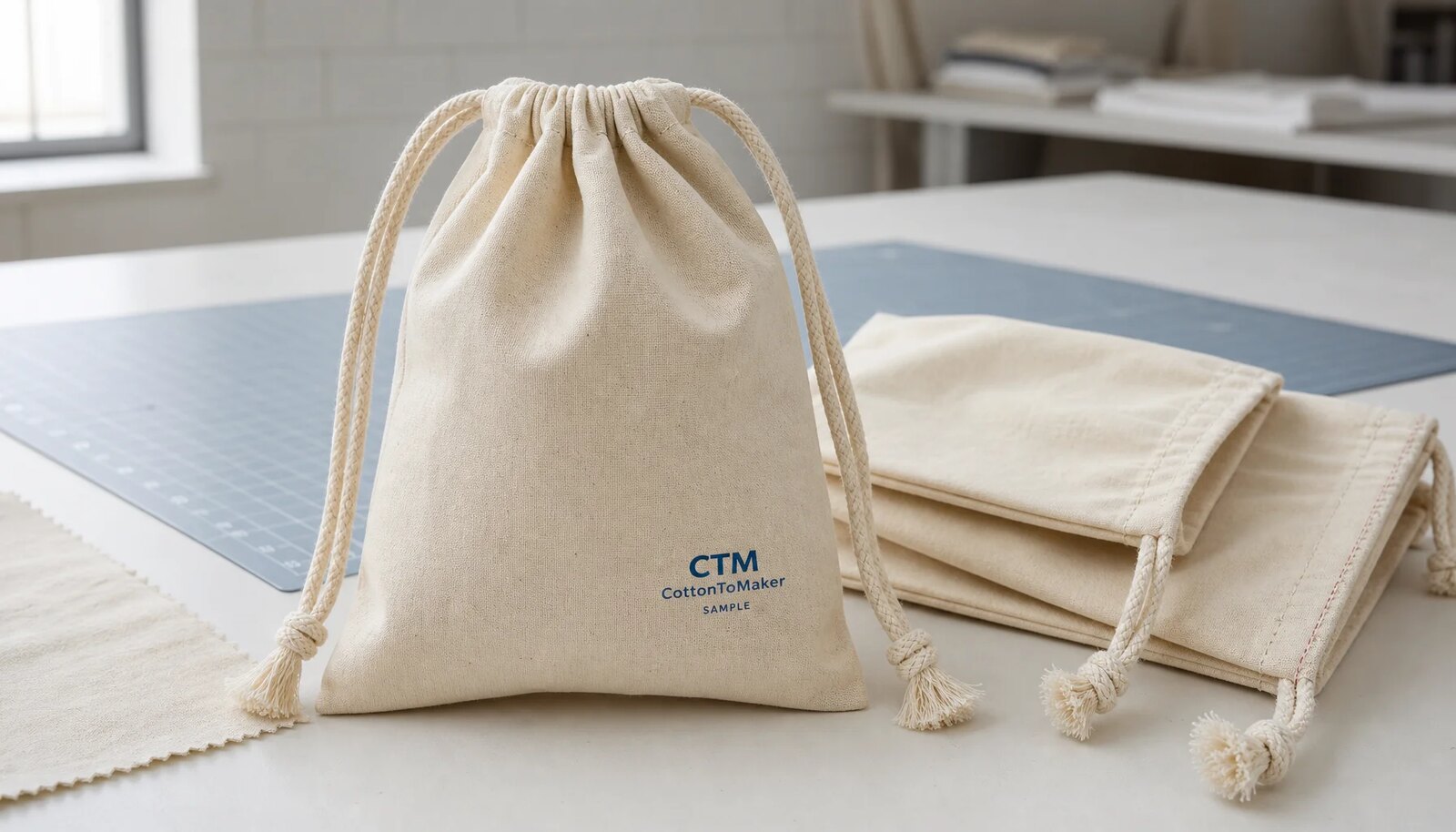
Start with the gift job
For corporate gifting buyers, fabric weight is a commercial decision as much as a textile decision. GSM affects handfeel, opacity, print stability, fold bulk, carton volume, and how confidently the pouch supports the item inside. A pouch can be 100% cotton and still feel under-specified if the weave is loose, the channel is shallow, or the print surface is uneven.
Begin with the actual gift and the recipient moment. A light pouch may be right for a conference card set, jewelry insert, pin pack, or small textile sample. The same pouch may look weak around a candle, charger, boxed notebook, bottle, or premium client set. The target is not the heaviest cotton by default. The target is the lightest fabric that still gives the required presentation, function, and inspection result.
Record GSM together with construction, color, cord style, decoration method, finished size, packing method, and approved sample reference. GSM measures fabric mass per square meter. It does not prove tight weave, smooth printing, clean stitching, shade consistency, or durability by itself.
- Use contents, loaded weight, and presentation standard as the starting point.
- Check show-through with the actual product, especially with natural cotton and dark contents.
- Ask for GSM and fabric construction together; one number is not enough for repeat sourcing.
- Consider carton volume before upgrading every program from 120 gsm to 220 gsm.
- Treat the approved physical sample as the reference for handfeel, print surface, cord behavior, and finish quality.
Choose the GSM range
Lightweight cotton around 100 to 120 gsm works best when the pouch is a simple carrier for low-weight items. It can keep cost, carton bulk, and freight down. The tradeoff is lower opacity, less body, and a less forgiving logo surface. If the campaign depends on premium presentation, approve this range only after testing it with the actual contents.
A middle range around 130 to 180 gsm is often the practical zone for corporate gifting. It usually improves handfeel and print stability without making the pouch difficult to fold or close. Within that range, 140 to 160 gsm can be a balanced starting point for many programs, provided the weave is suitable and the supplier can hold the agreed tolerance.
Heavier cotton from 200 to 240 gsm suits premium sets, reusable storage, and heavier contents. Above 240 gsm, confirm sewing feasibility before approving bulk. The factory may need different needles, adjusted stitch settings, wider seams, and a deeper drawcord channel. Heavy fabric can look better on a table but create bulky closure and packing problems in production.
- 100-120 gsm: use for low-cost events, lightweight samples, and short-use promotions.
- 130-150 gsm: use when price matters but the pouch still needs acceptable body.
- 160-180 gsm: use for stronger handfeel, better opacity, and more stable print results.
- 200-240 gsm: use for premium sets, heavier contents, and reusable storage.
- 250 gsm and above: use only after checking sewing, closure, folding, and carton impact.
Qualify tolerance and evidence
A tolerance such as plus or minus 5% can be a reasonable starting point for fabric GSM, but it should not remain a vague promise. Define whether the tolerance applies to incoming fabric rolls, production-cut panels, finished pouches, or comparison against a retained sample. Different mills, weave types, washing treatments, and finishing processes can produce different measurement results.
Ask for supplier evidence before the order is priced as final. For stock fabric, request a labeled swatch card with GSM, fabric construction, color, finish, supplier reference, and date. For larger custom orders, ask whether the factory can provide a mill sheet, incoming material record, or roll reference. The point is to connect the quoted fabric to the material that will actually be cut.
For organic cotton, recycled cotton, or other certified material claims, request proof that is relevant to the supplier and the order. A certificate logo in a presentation is not enough. Check supplier name, scope, validity date, material type, and whether a transaction certificate or order-level material document is available where the claim requires it.
- State target GSM, tolerance, inspection stage, and test method in the RFQ.
- Ask how many rolls will be checked and what happens if one roll falls outside tolerance.
- Retain a labeled swatch and approved pouch sample for handfeel, shade, and surface comparison.
- Check certification proof for supplier name, material scope, validity date, and product relevance.
- Require written approval before changing fabric source, dye lot, finish, or mill lot on repeat orders.
Translate product size into pouch size
Sizing errors often come from using catalog dimensions without checking usable space. A pouch listed as 20 x 30 cm may be measured as finished flat outside size, while the product inside loses space to seams, fabric thickness, channel depth, and closure gathering. Rigid boxes, jars, bottles, and square-edged products need more allowance than soft goods.
A strong RFQ states finished flat width and height, usable opening width, channel depth, and whether the pouch must close fully. Add product length, width, depth, weight, and shape. If the item is boxed, rounded, sharp-cornered, or irregular, send photos or a drawing. For gift sets, list all components and whether the pouch ships empty, loaded, tied, or folded into another box.
Decide early whether the pouch needs a gusset. Flat pouches are efficient for cards, textiles, slim samples, and small accessories. Gusseted pouches can work better for candles, jars, drinkware, bottles, and products that should sit more neatly. Simply making a flat pouch larger can create extra fabric at the closure and make logo placement look low or distorted.
- Confirm whether dimensions are finished flat outside measurements or usable inner measurements.
- Provide product dimensions and loaded weight with the RFQ.
- Check opening width and channel depth, not only total pouch height.
- Compare flat and gusseted options for bulky or rigid gifts.
- Test logo position with the product inside the pouch, not on an empty sample only.
Specify fabric and sewing
Cotton pouch quality comes from several small choices that should be written down. Plain weave cotton is common for general gifting because it feels familiar and often accepts screen print well. Muslin-style cotton can look more natural but may show slubs, seed flecks, or open texture. Twill and canvas-style cotton can feel more substantial, but the surface may change how fine artwork appears.
Color needs practical language. Natural cotton is not pure white; it may show cream tones, flecks, and lot variation. Bleached cotton looks cleaner but can have a different handfeel. Dyed cotton needs shade approval, preferably through a lab dip or retained reference. If the brand wants a natural look, define acceptable flecks. If the brand wants a clean premium pouch, define limits for stains, dark specks, and contamination.
Cord and sewing choices affect usability. Specify cord material, approximate diameter, color, closure style, knot or end-stop requirement, channel depth, seam allowance, stitch density, and reinforcement. For heavier contents, ask the factory to run a loaded pull and closure check. A low unit price can hide thinner cord, shallow channels, loose stitching, or rough trimming.
- Name the fabric type and finish instead of writing only cotton pouch.
- Define natural, bleached, dyed, or custom color fabric with an approval standard.
- Specify cord material, diameter, color, single or double drawcord, knot style, and end stop.
- Write seam allowance, stitch density expectation, and corner reinforcement into the spec.
- Clarify whether loose threads are minor defects, major defects, or reworkable trimming issues.
Match decoration to fabric
Decoration should be chosen for the artwork, the fabric surface, and the way the pouches will be packed. Screen printing is often the practical option for cotton drawstring pouches with solid logos, limited colors, sponsor marks, and larger wholesale runs. It can deliver good opacity when ink, mesh, fabric surface, and curing are matched properly.
Heat transfer can work for gradients, many colors, and small details that are inefficient to screen print. The risk is handling. Transfers may react differently to folding, rubbing, heat, pressure, and long carton storage. Digital print can also be useful for complex artwork, but cotton texture may reduce edge sharpness or color saturation. Approve a physical sample on the final fabric, then fold it and rub it before bulk approval.
Embroidery, woven labels, and side tags create a more textile-led brand effect. Embroidery may feel premium, but dense stitching can pucker lighter cotton, especially below the midweight range. Woven labels help when brand color consistency matters or when the pouch face should stay clean. Support every artwork method with a placement drawing measured from top edge, side seam, bottom seam, and drawcord channel.
- Use screen print for solid logos, limited color counts, and repeatable wholesale runs.
- Use heat transfer only after testing rub, fold, edge adhesion, and packing pressure.
- Use embroidery on fabrics that can support stitch density without puckering.
- Use woven labels or side tags when brand color needs tighter control than direct print allows.
- Define placement, logo size, registration, skew, and curing requirements before production.
Build a comparable RFQ
A pouch quote is only useful when every supplier prices the same item. The RFQ should include finished size, target GSM, fabric construction, color, cord, decoration, artwork size, labels, inner packing, master carton packing, order quantity, destination, delivery term, and required date. Without those details, the lowest quote may simply exclude work another supplier included.
When the final spec is flexible, ask for controlled alternates. For example, request the same pouch at 120 gsm, 160 gsm, and 220 gsm with identical cord, print, label, and packing assumptions. Or ask for one version with direct print and one with a woven side label. This helps procurement compare the real cost of a fabric upgrade instead of comparing unrelated supplier guesses.
Commercial and quality terms should sit in the same brief. Ask suppliers to separate sample cost, setup charges, unit price, decoration, labels, packing materials, kitting labor, cartons, inspection, and freight where relevant. Also request stated tolerances for GSM, finished dimensions, print placement, drawcord length, and carton count.
- Attach artwork files, color references, print size, and placement drawings.
- Ask each supplier to list all assumptions and exclusions in writing.
- Request line-item pricing for decoration, labels, packing, kitting, setup, samples, and freight where relevant.
- Ask for MOQ by size, fabric color, artwork version, cord color, label version, and packing format.
- State the delivery basis, such as ex-factory, FOB, DAP, or delivered warehouse.
Use samples to lock the standard
The sample stage prevents expensive disputes. A pre-production sample should be measured, loaded with the intended gift, closed with the drawcord, inspected under neutral light, and handled as a recipient would handle it. Do not approve only from a front-facing photo. The physical sample should confirm fabric weight, handfeel, dimensions, opening width, cord function, seam quality, print placement, print opacity, and packing format.
The approved sample should become a gold sample or be documented with a sample sheet. Record target GSM, fabric type, color reference, finished measurements, channel depth, cord material, cord length, print size, print position, label placement, fold method, inner pack, and carton quantity. Keep the retained fabric swatch and print strike-off with the approved pouch when possible.
Tolerances should be practical and measurable. Soft textile pouches will vary, but the accepted range must be agreed before production. Define critical, major, and minor defects separately. A missing logo, wrong artwork, broken seam, incorrect SKU mix, or unusable closure is not the same as a loose thread that can be trimmed.
- Measure the sample using the same method the inspector will use during bulk inspection.
- Confirm fit and closure with the actual gift item inside.
- Seal, sign, or tag the approved sample so it cannot be confused with earlier revisions.
- Require written approval for fabric, cord, print method, label, or packing changes.
- Create a sample sheet covering GSM, size, construction, print, label, cord, and packing.
Make QC procurement-grade
For bulk orders, write the inspection plan before production starts. Many pouch inspections use a general sampling standard such as ANSI/ASQ Z1.4 or ISO 2859-1, often at General Inspection Level II unless the buyer, order size, or risk profile requires another level. AQL levels vary by program, but a common structure is zero acceptance for critical defects, tighter limits for major defects, and a higher allowance for minor defects. The exact AQL must be agreed in the PO or inspection booking.
Defect classification should be pouch-specific. Critical defects may include unsafe contamination, mildew odor, sharp foreign matter, or illegal labeling. Major defects may include wrong fabric, wrong size outside tolerance, missing print, wrong logo, broken seam, unusable drawcord, severe stain, incorrect SKU mix, or carton shortage. Minor defects may include trimmable thread ends, slight shade variation within the approved range, or small cosmetic marks that do not affect use or presentation.
Inspection should cover material, sewing, decoration, and final packing. Check GSM by the agreed method, compare shade to the approved sample, measure finished dimensions, test drawcord function, inspect seam security, and verify print curing. For final packing, confirm inner quantity, SKU separation, barcode readability, carton marks, gross weight, and master carton count.
- Use a written AQL plan with inspection level, sample size, defect classes, and acceptance limits.
- Set critical defects at zero acceptance for safety, severe contamination, and unusable product issues.
- Classify wrong artwork, broken seams, unusable closure, and incorrect SKU mix as major defects.
- Define which minor defects can be reworked before final acceptance.
- Require inspection photos of measured dimensions, print placement, cord function, labels, carton marks, and carton condition.
Control packing and timeline
The pouch unit price is only part of landed cost. A bulk-packed empty pouch is simple. A pouch that must be folded in a certain direction, tied closed, inserted with a card, individually bagged, paper-banded, barcode labeled, separated by version, or loaded with product needs more labor and control. Those steps can change total cost more than a modest GSM upgrade.
Packing affects presentation. A premium cotton pouch can arrive wrinkled if compressed without a fold method. Natural cotton can pick up dust or carton rub if packed loose. Freshly printed pouches can suffer ink transfer if curing time is shortened and pouches are stacked under pressure. Ask for packing photos before shipment, including inner pack, carton marks, carton dimensions, and gross weight.
Lead time should be managed by milestone, not one vague production number. Fabric booking, lab dip approval, artwork proofing, screen preparation, sample making, sample courier time, revisions, cutting, printing, sewing, trimming, inspection, packing, and shipment booking all add time. Ask when the clock starts: deposit, artwork approval, fabric approval, sample approval, or receipt of all kitting components.
- Specify bulk pack, folded pack, tied pack, polybag, paper band, insert card, or full set assembly.
- Define inner quantity and master carton quantity by size, color, artwork version, and destination.
- Confirm suffocation warnings, recycling marks, barcodes, and customer labels where needed.
- Ask for carton dimensions and gross weight early for freight planning.
- Request a dated schedule for sample, approval, cutting, printing, sewing, inspection, packing, and ex-factory readiness.
Specification comparison for buyers
| Fabric weight | Best-fit gifting use | Opacity and handfeel | Print suitability | Packing impact |
|---|---|---|---|---|
| 100-120 gsm | Low-cost event giveaways, sample inserts, card packs, pin sets, small textile items, and short-use promotional programs. | Light handfeel with visible drape. Natural or light colors may show dark contents, sharp corners, or printed inserts through the fabric. | Suitable for simple one-color logos when the weave is even. Fine detail, heavy ink coverage, and dark contents behind the print need sample testing. | Lowest fold bulk and efficient carton use. Can wrinkle easily if packed loosely, compressed unevenly, or handled repeatedly. |
| 130-150 gsm | Standard corporate gifting where cost, presentation, and packing efficiency need to stay balanced, especially for small to mid-size pouches. | Moderate body with better coverage than 120 gsm. Still needs show-through testing for dark, rigid, or sharply edged contents. | Good for screen print, woven labels, and simple heat transfer. Smooth plain weave usually performs better than open muslin at the same GSM. | Still efficient for campaign volumes. Slightly more fold bulk than lightweight cotton but usually manageable for carton planning. |
| 160-180 gsm | Employee welcome kits, client gifts, small tech accessories, wellness items, retail-adjacent samples, and reusable storage pouches. | Noticeably firmer handfeel with improved opacity. Often feels substantial without becoming difficult to close. | Strong option for most direct screen prints and side labels. Better surface stability for logos than lighter open-weave cotton. | Higher carton volume than light pouches. Fold method and print curing time matter when pouches are stacked tightly. |
| 200-240 gsm | Premium gift sets, heavier contents, candles, bottles, boxed accessories, and programs where the pouch should feel reusable. | Structured feel with better coverage and less show-through. Can feel stiff in small sizes if the channel is narrow or the item is bulky. | Good for bold logos, woven labels, and embroidery if the fabric surface is suitable. Fine screen detail still depends on weave smoothness. | Bulkier in cartons and less forgiving when folded. Channel depth, cord diameter, and carton compression should be tested. |
| 250 gsm and above | Special presentation pouches, heavy reusable storage, or structured brand packaging where fabric body is part of the brief. | Heavy and substantial. May feel premium, but can be too rigid for small gifts, tight closures, or fast kitting work. | Can support embroidery and labels well, but screen print may require adjusted ink, pressure, and curing. Always approve the final fabric. | Largest packing impact. More carton space, higher weight, slower folding, and possible changes to kitting labor. |
| Material | 6-10 oz cotton canvas, 210D polyester, rPET, or blended cotton with shrinkage and colorfastness expectations set before sampling | Before price comparison | Different cloth weights, backing, or certification claims make quotes hard to compare | |
| Construction | cord diameter, eyelet or reinforced channel, bottom corner reinforcement, seam allowance, bar-tack position, and load target | Before sampling | Weak stress points create returns and failed inspections | |
| Decoration | screen print, transfer, embroidery, woven label, or drawstring tag tested against folding and abrasion | Before artwork approval | The wrong method can crack, bleed, pucker, or fail on the chosen fabric |
Buyer checklist before sampling
- Define the gift job: event giveaway, employee welcome kit, executive gift, retail accessory, sample packaging, reusable storage, or gift-set component.
- List the actual contents with length, width, depth, shape, loaded weight, and whether the pouch must close fully over the item.
- State finished flat width, finished flat height, usable opening width, channel depth, and gusset requirement if the item is bulky.
- Specify target fabric GSM, tolerance, inspection stage, and whether GSM will be checked from incoming roll fabric, cut panels, or a retained sample.
- Name the fabric construction: plain weave cotton, muslin-style cotton, twill, canvas-style cotton, washed cotton, organic cotton, recycled cotton blend, or cotton-poly blend.
- Define fabric color as natural, bleached, dyed, or custom, and state acceptable limits for seed flecks, slubs, stains, shade variation, and odor.
- Choose decoration method and define print size, color count, artwork placement, registration tolerance, curing standard, and whether artwork crosses folds, seams, or the drawcord channel.
- Specify cord material, cord color, approximate diameter, single or double drawcord closure, knot style, end stop, and whether polyester cord or self-fabric cord is acceptable.
- Write seam allowance, stitch density expectation, corner reinforcement, thread trimming standard, and defect classification for loose threads or skipped stitches.
- State label and packing requirements, including side label, care label, origin label, barcode, paper band, insert card, polybag, inner quantity, and master carton quantity.
Factory quote questions to send
- What exact fabric GSM, weave, finish, and color are included in the quote?
- Does the GSM tolerance apply to incoming rolls, cut panels, finished pouches, or the approved sample reference only?
- Can you provide a labeled fabric swatch showing GSM, construction, color, finish, supplier reference, and date?
- For organic or recycled cotton claims, what certificate, scope document, transaction certificate, or material proof connects the claim to this order?
- Is the quoted size a finished flat outside size, cut size, usable inner size, or standard blank size?
- Can you quote 120 gsm, 160 gsm, and 220 gsm options using the same size, cord, artwork, label, packing, quantity, and delivery assumptions?
- Which decoration method is included, how many colors are covered, what is the maximum print area, and are screen, setup, or artwork charges separate?
- What is the MOQ by pouch size, fabric color, artwork version, cord color, label version, and packing format?
- What exactly is included in the unit price: drawcord, labels, polybag, paper band, insert card, barcode sticker, carton marks, master carton, and kitting labor?
- Will bulk production use the same fabric source as the approved sample, and how will roll substitution, dye-lot change, or material shortage be approved?
Quality-control points to confirm
- Fabric GSM is checked by the agreed method before cutting, with sample size, tolerance, and acceptance rule written into the inspection plan.
- Fabric color, handfeel, weave tightness, slubs, seed flecks, odor, and surface cleanliness match the approved sample under consistent neutral light.
- The approved sample, retained fabric swatch, mill sheet, print strike-off, and packing reference are available to production and inspection teams.
- Finished width, height, opening position, channel depth, seam allowance, and drawcord length are checked against the same measurement method used at sample approval.
- Seam density is even, corners are secure, channel stitching is not twisted, and skipped stitches do not appear at stress points or cord exits.
- Loose threads are trimmed, seam ends are locked, and the pouch does not show fraying, holes, broken yarns, oil marks, mildew odor, or visible contamination.
- Drawcords pull smoothly, knots or end stops do not slip, cord length is consistent, and closure strength is suitable for the intended loaded weight.
- Print alignment, opacity, curing, registration, logo size, edge sharpness, and placement match the approved artwork layout and physical sample.
- Prints pass a basic dry rub, fold, tape, or handling check appropriate to the decoration method, especially when pouches are folded tightly or packed under pressure.
- Labels, side tags, care labels, barcode stickers, paper bands, and insert cards are attached in the approved position and match the correct SKU version.