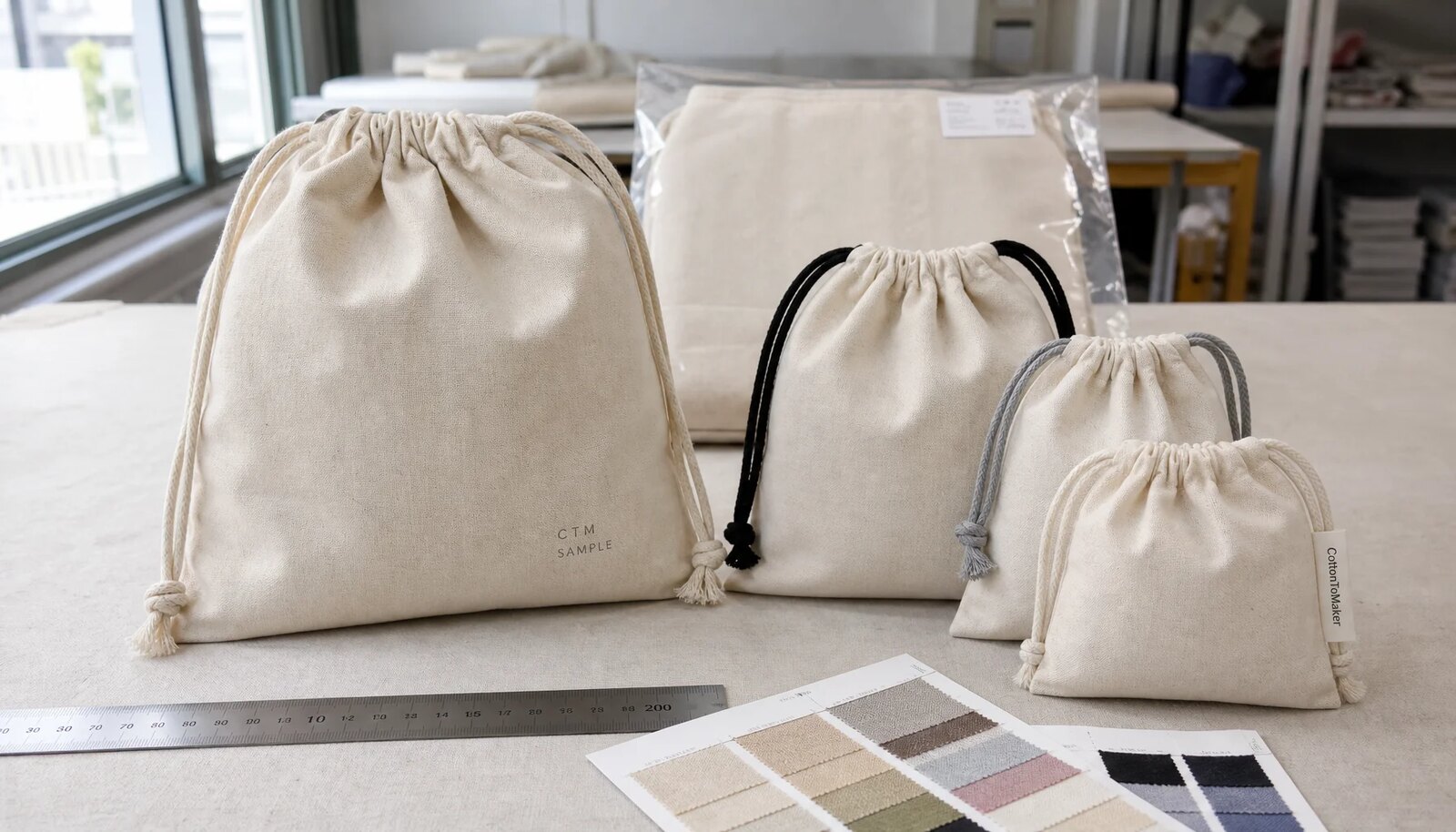
Start With the Job the Pouch Has to Do
Wholesale cotton drawstring pouches for craft fairs look simple until the order has to pass receiving, support a brand claim, fit real products, and arrive before a fixed event date. A buyer may receive three quotes for a natural cotton pouch, but one supplier may be pricing a 120 GSM stock bag, another a custom 180 GSM pouch with screen printing, and a third a retail-packed item with labels and carton marks. Those are different products. Treating them as the same quote creates cost surprises later.
Procurement should begin with the pouch use, not the catalog name. A pouch for loose jewelry at checkout can be lighter than one holding candle tins or boxed soaps. A pouch sold as a reusable branded item needs stronger fabric, cleaner stitching, and better print control than a temporary inner bag. A pouch shipped to multiple craft fair vendors may need SKU separation, barcode labels, and carton-level allocation. The specification should make those differences visible before price negotiation starts.
A practical RFQ names the contents, approximate filled weight, closure requirement, brand presentation level, destination market, and required arrival date. This helps suppliers quote the same target instead of filling gaps with their cheapest normal option. It also helps buyers decide where to spend money: heavier fabric, better cord, tighter print placement, retail labeling, or faster freight.
- Define whether the pouch is protective packaging, gift packaging, reusable packaging, resale packaging, vendor-kit packaging, or promotional giveaway packaging.
- State product dimensions, filled weight, and whether the pouch must close fully without bending or crushing the contents.
- Separate table presentation requirements from warehouse, transit, or resale requirements.
- Confirm whether sustainability, organic, recycled, plastic-free, reusable, or country-of-origin claims will appear on labels, listings, invoices, or signage.
- Work backward from warehouse arrival date, inspection date, ship-ready date, and craft fair date.
- Ask every supplier to list assumptions, exclusions, optional charges, and substitutions so the quote can be audited before approval.
Specify Fabric in Buying Language
Fabric is the first quality signal most customers notice. For cotton drawstring pouches used at craft fairs, common fabric weights often fall around 120-220 GSM. Lighter 120-140 GSM cotton can be economical for small jewelry, sachets, sample inserts, and low-cost promotional packaging. Midweight 160-180 GSM is often a balanced choice for branded craft fair packaging because it improves opacity and handfeel without making the shipment unnecessarily bulky. Heavier 200-220 GSM cotton or cotton canvas feels more substantial and may suit reusable gift packaging, but it increases fabric cost, carton cube, freight weight, and sometimes sewing difficulty.
GSM alone is not enough. Weave, yarn, finish, and shade affect appearance and print performance. A tighter plain weave may hold a logo more cleanly than a looser fabric at the same GSM. Natural unbleached cotton usually has a warm tone with seed flecks and small slubs. That texture may fit a handmade brand very well, but it should be defined by a reference swatch. Otherwise a buyer may call a mark natural character while an inspector calls it a defect.
Claim language needs special care. Natural cotton describes appearance or fiber content; it does not automatically mean organic cotton, recycled cotton, certified cotton, or chemical-free material. If a certification claim will appear anywhere customer-facing, the buyer should request the relevant certificate scope, supplier role, product coverage, and transaction-document process before production. If no certified claim is needed, keep the wording plain and avoid accidental promises.
- 120-140 GSM: flexible, lower-cost, less opaque, and suitable for light contents or short-term packaging.
- 160-180 GSM: useful middle range for many branded wholesale cotton drawstring pouches for craft fairs.
- 200-220 GSM: stronger handfeel and more premium presentation, with higher fabric, sewing, carton, and freight impact.
- Natural unbleached cotton: define acceptable flecks, slubs, shade range, odor, stains, and surface marks with a physical swatch.
- Bleached white cotton: better for brighter logo color, but stains and shade differences are easier to see.
- Dyed cotton: require lab dip approval, bulk shade tolerance, and colorfastness expectations before approving the order.
Make Size and Capacity Measurable
Pouch size should be written as finished width x finished height after sewing. Use one unit of measure and state whether height includes the drawcord channel. Many fit problems begin with this small omission. A buyer may expect the full height to be usable space, while the factory includes the top channel and seam allowance in the quoted height. For candles, soap boxes, ceramics, jewelry cards, small apparel accessories, or bundled craft kits, usable internal height is often the real buying measurement.
Flat measurements also do not tell the whole story. A pouch changes shape when filled. A narrow bag may look neat on a sample table and strain around a round candle tin. A tall pouch may close securely but hide too much of a product card. A pouch holding fragile or angular items may need more width, stronger seams, or heavier fabric than a flat jewelry pouch. Ask the supplier to check fit against product dimensions, and for higher-risk orders, send a physical product or a weight-equivalent sample.
Drawcord construction belongs in the size conversation because the channel uses space. Single-draw pouches are economical and work well for many packaging uses. Double-draw pouches close more evenly and feel more finished, but they use more cord and sewing time. Cord diameter should match the scale of the pouch. A thin cord may suit small jewelry pouches; larger bags usually need a thicker cord for comfort, appearance, and durability.
- Confirm whether quoted dimensions are finished size, cutting size, or approximate catalog size.
- Measure full height, channel height, mouth opening, and usable internal height separately when fit matters.
- For jewelry cards, confirm the closure does not bend the card or cover the brand area.
- For candles, soap, ceramics, and boxed goods, allow clearance for the product plus gathered closure.
- Specify single draw or double draw, cord material, diameter, color, length, and end finish.
- Test filled samples for closure, seam strain, visual balance, hand insertion, twisting, and slumping.
Choose Print Method by Artwork and Quantity
Printing can change the quote more than buyers expect. Screen printing is usually the most practical option for bulk cotton drawstring pouches with one to three solid colors. It works well for logos, craft fair branding, retail marks, and simple promotional graphics. The supplier needs vector artwork, Pantone references, print dimensions, print location, number of colors, number of sides, and artwork version numbers. Without that detail, a quote may assume one-side printing, a smaller print area, or excluded screen charges.
Digital printing can be a better fit for low quantities, many artwork versions, gradients, or illustrations. It reduces screen setup complexity but should still be checked on the selected cotton because fabric absorption affects color and edge definition. Heat transfer can deliver sharper multi-color graphics, although the transfer edge and surface handfeel may be more noticeable on soft natural cotton. Embroidery can look premium on heavier pouches, but dense stitching may distort lightweight fabric and small lettering.
Do not approve printing from a digital mockup alone. Cotton texture changes ink absorption, opacity, line sharpness, and handfeel. Large ink blocks can stiffen lightweight fabric. Fine lines can disappear into loose weave. Placement should also be tested on a filled pouch because a logo that looks centered when flat may sit too low once the drawcord is gathered.
- Use screen printing for repeat programs, solid-color logos, and stable quantities per artwork.
- Use digital printing for short runs, many designs, gradients, illustrations, or variable artwork programs.
- Use heat transfer when sharp multi-color detail matters more than soft fabric handfeel.
- Use embroidery only when the fabric weight and logo design can support stitch density without puckering or distortion.
- Define print size, side count, position from edges, position from channel, color references, and artwork version control.
- Approve a physical print standard for color, opacity, handfeel, curing, edge sharpness, and placement tolerance.
Turn Compliance Into Evidence
A supplier compliance checklist should separate product evidence from production capability. Product evidence may include fiber composition confirmation, certification documents where applicable, restricted substance controls, print material information, label review, country-of-origin marking, and packing material details. Production capability is different: it asks whether the supplier can cut, print, sew, inspect, pack, document, and ship the order according to the purchase order. Both matter, but they should not be blurred together.
Broad marketing language creates avoidable risk. Terms such as eco friendly, organic, sustainable, non-toxic, plastic-free, recyclable, and reusable may require support if they appear on listings, hangtags, invoices, booth signage, or retail packaging. Natural cotton is not the same as organic cotton. A cotton pouch with plastic cord tips may not support a plastic-free claim. Individual polybags may conflict with a low-plastic packaging promise unless the claim is carefully written.
Requirements vary by destination market and sales channel. Some buyers need country-of-origin labels, fiber content wording, barcode labels, SKU labels, warning statements, or customer-specific carton marks. If a retailer, distributor, or marketplace has restricted substance rules, name the required standard in the RFQ and state which components are in scope: fabric, ink, cord, labels, trims, or all of them. Compliance is easier when the artwork, label files, PO, invoice, packing list, and supplier documents describe the same pouch in the same way.
- Request fabric composition confirmation for the exact bulk material, not only a catalog description.
- For organic or recycled cotton claims, verify certificate scope, supplier role, product coverage, and transaction-document process before using the claim.
- For printed pouches, request ink or print-material information relevant to the destination market and customer requirements.
- For retail distribution, define country-of-origin marking, fiber wording, barcode content, SKU label placement, and carton mark requirements.
- For restricted substance programs, state the required standard and tested components in the RFQ.
- Keep certificates, artwork, label files, invoice wording, packing list descriptions, and PO language aligned.
Compare MOQ, Price Breaks, and Landed Cost
MOQ is rarely one clean number. A supplier may offer low MOQ for plain stock pouches but require more pieces for custom size, dyed fabric, custom cord, multiple print artworks, woven labels, hangtags, barcode labels, or retail packing. MOQ is driven by fabric roll usage, cutting efficiency, print setup, trim sourcing, packing labor, and production scheduling. Asking only for the lowest MOQ often leads to a stock quote that does not match the intended pouch.
Separate fixed costs from unit costs. Screen charges, sample fees, lab dip fees, label setup, hangtag setup, barcode setup, testing fees, and document fees can change the real cost of a small craft fair program. A 2,000-piece order with one artwork is not the same production job as 2,000 pieces split across ten designs. Ask suppliers to show cost by design, size, fabric color, and packing format instead of hiding everything in one blended price.
Landed cost is the number procurement should care about. Higher GSM may improve handfeel but adds fabric cost, carton volume, freight weight, and handling. Individual packing protects the product but adds material and labor. Vendor-kit packing may cost more at the factory but reduce warehouse sorting before craft fair distribution. The better comparison is cost per usable, correctly packed pouch that arrives on time and passes inspection.
- Lowest MOQ is easiest with stock natural fabric, standard size, stock cord, one artwork, and bulk packing.
- Custom dyed fabric raises MOQ because dyeing is batch-based and shade approval takes time.
- Multiple artworks add setup charges, changeover time, inspection complexity, and possible shortages or overruns by design.
- Retail labels, hangtags, barcode stickers, and vendor kits add labor and file-control requirements.
- Heavy GSM increases fabric cost, sewing time, carton cube, freight weight, and receiving handling.
- Request price breaks at realistic volumes such as 500, 1,000, 2,500, 5,000, and 10,000 pieces using the same specification each time.
Use Samples as the Production Standard
Sampling should not stop at a pretty development sample. A development sample confirms general size, fabric direction, cord style, print scale, and appearance. A pre-production sample should be made with bulk-intended fabric, thread, cord, ink, label, hangtag, barcode label, and packing materials. That sample becomes the physical inspection standard. Photos are useful for communication, but they cannot fully show handfeel, opacity, odor, shade, print texture, drawcord sliding, or closure behavior.
Freeze decisions in a sensible order. Confirm size and capacity first. Then confirm fabric and cord. Then approve artwork, print size, placement, and color. Finally approve packing. Changing GSM after print approval can change ink absorption and handfeel. Changing pouch size after artwork approval can move the logo into the wrong visual position. Every revision should have a version number, date, and approval status.
Sample review should include real-use checks. Fill the pouch with the actual product or a weight-equivalent substitute. Open and close it repeatedly. Inspect the side seams, bottom seams, cord ends, and channel. Look at the print under ordinary booth or retail lighting, not only under bright sample-room lights. Fold and stack the pouch in the intended packing format. If multiple internal teams approve the order, give them the same measurement sheet so everyone signs off on the same standard.
- Measure sample width, full height, channel height, usable internal height, seam allowance, cord length, and print position.
- Fill the sample with the actual product to test capacity, closure, seam strain, and appearance.
- Rub the print after curing and check for cracking, transfer, rough edges, bleeding, or excessive stiffness.
- Photograph approved samples with measurement points, cord details, label placement, and packing details.
- Keep one sealed approved sample with the buyer and one with the factory, each marked with PO number, date, and version.
- Do not authorize bulk cutting, bulk printing, or trim purchasing until sample deviations and approvals are documented.
Write QC Criteria Before Cutting Starts
Quality control works best when it is written into the purchase order before production starts. For cotton drawstring pouches, the main control points are finished dimensions, usable capacity, fabric condition, shade, stitching, drawcord function, print quality, label accuracy, packing count, and carton marks. A useful PO names the approved sample, measurement method, tolerance, defect categories, and inspection timing.
Finished dimension tolerance depends on size and construction. Small pouches are often controlled around +/- 0.5 cm, while larger pouches may need about +/- 1 cm. Print placement usually needs tighter control, often around +/- 3 mm to +/- 5 mm depending on artwork size and pouch scale. These figures should be agreed with the supplier; they are starting points, not universal rules. The important thing is that the factory, inspector, and buyer all measure the same way.
Defect classification prevents arguments at the end of production. Critical defects may include unsafe sharp trim, severe contamination, incorrect material claims, or labeling mistakes that create compliance risk. Major defects may include wrong size outside tolerance, open seams, nonfunctional drawcords, severe stains, incorrect artwork, poor print adhesion, wrong SKU packing, or missing labels. Minor defects may include small loose threads, slight natural flecks within the approved standard, or small cosmetic marks that do not affect function or presentation.
- Name the approved sample and version number in the PO and inspection checklist.
- Define measurement points for width, height, channel height, usable internal height, print location, cord length, and label position.
- Set practical tolerances for finished size, print placement, fabric shade, and carton quantity.
- Classify critical, major, and minor defects before inspection so pass or fail decisions are clearer.
- Require first-piece approval after cutting, printing, and sewing start, especially for new suppliers or new artwork.
- Inspect goods when production is complete and packed, with enough time left to correct defects before shipment.
Control Packing and Receiving Accuracy
Packing is part of the product specification. A wholesale pouch order may require bulk packing, inner bags by SKU, individual bags, paper bands, hangtags, barcode stickers, size labels, carton labels, or vendor-kit assortments. Each choice affects labor, material, carton dimensions, freight, and receiving time. The RFQ should say whether the buyer wants lowest-cost export packing or craft-fair-ready distribution packing.
Cotton pouches need protection from moisture, dirt, and odor. Natural cotton can absorb warehouse smell or moisture if cartons are stored poorly. Clean cartons, carton liners, bulk inner bags, and dry storage can reduce risk. At the same time, too much individual plastic may conflict with a brand’s packaging position. Many buyers choose bulk inner bags by SKU inside clean export cartons as a practical balance between protection, cost, and receiving efficiency.
Carton accuracy matters when the order includes multiple sizes, colors, artworks, or vendor allocations. Mixed-SKU cartons may reduce carton count but increase sorting errors. Single-SKU cartons are easier to inspect and receive, though they may use more space. If pouches will be redistributed to craft fair vendors, pop-up locations, or retail stores, provide a carton-level packing matrix and require the supplier to inspect against it before shipment.
- Define pieces per bundle, bundles per inner bag, inner bags per carton, and total pieces per master carton.
- Require carton marks showing PO number, SKU, artwork version, size, fabric color, quantity, carton number, and destination when needed.
- Confirm barcode label file, size, placement, scan readability, adhesive performance, and whether the label goes on pouch, inner bag, or carton.
- For mixed assortments, provide a carton-level packing matrix and require inspection against the matrix.
- Set carton gross weight limits and carton strength expectations if goods will be reshipped to vendors or retail stores.
- Request carton dimensions, CBM, net weight, and gross weight before freight booking so landed cost can be estimated accurately.
Plan Lead Time Backward From the Event
Craft fair deadlines are unforgiving, so lead time should be broken into stages. A supplier may say production takes 20 days, but that clock may start only after deposit, artwork approval, fabric confirmation, and sample sign-off. A real calendar includes development sample, sample shipping, buyer review, revision time, fabric preparation, cutting, printing, sewing, trimming, packing, final inspection, export handling, and freight. Start from the warehouse arrival date and work backward.
Schedule risk increases with custom dyed fabric, many artwork versions, retail labels, certified material documents, testing, and third-party inspection. Air shipment can rescue small urgent orders, but cotton pouches may be costly by air because both weight and volume matter. Sea freight is usually better for planned larger orders, but it requires earlier release. When time is compressed, simplify the specification: stock fabric, fewer artwork versions, standard cord, bulk packing, and no late artwork changes.
The final supplier decision should include inspection readiness, not only price. A strong quote lists fabric GSM, finished size, usable height if relevant, print method, print colors, cord details, packing format, MOQ, setup charges, sample charges, carton data, incoterm, production lead time, quote validity, and document responsibilities. The PO should then align the quote, approved sample, artwork files, packing plan, compliance evidence, and inspection checklist. When every document describes the same pouch, the buyer has a stronger position before shipment.
- Build the schedule backward from warehouse arrival date, then add receiving buffer, freight, export handling, inspection, packing, sewing, printing, cutting, fabric preparation, and sampling.
- Reserve time for one sample revision even when the first sample is expected to pass.
- Set final inspection several days before courier pickup, vessel closing, or forwarder handoff.
- Compare unit price only after GSM, finished size, cord detail, print method, artwork count, and packing method match.
- Add setup charges, sample charges, label fees, test fees, document fees, carton CBM, and gross weight into landed cost.
- Release the purchase order only when quote, specification, artwork, approved sample, packing plan, compliance evidence, and inspection method are aligned.
Specification comparison for buyers
| Supplier option | What to verify | Commercial advantage | Buyer risk to control |
|---|---|---|---|
| Direct sewing factory | cord material proof, reinforcement close-ups, load-test photos, approved sample tag, and bulk-line first-piece record | Better sample-to-bulk control and faster production feedback | May be weaker on export paperwork or branded packing unless checked early |
| Trading company | Factory name, production photos, trim-source proof, and who owns QC decisions | Can coordinate small mixed orders and extra services | Markup can hide real factory capability and slow defect decisions |
| Specialized bag workshop | cord diameter, eyelet or reinforced channel, bottom corner reinforcement, seam allowance, bar-tack position, and load target | More practical for detailed construction, trims, and repeat programs | Capacity may be limited during peak seasons |
| Low-price general supplier | 6-10 oz cotton canvas, 210D polyester, rPET, or blended cotton with shrinkage and colorfastness expectations set before sampling | Useful for simple promotional runs with loose specs | Material downgrades, weak packing, and vague inspection scope can erase savings |
| Retail-ready supplier | fold direction, cord protection, bundle count, carton compression, moisture bag, and retail label position | Can handle labels, SKU separation, carton marks, and receiving rules | Higher unit cost must be compared against reduced warehouse work |
| Compliance-focused supplier | Fabric records, labeling review, test plan, and production traceability | Safer for retail programs and repeat brand orders | Documentation claims need evidence, not only sales language |
| Local sample room plus bulk factory | Signed sample, bulk factory handoff, first-piece photos, and deviation owner | Good for complex branding before large production | Sample room quality may not match bulk line unless handoff is controlled |
Buyer checklist before sampling
- Define the pouch use before quoting: product packaging, reusable gift pouch, retail add-on, vendor kit component, sample bag, subscription insert, or event giveaway.
- List the contents, product dimensions, approximate filled weight, sharp edges, fragile surfaces, and whether the pouch must close fully above the product.
- State finished size as width x height, use one measurement unit, and specify whether the height includes the drawcord channel.
- Add usable internal height and mouth-opening requirements when pouches must fit candles, soap boxes, jewelry cards, ceramics, stationery bundles, or craft kits.
- Specify fabric type, weave, color, and target GSM, such as natural cotton plain weave 140 GSM, 180 GSM cotton, or 220 GSM cotton canvas.
- Set an agreed GSM tolerance or acceptance range and require bulk fabric to match the approved swatch in shade, handfeel, and opacity.
- Define acceptable natural cotton flecks, slubs, shade variation, shrinkage after steam or light laundering if relevant, moisture condition, and odor condition.
- Separate natural cotton appearance from certified claims such as organic cotton, recycled cotton, or OEKO-TEX certified material.
- Specify drawcord material, cord diameter, cord color, single-draw or double-draw construction, channel width, and cord-end finish.
- Provide vector artwork with print size, print position, Pantone or process color references, side count, and artwork version numbers.
Factory quote questions to send
- Which exact fabric is included in the quote: fiber composition, weave, finish, color, target GSM, width, and whether it is stock fabric or custom-made fabric?
- What GSM tolerance do you normally control for this cotton fabric, and can you provide a swatch, bulk reference, or fabric test report for comparison?
- Is the quoted size finished width x finished height after sewing, does the height include the drawcord channel, and what finished-size tolerance do you accept in the purchase order?
- What is the usable internal height below the drawcord channel for this construction, and can you check fit if we provide product dimensions or a physical product sample?
- What is the MOQ per finished size, fabric color, cord color, print artwork, label style, and packing format?
- Which drawcord is quoted by material, diameter, color, construction, and end finish, and is it stock cord or custom dyed cord?
- Which print method do you recommend for our artwork, and what are the setup fees, color limits, curing requirements, handfeel differences, wash or rub expectations, and placement tolerances?
- Can you make a pre-production sample using bulk-intended fabric, cord, thread, print ink, label, hangtag, barcode label, and packing materials before mass production starts?
- What internal QC checks do you run for incoming fabric, cutting size, print approval, stitch density, seam strength, drawcord function, trimming, packing count, carton marks, and final inspection?
- How many working days are required for sample making, sample shipping, buyer review, fabric preparation, printing, sewing, trimming, packing, final inspection, and export handoff?
Quality-control points to confirm
- Finished size should be measured flat after sewing and before packing; a practical tolerance is often about +/- 0.5 cm for small pouches and +/- 1 cm for larger pouches, unless the approved sample or fabric behavior requires another written tolerance.
- Usable internal height below the drawcord channel should be checked separately when the pouch must close above a product; full height alone can overstate capacity.
- Fabric GSM should be checked against the approved swatch or report because a 20-40 GSM difference can change opacity, handfeel, print result, carton cube, and unit cost.
- Fabric condition should be checked for stains, oil marks, weaving faults, holes, needle damage, unacceptable slubs, excessive seed flecks, odor, dampness, and uneven dyeing before cutting and during final inspection.
- Natural cotton shade should be compared under consistent lighting; acceptable flecks and slubs should be defined by reference sample instead of verbal approval only.
- Drawcord channels must open and close smoothly without trapped cord, broken stitches, twisted channels, uneven gathering, excessive friction, or cord slippage.
- Cord ends must be consistently knotted, heat sealed, tipped, or otherwise finished according to the approved sample, with no sharp edges, loose unraveling, or mismatched lengths.
- Print placement should be measured from pouch edges, centerline, or channel reference points; common placement tolerance is about +/- 3 mm to +/- 5 mm depending on pouch size and artwork scale.
- Print quality should be checked for color match, opacity, edge sharpness, registration, curing, cracking, bleeding into the cotton weave, transfer, blocked channels, and excessive stiffness.
- Side seams and bottom seams should be straight, back-tacked where needed, and free from skipped stitches, loose threads, open seams, puckering, holes, or uneven seam allowance.