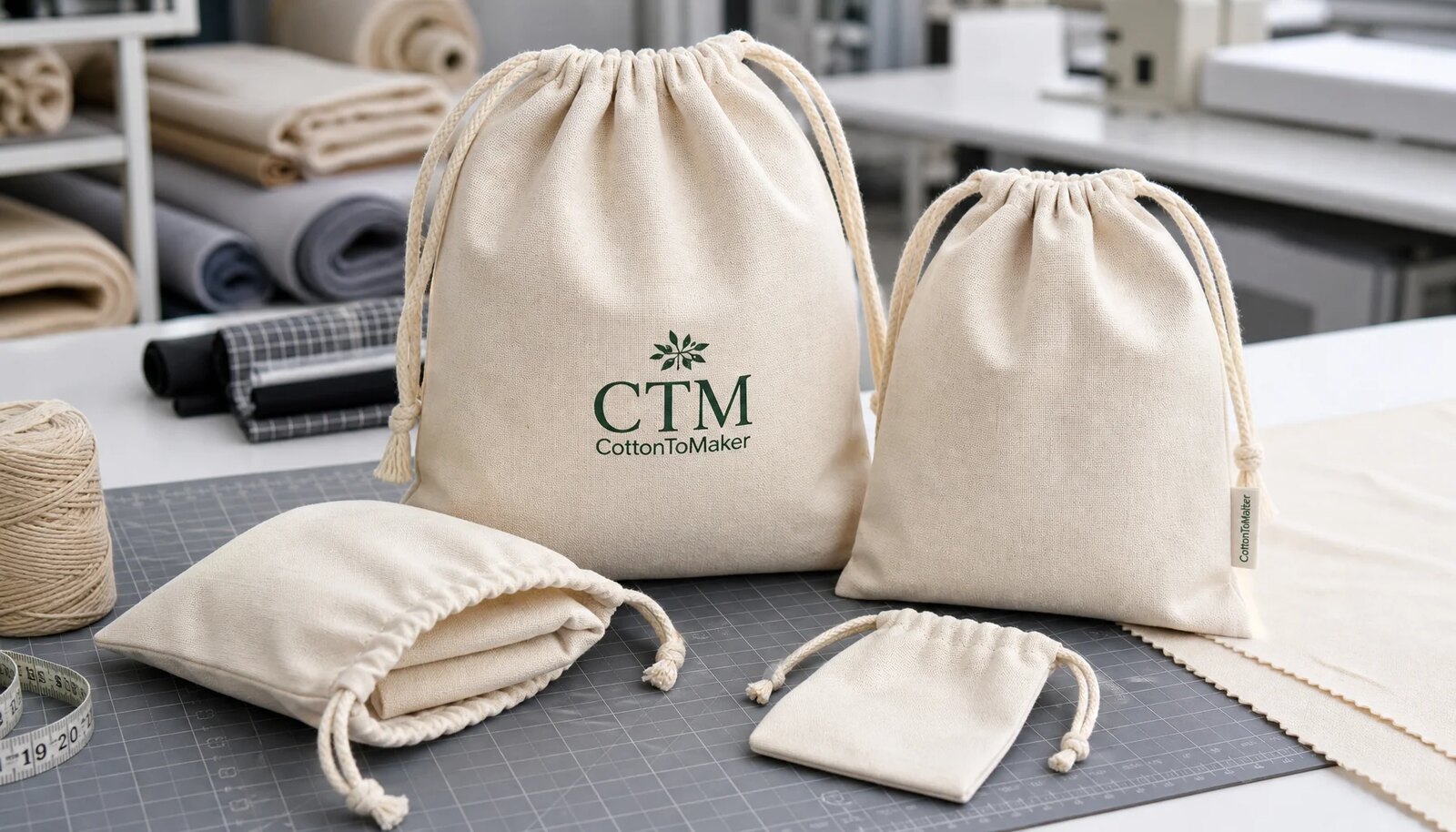
Why MOQ Is a Production Question
A cotton drawstring pouch may look like a simple sewn item, but its minimum order quantity is shaped by fabric buying, cutting efficiency, print setup, cord preparation, sewing-line changeover, inspection, packing, and carton labeling. For craft fair buyers, the challenge is often variety: several sizes, several vendors, seasonal artwork, and a fixed event date. That mix can make 300 pieces in six versions harder to produce than 2,000 pieces in one size and one print.
The goal is not simply to force the lowest MOQ. A low minimum can be expensive if it hides thinner fabric, vague tolerance, weak print curing, mixed shade lots, or unplanned packing labor. A better negotiation makes the order easier to run while protecting the commercial result: the pouch fits the product, presents well at the booth, arrives on time, and can be counted and allocated quickly.
Start by asking which parts of the order create the MOQ. Some limits come from the sewing factory; others come from fabric suppliers, dye houses, screen rooms, label makers, or packing teams. When procurement separates those drivers, the supplier can explain what can be combined and what genuinely needs a minimum lot.
- Treat MOQ as a production-efficiency discussion, not only a supplier policy.
- Negotiate total program volume before pushing each SKU minimum lower.
- Compare quotes only when GSM, size, print method, packing, and Incoterm are aligned.
- Protect quality requirements first, then trade off artwork versions, packing format, or schedule where possible.
Define the Craft Fair Use Case First
The same pouch cannot be optimized for every craft fair purpose. Jewelry packaging needs opacity, soft hand-feel, and a clean closure. Soap and cosmetics packaging may need odor review, stain resistance, and ink transfer checks. Candle accessories or small jars need seam strength and enough internal space to avoid bulging. Vendor welcome kits need a wider mouth opening and stronger drawcord action because staff may pack several items quickly.
Map the pouch journey before requesting quotes. Will pouches be shipped in bulk to one warehouse, split by vendor, pre-filled before the fair, sold as merchandise, or used as checkout packaging? This affects carton marks, inner bundles, label needs, and the inspection plan. A nice pouch that arrives in mixed cartons with unclear quantities can still create labor cost and shortage disputes.
Capacity should be tested with the real product or a weighted substitute. Insert the item, close the pouch, reopen it, and place it on a table as a customer would see it. Watch for strained seams, tight mouth opening, twisting side seams, cord friction, and awkward proportions. For B2B buying, appearance and packing speed both matter.
- Jewelry and accessories: check opacity, print sharpness, soft hand-feel, and smooth drawcord action.
- Soap and cosmetics: review odor, moisture exposure, staining, lint, and ink transfer risk.
- Candles or jars: test bulging, seam stress, carton weight, and product movement.
- Vendor kits: confirm usable capacity, mouth opening, and fast manual packing.
Build a Spec Suppliers Can Price
A vague RFQ such as “cotton pouch with logo” invites non-comparable offers. One supplier may quote 120 GSM cotton with polyester cord; another may quote 160 GSM with cotton cord and ironing included. The lower price may not be a better deal; it may simply be a different pouch.
A clean specification should include finished flat size, fabric composition, GSM, fabric color, finish, drawcord material, cord diameter, cord color, channel width, knot method, stitching expectation, print method, artwork size, print placement, packing method, inspection scope, Incoterm, and required arrival date. These details help the factory identify where MOQ can be reduced without changing the product.
Finished size needs particular care. State width x height in centimeters, measured flat after sewing and ironing unless another method is agreed. Say whether cord length is excluded. If the pouch is designed around a product, provide the product dimensions and target usable capacity. For small craft fair pouches, a 1 cm difference can affect both fit and presentation.
- Specify finished flat dimensions and measurement method.
- State cotton GSM, composition, finish, color, and acceptable natural variation.
- Define cord material, diameter, channel width, length, color, knot, and end finish.
- Provide print-ready artwork with size, placement, ink reference, and print side.
- Include packing, carton marks, inspection scope, Incoterm, and warehouse arrival date.
Choose Fabric Without Overbuying
Fabric GSM drives hand-feel, opacity, durability, unit price, carton weight, and MOQ. Stocked natural or greige cotton usually gives more flexibility than custom dyed, washed, unusual-weight, or certified fabric. If the project requires organic cotton, recycled content, a special finish, or a documented claim, confirm supplier capability and paperwork before sampling.
For lightweight goods, 120-140 GSM can work when opacity and seam strength pass review. For many general craft fair programs, 150-160 GSM is a practical range for branded packaging because it balances presentation and cost. For premium kits, candles, or reusable gift packaging, 180-220 GSM may improve perceived value, but heavier fabric can increase freight weight and make small pouches bulky at the drawcord channel.
Natural unbleached cotton is not a defect-free white fabric. Seed specks, slubs, and slight shade variation may support an artisan look, but they must be accepted deliberately. Dyed fabric needs lab dip approval and shade-lot control. Certified material needs the right documentation; do not use terms such as organic, recycled, sustainable, or biodegradable unless the claim can be supported.
- Use lighter GSM only after checking transparency, print show-through, and seam strength.
- Use mid-weight cotton for general packaging where cost and presentation both matter.
- Use heavier cotton for premium or reusable programs, with carton weight reviewed.
- Ask whether fabric is stocked, dyed, washed, certified, or mill-booked.
- Define acceptable seed specks, slubs, shade variation, wrinkles, lint, and odor.
Compare Supplier Routes Before Negotiating
Not every supplier option carries the same MOQ logic. A stock natural pouch may support a small launch, but size and fabric choices are limited. A custom cut pouch improves fit and branding control, but each size adds cutting and measurement work. Dyed cotton adds color approval and lot control. Certified cotton adds documentation and supplier qualification. Print method also changes the economics: screen printing favors simple repeat artwork, while heat transfer can help with detailed short runs.
Use the supplier-option comparison to decide where flexibility is acceptable. If the event date is close, a stocked size with standard cord may be safer than a fully custom dyed pouch. If the pouch is part of a premium retail set, paying for a pre-production sample and tighter packing control may be more important than shaving the MOQ.
The best award decision compares landed, usable pouches, not just unit price. A supplier that includes carton labels, clean SKU separation, and realistic tolerances may reduce receiving labor and rework. A cheaper offer with missing carton data, unclear GSM, and no inspection criteria can become more expensive once the order reaches the warehouse.
- Use stock items for speed and lower first-order risk.
- Use custom cut sizes when product fit drives customer experience.
- Use dyed or certified materials only when the added MOQ and lead time are justified.
- Choose print method based on artwork, repeat plan, hand-feel, and setup cost.
- Compare carton data and allocation accuracy alongside unit price.
Consolidate SKUs for Real MOQ Leverage
Craft fair programs often expand quickly: three pouch sizes, two colors, several vendor logos, and multiple packing instructions. Each variation may require separate cutting, printing, sewing checks, inner labels, carton marks, and inspection records. Too many near-duplicate SKUs weaken negotiation and raise error risk.
Build a SKU matrix before the final RFQ. List size, contents, fabric GSM, fabric color, cord type, cord color, artwork, ink color, print method, packing style, carton mark, and required arrival date. Once the matrix is visible, shared inputs become obvious. Several sizes may share one fabric roll, one cord, one ink, one print placement rule, and one packing format.
A smaller first assortment is often stronger than a complex trial order. Launch with sizes that serve distinct product groups, collect event feedback, then reorder the proven winners. If repeat orders are likely, ask whether screens, labels, or approved samples are stored, and for how long. Do not use unsupported annual forecasts as negotiation currency unless procurement can actually place those orders.
- Remove sizes that differ only slightly and serve the same product.
- Group SKUs by shared fabric, cord, ink, print method, packing, and deadline.
- Negotiate by size group or artwork family instead of isolated SKUs.
- Prepare a target assortment and a fallback assortment before supplier calls.
- Ask for first-order and repeat-order terms separately.
Manage Print, Artwork, and Setup Fees
Printing is a major MOQ driver. Screen printing usually fits cotton drawstring pouches when the artwork is simple, solid, and repeatable. Each screen, color, artwork size, and placement can create setup cost, so ten vendor logos at 200 pieces each may be less efficient than one shared event mark at 2,000 pieces. Standardizing logo size or ink color across pouches can produce meaningful savings.
Heat transfer may be useful for detailed art, gradients, or short trial runs where screen setup is inefficient. It must be approved for hand-feel, edge quality, flexibility, and appearance on textured cotton. Woven or sewn labels can work for repeat premium programs, but label MOQ and placement labor should be quoted separately.
Artwork should be production-ready before pricing is locked. Provide vector files for screen print, define print size in centimeters, state placement from a seam or edge, list ink references, and note whether printing is one side or two sides. Very thin strokes, tiny text, tight registration, and heavy ink blocks should be checked against the supplier’s print limits. A digital proof confirms layout; a physical sample confirms the real print.
- Use screen print for simple one- to three-color repeat logos.
- Use heat transfer only after approving texture, edge quality, and rub performance.
- Ask for minimum line thickness, text height, and registration capability.
- Separate screen, artwork, sample, courier, and repeat-order charges.
- Approve placement by measurement, not only visual centering.
Structure the MOQ Negotiation
Open the negotiation by asking which minimums apply to fabric, dyeing, cutting, printing, sewing, packing, labels, and carton marks. Then ask what can be shared. A supplier may reduce per-size MOQ if the order uses one fabric, one cord, one ink, one packing method, and one delivery date. The same request may be unrealistic if every SKU has a different material, artwork, cord, and label.
Request price breaks at useful tiers such as 300, 500, 1,000, 2,000, and 5,000 pieces. The exact breakpoints vary, but the pattern shows where economics change. A steep drop may reveal a setup threshold or material minimum. A flat curve may mean the supplier is already using stock inputs or that labor, not material, is the main cost.
Keep must-haves separate from negotiables. You may accept bundled inner packing instead of individual retail bags, or one shared ink color instead of several. You may not accept lower GSM, untested fabric, or skipped pre-production sample approval. This lets the supplier offer options without eroding the product.
- Negotiate total program volume before per-SKU minimums.
- Ask which requirements create separate lots or setup charges.
- Offer to pay setup charges separately to keep unit price transparent.
- Reduce artwork versions, ink colors, and packing variations before reducing quality.
- Confirm lead-time impact for every MOQ concession.
Build a Quote Sheet That Exposes Risk
A B2B quote should show more than a unit price. Require item code, finished size, fabric composition, GSM, fabric color, drawcord details, print method, print colors, print size, packing method, carton quantity, carton dimensions, gross weight, net weight, CBM, unit price, setup charges, sample cost, courier cost, Incoterm, payment terms, quote validity, production lead time, and earliest ship date.
Separate first-order charges from repeat-order costs. Screen charges, artwork separation, label setup, custom sample cost, courier cost, and special packing setup may apply once. Fabric, cutting, printing, sewing, trimming, inspection, and packing recur. If setup charges are hidden inside a low first-order price, repeat pricing becomes unclear.
For craft fairs, packing accuracy can be as important as product cost. Single-SKU cartons with clear marks are safest. If mixed cartons are unavoidable, each inner bundle should be labeled with item code, artwork, size, quantity, and vendor allocation. The packing list should match cartons exactly, so receiving teams can split stock without re-counting every pouch.
- Require the Incoterm and location: EXW, FOB, CIF, DAP, or another agreed term.
- Separate unit price, setup fee, screen charge, sample cost, courier cost, and packing surcharge.
- Request carton size, pieces per carton, gross weight, net weight, and CBM.
- Confirm whether ironing, trimming, inspection, carton marks, and inner packing are included.
- Compare landed cost per usable, correctly allocated pouch.
Approve Samples and Lock QC Standards
Sampling should prove the pouch can perform, not just look acceptable in a photo. A stock sample is useful for screening workmanship and fabric options. A custom sample checks construction and artwork direction. A pre-production sample should represent the final bulk specification: actual fabric GSM, fabric color, cord, channel, print method, stitching, and packing format.
Review samples with measurements and use tests. Measure width, height, channel depth, cord length, and print position. Pack the real product, close and open the pouch at least several times, and check for cord friction, seam twisting, print cracking, odor, lint, stains, and presentation on a table. Photograph key measurements with a ruler so the factory and inspector share the same reference.
Before bulk production, write inspection expectations into the PO. Define critical, major, and minor defects; measurement method; supplier-agreed tolerances; carton count rules; and the approved sample reference. Examples such as a GSM percentage range or size tolerance should be treated as negotiated purchase-order terms, not universal standards. The approved sample should be sealed, labeled, dated, and available for production and inspection review.
- Use stock samples for screening, not final approval of custom pouches.
- Approve pre-production samples with actual bulk material and intended print method.
- Define defects for material, stitching, drawcord action, print quality, odor, stains, and packing.
- Write measurement points and tolerances into the PO before production starts.
- Agree rework, replacement, discount, or rejection rules for failed inspection lots.
Specification comparison for buyers
| Supplier option | What to specify | Best fit for craft fair buyers | MOQ, cost, or QC control point |
|---|---|---|---|
| Stock natural cotton pouch | Available sizes, stocked GSM, natural unbleached finish, standard cotton cord, blank or simple print | Fast first orders, small vendor programs, deadline-sensitive craft fairs | Usually the easiest route for lower MOQ, but confirm actual GSM, size tolerance, carton quantity, and whether seed specks are acceptable |
| Custom cut natural cotton | Finished flat size, GSM, seam construction, cord diameter, print placement, packing method | Buyers needing exact fit for jewelry, soap, candles, cards, or gift sets | More flexible than dyed or certified programs, but each size may still create cutting and measurement controls |
| Dyed cotton pouch | Fabric color standard, lab dip approval, shade tolerance, dye lot control, colorfastness expectations | Seasonal campaigns, brand-color packaging, holiday fairs, merchandise ranges | Dyeing can introduce material minimums, longer lead time, and shade-lot inspection needs |
| Certified cotton pouch | Certification type, document requirements, label claim, chain-of-custody needs, transaction certificate timing | Retailer-facing programs or brands making verified organic/recycled claims | Do not treat natural cotton as certified cotton; certification can change supplier eligibility, MOQ, and documentation cost |
| 120-140 GSM fabric | Lightweight cotton, opacity check, seam stress test, print show-through review | Seed packets, cards, lightweight jewelry, small giveaways | Lower fabric cost and carton weight, but approve opacity, hand-feel, and stitching before bulk |
| 150-160 GSM fabric | General packaging weight, defined GSM tolerance, approved hand-feel and surface standard | Most general craft fair packaging, checkout pouches, small gift sets | Often a practical balance; compare quotes only against the same GSM and finish |
| 180-220 GSM fabric | Heavier cotton, larger channel allowance, stronger seam expectations, carton weight impact | Premium kits, candles, reusable packaging, higher-value presentation | Higher material use and freight weight; small pouches may feel bulky at the drawcord channel |
| Screen print | Vector artwork, ink reference, print size, placement, number of colors, screen charges | Simple logos, one- to three-color marks, repeat wholesale programs | Setup cost is driven by artwork, screen size, colors, and placement; standardize where possible |
| Heat transfer | Artwork file, transfer size, hand-feel approval, edge quality, rub risk, curing standard | Detailed art, gradients, short trial runs, multi-color designs | Can reduce screen setup for small runs, but must be approved for texture, flexibility, and appearance on cotton |
Buyer checklist before sampling
- Define the pouch role: jewelry packaging, soap pouch, candle accessory bag, cosmetics sample bag, checkout pouch, vendor welcome kit, product refill bag, or resale merchandise item.
- Create a SKU matrix with finished flat width x height in centimeters, target contents, usable capacity, artwork, quantity, packing style, and required arrival date.
- Specify cotton composition, fabric GSM, finish, and color: natural unbleached, bleached white, dyed, washed, organic, recycled blend, or another documented material.
- Ask whether fabric is in stock, custom cut, custom dyed, certified, washed, or mill-booked before assuming MOQ is negotiable.
- Define supplier-agreed tolerance examples for GSM, finished size, print placement, and cord length instead of relying on vague “normal tolerance” language.
- Provide vector artwork, print size, ink or Pantone reference, print location from edge or seam, number of print colors, and one-side or two-side print requirement.
- Group items by shared fabric, cord, ink, print method, packing, carton mark, and delivery date before requesting lower per-SKU MOQ.
- Request price breaks at realistic tiers such as 300, 500, 1,000, 2,000, and 5,000 pieces per artwork, per size group, or per consolidated program.
- Require quotes to separate unit price, screen charge, setup fee, sample cost, courier cost, special packing cost, inspection cost, Incoterm, and quote validity.
- Approve a pre-production sample when fabric hand-feel, opacity, closure action, print quality, odor, or retail presentation affects acceptance.
Factory quote questions to send
- Which pouch sizes and cotton GSM options are stocked now, and which require new cutting, dyeing, washing, certification documents, or mill booking?
- What is your MOQ by fabric GSM, fabric color, pouch size, artwork, print color, drawcord type, packing style, and shipment date?
- Can we combine several sizes under one fabric lot, one cord, one ink color, one print method, and one carton-mark system to reduce MOQ?
- Please quote 140 GSM, 160 GSM, and 200 GSM versions of the same pouch so we can compare unit price, opacity, hand-feel, carton weight, CBM, and MOQ impact.
- What finished-size tolerance can you agree for this construction, and are dimensions measured flat after sewing and ironing, excluding drawcord length?
- What GSM tolerance and test method do you use, and can you provide a fabric swatch or measured fabric reference before sample approval?
- Which print method do you recommend for our artwork, and what minimum line thickness, text height, registration tolerance, and maximum print area are safe on this cotton?
- Are screen charges, artwork separation, sample charges, courier cost, setup fees, and repeat-order screen storage included or listed separately?
- What drawcord material, diameter, channel width, cord length, knot method, cord color, and cord-end finish are included in the quoted price?
- How will cartons be packed and labeled by SKU, artwork, size, vendor allocation, carton number, gross weight, and CBM?
Quality-control points to confirm
- Fabric GSM is checked against the purchase-order tolerance agreed with the supplier, such as a defined percentage range, using a stated swatch or test method rather than visual judgment.
- Finished flat width and height are measured from agreed reference points; example tolerances such as ±0.5 cm for small pouches or ±1.0 cm for larger pouches should be written into the PO if acceptable.
- Print placement is measured from defined edges or seams, not only judged by eye, and each artwork version is checked against the approved sample.
- Fabric shade, seed specks, slubs, weave flaws, lint level, odor, stains, and surface cleanliness are compared with the approved fabric or sample standard.
- Dyed or natural cotton lots are reviewed for visible shade mixing; cartons with different shade lots are identified before shipment.
- Drawcord pulls smoothly through the channel without tearing seams, twisting inside the channel, slipping through knots, fraying excessively, or leaving uneven cord lengths.
- Cord material, diameter, color, channel width, knot security, cord length, and cord-end finish match the approved pre-production sample.
- Stitching has no open seams, skipped stitches, broken lockstitch, thread nests, severe puckering, needle cuts, or weak stress points at the channel and side seams.
- The pouch mouth closes evenly and opens without excessive friction, channel blockage, cord snagging, or fabric bunching that slows retail packing.
- Print shows no obvious bleeding, ghosting, pinholes, cracking, scorching, smudging, ink transfer, heavy buildup, or off-center placement beyond the approved tolerance.