Start with the product, not the pouch name
A cotton drawstring pouch can be a simple sleeve, a branded retail package, a reusable gift bag, or part of a craft fair display. Those uses sound similar in a catalog, but they do not perform the same way in production. Earrings, handmade soap, boxed candles, wax melts, stationery sets, small jars, and ceramic ornaments all put different pressure on fabric, seams, opacity, and closure. If a buyer sends an RFQ that only says “cotton drawstring pouch,” suppliers may quote several very different products while using the same item name.
Begin with the item going inside. Record the product dimensions, packed weight, surface sensitivity, fragrance or oil contact, and how the pouch will be handled. Jewelry needs clean trimming and a smooth enough interior so chains and earring hooks do not catch on loose threads. Soap and wax products may need breathable cotton, but they should also be tested for fragrance transfer, surface oil marks, and dust. Dense items such as candles, jars, tools, and ceramics stress the bottom corners and drawcord channel in a way that a flat empty sample will not reveal.
Also decide where filling happens. Empty pouches shipped to a distributor can be bundled flat. Pouches filled by warehouse staff may need fast cord operation and consistent opening size. Pouches packed at a booth before a craft fair should be easy to count, sort, and open quickly. Pre-filled pouches require a different carton plan because compression, weight, and product protection all change. These details influence unit cost, labor time, carton volume, inspection method, and the type of defects that matter most to the buyer.
- For jewelry and small accessories: 120-170 GSM can work, but prioritize clean seams, thread trimming, smooth cord operation, and accurate logo position.
- For soaps, wax melts, stationery, and small gift sets: 160-180 GSM is usually safer because it improves opacity, hand feel, and retail presentation.
- For candles, jars, tools, and small ceramics: 220-240 GSM canvas is often more appropriate, especially for pouches over about 20 x 30 cm.
- For herbs, dried flowers, sachets, and breathable packaging: natural muslin or plain cotton can work, but test odor transfer and product dust leakage.
- For retail display: approve the pouch with the real product inside, not as an empty sample only.
- For multi-SKU programs: group products by size and weight so one specification is not forced to cover incompatible items.
Use GSM as a buying control, not a vague quality label
GSM means grams per square meter. For wholesale cotton drawstring pouches, it is one of the fastest ways to bring discipline to a quote comparison. A 120 GSM muslin pouch and a 240 GSM canvas pouch can have the same finished size, the same natural color, and even the same logo, but they will not have the same opacity, durability, print behavior, freight weight, or cost.
For many craft fair packaging programs, 160-180 GSM is the practical center. It feels more substantial than a thin giveaway pouch, prints more predictably than very light muslin, folds flat for shipment, and usually gives enough opacity for retail use. When the product is heavier, larger, or positioned as premium reusable packaging, 220-240 GSM canvas may be a better choice. The trade-off is bulk: heavy fabric can make small pouches stiff, create thick seam intersections, and prevent the top channel from cinching neatly.
Do not treat GSM as the only quality indicator. Two cotton fabrics with the same GSM can differ in yarn count, weave density, surface hairiness, shrinkage, finishing, and logo sharpness. Still, GSM is the first checkpoint. If one supplier quotes “medium cotton” and another quotes “canvas,” the prices are not comparable until GSM, construction, cotton composition, cord, print method, and packing are all written down. Ask for the GSM tolerance as well; it is easier to manage a stated tolerance than an undefined promise of “good quality.”
- 120-140 GSM: economical, light, and suitable for low-weight items; check transparency, wrinkling, and weak channel stitching.
- 160-180 GSM: balanced retail option for many craft fair pouches and simple logo prints.
- 200-240 GSM: stronger and more premium; better for reusable positioning, larger sizes, and denser products.
- Above 280 GSM: usually unnecessary for small drawstring pouches unless the buyer wants a very structured canvas look or the product is unusually heavy.
- Quote rule: do not compare prices unless GSM, construction, composition, print method, cord, and packing are all stated.
- Freight rule: compare FOB price together with carton dimensions and gross weight because heavier fabric can change landed cost.
Choose construction by function: muslin, plain cotton, canvas, twill, or washed cotton
Material construction changes the pouch long before decoration begins. Muslin is light, soft, and often chosen for rustic packaging, sachets, dried flowers, herbs, or low-cost sample programs. It can look handmade and approachable, which suits many craft fair tables. The weakness is that it may be more transparent, more wrinkled, and less crisp for logo presentation than buyers expect from product photos.
Plain cotton in the 160-180 GSM range is a safer general-purpose option for many wholesale craft fair pouches. It gives a more balanced face for screen printing, enough body for retail display, and a familiar natural cotton feel. Cotton canvas is stronger and more structured. It is useful for larger pouches, heavier handmade goods, and reusable packaging programs, although its texture can soften small print details. Twill is less common for small drawstring pouches, but it may provide a denser-looking surface when the supplier has suitable fabric. Washed cotton feels softer and more relaxed; the buyer should then pay closer attention to shrinkage, shade variation, and final-size tolerance.
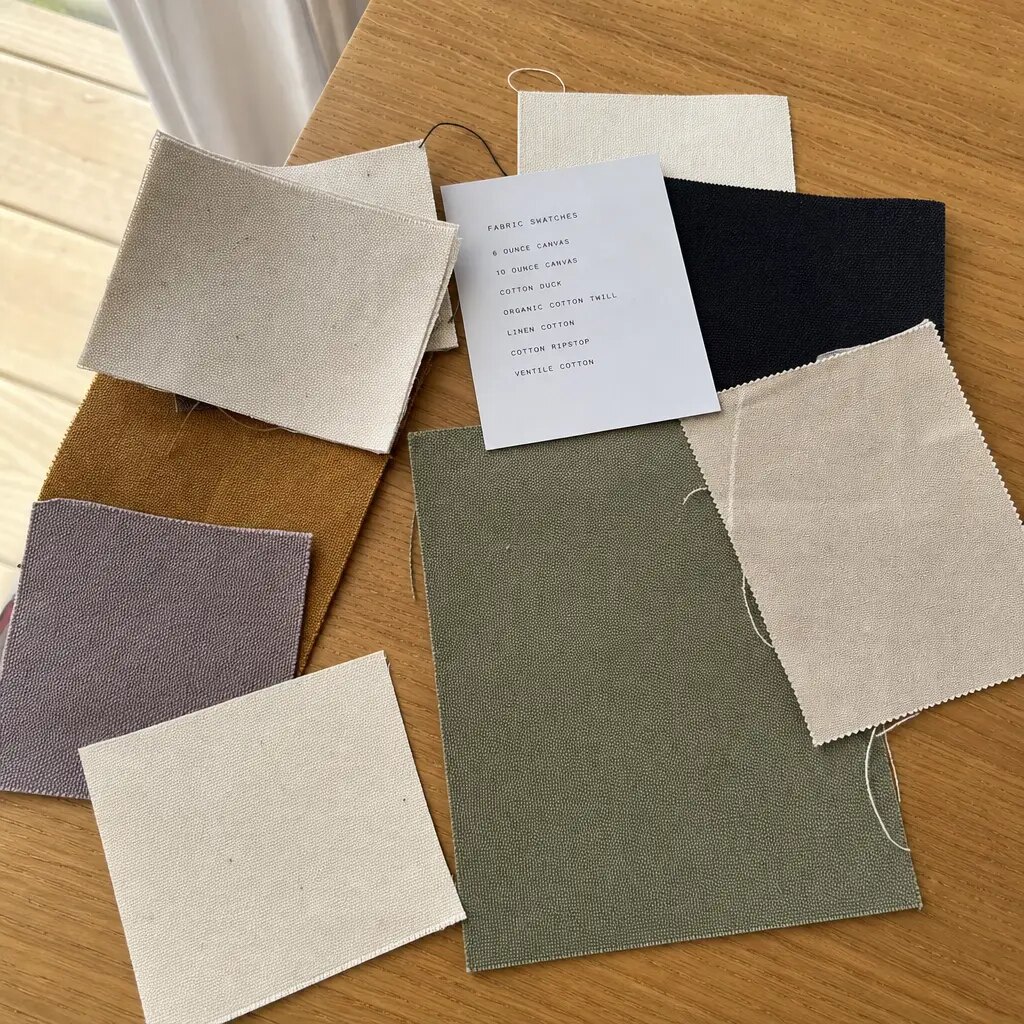
Photos are not enough for fabric approval. Natural cotton photographed under soft studio light can appear thicker, smoother, or cleaner than it is. Ask for a labeled swatch card showing GSM, construction, composition, color, and finish. Keep that swatch with the approved pre-production sample and the purchase order. If bulk production later uses a different stock fabric, the pouch may still meet the size requirement but miss the intended opacity, texture, or hand feel.
- Muslin: best for lightweight rustic packaging, sachets, and low-cost programs; weaker for opacity and crisp logo presentation.
- Plain cotton: best general-purpose construction for craft fair retail pouches and simple screen-printed logos.
- Cotton canvas: best for premium reusable pouches, larger sizes, and heavier handmade goods.
- Cotton twill: useful where a smoother or denser face is preferred; confirm availability, MOQ, shrinkage, and print performance.
- Washed cotton: softer and more relaxed; define shrinkage, shade variation, and finished-size tolerance after washing.
- Blended fabric: may reduce cost, but do not market it as 100% cotton unless composition is confirmed.
Lock color and finish before the artwork is judged
Base color changes both the pouch story and the print result. Natural unbleached cotton is popular for craft fairs because it supports handmade, rustic, low-plastic, and eco-inspired displays. It is often simpler than custom dyeing, yet it is not perfectly uniform. One lot may lean cream; another may look more beige. Buyers should approve an acceptable shade range instead of relying on a single edited product image.
Bleached white gives a cleaner background and stronger contrast for bright print colors. It also reveals dirt, yellowing, oil marks, and handling stains more quickly. Dyed cotton can support a brand color, a seasonal range, or a special event program, but it usually adds lab dip approval, fabric MOQ, longer lead time, and stricter shade-control language. Washed or enzyme-washed finishes can improve softness, although they may make size tolerance and shade control more difficult.
If the pouch touches soap, candles, oils, herbs, or fragrance products, run a simple product-contact test before mass production. Cotton can absorb odor and surface oil. Natural cotton may hide minor marks better than white, but it can still show water marks, mildew spots, or uneven yellowing if goods are packed damp. For export or seasonal storage, confirm that the finished pouches are dry, clean, and odor-free before cartons are sealed.
- Natural cotton: good handmade appearance and lower finish complexity; approve acceptable shade variation by swatch range.
- Bleached white: cleaner print background; higher risk of visible dirt, yellowing, and handling marks.
- Dyed cotton: useful for brand color or seasonal programs; requires lab dips, shade tolerance, and usually higher MOQ.
- Washed cotton: softer hand feel; requires shrinkage and final-size control after washing.
- Print warning: bright inks can look muted on natural beige cotton compared with white fabric.
- Storage warning: cotton should be dry and odor-free before packing, especially for sea freight or long warehouse storage.
Match decoration to fabric texture, artwork count, and order structure
Decoration should come after the fabric decision, not before it. Cotton texture affects edge sharpness, ink coverage, color appearance, and how the logo feels in the hand. Screen printing is usually the strongest commercial choice for one-color or two-color repeat logos at wholesale quantities. It works well for bold icons, simple wordmarks, and solid areas because setup costs can be spread across the order.
Digital printing and heat transfer become useful when the buyer has many artworks, event names, seasonal graphics, or lower quantities per design. They can reduce screen setup complexity, but each method introduces checks of its own. Transfer edges may be visible on natural cotton. Digital printing may require pretreatment and controlled curing. Embroidery can look premium on heavier canvas, yet it is not ideal for thin muslin, tiny pouch panels, or very small lettering.
The artwork file should be production-ready, not just visually approved. Include the decoration method, color count, file format, maximum print area, logo placement, target color, and tolerance. If Pantone matching is requested, make clear that the color is judged on the actual cotton base, not on coated paper or a screen mockup. Natural, white, and dyed cotton will each shift perceived color. As a practical rule, avoid lines below about 0.3 mm unless the supplier proves the result with a strike-off on the approved fabric.
- Screen print: best for simple repeat logos, solid colors, and bulk orders.
- Heat transfer: useful for multi-color small runs; check edge appearance, hand feel, and peeling risk under handling.
- Digital print: flexible for artwork variety; check pretreatment, curing, dry rub, and color on actual fabric.
- Embroidery: premium on heavier canvas; avoid for thin muslin, tiny text, and very small pouch panels.
- Artwork rule: specify minimum line thickness, minimum text size, print area, color references, and file format.
- Strike-off rule: approve print on actual bulk fabric or approved swatch fabric, not only a digital mockup.
- Placement rule: measure logo position from the top channel and side seams because the channel reduces usable visual height.
Specify finished size, usable height, seams, and cord details
Size language causes many avoidable disputes. The purchasing size should be the finished width x height measured flat after sewing, not the cut fabric size. Also remember that the usable internal height is lower than the total height because the drawstring channel takes space at the top. A boxed item that is 15 cm high will not fit properly in a 15 cm pouch once the channel, seam allowance, product depth, and closure are considered.
Seams and channels matter more as product weight increases. Lightweight muslin can distort if the cord is pulled hard. Heavy canvas may need a suitable needle size, wider seam allowance, and careful channel construction so the cord does not jam. The side seam near the cord exit and the bottom corners are common stress points. An empty pouch may look fine during sample review, then twist, pucker, or open after it is filled and lifted.
Drawcord choice affects both performance and brand language. Cotton cord matches the pouch body and supports a natural retail story. Polyester cord may slide smoothly or cost less, but it weakens any cotton-only claim unless disclosed. Small jewelry pouches often use 3-4 mm cord; medium reusable pouches often need 4-6 mm. Cord ends should be defined because unfinished cotton cord can fray, pull through the channel, or look inconsistent across the run.
- State finished size, measured flat after sewing, and clarify whether tolerance applies before or after washing.
- State usable internal height below the drawstring channel when product fit is tight.
- Define top channel width when logo placement, hang display, or closure appearance is important.
- Specify seam type, seam allowance target, stitch density, thread color, and backtack locations.
- Require reinforcement or secure backtacking at cord exits, side seams, and bottom corners for reusable or heavier pouches.
- Specify cord material, diameter, length, color, and end treatment such as knots, stitched ends, plastic tips, metal tips, or heat seal where applicable.
- Test the filled pouch by opening, closing, and lifting it from the cord several times to check seam distortion and channel function.
Separate the MOQ drivers before comparing unit prices
MOQ is rarely one simple number. For wholesale cotton drawstring pouches, minimums can be driven by fabric stock, dyeing, cutting efficiency, sewing setup, print setup, cord sourcing, label application, packing method, and SKU split. A stock natural cotton pouch with a one-color screen print may be practical at a lower quantity than a custom dyed canvas pouch with several artwork versions and retail-ready packaging.
Craft fair programs often include multiple pouch sizes, product categories, or event graphics. The total order quantity may look healthy, but the factory still has to manage minimums by size, fabric color, artwork, and packing style. A supplier might accept 3,000 pieces total while requiring a minimum per print design or per pouch size. Dyed fabric can create a separate fabric-lot MOQ. Barcode stickers, paper bands, individual polybags, or mixed cartons can add setup work by SKU.
To control cost, standardize the hidden parts of the specification. Use one base fabric, one GSM range, one cord type, one seam construction, and one packing method wherever possible. Then vary only the size and artwork where it supports selling value. This approach reduces shade variation, simplifies inspection, improves repeat-order control, and makes supplier quotes easier to compare.
- Fabric MOQ: affected by stock availability, custom dyeing, custom weaving, non-stock GSM, special finish, or certified material.
- Print MOQ: affected by artwork count, color count, screen setup, registration requirements, and changeover time.
- Sewing MOQ: affected by size mix, channel construction, cord insertion, seam complexity, and line setup.
- Cord MOQ: affected by custom color, diameter, material, tipping, and supplier availability.
- Packing MOQ: affected by polybags, barcodes, paper bands, retail packs, and mixed-carton rules.
- Negotiation point: ask for MOQ by size, by artwork, and by fabric color separately.
- Cost-saving point: standardize fabric and cord first; vary print only where it drives sales.
Approve samples that reflect the real bulk process
A sales sample is useful for first impressions, but it should not become the production standard unless it uses the correct material and process. The pre-production sample should match the intended bulk fabric, approved shade range, actual cord, actual decoration method, thread color, seam construction, channel width, and packing fold. If a buyer approves a substitute sample, later disputes become difficult because the sample did not prove the real production route.
Review the sample with measurements, not only with a visual yes or no. Measure finished size at the top, middle, and bottom. Check usable internal height below the channel. Measure print placement from the top channel and side edges. Inspect the cord exit, seam allowance, stitch consistency, trimming, logo opacity, and whether the pouch lies flat. Then put the real product inside and judge fit, opacity, closure, shape, seam stress, and display appearance.
Create an approval file for repeat orders. Photograph the accepted sample with a ruler, fabric swatch, cord reference, logo close-up, and packing method. Record GSM, construction, shade approval, print method, print color, size tolerance, placement tolerance, inner pack quantity, and carton plan. This file prevents the next reorder from relying on memory, old email threads, or a single pouch that may have changed with handling.
- Measure finished size at top, middle, and bottom to detect cutting or sewing distortion.
- Pull the drawcord open and closed at least 10 times to identify tight channels, twisting, or snagging.
- Rub the print with a dry white cloth to check poor curing or excessive ink transfer.
- Pack the real product inside and evaluate fit, opacity, closure, seam stress, and display appearance.
- Check the print after folding and light compression if pouches will ship bundled or carton-packed.
- Photograph the approved sample with ruler, swatch, cord, print close-up, and packing method.
- Write approved deviations clearly; do not rely on verbal acceptance for shade, hand feel, or print softness.
Write QC requirements into the purchase order
Quality control works best when the standard is clear before production starts. The purchase order should reference the approved sample and state fabric GSM tolerance, finished-size tolerance, print placement tolerance, seam requirements, cord specification, shade range, packing method, and defect classification. Without written criteria, a factory may treat loose threads, shade movement, slight logo tilt, or small stains as acceptable while the buyer sees them as customer-facing defects.
Defect classification helps procurement teams make consistent decisions. A loose internal thread may be minor if it can be trimmed. An open bottom seam, missing cord, wrong fabric, wrong print, heavy stain, mildew odor, or severe print offset should be major or critical depending on the program. Because these pouches are visible packaging at craft fairs, logo placement and cleanliness can be commercially important even when the pouch technically still functions.
Inspection should not wait until sealed cartons. Incoming fabric checks can catch wrong GSM, shade problems, stains, or odor before cutting. In-line sewing checks can catch skipped stitches, tight channels, or weak backtacks before the full run is complete. Print checks can identify poor curing, set-off, or placement drift before packing. Final inspection should verify count, SKU split, carton marks, odor, moisture condition, and carton strength. Leave time for rework before the shipment date.
- Finished size: commonly controlled around +/-5 mm for small pouches and +/-10 mm for larger pouches unless another tolerance is agreed.
- GSM: verify from bulk fabric before full cutting and compare to the approved specification.
- Shade: compare under consistent light against approved swatch range, not against edited photos.
- Seams: inspect skipped stitches, open seams, needle cuts, broken threads, uneven channels, loose backtacks, and untrimmed threads.
- Cord: check material, diameter, length, color, knots or tips, fraying, and smooth closure after folding.
- Print: measure placement, tilt, opacity, color, registration, adhesion, and set-off after packing pressure.
- Function: test filled pouches at the intended product weight, especially for candles, jars, ceramics, and tools.
- Packing: verify SKU count, inner pack count, carton labels, carton marks, moisture condition, odor, and carton strength.
Plan packing for receiving, freight, and craft fair preparation
Packing is not just the last production step. It affects landed cost, warehouse labor, inventory accuracy, and the way the pouches look when they reach the event team. Loose bulk packing is inexpensive and uses less packaging material, but it can create count errors, deep creases, and sorting delays. Flat inner bundles of 50 or 100 pieces are often easier for distributors, stockrooms, and booth teams to count and allocate.
Individual polybags protect against dirt and moisture, but they add cost, labor, carton volume, and plastic use. For craft-oriented brands, paper bands or kraft wraps may be a better compromise when the buyer wants tidy presentation without individually bagging every pouch. Test paper bands before approval; they should not mark natural cotton, over-compress the folds, or damage printed areas. If pouches are printed, avoid packing that presses the logo face hard against rough carton walls.
Ask for carton data before approving price. Pieces per carton, carton dimensions, net weight, gross weight, inner pack quantity, SKU split, and carton mark format all affect receiving and landed cost. Mixed cartons can work, but only when inner labels and counts are clear. Cotton absorbs humidity and odor, so finished goods should be dry, clean, and properly ventilated before cartons are sealed, especially for sea freight or seasonal storage.
- Loose bulk: lowest packing cost but higher count, crease, and sorting risk.
- Inner bundles: practical for wholesale receiving, warehouse allocation, and booth preparation.
- Individual polybags: better dirt and moisture protection but higher cost, volume, labor, and plastic use.
- Paper bands: good craft retail presentation if they do not mark or over-compress the fabric.
- Mixed cartons: use only with clear SKU labels, inner pack counts, and carton marks.
- Carton rule: request pieces per carton, carton dimensions, net weight, gross weight, and carton mark format before price approval.
- Moisture rule: pouches must be dry and odor-free before carton sealing to reduce mildew and receiving complaints.
Specification comparison for buyers
| Spec decision | Recommended option | When it fits | Buyer risk to check |
|---|---|---|---|
| Main fabric weight | 160-180 GSM cotton plain weave or light canvas | Most craft fair retail pouches for jewelry cards, soaps, wax melts, stationery, textile accessories, small gift sets, and lightweight candles where the pouch must feel better than a thin giveaway bag | Below 140 GSM may be semi-transparent and weak at the drawcord channel; above 220 GSM may add freight weight, seam bulk, and poor cinching on small sizes |
| Premium material upgrade | 220-240 GSM cotton canvas | Higher-priced handmade goods, reusable packaging programs, pouches larger than about 20 x 30 cm, and dense products such as small candles, jars, tools, or ceramics | Thicker fabric needs suitable needle size, wider seam allowance, clean channel construction, and cord diameter that closes smoothly without jamming |
| Budget material | 120-140 GSM cotton muslin or lightweight plain cotton | Low-cost sample kits, dried flowers, herbs, sachets, lightweight stationery, inner packaging, and short-term event giveaways | Opacity, logo show-through, weaker seams, shade inconsistency, wrinkling, and cheaper hand feel can reduce retail presentation |
| Fabric construction | Plain cotton for general retail; canvas for premium reusable programs; muslin for light rustic packaging | Plain weave gives a balanced print surface; canvas gives structure; muslin gives a soft handmade appearance | Fabric names are used loosely by suppliers, so require GSM, construction, composition, and an approved physical swatch |
| Color and finish | Natural unbleached cotton for the typical craft-fair look; white for high-contrast branding; dyed only when brand color justifies MOQ | Natural works for rustic, eco-inspired, handmade displays; white supports bright logo colors; dyed fabric supports brand or seasonal programs | Natural shade varies by lot; bleached white shows dirt; dyed fabric needs lab dips, shade tolerance, and usually longer lead time |
| Print method | Screen print for 1-2 solid colors at bulk quantities; digital or heat transfer for multi-design small runs | Screen print is efficient for repeat logos; digital and transfer are useful for seasonal graphics, event names, and lower quantities per artwork | Fine lines below about 0.3 mm can fill in on cotton; require a strike-off on actual fabric and define print placement tolerance |
| Drawcord material | Cotton cord, typically 3-4 mm for small pouches and 4-6 mm for medium reusable pouches | Matches the cotton body, supports a natural retail story, and improves perceived value for customer-kept packaging | Cord ends can fray or pull through if not knotted, tipped, stitched, or otherwise finished; thin cord may cut into the channel under load |
| Seam and channel construction | Lockstitch side seams with backtack at stress points, even top channel, and clean trimming | Needed for repeated opening and closing, warehouse filling, booth handling, and heavier craft products | Skipped stitches, narrow seam allowance, tight channel, untrimmed threads, and weak cord exits cause functional complaints even when fabric looks acceptable |
| Packing method | Flat packed in inner bundles of 50 or 100 pieces unless retail-ready individual packing is required | Improves receiving count, SKU separation, warehouse allocation, and craft fair booth preparation | Loose bulk packing can create count errors and creases; individual polybags add cost, volume, labor, and plastic use |
Buyer checklist before sampling
- Define the carried product category, dimensions, packed weight, surface sensitivity, odor or oil contact, and whether the pouch is customer-facing packaging or only inner protection.
- State finished pouch size as width x height measured flat after sewing; do not use fabric cut size as the purchasing size.
- Calculate usable internal height below the drawstring channel and confirm clearance for rigid products such as candles, jars, boxed jewelry, ceramics, soap bars, and gift sets.
- Specify fabric composition, GSM, weave or construction, color, finish, and acceptable GSM tolerance before requesting price comparison.
- For cotton-only marketing claims, request written composition confirmation and avoid blended cords or labels unless clearly disclosed.
- Approve a physical swatch card showing GSM, construction, base shade, finish, and hand feel; keep the approved swatch with the signed pre-production sample.
- Select decoration by artwork and order structure: screen print for simple repeat logos, digital or heat transfer for multi-color small runs, embroidery only for suitable heavier canvas.
- Set artwork rules for minimum line thickness, font size, logo area, print placement tolerance, registration tolerance, and whether Pantone matching is exact or approximate on cotton.
- Specify drawcord material, diameter, color, length, cord-end treatment, and whether knots, stitched ends, metal tips, plastic tips, or bartacks are included.
- Specify seam type, seam allowance target, stitch density, backtack locations, top channel width, thread color, and trimming standard.
Factory quote questions to send
- What exact GSM, weave, and fabric name are you quoting: muslin, plain cotton, canvas, twill, washed cotton, or another construction?
- Is the body fabric 100% cotton? Are the cord, sewing thread, label, or decoration components also cotton, or are they polyester, nylon, metal, or plastic?
- Is the quoted size the finished size after sewing? What is the normal finished-size tolerance for this size and GSM?
- What is the usable internal height below the drawstring channel, and what top channel width is included in the price?
- What finished-size tolerance do you recommend for this pouch size: for example, +/-5 mm for small pouches or +/-10 mm for larger pouches?
- What GSM tolerance applies to bulk fabric, and how do you verify GSM before cutting?
- Will production use stock fabric, stock dyed fabric, or custom woven or dyed fabric? What shade range or lab dip process should be approved?
- What is the MOQ separately for fabric color, pouch size, artwork, print color count, cord type, and packing method?
- What drawcord material, diameter, color, length, and end treatment are included? Are knots, tipping, stitched ends, or reinforcement bartacks included or extra?
- What seam type, seam allowance target, stitch density, top channel construction, and thread color are included in the standard quotation?
Quality-control points to confirm
- Finished size should be measured flat after sewing. A practical tolerance is often about +/-5 mm for small pouches and +/-10 mm for larger pouches unless the PO states otherwise.
- Usable internal height should be checked separately when product fit is tight because the drawstring channel reduces available space.
- Fabric GSM should be verified from bulk fabric before full cutting, not only from the sales swatch. The accepted GSM tolerance should be written in the PO.
- Fabric construction, color, finish, and hand feel should be compared against the approved swatch and signed pre-production sample under consistent lighting.
- Natural cotton shade should fall within the approved shade range and should not show unacceptable stains, oil marks, water marks, mildew spots, or yellowing.
- Drawstring channel must open and close smoothly without cord snagging at side seams, twisting inside the channel, or excessive friction from bulky seams.
- Seams should show no skipped stitches, open seams, needle cuts, broken threads, uneven top channels, loose backtacks, or loose threads beyond the agreed trimming standard.
- Stress points at the cord exit, side seams, bottom corners, and top channel should be tested with the intended product weight, not only on empty pouches.
- Cord diameter, material, color, length, and end treatment should match the approved sample and should not fray excessively during normal handling.
- Print position should be measured from the top channel and side edges. Tilt and placement tolerance should be written for each pouch size.