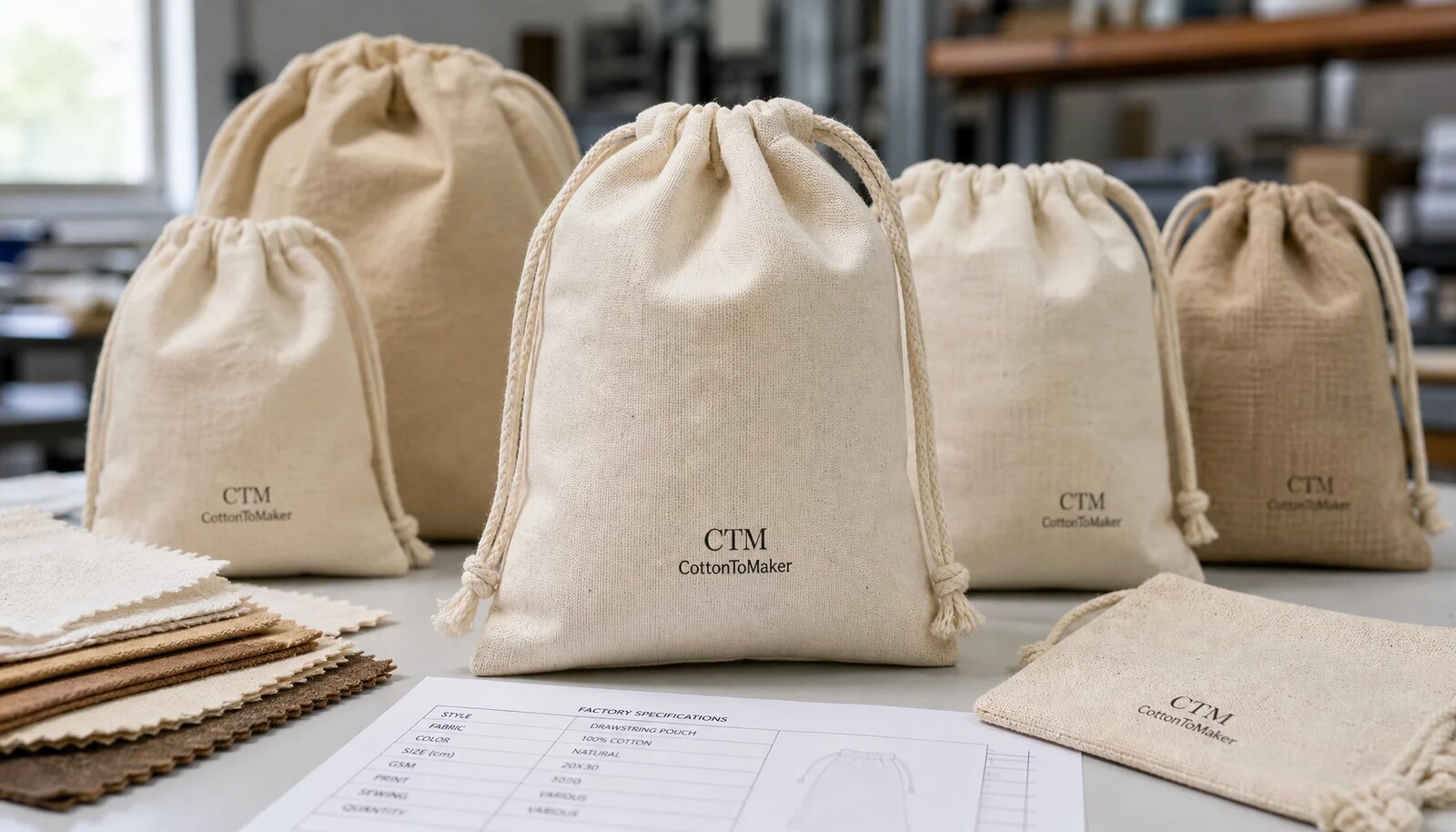
Start With the Craft Fair Use Case
Wholesale cotton drawstring pouches for craft fairs should not begin with a generic pouch photo and a request for best price. They begin with the job the pouch has to do. One buyer may need an economical checkout bag for light jewelry cards. Another may need a sturdier branded pouch for candles, ceramics, boxed soaps, or gift sets. Both are sourcing cotton pouches, but the right fabric weight, drawcord, seam construction, print method, packing format, and inspection standard are different.
The most useful RFQ describes how the pouch will move through the program. Will it be filled by the factory, by a distributor, by warehouse staff, or by booth staff during a busy fair? Will finished pouches be shipped to one location or allocated across several makers and events? Will the customer reuse the pouch, or is it mainly a branded carrier that replaces a paper bag? Those details sound operational, but they protect the buyer from paying for the wrong specification.
The product inside is the real test. Light charms, seed packets, sachets, cards, and wrapped soaps put little strain on seams. A boxed candle, jar, ceramic ornament, or accessory kit creates pressure at corners and along the bottom fold. A small 5 oz cotton pouch may be perfectly adequate for flat goods and look weak around a heavier object. A 10 oz canvas pouch can feel premium, yet on a very small size it may gather badly and close slowly.
For procurement teams, the goal is not to buy the heaviest pouch. The goal is to buy the lightest reliable spec that supports the product value, booth workflow, brand presentation, and QC standard. A short use-case note in the quote request often prevents vague sampling and the familiar argument over what good quality was supposed to mean.
- Describe the product by size, packed weight, retail value, edges, fragrance, oil content, dye risk, and inner packaging.
- State whether the pouch is a giveaway, checkout bag, reusable retail pouch, gift pouch, storage pouch, dust bag, or durable utility pouch.
- Identify who fills the pouch: factory, warehouse, store team, craft fair booth staff, distributor, or end customer.
- Approve the filled pouch, not only the empty sample, because closure, logo shape, opacity, and handfeel change after packing.
- Group SKUs by product weight and destination before negotiating MOQ, carton labels, and delivery splits.
Fabric Weight Ranges Buyers Can Use
Cotton pouch fabric is usually specified in ounces per square yard or GSM. Use both. Some factories speak in ounces, some mills quote GSM, and many buying teams need both units for internal comparison. As a practical commercial guide, 4 oz cotton is often around 135 GSM, 5 oz around 170 GSM, 6 oz around 200 GSM, 7 oz around 240 GSM, 8 oz around 270 GSM, and 10 oz around 340 GSM. These conversions are useful for sourcing, but they are not a substitute for a written tolerance on the purchase order.
Fabric weight is a performance choice, not a simple quality ladder. Light cotton can be right for high-volume event packaging where the product is small, protected, and low risk. Midweight cotton is often the better everyday choice for craft fair retail packaging because it improves opacity and handfeel without the bulk of heavy canvas. Heavy cotton canvas gives more structure and a more substantial feel, but it can increase sewing time, carton volume, carton weight, and landed cost.
Pouch size changes the way the same fabric behaves. A 5 oz fabric in a small jewelry pouch has a short fabric span and may feel acceptable. In a 25 x 35 cm pouch, the same material may appear thin, transparent, and limp. The reverse problem also appears: 10 oz canvas can support a premium candle pouch, but in a tiny pouch the gathered top may feel stiff and crowded, making the drawstring harder to pull.
Use the ranges as a buying filter, then sample against the actual product. For light goods and economical packaging, start at 4-5 oz. For most reusable craft fair pouches, ask for 6-7 oz. For heavier goods or higher-value presentation, review 8-10 oz canvas. Reserve 10 oz+ cotton duck or canvas for pouches that are expected to act like durable storage, not just packaging.
- 4-5 oz cotton, about 135-170 GSM: light packaging for jewelry cards, seed packets, sachets, small stationery, charms, and low-cost event items.
- 6-7 oz cotton, about 200-240 GSM: standard reusable retail pouch range where opacity, handfeel, and print clarity matter.
- 8-10 oz canvas, about 270-340 GSM: premium option for candles, ceramics, boxed soaps, accessories, gift sets, and heavier handmade goods.
- 10 oz+ canvas or cotton duck, above about 340 GSM: utility option when durability is part of the customer promise.
- Record both GSM and oz in the RFQ, sample tag, purchase order, carton file, and reorder notes to reduce substitution risk.
Opacity, Handfeel, and Protection
Opacity can make or break the retail impression. If a dark product label, sharp corner, or inner box shows through natural cotton, the pouch may look cheaper even when the sewing is technically acceptable. GSM helps, but it does not tell the whole story. Weave density, yarn thickness, cotton finish, bleaching, washing, and fabric lot all affect show-through. Two suppliers can quote the same weight and still send fabrics that look different on the booth table.
Handfeel matters because craft fair shoppers handle products closely. A pouch that feels papery, scratchy, limp, or overly stiff can weaken the handmade presentation. Do a simple booth-speed handling check: open the pouch, insert the product, pull the cord, close it, set it down, reopen it, and remove the item. Repeat the process. This reveals friction, fabric stress, logo distortion, and corner marks faster than a tidy supplier photo ever will.
Product protection is a construction question as much as a fabric-weight question. Seam allowance, stitch density, bottom fold, gusset shape, channel height, and cord quality all affect durability. A jar lid, zipper pull, ceramic edge, candle tin, or rigid product card can create wear points. Heavier fabric may hide pressure marks better, but it will not compensate for a weak seam, narrow channel, poor stitch tension, or a pouch that is simply too tight.
Scented, oily, waxed, dyed, or damp-prone products need extra caution. Cotton can absorb fragrance, show oil spots, or pick up dye transfer. Soaps, candles, bath goods, and essential oil products often need an inner wrap, glassine sleeve, box, or label before they go into cotton. A thicker pouch is not a barrier material. Test storage with the final packed product before approving bulk production.
- Place the real product or a dark test card inside the pouch and check show-through under daylight and warm booth lighting.
- Run at least ten filled open-close cycles to evaluate cord speed, fabric stress, and customer handling feel.
- Check whether corners, tins, jars, zippers, or ceramic edges mark the fabric, seams, or bottom fold.
- For scented or oily products, test the final inner packaging for fragrance transfer, residue, staining, and fabric discoloration.
- Judge premium pouches by filled presentation and repeated handling, not only by empty sample appearance.
Size, Capacity, and Construction
Finished size causes more trouble than it should because buyers and suppliers may not be measuring the same thing. A request for 10 x 15 cm can mean cut panel size, finished flat outside size, or usable internal capacity. After seams, bottom fold, and the drawstring channel are sewn, the space available for the product is smaller. A pouch can technically match the quoted size and still fail if the opening is tight or the item sits too close to the channel.
A clean RFQ states finished flat outside width and height, then adds the required usable space. Include the product dimensions, packed weight, whether the item is loose or boxed, and whether the pouch must close completely. If booth staff will fill the pouch during checkout, allow extra clearance. A pouch that requires careful angling or force will slow the line and increase handling damage.
The drawstring channel deserves its own measurement. A narrow channel creates friction, especially with thicker cotton cord or rope. A loose channel can look unfinished and allow the cord to shift. Channel height also reduces the usable body height. Logo position must account for this: too high and it gets swallowed by the gathered top; too low and it bends around the product bulge or bottom fold.
Gussets can help bulky products look better, but they change cost and QC. A flat pouch is usually cheaper, faster to sew, and efficient to pack. A bottom gusset, side gusset, boxed bottom, or round bottom may help candles, jars, or gift sets stand more neatly. It also uses more fabric, adds sewing steps, and may need a heavier material to hold shape. Decide whether the pouch must stand, lie flat, sit in a basket, or fit inside another carton.
- Specify finished flat outside size as width x height, plus usable internal target when product fit is critical.
- State construction clearly: flat, bottom gusset, side gusset, boxed bottom, round bottom, lined, unlined, or reinforced.
- Measure channel height, body height below channel, opening width, gusset depth, seam allowance, and cord length on the approved sample.
- Allow enough top height for the pouch to close without forcing the fabric, hiding the logo, or exposing the product.
- For heavy canvas, test whether the gathered top becomes bulky, uneven, or slow for booth staff to close.
Print Method and Artwork Limits
Screen printing remains a practical choice for many wholesale cotton drawstring pouches for craft fairs. It suits one-color or two-color maker logos, shop names, distributor private label, and repeat wholesale runs. It works best when the fabric surface is reasonably consistent, the artwork avoids very fine lines, and the print is kept away from channels, seams, gussets, and bottom folds. On loose natural cotton, small lettering can fill in, break, or feather.
Fabric weight and weave change print behavior. Light muslin may absorb ink differently from dense canvas. Natural slubs can interrupt thin logo strokes or small text. Heavy canvas can feel premium, but its surface may be rougher for large solid print areas. Approve the strike-off on the exact bulk fabric or a confirmed bulk-equivalent fabric. A smooth sample swatch can flatter the print and hide a production problem.
DTF and heat transfer methods can be useful for multi-color artwork, QR codes, seasonal graphics, small production splits, or programs with several logo versions under one purchase order. They solve some setup problems but bring their own checks: edge feel, gloss mismatch, heat marks, cracking, peeling, and stiffness where the pouch bends. Review the transfer after curing and after filled handling, not only while the sample is fresh and flat.
Embroidery can work on premium cotton canvas, but it is not automatically the better option. It can pucker lighter fabrics, distort small pouches, add weight to the front panel, and extend lead time. It is usually best for simple marks on midweight or heavy cotton when a tactile textile finish is part of the brand direction. Whatever decoration method is chosen, the artwork limits belong in the quote, sample approval, and PO.
- For screen print, define color count, Pantone reference, print size, print position, minimum line thickness, and minimum text height.
- For transfer print, approve edge feel, gloss, adhesion, heat marks, cracking, and flex after repeated pouch opening and closing.
- For QR codes, request a scan test on the finished pouch after printing and again after the pouch has been filled and handled.
- Keep artwork away from drawstring channels, side seams, gussets, bottom folds, and heavy gathered areas.
- Set logo placement tolerance from finished edges or centerline, commonly around +/-0.5 cm for small to medium pouches.
MOQ, Price Breaks, and Cost Drivers
Wholesale pricing is rarely driven by total pieces alone. MOQ can change by pouch size, fabric weight, fabric color, drawcord color, print method, artwork version, packing style, and shipment split. A 10,000-piece order spread across many sizes, colors, logos, cords, and destinations may be less efficient than a smaller order with a standardized platform. Ask for MOQ by component and process, not only by the headline order quantity.
Break the quote into cost drivers. Fabric cost changes with GSM, pouch dimensions, shrinkage allowance, cutting yield, fabric finish, and fabric lot. Sewing cost changes with seam construction, gussets, channel type, drawstring insertion, trimming, and inspection. Printing cost changes with screen or film setup, color count, print area, curing, registration, and artwork versions. Packing cost changes with inner packs, individual polybags, hangtags, barcodes, carton labels, and kitting.
Useful price breaks should match the buying program. Ask for 1,000, 3,000, 5,000, and 10,000 pieces only if those quantities are realistic. If a supplier quotes one blended number, procurement cannot see whether the saving comes from fabric purchasing, print setup efficiency, packing simplification, or shipping density. For multi-brand craft fair programs, it may be cheaper to standardize size, weight, and cord, then vary only the print.
Clarify overage, shortage, and reject handling before production starts. Cotton pouch orders can lose units through fabric flaws, print rejects, stitching defects, shade sorting, and packing mistakes. If the pouches are tied to event dates, a shortage discovered after arrival may be expensive or impossible to fix. State whether quantity tolerance is allowed and how rejected goods will be replaced, credited, remade, or sorted.
- Request MOQ by size, fabric weight, fabric color, cord color, print method, logo version, packing method, and shipment destination.
- Ask for price breaks at practical quantities per SKU or size family, not only by total purchase order value.
- Separate unit price from sample fees, screen charges, film charges, label charges, packing materials, carton marking, and inland freight.
- Identify cost-raising customizations such as dyed fabric, unusual cord color, gussets, retail polybags, barcodes, hangtags, and extra logo versions.
- State shipment quantity tolerance and reject handling before approving bulk production for fixed event schedules.
RFQ Specification Template
A strong B2B RFQ makes two suppliers quote the same pouch. It does not need to be long, but it must remove guesswork. Include the product use case, finished pouch size, target capacity, fabric weight, cotton construction, finish, drawcord details, decoration method, packing plan, inspection expectations, and delivery terms. Without those items, quotes may look similar while hiding different fabric, stitching, print, or packing assumptions.
Begin with the commercial context. Say whether the pouches are for craft fair retail packaging, premium gift packaging, dust bags, reusable storage, or a product component. List the item going inside and whether it is loose, boxed, wrapped, scented, oily, sharp-edged, or fragile. If the pouch supports a higher-value handmade product, say so. This helps suppliers quote a specification that fits the intended presentation instead of defaulting to the cheapest cotton.
Technical details should be measurable. Use finished flat outside dimensions, target GSM and oz, fabric construction, fabric color, cord diameter, cord draw style, stitch color, logo size, print position, and tolerance. If the fabric weight is still open, request controlled alternatives, such as 5 oz, 6 oz, and 8 oz options, each with pricing and sample availability. That gives the buying team a real comparison instead of a vague light, medium, heavy discussion.
Operational data belongs in the quote, too. Carton dimensions, gross weight, units per carton, inner-pack count, estimated CBM, Incoterm, sample timing, bulk lead time, approval deadlines, and inspection support all affect landed cost and event readiness. For distributors and importers, those details can matter more than a small difference in FOB unit price.
- Include product-use note, finished size, target capacity, fabric weight range, cotton construction, color, cord, stitching, print, packing, and delivery terms.
- Ask suppliers to quote each fabric weight option separately so 5 oz, 6 oz, and 8 oz offers are not mixed together.
- Require the quote to state exclusions, including screens, samples, labels, polybags, cartons, inspection support, and inland freight.
- Ask for sample timing, bulk timing, latest approval dates, and whether lead time begins after deposit, artwork, fabric approval, or final sample approval.
- Request carton and CBM data at quote stage so the buying team can compare landed cost, not just FOB unit price.
Sample Approval and Control Samples
A showroom sample is useful for early screening, but it should not become bulk approval by default. Bulk fabric may differ in shade, weave openness, shrinkage, handfeel, and print absorption. The approved sample should use the final fabric weight, final cord, final construction, final print process, final stitching, and intended packing method. For craft fair programs with fixed dates, sampling needs enough calendar space for correction before cutting or printing begins.
Separate the approval into checkpoints when timing allows. First, approve the fabric swatch for GSM, shade, handfeel, weave, opacity, and finish. Second, approve the print strike-off for color, edge clarity, registration, curing, adhesion, and placement. Third, approve the finished pouch for dimensions, seams, drawcord function, filled appearance, logo position, and packing. One rushed photo approval can miss problems that are expensive to fix after bulk production starts.
The pre-production sample should become the control sample. Label it with supplier name, approval date, SKU, fabric weight, fabric color, finished size, cord specification, print method, logo version, and packing method. If physical samples cannot be shared with every stakeholder, keep measurement photos and a signed specification sheet. Even then, physical approval remains stronger for handfeel, opacity, shade, and closure fit.
Approval language should be exact. Fabric approval does not mean mass printing approval. A print strike-off approval does not cover a later logo-size change. Photo approval should state which points are accepted and which remain subject to inspection. Clear approval gates protect both buyer and supplier because they define when bulk cutting, printing, sewing, and packing may begin.
- Approve fabric swatch, print strike-off, and finished pre-production sample as separate checkpoints when timing allows.
- Use the actual product for sample testing, including insertion, closure, reopening, and booth-speed handling.
- Measure approved sample width, height, channel height, body space below channel, gusset depth, cord length, seam allowance, and logo position.
- Tag and photograph the control sample so bulk inspection has a practical reference beyond written descriptions.
- Do not release bulk cutting, printing, or sewing until the supplier confirms which approvals are complete and which remain open.
QC Tolerances and Defect Classification
Quality control for cotton drawstring pouches needs written commercial limits before cartons are packed. Common defects include wrong fabric weight, shade variation, size variation, open seams, skipped stitches, loose threads, weak corners, broken cords, narrow drawstring channels, crooked logos, print smudges, stains, odor, wrong carton labels, and incorrect inner counts. If the standard only says good quality, both sides are left to argue after the fact.
Tolerances should be realistic and measurable. Many small pouch programs use a finished-size tolerance around +/-0.5 cm. Larger canvas pouches, washed fabrics, and gusseted styles may need a wider written tolerance. Fabric weight can be controlled by a GSM or oz tolerance such as +/-5% or +/-10%, depending on fabric and supplier capability. Logo placement should be measured from finished edges or centerline, not from the cut panel, because sewing affects final position.
Defect classification keeps inspection decisions consistent. Critical defects make the pouch commercially unusable or create a serious receiving problem: wrong logo, wrong SKU, wrong fabric, open seam, broken drawcord, pouches that cannot close, heavy contamination, or carton labels that misidentify the contents. Major defects include visible stains, severe shade mismatch, crooked print outside tolerance, weak channel stitching, or size outside tolerance. Minor defects include trim-able loose threads or slight irregularities that do not affect function or retail presentation.
Inspection must include packing accuracy. A pouch can pass sewing inspection and still fail the program if the wrong logo version is mixed into a carton, inner packs do not match the packing list, or carton labels hide a SKU error. For importers, distributors, and event buyers, pre-shipment inspection is usually safer than discovering mistakes during allocation. QC should connect pouch inspection, carton labels, inner counts, and packing list into one release decision.
- Define critical, major, and minor defects before production and attach the list to the PO or order confirmation.
- Measure finished flat size after sewing and channel formation, not cut panel size.
- Check GSM, shade, seam strength, skipped stitches, channel openings, drawcord pull, print adhesion, logo placement, stains, odor, and lint.
- Use dry rub, tape pull, light flex, and filled handling checks for printed or transfer-decorated pouches.
- Verify carton labels, inner counts, SKU codes, logo versions, mixed-carton maps, and total PO quantity before shipment release.
Packing, Cartons, and Landed Cost
Unit price is only one part of wholesale pouch sourcing. Heavier cotton and canvas raise carton weight. Thick fabric, gussets, and bulky cord increase carton volume. Retail polybags, hangtags, barcode labels, paper bands, inserts, and kitting add labor and space. A pouch that looks cheaper at FOB level may cost more after freight, receiving labor, repacking, and allocation are included.
Ask for carton data during the quote stage. At minimum, request units per carton, inner-pack quantity, carton dimensions, net weight, gross weight, estimated CBM, carton label format, and whether cartons are single-SKU or mixed. This allows freight teams to estimate landed cost and warehouse teams to plan receiving. If final carton data is not available before production, the supplier should provide a reasonable estimate based on similar fabric weight and packing.
Packing should follow the distribution plan. Flat bulk packing is efficient when the buyer, warehouse, brand team, or event staff will fill the pouches later. Inner packs of 50 or 100 pieces help with counting and allocation. Individual polybags may make sense when pouches are sold as retail items, need barcode control, or must stay clean through handling, but they add cost, material, and carton volume. Paper bands or inner cartons can be a practical middle option.
Carton labels are part of the specification, not an afterthought. Labels should show PO number, SKU, size, fabric code or GSM, color, logo version, quantity, carton number, and destination if applicable. Avoid mixed cartons when possible. If mixed cartons are necessary, require a carton-level SKU map and clear internal separation. This reduces receiving errors and keeps the right pouch moving to the right craft fair booth, retail kit, or distributor order.
- Request carton dimensions, units per carton, inner-pack count, gross weight, net weight, estimated CBM, and carton label template before final quote comparison.
- Use flat bulk pack for warehouse efficiency when pouches will be filled later by the buyer or event team.
- Use inner packs of 50 or 100 for fast counting, event allocation, kitting, and reduced handling errors.
- Use individual polybags only when retail cleanliness, barcode control, or customer-facing presentation justifies the added cost and volume.
- Require packing lists and carton labels to separate each SKU, size, fabric weight, color, logo version, and destination.
Specification comparison for buyers
| Spec decision | Recommended option | When it fits | Buyer risk to check |
|---|---|---|---|
| Low-cost event or giveaway pouch | 4 oz to 5 oz cotton, commonly about 135-170 GSM | Light jewelry cards, seed packets, charms, sachets, flat stationery, small soaps with inner wrap, or high-volume booth packaging | May be semi-transparent, limp, or less reusable; check show-through, corner marks, seam strength, and print feathering on the exact fabric |
| Standard reusable retail pouch | 6 oz to 7 oz cotton, commonly about 200-240 GSM | Most craft fair merchandise where the pouch replaces a paper bag and supports a branded handmade presentation | Higher unit cost than light cotton; verify opacity, closure smoothness, print flatness after filling, and carton weight |
| Premium handmade goods pouch | 8 oz to 10 oz cotton canvas, commonly about 270-340 GSM | Candles, ceramics, boxed soaps, small accessories, gift sets, keepsake packaging, or higher-retail-price products | Bulkier packing and slower sewing; confirm drawstring channel allowance, seam allowance, needle size, stitch density, and carton CBM |
| Durable utility pouch | 10 oz+ canvas or cotton duck, often above 340 GSM | Tool-like kits, reusable storage pouches, heavier accessory bundles, or packaging expected to remain in use after purchase | Can be too stiff for small pouches; require filled closure test, abrasion check at corners, cord pull test, and realistic freight estimate |
| Simple logo print | Screen print, 1-2 spot colors, artwork kept away from channel, seams, gusset, and bottom fold | Maker logos, shop names, distributor private label, simple booth branding, and repeat wholesale runs | Loose-weave cotton can blur edges; approve a strike-off on bulk-equivalent fabric and define minimum line thickness and placement tolerance |
| Detailed or multi-color artwork | DTF or heat transfer on smoother cotton or canvas, with agreed curing and handling checks | Seasonal graphics, QR codes, gradients, small runs, multi-brand programs, or multiple logo versions under one PO | Transfer edge feel, gloss mismatch, heat marks, cracking, or peeling; run dry rub, tape pull, flex, and closure tests |
| Drawcord specification | Cotton cord, braided cotton cord, or thicker cotton rope matched to pouch weight and channel size | Visible retail presentation where the cord is part of the finished look and must close quickly at booth speed | Cord diameter changes closing force; test repeated open-close cycles with the actual product inside |
| MOQ strategy | Consolidate by fabric weight, fabric color, size family, cord type, and print process before splitting logo versions | Importers, distributors, craft fair programs, or multi-brand buyers managing several SKUs | Too many size/color/logo/packing splits can erase wholesale savings and increase carton marking or picking errors |
| Packing method | Flat bulk pack with inner packs of 50 or 100, carton labels by SKU, fabric code, size, logo version, and quantity | Warehouse receiving, event allocation, brand teams filling pouches later, retail kitting, or distributor programs | Mixed cartons without a SKU map create receiving errors; require carton-level packing list before shipment |
Buyer checklist before sampling
- Define the product going inside the pouch, including dimensions, packed weight, retail value, sharp corners, fragrance, oil, dye, moisture risk, and whether it is boxed, wrapped, or loose.
- Classify the pouch job as dust bag, checkout packaging, reusable retail pouch, gift packaging, premium product component, storage pouch, or durable utility pouch.
- Select fabric weight by function: 4-5 oz for light packaging, 6-7 oz for standard reusable retail use, 8-10 oz for premium or heavier goods, and 10 oz+ only when durability is part of the product promise.
- Specify both GSM and oz per square yard, and state whether the acceptable tolerance is by supplier standard or a written range such as +/-5% or +/-10%.
- Give finished outside pouch dimensions, usable internal capacity requirement, product-fit allowance, channel height, cord length, and whether dimensions are measured flat after sewing.
- Specify cotton construction and finish: muslin, plain weave cotton, canvas, cotton duck, natural, bleached, dyed, washed, unwashed, pre-shrunk, or custom finished.
- Define drawcord material, cord diameter, cord color, one-side or two-side draw, knot style, cord end treatment, and whether the cord must stay captured in the channel.
- Send production-ready artwork with Pantone or color references, logo width and height, print position from finished edges, maximum placement tolerance, and minimum acceptable line/text size.
- Require a fabric swatch, print strike-off, and pre-production sample using the final fabric weight, final cord, final print process, final stitching, and intended packing method.
- Ask for MOQ by size, fabric weight, fabric color, drawcord color, print color count, artwork version, packing format, delivery split, and Incoterm rather than relying on one headline MOQ.
Factory quote questions to send
- What exact fabric weight is included in the quote in both GSM and oz per square yard, and what commercial tolerance will apply to bulk fabric?
- Is the fabric greige, natural stock, bleached, dyed stock, washed, unwashed, pre-shrunk, or custom finished, and will the same fabric lot be used for all SKUs?
- What cotton construction is quoted: muslin, plain weave cotton, canvas, cotton duck, brushed cotton, or another construction?
- Is the quoted size cut panel size, finished flat outside size, or usable internal capacity after the drawstring channel is sewn?
- What are the finished-size tolerances for width, height, gusset depth if applicable, channel height, cord length, and logo placement?
- What is the MOQ per size, per fabric weight, per fabric color, per drawcord color, per print method, and per printed logo version?
- Which print method is included, and what are the artwork limits for minimum line thickness, small text height, halftones, QR code size, color count, registration, and print area?
- Can you provide a fabric swatch, print strike-off, and pre-production sample on the exact bulk fabric before mass cutting or mass printing starts?
- What dry rub, tape pull, wash or handling, curing, and flex checks do you use for the selected print method?
- What stitch type, seam allowance, stitch density, needle size range, and seam finishing are included for this fabric weight?
Quality-control points to confirm
- Fabric weight should be checked against the approved control sample and purchase order, with GSM or oz tolerance agreed before bulk cutting; many buyers use a written commercial range such as +/-5% to +/-10% depending on fabric and supplier capability.
- Finished pouch size should be measured flat after sewing, including opening width, body height below channel, total height, gusset depth if present, drawstring channel height, and usable internal space.
- For small pouches, a typical commercial finished-size tolerance may be around +/-0.5 cm; larger canvas pouches or washed fabrics may need a wider written tolerance agreed in advance.
- Seams should be straight, secured at stress points, and free from skipped stitches, open seams, loose threads, puckering, needle cuts, weak corners, or fraying channel openings.
- Stitch density should be consistent with the approved sample; very low stitch density can weaken corners, while excessive density on heavy canvas can create puckering or needle damage.
- Drawcords should pull evenly, close the pouch without jamming, and should not fray, detach, twist excessively, or disappear into the channel during normal handling.
- Drawstring channel width should suit the cord diameter; the pouch should complete repeated open-close cycles without tearing, cord slippage, or excessive pulling force.
- Print should match approved artwork, color, edge definition, and curing standard, and should pass agreed dry rub, tape pull, light flex, and handling checks.
- Logo placement should stay within the approved tolerance from centerline and finished edges, commonly around +/-0.5 cm for small to medium pouches unless otherwise specified.
- Fabric shade should be consistent within each carton and across cartons for the same SKU, especially for natural, bleached, and dyed cotton where lot variation is visible.