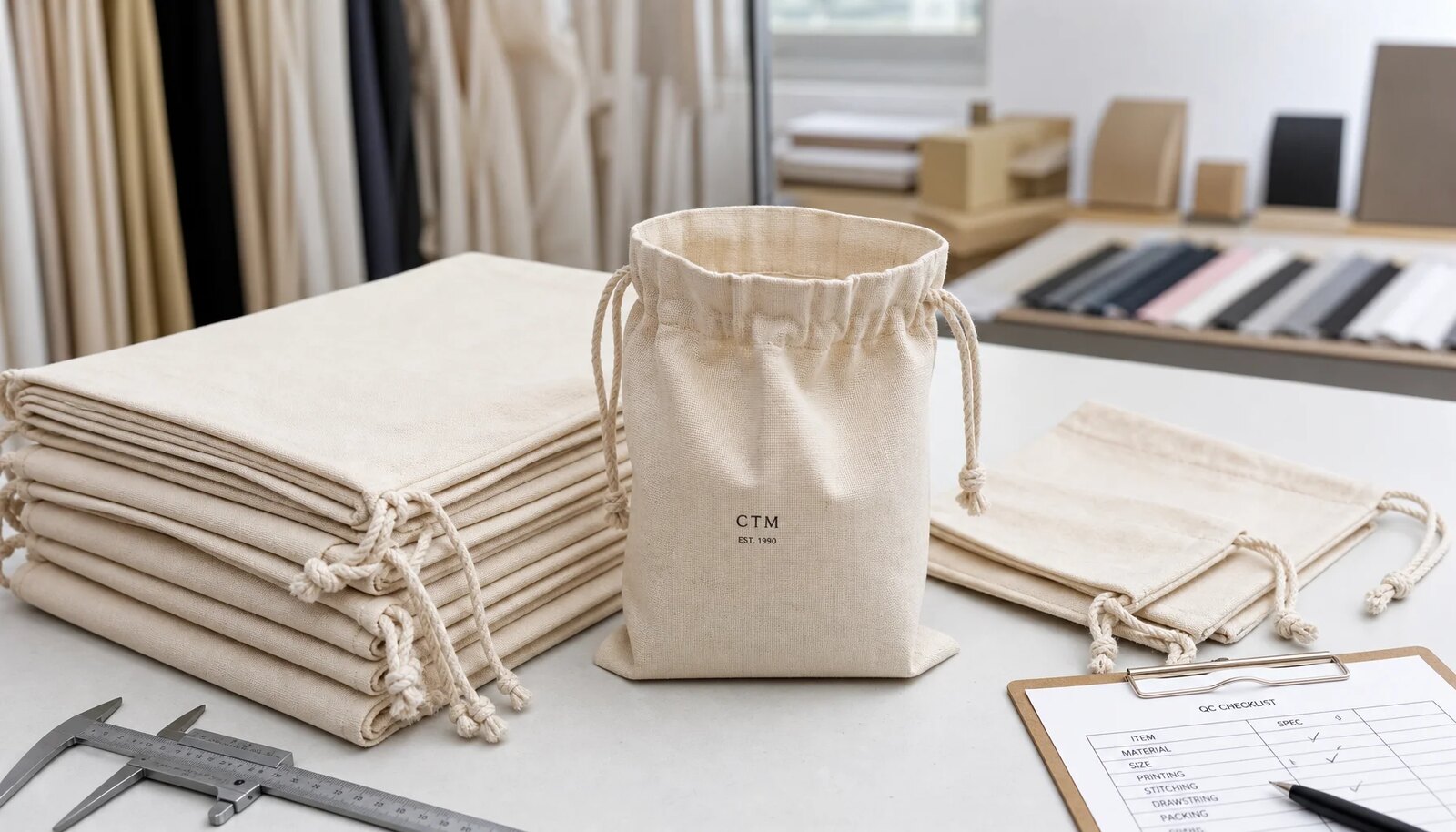
Start With the Booth Reality, Not the Bag
Wholesale cotton drawstring pouches for craft fairs are retail packaging, handling protection, and brand presentation all at once. They may be opened by shoppers, refilled by vendors, stacked in totes, tied and untied all day, and reused after the event. That is a very different job from a pouch that only sits inside a shipping carton.
Before comparing prices, define the environment. Is the pouch sold empty, packed with product, used as a dust bag, bundled into a subscription kit, or handed out as reusable gift packaging? A soap maker, jewelry brand, candle studio, and craft kit seller can all ask for a natural cotton pouch and still need different specifications.
Product shape matters as much as weight. A smooth jewelry card is easy on seams. A candle tin adds density. A ceramic ornament can create point pressure. A kit with instruction cards, twine, charms, and tags may snag inside the casing. If the brief only says cotton drawstring pouch, the factory has to guess where the stress will land.
A better RFQ describes the product weight, product dimensions, edge sharpness, inserts, hangtags, expected opening and closing cycles, display method, and packing destination. This helps suppliers quote a pouch that can actually survive craft fair handling instead of the lowest-cost version that only looks similar in a photo.
- For jewelry and tags, prioritize size accuracy, clean seams, smooth cord movement, and centered logo placement.
- For soap, candles, jars, and ornaments, prioritize GSM, seam strength, load testing, and closure clearance.
- For craft kits, test the pouch with every insert, card, accessory, and label packed inside.
- For reusable gift packaging, inspect appearance after repeated opening, closing, folding, and display handling.
- For distributor programs, define SKU separation, inner quantities, carton labels, and receiving requirements before quotation.
Select Cotton GSM and Weave by Use Case
Cotton GSM is an important starting point, but it is not the whole durability story. GSM tells you fabric weight. It does not tell you weave tightness, shrinkage, thread quality, print behavior, or how well the pouch is sewn. A heavy fabric with weak casing construction can still fail quickly.
For light craft fair items, 120-140 GSM can be suitable. This range often works for jewelry, charms, seed packets, soap samples, sachets, and small inserts. For general retail-facing packaging, 140-160 GSM is a practical middle range because it improves handfeel without creating unnecessary freight weight. For candle tins, jars, small ceramics, boxed kits, ornaments, or reusable gift pouches, 180-220 GSM usually gives a stronger, more premium feel.
Do not buy on GSM alone. A loose plain weave may stretch at the seams, fray near the casing, reveal product outlines, or absorb ink unevenly. A tighter plain weave or canvas-style cotton can improve opacity, abrasion resistance, and print edge definition. It may also change handfeel, cost, MOQ, and folding behavior.
Natural cotton needs its own approval standard. Slubs, seed flecks, and shade variation may be acceptable for handmade positioning, but they should be controlled by an approved sample. Dyed or bleached cotton adds color control, shrinkage, and possible colorfastness questions. The purchase order should name the GSM, tolerance, weave or construction, color reference, finishing process, and approved natural variation.
- 100-120 GSM: low-cost option for very light giveaways, dust covers, inserts, or samples.
- 120-140 GSM: useful for jewelry, seed packs, soap samples, charms, and lightweight accessories.
- 140-160 GSM: balanced choice for many wholesale cotton drawstring pouches for craft fairs.
- 180-220 GSM: stronger handfeel for candles, jars, ornaments, boxed kits, and reusable gift packaging.
- Natural cotton: approve slubs, seed flecks, shade range, opacity, and handfeel before bulk cutting.
Lock Down Finished Size and Usable Height
Finished size is the size buyers receive. Cutting size is only a production input. This difference causes many sourcing problems because a pouch can meet the quoted panel size and still fail once it has been sewn, pressed, printed, folded, packed, and allowed to recover.
Separate finished width, total height, usable height below the drawcord casing, and casing width. Usable height is often the missed measurement. A pouch may look tall enough on paper, but if the product pushes into the cord channel, the drawstring will not close neatly. That problem shows up fast at a booth when vendors need to pack inventory cleanly and quickly.
Use the real product for fit testing whenever possible. If production timing makes that difficult, use a dimensional dummy with the same weight, thickness, corners, and packing orientation. Test hangtags, folded instruction cards, labels, hooks, and inserts too. These small extras often catch on seams or block the closure.
Write tolerance in finished-measurement terms. For small pouches, +/- 0.5 cm is often a workable commercial target. For medium and larger pouches, +/- 1.0 cm may be acceptable if the product fit is not tight. If the pouch is built around a fixed item, such as a soap bar, tarot deck, candle tin, or jewelry card, ask the factory to confirm whether tighter control is realistic at the order quantity and price.
- Specify finished width, total height, usable height below casing, casing width, and tolerance for every size.
- Measure flat finished pouches after sewing, printing, folding, and packing recovery, not only after cutting.
- Leave enough headroom so the drawcord closes without forcing the product into the casing.
- Test corners, hangtags, labels, hooks, and inserts that may catch on seams or the cord channel.
- Approve any washed, steamed, dyed, or pressed finish under the same process planned for bulk production.
Make the Drawcord a Written Spec
The drawcord is a small component with a large failure risk. Buyers often spend time on fabric and artwork, then leave the cord vague. In use, however, stress concentrates at the cord, casing ends, knots, and top seam. If this area is weak, the pouch feels cheap even when the fabric is acceptable.
Name the cord material in the quote and purchase order. Cotton cord supports natural branding and plastic-free positioning. Polyester cord may be smoother, cheaper, or easier to source, but it changes handfeel and may conflict with packaging claims. If cotton is required, say so clearly and confirm it on the production sample.
Cord diameter should match pouch size and casing width. A 3 mm cord is a common starting point for small pouches. Medium or heavier pouches may need 4-5 mm cord for better grip, but only if the casing allows smooth movement. Too-thin cord can shed, fray, cut into the fabric, or slip into the channel. Too-thick cord can make small bags hard to close.
Cord length and finish affect both function and display. Uneven cords look messy on a vendor table. Loose knots come undone. Bulky knots can leave pressure marks during carton packing. Raw ends may shed after repeated use. Include a simple 30-50 cycle open-close test before approving bulk production or shipment.
- Specify cord material, diameter, length, color, knot style, end finish, and replacement rules for uneven cords.
- Confirm casing width is compatible with cord diameter and does not create excessive friction.
- Inspect casing ends because repeated pulling concentrates stress at those points.
- Reject cords that shed heavily, fray, slip into the channel, or pull unevenly from side to side.
- Run a 30-50 cycle open-close test on the final sample and during shipment inspection.
Set Sewing Standards Before Production Starts
Durability is often decided at the sewing machine. Seam type, stitch density, thread tension, seam allowance, backtacking, and raw-edge control determine whether the pouch survives repeated handling. A lighter pouch with good sewing can outperform a heavier pouch with poor casing construction.
For many cotton drawstring pouches, 8-10 stitches per inch is a reasonable commercial range, but it should be matched to fabric weight. Too few stitches can weaken the seam and leave gaps. Too many stitches can perforate lighter cotton and make the fabric easier to tear. The goal is balanced sewing, not the highest stitch count.
Pay close attention to side seams, bottom corners, casing ends, and the point where the side seam meets the casing. These are the areas most likely to fail under product weight and repeated pulling. Dense goods such as candle tins, jars, small ceramics, and boxed kits need stronger scrutiny than a flat jewelry card.
Defect rules should be agreed before inspection. Open seams, skipped stitches at stress points, broken threads, twisted casing, holes, raw fraying that affects function, and thread nests on the front panel should normally be treated as major defects for retail-facing craft fair packaging. If the pouch will sit in front of shoppers, appearance defects are commercial defects too.
- Define seam type, seam allowance, stitch density range, thread color, and backtacking locations.
- Check side seams, bottom corners, casing ends, and the intersection between side seam and casing.
- Use firm hand pull tests on loaded or product-dummy pouches to screen for weak seams.
- Control raw edges with overlock, folding, or another method when fraying affects function or appearance.
- Classify open seams, skipped stress-point stitches, broken threads, and twisted casing before inspection starts.
Match Print Method to Cotton Texture
For craft fair sellers, the pouch often carries the maker brand. Print quality is not a decorative extra. A crooked, smeared, cracked, or poorly cured logo can make otherwise acceptable pouches hard to use in retail settings.
Screen printing is usually the safest option for solid one-color or two-color logos on cotton drawstring pouches. It works well for simple marks, text, and line graphics at wholesale quantities. It also gives buyers a clearer path for repeat orders when screens and artwork are controlled.
Heat transfer can work for short runs, detailed artwork, gradients, or multi-color designs, but it needs testing on the final fabric. Rough natural cotton can make transfer edges lift or details look uneven. Thick transfers may feel stiff on a soft pouch, and aggressive folding can create creases. Woven labels are another option when the front panel should stay plain, but labels add MOQ, placement tolerance, and sewing checks.
The RFQ should include artwork format, print size, print location, color reference, method, and placement tolerance. Very small reversed text, fine lines, and small QR codes can fill in or distort on textured cotton. Always approve the print on final GSM, final shade, and final finishing process, not on a substitute swatch.
- Use screen print for simple solid logos, repeat programs, and predictable wholesale cotton pouch pricing.
- Use heat transfer only after checking edge lift, handfeel, rub resistance, scratch resistance, and fold behavior.
- Use woven labels when branding should be subtle or the front pouch should remain plain.
- Avoid tiny reversed text, thin lines, and small QR codes unless tested on the final fabric.
- Request first-bulk print photos or samples when placement, curing, or color accuracy is commercially important.
Compare Quotes Beyond Unit Price
MOQ and price are shaped by more than sewing time. Fabric availability, dyeing or bleaching, cord sourcing, print setup, label production, cutting efficiency, packing method, and inspection support can all change the final cost. A supplier may offer a low total MOQ but still apply minimums by size, fabric color, cord color, artwork, label, or shipment.
Ask for a structured quote. It should show fabric GSM, construction, drawcord material, print method, setup charges, sample fees, packing, carton data, lead time, and inspection support. Not every factory will itemize every cost, but the answers reveal what is included and what may become an add-on later.
Price breaks at 1,000, 3,000, 5,000, and 10,000 pieces help buyers compare realistic options. If the program will repeat, ask whether screens, artwork setup, labels, or approved materials can be reused. For multi-size programs, standardizing one fabric and cord across the range may simplify procurement, but only if product fit and brand presentation still work.
Landed cost deserves attention. Carton quantity, carton dimensions, gross weight, net weight, and CBM affect freight, warehousing, and receiving labor. A small unit-price saving can disappear if cartons are bulky, counts are unclear, or mixed packing creates repacking work before the selling season.
- Ask whether MOQ applies by size, fabric color, cord color, print design, label, or shipment.
- Request price breaks at 1,000, 3,000, 5,000, and 10,000 pieces where those quantities match demand.
- Separate one-time setup charges from repeat-order unit prices whenever possible.
- Compare carton CBM, gross weight, net weight, and pieces per carton as part of landed cost.
- Check whether a cheaper quote changes GSM, cord material, stitching, print method, packing, QC, or lead time.
Use Samples as the Production Standard
The pre-production sample should become the physical standard for bulk production. It should use final cotton GSM, final fabric color, final drawcord, final thread, final print method, final label if any, and final packing fold. A sample made with substitute fabric only confirms approximate shape. It does not prove handfeel, opacity, shrinkage, print durability, or closure performance.
Document the approval carefully. Record finished measurements, usable height, casing width, cord length, logo location, print color, seam appearance, acceptable slub level, and required corrections. Photos are useful for communication, but physical samples remain important because touch, cord movement, closure force, and fabric thickness do not translate well through images.
For a controlled order, keep one approved sample with the buyer, one sealed standard with the factory, and one reference for any third-party inspector. If the order includes multiple sizes, colors, prints, or labels, each variation needs its own approval record. A single natural cotton sample cannot approve a dyed version, a different GSM, or a different print method.
Approve the packing fold as well. Overly tight folding can crease logos, deform cords, or create pressure marks from knots. Craft fair orders are often event-driven, so rushing sample approval can create larger problems if bulk goods fail close to the fair date.
- Keep one approved sample with the buyer and one sealed production standard with the factory.
- Record finished size, usable height, casing width, cord length, logo placement, and tolerances.
- Photograph the pouch flat, open, closed with product, and packed in the intended inner pack.
- Approve every size, print, color, and label variation that will be produced in bulk.
- If approving by photo, require first-bulk photos or early production samples before the full run is packed.
Run a Practical Durability Checklist
Durability testing for wholesale cotton drawstring pouches does not need to be complicated. It does need to be specific. A visual inspection alone can miss weak casing, poor cord movement, loose knots, seam stress, and ink that rubs after handling.
Focus on the way craft fair pouches are actually used. Load the product, close the pouch, open it again, pull the cord, handle the seams, rub the logo, and check how the pouch recovers after packing. These checks are especially important for heavier goods, textured cotton, dark print on natural fabric, tight product fit, and reusable packaging claims.
A load test can be simple: pack the intended product or a weight-matched dummy for 24 hours, then inspect seam distortion, closure quality, fabric stress, and pressure marks. A drawcord cycle test should open and close the pouch 30-50 times before inspecting the cord, casing ends, knots, and top seam. A seam pull test should apply firm hand tension to side seams and casing ends without popped stitches or thread breakage.
Print checks should happen after curing. Rub the logo area with a clean dry cotton cloth and check for transfer or smearing. Lightly scratch the printed area and reject obvious flaking, lifting, or cracking. After carton packing, check fold marks, moisture odor, crushing, cord deformation, and whether the logo still presents well when the pouch is placed on a table.
- Load test: pack the intended product for 24 hours and inspect seam distortion, closure, pressure marks, and fabric stress.
- Cycle test: open and close the pouch 30-50 times and inspect cord, casing, knots, and top seam.
- Pull test: apply firm hand tension to side seams and casing ends without seam popping or thread breakage.
- Print rub test: rub the cured logo area with a clean dry cotton cloth and check ink transfer or smearing.
- Scratch check: lightly scrape the printed area after curing and reject obvious flaking, lifting, or cracking.
- Packing recovery: unpack carton samples and check fold marks, crushing, moisture odor, cord deformation, and logo presentation.
Control Packing, Inspection, and Shipment
Packing is part of quality. Poor packing can deform cords, crease prints, trap moisture, and create counting errors. Craft fair sellers often prepare inventory under time pressure, so mixed cartons and unclear inner quantities create avoidable labor. Distributors and retail teams need SKU separation, predictable counts, and labels that match receiving systems.
Pack flat by SKU, size, fabric color, and artwork with fixed inner quantities. Inner poly bags, paper bands, kraft wraps, carton liners, or bulk packing can all work depending on brand requirements and destination rules. If plastic-free packing is required, state it before quotation because it can affect moisture protection and count control.
For humid routes or long ocean shipments, discuss desiccants, carton liners, warehouse storage, and whether paper-only packing is practical. Export cartons should stay within manageable weight limits for the receiving operation. Confirm carton dimensions, gross weight, net weight, and CBM before comparing freight options.
Inspection should combine AQL sampling with functional checks from the durability checklist. The inspection booking should include the approved sample, measurement sheet, defect classifications, carton count rules, barcode or label requirements, and a product-fit dummy if needed. Good packing and inspection controls reduce the risk of mixed SKUs, shortages, odor, display damage, and urgent rework before fair season.
- Confirm pieces per inner pack, pieces per export carton, SKU separation, and carton numbering.
- Use carton marks that match PO number, SKU, size, color, artwork code, quantity, and destination rules.
- Request carton dimensions, gross weight, net weight, and CBM before final freight comparison.
- Avoid over-compression when drawcord knots, folded casing edges, or printed logos may leave pressure marks.
- Book inspection with approved sample, measurement points, AQL level, defect list, and functional test checklist.
Specification comparison for buyers
| Spec decision | Recommended option | When it fits | Buyer risk to check |
|---|---|---|---|
| Fabric weight | 120-140 GSM for light inserts and small goods; 140-160 GSM for general craft fair packaging; 180-220 GSM for candles, jars, ceramics, boxed kits, ornaments, or reusable gift pouches | Use lower GSM when the pouch is a simple giveaway or dust bag; use higher GSM when the pouch is handled repeatedly, carries dense products, or must look premium on a vendor table | Do not accept the word cotton without GSM and tolerance. Require finished sample approval and a PO tolerance such as +/- 5% GSM unless another range is negotiated |
| Fabric construction | Plain-weave cotton for most programs; tighter plain weave or canvas-style cotton when opacity, abrasion resistance, and print edge definition matter | Useful for retail-facing pouches, darker logos on natural cotton, angular products, and reusable packaging programs | Loose weave can distort during sewing, absorb ink unevenly, reveal product outlines, fray at the casing, or make small printed text unreadable |
| Finished size tolerance | +/- 0.5 cm for small pouches; +/- 1.0 cm for medium and larger pouches unless product fit requires tighter control | Important for soap bars, jewelry cards, tarot decks, candle tins, ornament boxes, inserts, or craft kit components | Factories may quote cutting size instead of finished size. Measure flat finished pouches after sewing, pressing, printing, folding, and packing recovery |
| Usable height | Specify total height and usable height below drawcord casing separately | Needed when the product must close cleanly without pushing into the cord channel | A pouch can meet total height but still fail product fit if the casing consumes too much space or the item blocks the draw closure |
| Drawcord | Cotton cord for natural positioning, commonly 3 mm for small pouches and 4-5 mm for medium or heavier pouches; define length, knot, and end finish | Best for handmade brands, plastic-free packaging claims, and repeated booth handling | Polyester substitution, too-thin cord, uneven length, loose knots, and shedding can cause claim issues, poor closure, or inconsistent display presentation |
| Seam construction | Lockstitch or overlock-controlled side seams, secure casing ends, balanced thread tension, and commonly 8-10 stitches per inch depending on fabric weight | Suitable for distributor handling, vendor restocking, filled product display, and reusable gift pouch programs | Low stitch density, skipped stitches, weak backtacking, raw fraying edges, or poor casing intersections can fail before the fabric itself fails |
| Print method | Screen print for solid 1-2 color logos; heat transfer only after rub and edge-lift checks; woven label when front-panel simplicity is preferred | Screen print fits most wholesale cotton drawstring pouches for craft fairs with simple brand marks and repeat orders | Poor curing, misregistration, ink transfer, placement drift, rough fabric texture, and dye migration can make pouches commercially unacceptable |
| Packing plan | Pack flat by SKU, size, color, and artwork with fixed inner quantities, carton labels, and agreed moisture controls | Works for importers, distributors, craft fair sellers, subscription kits, and retail teams needing clean counts and quick booth preparation | Mixed cartons, over-compression, pressure marks from knots, carton shortages, moisture odor, or missing barcode labels create downstream labor and chargeback risk |
| Inspection level | Use AQL inspection plus functional checks for size, loading, drawcord cycling, seam pull, print rub, odor, moisture, carton count, and product fit | Recommended for bulk orders shipped to warehouses, marketplace prep centers, distributors, or event inventory locations | Standard visual-only inspection can miss casing failure, weak cord, print curing problems, incorrect inner packs, or pouches that do not fit the intended product |
Buyer checklist before sampling
- Define the exact use case: sold empty, packed with product, reused as gift packaging, used as a dust bag, or handled repeatedly at a craft fair booth.
- Record the product weight, shape, corner sharpness, hangtags, inserts, and number of expected opening and closing cycles before requesting quotes.
- Specify finished pouch width, total height, usable height below casing, casing width, cord length, cord diameter, and size tolerance by pouch size.
- State cotton GSM, acceptable GSM tolerance, weave or construction, color standard, shrinkage expectation, opacity requirement, and acceptable natural slub level.
- Set seam requirements: seam type, stitch density range, seam allowance, backtacking at stress points, raw-edge control, thread color, and loose-thread trimming standard.
- Choose print or label method based on logo detail, color count, fabric texture, order volume, handfeel, and expected wear during booth handling.
- Approve a physical pre-production sample with final fabric, final cord, final logo, final label if any, final fold, and final inner packing method.
- Test the pouch with the intended product using load, drawcord cycle, seam pull, casing stress, print dry rub, light scratch, and packing recovery checks.
- Confirm inspection criteria before production: critical defects, major defects, minor defects, AQL level, measurement points, test sample size, and acceptance rules.
- Request quote details by size, color, print, MOQ, setup charges, sample fees, packing, carton dimensions, gross weight, net weight, CBM, lead time, and inspection support.
Factory quote questions to send
- What cotton GSM, GSM tolerance, fabric construction, fabric color standard, shrinkage expectation, and finishing process are included in this quotation?
- Will the pre-production sample use the same bulk fabric, cord, thread, ink, label, and packing fold as production, or are any materials temporary substitutes?
- What are the finished pouch width, total height, usable height below casing, casing width, and measurement tolerance for each quoted size?
- What drawcord material, diameter, length, color matching method, end finish, knot style, and replacement policy for uneven cord lengths are included?
- Which seam type, stitch density range, seam allowance, thread type, backtacking method, and raw-edge control will be used for side seams, bottom corners, and casing ends?
- Which print method is quoted, how many colors are included, what ink or transfer type is used, and what curing time or durability check is standard?
- What logo placement tolerance can you hold in bulk, and can you send first-bulk print photos or samples before completing the full production run?
- What is the MOQ by pouch size, fabric color, cord color, print design, label, and shipment, and what price breaks apply at 1,000, 3,000, 5,000, and 10,000 pieces?
- Are screen charges, artwork adjustment, label setup, sample fees, special packing, bank charges, inland freight, and inspection support included or charged separately?
- What inner pack quantity, export carton quantity, carton dimensions, gross weight, net weight, and estimated CBM are planned for each SKU?
Quality-control points to confirm
- Fabric GSM should match the approved specification within the PO tolerance, commonly +/- 5% unless a different range is agreed in writing.
- Finished pouch dimensions should be measured flat after sewing, pressing, printing, folding, and packing recovery, not only immediately after cutting.
- Usable height below the casing should be verified with the intended product or dimensional dummy when product fit is part of the specification.
- Fabric shade, handfeel, opacity, weave tightness, and natural slub level should match the approved production sample closely enough for retail-facing use.
- Drawcord material, diameter, length, knot style, end finish, color, and movement should be consistent and should not show heavy shedding, fraying, or slipping into the casing.
- Side seams, bottom corners, casing ends, and backtacking should pass agreed pull and opening-cycle checks without broken threads, skipped stitches, seam separation, or twisting casing.
- Print should be inspected after curing for dry rub transfer, cracking, lifting, smearing, misregistration, ink buildup, color mismatch, and placement drift beyond tolerance.
- Logo position, cord length, casing width, fold presentation, label placement, and front-panel cleanliness should be checked against the approved sample and measurement sheet.
- Packing should match SKU counts, inner pack quantities, carton marks, barcode labels, export carton dimensions, and destination warehouse or distributor requirements.
- Moisture, mildew odor, strong chemical odor, oil stains, rust marks, holes, needle damage, contamination, heavy loose threads, and visible front-panel defects should be treated as commercial defects.