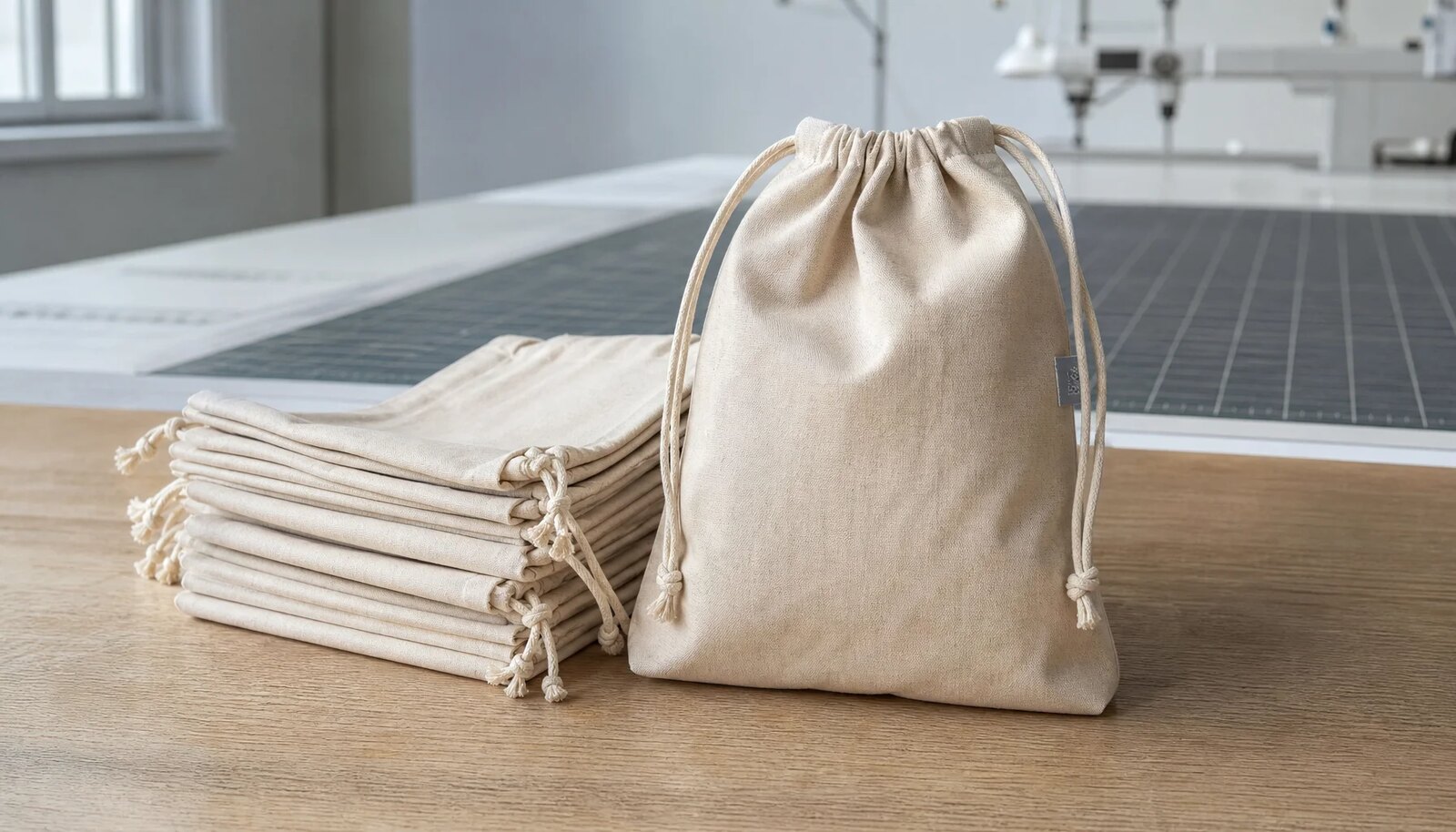
Start With the Gift, Not the Pouch Catalog
Wholesale cotton drawstring pouches for corporate gifting should be specified from the gift outward. The pouch is the first packaging layer the recipient touches, but procurement also has to think about filling, transit, storage, event handling, and repeat orders. A pouch for a soft scarf can be simpler than one holding a glass candle, a boxed tech accessory, a metal pen set, or several wellness items. The same cotton bag can look acceptable on a sample table and fail once a fulfillment team starts packing thousands of units at speed.
Begin the RFQ with the contents. List every item going into the pouch, including width, height, depth, weight, sharp corners, delicate finishes, and whether items will be inserted by the pouch supplier, a third-party fulfillment center, a regional distributor, or an internal events team. A 15 x 20 cm finished pouch may work for a flat notebook insert and still be too tight for a small rigid box if there is not enough clearance below the drawcord channel. Fit is not theoretical. It should be tested with the real item or a close weight-and-shape equivalent.
Then decide how polished the pouch needs to look. A light conference giveaway can usually accept a simpler construction if it only carries a small insert for a day. A senior client gift, sales sample kit, or employee welcome pack may need stronger opacity, cleaner front-panel appearance, tighter print placement, and more careful trimming. Write that expectation into the spec before suppliers quote. Words like standard, premium, eco, or good quality are too loose for production decisions unless they are supported by GSM, finished size, decoration, packing, and QC standards.
- Record item dimensions, weight, sharp edges, fragility, and insertion sequence before requesting prices.
- State whether the pouch is for presentation, protection, reuse, retail display, internal kit assembly, or event distribution.
- Use actual contents or a weight-and-shape equivalent for sample fit testing.
- Treat side seams, bottom seams, and the drawcord channel as functional specs when contents are heavy or irregular.
- Reject quotes that do not identify finished size, GSM, decoration method, packing format, trade term, and lead time.
Specify Finished Size, Usable Space, and Fit
Size language causes many avoidable sourcing problems. A buyer may ask for a 15 x 20 cm pouch while one supplier quotes finished size after sewing, another quotes cut panel size before sewing, and another uses a stock catalog size that shifts slightly by batch. For B2B procurement, the PO should state finished size after sewing. That is what the recipient receives, what the fulfillment team packs, and what QC can measure.
The drawcord channel reduces usable space. If contents sit too close to the top, the pouch will not gather cleanly. The logo panel may distort, the channel may pull, and the side seam can be stressed during closure. Small accessories may need only modest headroom. Rigid boxes, candles, bottles, or multi-item kits usually need more clearance. Ask the supplier to identify the channel height and the usable fill area below it, then test the sample in the same orientation that fulfillment will use.
Tolerances should be practical and written. Cotton cutting and sewing are not precision machining, but a factory can work to measurable limits when the target is clear. Many buying teams use +/- 5 mm for smaller pouches and +/- 10 mm for larger pouches, with tighter limits only when the contents require it and the supplier confirms feasibility. The point is to tie tolerance to the risk. A 5 mm shortfall might be harmless for a loose presentation pouch and serious for a rigid product kit.
- Define dimensions as finished size after sewing, for example 15 x 20 cm finished.
- Ask for channel height and usable fill area below the drawcord channel.
- Confirm whether the pouch is flat, gusseted, square-bottom, lined, or otherwise shaped before comparing prices.
- Use practical size tolerances such as +/- 5 mm for smaller pouches and +/- 10 mm for larger pouches unless the fit requires tighter control.
- Test the sample with the actual gift contents, insert card, tissue, barcode label, or any planned folding method.
Choose Cotton GSM for the Job
Fabric weight is one of the easiest ways to make supplier quotes comparable. For cotton drawstring pouches used in corporate gifting, 90-110 GSM is typically an economy range for light inserts and event use. A 120-140 GSM pouch is often the middle ground for employee kits, client gifts, and compact product bundles. A 150-180 GSM pouch gives more structure, opacity, and perceived value, though it increases cost and can change how the drawcord gathers.
GSM alone does not tell the whole story. Two cotton fabrics at the same GSM can feel different because of yarn, weave, finishing, and mill lot. Natural unbleached cotton has visible texture and shade variation, which many brands like, but it should not be treated as one exact color. Bleached cotton gives a cleaner background for dark logos and crisp artwork, but it also shows handling marks more easily. Custom dyed cotton can support brand color coordination, but it adds lab dips, shade approvals, higher minimums, and more calendar risk.
Opacity needs its own check. A pouch can look fine while empty and become too transparent once packed with a dark bottle, cable, printed insert, or retail box. If the contents should remain hidden, ask the supplier to test with the actual item or a dark insert. For premium programs, also define what is unacceptable on the front panel: severe slubs, holes, stains, oil marks, shade mismatch, or visible yarn defects beyond the approved swatch.
- Use 90-110 GSM for light inserts, sample bags, and economy event giveaways.
- Use 120-140 GSM for most corporate gifting programs that need a balance of cost, opacity, and handling.
- Use 150-180 GSM for heavier kits, premium presentation, or reusable branded packaging.
- Approve fabric from a physical swatch or blank sample, not only a digital photo.
- For repeat orders, reference the approved swatch and state whether close shade matching is acceptable.
Define Drawcord, Channel, and Sewing Details
The drawcord is small, but it affects how the pouch works every time someone opens or closes it. Buyers should specify cord material, diameter, color, exit direction, and finishing. Cotton cord gives a consistent natural look. Polyester cord may offer more color options and abrasion resistance. A common small or medium pouch may use a cord around 3-5 mm, but the right diameter depends on pouch size, fabric weight, and the feel the brand wants. Too thin can look under-specified on a larger pouch; too thick can bunch the channel and slow packing.
Single-cord and double-cord closures should be quoted separately when the choice matters. A single cord exiting one side is simple and cost-efficient. A double-cord closure can feel more balanced and secure on larger pouches, but it adds material and labor. Cord ends should also be defined. Are they knotted, heat sealed, tipped, or left raw? Raw ends may be acceptable for some natural-looking programs, but they should be approved intentionally rather than discovered during final inspection.
Sewing specs belong in the RFQ, even for a simple pouch. Ask for seam construction, seam allowance, thread color, stitch density, and drawcord channel construction. Most cotton pouch orders do not need complex sewing, but they do need consistent stitching, clean lock points, no open seams, and no fraying at stress areas. If contents are heavy or angular, request a loaded sample and a simple manual pull test. A pouch that looks tidy when empty still has to survive real handling.
- Specify cord material, diameter, color, exit style, knotting, and whether single-cord or double-cord closure is required.
- Ask for seam construction, seam allowance, thread color, stitch density, and channel construction in the quote.
- Check that the drawcord slides smoothly and does not snag, twist, tear the channel, or pull out during normal use.
- For heavier contents, request a loaded sample and a basic manual pull test.
- Include cord defects, open seams, skipped stitches, broken threads, and fraying in the written QC standard.
Compare Supplier Routes With Accountability in Mind
A low unit price only helps if procurement understands what the supplier actually controls. Cotton drawstring pouches may come from a direct sewing factory, a trading company, a stock wholesaler, or a mixed route where sewing and decoration happen at separate sites. Each route can work. Direct factories usually offer better control over fabric, sewing, sample revisions, and repeat production. Trading companies can simplify multi-SKU programs. Stock wholesalers can move quickly when the size and color can follow available inventory.
The quote should make accountability clear. Does one facility cut, sew, decorate, inspect, and pack? If printing is outsourced, who checks curing, placement, and rub resistance before cartons are sealed? If a trading company coordinates several workshops, who signs the golden sample? Who owns rework if the defect source is disputed? Those questions can feel detailed at the RFQ stage, but they prevent slow arguments once production has already moved.
For repeat programs, stability is often worth more than a small unit-price reduction. A buyer may reorder a natural cotton pouch every quarter and find that shade, cord, stitching, or logo position changed because production moved to another workshop or fabric lot. The RFQ and PO should reference the approved sample, material basis, cord, decoration method, packing format, and carton plan. If the supplier needs to change a production input, require notice and a new approval sample before bulk production.
- Use a direct factory when custom sizing, repeatability, and QC control matter most.
- Use a trading company when one team must coordinate several promotional packaging products.
- Use a stock wholesaler for rush dates, low quantities, or simple logo application on available stock.
- Ask who owns final QC when sewing, decoration, and packing happen at different sites.
- For repeat orders, require approval before changes to fabric, cord, factory route, decoration method, or packing format.
Build the RFQ Around Real Cost Drivers
A procurement-ready quote should show the cost build-up instead of burying every decision inside one unit price. At minimum, the supplier should identify finished size, GSM, fabric finish, cord specification, decoration method, setup charges, packing format, carton data, trade term, and lead time. Without those details, two similar prices may describe very different products. One supplier may include 120 GSM cotton, one-color screen print, carton marks, and inner bundles, while another assumes lighter fabric, blank pouches, and bulk packing.
Main cost drivers include fabric weight, fabric color route, cutting waste, sewing complexity, decoration, order quantity, and packing labor. Custom dyed fabric, multiple sizes, several logo versions, dense embroidery, individual polybags, barcode labels, insert cards, and destination sorting can all change the price. MOQ follows the same logic. A standard natural cotton pouch in one common size can usually run at a lower minimum than a custom dyed pouch with multiple regional artwork versions.
Trade terms need to be normalized before supplier ranking. FOB may look cheaper because freight, customs, destination charges, and final delivery sit outside the factory price. DDP may look higher because more of the landed cost is bundled into one quote. Neither is automatically better. Buyers with import operations may prefer FOB. Teams without import infrastructure may need DDP. In both cases, carton dimensions, gross weight, carton count, and packing list format should be requested early because they affect freight, receiving, and delivery planning.
- Request separate lines for pouch body, decoration, setup, packing, freight, and trade term where possible.
- Ask whether screen setup, label setup, lab dips, artwork revisions, carton marks, and export documents are included.
- Compare quotes only after matching finished size, GSM, cord, decoration, packing, quantity, and trade term.
- Request carton dimensions, gross weight, carton count, and master carton quantity before estimating landed cost.
- Ask for price breaks at practical quantities so procurement can see where production efficiency improves.
Select Branding That Can Be Produced Consistently
Branding should match the artwork, fabric, order quantity, and expected handling. Screen printing is often the practical default for wholesale cotton drawstring pouches because it works well for simple logos, campaign text, and one-to-three spot colors. It is most reliable when artwork is not too fine and the cotton surface is reasonably stable. Ask whether the ink system suits the selected cotton and whether curing, rub resistance, edge sharpness, and placement will be checked before packing.
Woven labels and side seam tabs are useful when the brand wants a quieter and more durable finish. They can make the pouch feel finished without covering the front panel. They also have their own setup, minimums, artwork approval, and placement checks. Embroidery can look premium on heavier cotton, but it should be sampled because dense stitches can pucker lighter fabric. Heat transfer can support more detailed artwork, but buyers should check hand feel, edge durability, and adhesion on textured cotton.
Artwork approval should be physical when brand quality matters. A digital mockup cannot prove ink coverage, fabric absorption, label stitching, or how small text reads on natural cotton. The RFQ should state logo size, placement measurement from the top channel or side seam, Pantone or brand color reference where needed, and acceptable placement tolerance. For many pouch programs, a tolerance of +/- 3 mm to +/- 5 mm is more useful than saying centered, provided the supplier confirms it is realistic for the pouch size and decoration process.
- Use screen print for simple spot-color logos and cost-controlled repeat orders.
- Use woven labels or side labels for subtle branding and repeated handling.
- Avoid dense embroidery on light GSM cotton unless the sample proves the fabric stays flat.
- Request a print strike-off for small text, fine lines, strict color matching, or dark ink on natural cotton.
- Define logo dimensions, placement measurements, color references, and acceptable placement tolerance.
Approve Samples Like a Production Buyer
Sampling is where most problems are still inexpensive to fix. Early swatches and blank samples are useful for narrowing fabric, size, and color decisions, but they should not become final approval if the production pouch will use different GSM, cord, branding, or packing. A true pre-production sample should match final fabric, finished size, seam construction, drawcord, decoration method, logo placement, folding, and individual packing if required. If the order uses custom dyed fabric, lab dip approval and bulk fabric approval should be treated as separate checkpoints.
Inspect the sample systematically. Measure width and height after sewing. Check channel height and usable fill area. Pull the drawcord several times. Inspect side seams, bottom seams, stitch locks, loose threads, and fabric defects. Compare shade under consistent lighting. Review logo placement from a defined reference point. Pack the actual contents. If the pouch must sit inside a rigid gift box, test the folded or filled pouch inside that box. If a fulfillment team will insert items quickly, confirm that the opening and closure are practical at working speed.
The approved sample should become the golden sample. Keep one with procurement and require the supplier to keep a matching reference for production and final QC. The PO should state that bulk production must match the golden sample within written tolerances. This protects both sides: the factory has a concrete production target, and the buyer has a clear standard for inspection, replenishment, and any dispute about quality.
- Approve final production materials, not only a catalog pouch or digital mockup.
- Measure finished size, logo placement, channel height, cord function, seam quality, and folded appearance.
- Test with actual contents or an equivalent weight and shape.
- Reject samples with wrong GSM, odor, stains, loose threads, crooked labels, weak seams, or poor print curing.
- Keep matching golden samples with procurement and the supplier for inspection and repeat orders.
Write QC Standards Before Production Starts
Quality control works best when it is written before mass production starts. For cotton drawstring pouches, the checklist should cover finished size, GSM, shade, cutting, stitching, drawcord function, decoration, cleanliness, odor, packing, carton marks, and final count. Buyers should also classify defects. Critical defects may include wrong logo, unsafe contamination, or unusable construction. Major defects may include open seams, wrong size that affects fit, broken cords, severe stains, misprinted logos, missing labels, or incorrect packing. Minor defects may include small loose threads or slight cosmetic variation within the approved standard.
Finished-size and logo-placement tolerances should be measurable. If the pouch must hold fixed contents, inspection should include a fit test. If logo appearance matters, QC should measure placement from the approved reference point, such as the top channel, side seam, or bottom edge. Print checks should include ink coverage, edge sharpness, registration, curing, cracking, bleeding, and rub resistance. Label checks should include correct artwork, orientation, straightness, stitch neatness, and secure edges.
Packing QC is part of product QC because many corporate gifting problems appear during fulfillment rather than sewing. Carton marks, inner pack counts, master carton quantities, gross weights, and destination codes should match the packing list. Cotton should be protected from moisture, dust, oil marks, and rough warehouse handling. If cartons will travel by sea freight or sit in storage, ask about carton strength and moisture control. If the order ships to multiple offices or events, carton labeling should support allocation without unnecessary repacking.
- Inspect against the golden sample and written tolerances, not a verbal description.
- Use defect classifications for wrong logo, wrong size, broken cords, open seams, stains, odor, and packing errors.
- Check fabric GSM, shade, panel consistency, stitching, drawcord action, decoration quality, and cleanliness.
- Confirm carton marks, inner pack count, master carton count, carton strength, gross weight, and packing list accuracy.
- For high-risk orders, consider pre-shipment inspection using an agreed AQL level and a defined defect list.
Control Packing, Quantity, and Delivery Timing
Packing instructions should be settled before production because they affect labor, material cost, carton size, freight, and fulfillment speed. Some programs need clean bulk bundles that will be filled later by a warehouse. Others need individual polybags, paper bands, barcode labels, insert cards, regional sorting, or direct packing into gift boxes. Adding these requirements after sewing can create repacking fees and schedule pressure. The RFQ should state the next step in the supply chain so the supplier can recommend a workable packing plan.
Quantity tolerance matters more in corporate gifting than many teams expect. If pouches are paired with 5,000 gift kits, a normal production underrun can leave fulfillment short even if the supplier considers it within routine practice. The PO should define overrun and underrun tolerance, whether overruns are billable, and whether exact or tighter quantity control is required. For event delivery or multi-location allocation, carton plans should match the destination list or campaign version.
Delivery planning should include more than production lead time. Buyers need sample lead time, artwork approval time, lab dip time if dyed fabric is used, production time after approval, inspection time, export handoff, transit time, customs time, and final delivery. Rush orders should simplify customization before they compress QC. A stock natural cotton pouch with one-color print and bulk packing is usually easier to control under time pressure than a custom dyed, multi-version, individually packed program.
- Define bulk packing, inner bundles, individual polybags, paper bands, barcode labels, insert cards, or gift-box insertion before PO approval.
- Request master carton quantity, inner pack quantity, carton dimensions, gross weight, and carton marks.
- Write overrun and underrun tolerance into the purchase order, especially for kit-matched quantities.
- Use destination codes or carton marks for regional allocation and multi-event delivery.
- Build the calendar around sample approval, production, inspection, export, transit, customs, and final delivery, not production time alone.
Specification comparison for buyers
| Spec decision | Recommended option | When it fits | Buyer risk to check |
|---|---|---|---|
| Supplier route: direct sewing factory with confirmed decoration capability | Best when procurement needs repeatable fabric, stitching, logo position, carton count, and production records across one or more buying cycles | Recurring corporate gifting programs, distributor replenishment, employee welcome kits, brand-controlled launches, and multi-market campaigns | Verify whether cutting, sewing, printing, QC, and packing are handled in-house or subcontracted; ask who signs the golden sample and who releases final production |
| Supplier route: trading company managing several factories | Useful when one commercial contact must coordinate several promotional packaging SKUs or gift-set components | Programs that combine pouches, totes, notebooks, bottles, rigid boxes, insert cards, hangtags, and other packaging pieces | Confirm who owns corrective action if sewing, printing, or packing defects come from different sites, and define who pays for rework before the PO is issued |
| Supplier route: stock wholesaler with light customization | Fastest route when the size, cotton shade, cord, and packing can follow existing stock standards | Rush events, pilot programs, low-quantity HR gifts, conference giveaways, and simple secondary packaging | Expect limited GSM choices, batch-to-batch shade variation, less control over seam allowance, and narrower logo placement options |
| Material route: natural unbleached cotton | Practical default for many B2B gifting orders because it is neutral, flexible for simple branding, and easy to review by swatch | Sustainability-positioned gifts, client kits, wellness sets, employee onboarding packs, and low-to-mid complexity programs | Natural cotton is not one fixed shade; approve a physical swatch and define an acceptable shade range for the bulk lot |
| Material route: bleached cotton | Better background when the brand needs a cleaner white base or stronger print contrast | Retail-facing kits, dark logo prints, crisp visual identity systems, and pouch artwork with smaller text | Bleached fabric shows dirt, creasing, oil marks, and warehouse handling more easily, so packing cleanliness and moisture protection need attention |
| Material route: custom dyed cotton | Use when brand color coordination matters more than speed, simplicity, or low MOQ | Product launches, retail displays, premium gift systems, and coordinated packaging across several SKUs | Request lab dips, bulk shade approval, dye fastness expectations, and repeat-order shade controls; MOQ and lead time usually increase |
| Fabric weight: 90-110 GSM | Economy range for light inserts where the pouch is mainly presentation packaging | Event handouts, sample packs, lightweight stationery, jewelry cards, and small accessories | May show contents, wrinkle more easily, and distort under dense embroidery or heavy filling |
| Fabric weight: 120-140 GSM | Balanced range for most corporate gifting pouches that need acceptable opacity, hand feel, and cost control | Client gifts, employee kits, compact tech accessories, wellness items, and product bundles | Check finished opacity with the actual contents; cotton at the same GSM can still vary by weave, yarn, and finish |
| Fabric weight: 150-180 GSM | Stronger option when the pouch should feel more substantial, hide contents better, or support repeated use | Premium gift presentation, glass items with inner protection, heavier multi-item kits, and reusable branded packaging | Higher GSM increases unit cost and may affect drawstring gathering; test the filled pouch before approving mass production |
Buyer checklist before sampling
- Define the gift use case first: presentation sleeve, protective pouch, reusable branded packaging, retail-facing kit, event giveaway, employee welcome pack, or distributor program.
- Measure the actual contents and provide width, height, depth, weight, sharp edges, fragile surfaces, and the packing sequence; do not source from a product photo alone.
- Specify pouch dimensions as finished size after sewing, such as 15 x 20 cm finished, and state the required clearance below the drawcord channel.
- Use practical finished-size tolerance targets, such as +/- 5 mm for small pouches and +/- 10 mm for larger pouches, unless the gift fit requires tighter control.
- Specify cotton GSM, fabric finish, color route, weave feel, opacity requirement, and whether the supplier must match an approved physical swatch.
- Define drawcord material, diameter, color, exit direction, knotting or tipping, and whether single-cord or double-cord closure is required.
- Choose branding based on fabric and artwork: screen print for simple spot-color logos, woven label for subtle durability, heat transfer for detailed artwork, and embroidery only after testing on the chosen GSM.
- Provide artwork size, placement measurements from seams or channel, Pantone or brand references where needed, and limits on fine lines or small text.
- Request a pre-production sample made with final fabric, final finished size, final cord, final decoration, final seam construction, and intended folding or packing format.
- Set measurable acceptance standards for size, logo placement, shade, GSM, stitch quality, cord function, print curing, stains, odor, loose threads, carton marks, and final count.
Factory quote questions to send
- Is the quoted size a finished size after sewing, a flat catalog size, or a cut panel size before sewing?
- What is the exact cotton GSM, weave type, fabric finish, fabric width, color route, and expected shrinkage before cutting?
- Is the quoted material natural unbleached cotton, bleached cotton, stock dyed cotton, or custom dyed cotton with lab dip approval?
- What finished-size tolerance will you hold in mass production for this pouch size?
- What seam construction, seam allowance, thread type, thread color, stitch density, and drawcord channel construction are included?
- What drawcord material, cord diameter, cord color, cord exit style, knotting, tipping, and replacement tolerance are included in the quoted price?
- Which decoration method is included, how many colors are priced, what setup charge applies, and what artwork format do you need for production?
- Can you quote separate prices for blank pouch, pouch with screen print, pouch with woven side label, and pouch with both print and label?
- What is the expected logo placement tolerance from the approved sample, and how will placement be checked during production?
- What is the MOQ by finished size, GSM, fabric color, custom dye, cord color, print color count, label method, and packing format?
Quality-control points to confirm
- Confirm finished size against the signed golden sample and written tolerance; use actual packed contents when fit is critical, not only an empty pouch measurement.
- Check cotton GSM against the approved swatch or purchase specification; a lower GSM may pass visually but fail on opacity, hand feel, or durability.
- Inspect shade under consistent lighting and compare against the approved swatch, especially for natural cotton, bleached cotton, and custom dyed lots.
- Check panel cutting direction, fabric defects, slubs beyond agreed limits, holes, oil marks, stains, mildew marks, odor, and moisture exposure.
- Review seam allowance, stitch density, thread tension, backstitching or stitch lock, skipped stitches, broken threads, fraying, and stress points at side seams, bottom seams, and the drawcord channel.
- Pull-test the drawcord manually across a representative sample; confirm the cord slides, gathers, and reopens without snagging, tearing the channel, or pulling out.
- Inspect cord material, diameter, color, knotting, exit direction, matched lengths, and absence of frayed cord ends unless raw ends were specifically approved.
- Check screen print or transfer decoration for placement, registration, ink coverage, edge sharpness, color consistency, curing, cracking, bleeding, and rub resistance.
- Check woven labels or side labels for correct artwork, straight placement, orientation, stitch neatness, consistent height from seam, and no loose edges.
- Confirm decoration tolerances in measurable terms, such as placement within +/- 3 mm to +/- 5 mm where the design and pouch size allow it.