Start With the Gift Job
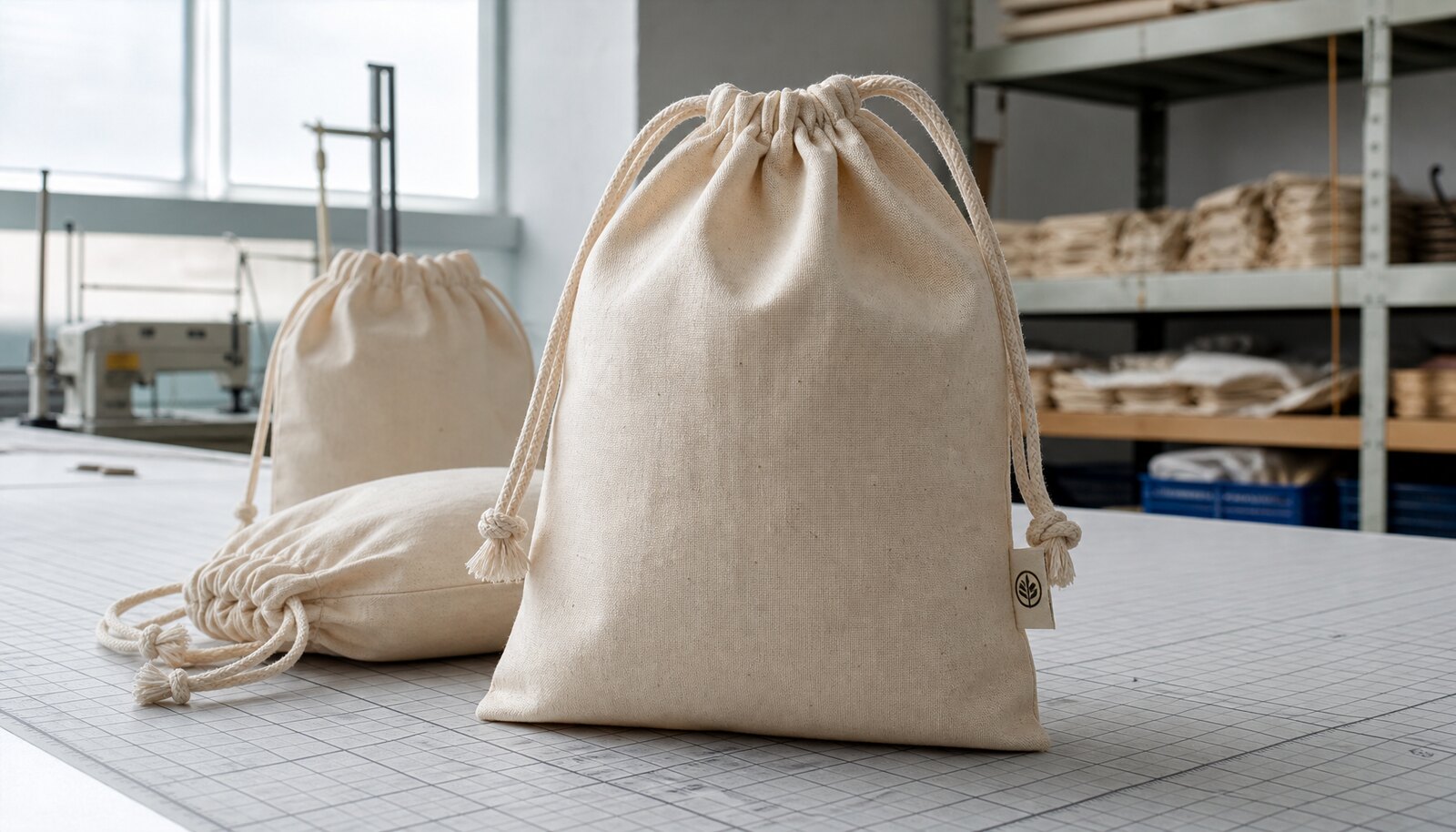
A cotton drawstring pouch is not only a nice-looking add-on. In a corporate gifting program, it has to hold the item, present the brand well, survive handling, and arrive in a format the warehouse or event team can actually use. The same general pouch category may be used for an onboarding kit, a jewelry card, a candle, a charger set, a hotel amenity, a sample bottle, a holiday gift, or a retail insert. Each job changes the specification.
Start by defining the product going inside the pouch. A flat gift card can use a lighter fabric and simple closure. A boxed tech accessory needs more usable internal space and cleaner dimension control. A glass bottle or candle may need stronger seams, wider seam allowance, and a filled load check. If the pouch will sit inside an executive gift box, fabric hand feel, folding, opacity, and logo alignment may matter more than the lowest unit price.
This is where procurement can prevent weak quotes. Suppliers may all respond to the phrase cotton drawstring pouch, but they may quote very different products: 120 GSM muslin, 200 GSM cotton canvas, a stock size with one-color print, or a made-to-order pouch with custom cord. Those prices are not comparable until the job is defined.
A practical sourcing brief should name the fill item, approximate fill weight, gifting tier, distribution path, and presentation requirement. It should also state the failures the buyer cannot accept: seam strain, visible contents, dusty fabric, weak cord pull, crooked logo, mixed cartons, missing labels, or a pouch that will not close around the item. That simple list turns a vague branding request into a usable supplier compliance checklist.
- Name the exact item or kit going inside the pouch, including dimensions and approximate fill weight.
- State whether the pouch must close fully, fold flat, stand upright when filled, or protect a delicate surface.
- Identify the gifting tier: event giveaway, employee kit, executive gift, retail insert, or hospitality amenity.
- Define the distribution path: event handout, warehouse pick, gift-box assembly, direct mail, retail shelf, or multi-location delivery.
- List unacceptable failures before quoting, not after the first sample arrives.
Convert Brand Intent Into Specs
Brand teams often approve a pouch visually. Factories produce it through fabric rolls, cut panels, sewing operations, cord trims, print setup, and packing instructions. Procurement sits between those worlds. The stronger the technical pack, the less room there is for guesswork.
At minimum, the specification should include finished size, usable internal space, fabric composition, fabric weight, shade, cord details, construction, decoration, packing, tolerance, and inspection method. Finished size and usable space need separate fields. A supplier may describe a catalog size as the flat outer size, a cut-panel size before sewing, or a rough post-sewing dimension. Usable space is smaller because seams, the top channel, gusset structure, drawcord path, and production variation all consume room.
Tolerance should also be written before sampling. For many small pouches, buyers commonly use a millimeter tolerance such as plus or minus 5 mm on width and height. Larger pouches may need a percentage tolerance instead. The right number depends on pouch size, fabric, finishing, and fit requirements. What matters is that the supplier knows where to measure and what counts as a defect.
Do not let the fabric field stop at natural cotton. Natural cotton is not one color. It can look cream, beige, greyish off-white, or slightly speckled depending on yarn and finishing. If the pouch sits next to brand packaging or a printed logo, approve a physical swatch under realistic lighting. Photos help, but they do not settle shade, hand feel, or opacity.
- Specify finished width by height after sewing and finishing, with gusset depth stated separately.
- Request usable internal dimensions after seams, top channel, gusset, and normal tolerance.
- Define measurement points, tolerance, and whether the pouch must pass a fit test with the intended item.
- Identify fabric composition, weave, GSM or ounce weight, shade reference, and any claim language that must be documented.
- Attach artwork with print size, placement from edges, color reference, and logo-placement tolerance.
Choose Fabric With Purpose
Fabric weight is one of the biggest drivers of cost, feel, opacity, print quality, and freight weight. Lightweight cotton around 120 to 140 GSM can work for jewelry cards, sachets, paper inserts, small samples, and short-life event programs. It keeps the pouch economical, but it may show the shape or color of the contents.
Midweight cotton around 160 to 200 GSM is often a better starting point for corporate gifting. It feels more substantial in the hand, improves opacity, and usually supports cleaner stitching and logo decoration. Heavier cotton canvas or drill, often 220 GSM and above, is better suited to premium presentation, heavier contents, or reuse. The tradeoff is higher material cost, more bulk, and sometimes a stiffer closure on small pouch sizes.
Make suppliers state fabric weight in a consistent unit. Some quote in GSM, while others use ounces per square yard. Do not compare 6 oz cotton with 200 GSM cotton casually unless the supplier confirms the actual basis. The fabric construction also matters. A plain muslin, canvas, or drill can behave differently even at similar weight.
Opacity should be tested with the real fill item or a realistic substitute. An empty natural pouch can look clean on the sample table and become too transparent once a dark box, printed booklet, or colored product goes inside. Dyed cotton may solve part of the presentation issue, but it adds shade-lot control, colorfastness checks, and potential crocking concerns. For gift programs, fabric approval should cover weight, shade, touch, opacity, and how the material behaves when filled.
- Use 120-140 GSM for light inserts, sachets, jewelry cards, and cost-sensitive short-life programs.
- Use 160-200 GSM for many corporate gifting pouches where opacity, hand feel, and print quality matter.
- Use 220 GSM and above for heavier contents, premium reuse, or a more structured presentation.
- Check opacity with the intended product or a realistic substitute, not only with an empty pouch.
- Ask suppliers to state fabric weight consistently in GSM, ounces per square yard, or both.
Engineer the Drawstring System
The drawstring is not a minor trim. It affects closure, appearance, stress points, and the recipient’s first touch. Cord may be cotton, polyester, polypropylene, braided cord, flat tape, recycled-content trim, or another material. Diameter controls both look and function. A thin cord can save cost but feel sharp or weak. A thick cord can look better but jam if the channel is narrow.
The channel must match the cord and fabric. If the channel is too tight, the cord drags, twists, or refuses to close evenly. If it is too loose, the top can look bulky and uncontrolled. For heavier contents, the channel opening and nearby side seam need extra attention because pulling concentrates stress in that area.
Seam construction should be written in production language. Buyers can specify lockstitch, overlock, double stitching, seam allowance, stitch density, thread color, reinforced bottom corners, and bar-tacks where needed. Stitch density is usually expressed as stitches per inch or stitches per centimeter. More is not always better. Very dense stitching can perforate light fabric, while sparse stitching can look loose and fail under load.
A filled test is still the fastest way to find construction problems. Put the intended product or an equivalent weight inside, close the pouch, handle it as the recipient or warehouse team would, and check the cord, top channel, side seams, and bottom corners. For a paper insert, that test may be simple. For a candle, bottle, or tech item, it is a gate before mass production.
- State cord material, diameter, length, color, knot style, pull feel, and end finish.
- Match channel width to cord diameter so the drawstring closes without twisting, snagging, or cutting into the fabric.
- Define seam allowance, stitch density, thread color, and whether seams are lockstitched, overlocked, doubled, or reinforced.
- Require reinforcement at bottom corners or channel openings when the fill item is heavy, rigid, or repeatedly handled.
- Run a filled-sample check before bulk approval.
Compare Suppliers by Capability
The cheapest quote is not always the lowest-cost outcome. Supplier type changes the risk profile. A direct sewing factory may offer better control over sampling, production feedback, and rework. A specialized bag workshop may be stronger on gussets, drawcord channels, reinforcement, labels, and custom trims. A trading company may be useful for mixed corporate gift programs, but the buyer needs to know who controls factory selection and QC decisions.
Ask for evidence that matches the pouch being quoted. Useful proof includes fabric swatches, cord samples, stitch close-ups, similar pouch photos, print examples, packing photos, and a sample inspection report. For repeat orders, ask how approved samples are labeled, how fabric lots are tracked, and how deviations are recorded. A supplier that can describe its process clearly is easier to manage when schedules tighten or details change.
Responsiveness during RFQ is a signal. Send each supplier the same structured question set and watch what comes back. Do they confirm GSM, finished size, usable space, cord diameter, packing count, and inspection tolerance? Or do they answer with broad phrases like standard cotton and regular packing? Vague answers are not automatically disqualifying, but they show where the buyer must push for confirmation.
For recurring corporate gifts, reproduction control matters. The second order should not quietly change shade, cord thickness, print location, or carton count. Ask whether the supplier can keep a technical record for fabric, cord, print ink, screen, logo position, packing method, labels, and carton specification. That record is often what separates a one-time promotion from a stable procurement program.
- Confirm whether the supplier is a factory, workshop, trading company, stock distributor, or mixed-service provider.
- Ask for evidence that matches the quoted pouch, not unrelated catalog photos.
- Clarify who owns QC decisions, who approves rework, and who pays if bulk goods do not match the signed sample.
- Check whether the supplier can maintain technical records for repeat orders.
- Use the comparison table to separate convenience, capability, documentation, and risk.
Build a Comparable RFQ
A strong RFQ makes every supplier quote the same product. It should include quantity, finished size, usable internal space, fabric composition, fabric weight, cord details, construction, decoration method, logo color count, packing method, carton requirement, sample type, inspection expectation, documents required, Incoterms, destination, currency, and quote validity. Without those fields, procurement ends up comparing unlike products.
Quote gaps often hide in branding and packing. One supplier may include one-color screen printing and bulk packing only. Another may include individual polybags, insert cards, barcode labels, inner cartons, export cartons, and carton marks. A third may exclude screen setup, treat Pantone matching as an extra, or assume a different artwork size. The quote format should split unit price from setup fees, sample charges, screen costs, packing extras, label application, document fees, inspection fees, and freight assumptions.
MOQ is tied to the customization level. Low MOQ is easier with stock fabric, a standard size, standard cord, and simple one-color artwork. Custom dyed fabric, special cord, woven labels, multi-color decoration, or retail-ready packing can raise MOQ or setup cost. Ask for one realistic price break above the target order quantity, not a distracting ladder of volumes the program will never buy.
Lead time should be broken into steps. Artwork review, sample making, sample shipping, approval time, material purchase, printing, sewing, inspection, packing, document preparation, and shipping handoff all belong on the calendar. Corporate gifting schedules often slip because approval time is treated as production time. Procurement should separate them from the start.
- Require all suppliers to quote the same size, fabric weight, decoration method, packing method, quantity, and delivery basis.
- Separate unit price from setup fees, screen fees, sample costs, packing costs, label application, testing, inspection, and freight.
- Ask for MOQ, one realistic volume price break, quote validity, payment terms, and overrun or underrun policy.
- State Incoterms, destination, currency, required documents, and target dispatch date.
- Replace vague quote language with measurable terms before awarding the purchase order.
Control Logo and Label Risk
Cotton is textured and absorbent, so artwork does not behave the same way it does on a screen or coated paper. Fine lines can break. Small text can fill in. Light ink can look dull on natural cotton. A brand guide is useful, but it is not a production approval by itself. The supplier should review the artwork against the fabric and decoration method being quoted.
Screen printing is common for simple logos, solid artwork, repeat programs, and controlled cost. Transfer printing can support more complex designs, but it should be checked for hand feel, edge lift, cracking, and rub resistance. Embroidery can feel premium on heavier cotton, yet it may pucker light fabric or distort small pouch panels. Woven labels, side labels, and sewn patches can work well when subtle branding is preferred.
The specification should state maximum print area, exact print size, placement from edges, color reference, minimum line weight, and allowed placement tolerance. Ask whether decoration happens before sewing or after sewing. Printing before sewing can improve flatness but requires cutting and sewing alignment. Printing after sewing can be practical for small runs, but seams, gussets, and drawcord channels may limit placement.
Color expectations need physical approval when they matter. Pantone references help, but cotton shade, ink absorption, curing, and lighting can shift the final appearance. Remote photos are useful for fast communication, but they can mislead because camera settings and lighting vary. For a color-critical executive gift or retail-adjacent program, approve a strike-off or pre-production sample.
- Provide vector artwork and specify print size, placement, color reference, and minimum acceptable line weight.
- Use screen print for simple solid logos, transfer for complex artwork after testing, embroidery for suitable heavier fabrics, and woven labels for subtle branding.
- Confirm whether decoration happens before or after sewing and how placement will be controlled.
- Approve a strike-off when small text, Pantone color, edge sharpness, or multi-color registration matters.
- Check curing, rub resistance, cracking, smudging, label alignment, and print behavior when the pouch is folded and filled.
Make Sampling a Gate
Sampling should prove the production method, not just the design idea. A blank sales sample can confirm approximate size and sewing style, but it does not confirm final fabric, final cord, final print, final packing, or bulk tolerance. For controlled corporate gifting, the strongest approval sample is made with production fabric, production cord, final decoration, and intended packing where practical.
Bring the right stakeholders into sample approval. Brand should approve logo appearance and placement. Procurement should confirm the sample matches the quote and purchase order. Operations should check packing, barcode placement, carton rules, and fit with the wider gift kit. When these approvals happen informally, bulk production can start while important requirements are still unresolved.
Control the signed sample. Label it with supplier name, project name, date, finished size, fabric reference, cord reference, decoration method, packing status, and approved tolerance. The buyer should keep one sample and the factory should keep one matching standard. Photos are helpful, but they cannot replace a physical reference for fabric shade, hand feel, cord pull, stitching, and fit.
First-piece approval is the next control. Before the factory runs the full order, request photos or a first-piece check from the bulk line. This verifies that operators are using the same fabric, cord, construction, logo placement, and packing instructions as the approved sample. Small corrections at this stage are far less painful than sorting finished cartons.
- Request the right sample type: swatch, blank size sample, strike-off, pre-production sample, or packed approval sample.
- Approve size, usable fit, fabric shade, opacity, logo placement, seam quality, cord pull, and filled appearance.
- Label and retain the signed sample so inspection can compare bulk goods against it.
- Record any approved deviation, such as adjusted logo position or wider channel, in the technical pack.
- Do not release bulk production until artwork, packing, carton marks, and required documents are aligned.
Inspect Against Measurable Criteria
Quality control should not rely on the phrase good quality. The inspection plan should state sample size, measurement points, defect categories, and release authority. If the buyer uses AQL, specify the inspection level and acceptance limits. If the program uses an internal sampling plan, define how many units are checked and what causes a fail.
Dimensional inspection should be consistent. Measure finished width, height, channel width, gusset depth if any, drawcord length, and logo placement at agreed points. Compare the results with the signed sample and written tolerance. A pouch can pass flat measurement and still fail the real job, so include a fit test when the item is rigid, boxed, or close to the pouch dimensions.
Functional checks should cover cord movement, seam strength, and handling behavior. The drawcord should move smoothly, close evenly, and remain secure without fraying or slipping. Seams should not open when filled to the target weight. Bottom corners should not distort under realistic use. Loose threads can often be trimmed, but skipped stitches, open seams, weak locking, and broken thread are construction defects.
Appearance standards should match the gifting tier. Natural cotton may include small specks, but premium corporate gifts often require tighter limits for stains, oil marks, odor, dust, shade variation, print smudging, and crooked labels. Ask for inspection photos that show measurements, fabric close-ups, cord detail, logo quality, filled fit, packing, carton labels, and sealed cartons before shipment release.
- Define sample size, AQL level if used, defect categories, and who can approve shipment release.
- Measure finished dimensions, channel width, cord length, logo placement, and packing count against the signed sample.
- Run fit and load checks using the intended item or a realistic substitute.
- Check print curing, rub resistance, edge clarity, color consistency, seam locking, and drawcord movement.
- Require inspection photos that show product, measurements, defects if any, packed units, carton marks, and sealed cartons.
Verify Packing and Cartons
Packing is part of supplier compliance because it affects presentation, receiving, and damage risk. Cotton pouches can collect dust, absorb odor, crease under pressure, and scuff printed surfaces if packed poorly. Bulk packing may be efficient for basic event handouts. Individual polybags, tissue, insert cards, barcodes, or hang tags may be necessary for premium gifts, retail-adjacent programs, or warehouse pick-and-pack operations.
Confirm carton planning before production. The specification should state pieces per inner pack, pieces per master carton, carton dimensions, gross weight, carton marks, and whether cartons are single SKU or mixed. Many corporate programs move through third-party warehouses or event logistics teams. Incorrect carton marks, missing barcodes, mixed contents, or overweight cartons can delay receiving even when the pouches themselves are acceptable.
Compression deserves a real check. Overfilled cartons can crush folds, deform the drawcord channel, and leave deep creases in cotton. Vacuum packing may reduce volume but can make the pouches look poor when opened. If presentation matters, approve the packing method with a packed sample or clear packing photos. The supplier should not seal cartons while ink, fabric, or packing materials still carry moisture or strong odor.
For multi-location gifting, carton labels should match the logistics plan. Event name, destination code, SKU, item description, quantity, PO number, carton number, and total carton count may be required. If the order includes multiple sizes, colors, logos, or recipient groups, require a packing list by carton number. That detail prevents sorting problems when the campaign is already on a deadline.
- Choose bulk packing, individual polybags, tissue, insert cards, barcodes, or hang tags according to the distribution path.
- Confirm pieces per inner pack, pieces per master carton, carton dimensions, gross weight, and carton marks.
- Set rules for single-SKU cartons, mixed cartons, carton numbering, and packing lists by carton.
- Avoid over-compression when the pouch must arrive clean, flat, and ready for presentation.
- Ask for packing photos and draft carton labels before final cartons are sealed.
Specification comparison for buyers
| Supplier option | What to verify | Commercial advantage | Buyer risk to control |
|---|---|---|---|
| Direct sewing factory | cord material proof, reinforcement close-ups, load-test photos, approved sample tag, and bulk-line first-piece record | Better sample-to-bulk control and faster production feedback | May be weaker on export paperwork or branded packing unless checked early |
| Trading company | Factory name, production photos, trim-source proof, and who owns QC decisions | Can coordinate small mixed orders and extra services | Markup can hide real factory capability and slow defect decisions |
| Specialized bag workshop | cord diameter, eyelet or reinforced channel, bottom corner reinforcement, seam allowance, bar-tack position, and load target | More practical for detailed construction, trims, and repeat programs | Capacity may be limited during peak seasons |
| Low-price general supplier | 6-10 oz cotton canvas, 210D polyester, rPET, or blended cotton with shrinkage and colorfastness expectations set before sampling | Useful for simple promotional runs with loose specs | Material downgrades, weak packing, and vague inspection scope can erase savings |
| Retail-ready supplier | fold direction, cord protection, bundle count, carton compression, moisture bag, and retail label position | Can handle labels, SKU separation, carton marks, and receiving rules | Higher unit cost must be compared against reduced warehouse work |
| Compliance-focused supplier | Fabric records, labeling review, test plan, and production traceability | Safer for retail programs and repeat brand orders | Documentation claims need evidence, not only sales language |
| Local sample room plus bulk factory | Signed sample, bulk factory handoff, first-piece photos, and deviation owner | Good for complex branding before large production | Sample room quality may not match bulk line unless handoff is controlled |
Buyer checklist before sampling
- Finished pouch size in width by height, measured after sewing and finishing, with gusset depth stated separately if applicable.
- Usable internal space after side seams, bottom seam, top hem, drawcord channel, gusset if any, and normal production tolerance.
- Target fill item, item dimensions, approximate fill weight, edge shape, and whether the pouch must close fully when filled.
- Fabric composition, weave, GSM or ounce weight, yarn shade, dye reference if applicable, and whether the fabric is pre-shrunk or unfinished.
- Expected size tolerance, such as plus or minus 5 mm for small pouches or an agreed percentage for larger formats, confirmed against the signed sample.
- Cord material, diameter, color, length, knot style, end finish, pull feel, and whether cord ends must be waxed, tipped, heat sealed, or left natural.
- Top-channel width, seam allowance, stitch density, thread color, overlock or lockstitch requirement, bottom-corner reinforcement, and bar-tack placement if used.
- Logo artwork format, decoration method, print size, placement from pouch edges, Pantone or color reference, minimum line weight, and allowed placement tolerance.
- Sample requirement: fabric swatch, blank size sample, strike-off, printed pre-production sample, packed sample, or full approval sample with production materials.
- Packing format: bulk bundle, individual polybag, tissue, insert card, barcode, hang tag, inner carton, master carton, pallet rule, or destination-specific labeling.
Factory quote questions to send
- What exact fabric is included in the quote, including composition, weave, GSM or ounce weight, yarn shade or dyed color reference, and whether the fabric is stock or made to order?
- Is the quoted size a finished sewn size, a cut-panel size before sewing, or an approximate catalog size, and what finished-size tolerance will be used in inspection?
- What is the usable internal space after the top channel, side seams, bottom seam, gusset if any, and normal production variation?
- What fill weight has the pouch construction been quoted to carry, and can you run a filled-sample check using our item dimensions or a substitute weight?
- Which cord material, diameter, color, length, knot style, and end finish are included in the unit price?
- What top-channel width, seam allowance, stitch density, thread type, and reinforcement method will be used for the quoted construction?
- Which branding method is included, how many colors are included, what is the maximum print area, what setup fee applies, and what line weight is too fine for production?
- Will printing happen before sewing or after sewing, and how will logo placement be controlled against the approved sample?
- Can you provide a pre-production sample using production fabric, production cord, final decoration method, and intended packing before mass production starts?
- What does the unit price include at the quoted MOQ: sample, setup, screen, packing, barcode label, insert card, inner carton, master carton, carton marks, and export documents?
Quality-control points to confirm
- Finished width, height, gusset depth if any, channel position, and usable internal space are measured at agreed points against the signed sample and tolerance.
- Fabric composition, GSM or ounce weight, weave, hand feel, opacity, natural shade or dyed color, and visible lot consistency match the approved reference.
- Cotton shade variation is checked under consistent lighting, with unacceptable shade bands, mixed lots, or panel mismatch separated as defects.
- Cord material, diameter, color, length, knotting, end finish, and pull performance match the approved sample and do not fray during normal handling.
- Drawcord pulls smoothly, closes evenly, does not twist or jam inside the channel, and does not cut into the fabric when the pouch is filled.
- Top hem, side seams, bottom seams, gusset seams, and stress points show no open seams, skipped stitches, broken thread, loose locking, twisting, or uneven tension.
- Stitch density and seam allowance are checked against the agreed construction, especially at bottom corners and drawcord-channel openings.
- Logo size, placement, alignment, edge sharpness, ink coverage, color, curing, rub resistance, and folding performance match the approved strike-off or pre-production sample.
- A fit and load check confirms the intended item enters cleanly, the pouch closes as required, and the seams do not strain at the target fill weight.
- Finished goods are checked for odor, dust, oil marks, stains, mold risk, moisture, insect contamination, excessive loose fibers, and unacceptable natural specks for the gifting tier.