1. Plan from the date the pouches must be usable, not just sewn
Coffee pouch deadlines are usually tied to real commercial events: holiday gift sets, subscription drops, new-origin launches, wholesale customer kits, cafe merchandise, ecommerce bundles, or retail displays. The date that matters is not the day sewing ends. It is the day the pouches are received, counted, checked, and ready for kitting, photography, allocation, or production use.
A common procurement mistake is treating a supplier’s “25 to 35 days” as the full project timeline. In many wholesale cotton drawstring pouch quotes, that number means bulk production after all approvals are complete. It may exclude RFQ clarification, artwork revision, fabric booking, print strike-off, sample courier time, buyer review, carton mark approval, final inspection, export booking, transit, customs, domestic trucking, and warehouse receiving. The order can leave the factory on time and still miss the coffee launch if the calendar started from the wrong point.
Build the schedule backward. Start with the date your team needs warehouse-ready or kitting-ready pouches. Add time for receiving, internal QC, assembly, and delivery to the selling channel. Then add freight, customs, export documents, final inspection, packing, bulk production, pre-production sample approval, and RFQ alignment. The calendar becomes a sequence of gates instead of a vague lead-time promise.
The useful word is readiness. Fabric readiness, artwork readiness, trim readiness, sample readiness, carton readiness, and shipment readiness are separate milestones. If one is open, the production clock may not be running. A strong wholesale cotton drawstring pouches for coffee roasters lead time planning guide should therefore focus on dependencies and approvals, not only days.
- Ask suppliers to state exactly when lead time starts: deposit, artwork approval, material readiness, PPS approval, or all approvals complete.
- Work backward from warehouse-ready or kitting-ready date, not only ex-factory date or vessel departure date.
- Reserve buyer-side review time for marketing, packaging, operations, and compliance before approving the PPS.
- For seasonal launches, add buffer for one sample or artwork correction instead of assuming first approval will be final.
2. Turn the coffee use case into a factory-ready specification
“Cotton drawstring pouch with logo” is not enough for a reliable quote. The functional need changes by use case. A pouch for a cupping spoon or grinder brush is different from one that overpacks a filled 250 g or 12 oz coffee bag. A gift pouch may need body, opacity, and shelf appeal. A subscription insert may need compact cartons and low unit cost. A merchandise pouch has to feel good because the pouch itself carries the brand experience.
Start with finished flat size, then go further. Drawstring pouches lose usable height in the channel. When filled, a flat pouch narrows, the top gathers, and the printed logo may shift or distort. For coffee bag overpacks, test with the actual filled bag, including folded top, gusset depth, valve position, and retail label thickness. A size that looks generous on paper can feel tight after closure.
Tell the supplier what success looks like. Does the pouch need to close fully over the coffee bag? Should it leave a visible gathered header? Must it stand inside a gift set, lie flat for fulfillment, or fit a rigid box cavity? If the pouch will be photographed for ecommerce, opacity, wrinkle behavior, and logo visibility matter. If it is only used for internal kitting, count accuracy and packing format may matter more than premium handfeel.
A complete RFQ gives the supplier a chance to flag risk before sampling. Include the item going inside, approximate filled dimensions and weight, presentation requirements, and handling constraints. This also makes quote comparison fair. Without the same assumptions, a cheaper quote may simply be quoting a weaker fabric, smaller usable size, simpler seam, or looser packing method.
- State finished flat size as width x height, and specify whether height includes the drawstring channel.
- Provide actual coffee bag or accessory dimensions, including gusset depth and folded top height where relevant.
- Confirm whether the pouch must close fully, leave a gathered header, fit into a gift box, or support retail display.
- For hard accessories, request bottom corner and seam review under filled condition, not only flat inspection.
3. Specify cotton by finished GSM, color, and acceptable surface character
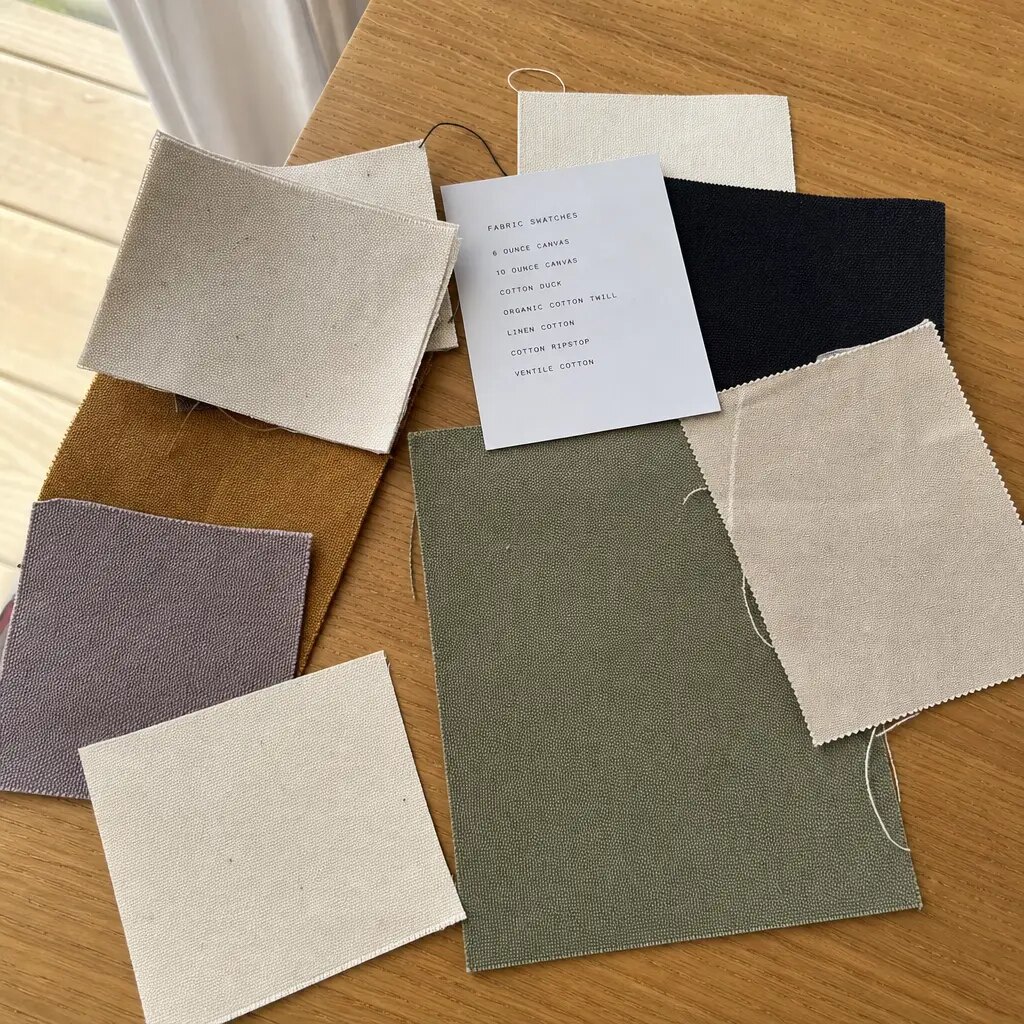
Fabric drives cost, appearance, print behavior, carton weight, and lead time. Cotton pouches may be described as lightweight cotton, muslin, canvas, 5 oz, 8 oz, or by GSM. For procurement, finished GSM is usually the cleanest control point. A budget pouch may use about 140 to 200 GSM cotton. A general branded pouch often sits around 220 to 270 GSM. A premium coffee gift pouch may use about 270 to 340 GSM cotton canvas when stronger body and lower show-through are important.
Ounce descriptions are not always consistent across suppliers. One supplier may be talking about greige fabric, another about finished fabric, and another about a market shorthand. Washing, bleaching, dyeing, printing, and finishing can change handfeel and weight. State the target finished GSM and tolerance in the purchase order, such as 270 GSM ±5%, and identify the approved sample or swatch as the bulk standard.
Color choice affects both schedule and inspection. Natural cotton is often the simplest route and matches many coffee brands, but it can include seed flecks, slubs, and shade variation. These are not automatically defects if approved in the standard. Bleached cotton looks cleaner but shows dirt and handling marks more easily. Black cotton can feel premium but may show lint, rub marks, and shade inconsistency. Dyed cotton may require lab dips or bulk shade approval, especially for reorder programs.
Do not leave natural cloth judgment until final inspection. Define unacceptable issues before production: oil stains, mildew odor, dark yarn contamination, heavy slubs on the logo face, or obvious shade mismatch between cartons. Keep a retained PPS or approved swatch. It prevents arguments later about whether a visible mark is a natural feature or a defect.
- Use 140-200 GSM for cost-sensitive accessory or promotional pouches where structure is less important.
- Use 220-270 GSM for general branded drawstring pouches with moderate handfeel and manageable freight weight.
- Use 270-340 GSM cotton canvas when coffee gift presentation, opacity, and body are priorities.
- Approve natural shade, speck level, slub level, and surface cleanliness before bulk production.
4. Engineer the drawstring, channel, and seams for real handling
Many pouch complaints are construction problems rather than fabric problems. Coffee customers may open and close the pouch repeatedly. Warehouse teams may pull cords quickly during kitting. Retail staff may handle display samples many times. The drawstring system deserves its own specification: cord material, diameter or tape width, color, cord count, pull direction, knot or end finish, and brand color requirements.
Cord choice changes the feel. A small round cotton cord may be fine for a small accessory pouch but feel weak on a larger coffee bag overpack. A 3 to 5 mm cord is common across many pouch sizes, although the right size depends on fabric weight and channel width. Herringbone tape can look flatter and more premium, but it needs a wider channel and may raise cost. Polyester cord can be uniform and durable in some applications; cotton cord may fit a natural packaging story better. If a sustainability claim matters, ask for documentation rather than accepting broad wording.
The channel should open and close smoothly without trapping the cord. Confirm whether the pouch uses one cord, two cords, or two-sided pull. Double-cord closure can feel more balanced on larger pouches, but it adds material and handling. The channel stitch should be even. Seam allowance should not block the cord path. A pouch can look acceptable flat and still annoy users if the cord snags at the corners.
Seams should match what the pouch carries. A plain seam with overlock may be enough for light promotional use. Heavier coffee gifts, scoops, filters, or rigid accessories may justify reinforced bottom stitching or cleaner internal finishing. If the pouch is positioned as a premium reusable item, loose internal threads become more visible. Specify seam type and inspection criteria instead of assuming all cotton pouches are constructed the same way.
- Define cord material, diameter or tape width, color, number of cords, pull direction, and end finish in the RFQ.
- Check channel depth and cord movement on the PPS with the actual pouch fabric, not only on a stock sample.
- For larger pouches, confirm whether single-cord closure gathers evenly enough or whether double-cord closure is preferred.
- Inspect seams for skipped stitches, broken stitches, open seams, loose threads, and cord path blockage.
5. Choose print and branding methods based on artwork reality
Coffee packaging often includes detailed logos, origin names, tasting notes, badges, QR codes, and seasonal illustrations. Cotton is a textured woven surface, so it will not reproduce artwork like coated paper or plastic film. Screen printing is usually a dependable wholesale option for bold one-color or two-color artwork, especially on natural or light cotton. It works well for roaster logos, simple marks, short text, and moderate coverage.
Risk rises with fine type, thin lines, tight registration, large solid areas, and multiple colors. Small text may fill in. Fine lines may break. Large ink areas can feel stiff or show curing inconsistency if not controlled. White ink on black cotton needs more attention than dark ink on natural cotton. Multi-color artwork adds registration tolerance and additional drying or curing steps. A digital mockup cannot show fabric texture, ink absorption, or how the artwork looks after the top gathers.
For fine detail, woven labels may be the better choice. A folded side tag, front patch, or sewn woven label can keep small logos readable and make repeat programs easier. Labels also allow a master pouch to stay consistent while roast information changes on hangtags, stickers, belly bands, or inserts. The tradeoff is trim MOQ, trim lead time, and label placement tolerance. If custom labels are late, sewing may stop even when fabric is ready.
Approve branding on real material. The strike-off or PPS should show actual fabric color, print method, size, placement, edge definition, color, curing, rub resistance, and visual balance after filling. Define placement from fixed reference points, such as side seam and channel stitch line. “Centered” sounds simple, but it can be interpreted differently after cutting, sewing, and gathering.
- Use screen print for bold logos and simple one- or two-color artwork on natural or light cotton.
- Use woven labels when small text, fine detail, or multi-SKU repeatability is more important than a large printed face.
- Avoid placing important artwork too close to the drawstring channel because gathering can distort it.
- Define print placement tolerance before production, commonly around ±0.5 cm for small/medium pouches where realistic.
6. Quote MOQ by SKU reality, not headline quantity
A 10,000-piece pouch order can be simple or complicated. If every pouch is the same size, fabric, cord, print, and packing method, the factory can run it efficiently. If the same total is split across two sizes, five artworks, two cord colors, custom labels, and three carton mark destinations, the supplier is managing many smaller lots. Each lot may require separate cutting bundles, screen setup, print alignment, sewing tracking, counting, packing, and inspection.
MOQ should be quoted by production variable, not only by total order quantity. Ask for MOQ and price by size, artwork, fabric color, cord color, label version, and packing configuration. This prevents surprise charges after artwork approval. It also makes supplier comparison more accurate. One supplier may be competitive for one large design but less capable with mixed SKU handling. Another may charge more per unit but provide better sorting, barcode control, and carton discipline.
Coffee roasters should decide whether every roast line needs a unique pouch. A master brand pouch with a hangtag, sticker, belly band, or insert can reduce screens, simplify packing, and shorten lead time. Unique artwork may be worthwhile for limited-origin or seasonal programs, but it should earn its added setup and schedule risk. When the deadline is tight, standardizing size and base print while varying outer information is often the safer route.
Below-MOQ quantities need an honest conversation. A supplier may accept them with a surcharge, but setup time for screens, cutting, and packing can still be similar to a larger run. Ask whether small SKUs can be grouped by fabric color or print day, and whether they delay larger SKUs. If one artwork is urgent, confirm whether it can be produced, inspected, and shipped separately with its own carton marks and freight cost.
- Request a price matrix by quantity break, size, artwork, fabric color, cord color, label version, and packing method.
- Separate unit price from screen charges, label development, sample fees, custom dyeing, and below-MOQ surcharges.
- Standardize pouch size and base artwork where possible if the main variation is roast information.
- For urgent SKUs, ask whether partial shipment is possible and how it affects inspection, packing, and freight.
7. Use sampling as a decision gate, not a formality
Sampling should prove the bulk production path. A stock sample is useful for checking general workmanship, fabric category, and drawstring feel, but it does not approve the actual order. A meaningful pre-production sample should use the intended finished GSM, fabric color, print method, cord, seam finish, label, and packing reference. If anything is substituted, write down what remains unapproved and when the real component will be reviewed.
A clean approval sequence saves time later. First, lock the written specification and artwork layout. Second, approve fabric swatch or shade standard if needed. Third, review the print strike-off or pre-production sample. Fourth, test filled fit with the actual coffee bag or accessory. Fifth, approve tolerances, carton plan, and carton marks. Only then should bulk cutting and bulk printing begin. Skipping detail may appear to save a few days, but rework can consume weeks.
Filled-fit testing is critical for coffee programs. Put the actual coffee bag, scoop, filter set, grinder brush, or gift component inside the sample. Close the drawstring. Check top gathering, logo visibility, bottom corner strain, and fit inside any outer box or kit. Photograph the front, back, side profile, closure, and packed kit. These photos become useful references for the factory, inspector, marketing team, and warehouse.
Buyer-side approval is often the hidden delay. Procurement may need feedback from marketing, brand, operations, ecommerce, and the warehouse. If comments arrive separately, revisions become messy. Use one consolidated sample approval document with measurements, photos, pass/fail decisions, change notes, and a clear approval to start bulk. That protects schedule and accountability for both sides.
- Require PPS in actual fabric, actual print, actual cord, actual label, and intended seam finish whenever launch presentation matters.
- Record approved size, GSM, shade, cord, channel, print placement, label position, and packing reference.
- Test the sample with the real filled product, not only with flat measurement.
- Do not release bulk cutting until all open substitutions are either approved or formally waived in writing.
8. Build a lead time map with clear decision gates
Break lead time into stages. RFQ clarification may take 2 to 4 business days when the buyer supplies complete size, fabric, artwork, packing, and quantity details. A straightforward PPS for natural cotton with simple screen print may take about 5 to 10 production days, excluding international courier and buyer review. Bulk production for a simple custom run may take about 20 to 35 days after PPS approval. Dyed fabric, woven labels, multiple sizes, several artworks, or complex packing can add time. Final packing and inspection often need several more days depending on order size and carton structure.
These are planning ranges, not guaranteed promises. Capacity, material availability, holidays, order volume, and buyer approval speed all affect timing. The point of mapping is to identify the critical path. For a natural cotton one-color print pouch, print approval may drive the schedule. For black dyed canvas, shade approval and fabric readiness may be the bottleneck. For a multi-destination retail program, carton marks and SKU-separated packing may become the slowest step.
A good calendar includes buyer deadlines as well as supplier tasks. Artwork final by a certain date. Fabric approved by a certain date. PPS comments returned within a set number of days. Carton marks approved before packing materials are printed. Inspection booked before cartons are sealed. Freight forwarder details supplied before ex-factory readiness. These gates make delays visible before they become disputes.
If the launch date cannot move, decide the backup route early. That may mean using natural stock fabric instead of custom dyeing, choosing one standard pouch design instead of several roast-specific prints, approving woven labels earlier, or air shipping only the first release quantity. Backup decisions are far easier before the PO is placed than after bulk goods are late.
- Illustrative simple path: RFQ alignment 2-4 business days, PPS 5-10 production days, buyer review 1-5 days, bulk 20-35 days, packing/inspection 3-5 days.
- Add sample courier time, public holidays, freight booking, customs, receiving, and kitting time to the calendar.
- Confirm what must be approved before the supplier starts bulk: deposit, artwork, fabric, cord, label, carton mark, and PPS.
- For fixed launches, define a simplification plan before production starts, not after the schedule is already at risk.
9. Lock packing, carton marks, and receiving rules early
Packing is easy to underestimate. It can determine whether the order is simple to receive or expensive to untangle. Loose bulk packing may work for one SKU going to one assembly line. It becomes risky when a coffee roaster manages several roast programs, ecommerce kits, retail customers, or multiple warehouses. Mixed cartons can create recount labor, SKU errors, delayed kitting, and receiving disputes even when the pouches themselves are acceptable.
A B2B packing plan should define units per inner pack, inner pack material, master carton quantity, carton dimensions, gross weight target, SKU separation, and carton mark content. For example, the buyer may require 50 pouches per paper band or inner bag, one artwork per inner pack, and one SKU per master carton. Carton marks may need PO number, SKU, pouch size, artwork name, quantity, destination warehouse, barcode, and carton sequence. If barcodes are required, supply files early enough for printing and verification.
Cotton canvas weight changes carton planning. Larger 270-340 GSM pouches can increase carton weight and volume quickly. Overpacked cartons may create hard creases or exceed warehouse handling limits. Underpacked cartons raise freight volume. Many manual warehouse environments prefer cartons below about 15 to 18 kg gross weight, but each buyer should confirm its own receiving rules. The carton plan should balance protection, freight efficiency, and operational accuracy.
Packaging material rules should be set before packing begins. Some buyers prohibit individual polybags. Others require dust protection or unit-level scanning. If plastic-free packing is required, tell the supplier whether paper bands, kraft inner cartons, or bulk liners are acceptable. Changing packing instructions after production can delay shipment because goods must be reopened, sorted, relabeled, or repacked.
- Define loose pack, bundled pack, paper-banded pack, individual bag, or inner carton requirements before final quote.
- For mixed programs, keep one size/artwork per inner pack unless the receiving team explicitly accepts mixed inner packs.
- Approve carton marks and barcode data before final packing starts.
- Request estimated carton quantity, dimensions, gross weight, and SKU allocation for logistics planning.
10. Set QC standards that fit coffee retail presentation
Quality control should focus on defects that affect brand presentation, function, and warehouse accuracy. Typical issues include lighter-than-approved fabric, inconsistent finished size, off-center print, dirty natural cotton, weak channel stitching, cord snagging, label misplacement, loose threads, and mixed-SKU cartons. Some issues may not make the pouch unusable, but they can weaken a premium coffee presentation or slow fulfillment.
The approved pre-production sample should become the inspection reference. Inspectors should compare bulk goods to the PPS for fabric shade, handfeel, print color, placement, seam construction, cord style, and label position. Measurements should be taken flat using the agreed method. Width, height, channel depth, print location, and label position should be checked against tolerances. For many pouch sizes, ±0.5 cm to ±1.0 cm is realistic, but tighter control may be needed when the pouch fits a rigid box or insert.
Define defects in practical language. Major defects may include open seams, missing cords, wrong artwork, severe stains, size outside tolerance, unreadable print, wrong label, or wrong SKU packing. Minor defects may include small loose threads, light wrinkles, or natural slubs within the approved standard. Natural cotton flecks should not be rejected if they match the approved sample; oil marks or mildew odor should not be accepted as natural variation.
Packing inspection matters as much as product inspection for procurement buyers. Final inspection should verify inner pack count, master carton count, carton marks, SKU separation, barcode readability if used, gross weight, and carton condition. Photo documentation tied to PO lines helps resolve questions before the goods leave the factory. For gift assembly or retail distribution, catching packing mistakes before export is far cheaper than correcting them after receiving.
- Define major and minor defects before production, with examples for fabric, print, sewing, cords, labels, and packing.
- Measure finished pouch size, channel depth, print placement, and label position using fixed reference points.
- Test drawstrings by opening and closing sampled pieces, not only by visual inspection.
- Inspect carton marks, SKU separation, counts, and inner packing before shipment release.
Specification comparison for buyers
| Spec decision | Recommended B2B sourcing position | Typical range or tolerance to define | Procurement risk to verify |
|---|---|---|---|
| Supplier route | Use a supplier that can document responsibility for cutting, sewing, printing, trim control, packing, and final inspection, even when one step is subcontracted. | Ask for the process owner by step: fabric, printing, sewing, labels, cords, packing, and inspection. | A quote from a “factory” may still rely on outside printing, dyeing, labels, or cords. Confirm who approves defects and who pays for rework if a subcontracted step fails. |
| Finished size | Quote by finished flat size in width x height, and state whether the height includes the drawstring channel and any top header. | Common tolerance: ±0.5 cm for small pouches; ±1.0 cm for larger formats, unless a rigid insert, gift box, or exact coffee bag fit requires tighter control. | If a supplier measures before channel folding or before finishing, the usable height may be short. Always test with the real filled coffee bag or kit item. |
| Fabric weight | Specify finished GSM plus tolerance instead of relying only on “5 oz cotton,” “muslin,” or “canvas.” | Budget: about 140-200 GSM; general branded: about 220-270 GSM; premium canvas: about 270-340 GSM. A common procurement tolerance is ±5% if the application allows it. | Ounce ratings may refer to greige fabric, finished fabric, or supplier habit. Request a cut swatch, test reference, or approved PPS standard. |
| Fabric color | Choose natural cotton when speed and an earthy coffee presentation matter; use dyed, black, or bleached cotton only with clear shade-control expectations. | Natural shade variation should be approved by reference sample. Dyed fabric may require lab dip or bulk shade approval. | Natural cotton can include seed flecks and slubs; black cotton can show lint and rub marks; dyed lots can shift across reorders. |
| Drawstring construction | Define cord material, diameter or tape width, color, pull direction, knot finish, and single-cord versus double-cord closure. | Typical round cord may be about 3-5 mm depending on pouch size; herringbone tape may be 8-15 mm when a flatter look is wanted. | A thin cord can feel cheap or cut into the channel; an oversized cord can jam. Confirm smooth open-close action on the PPS. |
| Print method | Use screen print for bold one-color or two-color artwork; consider woven labels for fine type, small marks, or repeat programs. | Placement tolerance often sits around ±0.5 cm for small/medium pouches and ±1.0 cm for large pouches, subject to artwork scale. | Digital mockups do not show fabric texture, ink absorption, curing, or gathering at the top. Approve a strike-off on actual fabric. |
| Brand trim | Quote woven labels, side tags, care labels, hangtags, belly bands, stickers, barcodes, and inserts as separate components. | Define label size, fold type, placement from seam or bottom, stitch color, and acceptable placement tolerance. | Custom labels have their own MOQ and lead time. If labels arrive late, sewing can stop even when fabric is ready. |
| MOQ structure | Request MOQ and price by size, artwork, fabric color, cord color, label version, and packing format. | A 10,000-piece order split across 10 SKUs may behave like 10 small lots, not one efficient run. | Hidden costs may appear as screen charges, cutting loss, below-MOQ surcharges, sorting labor, carton relabeling, or repacking. |
| Sample path | Approve digital layout first, then a pre-production sample made in bulk fabric with actual print, cord, seam, label, and packing reference. | Plan sample making, courier time, buyer review, and one possible revision if the launch date is fixed. | Stock samples confirm workmanship only. They do not confirm actual GSM, filled fit, logo scale, cord color, print result, or packing presentation. |
Buyer checklist before sampling
- State finished pouch size as width x height in centimeters or inches, and specify whether height includes the drawstring channel and top header above the cord.
- Describe the filled use: coffee bag overpack, 250 g or 12 oz retail bag cover, brewing accessory pouch, gift set component, subscription insert, merchandise pouch, or internal kitting bag.
- Provide the actual product dimensions and approximate filled weight, including folded coffee bag height, valve location, gusset depth, or accessory shape if relevant.
- Specify fabric composition and target finished GSM with tolerance, for example 270 GSM ±5%, and confirm whether fabric is unwashed, washed, bleached, dyed, or printed after cutting.
- Define acceptable natural cotton appearance: seed flecks, slubs, shade variation, crease marks, and any areas where stains or dark yarn contamination are unacceptable.
- List fabric color as natural, bleached, black, or dyed target, and state whether a lab dip, bulk swatch, or approved PPS shade will control production.
- Define drawstring material, diameter or tape width, color, cord count, pull direction, knot style, end finish, and whether cord ends must resist fraying after repeated use.
- Provide vector artwork, print dimensions, color count, ink color reference, print position from side seam and bottom or top edge, and whether artwork may distort when the pouch is gathered.
- State whether woven labels, side tags, care labels, hangtags, belly bands, barcode stickers, retail inserts, or carton barcodes are required, including who supplies data files.
- Require a pre-production sample in bulk fabric with actual print, cord, seam finish, label, and a filled-fit test before bulk cutting or bulk printing begins.
Factory quote questions to send
- What exact finished GSM are you quoting, what tolerance do you allow, and is the weight measured before or after dyeing, washing, printing, or finishing?
- Is the fabric stock-supported, mill-booked per order, or custom dyed, and how many calendar days are required for fabric readiness for this color and weight?
- Can you provide a fabric swatch or previous bulk reference showing natural specks, slub level, opacity, and handfeel before we approve the PPS?
- Are cutting, sewing, screen printing, label attachment, cord preparation, packing, and inspection done in one facility or split across subcontractors? Please identify the process owner for each step.
- What is the MOQ and price break per size, artwork, fabric color, cord color, label version, and packing configuration, not only total order quantity?
- Which print method are you quoting for this artwork size and coverage, and what are the screen, setup, strike-off, or ink-matching charges by color?
- What print placement tolerance can you hold from the side seam and from the top edge, channel seam, or bottom edge, and how will operators check this during production?
- Can you make the pre-production sample in actual bulk fabric with actual cord and print, or will any component be substituted? If substituted, when will the real component be approved?
- What seam construction is included: plain seam, overlock inside, folded seam, French seam, double stitch, box reinforcement, or reinforced channel stitching?
- What drawstring options are available in cotton cord, polyester cord, recycled-content cord, or herringbone tape, and which are stock colors versus custom sourced?
Quality-control points to confirm
- Finished size should be measured flat using the agreed method, with a typical tolerance such as ±0.5 cm for small pouches and ±1.0 cm for larger pouches unless the application requires tighter control.
- Channel depth and opening width should be checked because a correct overall height can still fail if the drawstring channel consumes too much usable space.
- Fabric GSM should be checked against the approved standard, commonly using cut weight calculation or supplier test method, because large deviation changes body, opacity, print behavior, and carton weight.
- Fabric shade and surface character should be compared by lot against the approved PPS or swatch, especially for natural, bleached, black, or dyed cotton across multiple sizes or reorders.
- Print placement should be checked from consistent reference points such as side seam and channel stitch line, with tolerance agreed before bulk production.
- Print quality should be checked for edge definition, pinholes, registration, ink coverage, color consistency, curing, dry-rub transfer, cracking after flexing, and unwanted show-through.
- Drawstring channel should open and close smoothly without trapped cord, twisted cord, skipped stitches, blocked corners, excessive friction, or uneven top gathering.
- Cord ends should match the approved finish and withstand normal pulling without immediate fray, unraveling, knot slip, or pull-out from the channel.
- Seams should be checked for broken stitches, skipped stitches, seam slippage, loose tension, needle cuts, open seams, uneven seam allowance, and loose internal threads visible at the opening.
- Bottom corners should be reviewed under filled condition for strain, especially when pouches hold coffee tools, scoops, grinder accessories, or rigid gift components.