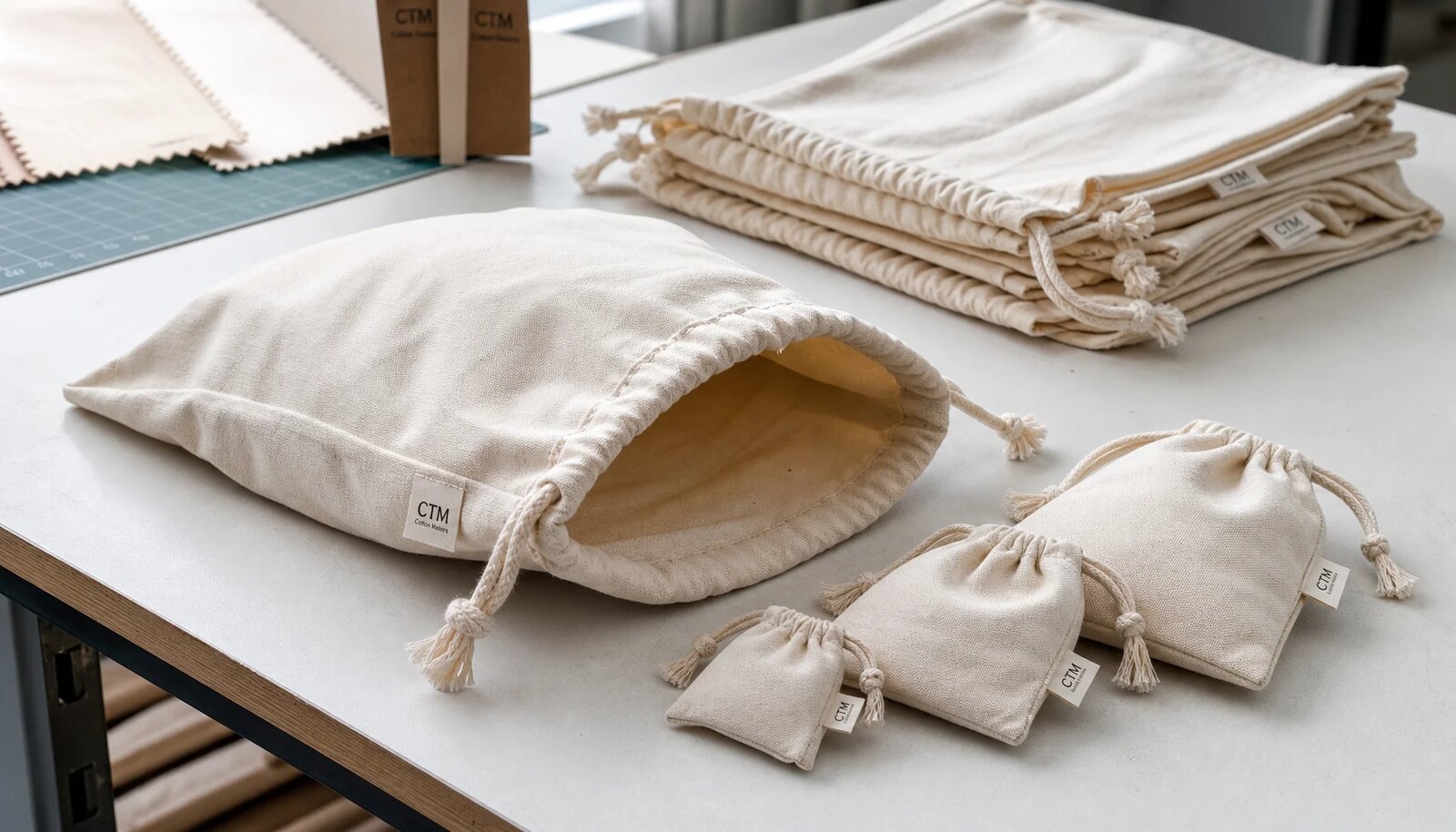
Why carton planning changes the economics
For wholesale cotton drawstring pouches for farmers market vendors, the quoted unit price is only the starting point. The real economics show up in how the pouches fold, stack, label, and survive the trip from factory to receiving dock. If the carton is oversized, freight cost rises and pallet utilization drops. If it is too tight, the drawcords crease, the print rubs, and the receiving team spends time recounting damaged units instead of stocking sellable product. That is not a minor packaging issue. It becomes a direct service problem when the buyer needs clean, ready-to-use inventory before a sales weekend.
Carton planning also changes how procurement compares suppliers. Two factories can quote the same pouch size and print method, but one may load 200 pieces per carton while another loads 300 with no extra protection. That difference affects carton count, pallet count, handling time, and often the actual landed cost. A good RFQ treats carton design as part of the product spec, not as a loose detail to be finalized after sample approval.
- Ask for the finished folded size, not only the sewn flat size.
- Require the factory to quote carton count, carton dimensions, and gross weight.
- Treat damaged corners, crushed prints, and mixed counts as cost drivers, not minor defects.
Start from the selling channel, not the pouch alone
The correct carton plan depends on where the pouch will be sold and how it will be handled after arrival. A farmers market vendor usually needs simple replenishment, quick counting, and a clean natural look that fits with produce, herbs, candles, soaps, or dry goods. If the pouch is part of a booth display or a resale bundle, the buyer may care more about presentation and less about the absolute lowest case pack. If it is a backroom replenishment item, speed and carton efficiency matter more.
Start the quote by defining the use case. Will the pouch be sold empty, filled, or bundled with another item? Will it go directly to end consumers, to a retail shelf, or to a warehouse that relabels and repacks? Those answers change the right decoration, the right packing format, and the right carton size. A simple wholesale order can still fail if the factory guesses the channel incorrectly and ships a format that is awkward to count, label, or display.
- Define the selling channel before the factory proposes a pack format.
- State whether the pouch is a standalone item, a gift set component, or a backroom replenishment SKU.
- If the order is seasonal, confirm whether the carton format needs to support fast reordering later.
Specify fabric, size, and closure behavior tightly
The carton plan starts with the pouch body. Lightweight cotton around 100 to 120 GSM packs thinner and costs less to ship, but it can wrinkle more, collapse in the carton, and feel too soft for repeat retail handling. A range around 140 to 180 GSM is often a better balance for wholesale orders because it holds shape more consistently, prints more cleanly, and resists looking tired after stacking. Heavier fabric can work for premium sets or long-use merchandise, but it raises gross weight and may force a smaller case pack. Do not accept a vague description like good quality cotton. State the GSM target and the tolerance you will accept from the bulk lot.
Size matters just as much as fabric weight. A 10 x 15 cm pouch and a 20 x 30 cm pouch behave very differently once folded around the cord channel. Ask the supplier to show the flat cut size, finished sewn size, and folded shipping size. Also make the cord diameter, hem width, and seam allowance part of the approved spec. If the cord is too thick for the hem, the pouch bulks up in the carton and the stack height becomes unpredictable. If the seam allowance is too narrow, the pouch may shift or twist after repeated closing and opening.
- Common buying range: 120 to 140 GSM for promotional use, 140 to 180 GSM for retail or market resale.
- Request separate dimensions for flat size, finished size, and folded shipping size.
- Make the cord diameter and hem width part of the approved spec.
- Ask the supplier to state whether shrinkage allowance is already built into the pattern.
Choose print and label methods by handling, not artwork alone
For natural cotton pouches, screen print is still the most predictable option when the artwork is one or two spot colors and the logo placement is fixed. It usually gives better opacity on undyed cotton than a rushed transfer process, and it is easier to repeat across reorders. The tradeoff is that the ink must be cured correctly and protected during packing. If it is still soft, stacked pouches can stick, gloss, or rub at the fold line. That becomes a receiving complaint the moment a carton is opened and the top layer shows visible marks.
When the artwork has fine text, thin lines, or multiple colors, it is often better to simplify the print and add a woven or sewn label instead of forcing detail onto soft cotton. That approach can improve legibility and reduce reprint risk. It also gives procurement more control over repeat orders because the label and pouch body can be managed as separate quality points. The sample approval should include a rub test, a fold test, and a visual check after compression in a stack. If the logo shifts after packing, the decoration method is wrong for the route.
- Use screen print for bold logos and stable repeat orders.
- Use a label solution when the artwork is too fine for consistent bulk printing.
- Test the print after folding and stacking, not only on a flat sample sheet.
- Confirm whether print registration tolerance is measured to the pouch edge or to the seam line.
Build the master carton from the folded sample and target gross weight
The correct carton is designed from the folded pouch, not from the cut panel size. Ask the factory to fold one finished sample the way it will be packed in bulk, then measure the stack height for 10, 25, or 50 pieces. That tells you the real carton geometry. A pouch that looks small in flat form can still create a thick pack if the cord channel is stiff or the print layer is heavy. If the carton is too deep, the stack shifts during transit. If it is too shallow, the lid bulges and the corners crush. Both outcomes create receiving losses.
Gross weight should be part of the same conversation. For many buyers, keeping a carton in a manageable range is worth more than squeezing in a few extra units. A practical gross-weight ceiling helps warehouse staff move cartons safely and reduces the chance of repacking. For export programs, ask the supplier to provide a carton loading diagram and a packed-carton photo. Those two items are usually more useful than a generic spec sheet because they show how the pouches actually sit inside the case.
- Base carton dimensions on the finished folded pouch, not on the cut panel size.
- Set a practical gross-weight ceiling so warehouse staff can move cartons safely.
- Request a carton loading photo and a dimensional drawing before production starts.
- Ask whether the carton is designed for shelf stack, warehouse shelf, or pallet storage.
Use the sample stage to lock defect boundaries
The sample stage should do more than confirm color. It should define the limits of what the bulk order is allowed to vary. Approve one golden sample that shows the exact fabric hand feel, print placement, cord finish, and carton pack method. From there, the factory needs written tolerances. For example, the size can move within a controlled band, but the print must stay centered and the seam must not twist. If the supplier cannot define tolerance, every carton dispute becomes subjective later.
The most common mistake is approving a pre-production sample and forgetting to test it in a packed carton. Fold it the way the factory will fold it, stack it the way the warehouse will receive it, and open one carton after it has sat compressed for a short period. That reveals print rubbing, cord imprinting, and shape distortion before the bulk run is locked. For wholesale cotton drawstring pouches for farmers market vendors, that step is usually cheaper than correcting thousands of units later.
- Keep one sealed sample as the production reference.
- Define acceptable size, print, and seam tolerances in writing.
- Test the packed sample after compression, not only as a loose unit.
- Request a carton-loading photo that matches the approved folded sample.
Set packing format based on warehouse speed and retail presentation
There is no single best packing method for cotton drawstring pouches. The right choice depends on how the cartons will be received and sold. If the pouches are going straight into a warehouse for relabeling, a simple bulk pack may be best because it keeps labor low and carton count manageable. If they are destined for gift sets, shelf display, or direct-to-consumer resale, the buyer may need inner polybags, barcode labels, or tissue protection. Each add-on changes the carton fill and may increase carton size more than the pouch itself suggests. Buyers should not allow the factory to add retail packing unless it is written into the quote and approved against the carton plan.
Labeling matters as much as protection. Outer carton marks should show SKU, color, quantity, and pack count in a format the receiving team can read quickly. If the order has multiple sizes or print versions, make the SKU code visibly different so the wrong carton is not opened on the dock. For sea freight, a moisture barrier or desiccant can be justified if the route is humid or long, but do not let that become an excuse to overpack and crush the product. The pack format must fit the route, not the factory's default habit.
- Bulk pack works when warehouse handling is the priority.
- Retail-ready pack works when the pouch is sold individually or in a gift set.
- Outer carton marks must match the PO and packing list exactly.
- Ask whether inner packs are bundled by count, by weight, or by retail unit.
Plan freight, palletization, and receiving from the start
Carton planning should include the freight lane, not stop at the factory door. Air freight and express shipments reward smaller case packs and lower gross weight because cartons are handled individually. Ocean freight and warehouse programs reward stable carton dimensions, pallet efficiency, and count consistency. If you plan to palletize, confirm the pallet footprint, pallet height limit, and whether overhang is allowed. A carton that is technically fine on paper can still be a poor fit if it forces unstable pallet layers or awkward mixed heights.
Receiving speed is part of the landed cost. Buyers often focus on freight rate and overlook dock time, counting labor, and damage checks. A carton with clear marks, clean corners, and a predictable count is easier to receive and easier to reorder later. If the pouches are going to a multi-location program, ask for carton labels that support scan-based receiving. That is a small requirement that can save time every time the order repeats.
- Confirm pallet footprint and maximum stack height before carton approval.
- Match carton size to the freight mode you actually plan to use.
- Ask for scan-friendly carton marks if the product will be received in multiple locations.
- Make sure the gross weight fits manual handling limits at the receiving site.
Read quotes by landed cost and risk, not by unit price alone
A useful quote for wholesale cotton drawstring pouches should show more than a single unit number. It should break out fabric GSM, pouch size, print method, label method, pack count, carton size, gross weight, incoterm, and packing type. Without those fields, two quotes are not comparable. A lower unit price can be the more expensive option if the cartons are larger, the print is weaker, or the pack count is too low for efficient freight. Procurement should compare the total landed cost and the receiving effort required to process the shipment.
Cost also moves with the carton plan. Heavier fabric raises freight. More print colors increase setup and scrap risk. Custom carton printing adds time and cost. Extra inner packs or retail labels add labor. None of these are bad by themselves, but they should be priced intentionally. The strongest supplier quote is the one that tells you exactly where the cost sits so you can decide whether to simplify decoration, reduce the carton count, or switch from retail pack to bulk pack. That is how buyers keep the order profitable instead of just cheap on paper.
- Compare quotes only after matching GSM, size, print method, and pack count.
- Ask for carton spec and gross weight before choosing freight mode.
- Treat quote clarity as a quality signal, not just a sales habit.
- Request separate pricing if carton printing or label sewing is optional.
Create a repeat-order file before you release bulk
A procurement file should make the next order easier than the first one. Keep the approved spec sheet, the golden sample reference, carton dimensions, carton mark artwork, packing photos, and any signed tolerance notes in one place. If the vendor changes mills, ink, or a stitching step later, that record gives you a clean comparison point. Repeat orders go wrong when the buyer relies on memory instead of documentation. Cotton pouches are simple only until the factory swaps a channel width or a label size without saying so.
For seasonal buyers, the repeat-order file also protects speed. If the supplier knows the approved fold method, carton count, and label format are already locked, the re-quote can move faster and the production line can stay stable. Ask for a revised sample whenever the supplier changes the fabric lot, print screen, or carton supplier. Those are the small changes that usually create the biggest receiving issues. Strong documentation turns carton planning into a repeatable sourcing process instead of a one-off scramble.
- Archive the approved spec sheet, golden sample note, and carton photo together.
- Require re-approval if fabric lot, print screen, or carton board changes.
- Keep the same SKU naming across PO, carton mark, and packing list.
- Use the repeat-order file to compare vendor claims against the last shipped lot.
Specification comparison for buyers
| Spec decision | Recommended option | When it fits | Buyer risk to check |
|---|---|---|---|
| Low-volume trial order | Factory-direct with one pouch body, one print method, and one carton spec | You are testing a new vendor, market, or seasonal assortment and need the first PO to stay simple | Late changes to fold size or label placement can force carton rework and raise freight cost |
| Mixed-SKU program | Shared base pouch with SKU-specific outer marks and a fixed case-packing rule | You ship several colors, sizes, or logo versions in the same program | Mixed-pack errors and wrong carton labels can slow receiving and trigger chargebacks |
| Fast replenishment | Stock-supported blank pouch plus local print or label add-on | Lead time matters more than fully custom fabric or carton printing | Shade drift, GSM variation, and weaker control over the finished look |
| Retail-ready presentation | Factory-direct with tissue, barcode labels, and sewn or woven side labels | The pouches go straight into gift sets, retail shelves, or display bins | Packing labor rises and the carton fill may drop if each unit needs extra protection |
| One-color branding | Single-screen print on one face | Artwork is bold, legible, and placement will not move between orders | Ink opacity on natural cotton and rub resistance must be proven on the sample |
| Fine-detail logo | Simplified print plus woven label or sewn label | Artwork has tiny text, thin lines, or multiple colors | Extra sewing steps increase lead time and label placement must stay consistent |
| Sea freight optimization | Fold to finished size and use a 5-ply or equivalent corrugated master carton with a pallet plan | Ocean freight and warehouse receiving drive the program economics | Over-compression can create hard folds, wrinkling, and carton crush |
| Air or express replenishment | Smaller case pack with stronger outer carton and lower gross weight | You need speed and easier hand handling more than pallet efficiency | Higher carton count, higher packing cost, and more room for counting mistakes |
| Warehouse scan receiving | Outer carton marks with SKU, count, and barcode-ready labels | The order will be received at multiple locations or by a 3PL | Unreadable carton marks slow intake and increase mis-ship risk |
Buyer checklist before sampling
- Lock the finished pouch size, folded size, and seam allowance before you discuss carton count.
- State the fabric weight target in GSM and the acceptable lot-to-lot tolerance.
- Define the print method, ink color count, print placement, and whether a woven or sewn label is required.
- Specify the case pack, inner pack count, and target gross weight per master carton.
- Set the outer carton grade, whether it will be printed or plain, and whether palletization is required.
- Request a pre-production sample, a sealed golden sample, and a carton loading photo before bulk approval.
- Ask for lead time by stage: fabric booking, print setup, sewing, packing, and export readiness.
- Confirm the incoterm, freight basis, and which charges are excluded from the quote.
- Require carton marks, barcode format, country-of-origin marking, and SKU identification in writing.
- Agree on size tolerance, color tolerance, print registration tolerance, and seam strength acceptance limits.
Factory quote questions to send
- What is the finished size after sewing and the folded size after packing?
- What GSM cotton are you quoting, and what tolerance do you hold from lot to lot?
- Which decoration method is included: screen print, heat transfer, embroidery, woven label, sewn label, or a mix?
- What is the exact case pack, carton size, and gross weight per master carton?
- Will the master carton be single-wall, double-wall, 3-ply, 5-ply, or 7-ply, and can you palletize it if needed?
- What MOQ applies to blank pouches, printed pouches, and custom carton printing?
- What sample types do you provide before bulk, and are they charged or credited back?
- What is the lead time for fabric, printing, sewing, packing, and shipment readiness?
- Which incoterm are you pricing, and what freight or destination charges are excluded?
- What QC tolerances do you accept for size, color, print registration, seam strength, and packing count?
Quality-control points to confirm
- Measure finished size, folded size, and drawcord opening against the approved sample, not against the flat cut drawing alone.
- Verify GSM or fabric weight by production lot so a lighter substitute does not slip into bulk.
- Check seam density, bar-tacks, top hem construction, and cord channel strength at the stress points.
- Confirm the print is centered, fully cured, and resistant to rub marks when the pouch is folded and stacked.
- Inspect drawcord pull action so the pouch closes smoothly without snagging, twisting, or uneven closure.
- Count inner packs and master cartons against the packing list and carton labels before the shipment leaves the factory.
- Review carton compression, corner condition, and drop resistance if the route is long-haul sea freight.
- Check moisture protection, odor, and dust control if the pouches will sit in transit or warehouse storage.
- Keep a sealed golden sample and a carton photo record as the reference for all future repeats.
- Ask the factory to sign off on a defect list that names allowed and rejected issues before bulk starts.