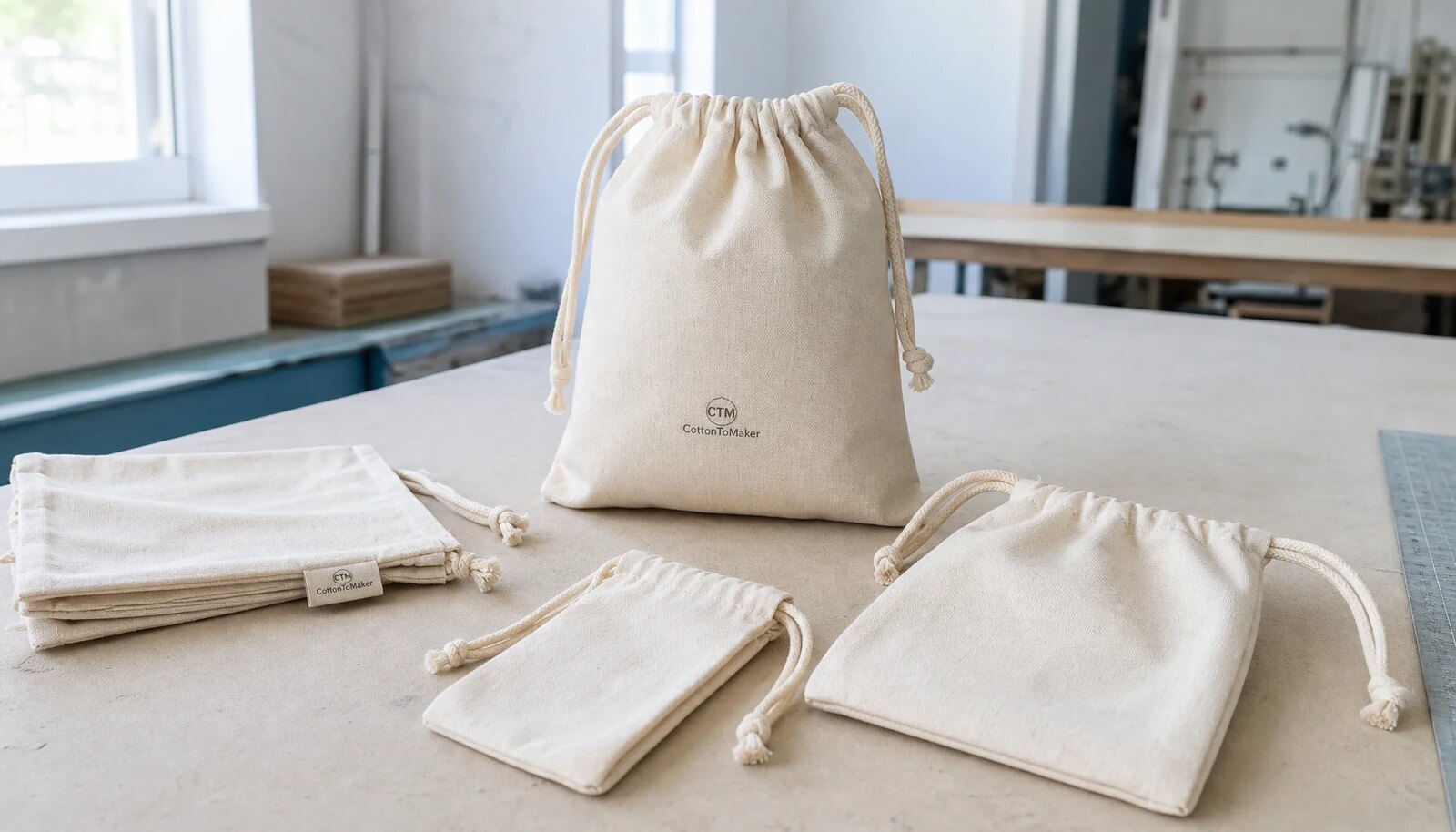
Start With the Market Table Job
Wholesale cotton drawstring pouches for farmers market vendors need to do more than hold a logo. At the table, they help a vendor move quickly, bundle small goods, protect items during local transport, and give the shopper a package that feels intentional instead of disposable. A pouch for handmade soap has a different job from one used for seed packets, dried herbs, jewelry, coffee samples, candle tins, jam accessories, or seasonal gift sets.
Before asking for price, define the fill condition. A flat pouch for three seed packets can be lighter and narrower than a pouch that must hold two thick soap bars without stressing the seams. A candle tin or small jar needs more width and bottom allowance, because the top still has to gather after the item is inside. A checkout giveaway may lean toward low unit cost and fast packing. A retail add-on pouch should feel stronger, because the vendor may sell it as part of a giftable bundle.
Farmers market handling is not gentle. Pouches are opened during setup, touched by shoppers, stacked in baskets, repacked after the event, and exposed to dust, damp hands, and changing outdoor conditions. Procurement teams should translate that use into measurable requirements: finished size, fabric weight, drawcord quality, decoration method, packing count, and inspection tolerances. That is what turns a generic bag inquiry into a wholesale buying checklist a factory can actually quote.
- List the intended contents in the RFQ, including item dimensions and packed weight.
- State whether the pouch is a retail package, free giveaway, gift-set component, refill pack, or reusable brand item.
- Confirm whether the pouch will touch food directly, touch wrapped food, or only hold already packaged products.
- Ask how the pouch will be displayed: hung, stacked flat, placed in baskets, bundled by SKU, or handed out at checkout.
- Test-fill the real product before approving a catalog size, especially for rigid items like tins, jars, and boxed sets.
Build Size Around Usable Space
Size is one of the easiest places to lose money. Many quotes use nominal dimensions, while buyers picture usable dimensions. A pouch sold as 4 x 6 inches does not offer the full 4 x 6 inches in practical loading space. Side seams, bottom seams, fabric thickness, shrinkage, the drawcord channel, and the shape of the filled item all reduce capacity. On small pouches, even 5 mm can decide whether staff can load the product quickly or whether the print looks centered after sewing.
Opening width deserves special attention. A pouch may fit the product once the item is forced inside, but that is not good enough for a busy market table. If the vendor has to fight the opening at checkout, the pouch slows service and creates avoidable damage. The channel depth also consumes height. When the product sits too high in the bag, the drawstring cannot gather cleanly and the top looks strained.
Separate finished dimensions from cut-panel dimensions in the RFQ. Finished width and height should be measured after sewing, trimming, and any finishing process. If the pouch needs a boxed bottom or gusset, name that construction instead of relying on a photo. For small cotton pouches, buyers often target finished dimension tolerances around +/-5 mm. Larger gift pouches may allow +/-10 mm if the fit and print placement are not sensitive. The agreed tolerance should be written into the spec and tied to the approved sample.
- Measure the widest, tallest, and thickest part of the product or product bundle before choosing pouch dimensions.
- Specify finished width and height after sewing, not cut-panel dimensions.
- Define usable opening width and distance from top edge to drawcord channel.
- Confirm whether the bottom is flat stitched, rounded, boxed, gusseted, or another construction.
- Request a test-fill photo or video using the buyer's product dimensions when sending physical product is not practical.
- Set tighter tolerances for small pouches, rigid contents, or items that must load quickly at checkout.
Specify Cotton Weight and Finish
Fabric weight shapes the pouch more than buyers sometimes expect. It affects hand feel, opacity, drape, print result, sewing behavior, carton weight, and freight cost. For many wholesale cotton drawstring pouches for farmers market vendors, 5 to 6 oz cotton, roughly 170 to 200 GSM, is a practical middle range. It feels more retail-ready than very light promotional cotton, usually supports simple screen printing, and keeps packing and freight reasonably efficient.
Lighter 4 oz cotton can still be the right choice for seed packets, sample bags, low-fill promotional use, and cost-sensitive giveaways. Heavier cotton is useful only when the product or brand position justifies it. An 8 oz pouch can feel substantial for heavier gift sets, but very small pouches may become stiff and awkward to close. It also adds fabric cost, sewing effort, ink coverage, and shipment weight. Two fabrics with the same GSM can behave differently because yarn, weave density, finishing, and washing all change the hand.
Natural unbleached cotton is popular in farmers market packaging because it suits handmade, agricultural, and small-batch brands. The tradeoff is shade variation. Natural cotton may show seed flecks and can shift cream, gray, or yellow between lots. That variation is not automatically a defect, but uncontrolled variation makes cartons look inconsistent on a vendor table. Approve a shade range, ask the factory to identify the planned bulk lot, and confirm how off-shade rolls will be separated before cutting. If the end customer may wash the pouch, check shrinkage and twisting on the approved sample.
- Use 4 oz cotton for light samples, seed sleeves, low-fill promotional use, or cost-sensitive giveaways.
- Use 5 to 6 oz cotton for most retail-friendly market pouches and branded gift sets.
- Consider 8 oz cotton when the pouch must support heavier contents or a stronger reuse position.
- Ask for GSM or ounces, weave type, finish, tolerance, shrinkage behavior, and shade range in writing.
- Clarify whether the fabric is natural, bleached, dyed, washed, unwashed, pre-shrunk, brushed, or treated.
- Approve natural cotton with an acceptable swatch range, not only one ideal reference piece.
Choose Decoration by Risk and Repeatability
Decoration should be chosen for repeatable production, not just for the cleanest digital mockup. For simple farm names, market logos, seasonal marks, and one-color branding, screen printing is usually the clearest starting point. The cost structure is understandable, it works well on natural cotton, and it scales across moderate and larger wholesale orders. The artwork still needs discipline. Tiny serif text, very thin strokes, tight registration, and heavy ink coverage can perform poorly on textured cotton.
A request for a centered logo leaves too much open to interpretation. Specify print size, distance from the top edge, side seam clearance, and centerline alignment. For small pouches, a placement tolerance of +/-3 to 5 mm may be appropriate if the supplier can hold it. Larger pouches may allow more. Keep print away from the drawcord channel, seam bulk, and fold lines that will be compressed in packing. Also ask the factory to fold the sample the same way bulk goods will be packed, so crease risk shows up before production.
Woven labels, side flags, sewn patches, and hangtags can make a cotton pouch feel more finished without covering the front panel in ink. They also help when several vendors share one base pouch but need different identifiers. The main risk is sewing accuracy. A label that sits too high can interfere with the channel; one sewn into a stressed seam can distort the pouch. Embroidery, heat transfer, and digital print can work for certain programs, but each needs testing: embroidery for puckering, heat transfer for adhesion, and digital print for hand feel, wash behavior, and cost at volume.
- Choose screen print for one- or two-color logos, simple farm marks, and repeatable wholesale programs.
- Define artwork size, placement from top edge and side seam, color reference, and acceptable placement tolerance.
- Avoid tiny text unless the supplier proves the smallest details on the actual fabric.
- Use woven labels or side flags when the pouch needs subtle retail branding or variant identification.
- Keep decoration away from the drawcord channel, seam bulk, and high-fold packing areas.
- Require rub, fold, and cure checks before approving mass production of printed pouches.
Turn MOQ Into a Variant Map
MOQ is rarely one clean number, even when the first quote makes it look that way. A supplier may advertise 1,000 pouches as a minimum, but the real minimum can shift by size, fabric color, artwork version, print color count, label, cord, and packing format. That matters for farmers market programs because buyers often split orders across several vendors, co-op members, seasonal designs, product categories, or private-label accounts. A 3,000-piece order in one size with one print is very different from 3,000 pieces split across six logos and three sizes.
Ask the supplier to show the MOQ logic by spec line. If the program uses stock natural cotton, the minimum may be driven by cutting and sewing efficiency. If the pouch is custom dyed, the mill minimum may control the order. If every vendor has a separate logo, screen setup and print run efficiency may become the bottleneck. If each pouch needs a unique barcode, retail fold, or vendor allocation label, packing labor may change the price more than the sewing does.
A useful quote separates the base pouch from variable charges. Buyers should be able to see the pouch body, print setup, screen charge, run charge, label cost, sample cost, packing cost, carton label cost, and inland freight where applicable. The goal is not to force the factory to reveal every internal cost. It is to compare offers on the same basis. A low unit price that excludes screens, sample revisions, carton marks, and inner packing may lose to a slightly higher unit price that includes the actual program requirements.
- Request MOQ by size, fabric color, artwork version, print color count, label type, cord option, and packing method.
- Ask whether setup charges apply per artwork, per color, per screen, per sample, or per production run.
- Get price breaks at realistic quantities such as 500, 1,000, 2,500, 5,000, and 10,000 pieces when relevant.
- Separate base pouch cost from decoration, labels, samples, setup, packing, and carton labeling.
- Check whether mixed-size or mixed-artwork orders create split-lot charges or longer lead times.
- Confirm overage and shortage policy, including whether the supplier may ship +/-3% to +/-5% or must ship exact quantity.
Verify the Supplier Route
The supplier route affects control, timing, and accountability. A direct factory that manages cutting, sewing, printing, inspection, and packing can be efficient for repeat cotton drawstring pouch programs, especially when the buyer needs stable samples and predictable reorders. Still, the word factory should be verified. Some suppliers quote as if they control production while subcontracting printing, labeling, or packing to another workshop. Outsourcing is not automatically a problem. Unconfirmed handoffs are the problem.
A trading company may be useful when the buyer is combining pouches with other packaging items or managing several small vendor needs. A local decorator or stock importer can work for urgent small runs. Both routes can be valid, but the limitations should be documented early: available fabric weights, pouch sizes, drawcord colors, label options, print methods, carton marks, and reorder continuity. The route should match the complexity of the order rather than the lowest first quote.
Supplier evaluation should include evidence. Ask for comparable physical samples, bulk fabric swatches, print samples on similar cotton, label examples, and photos of the packing format. Ask who signs off on the golden sample and who pays for rework if a subcontracted print is off-color, under-cured, or misplaced. If the supplier cannot explain fabric sourcing, print curing, final trimming, or carton counting, the buyer is carrying unknown risk. The strongest supplier is often the one that can hold a simple spec consistently and flag schedule risks early.
- Ask who controls fabric purchasing, cutting, sewing, printing, labeling, trimming, inspection, and packing.
- Request comparable physical samples instead of relying only on product photos.
- Confirm whether the same fabric, cord, label, and print method can be supported on reorders.
- Ask how subcontracted steps are checked and who pays for rework if defects are found.
- Use a direct factory when repeatability and production visibility matter most.
- Use a trading company or local decorator when the order structure fits their strengths, but document limitations before approval.
Approve Samples in a Controlled Sequence
Sampling should prove construction before decoration. A blank pouch sample lets the buyer check finished size, usable opening, seam quality, fabric weight, cord movement, fill behavior, and hand feel without being distracted by artwork. Once the blank body is right, the decorated pre-production sample can confirm print size, ink color, placement, label position, fold method, and packing condition. For custom or repeat programs, a signed or sealed golden sample should become the reference for bulk production and final inspection.
The golden sample must represent the complete product, not only the nicest front panel. It should include approved fabric shade, cotton weight, cord, stitching, label, print, fold, and any individual or inner packing. If the order will ship in fixed inner packs or retail-ready cartons, approve packing photos or a carton sample as well. Otherwise the pouch may look acceptable one piece at a time but arrive with creased print faces, tangled cords, mixed SKUs, or carton labels that do not match the receiving system.
Sample approval should be written with tolerances. A note that says approved is less useful than a sample sheet listing finished size tolerance, print placement tolerance, acceptable shade range, label placement, cord specification, and defect limits. If the sample needs a meaningful change, avoid approving that correction verbally. A revised sample takes more time, but it is usually cheaper than discovering during inspection that the factory interpreted the comment differently.
- Approve a blank body sample before decoration whenever fit, feel, or construction is important.
- Use the decorated pre-production sample to check print size, placement, ink behavior, label position, cord finish, and fold method.
- Keep one sealed golden sample with the buyer and one with the factory for bulk reference.
- Photograph the approved sample with a ruler for size and placement documentation.
- Do not authorize bulk cutting, printing, or label sewing until approval status is clear in writing.
- Require a new sample for changes to fabric weight, pouch size, print method, label, cord, or packing format.
Define Packing and Carton Math
Packing belongs in the product specification. It affects freight cost, receiving accuracy, vendor allocation, and the condition of the pouches when they arrive. Flat packing is usually practical for farmers market programs because it keeps pouches easy to count, limits excess volume, and protects the shape. The buyer should state whether pouches are bulk packed, bundled in inner packs, individually packed, paper banded, folded to a retail size, or separated by SKU in dedicated cartons.
Carton math should be requested before the purchase order is placed. Freight teams need carton dimensions, gross weight, net weight, carton count, and pack count to compare courier, air, ocean, or domestic trucking options. Receiving teams need clear carton marks, SKU labels, purchase order references, and consistent inner counts. If the order supports multiple vendors, avoid mixed cartons unless the assortment is intentional. Mixed cartons can work, but they must be documented on the packing list and carton labels.
Packing also protects decoration. Printed faces should not be tightly compressed before ink is stable. Severe fold marks can make a simple natural pouch look cheap at retail. Drawcords can tangle if loose pouches are dumped into oversized cartons. Natural cotton can pick up dirt or moisture if cartons are weak or stored poorly. A practical packing spec defines the fold method, inner count, master carton count, carton strength, label format, and any moisture protection needed for the route.
- Specify flat packing, folding, banding, inner bags, or individual packing before final pricing.
- Require inner pack count and master carton count by SKU.
- Ask for carton dimensions, gross weight, net weight, and estimated total cartons on the quote.
- Define carton marks, barcode labels, SKU labels, purchase order references, and vendor allocation labels.
- Avoid mixed cartons unless the assortment is intentional and clearly listed.
- Check that packing will not crease printed fronts, tangle cords, soil natural cotton, or hide SKU separation errors.
Plan Lead Time by Production Step
Lead time for cotton drawstring pouches is a sequence, not a single promise. The schedule can include swatch approval, blank sampling, decorated sampling, material booking, cutting, sewing, printing, curing or drying, label sewing, trimming, packing, final inspection, and freight handoff. A supplier may quote a short production window because the sewing is simple, but that window may not include late artwork, custom label approval, fabric shade decisions, or inspection rework.
The highest-risk schedule items are usually custom materials and late approvals. Stock natural cotton with a standard cord and one-color screen print can move efficiently after sample approval. Custom dyeing, special cord color, woven labels, embroidery, retail packaging, or multiple artwork versions add steps that may not run in parallel. If the pouches are needed for a farmers market season launch, holiday gift sets, or a distributor reset, preserve time for sample revision and final inspection.
A strong purchase order separates sample lead time, bulk production lead time, inspection time, and freight time. It should also state when the clock starts. Some suppliers count from deposit; others count from final artwork, sample approval, material booking, or PO confirmation. Buyers should not assume that a missed artwork deadline has no effect on factory scheduling. The cleanest workflow gives the supplier final artwork, approved sample status, packing instructions, and carton label files before production lead time begins.
- Break the schedule into swatches, blank sample, decorated sample, bulk production, inspection, and freight handoff.
- Ask which steps can run in parallel and which require prior approval.
- Treat custom dyeing, custom cord, woven labels, embroidery, and special retail packing as schedule risk items.
- Leave time for inspection, defect sorting, and possible rework before shipment.
- Confirm whether production lead time starts at deposit, artwork approval, sample approval, material booking, or PO confirmation.
- Keep a written approval log so late decisions are visible to both buyer and supplier.
Set QC Standards Before the PO
Quality control should be defined before the order is placed because it affects sampling, pricing, and factory behavior. For wholesale cotton drawstring pouches for farmers market vendors, the common risk areas are fabric shade, fabric weight, finished size, seam strength, drawcord movement, print quality, label placement, loose threads, stains, odor, and packing count. These defects may look small one by one. They become expensive when vendors receive inconsistent pouches across cartons or when a simple one-color logo appears visibly off-center.
Define critical, major, and minor defects in practical terms. A pouch that cannot close, has an open seam, uses wrong artwork, or is too small for the approved fill should be treated as critical. Crooked print, weak stitching, wrong shade, smeared ink, wrong label, or incorrect carton allocation is usually major. A small loose thread may be minor if it can be trimmed and does not affect retail appearance. Clear defect language helps inspectors and suppliers make consistent decisions instead of debating every finding at shipment time.
AQL-style final inspection can be useful for meaningful custom orders, but it must be tied to the golden sample. Inspectors should pull cartons from different parts of the shipment, not only pieces presented by the factory. They should measure finished dimensions, compare shade, check print placement, open and close the drawcord repeatedly, inspect seams and labels, perform rub and fold checks on the print, and reconcile inner packs against the packing list. For small seasonal orders, even a focused pre-shipment check using these same points is better than receiving blind.
- Define critical, major, and minor defects before confirming the purchase order.
- Use the golden sample as the reference for fabric shade, size, print, cord, label, fold, and packing.
- Measure finished dimensions from random cartons, not only from top-of-stack samples.
- Check side seams, bottom seams, drawcord channels, backtacks, label attachment, and loose thread trimming.
- Rub and fold printed areas to check curing, cracking, smearing, and transfer.
- Open and close the drawcord repeatedly to check sliding, fraying, uneven closure, and tight channels.
- Verify carton count, inner pack count, SKU separation, carton labels, barcode labels, and packing list accuracy.
Specification comparison for buyers
| Spec decision | Recommended option | When it fits | Buyer risk to check |
|---|---|---|---|
| Fabric weight | 5 to 6 oz cotton, about 170 to 200 GSM, with written tolerance such as +/-5% or the mill's standard tolerance | Most farmers market retail use, including soap bars, seed packets, small gift sets, light accessories, and repeated table handling | Too light can feel disposable and show contents; too heavy can increase sewing time, ink use, and freight cost without improving the selling use |
| Fabric route | Unbleached natural cotton from an identified stock lot or mill lot, with an approved shade range | Brands that want a natural, low-dye look and simple replenishment | Natural cotton can vary cream, gray, or yellow; approve a range and require lot separation if shade changes |
| Finished size | Quote by finished width, finished height, bottom style, drawcord channel depth, and usable opening width | Any pouch that must fit a measured soap bar, seed bundle, jar, tin, card set, or gift component | Catalog dimensions can overstate usable space because seams, channel depth, shrinkage, and product thickness reduce fit |
| Size tolerance | For small pouches, a typical target is +/-5 mm on finished width and height; for larger pouches, +/-10 mm may work if fit is not tight | Orders where the product must load quickly and close cleanly at a market table | Loose tolerance can cause mixed fit, off-center prints, and inconsistent cartons when displayed together |
| Print method | 1 to 2 color screen print with approved artwork limits, ink type, cure method, and placement tolerance | Simple logos, farm names, seasonal marks, and medium to high volume wholesale orders | Fine text may fill in, ink may bleed on textured cotton, and poor curing can transfer or crack after folding |
| Decoration route | Small front print, woven side label, sewn label, or hangtag depending on retail finish and SKU strategy | Programs where several vendors share a base pouch but need branded identification | Labels can distort seams or interfere with the channel unless placement, stitch type, and tolerance are specified |
| Drawcord choice | Natural cotton cord or cotton-blend cord, commonly 3 to 5 mm depending on pouch size, with approved end finish | Reusable pouches, gift sets, and products handled repeatedly by shoppers | Cord may fray, slip unevenly, shed fibers, or feel rough; confirm diameter, color, knot, heat seal if synthetic blend, and reorder availability |
| Supplier route | Direct factory with documented control of cutting, sewing, printing, and packing when possible | Repeat B2B programs where the buyer needs cost control, stable samples, and production visibility | If printing or packing is subcontracted, shade matching, cure checks, count accuracy, and rework responsibility must be assigned |
| MOQ structure | Break MOQ by size, fabric color, print color count, artwork version, label, cord, and packing style | Multi-vendor, multi-SKU, seasonal, or private-label farmers market programs | A low headline MOQ may hide screen charges, fabric minimums, split-lot fees, packing labor, or higher pricing on small variants |
Buyer checklist before sampling
- Measure the exact item or bundle the pouch must hold, including maximum width, height, depth, packed weight, and whether the contents are rigid, oily, dusty, fragile, or food-adjacent.
- Specify finished pouch width, finished height, bottom construction, drawcord channel depth, usable opening width, and target closure appearance after filling.
- State fabric weight in GSM or ounces, acceptable tolerance, weave type if known, finish, color route, shrinkage expectation, and whether the cotton is natural, bleached, dyed, washed, or unwashed.
- Ask whether the fabric is stock, booked from an existing mill lot, or custom produced, and require bulk swatches from the planned lot when shade consistency matters.
- Choose decoration before requesting final pricing because screen print, heat transfer, embroidery, woven label, sewn label, and hangtag each change setup, MOQ, timing, and inspection.
- Provide final artwork with print size, placement from top and side seams, Pantone or ink reference if needed, minimum line thickness, and instructions to avoid seams or the drawcord channel.
- Request a blank construction sample, a decorated pre-production sample, and a sealed golden sample that represents fabric, cord, stitching, print, label, folding, and packing.
- Ask the factory to declare MOQ by pouch size, fabric color, print color count, artwork version, label type, cord color, and packing format instead of one blended minimum.
- Require itemized costs for pouch body, decoration, screens or setup, labels, samples, packing, carton labels, inspection support, inland freight, and any split-lot or small-variant charges.
- Confirm drawcord material, diameter, color, end finish, knot style, closure smoothness, and whether the same cord can be held for reorders.
Factory quote questions to send
- What is the exact fabric specification in GSM or ounces, weave type, finish, shrinkage behavior, expected shade range, and fabric weight tolerance?
- Is the quoted fabric in stock, booked from an existing mill lot, or custom produced, and can bulk swatches come from the same lot planned for production?
- What are the finished pouch width and height, usable opening width, drawcord channel depth, bottom construction, and finished size tolerance after sewing?
- Is the quote based on direct production, or are fabric sourcing, cutting, sewing, printing, labeling, trimming, inspection, or packing outsourced to another facility?
- What is the MOQ by pouch size, fabric color, print color count, artwork version, label type, cord color, and packing style?
- Which decoration method is included, and what limits apply to minimum line thickness, small text, print area, ink coverage, registration, curing, and placement near seams?
- Can you provide a blank sample, a decorated pre-production sample, and a sealed golden sample for approval before bulk cutting or printing?
- What inspection checks do you perform for seam strength, skipped stitches, drawcord closure, print rubbing, print cure, fabric shade, stains, loose threads, and carton count?
- What are the inner pack count, master carton count, carton dimensions, gross weight, net weight, carton material, outer carton mark format, and SKU label placement?
- Which line items are included in the unit price, and which are charged separately for setup, screens, labels, samples, extra packing, inspection support, overage, shortage, and inland delivery?
Quality-control points to confirm
- Fabric weight should match the approved GSM or ounce specification within the agreed tolerance, and random pulls should not feel visibly thinner, looser, or stiffer than the golden sample.
- Natural cotton shade should remain within the approved swatch range; visibly off-shade rolls or cartons should be separated before mixed packing.
- Finished width, finished height, usable opening, bottom construction, and drawcord channel depth should match the approved tolerance so the buyer's product loads and closes without strain.
- Side seams, bottom seams, hems, and drawstring channels should be even, secure, and free of skipped stitches, broken threads, major puckering, open seams, and weak backtacks.
- Drawcord should slide smoothly, close evenly, resist excessive fraying, and match the approved material, diameter, color, length, knot, and end finish.
- Print position should stay within the approved placement tolerance and should not tilt, smear, bleed, crack, peel, or transfer when rubbed, folded, or lightly stretched.
- Ink color, opacity, and hand feel should match the approved sample closely enough for cartons to be displayed together without obvious variation.
- Woven labels, side flags, sewn patches, or branded tags should be straight, secure, correctly oriented, and free of loose threads or seam distortion.
- The pouch opening should be symmetrical, with no twisting, tight channel, or uneven cord path that makes the bag hard to close or unattractive when filled.
- Packing should protect printed faces from heavy creasing, dirt, moisture, and cord tangling; inner pack counts and master carton counts should remain consistent by SKU.