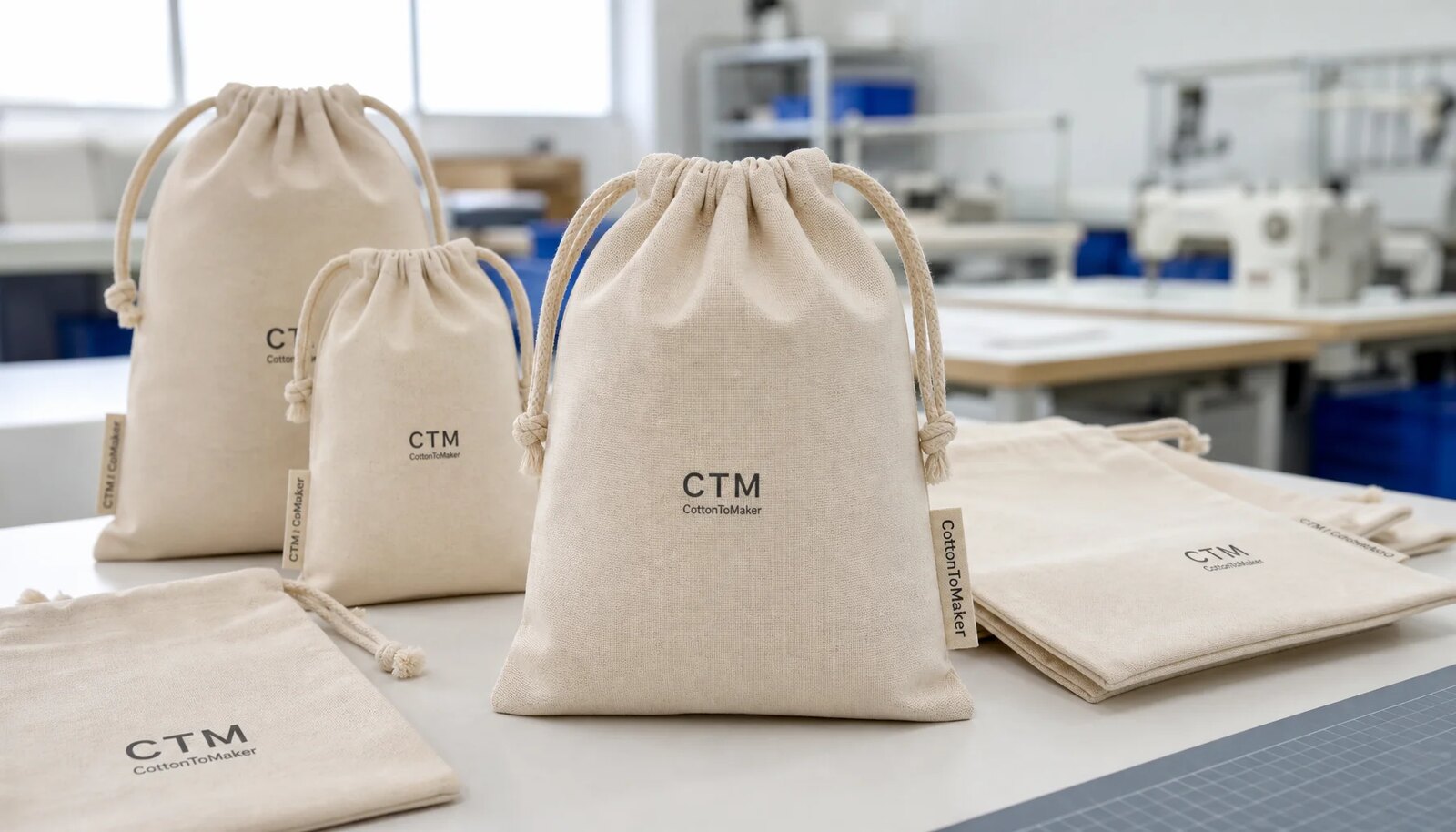
Why cotton drawstring pouches need a tighter buying brief than most buyers expect
A cotton drawstring pouch looks simple, which is exactly why it gets underspecified. The product only seems basic when the buyer has not yet had to reconcile fabric weight, stitch quality, cord behavior, print placement, packing count, and carton efficiency. Once those variables move out of line, the pouch stops being a neat brand touchpoint and becomes a source of inventory noise, receiving disputes, or customer complaints.
For eco apparel brands, the pouch is usually part of the product experience, not a disposable extra. It may sit inside a garment box, hold a folded item in transit, or act as a reusable bag the customer keeps. That means the sourcing brief has to cover more than price. It has to tell the supplier how the pouch should feel, how it should close, how the logo should sit, and how it should arrive at warehouse or fulfillment center.
The most useful sourcing brief removes ambiguity before the quote stage. State the intended contents, the presentation standard, the acceptable fabric look, the target retail feel, and whether the project is built for a launch, a seasonal drop, or an ongoing packaging program. When the brief is specific, wholesale cotton drawstring pouches for eco apparel brands become easier to compare because suppliers are quoting the same object instead of making their own assumptions.
- Treat the pouch as a controlled packaging component, not a generic commodity bag.
- Write down the use case before you compare suppliers.
- Separate visual requirements from production requirements, then quote both.
- Define the priority: low cost, premium hand feel, print clarity, or packing efficiency.
- Ask every supplier to quote from the same reference sample or spec sheet.
Start with finished size, seam allowance, and tolerance
Finished size is the first line item that needs to be locked. A nominal pouch size on a quote is not enough, because the real impact comes from the finished opening width, body width, and body height after sewing and turning. A pouch that is even a little off can sit awkwardly in a box, distort a printed logo, or fail to fit the item it was meant to hold. The buyer should always ask for measurements in centimeters and ask exactly where the factory measures each dimension.
Seam allowance matters because it affects both size and appearance. If the supplier is free to adjust seam allowance without a written spec, bulk production can drift from the approved sample even when the factory believes it is within normal practice. That is why a practical RFQ should state the target size, the measurement method, and a tolerance band. For smaller pouches, +/- 0.5 cm is a useful starting point; for larger formats, +/- 1.0 cm is often more realistic, unless the receiving line needs something tighter.
Pre-shrunk fabric is worth asking about when repeatability matters. If the pouch will be reused, sold at retail, or matched to other brand assets, the buyer should ask what shrinkage range the factory expects after wash or steam exposure. The point is not to demand a perfect textile lab result. The point is to make sure the factory has accounted for shrinkage in the quoted size instead of leaving that adjustment to chance.
- Specify finished size in cm for opening width, body width, and body height.
- Ask where the factory measures each dimension and after which production step.
- Define tolerance before quoting so all suppliers work to the same band.
- Call out whether the pouch must fit one product, a set, or a packaging insert.
- Ask for pre-shrunk status and the expected shrinkage range if the bag will be reused.
Choose fabric weight and finish based on what the pouch actually carries
For most wholesale cotton drawstring pouches, the practical GSM range is 120-140. Lighter fabric saves cost and can be fine for jewelry, accessory inserts, and soft goods, but it starts to show contents more easily and can feel flimsy in hand. Heavier fabric looks more substantial and usually gives a better retail impression, but it adds cost, bulk, and sometimes a stiffer closure. The right choice depends less on a general preference and more on what the pouch is supposed to do in the product flow.
Weave density is the second part of the fabric decision. Two pouches with the same GSM can perform differently if one cloth is loose and the other is tightly woven. If the contents should not show through, the buyer should ask the supplier whether the cloth is dense enough to reduce show-through and whether the sample shown is the actual fabric that will go into production. A quoted GSM alone does not tell you enough.
Color choice also changes how the pouch reads in market. Unbleached cotton supports a natural, eco-forward presentation, but it will carry slight shade variation and visible fiber speckling. Bleached cotton gives a cleaner and more uniform appearance, which can matter if the pouch sits next to bright garments or printed inserts. Buyers should decide in advance whether they want natural variation or controlled uniformity, because that decision affects both sourcing and QC.
- 120 GSM: lighter, flexible, and cost-sensitive, but more likely to show contents.
- 140 GSM: better balance for retail presentation and repeated use.
- Tighter weave: better opacity and a cleaner visual finish.
- Unbleached cotton: natural look, but allow for flecking and shade variation.
- Bleached cotton: more uniform appearance, but confirm the finish matches the brand palette.
Do not leave closure, cord, and hem details to the factory's default
The closure system is where a simple pouch becomes either reliable or annoying. A single drawcord with cotton rope or flat cotton tape is usually enough for light apparel items and gift packaging, but the buyer has to specify cord diameter, length, knot style, and whether the ends are tipped, clean cut, or tied off. If those points are vague, the factory may use a standard setup that works for sewing speed but not for the feel your brand wants.
Top hem construction deserves the same attention. A reinforced hem improves structure, reduces fraying, and usually helps the pouch close more cleanly. A single-layer top can be acceptable for low-cost projects, but if the bag will be opened repeatedly or handled in retail environments, the top edge should be strong enough to survive repeated pulls without distortion. The buyer should ask the factory to show how the cord channel is built and how the cord passes through it.
The closure should also be tested in the sample stage, not assumed. Ask the supplier to confirm the cord pull behavior on the actual sample. The bag should close symmetrically, neither side should bunch up early, and the cord should glide without snagging. If the pull feels uneven in a sample, the same issue usually appears more often in bulk.
- Specify cord type: cotton rope or flat cotton tape.
- Specify cord diameter and finished length, not just a visual description.
- Ask how the ends are finished: tipped, knotted, or clean cut.
- Check that the cord channel is even and does not twist in closing.
- Use a reinforced top hem if the pouch will be reused or opened often.
Match the decoration method to the artwork, not to habit
The print method should follow the logo, not the supplier's favorite process. For simple brand marks, one- or two-color screen printing is usually the most practical route because it gives strong coverage and predictable pricing. It is also easier to control when the artwork is large enough and the lines are thick enough to survive cotton texture. If the design depends on small type, gradients, or very fine detail, the buyer needs to check whether the chosen method can reproduce it cleanly at the final size.
Print placement is just as important as print type. A logo that sits too close to a seam, fold line, or cord channel can shift during sewing and turning. The buyer should specify the print position with a clear safe margin from edges and seams, and if there are multiple artwork positions, each one should be laid out against the final sewn dimensions, not a flat artwork template. That is a common place where otherwise good designs turn into production problems.
Heat transfer can be useful for small runs or detailed art, but it should be approved on the real fabric and checked for cracking, edge lift, and flex durability. Embroidery can create a premium finish, but it adds stitch density and can pucker lighter fabric. For eco apparel brands, the practical rule is simple: choose the method that survives handling and repeated folding, not the one that looks most dramatic in a mockup.
- Screen print: strongest default choice for simple logos and repeat orders.
- Heat transfer: useful for detail, but inspect flex durability and edge lift.
- Embroidery: premium feel, but check for puckering on lighter cloth.
- Avoid tiny text unless the sample proves it stays legible at final size.
- Ask for a strike-off or print proof on actual pouch fabric before approval.
Compare supplier quotes by setup logic, not just unit price
Cotton pouch quotes often hide the real cost drivers in setup assumptions. One supplier may include screen setup, one may break it out, and another may bundle print, sewing, packing, and labels into a single number. If the buyer does not ask for a line-item quote, the comparison is not clean and the cheapest quote may simply be the least complete. The practical approach is to request the same structure from every supplier so you can see where the money is actually going.
MOQ is rarely a single number. It can change by size, fabric color, print design, or packing version. A factory may give a lower minimum for a simple unprinted pouch and a much higher minimum once a second color or special label is added. That is why buyers should ask what element drives the minimum: fabric roll, print screen, sewing line, or packing setup. If a supplier cannot answer that clearly, there is usually a hidden assumption somewhere in the price.
The landed-cost view matters because these bags are light and bulky. A quote that looks attractive on paper can become expensive if the carton size is inefficient or the packing method creates excess air. Compare not only the ex-factory price but also carton dimensions, pack count, and freight density. On this kind of product, a few millimeters of packing efficiency can affect the total shipment more than the buyer expects.
- Ask for separate lines for fabric, sewing, print, labels, packing, and setup.
- Compare MOQ by size, color, and artwork version, not only a base number.
- Ask which setup can be reused on reorders and which has to be paid again.
- Request option pricing for fabric weight, cord type, and packing method.
- Compare landed cost, including carton size and freight density.
Use samples to test the pouch, not just to approve the look
A pouch sample is only useful if it proves the construction, not just the appearance. That means the buyer should inspect the seam behavior, cord movement, print placement, and how the pouch looks when empty and when filled with the real product. Flat mockups hide too much. A pouch that looks fine in an artwork render can still twist at the opening, pull unevenly, or show the contents more than expected once the real item is inside.
The approval record should be more disciplined than a casual sign-off. Keep a sealed reference sample, one working sample for internal checks, and a photo set that shows the front, back, inside, seam, top hem, cord ends, and any labels or inserts. Then write down what is acceptable and what is not. That record protects both sides later if the bulk shipment arrives with a subtle variation that someone notices immediately.
Fill testing is worth doing on the actual contents, not a stand-in. If the pouch will hold folded apparel, an accessory box, or a bundle of items, test it with that load. Watch whether the fabric stretches, whether the closure binds, and whether the print distorts when the pouch is tied. That one step often exposes a problem that would otherwise only show up at warehouse pack-out or after the customer opens the parcel.
- Inspect the pouch both empty and filled with the real insert.
- Measure the sample and compare it to the written spec, not to memory.
- Keep a sealed reference sample tied to the PO.
- Record the approved artwork version and fabric shade in writing.
- Ask for pre-production photos before bulk starts, not after the run begins.
Packing, carton marks, and freight planning belong in the RFQ
Packing is not a back-end detail on a light textile item. Because cotton drawstring pouches are low in weight and high in volume, the packing method has a direct effect on freight cost and warehouse receiving. Flat-packed pouches with clear count structure are easier to receive than loose cartons with vague counts. If the shipment is going to a fulfillment center or a retail DC, the packing spec should be fixed before production starts.
Cotton also picks up dust and lint easily, so the buyer should decide whether an inner polybag or bundle wrap is needed. This is especially relevant if the shipment will travel through humid conditions or sit in storage before use. Dark print can also pick up rub marks if the pouch is packed too tightly or with rough carton contact. Small damage in transit is still damage, and it is usually preventable with a better packing spec.
The carton should tell the warehouse exactly what is inside. Inner count, outer count, product description, SKU reference, and carton marks should all match the purchase order. If the team uses scanning or warehouse software, ask the supplier to label cartons in a way that matches the SKU logic. That speeds up receiving and reduces disputes when multiple sizes or print versions are in the same program.
- Define pack count per inner bundle and per outer carton.
- Ask for carton dimensions and target gross weight before freight booking.
- Specify whether a polybag, bundle wrap, or dust protection is required.
- Use carton marks that match the SKU and purchase order.
- Avoid mixed-size cartons unless your receiving process is controlled.
Build QC around the defects that actually show up in pouch production
The most common quality issues on cotton drawstring pouches are practical, not dramatic. Buyers usually see loose threads, uneven hems, print misregistration, dirty fabric, weak cord channels, and carton counts that do not match. A useful QC plan should name those failure modes directly. Generic language like good workmanship is too vague to help a factory correct anything before shipment.
Visual inspection is necessary but not enough. The drawcord should be operated multiple times, the pouch should be opened and closed under normal light, and the printed surface should be checked for transfer or cracking after light flexing. If the pouch is part of a premium brand presentation, subtle flaws become visible quickly. A slightly crooked hem or a rough cord pull can undermine the feeling of quality even if the logo print is technically correct.
For larger orders, ask the supplier what inspection standard it uses and whether defects are counted by type. If your team uses an AQL-style approach, state it in the PO or quality agreement. That gives receiving staff a clear acceptance rule and prevents disputes about whether a defect is cosmetic or acceptable. The goal is not to make QC theatrical. The goal is to make it specific enough that the factory can act on it.
- Check seams, cord channel, top hem, and print placement on random units.
- Operate the drawcord several times to catch friction and asymmetry.
- Inspect for stains, lint, oil marks, and loose fibers under bright light.
- Open cartons from different pallet positions, not only the top layer.
- Record defect type and count so corrective action is traceable.
Plan for sustainability claims, reorders, and change control
Eco apparel brands often want the pouch to support a sustainability story, but that story needs to be based on what can actually be documented. If the brand plans to mention cotton content, recycled packaging, or any other material claim, the buyer should ask the supplier for the supporting documentation before production starts. Do not leave claims to the last minute. Packaging language is easy to overstate and expensive to fix after artwork has already gone to print.
Change control matters on reorder programs. A pouch that was approved in one season can drift if the factory changes fabric source, cord type, print ink, or packing format without clearly flagging it. The buyer should ask what parts of the setup can be reused on a reorder and what changes require a new approval cycle. That includes the practical questions: can the same screen be used, will the same fabric shade be sourced again, and can the packing count remain identical?
If the pouch will stay in program for more than one season, store the approved spec sheet, sealed sample, and carton spec in one place. Then make sure the PO references the same revision. That simple control step reduces the chance that the second order quietly becomes a different product. Reorders fail less often when the specification is treated like a living control document instead of a one-time approval note.
- Ask what documentation is available for any material or origin claim.
- Lock the approved spec revision before reorder discussions start.
- Confirm which setup items can be reused and which need reset costs.
- Keep the sealed sample, carton spec, and artwork file tied to the PO.
- Require the supplier to flag any material or packing change before production.
Specification comparison for buyers
| Spec decision | Recommended option | When it fits | Buyer risk to check |
|---|---|---|---|
| Fabric weight | 120-140 GSM unbleached or bleached cotton | Best for apparel inserts, jewelry, small accessories, and brand packaging where hand feel matters | Below 120 GSM can look thin and show contents; above 140 GSM can add cost, bulk, and a stiffer close |
| Print method | 1-color or 2-color screen print for standard logos; heat transfer only for small runs or detailed art | Best when the artwork is simple and the order size is moderate | Thin strokes under 0.5 mm, small text below 6 pt, and gradients can fill in, blur, or crack after handling |
| Supplier route | Direct factory with pouch specialization | Best for repeat programs, custom sizing, and tighter production control | Ask for proof of sewing capacity, in-line QC, and batch-to-batch consistency |
| MOQ structure | 500-2,000 pcs per size/color/artwork as a realistic planning band | Fits most apparel brands testing a packaging SKU or seasonal launch | Low MOQ can carry high setup fees; multiple colorways can split production and raise unit cost |
| Closure style | Single drawcord with cotton rope or flat cotton tape | Best for lightweight apparel items and gift packaging | Cord length, knot method, and channel width must be specified to avoid weak closure and uneven pull |
| Panel construction | Single-layer for light inserts; double-layer or reinforced top hem for premium retail presentation | Single-layer suits cost control; reinforced top suits retail and repeated use | Unfinished edges, fraying, and uneven seam allowance are common reject points |
| Packing method | Flat-packed in poly bags with count labels and carton marks | Best for importers who need easy warehouse receiving and carton control | Loose packing creates count disputes, creasing, dust pickup, and contamination risk |
| Lead time plan | 30-45 days after sample approval for standard materials | Fits planned purchases with artwork and packaging locked | Custom rope, custom label, fabric dyeing, or peak-season loading can extend lead times |
| Land cost focus | Compare ex-factory price plus print, packing, carton size, and freight density | Best for buyers comparing multiple suppliers on total landed cost | A low unit quote can hide expensive setup, oversized cartons, or airfreight risk |
Buyer checklist before sampling
- Confirm finished pouch size in centimeters, not just a nominal label size, and define tolerance for width and height at the opening and body. A practical starting band is +/- 0.5 cm for small pouches and +/- 1.0 cm for larger pouch formats, unless your packaging line requires tighter control.
- Lock fabric weight, weave, and color before asking for a final quote. State whether the cotton is unbleached, bleached, or dyed, and whether surface slub, natural flecking, or slight shade variation is acceptable.
- Specify whether the fabric must be pre-shrunk and ask for the expected shrinkage range after one wash or steam exposure if the pouch will be reused or sold at retail.
- Define print method, logo size, ink colors, print location, and whether artwork must stay clear of the seam, cord channel, or fold line. Include a minimum clear margin around the logo, such as 1.5-2.0 cm from seam edges.
- State the required drawstring material, cord diameter, cord length, knot style, and whether cord ends need tipping, knotting, or a clean cut finish. If the closure must feel premium, ask for the cord pull force target and confirm it on samples.
- Request pre-production sample photos showing fabric texture, print placement, seam construction, top hem, cord channel, and closure operation before mass production starts. Do not approve from a flat mockup alone.
- Ask for carton pack count, inner polybag use, desiccant requirement, carton dimensions, and gross weight so shipping density can be estimated accurately and warehouse receiving can be planned.
- Compare MOQ by size, print version, fabric color, and packing version so you know which line item triggers setup charges or fabric minimums. Ask for the MOQ for the exact version you intend to order, not the most basic version.
- Collect lead time by stage: sample approval, material sourcing, first-piece check, bulk production, inspection, and dispatch. If the supplier cannot break the schedule down, the timing risk is usually hidden in the quote.
- Define acceptable defect levels for stains, loose threads, print misregistration, missing cords, broken stitches, size variance, and odor. Tie the acceptable quality standard to a reference sample or written inspection note.
Factory quote questions to send
- What exact fabric weight do you recommend for this pouch size, and is the quoted price based on greige cotton, pre-shrunk cotton, or finished fabric?
- Can you confirm the weave type, whether the cloth is dense enough to reduce show-through, and whether shrink allowance is already built into the quoted size?
- Which print method is included in the quote, how many colors are covered, and what is the surcharge for a second artwork position, extra color, or larger print area?
- What is the MOQ by size, color, and print design, and which element creates the minimum order requirement: fabric roll, print screen, sewing line, or packing setup?
- Can you share the finished dimensions, seam allowance, and production tolerance you will hold on width, height, and opening width?
- What packing format is included: bulk loose, polybagged, bundle-tied, or carton-packed with count labels and export marks?
- What is the sample approval process, and will production be matched to a sealed sample, approved image set, or written spec sheet?
- How many days are required for sample making, material preparation, production, in-line inspection, and final packing?
- What inspection standard do you use for stitching, print placement, dirt marks, cord movement, odor, and missing accessories?
- Can you provide carton size, gross weight, and loading quantity estimate for sea freight planning, and tell us whether the cartons are optimized for pallet stacking?
Quality-control points to confirm
- Measure finished pouch size at opening, body width, and body height; record the result against the approved tolerance instead of accepting vague 'around size' wording.
- Inspect seam strength at side seams and top hem; the top edge should not distort when the drawcord is pulled repeatedly, and seam waviness should be minimal and consistent.
- Check drawcord operation five times on every sample unit; cords should slide smoothly without snagging, twisting, or one side closing earlier than the other.
- Review print registration and edge definition under normal room light; thin lines, small font, and reverse-out text need special approval because cotton texture can break up detail.
- Rub-test print lightly by hand for color transfer and surface cracking, especially on heavier inks or transfer films, and reject any print that lifts visibly after basic flexing.
- Inspect the cord channel for even spacing so the rope does not twist, bind, or pull one side higher than the other when closed.
- Verify fabric cleanliness, odor, and fiber contamination; cotton pouches often fail on lint, thread ends, storage dust, or oil marks rather than major sewing defects.
- Pull-test the top hem and cord seam on random production units to catch weak stitches before packing starts, especially on top-folded single-layer pouches.
- Confirm inner packing count against carton marks before shipment; count discrepancies are common when multiple sizes or artwork versions are packed together.
- Check carton compression and stacking strength if the pouches will move through warehouse re-handling or long export routes, and ask for pallet stacking guidance if needed.