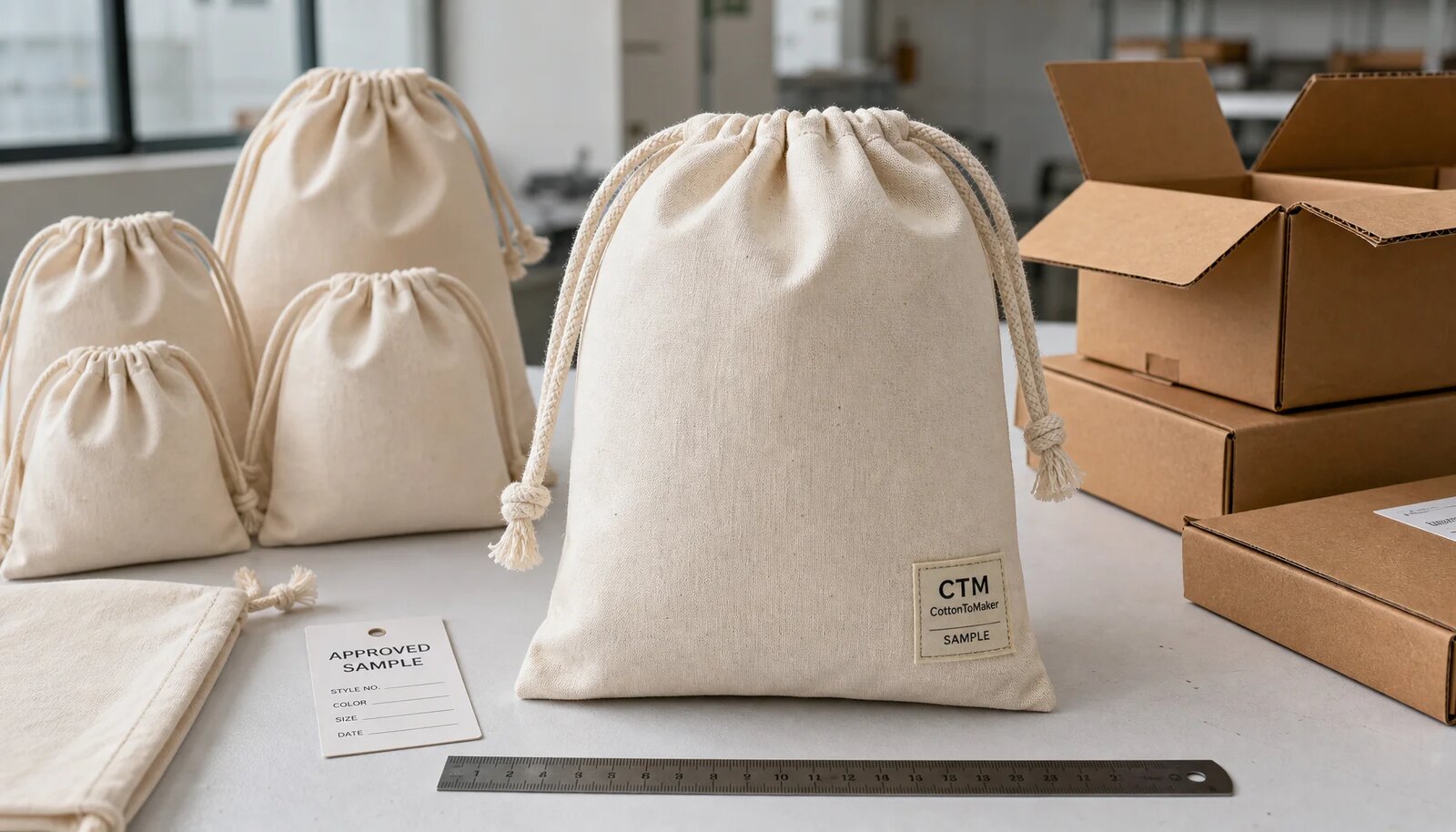
Start With the Apparel Item and Pack Fit
Wholesale cotton drawstring pouches are easier to source when procurement treats them as a fit and handling item first. A pouch for a folded T-shirt has different space needs than one for socks, swimwear, underwear, caps, accessories, or a gift bundle. The packed product often grows after tissue, hangtags, belly bands, care cards, or inserts are added, so early estimates from a flat product drawing are rarely enough.
Measure the real packed item before asking for bulk pricing. Record width, height, stack depth, and weight after the item is folded exactly as it will ship or sit at retail. Then test how the item enters the pouch, how the cord closes, and how the finished pack stacks in a carton. A pouch that looks roomy when empty can become tight once side seams, the cord channel, and fabric thickness reduce usable space.
The RFQ should state finished pouch size after sewing, pressing, and resting. Cut panel size is a factory detail, not a buyer approval dimension. Finished tolerance should also be written clearly. Plus or minus 5 mm can be a practical starting point for many standard apparel pouches, but the final tolerance should depend on pouch size, fabric behavior, printing position, and the brand's receiving standard.
- Measure the packed apparel item after tags, tissue, and inserts are included.
- Specify finished pouch size, not cut panel size.
- Test the pouch loaded, closed, stacked, and handled.
- Define tolerance for width, height, usable opening, and print placement.
- Keep one approved fit sample for future reorders.
Choose Fabric, GSM, and Cotton Claims Carefully
Fabric weight is a major cost driver in wholesale cotton drawstring pouches for eco apparel brands, but it is also a presentation choice. A lighter pouch may reduce material cost and freight weight. A heavier pouch may improve opacity, structure, and reuse potential. The best option depends on whether the pouch is a simple shipping insert, a retail packaging component, or part of a reusable branded experience.
For many apparel programs, 140 to 160 GSM is a useful middle range because it balances cost, hand feel, and printability. For lighter inserts or very cost-sensitive programs, 120 to 140 GSM may be enough. For pouches expected to hide contents, feel substantial, or be reused, 180 GSM or above may be justified. These ranges should be treated as sourcing starting points, not universal rules. Fabric weave, finish, pouch size, and the buyer's quality standard can move the best choice up or down.
Cotton description needs the same discipline. Plain weave cotton, muslin, canvas, and calico-style fabric do not behave the same way in cutting, sewing, or printing. Natural unbleached cotton can show seed flecks and shade variation. That may support an eco look, but it should be approved with physical samples. If the pouch is described as organic, recycled, undyed, azo-free, or certified, ask what documentation covers the fabric and whether it applies to the finished product or only the raw material.
- Use GSM as a performance and cost lever, not just a spec line.
- Approve natural cotton shade and seed fleck expectations with real swatches.
- Name the weave or fabric type in the RFQ.
- Ask for GSM tolerance and how the factory checks it before cutting.
- Confirm documentation before using sustainability or compliance claims.
Define Construction Before Comparing Quotes
Two factories can quote the same size, GSM, and logo yet produce noticeably different pouches. Construction details control sewing time, appearance, and durability. The RFQ should name seam allowance, top hem width, cord channel width, stitch density, thread color, internal trimming, and whether the pouch uses a single-cord or double-cord closure.
Cord details deserve their own line. State material, diameter, color, exposed length, knot style, and fray-control expectation. Cotton cord gives a natural look, but a loose twist or unfinished end can fray. A cord that is too thick may bind in the channel, while a cord that is too thin can feel weak or cheap. Channel width should match the cord so the pouch opens and closes smoothly in repeated handling.
Stitch quality should be defined in buyer language and inspection language. Require straight seams, consistent stitch density, trimmed loose threads, secure ends, no raw edges at the mouth, and no skipped stitches in the channel or side seams. If the pouch will be visible to consumers, a purely functional standard is not enough. The finished pouch needs to look intentional on a packing bench and in a customer unboxing moment.
- Specify seam allowance, hem width, channel width, stitch density, and thread color.
- State single-cord or double-cord closure before pricing.
- Define cord material, diameter, length, knot, and fray control.
- Require trimmed internal and external loose threads.
- Use the same construction standard across all pouch sizes in a program.
Select Decoration by Risk and Use Case
Decoration is often where a clean sample turns into uneven bulk production. The safest method depends on artwork complexity, fabric texture, color, quantity, and how much the pouch will be handled. For simple logos, one-color screen printing is often the most controllable option because it is easy to price, repeat, and inspect. It still needs measured placement, approved ink color, and a strike-off on actual production fabric.
Natural cotton changes how ink looks. Fine lines, small text, and tight registration can soften on open weave fabric. A digital proof cannot show ink absorption, edge sharpness, or opacity on the real cloth. If a supplier recommends a transfer, check stiffness, cracking, edge lift, and hand feel. A transfer that looks sharp may not match the softer positioning many eco apparel brands want.
Embroidery, woven labels, and sewn patches can add perceived value, but they add new control points. Embroidery may pucker lighter fabric. Woven labels can interfere with the cord channel or create rough internal threads if placed badly. Patches add labor and can change how flat the pouch packs. Use them when they support the product story and margin, not just because they look premium in a sample photo.
- Use screen print for simple logos and repeatable bulk control.
- Approve transfers for stiffness, cracking, peeling, and edge lift.
- Place artwork away from seams, corners, and the cord channel.
- Check labels and patches for internal roughness and distortion.
- Approve decoration on production fabric, not only on a mockup.
Build a Real Bulk Pricing Plan
A useful bulk pricing plan does more than list one unit price. It shows how quantity affects setup absorption, material buying, cutting efficiency, sewing time, decoration cost, packing labor, inspection, and freight basis. This is the section that should anchor the keyword intent: wholesale cotton drawstring pouches for eco apparel brands bulk pricing plan. Buyers need a table that makes tiers comparable, not a vague promise that higher volume is cheaper.
Ask every supplier to quote 500, 1,000, 3,000, 5,000, and 10,000 pieces against the same spec, incoterm, and destination assumptions. The exact price will depend on the factory, region, fabric, decoration, and packing method, so avoid treating online price snippets as sourcing data. What matters is the structure: sample charges, setup charges, unit cost by tier, packing cost, carton data, inspection options, and freight basis should be visible.
Separate one-time charges from recurring charges. Construction samples, screens, artwork cleanup, woven label tooling, patch dies, and color matching may apply once or per change. Fabric, cord, sewing, printing, thread trimming, cartons, inner packs, and labels are recurring. For the first order, amortize setup across the order quantity. For reorders, remove non-recurring charges unless the artwork, size, or tooling changes. That prevents a pilot run from distorting the long-term cost model.
- Request all tier prices in one table with the same spec and incoterm.
- Separate sample, setup, tooling, unit price, packing, inspection, and freight basis.
- Ask what changes if GSM, size, print color count, cord, or packing changes.
- Model first-order cost and reorder cost separately.
- Compare landed cost per usable pouch, not just ex-works unit price.
Clarify MOQ, SKU Mixing, and Reorders
MOQ is rarely just one number. A supplier may say the minimum is 1,000 pieces, but that minimum may apply per size, color, fabric lot, print screen, cord color, label type, or production batch. Eco apparel brands often need several pouch sizes across one packaging system, so procurement should identify the real MOQ rule before approving samples.
Mixed-size programs can work well when the rules are clear. Several pouch sizes may share one cotton fabric lot, helping shade consistency, but each size still needs its own pattern, measurement check, packing count, and carton label. Artwork variants may require separate screens or setup charges. Cord colors may also create separate minimums. Ask the factory to show which variables can be combined and which must be priced separately.
Reorders are easier when the first order creates a clean master file. Keep the final spec sheet, approved artwork, fabric standard, golden sample, packing plan, carton marks, and quote basis together. Reorder quotes should reference that file and list any changes in fabric source, shade, cord, print method, packing, or production facility. Without that discipline, each reorder becomes a partial restart.
- Ask whether MOQ applies by order, size, color, fabric lot, artwork, label, or batch.
- Confirm whether mixed sizes can share one fabric purchase.
- Require carton separation by SKU, size, artwork, and purchase order.
- Keep a dated golden sample for shade, hand feel, sewing, and logo placement.
- Plan safety stock around launch calendars and supplier lead times.
Use an RFQ That Forces Comparable Answers
The RFQ should read like a production brief. Include intended apparel item, finished size, tolerance, fabric type, GSM range, cotton color, cord details, construction, decoration, artwork files, packing method, carton requirements, quantity tiers, destination, incoterm, inspection expectations, required documentation, and quote validity period. The goal is to remove guesswork before suppliers calculate price.
A two-table RFQ format works well. The first table should capture product specification: dimensions, tolerance, weave, GSM, shade, cord diameter, channel width, seam allowance, stitch density, decoration size, placement, and packing count. The second table should capture commercial terms: sample fee, setup charge, tooling, unit price by quantity tier, carton dimensions, gross weight, lead time, inspection cost, and freight basis.
Require suppliers to list deviations. If they quote 120 GSM instead of 150 GSM, change the cord material, adjust carton packing, or move the logo to avoid production difficulty, procurement should see that clearly. A supplier's improvement suggestion may be useful, but it should be visible and priced as an alternative rather than hidden inside a cheaper quote.
- Use one RFQ table for product specs and one for commercial terms.
- Attach vector artwork and measured logo placement.
- Ask for lead times by sample, strike-off, pre-production, sewing, packing, and shipment.
- Require suppliers to disclose all deviations from the requested spec.
- Define rework responsibility before issuing the purchase order.
Treat Sampling as a Production Gate
Sampling should prove that the written spec works with the real fabric, cord, construction, decoration, and packed apparel item. Review the pouch empty and loaded. Check whether the item slides in easily, whether the drawstring closes smoothly, whether the logo distorts when filled, and whether the pouch still looks presentable after handling.
For custom or higher-volume work, use staged approval. A construction sample confirms size, sewing, fabric hand feel, cord behavior, and opening. A print strike-off confirms ink color, opacity, edge sharpness, hand feel, and placement on production fabric. A pre-production sample confirms that the actual fabric source, cord, print method, label, and packing plan are aligned before bulk cutting starts.
Approval comments should be measurable. Do not write only "looks good". Note finished size, tolerance, logo center point, cord length, channel width, acceptable shade range, stitch quality, and loose-thread standard. If natural cotton variation is acceptable, approve it with a physical reference. If it is not acceptable, state the limit before the factory buys or cuts fabric.
- Test the sample with the real apparel item inside.
- Approve construction and decoration separately when both carry risk.
- Use measurable notes for size, shade, cord length, print placement, and stitching.
- Keep one signed sample for inspection and one for reorder reference.
- Require approval before material, facility, or process changes.
Inspect the Defects That Cause Rework
Quality control should focus on the defects that create receiving delays, consumer complaints, or repacking work. Common issues include size drift, crooked seams, open seams, skipped stitches, loose threads, uneven cords, weak knots, twisted channels, shade variation, stains, odor, print smearing, poor opacity, misaligned artwork, mixed SKUs, and wrong carton counts.
Finished size should be measured after sewing and resting, without stretching the pouch to meet the number. Inspect width, height, channel height, and usable internal space. A pouch can meet outer dimensions but fail in use if the cord channel takes too much room or the loaded product strains the side seam. For apparel packaging, a loaded fit check is often more useful than measuring empty pouches alone.
Decoration inspection should follow the approved strike-off or golden sample. For screen print, check smearing, ghosting, pinholes, weak opacity, rough edges, wrong color, and placement. For transfers, check cracking, peeling, edge lift, and stiffness. For labels and patches, check orientation, stitch security, fraying, and internal roughness. Define critical, major, and minor defects before final inspection so the decision is not improvised at the carton stage.
- Measure finished size without stretching.
- Run a loaded fit test with the intended apparel item.
- Check seams, channel movement, cord length, knots, and thread trimming.
- Inspect decoration against the approved sample.
- Define defect categories and acceptable quality limits before shipment.
Plan Packing, Freight, and Landed Cost Together
Packing changes both cost and reliability. Bulk-packed pouches are usually economical, but they may not fit retail, kitting, or warehouse receiving needs. Individual poly-free bands, paper sleeves, barcode labels, hangtags, inner packs, fold direction, SKU separation, and master carton labels all add labor and material. These requirements should be priced before supplier selection.
Ask for pieces per inner pack, pieces per master carton, carton dimensions, gross weight, net weight, and carton marking layout. A carton packed too tightly can crush or wrinkle pouches. A carton packed too loosely wastes freight space and may shift during transit. If the receiving warehouse requires barcode format, country-of-origin marking, purchase order reference, or carton label placement, include those requirements in the RFQ and approve a carton proof.
Landed cost should include factory unit price, setup charges spread across the order, sample amortization where relevant, packing materials, inspection, inland freight, ocean or air freight, duty, brokerage, destination handling, warehouse receiving, repacking risk, and defect allowance. The cheapest unit price may not be the cheapest delivered program if carton data is poor, packing is wrong, or the shipment arrives with mixed SKUs.
- Quote packing requirements before choosing the supplier.
- Compare carton dimensions and gross weight, not only unit price.
- Verify inner pack counts, master carton counts, labels, and SKU separation.
- Ask about moisture and odor protection for long transit or humid storage.
- Calculate landed cost per usable pouch at the receiving location.
Specification comparison for buyers
| Cost line | 500 pcs | 1,000 pcs | 3,000 pcs | 5,000 pcs |
|---|---|---|---|---|
| Example pouch spec used for comparison | 18 x 24 cm, 140-160 GSM cotton, one-color print, cotton cord | Same spec | Same spec | Same spec |
| Indicative unit price logic | Highest unit cost because setup and cutting waste are spread over fewer pieces | Setup starts to dilute but small-batch handling remains significant | More efficient cutting, sewing, and print scheduling | Better fabric buying and production efficiency |
| Sample and approval charges | Often charged separately | Often charged separately | May be credited after bulk order | May be credited after bulk order |
| Setup or screen charge | High impact per pouch | Moderate impact per pouch | Low impact per pouch | Low impact per pouch |
| Packing assumption | Bulk pack, no individual barcode unless quoted | Bulk pack or simple inner packs | Inner packs become easier to standardize | Retail or warehouse labeling can be priced clearly |
| Inspection allowance | Basic final check or buyer-paid inspection | Buyer-paid inspection recommended | AQL-style final inspection becomes practical | In-line plus final inspection often worthwhile |
| Landed-cost fields to model | Unit price + setup + sample + packing + freight minimums | Unit price + setup + packing + freight | Unit price + inspection + freight + duty + brokerage | Unit price + carton efficiency + duty + destination handling |
| Best procurement use | Pilot run, market test, photo sample pack, urgent launch | Small launch or limited SKU test | First serious bulk order for one or two sizes | Balanced tier for recurring apparel lines |
Buyer checklist before sampling
- Define the packed item: folded tee, socks, underwear set, swimwear, cap, accessory kit, gift set, return insert, or retail bundle.
- Measure folded product width, height, stack depth, and weight after hangtags, tissue, belly bands, or inserts are added.
- Specify finished pouch size after sewing, pressing, and resting; do not rely on cut panel size.
- State dimensional tolerance separately for width, height, cord channel, and print placement, using values that match the pouch size, fabric, and buyer standard.
- Specify fabric type, weave, GSM range, cotton color, and whether the cotton is natural, bleached, dyed, organic, recycled, or conventional.
- Confirm what documentation is required for any organic, recycled, undyed, azo-free, RSL, or chain-of-custody claim before quoting.
- Choose cord material, diameter, color, exposed length, knot style, fray control, and single-cord or double-cord closure.
- Define hem width, cord channel width, seam allowance, stitch density target, thread color, and loose-thread trimming standard.
- Select decoration method: screen print, transfer, embroidery, woven label, sewn patch, hangtag, or no branding.
- Give artwork size, Pantone or color reference, number of colors, print position, and minimum distance from seams and cord channel.
Factory quote questions to send
- What exact finished size, GSM range, weave, cotton color, cord diameter, hem width, channel width, seam allowance, and stitch density are included in this quote?
- Is the MOQ based on total order quantity, size, color, fabric lot, print screen, cord color, label type, or production batch?
- Can multiple pouch sizes or artwork versions share one fabric lot, and what price or lead-time change applies if they cannot?
- What dimensional tolerance do you hold for width, height, cord channel, cord length, and print placement in bulk production?
- What GSM tolerance applies to bulk fabric, and how is GSM checked before cutting?
- Which print or label method do you recommend for this artwork on this fabric, and what failure mode does that method avoid?
- What are the separate charges for samples, screens, artwork preparation, woven label tooling, patch tooling, color matching, testing, and packing?
- Can you quote 500, 1,000, 3,000, 5,000, and 10,000 pieces in one table with the same incoterm and destination assumptions?
- What sample lead time, strike-off lead time, pre-production sample lead time, bulk sewing lead time, and packing lead time apply to this spec?
- Will the approved sample and bulk order be made in the same facility with the same fabric source, cord type, decoration method, and carton plan?
Quality-control points to confirm
- Finished size is measured after sewing, pressing, and resting, with width and height inside the approved tolerance and no stretching during measurement.
- Bulk fabric GSM is checked from production material before cutting and compared with the approved range and master sample hand feel.
- Natural, bleached, or dyed cotton shade is compared against an approved standard under consistent light, with an agreed tolerance for lot variation.
- Seam lines are straight, stitch density is consistent, and there are no open seams, skipped stitches, broken stitches, raw edges, or loose threads at the mouth, side seams, corners, or cord channel.
- Cord length is consistent, knots are secure, cord ends do not fray beyond the agreed standard, and the pouch opens and closes smoothly without twisting or uneven pull.
- Print placement, size, color, opacity, edge sharpness, and hand feel match the approved strike-off, with no smearing, ghosting, pinholes, blocked mesh, cracking, peeling, or visible color shift.
- Labels, patches, or embroidery are positioned consistently and do not distort thin fabric, interfere with the cord channel, create sharp internal threads, or reduce usable pouch space.
- The pouch fits the intended packed apparel item without excessive gaping, strained seams, logo distortion, twisted closure, or bulging that affects retail presentation.
- Rub, flex, handling, or light wash checks are completed when the brand expects the pouch to be reused or handled repeatedly after purchase.
- Carton counts, inner pack counts, barcode labels, carton marks, SKU separation, gross weight, packing list data, and purchase order quantities match the physical shipment.