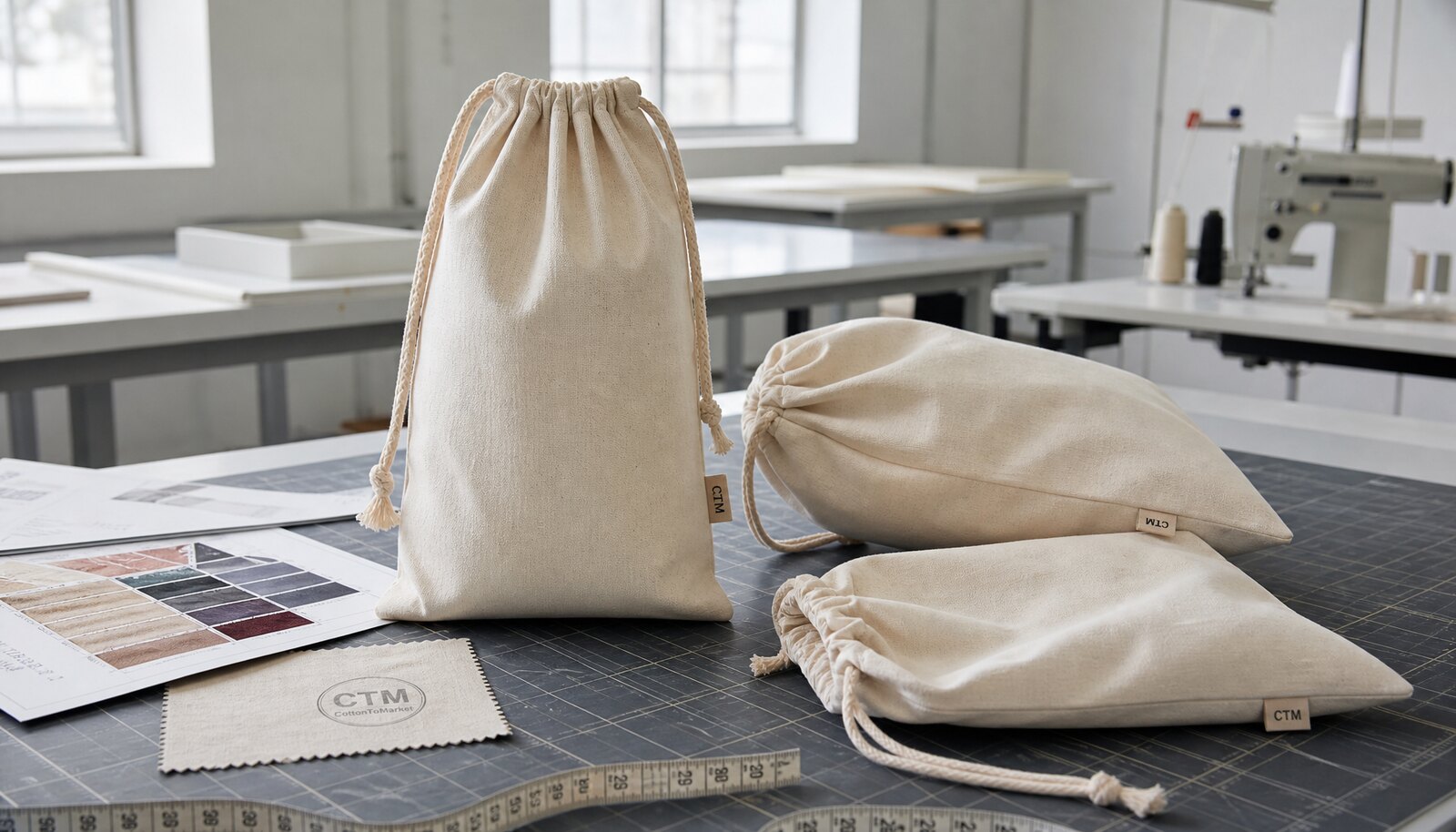
Why winery pouch lead times slip
For boutique wineries, the schedule usually slips before sewing begins. The common failure is treating cotton drawstring pouches like a generic giveaway item instead of a packaged component that has to align with a bottling date, tasting-room launch, or holiday gift release. If the pouch is meant to hold a bottle, a corkscrew, or a two-item set, the usable opening, cord action, and print placement all matter. One weak spec decision creates back-and-forth on samples, and that delay is usually more expensive than paying a slightly better factory rate.
Lead time is not just sewing time. It includes fabric reservation, color matching, print setup, sample approval, carton configuration, and export booking. Buyers who only ask for a unit quote usually get a unit price that looks good but hides a schedule risk. A cleaner RFQ forces the supplier to state what is already known and what still depends on approval. That is the difference between a quote you can compare and a quote that only looks complete.
- Tie the order to a real event date, not a rough seasonal window.
- State whether the pouch is for single bottles, tasting kits, or retail accessory packaging.
- Separate sample time from bulk time in the RFQ.
Choose the pouch structure before you talk price
For winery use, cotton drawstring pouches usually fall into three practical constructions. A light 120 to 140 GSM pouch works for labels, small accessories, and low-cost gift wrapping. A midweight 160 to 180 GSM pouch is the safest default for retail gifting because it holds its shape, prints cleanly, and still packs efficiently. If the bag needs to support a heavier bottle, a coated insert, or repeated retail handling, move up to 200 to 240 GSM and expect a larger impact on sewing speed and freight weight. The wrong fabric weight is one of the easiest ways to miss a shipment date because it changes both the sewing method and the packing plan.
Construction details matter as much as fabric. A single drawcord is faster and usually cheaper, but a double-cord closure gives a more balanced opening for bottle-shaped items. Side seams should be clean enough that the pouch can stand in a display carton without twisting. If the brand wants a premium look, a sewn side label or woven label is usually more durable than a large printed logo, but it adds another production step. Keep the choice practical: use the simplest structure that still protects the product and matches the shelf presentation.
- 120 to 140 GSM: light accessory packs and short-run gifting.
- 160 to 180 GSM: best all-around choice for boutique winery retail and gifting.
- 200 to 240 GSM: heavier contents, premium feel, or repeated handling.
Printing and branding choices that affect the calendar
Print method drives both schedule and defect risk. One-color screen print is still the most efficient option for many cotton pouches because the setup is stable and the result is easy to inspect. If the brand artwork has fine detail, multiple colors, or gradients, digital print or heat transfer may seem flexible, but those methods can introduce drying time, hand-feel issues, or durability concerns on textured cotton. Embroidery looks strong on a retail shelf, yet it adds needle time and can distort thinner fabric unless the pouch is properly weighted. For winery programs, a simple logo in one or two colors often wins because it keeps the bag readable and keeps the schedule under control.
Treat branding as a production decision, not a design discussion. The RFQ should say print area, color count, exact artwork size, and whether the logo must sit on one side only or on both sides. If the pouch uses a woven side label, the supplier needs approval for label width, thread color, fold direction, and stitch placement. Buyers often lose a week because artwork is approved in principle, but the factory still has to guess at the physical layout. Reduce that guesswork and the sample cycle usually shortens.
- Use one-color screen print when you want the safest balance of speed and cost.
- Use embroidery only if the fabric weight and logo size support it cleanly.
- Use woven or sewn labels when repeat orders need durable branding and fewer print variables.
MOQ logic and how to read a factory quote
MOQ on cotton drawstring pouches is rarely about one number. It is usually a mix of fabric width, cutting efficiency, print setup, cord color, and packaging labor. A supplier may quote a low MOQ on a blank pouch but require a higher minimum once you add custom print, a specific label, or a special cord color. Buyers should read MOQ by SKU, not by total order. If you need two pouch sizes and two artwork versions, the realistic MOQ may double even if the total quantity looks large on paper.
The quote should itemize what is being sold. A useful quote separates fabric, cutting, sewing, print, label, cord, packing, cartons, testing, and freight terms. If the quote only gives one all-in number, it is hard to compare suppliers and easy for the factory to reprice after sample approval. Ask for the cost difference between natural and bleached cotton, between one-color and two-color print, and between bulk carton packing and retail-ready inner packing. That reveals where the real cost sits and which changes are worth making.
- Expect MOQ to rise when you add custom colors, multiple sizes, or label changes.
- Ask for pricing by artwork version so the repeat order path is clear.
- Make sure sample charges and courier costs are stated separately.
Sample approval should lock the golden sample, not just the artwork
A buyer can approve a graphic and still receive the wrong pouch. The pre-production sample has to match the intended fabric lot, cord type, label method, and print process. Measure the finished width, gusset if any, and usable opening with the actual sample in hand. If the pouch must fit a specific bottle or gift kit, test that fit physically rather than trusting a dimension sheet. Cotton can relax, and stitched openings can land slightly different from a paper spec. The sample is the last cheap place to correct that.
The golden sample should be treated as the production reference. Keep one signed sample at the buyer side and one at the factory, and make sure both are marked with the approved date, artwork code, and revision level. If there is a minor revision after approval, do not rely on verbal alignment. Write the change into the PO or a revised spec sheet. That step saves arguments later about whether a shade difference, print shift, or cord length variation was already accepted.
- Test physical fit with the actual bottle or retail kit, not just a ruler.
- Approve the same fabric, print method, and label construction planned for bulk.
- Mark both sides of the golden sample with revision control.
QC thresholds that matter for retail and tasting-room use
Cotton drawstring pouches are simple, but simple products fail in simple ways. The first failure mode is dimension drift, which shows up when the bottle does not sit correctly or the pouch mouth closes unevenly. The second is stitch quality, especially at the top hem and cord tunnel where bulk sewing speed can create skipped stitches or loose thread tails. The third is print inconsistency, where the logo shade shifts from sample to bulk or the placement moves enough to look sloppy on a retail shelf. These defects are easy to catch if the acceptance criteria are written before production starts.
Set tolerances that fit the use case. For boutique winery packaging, the bag does not need lab-grade tolerances, but it does need consistent presentation. Define stitch appearance, seam straightness, acceptable print variation, and closure function. If the pouch is going into a gift box or tasting set, carton-level appearance matters too. A pouch that looks fine in isolation can still create a poor unboxing experience if it arrives creased, dust-marked, or packed with mixed sizes in the same carton.
- Measure size, opening, and cord length against the approved spec.
- Inspect print alignment and color against the golden sample under normal indoor light.
- Reject cartons with mixed SKUs, mixed labels, or visible moisture damage.
Packing decisions change freight cost and damage risk
Packing for winery pouches should be decided with the shipping mode in mind. If the order is going by sea, the factory should use moisture protection, clear carton marks, and a pack count that makes receiving easy at the warehouse. If the order is going by air or courier, smaller carton counts may reduce handling damage and speed up counts on arrival. For retail programs, inner polybags can help presentation, but they also add labor and waste; many buyers only need bulk cartons with a tidy carton label and a count sheet. The goal is not fancy packing. The goal is a clean handoff into the buyer's inbound process.
Carton data belongs in the quote. Buyers should know gross weight, carton dimensions, pieces per carton, and whether pallets are included. That information changes freight planning and can reveal whether one supplier's unit price will actually cost more once packed volume is included. For cotton pouches, the difference between a neat fold and a loose bulk pack can change the carton count enough to matter on a container booking. Do not leave packing as an afterthought.
- Define carton count, inner bag use, and barcode placement before bulk starts.
- Use desiccant or moisture protection when shipping into humid routes or long sea transit.
- Ask for carton dimensions and gross weight before you approve freight mode.
Lead time planning from PO to ship date
A realistic schedule should start with the purchase order, not the shipment date. A typical program needs time for artwork confirmation, sample production, sample courier transit, sample approval, fabric reservation, bulk sewing, packing, inspection, and booking. If the design is already stable and the factory has the right fabric in stock, a straightforward custom pouch order can move faster. If the order needs new fabric dyeing, special print colors, or multiple packaging formats, the calendar expands quickly. Buyers who plan only around sewing time usually miss the hidden steps that consume the first and last week.
Work backward from the launch date and protect the risky phases first. The most common schedule losses come from late artwork approval, changed size specs, and delayed deposit release. Peak season also affects booking and carton handling, so the same factory may quote a faster lead time in low season than in the fourth quarter. Build slack around sample approval and shipping booking, not just production. That is where most real delays happen.
- Sample stage often takes longer than the buyer expects because it includes revision cycles.
- Bulk production starts only after artwork, spec, and deposit are all aligned.
- Keep a buffer for peak-season booking, especially before holidays and wine festivals.
Use the right sourcing route for the order profile
Not every winery pouch order needs the same supplier model. If the order is large enough to justify custom fabric and repeated reorders, a direct factory route usually gives the best control over quality and lead time. If the buyer is launching a one-off event program or wants to test a design, a stock pouch route can reduce risk, though the spec choices will be narrower. Regional decorators and hybrid routes can work when speed matters more than perfect cost, but the buyer has to watch for hidden handoffs between vendors. The wrong sourcing route is a silent lead-time problem because it creates extra coordination instead of removing it.
The best comparison is not just unit price. Compare how each route handles sampling, setup charges, minimums, packing, and export paperwork. One vendor may have the lowest quoted price but the longest approval loop. Another may quote a slightly higher unit cost and still win on landed cost because the cartons are packed better and the shipment leaves earlier. For boutique wineries, the right route is the one that protects the launch date while staying close to the brand presentation standard.
- Use direct factory sourcing for repeat programs and custom build details.
- Use stock or hybrid routes only when speed outweighs spec control.
- Compare landed cost, not just ex-works unit price.
RFQ mistakes that cause quote noise and rework
The cleanest RFQ is short on marketing language and heavy on physical detail. Tell the supplier the pouch size, fabric GSM, cord style, print area, artwork colors, label requirement, pack count, and target ship window. Include one reference sample or one dimensioned spec if available. If the pouch is for boutique wineries, also state whether the customer will fill it with a bottle, glassware, or a mixed gift set. That one sentence can change the pouch depth, opening tolerance, and carton pack logic. Without it, the supplier quotes a generic bag that may be cheap but unusable.
The worst RFQ mistakes are usually omissions, not bad instructions. Buyers forget to define whether prices include sampling, whether cartons need barcode labels, whether the bag should be bleached or natural, or whether the artwork will be one color on one side only. These omissions do not just slow down the quote. They create mismatched assumptions that show up later as change orders. If the goal is to compare suppliers on equal terms, the RFQ must leave as little room as possible for interpretation.
- State the end use: bottle, accessory kit, or mixed winery gift set.
- Provide artwork format and the exact print side count.
- Name any packing or labeling requirement that affects inbound warehouse handling.
Specification comparison for buyers
| Spec decision | Recommended option | When it fits | Buyer risk to check |
|---|---|---|---|
| Direct factory in China | Best for custom fabric, custom print, and carton-level packing control | You need repeat orders, coordinated lead time, and room to tune specs | Longer sample cycle if artwork, size, or label details are not frozen |
| Trading company or sourcing agent | Useful when you need one point of contact across multiple factories | You have limited internal sourcing bandwidth or several product lines to bundle | Margins may be hidden and the real factory may change between quotes |
| Regional converter or decorator | Good for fast turnaround on simple branding and smaller batches | You need quick domestic replenishment or short-run event packs | Fabric choice and unit cost are often less competitive than factory direct |
| Stock pouch reseller | Fastest route for unbranded or lightly branded programs | You need to launch quickly or test demand before committing | Limited control over exact GSM, shade, and cord construction |
| Small domestic print shop | Suitable for simple one-color print on supplier-provided blanks | Artwork is stable and order volume is low | Blank quality varies, and pouch dimensions may drift between lots |
| Hybrid route: factory plus local print | Useful when you need factory sewing with local finishing speed | You want some control but do not need full factory branding integration | Two vendors can create handoff delays and color mismatch |
| Factory with in-house print and packing | Best for winery gift programs with strict pack-out rules | You need labels, inserts, and carton marks done before export | Quote comparison gets harder unless each finishing step is itemized |
| Multi-supplier split sourcing | Works when one vendor makes pouches and another handles kits or inserts | You have separate procurement owners or different ship dates by SKU | More touch points increase mispick risk and document confusion |
Buyer checklist before sampling
- Lock the pouch size, fill volume, and bottle or accessory fit before asking for quotes.
- Choose fabric weight in GSM and decide whether natural, bleached, or dyed cotton is acceptable.
- Specify print method, print area, number of colors, and whether a woven label or side label is required.
- Define MOQ by size and artwork version, not just by total order value.
- Require a pre-production sample that uses the intended fabric, cord, and print method.
- Set carton pack count, inner bag need, barcode labels, and moisture protection for ocean freight.
- Build buffer time for artwork revision, sample approval, and export booking.
- Separate production lead time from transit time in every supplier quote.
Factory quote questions to send
- What fabric GSM, weave, and shrinkage allowance are included in the quote?
- Is the print screen print, heat transfer, embroidery, woven label, or sewn label, and what setup cost applies?
- What is the MOQ per size, color, and artwork, and does the MOQ change if we add a label or special cord?
- How long does the sample take, and is the sample made from the same material and print process as bulk production?
- What is the bulk lead time after sample approval and deposit, and what factory calendar assumptions does it include?
- What packing method is quoted: bulk carton, inner polybag, tissue, desiccant, barcode sticker, or palletization?
- Which costs are excluded: artwork correction, courier samples, testing, cartons, labels, inland trucking, or export documents?
- Can you share carton dimensions, gross weight, and estimated loading quantity for the planned shipping mode?
Quality-control points to confirm
- Measure finished size against the approved spec and keep the tolerance tight enough for bottle fit, usually within plus or minus 0.5 cm to 1 cm depending on pouch size.
- Inspect stitch quality at side seams, top hem, and cord channel for skipped stitches, broken threads, or uneven seam allowance.
- Verify print placement, color density, and registration on the actual production fabric, not only on artwork proofs.
- Pull-test the cord tunnel and opening area so the pouch closes smoothly without tearing or twisting.
- Check that the fabric lot, cord color, and label match the golden sample before bulk packing starts.
- Confirm carton marks, case count, and moisture protection before containers or cartons leave the factory.