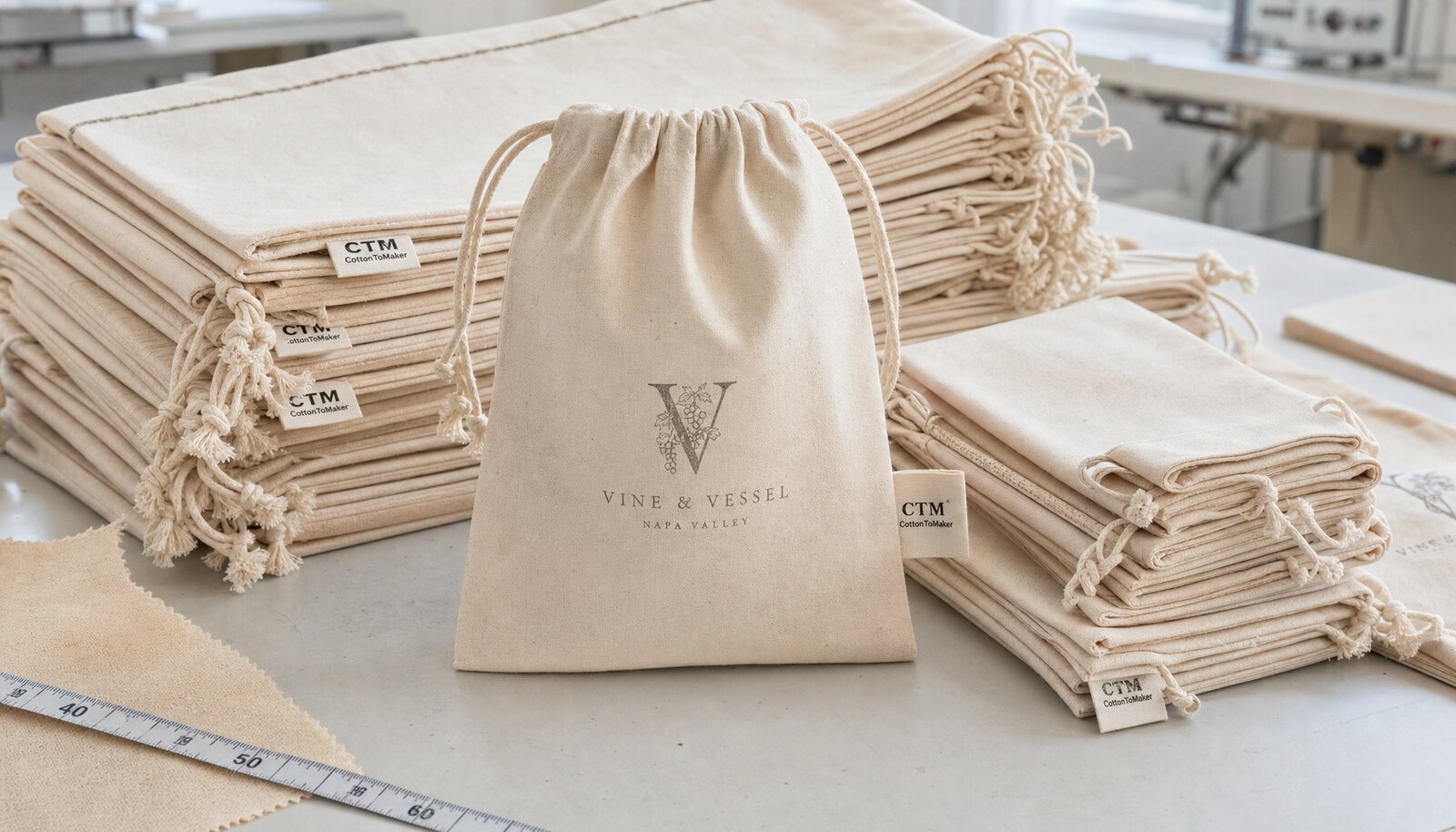
Start With the Winery Use Case
A boutique winery does not buy cotton drawstring pouches the same way a gift shop does. The use case drives the spec. If the pouch is for a tasting kit, it needs to fit a corkscrew, stopper, note card, or small accessory set without looking overbuilt. If it is for retail presentation, the pouch needs enough opacity and structure to feel intentional on a shelf. If the pouch is only a seasonal giveaway, the buyer can accept a lighter fabric and a simpler brand mark, but should still protect the logo from looking cheap after a few uses.
The first sourcing mistake is starting with decoration before the product size is fixed. A logo can be adjusted, but a bag that is too narrow for the contents creates returns, repacking labor, or a bad unboxing experience. For boutique wineries, the safest approach is to define the contents first, then work backward into the pouch dimensions, fabric weight, and cord length. If the item must carry a bottle, treat that as a different product category and do not force a drawstring pouch to do a bottle bag job.
- Typical winery pouch uses: tasting kits, bottle accessories, gift sets, event handouts, retail add-ons.
- Do not quote the logo before the contents are defined; size drives the rest of the spec.
- If the pouch must protect a fragile item, build in enough fabric weight and seam strength to keep the pouch from collapsing.
Lock the Fabric and Size Before You Request Quotes
For most boutique winery programs, natural cotton in the 140 to 170 GSM range is the practical baseline. It feels better than a thin promotional bag, it hides the contents more effectively, and it still keeps the unit cost under control. If the pouch must hold heavier accessories or the brand wants a more premium tactile feel, move up to 170 to 220 GSM. Below 140 GSM, buyers often get a bag that wrinkles heavily, telegraphs the contents, and looks more like a giveaway than packaging.
Size should follow the object, not the other way around. Common pouch formats for wineries are small accessory pouches around 10 x 15 cm, standard gift pouches around 15 x 20 cm or 18 x 24 cm, and larger retail pouches around 20 x 30 cm. Ask the factory to quote finished size, not only cut size, and make sure the sample includes the actual cord channel and seam allowance. A size that looks right on a drawing can still be wrong once the pouch is stitched, washed, and packed flat.
- Use 140 to 170 GSM for standard winery gift sets and accessory pouches.
- Use 170 to 220 GSM when the pouch must feel more premium or carry heavier contents.
- Request finished size, cut size, seam allowance, and shrink allowance in the same quote.
Choose the Right Branding Method
For winery packaging, one-color screen print is usually the best balance of cost, clarity, and durability. It handles logos, estate names, vintage marks, and short brand messages well. A good print should sit cleanly on natural cotton without bleeding into the weave or feeling sticky after curing. If the artwork is too detailed, simplify it before production rather than asking the printer to rescue a design that was built for a label, not fabric. Multiple colors can be done, but every extra color adds setup risk and can complicate alignment on a soft cotton surface.
A woven or sewn side label makes sense when the brand wants a quieter, more premium look. It can be a strong choice for boutique wineries that prefer retail packaging over promotional branding. The tradeoff is that the label itself becomes a quality item that must be sewn straight and sized correctly. Heat transfer can work for short runs or complex graphics, but it is usually less desirable for a reusable cotton pouch that will be handled, folded, and stored. For most buyers, the cleanest answer is a simple front print plus a small side label if the brand needs a retail finish.
- Screen print is the default for repeat orders and simple winery logos.
- Woven or sewn labels work best when the brand wants a premium, low-noise presentation.
- Heat transfer is a fallback for short runs, not the first choice for durable retail packaging.
How MOQ Really Changes the Price
MOQ logic on cotton drawstring pouches is usually driven by three things: fabric prep, print setup, and sewing line efficiency. A supplier may quote a lower MOQ for stock natural cotton but raise the minimum sharply once you ask for custom fabric weight, dyed cloth, multiple print colors, or a special cord. Buyers should not read MOQ as a random factory rule. It is a reflection of how many units are needed to absorb setup labor and avoid waste on short-run production.
The practical move is to separate the quote into base pouch, decoration, and packaging. A winery buyer can then see which change pushes the order out of the economic zone. For example, one-color print on a standard natural cotton pouch is often easier to scale than a custom-colored pouch with a woven label and individual polybagging. If the supplier refuses to break out these elements, the quote is too opaque to compare. Ask for price by spec variant, not only an all-in number.
- MOQ tends to rise with custom fabric, extra print colors, and special cord or label work.
- Separate the quote into base bag, branding, packing, and carton cost.
- Compare MOQ by size and decoration, not just by total quantity.
Supplier Evidence Should Match the Actual Process
A credible factory quote should come with evidence that matches the process it is pricing. If the supplier claims in-house sewing and printing, ask for photos of the cutting table, sewing line, print station, and finished packing area. The photos should show the same kind of pouch, fabric weight, and closure style you are buying. A winery buyer does not need a polished brochure. It needs proof that the supplier can repeat the same construction at scale without guessing.
Ask for one recent example that is close to your order in fabric weight, print method, and packing style. A similar pouch in a different category is less useful than a close match to your spec. Good evidence also includes a plain production sample, a measured swatch, and an explanation of where common defects appear, such as crooked cord channels, loose side seams, or print shift on soft cotton. The more concrete the evidence, the less likely the supplier is hiding a weaker process behind a low quote.
- Request factory photos of cutting, sewing, printing, inspection, and carton loading.
- Ask for a similar order example with the same GSM and decoration method.
- Do not rely on a catalog image if the actual pouch is custom sewn to your spec.
Sample Approval and QC Thresholds
Sample approval should test the things that will actually fail in bulk. Measure the finished pouch, weigh or verify the fabric if possible, open and close the drawcord several times, and inspect the logo under good light. A sample is not only a visual approval. It is the only chance to catch size error, bad stitch tension, weak cord, poor print cure, or a label that twists after the first fold. If the winery has a bottle or kit that must fit into the pouch, use the real object during sample review.
Set acceptance criteria before bulk approval. A practical standard might include size tolerance, aligned print, clean seams, no loose threads, no odor, and consistent carton count. If the pouch will be handled by retail staff or end customers, test how it looks after being folded and unfolded a few times. A pouch that photographs well but collapses awkwardly in hand will underperform in a tasting room or on a retail shelf.
- Approve the sample against the actual contents, not only against a drawing.
- Define tolerance for size, print placement, and seam appearance before bulk starts.
- Reject samples with odor, tacky print, weak cord movement, or loose seam ends.
Packing, Carton Planning, and Retail Handling
Cotton drawstring pouches are usually bulk packed flat, but the details matter. A winery that receives mixed packing by size or print variant wastes time on sorting and receiving. Ask for fixed carton counts per SKU, outer carton marks that match the purchase order, and a packing method that keeps the fabric clean during transport. If the order will sit in a retail back room before use, carton strength matters as much as the pouch itself because crushed cartons can distort the fabric and slow put-away.
Packaging choices also affect freight and warehouse cost. Individual polybags add cleanliness and retail protection, but they also add labor, material, and cube. Bulk flat packing is usually more efficient for internal storage or restaurant channel use. If the pouch will be sold directly to consumers, consider whether you want a hangtag, barcode, or individual bag. Lock those decisions before the quote is finalized, because changing packing late often changes carton size, loading quantity, and shipping cost.
- Use bulk flat packing when the winery needs efficient warehouse receiving.
- Use individual packing only when shelf presentation or retail hygiene justifies the extra cost.
- Keep SKU labels, carton marks, and purchase order references consistent across all cartons.
Lead Time and Production Risk
The usual lead time risk on custom cotton pouches is not sewing; it is all the upstream details that can reset the schedule. Artwork changes, fabric sourcing, print approval, and label corrections can each add days. A realistic plan is to separate sampling time from bulk production time and to treat approval as a hard gate. If the winery has a seasonal launch, the schedule should include buffer time for artwork revisions, courier transit, and possible re-sampling. Buyers who compress the front end of the project often create the longest delay at the end.
A stable order usually runs faster than a first-time project. Once the factory has the approved size, print file, and packing spec, repeat production becomes much easier. That is why the first order should be documented well even if it takes a little longer to approve. Capture final dimensions, pantone references, placement, label size, and carton count in writing. Those notes become the production standard for the reorder and reduce the risk of a second batch drifting from the first.
- Separate sample lead time from bulk lead time in the project plan.
- Build schedule buffer for artwork, print proofing, and shipment booking.
- Use the approved first order as the reference standard for all future repeats.
Landed-Cost Comparison and RFQ Package
The cheapest quote is rarely the best landed cost. For boutique winery pouches, landed cost changes with fabric weight, print setup, packing method, carton cube, and the sourcing route you choose. A direct factory may give the cleanest spec control, while a trading company may bundle multiple items and simplify procurement. A stock wholesaler can be faster, but the bag may not feel distinctive enough for a premium tasting-room program. Buyers should compare not only unit price but also setup cost, sampling cost, packing cost, and the freight impact of the final carton dimensions.
A good RFQ package reduces back-and-forth and flushes out hidden assumptions. Include the exact use case, size, fabric weight, print file, label requirement, packing method, target quantity, and destination. Add one reference sample photo if you have one and note any non-negotiables, such as no polybag, no shrink wrap, or no loose threads. The more specific the RFQ, the easier it is to compare suppliers on a like-for-like basis instead of comparing vague promises.
- Compare unit price together with setup, sampling, packing, and freight impact.
- Ask each supplier to quote the same spec set so the numbers are comparable.
- Use a written RFQ brief to protect the reorder standard after the first run.
Specification comparison for buyers
| Spec decision | Recommended option | When it fits | Buyer risk to check |
|---|---|---|---|
| Primary sourcing route | Direct factory with in-house sewing and printing | Best for repeat programs, custom sizes, and tighter control over logo placement | Confirm the factory actually cuts, sews, and prints in-house instead of passing work to a third party |
| Secondary sourcing route | Trading company or packaging agent with mixed-SKU consolidation | Useful when the winery also needs cartons, tissue, inserts, or multiple packaging items in one shipment | Watch for hidden markup, longer issue resolution, and weaker control over line-level quality |
| Rush replenishment route | Stock wholesaler with light customization | Fits seasonal top-ups, event deadlines, or a short reorder window when exact spec flexibility is limited | Check size consistency, fabric weight, and whether the logo method can survive repeat handling |
| Decoration route | 1-color screen print on natural cotton | Best for clean winery logos, vintage marks, tasting-room branding, and large repeat runs | Require a cured print standard and a signed strike-off so color and placement do not drift |
| Premium branding route | Woven or sewn side label with minimal front print | Works well for boutique positioning when the pouch should feel more like retail packaging than promo merch | Check label size, hand feel, seam placement, and whether the label will twist after washing or packing |
| Fabric route | 140 to 170 GSM natural cotton | Balances cost, hand feel, and opacity for most winery gift sets and accessory pouches | Too thin can show contents and wrinkle heavily; ask for an actual measured sample, not a catalog claim |
| Premium fabric route | 170 to 220 GSM natural or organic cotton | Fits higher-end gift kits, heavier contents, and buyers who want a sturdier retail impression | Expect more shrink control, higher fabric cost, and a longer lead time if the cloth is custom woven or dyed |
| Packing route | Bulk packed flat by SKU with fixed carton count | Best for warehouse receiving, easier counts, and less labor on arrival at the winery or 3PL | Lock carton dimensions, carton marks, and overpack rules early or the freight quote can become unreliable |
Buyer checklist before sampling
- Define the pouch use case first: tasting kit, bottle accessory set, gift wrap, retail add-on, or event giveaway.
- Lock the finished size, usable opening width, and drawcord length before asking for quotes.
- Choose fabric weight by contents and brand position, usually 140 to 170 GSM for standard winery use and 170 to 220 GSM for premium packs.
- Decide whether the logo should be screen printed, woven as a label, or both.
- Set MOQ expectations by size, color, and print color before comparing suppliers.
- Request a pre-production sample or strike-off that matches the actual fabric, cord, and print method.
- Confirm packing style, carton count, carton dimensions, and whether polybags are required.
- State target ship date, incoterms, and destination port or warehouse in the RFQ.
- Provide vector artwork, Pantone references, and any placement restrictions.
- Write down acceptance criteria for size tolerance, stitch quality, and print alignment before bulk approval.
Factory quote questions to send
- What is your minimum order quantity by size, fabric weight, color, and print method?
- Is the pouch sewn and printed in your own factory, or do you outsource any step?
- What fabric GSM do you quote, and what tolerance do you allow on the finished cloth weight?
- Which branding method do you recommend for my logo: screen print, woven label, sewn label, or a combination?
- Can you supply a sample made from the same fabric, cord, and print method planned for bulk?
- What are the setup costs, screen charges, label charges, and sampling charges?
- How do you pack each carton, and what is the standard carton count for this size?
- What is your bulk lead time after sample approval and deposit, and what can extend it?
- What inspection standard do you use for stitching, print alignment, and carton packing?
- What overrun or underrun policy applies if the order runs over the target quantity?
Quality-control points to confirm
- Finished size matches the approved spec within the agreed tolerance, usually tight enough to fit the bottle accessory or kit without excess slack.
- Fabric weight matches the approved GSM or measured swatch within the agreed tolerance, not just a supplier description.
- Stitching is straight, secure, and reinforced at the cord channel, side seams, and bottom corners.
- Drawcord pulls smoothly, does not jam, and both sides exit evenly with no twisting or fraying.
- Print is aligned to the approved artwork and cured properly with no tackiness, cracking, or faint ghosting.
- Side label or woven label is centered, sewn flat, and does not curl, pucker, or distort the pouch body.
- No broken threads, visible holes, strong odor, oil marks, or contamination from printing or packing.
- Carton count, carton marks, SKU label, and outer carton dimensions match the packing list and booking data.