What this buying decision really controls
Wholesale cotton drawstring backpacks for wellness studios are not just low-cost carry bags. They are small branded items that may be used as retreat welcome kits, class giveaways, retail merchandise, membership gifts, or event packs. In each case, the buyer is controlling a customer-facing object that has to look calm, clean, and intentional next to yoga mats, towels, bottles, apparel, and printed collateral.
That is why procurement for this category should not start with artwork alone. A logo can be technically correct and still underperform if the bag body collapses, the cord feels weak, the print area is too close to a seam, or the packaging arrives creased. In wellness retail, these details affect both perceived value and repeat order confidence. If the item feels underbuilt, the brand looks underbuilt too.
The right way to source these backpacks is to define the bag as a finished commercial product, not as a blank fabric shell. That means the RFQ should cover the bag construction, surface finish, branding method, packaging, and inspection standard in one place. When those items are treated separately, buyers often get quotes that look comparable but are not actually built on the same assumptions.
- Buy for shelf presentation, handling durability, and pack-out efficiency.
- Treat the printable surface as a brand asset, not a decoration zone.
- Compare finished goods on one spec sheet instead of comparing unit price in isolation.
Start with fabric structure, not a vague thickness claim
For most wellness-studio programs, the practical starting point is cotton drill or medium canvas in the 140–180 GSM range, but that range only makes sense when the buyer also defines the finish, weave tightness, and expected use. A lighter fabric can be acceptable for a giveaway bag that carries only a flyer, a water bottle, or a few samples. A bag intended for retail sale, daily studio use, or a premium retreat kit usually needs more body so it hangs well and keeps its shape.
Procurement teams should be careful with blanket rules like “always use the heaviest fabric possible.” Heavier is not automatically better. A very heavy bag may improve structure, but it can also raise sewing difficulty, increase needle breakage, and lead to longer production if the factory is not optimized for thicker cloth. The better decision is to match the fabric to the use case, then ask the supplier to prove that the chosen construction can be sewn cleanly and printed sharply.
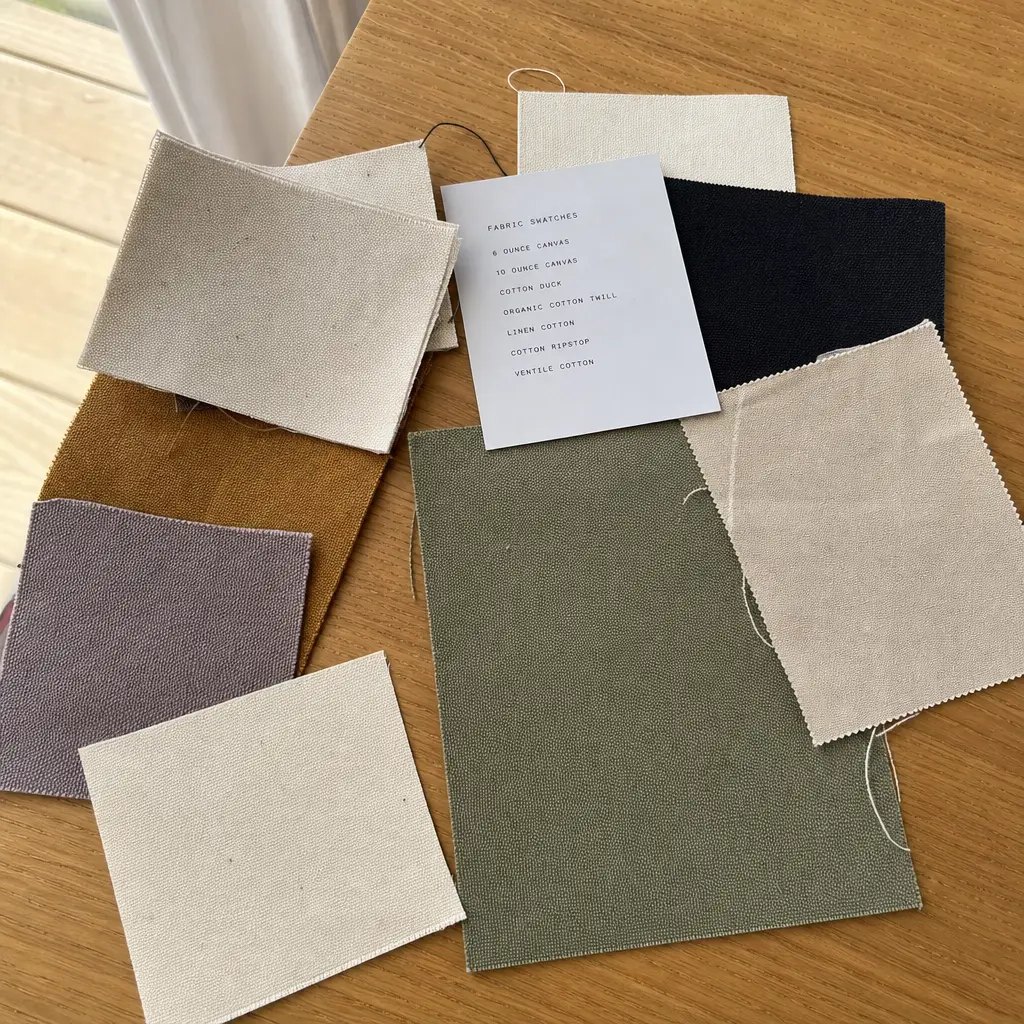
The surface matters as much as the weight. Cotton drill often gives a smoother and more predictable print face. Canvas can deliver a more rugged, premium texture, but it may show more natural variation. If the brand wants a natural unbleached look, buyers should still define what variation is acceptable. A wellness customer may like an organic aesthetic, but not a bag that looks blotchy, speckled in the wrong places, or inconsistent from carton to carton.
- Specify GSM, weave, color, and finish together.
- Ask for shrinkage allowance if the bags may be washed or lightly laundered.
- Approve the shade and texture on a physical swatch, not just a screen image.
Decide the branding method by artwork risk and order profile
Print method should be selected around artwork complexity, order size, and the level of durability the customer expects. For a simple one-color studio logo, screen print is often the strongest procurement choice because it is repeatable, efficient, and usually cleaner on cotton than more complex decoration methods. For a design with multiple colors, gradients, or many seasonal variations, a transfer-based method may be workable for an initial run, but the buyer should explicitly test adhesion, rub resistance, and fold behavior before approving volume production.
Embroidery can look premium on the right bag, but it is not automatically the best choice for wholesale cotton drawstring backpacks. On lighter cotton fabrics, dense embroidery can distort the cloth or create puckering. It also adds cost and can slow production if the artwork is large or detailed. Embroidery is best reserved for simple marks on a bag body that is sturdy enough to handle the stitch density and where the brand specifically wants a textured look.
The most common error is accepting a quote that says “logo included” without naming the process. Buyers need to know whether the price includes setup, how many colors are covered, whether a white underbase is part of the method, and whether the print is on one side or both sides. Placement also matters. A logo placed too close to the drawcord tunnel, side seam, or bottom fold may appear warped when the bag is filled or hung for retail display.
- Screen print suits simple logos and repeat orders.
- Transfer methods can help with short runs, but must be tested for wear.
- Embroidery should be approved only after fabric weight and stitch load are checked.
Use the MOQ conversation to uncover hidden setup costs
MOQ for cotton drawstring backpacks is rarely a single clean number. It often includes a fabric minimum, a print setup minimum, a label minimum, and a packing minimum. One factory may quote a low bag quantity but require a much larger minimum for the same fabric color or print screen. Another supplier may seem more expensive until you realize their quote already includes the setup items that the first supplier will charge later. That is why procurement should ask for each cost driver separately.
For wellness studios, the order mix often includes more than one color, more than one size, or a few destination-specific versions for retreats, memberships, or seasonal programs. Those are reasonable requests, but every added version increases the risk of setup charges and batch inconsistency. The cleanest approach is to keep the first order as simple as possible: one construction, one print method, and limited color variation. Once the production method is stable, then add assortment complexity.
A good supplier should be able to explain what actually drives the floor quantity. If the answer is only “factory policy,” the buyer probably has not yet reached a real cost conversation. Ask whether the MOQ is constrained by fabric purchase, cutting efficiency, print screen setup, packing labor, or outsourced accessory lead times. The more specifically the supplier can answer, the easier it is to negotiate a realistic order plan.
- Separate MOQ by bag body, decoration method, and packing configuration.
- Keep the first production run simple to reduce revision risk.
- Ask whether mixed colors or mixed carton assortments are allowed after production.
Comparison table: pick the sourcing route that fits the order
The right supplier route depends on how much control you need over bag construction, decoration, documentation, and delivery coordination. A direct factory is usually the best choice when you need precise control over sewing details, print placement, and carton packing. A trading company can still be useful when you are consolidating several items or need more hands-on coordination, but only if they can show who the real factory is and how QC decisions are made.
Use the comparison below as a practical sourcing filter. The goal is not to chase the lowest quoted unit price. The goal is to minimize landed-cost risk, which includes sampling time, rework, packing damage, delays, and the cost of a bad first impression when the bags arrive in a studio retail setting.
- Define specs in measurable terms, not marketing language.
- Tie all sample notes to the same version of the spec sheet.
- Ask who controls final QC, not just who sends the quote.
Approval samples should mirror production, not the showroom version
A polished sales sample is not enough for this product category. The pre-production sample should be built from the same fabric, cord, print method, and label method that will be used in bulk production. If the supplier substitutes any of those parts, the buyer should treat that as a revised sample and approve it again. Otherwise, the buyer is not approving the finished product; they are approving an illustration of it.
The sample should be tested in a way that reflects real use. Open and close it several times. Load it with a realistic weight. Check whether the cords sit evenly, whether the tunnel distorts, and whether the print holds position when the bag is filled. If the item is intended for retail sales in a wellness studio, hang it on a hook and see whether it still looks balanced when displayed. A bag that looks fine in a flat photo can look awkward when it carries a bottle, towel, or class materials.
Buyers should also examine the small details that usually cause complaints later: smell, loose threads, skipped stitches, mismatched labels, uneven top hems, and off-center placement. These are not cosmetic only. They are indicators of whether the factory has a controlled process or whether each bag is being made with loose tolerance and minimal supervision.
- Measure dimensions against the approved spec, not against memory.
- Check cord pull security and side-seam strength by hand before sign-off.
- Reject any sample that changes fabric, print method, or label construction without a new approval.
QC should test construction, not just appearance
The best quality control plan for cotton drawstring backpacks checks both visible finish and load-bearing construction. Appearance issues are easy to spot, but they are not the only source of returns. The seam that closes the cord tunnel, the side seam that takes the most pull, and the top hem that supports the drawcord are all failure points if the factory uses the wrong stitch density or rushes the line.
A strong inspection checklist should include dimension tolerance, stitching uniformity, cord security, print clarity, color consistency, and pack accuracy. If the bags are going to be used in a studio retail context, the odor and lint level also matter. Buyers should define what they will reject before production starts, because a vague QC standard becomes a dispute once goods are already packed.
The QC discussion should also distinguish between defects that are acceptable at a promo-goods level and defects that are not acceptable for a wellness brand. A small amount of natural fiber variation may be fine on an eco-looking bag. Random thread nests, crooked prints, weak corners, or bag-body distortion are not. The standard should reflect the customer environment, not a generic commodity tolerance.
- Check stress points at the cord tunnel, corners, and side seams.
- Define acceptable color variation before cutting begins.
- Include odor, lint, and surface cleanliness in the inspection standard.
Packing choices change damage rate and warehouse labor
Packing is often treated as a clerical detail, but it changes the real economics of wholesale cotton drawstring backpacks. Bulk packing in export cartons is usually the default, yet the buyer still needs to decide whether each bag needs a polybag, whether cartons should be lined for moisture control, and whether the finished item will ship retail-ready or as warehouse stock. A packing spec that is too loose can create dust issues, crushed prints, or unpredictable unpacking labor at the destination.
For wellness studios, the right pack format depends on the downstream use. If the bags are going directly into a studio or fulfillment center, an efficient bulk carton may be best. If they are being placed into subscription boxes, retail displays, or event kits, pack count and carton size should be chosen to support pick-and-pack speed. A low unit price can disappear quickly if the warehouse has to repack, relabel, or separate mixed cartons by hand.
The supplier should be able to provide a packed sample photo and carton data before the shipment leaves. Buyers should ask for carton dimensions, gross weight, and label placement in advance so they can confirm pallet fit and warehouse intake requirements. This is especially important when cartons are going to multiple destinations or when the order needs to move through a 3PL, because the receiving team may reject cartons that are too heavy, too small, or incorrectly marked.
- Confirm carton size, gross weight, and pallet fit before production starts.
- Specify polybag, barcode, hangtag, and carton mark requirements in the RFQ.
- Request a packed sample photo before final shipment release.
Lead time risk usually hides in fabric booking and proof approval
The quoted lead time should cover the full cycle from sample approval to goods ready to ship. That cycle usually includes fabric booking, print preparation, cutting, sewing, trimming, final inspection, and carton packing. If the quote only states sewing time, the buyer is not seeing the real schedule. In this category, fabric availability and print approval often matter more than stitching speed.
Wellness studios tend to buy around retreat dates, seasonal campaigns, teacher training events, or membership launches, so timing matters. Buyers should build room for at least one revision cycle and one final inspection cycle. If the supplier cannot explain the critical path clearly, the project is already exposed. A reliable factory should be able to say what starts before artwork approval and what must wait until the proof is signed off.
It also helps to ask the supplier where the slowest step usually is for your exact order profile. The answer may be fabric sourcing, print screen setup, or accessory procurement. That is useful information because it tells the buyer where to hold contingency time and where to avoid last-minute changes. Small artwork edits may seem harmless, but if they require a new screen or revised layout, they can move the whole schedule.
- Tie the schedule to sample approval date, not PO date.
- Ask which step creates the bottleneck when order volume rises.
- Add extra time if the bag needs new labels, custom dyeing, or packaging changes.
Compare quotes on the same spec, not the same headline price
A useful procurement comparison starts with a controlled spec. If one supplier quotes a blank bag and another quotes printing plus packing, the unit prices are not comparable. If one quote assumes a lighter fabric or a different print method, the comparison is still misleading. To make supplier quotes usable, the buyer needs identical bag size, GSM, print method, color count, label method, and carton count across all responses.
The landed cost for wellness-studio bags is usually driven by a combination of fabric, branding, packing, and freight. A supplier with a slightly higher ex-factory price may still be the better commercial choice if they produce fewer rejects, pack more consistently, or save labor in the warehouse. Procurement teams should think in terms of usable goods delivered on time, not only in terms of cheapest factory quote.
The comparison should also capture risk terms. Ask who pays for sample revisions, whether tooling or screen charges are reusable on repeat orders, and whether freight assumptions are included. If the supplier will not separate those items, request the numbers in writing before you compare. That makes the final discussion much easier when brand, finance, and operations all review the order.
- Compare quotes only after aligning spec, packing, and freight assumptions.
- Include setup and sampling policy in the price comparison.
- Use landed cost and reject risk, not just unit price, as the decision metric.
Specification comparison for buyers
| Decision area | Recommended procurement target | Buyer tradeoff | Common failure mode to check |
|---|---|---|---|
| Fabric body | 140–180 GSM cotton drill or medium canvas for most studio use | Better structure and print appearance, but higher cost and more sewing load than light cotton | Bags feel limp, show light-through, or lose shape when filled |
| Fabric finish | Natural, dyed, or enzyme-washed only if the shade and hand feel are approved on a physical swatch | Natural and washed looks are attractive for wellness brands, but shade variation is harder to control | Supplier matches the color name but not the actual tone or fleck level |
| Closure build | Cotton cord with reinforced eyelets or a stitched tunnel with bar-tack reinforcement | More durable opening/closing, but it adds sewing steps and can raise MOQs | Cord cuts into the tunnel, eyelets pull out, or tunnel stitching opens under load |
| Print method | Screen print for simple one- or two-color logos; transfer only when artwork complexity or short runs justify it | Screen print is durable and economical, but it needs clean artwork and setup; transfer is flexible, but durability must be tested | Cracking, edge lift, poor opacity, or print distortion near seams |
| Branding placement | Logo centered on the body with a safe margin from seams, cord tunnel, and bottom fold | Cleaner presentation, but the printable area may be smaller than marketing wants | Logo gets hidden when the bag is filled or folds over the seam line |
| Sampling route | Pre-production sample in production fabric, production cord, production label, and final print method | Slower than approving a sales sample, but much safer for first orders | Sample looks right but does not match the final bulk run |
| Packing method | Export cartons with packing quantity, carton markings, and moisture control defined up front | More planning work, but lower damage and warehouse confusion | Over-compression creases the print, distorts cords, or creates packing disputes |
| Supplier route | Direct factory for custom construction; trading company only if they add verified factory control and documentation | Factory-direct often gives better process control; intermediaries can help with consolidation | Middleman quote hides the true source, QC responsibility, or change fees |
Buyer checklist before sampling
- Confirm finished size, usable volume, and flat dimensions; do not rely on pattern size alone.
- Lock fabric type, GSM, color, and acceptable shade variation before asking for price.
- Specify cord diameter, cord length, tunnel construction, and whether end knots, tips, or stoppers are included.
- State logo size, placement, number of colors, print coverage area, and whether a white underbase is allowed.
- Require a pre-production sample made with production fabric, production cord, and production label method.
- Ask for separate pricing for blank bags, printing, labels, packaging, and any extra finishing work.
- Define carton pack count, carton size, gross weight limit, and whether inner polybags are required.
- Set inspection criteria for stitch quality, print registration, seam strength, odor, and carton accuracy.
- Agree on lead time from sample approval date, not from purchase order date.
- Confirm whether the quote includes customs-ready export packing or only factory packing.
Factory quote questions to send
- What exact fabric construction, GSM, weave, and shrinkage allowance are included in this quote?
- Is the unit price for blank bags only, printed bags, or retail-ready packed goods?
- What is the MOQ per color, per size, and per artwork version?
- Which parts of the cost are one-time setup charges, and which are recurring per unit?
- What sample charges apply, and are they deductible from the bulk order if we proceed?
- Which print method is being quoted, what is the included color count, and what changes the price?
- What is the minimum printable area and the safe distance from seams, cords, and folds?
- What carton count, packing method, and master carton dimensions are assumed in the quote?
- What is the production lead time after sample approval, and what steps are included in that timeline?
- What in-line checks and final inspections are performed before shipment, and can you share the standard?
Quality-control points to confirm
- Fabric matches the approved GSM, weave, color, and hand feel across cartons within the agreed tolerance.
- Finished bags stay within dimension tolerance after pressing and packing, with no obvious asymmetry.
- Stitching is even, with reinforced stress points at side seams, corners, and cord channels.
- Cord length, cord tension, and cord security are consistent, with no fraying or pull-out risk.
- Print alignment is centered and within tolerance, with no visible smearing, cracking, ghosting, or weak opacity.
- Seams do not pucker excessively, and the bag opens and closes smoothly without tunnel distortion.
- Cartons match the approved pack count, label content, and marking format exactly.
- Odor, lint, loose threads, and surface contamination are acceptable for retail presentation.
- If a retail hangtag or barcode is required, it is placed correctly and matches the purchase order.
- Packing prevents crushing, moisture damage, and print transfer during transport and storage.