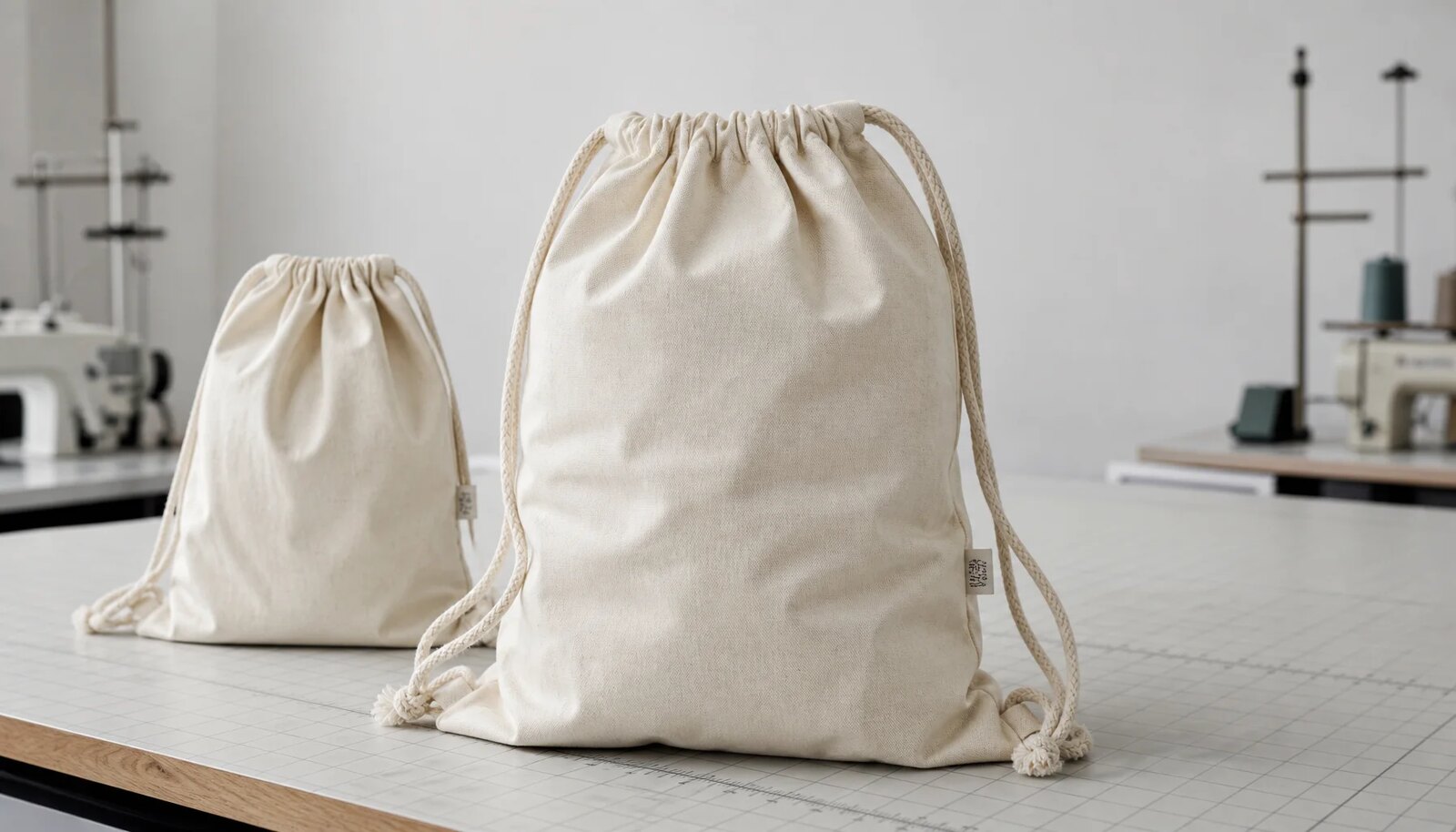
Start With the Use Case, Not the Bag Style
For wholesale cotton drawstring backpacks in farmers market programs, the first decision is not logo or color. It is how the bag will be used. A giveaway bag for market maps, seed packets, and sponsor flyers is a different product from a retail bag sold by a farm stand, used as a CSA add-on, or packed with jars and bottled goods. The picture may look the same in a mockup, but the sourcing spec should not.
Buyers often under-specify this category because the product is visually simple. In practice, market bags are handled quickly, stacked under tables, loaded with damp produce, and reused in ways that create uneven stress. The weak points are usually the cord tunnel, lower corners, and side seams, not the middle of the fabric panel.
A workable starting point for many programs is a finished size around 34 x 40 cm to 38 x 42 cm, a cotton body in the middle GSM range, double drawcords, and some form of lower-corner reinforcement. That is only a benchmark. The right spec depends on the load, the print, the retail channel, and whether the bag needs to look premium on a shelf or simply perform as a handout.
Treat the RFQ like a procurement document, not a design brief. If the order needs retail folding, barcode labels, or distributor carton marks, those requirements belong in the first quote. If they are added after pricing, the supplier may need to revise both cost and lead time.
- Define the channel: giveaway, retail, CSA, staff use, sponsor pack, or association program.
- List the expected contents in practical terms, not just as a reusable bag.
- State whether the bag must work as a backpack, a pouch, or both.
- Call out any retail packing, barcode, or distributor requirements before quoting.
- Identify the stress points that need reinforcement.
- Separate the bag spec from the artwork spec so the supplier can price each cleanly.
Use GSM as a Range, Not a Shortcut
GSM matters because it affects handfeel, opacity, print behavior, sewing stability, freight weight, and carton volume. It does not tell the whole story. Two bags can both be quoted at 220 gsm and still perform very differently if one uses loose plain weave and the other uses tighter canvas or duck cotton.
For buyers sourcing farmers market vendor bags, 140 to 180 gsm is usually the light giveaway range. It is acceptable when the bag is carrying paper, seed packets, or a small sponsor kit. Once the bag is expected to hold produce, bread, or glass containers, that range becomes risky unless the rest of the construction is unusually strong and the load is light.
The most useful middle ground is often 200 to 240 gsm. That range usually gives enough body for repeat use without making the bag bulky or expensive to ship. It also provides a more reliable surface for screen print compared with very thin cotton. For many B2B programs, that is the sweet spot because it balances price, presentation, and performance.
Above 240 gsm, buyers should have a clear reason for the extra weight. Heavier cotton improves structure and perceived value, but it also increases sewing effort, carton weight, and freight cost. That tradeoff makes sense for retail resale or heavier-carry items, but it can be overkill for short-life event giveaways.
- 140 to 180 gsm: light promotional use and low-load handouts.
- 200 to 240 gsm: the most practical range for many reusable market programs.
- 240 to 280 gsm: stronger retail positioning and heavier contents.
- 280 to 320 gsm: premium or heavy-carry use with higher freight and sewing demands.
- Ask whether the GSM is finished weight or base cloth weight.
- Review a physical swatch for opacity, weave tightness, and print suitability.
Choose the Fabric Construction Deliberately
Fabric type is as important as weight. A loose plain weave, a tighter canvas, and duck cotton can all sit in similar GSM bands but behave differently in production and in use. The tighter the weave, the more body the bag usually has, and the better it resists distortion around the seams. The tradeoff is cost and, sometimes, stiffness.
Natural unbleached cotton is a common choice for farmers market branding because it matches handmade, farm, bakery, and regional market positioning. That look is useful, but it comes with a quality-control burden. Visible seed flecks and shade variation can be normal if they are defined against an approved swatch. They should not be used to excuse stains, odors, or heavy defects.
Bleached cotton gives a cleaner print base. Dyed cotton can support stronger brand color, but it introduces shade management, lot control, and in some cases higher MOQ or longer lead times. If organic or recycled claims are part of the product story, those claims should be documented before the artwork or label is approved. The supplier should not be allowed to fill in the paperwork later.
If the buyer expects repeat orders, ask what the supplier does when the fabric source changes. A small variation in shade or texture can be acceptable for a hand-crafted look, but not for a private-label program that needs continuity across seasons. Reorder discipline matters more than many buyers expect.
- Name the fabric construction in the quote, not only the GSM.
- Use natural cotton when the brand wants a rustic or low-processed look.
- Use bleached cotton when artwork needs a cleaner background.
- Use dyed cotton only when shade control and reorders are being managed deliberately.
- Request documentation before using organic or recycled claims on packaging or listings.
- Confirm whether pre-shrinking or finishing has already affected the final weight and feel.
Specify the Construction Around Failure Points
Most failures in cotton drawstring backpacks happen at stress points. The top tunnel, the lower corners, the cord exits, and the side seams take the strain every time the bag is opened, closed, lifted, or worn on the back. Farmers market loads are irregular, so the pressure is uneven. A bag full of apples behaves differently from one full of jars or bread.
That is why buyers should not approve a bag on size and logo alone. The factory can meet the visual mockup while quietly saving cost on seam allowance, thread quality, or reinforcement. That may be fine for a flyer bag. It is not fine for a retail item meant to survive repeat handling.
The cord tunnel should be wide enough for smooth movement and straight enough not to twist under load. If the cord jams, the user pulls harder and the top seam takes more strain. Cord length matters too. Uneven cords are one of the fastest ways to make a simple bag feel cheap, even when the fabric itself is acceptable.
Lower-corner reinforcement should be visible in the sample and written into the PO. A bartack, extra stitch pass, or reinforced loop is often enough, but the method must match the intended load. If the bag is expected to carry jars or bottled goods, the buyer should ask for a more explicit load check rather than assuming a standard sewing construction will be enough.
- Require reinforcement at the lower corners and cord exits when the bag will carry anything heavier than paper.
- Use double drawcords if the bag must be worn comfortably as a backpack.
- Define cord material, diameter, length, and end finish.
- Set seam allowance and stitch density in writing, even if the factory calls it standard.
- Check for skipped stitches, loose thread tails, and tunnel puckering.
- Ask for a function check on the cord movement before bulk approval.
Match the Print Method to the Fabric and Artwork
Print is not just decoration. It affects cost, lead time, and whether the bag looks retail-ready. For simple market logos, one-color or two-color screen printing is still the most practical route at volume because it is easy to inspect and repeat. On cotton, however, the outcome depends on the fabric texture, ink system, and curing control, not just the artwork file.
Water-based ink can give a softer handfeel that suits natural cotton. Higher-opacity systems may be better for darker dyed bags or bold solid logos. Large solids on textured cotton will still show some weave character, so the buyer should decide whether that texture is part of the brand story or a defect. That decision should happen before the first strike-off, not after bulk production starts.
Heat transfer can work for short runs or frequent artwork changes, but it needs testing on the actual fabric. A transfer that looks clean in a mockup can crack, lift at the edges, or feel too plastic once the bag is folded and reused. Embroidery can look premium, but it can also pucker lighter fabric and create a stiff patch that does not fold neatly.
The safest approval path is a strike-off on the same finished fabric that will be used in bulk. A digital proof is not enough because it does not show opacity, rub resistance, or how the print sits on the cotton texture. If multiple vendor logos are involved, standardize the print zone and avoid approving a new layout for each one unless the supplier has agreed to that complexity in the quote.
- Use screen printing for repeatable branding and simple color counts.
- Use a strike-off on actual bulk fabric before final approval.
- Use higher-opacity inks when darker cotton or strong coverage is required.
- Use heat transfer only after checking fold marks, flexing, and edge adhesion.
- Use embroidery only when the fabric weight can support it cleanly.
- Approve print placement from fixed reference points, not by eye alone.
Build a Clear RFQ and Avoid Quote Drift
A good RFQ reduces back-and-forth and makes quotes comparable. If the supplier receives only a mood board and a target price, the result will usually be vague pricing with hidden assumptions. For cotton drawstring backpacks, quote drift often starts with unspoken choices around fabric finish, cord type, print setup, and packing.
Ask for the exact fabric GSM, construction, and finish. Ask whether the quote includes the same cord, the same reinforcement, the same label type, and the same folding standard that will be used in bulk. If those items are not named, the supplier may substitute a lower-cost version that still looks close in a photo.
MOQ needs to be broken down by variable. A total MOQ of 1,000 pieces is not the same as 1,000 per artwork, per fabric color, or per label version. Farmers market association programs often need one base bag with multiple vendor marks. In that case, the print setup and label changes may matter more than the bag body itself.
Ask for tiered pricing at 500, 1,000, 3,000, and 5,000 pieces using the same specification. That shows whether price breaks come from scale or from changes in materials and packing. It also makes it easier to see where the real cost drivers are before the order is placed.
- Ask what is included in the base unit price and what is treated as an add-on.
- Separate one-time costs from recurring costs.
- Request the MOQ by fabric color, print version, label, and packing style.
- Ask whether screens, labels, or artwork files can be reused on reorders.
- Compare tiered pricing on the same spec, not on changing specs.
- Keep the RFQ narrow enough that suppliers are quoting the same product.
Choose the Right Supplier Route for the Program Risk
The best sourcing route depends on how much control the buyer needs. A stock supplier can be useful for fast replenishment, late-season launches, and small pilot orders. The tradeoff is limited control over exact GSM, shade, stitching, and repeatability. If the blank bag changes source behind the scenes, the product may drift between orders.
A direct factory route gives better control over fabric, sewing, decoration, and packing. That matters for repeat wholesale programs, retail bags, and association orders where consistency is more important than the lowest possible setup cost. Buyers should ask whether printing and packing are done in-house or outsourced, because that changes accountability if the bulk lot misses the approved sample.
Trading companies and sourcing partners are not automatically a problem. They can be useful when the buyer wants document support, consolidated shipping, or multiple product categories. The risk is opacity. If the actual factory is hidden, the buyer should still require sample traceability, inspection evidence, and a named quality contact who can answer bulk questions without delay.
For farmers market use, the right route usually comes down to the need for repeatability. A one-off giveaway can tolerate more variation. A retail or association program should not. If the bag will be re-ordered every season, the supplier should be able to explain how they preserve fabric, cord, print, and packing consistency over time.
- Use stock suppliers for speed and low commitment.
- Use direct factories when fabric weight, construction, and packing need tighter control.
- Use sourcing partners only when factory disclosure and QA responsibility are clear.
- Ask whether printing and packing happen in-house or through subcontractors.
- Request production or inspection photos tied to the actual PO.
- Confirm who pays if sorting, rework, or replacement is needed after inspection.
Plan Packing, Cartons, and Transit Conditions Early
Packing is part of the spec, not an afterthought. Cotton drawstring backpacks are flexible, so buyers often focus on unit price and leave packing decisions until late. That is risky. Retail folding, paper bands, polybags, barcode stickers, carton marks, and inner pack counts all affect labor, warehouse receiving, and freight.
If the bags go into farm shops, grocery channels, or e-commerce fulfillment, the fold standard should be fixed before production starts. A clean fold makes the product easier to display and receive, but a bad fold can crush the print or leave the cords tangled. The buyer should approve the fold sample or at least a clear packing diagram.
Carton data matters because lighter-looking items can still create expensive freight when the fabric is heavy. Request carton dimensions, net weight, gross weight, and pieces per carton before the PO is finalized. A move from 220 gsm to 300 gsm can change freight economics enough to alter the landed cost, even if the unit price looks manageable.
For shipments with long transit times, humidity, or rough handling, ask about moisture protection and carton strength. Cotton can pick up odor or dampness in storage if the carton spec is too light for the route. If the bags are packed tightly, the buyer should also confirm that the folds, prints, and cords still look acceptable after the carton is opened.
- Set the packing style before final approval: bulk, inner pack, polybag, paper band, or retail-ready.
- Approve fold size and cord orientation with a sample or diagram.
- Request carton dimensions, net weight, gross weight, and pieces per carton.
- Use moisture protection when the route is humid or storage time is long.
- Match carton marks to SKU, color, quantity, PO, and destination.
- Confirm barcode placement if the bags will be scanned at receiving or retail.
Put QC on Paper Before Production Starts
QC should be written into the PO before the factory cuts fabric. A bag this simple can still fail in ways that matter commercially: wrong weight, wrong shade, weak seams, crooked print, miscounted cartons, or poor packing. If the buyer waits until the shipment arrives, the correction path is slower and more expensive.
A workable inspection structure starts with an AQL plan tied to the lot size. The exact sample count should be agreed in advance, along with the defect definitions. Critical defects should cover contamination, mold, sharp fragments, or the wrong product. Major defects should cover open seams, wrong fabric weight, incorrect reinforcement, bad print placement, undercured ink, wrong labels, or wrong carton quantity.
Inspection should include measurement and function tests, not only visual review. That means checking dimensions, cord lengths, opening width, print location, label position, and carton count. The inspector should open and close the cord, check seam security, and compare the lot against the golden sample. For heavier programs, a load test or pull test should be used to reflect actual market use rather than a generic test claim.
Carton and transit checks matter too. Ask for a drop check or at least a carton handling review on packed goods, especially if the route is long or humid. If the bags are going into retail or distributor channels, the QC file should include the sample, strike-off, packing standard, and the acceptable tolerance list so the shipment can be judged consistently.
- Use an AQL plan with sample size and defect classes written before production.
- Define critical, major, and minor defects clearly.
- Measure dimensions, cord length, print placement, and carton count during inspection.
- Add a load or pull test when the bag is intended for heavier market use.
- Check cartons for moisture protection and transit damage risk.
- Keep the golden sample and approved strike-off with the QC file.
Use a Reorder Spec So the Product Does Not Drift
The first order is only half the job. Many buyer problems show up on the second or third run when a fabric lot changes, a cord source changes, or the packing standard is relaxed. That is common in commodity sewn goods and avoidable when the original spec is written well.
A reorder spec should name the approved fabric type, GSM range, cord material and diameter, seam and reinforcement details, print method, label type, carton count, and packing method. If the bag is sold under a private label, the buyer should also keep the artwork files, the strike-off image, and the exact sample reference in the same procurement file. That makes it easier to compare a reorder against the original standard.
For farmers market vendors, drift is often most visible in natural cotton. A slightly different shade or fleck level may be acceptable if the brand wants an artisanal look. It is not acceptable if it changes the retail presentation from one season to the next. Buyers should decide where they are willing to allow variation and where they are not.
The goal is not perfect sameness in every fiber. The goal is controlled variation. If the supplier can explain the source of a change and it falls inside the agreed standard, the order can move. If not, the buyer should treat it as a nonconformance instead of assuming it will average out later.
- Keep a reorder spec that mirrors the approved sample, not just the original quote.
- Store the strike-off, golden sample, and packing sample in the procurement file.
- Define where variation is acceptable and where it is not.
- Review shade drift, cord drift, and packing drift separately.
- Ask the supplier to disclose any change in source before production starts.
- Use the same inspection standard on reorder lots as on the first shipment.
Specification comparison for buyers
| Fabric weight | Best use case | What it buys you | Buyer risk to check |
|---|---|---|---|
| 140 to 180 gsm | Flyers, seed packets, sponsor handouts, low-load event bags | Low cost, lighter freight, easier folding, adequate print surface for simple giveaways | Can feel thin, show contents, and wear out quickly if reused with produce or bottles |
| 180 to 220 gsm | Light retail, farm-shop impulse items, CSA add-ons, short-run vendor bags | Balanced price, improved handfeel, better print stability, still easy to pack | Check opacity, seam strength, and whether the fabric drifts too soft or too loose in weave |
| 220 to 240 gsm | Core farmers market vendor bag | Best all-around choice for many wholesale programs: more body, better repeat use, acceptable freight | Confirm finished GSM, shrinkage, reinforcement, and that the sample matches the bulk lot |
| 240 to 280 gsm | Premium retail bag, heavier customer carry, jar or candle kits | Stronger body, better perceived value, better support for structured branding | Higher unit cost, thicker seams, and more chance of print or fold issues if the factory is not set up for heavier cotton |
| 280 to 320 gsm | Heavy-carry or premium branded merchandise | Maximum body and durability in this category | Freight, carton size, sewing setup, and print curing need more control; can be overkill for simple market giveaways |
| Natural unbleached cotton | Farm, bakery, handmade, or low-processed brand positioning | Authentic look, broad appeal, simple decoration | Shade variation, seed flecks, stains, and odor need clear acceptance limits |
| Bleached or dyed cotton | Cleaner print base or tighter brand color control | Better logo contrast and more polished retail presentation | May cost more, show dirt sooner, or require tighter shade approval and lot control |
Buyer checklist before sampling
- State the commercial use first: giveaway, retail resale, CSA add-on, staff bag, sponsor item, or market association program.
- Define what the bag must carry in plain terms: flyers only, bread and produce, jars, bottles, or mixed retail goods.
- Specify finished size, usable opening width, and whether the bag must function as a backpack or only as a drawstring pouch.
- Confirm whether quoted GSM is finished weight after dyeing and finishing or base cloth weight before processing.
- Choose the fabric construction: plain weave, canvas, duck cotton, recycled cotton blend, organic cotton, bleached cotton, or dyed cotton.
- Set a fabric weight range by use and do not treat GSM as the only decision factor.
- Lock decoration details: print method, number of colors, artwork placement, print size, Pantone target, and handfeel expectation.
- Require a strike-off or pre-production sample on the same fabric and finish that will be used in bulk.
- Specify cord material, diameter, length, color, and end finish, and state whether the cord runs through a folded tunnel or eyelets.
- Define seam allowance, stitch density, bottom-corner reinforcement, label type, fold standard, and carton packing count.
Factory quote questions to send
- What exact GSM are you quoting, and is it measured on finished fabric or on base cloth before finishing?
- What fabric construction is included, and can you provide yarn or weave details if available?
- Can you provide a swatch or past bulk sample in the same fabric weight, construction, and finish before PO approval?
- For natural cotton, what shade range, fleck level, and visible surface variation do you consider acceptable?
- For dyed or bleached cotton, do you provide lab dips or shade approval before bulk production?
- What finished bag size, seam allowance, and stitch density are included in the quote?
- How are the lower corners reinforced, and is that reinforcement part of the base price or an upgrade?
- What cord material and diameter are included, and what is the length tolerance on each side?
- What print method and ink system will you use, and what setup charges apply per color or artwork version?
- What are your tolerance limits for print placement, label position, fold size, carton count, and gross carton weight?
Quality-control points to confirm
- Confirm fabric GSM against the approved range and verify the finished fabric matches the golden sample for handfeel, weave, and opacity.
- Reject fabric with oil marks, mildew odor, holes, broken yarns, heavy slubs beyond the approved standard, or visible contamination.
- Measure finished width, height, opening width, and folded size against the PO tolerances; for simple cotton bags, many buyers use about plus or minus 1 cm unless tighter control is needed.
- Check the drawcords for equal length, smooth movement through the tunnel, secure knots or end finishes, and no fraying or pullout under repeated open-close checks.
- Inspect the top tunnel, side seams, and bottom seams for skipped stitches, puckering, open seams, and loose thread tails that can catch the cord.
- Verify lower-corner reinforcement, bartacks, or other stress-point treatment is present, consistent, and placed where the sample showed it.
- Compare print color, placement, opacity, and registration against the approved strike-off; check for edge lift, cracking, tackiness, or undercure after rub and flex tests.
- Use an AQL-based final inspection plan tied to the lot size, with sample counts and defect definitions written before production starts.
- For heavier-use programs, ask for a load test or pull test that reflects the intended contents rather than a generic pass/fail claim.
- Check carton quality for moisture protection, clean interior packaging, correct carton marks, and a drop or transit check when the route is long or humid.