Start with the bookstore use case
A university bookstore order should begin with the program requirement, not a generic backpack photo. A retail item needs a cleaner front panel, controlled folds, accurate barcode or hangtag placement, and cartons that receiving staff can process quickly. An orientation giveaway can use simpler packing, but it still needs secure seams, reliable cord exits, and print curing that survives bulk handling. An admissions kit has a different risk: the bag must fit folders, brochures, apparel, lanyards, and inserts without slowing the packing line.
The first sourcing decision is therefore practical: who receives the bag, what it carries, how it is displayed or distributed, and how cartons arrive. That context helps the supplier recommend fabric weight, cord type, reinforcement, print method, carton quantity, and sample steps. It also keeps the quote focused on buyer value rather than decorative options that do not matter to the program.
- Retail sale: control stitching, front-panel appearance, fold method, barcode accuracy, and carton labels.
- Orientation giveaway: prioritize durable corners, smooth distribution, cured print, and simple bulk packing.
- Admissions kit: test the sample with the actual folder, inserts, apparel, and lanyard before approving size.
- Department merchandise: standardize the bag body and separate artwork versions by SKU and carton mark.
- Online fulfillment: approve individual packing, folded size, scan accuracy, and moisture protection.
Specify fabric beyond cotton
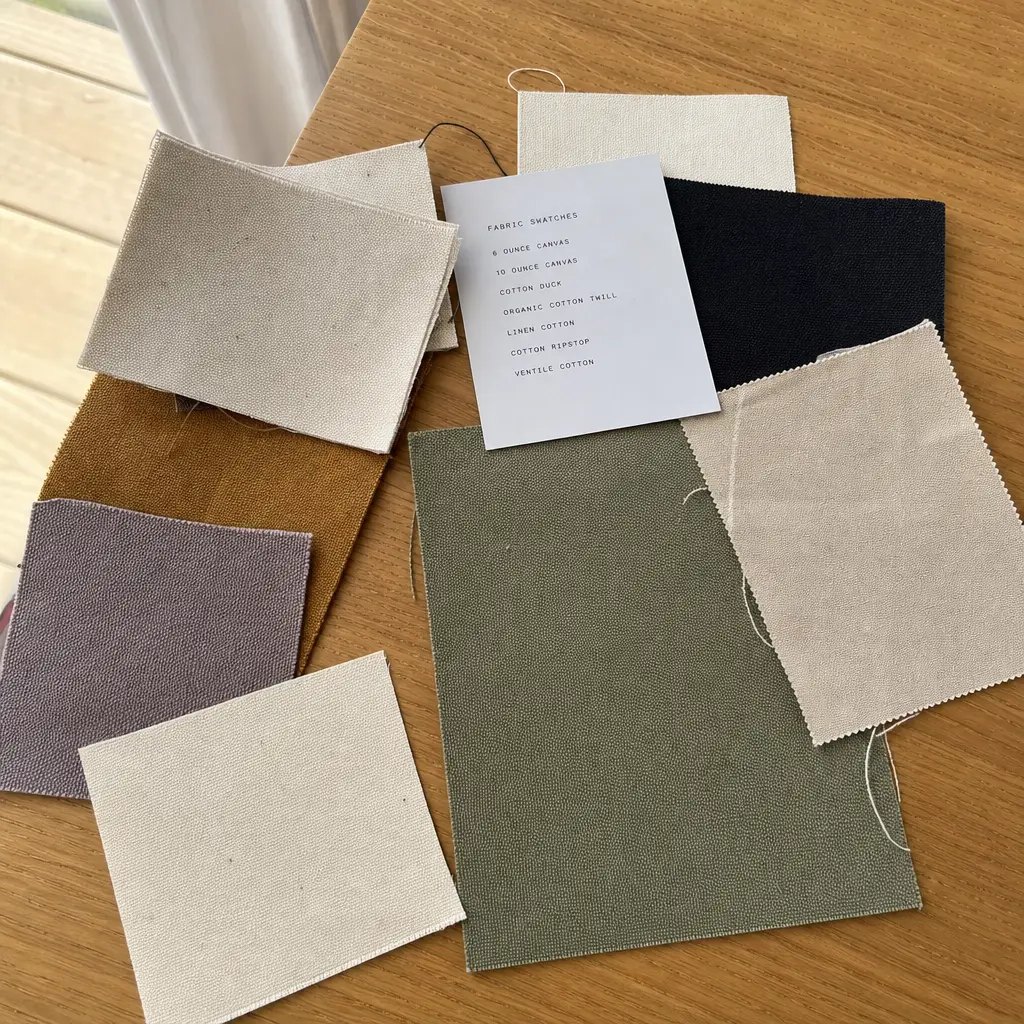
Cotton is only the fiber. A useful RFQ includes ounce, GSM, weave, finish, color route, shrinkage expectation, and tolerance. Suppliers may describe similar bags as cotton sheeting, canvas, duck, 5 oz, 6 oz, 8 oz, or by GSM, and those descriptions are not always interchangeable. For many bookstore programs, 6 oz to 8 oz cotton canvas or duck, roughly 200-270 GSM, is a practical buyer-spec example because it balances handfeel, print support, carton weight, and cost.
Lighter fabric can work for short-term giveaways, but it may look thin under store lighting and show contents through the body. Heavier fabric may feel more premium, yet it can increase freight weight, create fold marks, and make the drawstring harder to close. The sample should prove that the bag prints, folds, closes, and carries correctly; premium does not always mean heavier.
Finish and claim language need attention. Natural cotton has an unbleached look with seed flecks and slubs that should match a physical reference sample. Bleached cotton gives a cleaner print base but should be checked for stains and whiteness consistency. Dyed cotton requires swatch or lab dip approval and may change MOQ or lead time. If the bookstore wants organic, recycled, or other sustainability wording on tags, product pages, or signage, request documentation before approving that copy.
- Request ounce, GSM, weave, finish, shrinkage expectation, and GSM tolerance in the RFQ.
- Use 200-270 GSM as a balanced example range, then adjust for budget, retail positioning, and carry weight.
- Approve natural shade, seed flecks, and slub level with a physical reference sample.
- For dyed cotton, confirm lab dip process, dye-lot MOQ, and reorder shade control.
- Do not publish sustainability claims until supplier documentation supports the exact wording.
Lock finished size and fit
A common drawstring backpack size is about 35 x 42 cm, but the buyer should not approve size from a flat photo. University bookstore bags often carry letter or A4 folders, notebooks, folded T-shirts, admissions packets, or event materials. The opening may look acceptable when empty and become too tight during kit assembly. The bottom corners may pull sharply under load, or the cords may sit uncomfortably on the shoulders.
Write dimensions as finished measurements after sewing, printing, heat curing, pressing, and final packing preparation. Cotton may shrink during dyeing, washing, pressing, or curing, so cut size is not the right purchase-order measurement. A practical commercial tolerance for sewn cotton drawstring backpacks is often around +/-1 cm measured flat, but the PO should state the buyer’s accepted range. If a mailer, shelf fixture, or kit requires tighter control, confirm feasibility and inspection cost before placing the order.
Measurement instructions should be simple. Measure width across the flat body, height from top edge to bottom seam, opening width when packing speed matters, and logo placement from fixed edges. Then load the sample with the real contents. That test catches issues that a measurement chart will not.
- Use 35 x 42 cm only as a starting point, then test the largest real insert or bundle.
- State that size is measured flat, empty, after sewing and finishing.
- Define width, height, opening width if relevant, and print placement tolerances.
- Approve cord length and shoulder fit with realistic contents, not an empty sample.
- Record the approved sample measurements for production, inspection, and receiving comparison.
Control cords and reinforcement
Cords and corners are functional parts, not trim details. Cotton rope gives a natural look and works well with unbleached cotton programs. A 5-7 mm cotton rope is a common buyer-spec example for sturdier natural styling. A 4-6 mm braided polyester cord may be better when the buyer needs smoother movement, shade consistency, lower moisture absorption, or bright school colors. Very thin cords may reduce cost but can dig into shoulders once students carry notebooks or event materials.
The top channel should let cords move without trapping, twisting, or puckering. Stitching through the cord is a serious defect because it prevents smooth closing. Thread nests inside the channel can snag. If the front print sits high, check whether ink coverage and curing heat make the channel stiff.
Corner reinforcement needs an approved construction. Eyelets can look retail-ready, but they need backing patches and checks for looseness, sharp edges, rust marks, and fabric cutting. Stitched buttonholes, bar tacks, or sewn channels can support metal-free programs, but stitch density and stress points must be reviewed. During sample approval, load the bag and pull both cords repeatedly. The reinforcement should not tear, shift, or deform.
- Specify cord material, diameter, shade, length, end treatment, and tolerance.
- Check left-right cord balance so the bag wears evenly on both shoulders.
- For eyelets, inspect backing patch, sharp edges, rust risk, and movement after pull testing.
- For stitched reinforcement, approve bar-tack location, stitch density, and fabric stress area.
- Keep cord and reinforcement details stable across reorders to avoid visible program differences.
Match decoration to artwork
University bookstore backpacks often carry licensed marks: school logos, mascots, department names, orientation themes, athletics graphics, or alumni artwork. Screen printing is usually the practical wholesale method for one to four solid PMS colors when the buyer supplies vector artwork. It can be clean and repeatable, but only when ink, mesh, curing, fabric absorption, print size, and packing timing are controlled.
Heat transfer can fit gradients, fine detail, photographic artwork, or many colors, but it should be tested on the final fabric for handfeel, edge lifting, cracking, fold performance, and transfer risk. Embroidery works best as a small premium mark on heavier fabric; large embroidery on lightweight cotton can pucker the front panel and change drape. Decoration should be selected around order quantity, logo size, fabric weight, and retail expectation, not only the look of a digital proof.
Physical approval matters for licensed colors. A PDF can confirm layout, but it cannot show how natural cotton warms ink color, how a dyed ground shifts PMS appearance, or whether a large print feels too stiff. Keep the approval record precise: artwork version, print width and height, placement from top and side edges, PMS target, clear-space rule, and acceptable variation.
- Use screen print for bold logos, mascot marks, department names, and repeat programs.
- Use heat transfer for complex color only after checking edge durability and handfeel.
- Use embroidery for small premium marks on fabric weight that can support stitching.
- Provide vector artwork, PMS references, print size, placement, and licensed brand rules.
- Approve a physical strike-off or printed pre-production sample before bulk printing.
Compare MOQ and supplier capability
MOQ can be driven by more than sewing capacity. Fabric availability, dye lots, cord color, print screens, label application, packaging style, carton segregation, and artwork versions can all create minimums. A supplier may support a low MOQ in stock natural cotton but require more pieces for custom dyed fabric, custom cord colors, certified materials, or multiple department logos.
Ask for tiered quotes using identical specifications. Common comparison points are 500, 1,000, 3,000, and 5,000 pieces, but the tiers should match your bookstore demand. The goal is to reveal real price breaks, not quiet specification changes. If one tier uses lighter fabric, a smaller print, simpler packing, or a different Incoterm, the unit prices are not comparable.
Supplier qualification should be part of the quote review. Ask about relevant production capacity during peak season, recent audit or social-compliance documentation if your institution requires it, whether any work is subcontracted, and how reorder records are maintained. For repeat bookstore programs, the supplier should be able to retrieve approved fabric, cord, print size, artwork version, carton marks, and inspection notes from the prior order.
- Ask for MOQ by bag body, body color, cord color, print design, and packing style.
- Compare tiers only when fabric, size, cord, print area, packing, carton quantity, and Incoterm match.
- Separate one-time screen charges, sample costs, strike-off charges, and label costs from unit price.
- Confirm capacity, subcontracting policy, audit history if needed, and peak-season production schedule.
- For reorders, require documentation for approved fabric, cord, artwork, packing, carton marks, and tolerances.
Build a clean RFQ package
A low unit price is not useful when the quotation omits fabric weight, finished size, print method, carton data, sample terms, or trade terms. Missing fields become landed-cost problems later. Carton dimensions affect freight. Gross weight affects shipping estimates. Polybags, hangtags, UPC labels, SKU stickers, inner packs, moisture protection, and carton marks all add material or labor. They should be quoted before the purchase order is issued.
A strong RFQ makes each supplier answer the same fields. Include finished size, fabric GSM, fabric finish, cord type, cord length, reinforcement method, decoration method, print size, color count, packing format, carton quantity, and Incoterm or handover point. Ask for sample lead time, bulk lead time, inspection window, payment terms, quote validity, and the event that starts production.
Schedule language is important for semester-start and orientation orders. Lead time may start after deposit, artwork approval, lab dip approval, sample approval, barcode receipt, or packaging-file approval. If that is unclear, the buyer may need upgraded freight or may miss the event. Put dates and dependencies in the RFQ instead of solving them after delays appear.
- Product fields: GSM, finish, finished size, cord, reinforcement, print method, print size, and placement.
- Commercial fields: MOQ, tier pricing, setup charges, sample fees, payment terms, currency, and quote validity.
- Packing fields: bulk or individual pack, carton quantity, carton dimensions, net weight, gross weight, labels, and marks.
- Schedule fields: sample lead time, revision time, bulk lead time, inspection window, and handover date.
- Risk fields: fabric availability, dye-lot approval, artwork approval, label deadline, capacity, and subcontracting.
Use samples as control points
Samples are approval controls, not souvenirs. A plain construction sample confirms fabric handfeel, finished size, seam quality, cord comfort, top channel movement, and corner reinforcement. A swatch or lab dip is needed when body color matters. A print strike-off confirms ink color and print hand on the actual fabric. A printed pre-production sample confirms final artwork, placement, curing, fold method, label placement, and front-panel appearance.
Digital proofs are useful for layout, but they are not enough for procurement approval. A logo may look centered on screen and sit too low once the bag is filled. Natural cotton may make the ink appear warmer. A large print may be too stiff after curing. A cord may be too short for shoulder wear. An eyelet may photograph well but loosen during a pull test.
Keep the sample record objective. Record finished measurements, fabric GSM if available, fabric shade, cord details, reinforcement type, print size, print placement, PMS target, fold method, label position, and approved variation. The buyer should keep one reference sample, and the factory should keep a sealed reference. Any change after approval should trigger written confirmation.
- Approve a construction sample before relying on bulk production photos.
- Approve lab dips or swatches for dyed cotton and custom colors.
- Approve a printed pre-production sample using final artwork, fabric, cord, reinforcement, and fold method.
- Scan UPC or SKU labels on samples if receiving depends on barcode accuracy.
- Keep sealed reference samples for production, inspection, and receiving comparison.
Inspect packing before shipment
Inspection should focus on defects that matter to students, retail staff, brand reviewers, and receiving teams. Common problems include open seams, skipped stitches, weak corners, uneven cord length, dirty fabric, stains, print smudges, under-cured ink, wrong logo placement, barcode errors, mixed artwork cartons, incorrect carton quantities, and moisture-damaged cartons. Natural cotton flecks may be acceptable when they match the approved sample; a front-panel stain or crooked licensed logo is not the same issue.
Define major and minor defects before inspection. Major defects usually include wrong artwork, wrong body color, severe PMS deviation, open seams, broken cords, missing reinforcement, sharp or loose eyelets, size outside tolerance, unscannable barcode, wet cartons, mixed SKUs, or incorrect carton marks. Minor defects may include small loose threads, slight packing wrinkles, or shade variation inside the approved range. This distinction helps inspectors make consistent decisions.
A simple inspection flow keeps the process usable: confirm carton labels first, open cartons across SKUs and artwork versions, measure finished size, compare fabric and shade to the approved sample, check seams and channels, pull-test corners, measure cords, test print adhesion after curing, scan barcodes, and verify carton counts. Printed bags should be packed only after ink is fully cured and dry.
- Measure finished size flat and compare it with the approved tolerance.
- Check seams, top channel, bottom corners, and reinforcement with a realistic pull test.
- Review print adhesion with dry rub, tape, scratch, and fold checks after curing.
- Verify barcode scans, hangtag placement, carton marks, PO number, SKU, artwork version, and quantity.
- Quarantine wet cartons, crushed cartons, mixed SKUs, severe stains, and obvious logo errors before shipment.
Specification comparison for buyers
| Spec decision | Buyer-spec example | Best fit | Risk to verify |
|---|---|---|---|
| Fabric weight | 6 oz to 8 oz cotton canvas or duck, roughly 200-270 GSM as an example range, with quoted GSM tolerance such as +/-5% to +/-8% | Retail bookstore programs, orientation packs, admissions kits, alumni events, department merchandise, and light student carry | Very light fabric can look translucent and distort under print; very heavy fabric adds freight weight and may close poorly |
| Finished size | 35 x 42 cm measured flat after sewing and finishing, with an agreed tolerance such as +/-1 cm where feasible | Folders, notebooks, folded apparel, brochures, lanyards, welcome-kit inserts, and course-material bundles | Cut-size quotes can hide shrinkage; narrow openings slow kit packing; oversized lightweight bags sag under load |
| Drawcord | 5-7 mm cotton rope for natural styling, or 4-6 mm braided polyester cord for smoother movement and tighter shade control | Cotton cord suits natural bookstore ranges; polyester cord suits dyed bodies, school colors, athletics, and repeat programs | Thin cords dig into shoulders; uneven cord length affects comfort; cord shade variation is visible on reorders |
| Cord exit reinforcement | Eyelet with backing patch, stitched buttonhole with bar tack, or sewn reinforced channel | Eyelets suit retail appearance; stitched or sewn options suit metal-free or sustainability-led programs | Loose eyelets, sharp edges, weak patches, rust marks, and tearing at corners are common failure points |
| Logo decoration | Screen print for 1-4 solid PMS colors; transfer for gradients or full color; small embroidery only on heavier fabric | University marks, department logos, mascot graphics, orientation themes, and alumni merchandise | Poor curing causes odor, tackiness, cracking, rub-off, or print transfer during packing |
| MOQ structure | Quote 500, 1,000, 3,000, and 5,000 pieces on the same specification and Incoterm, or use tiers that match bookstore demand | Demand planning across retail, orientation, departments, athletics, and alumni orders | Price breaks may come from downgraded fabric, smaller print, simpler packing, or omitted setup charges |
| Packing format | Bulk flat pack for events; individual polybag, hangtag, UPC, SKU sticker, or inner pack only when required | Bulk pack suits handouts; retail packing suits shelves, e-commerce, and warehouse receiving | Unneeded packaging raises cost and carton volume; missing barcodes or wrong labels delay receiving |
| Carton packing | 50-100 pieces per export carton as a planning example, finalized after sample bulk, print protection, and carton strength review | Freight estimates, warehouse receiving, mixed department shipments, and carton-level inventory control | Over-tight cartons cause creases, tangled cords, print transfer, and distorted eyelets; under-filled cartons increase landed cost |
| Sample approval | Construction sample, swatch or lab dip for dyed fabric, print strike-off, and printed pre-production sample | Licensed colors, retail standards, barcode requirements, multiple artwork versions, and fixed event dates | Digital proofs miss fabric shade, shrinkage, print handfeel, cord comfort, pull strength, and packing presentation |
Buyer checklist before sampling
- Define the use case first: retail shelf item, orientation giveaway, admissions kit, alumni event, athletics promotion, department merchandise, online fulfillment, or bundled course-material kit.
- Specify fabric by ounce, GSM, weave, finish, color route, shrinkage expectation, and GSM tolerance; treat 200-270 GSM as an example range, not a universal standard.
- State finished dimensions measured flat after sewing and finishing, including width, height, opening width if relevant, and approved tolerance.
- Define drawcord material, diameter, finished length, shade, end treatment, top channel construction, corner reinforcement, and pull-test expectation.
- Send vector artwork with PMS targets, print dimensions, placement from fixed edges, licensed logo rules, clear-space requirements, and artwork version names.
- Request tiered pricing using the same fabric, size, cord, print area, packing, carton quantity, and Incoterm so quotes are comparable.
- Separate sample fees, screen/setup charges, lab dip costs, bulk unit price, barcode or hangtag costs, inspection costs, and freight assumptions.
- Ask whether pricing uses in-stock natural fabric, in-stock dyed fabric, or custom dyed fabric, and how lot changes will be controlled on reorder.
- Approve physical samples in sequence: construction sample, swatch or lab dip, print strike-off, then printed pre-production sample with final packing fold.
- Set inspection checks for finished size, GSM, seams, cord length, corner strength, print adhesion, PMS appearance, stains, barcode accuracy, carton quantity, and moisture.
Factory quote questions to send
- What exact cotton fabric is quoted: ounce, GSM, weave, finish, GSM tolerance, shrinkage expectation, and natural, bleached, dyed, organic, recycled blend, or conventional status?
- Is pricing based on in-stock natural fabric, in-stock dyed fabric, or custom dyed fabric, and what happens if that lot is unavailable at PO release or reorder?
- What MOQ applies to the bag body, each body color, each cord color, each logo design, each print method, and each packaging style?
- What finished size tolerance, fabric weight tolerance, print placement tolerance, cord length tolerance, and carton quantity tolerance are included?
- Which print method is quoted, how many colors are included, what maximum print area is included, and what are the screen, setup, strike-off, or artwork charges?
- How will licensed PMS colors be matched on natural or dyed cotton, and will the supplier provide a physical strike-off before bulk printing?
- How are cord exits reinforced: eyelet with backing patch, stitched buttonhole, bar tack, sewn channel, or another approved construction?
- What cord material, diameter, shade, finished length, knotting or tipping method, and reorder control are included in the price?
- What packing is included: bulk flat pack, individual polybag, hangtag, UPC, SKU sticker, inner pack, carton marks, moisture protection, and print-protection method?
- What is the supplier’s relevant production capacity, recent audit or social-compliance status if required, subcontracting policy, reorder documentation process, and inspection support?
Quality-control points to confirm
- Finished size should match the approved sample and PO tolerance, commonly around +/-1 cm measured flat after sewing and finishing when feasible.
- Fabric GSM should be checked against the approved sample and quoted tolerance because lower GSM changes opacity, strength, drape, and perceived retail value.
- Fabric surface should be commercially clean, with no front-panel oil stains, dirt marks, holes, dye streaks, or unapproved prominent slubs.
- Natural cotton flecks, shade, and slub level should be judged against the approved reference sample, not only against digital photos.
- Side and bottom seams should be straight, locked, and free from open seams, skipped stitches, broken threads, thread nests, and exposed raw edges.
- Top channel stitching should allow smooth cord movement without trapped cords, puckering, needle damage, uneven opening width, or stitching through the drawcord.
- Corner reinforcement should withstand repeated pulling without tearing, eyelet movement, sharp metal edges, rust marks, distorted fabric, or loose bar tacks.
- Drawcord length should be consistent within the approved tolerance, balanced left to right, and comfortable enough for shoulder wear with a realistic student load.
- Printed logos should pass reasonable dry rub, tape, scratch, and fold checks after curing, especially for large prints and dark ink on natural cotton.
- Packing inspection should verify barcode scans, carton quantity, SKU, artwork version, PO number, carton marks, moisture condition, and segregation of mixed designs.