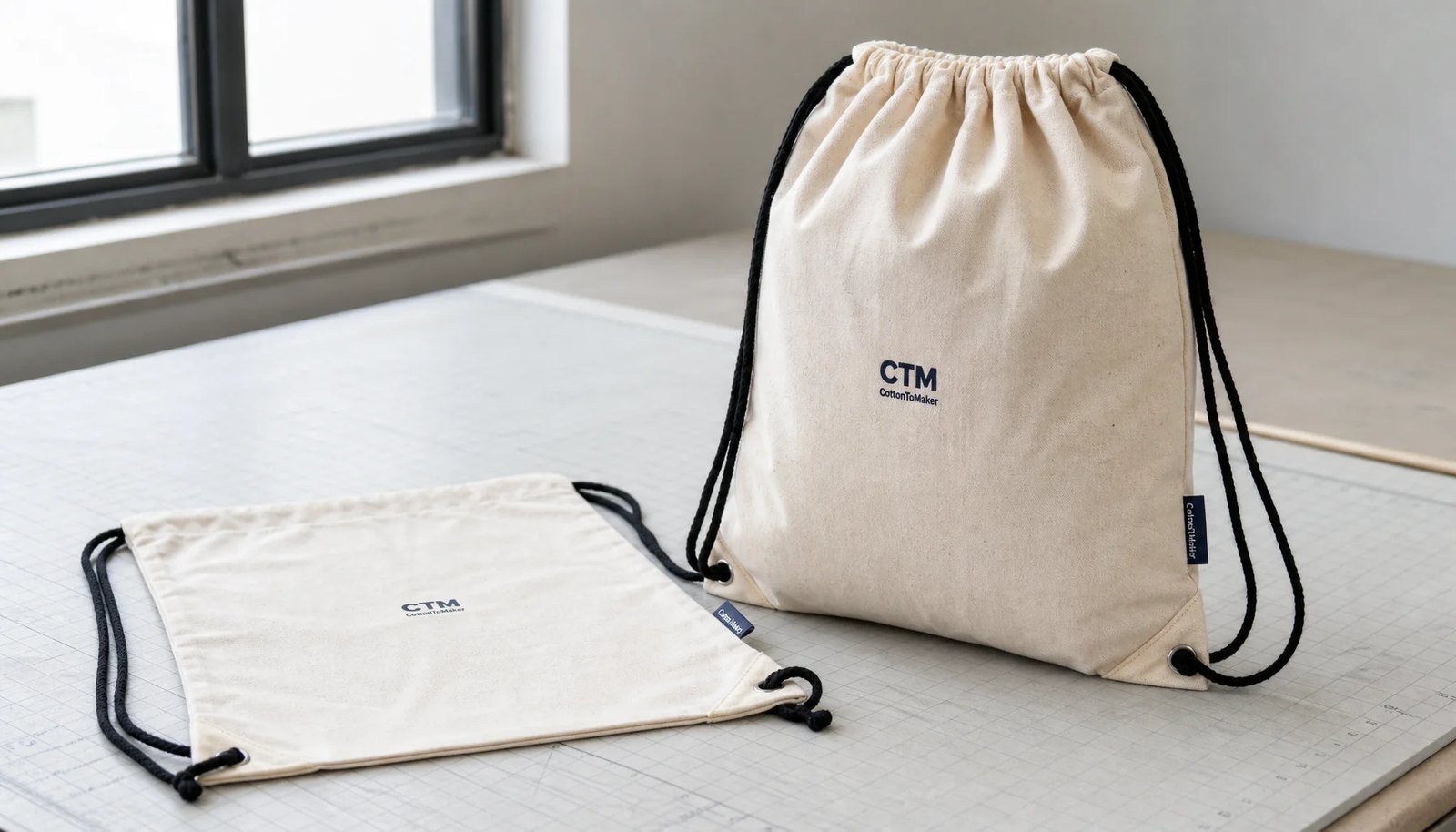
The bulk pricing problem bookstore buyers need to solve
Wholesale cotton drawstring backpacks for university bookstores look simple on a product page, but quote comparison becomes difficult when every supplier prices a different bag. One quote may use 5oz cotton, another may use 8oz cotton canvas, and a third may include retail packing while another assumes loose bulk packing. The cheapest line is often not the cheapest landed product once print setup, carton volume, rework, and allocation labor are included.
For a bookstore buyer, the pricing plan should start with the selling or distribution purpose. A retail backpack sold beside hoodies needs a different hand feel from a freshman orientation giveaway. A bag bundled with course materials needs stronger cord exits than a lightweight promotional sack. The RFQ should force suppliers to quote the same specification at multiple quantity breaks so your team can see the real cost curve instead of negotiating against unclear assumptions.
- Use one locked specification when requesting bulk price breaks; do not allow suppliers to change fabric weight at each quantity.
- Separate product cost from setup, sampling, packing, inland freight, export charges, and ocean or air freight.
- Request carton data early because cotton backpacks can become freight-sensitive at higher GSM and thicker cord specifications.
- Compare price per usable bag, not only price per produced bag; defects, poor packing, and weak reinforcement raise the real unit cost.
Choose fabric weight by use, not by habit
Cotton drawstring backpacks are commonly quoted by ounces, but factories may also work in GSM. As a practical guide, 5oz cotton is usually around 150-170 GSM, 6oz around 180-200 GSM, 8oz around 240-270 GSM, and 10oz canvas around 300-340 GSM. The exact number depends on yarn count and weave density, so a responsible supplier should be willing to state both the marketing weight and the tested GSM range.
For university bookstores, 8oz cotton canvas is often the balanced starting point. It has enough structure for retail presentation, accepts screen printing well, and still packs efficiently. If the bag is expected to carry books, drink bottles, or a campus hoodie, 10oz may be worth the added cost. If the order is a large welcome-week giveaway with a tight budget, 6oz can work, but only if the buyer accepts a softer, more promotional feel.
- 5oz cotton: lowest cost, best for light giveaways, weakest retail feel.
- 6oz cotton: acceptable for large event quantities when the logo is simple and load is light.
- 8oz cotton canvas: good default for bookstore merchandise and branded campus programs.
- 10oz cotton canvas: stronger hand feel, higher freight cube, better for premium retail or repeat-use positioning.
- Natural cotton usually costs less than dyed cotton and avoids dye-lot variation, but the base fabric color can affect logo accuracy.
Build a quantity break plan that reflects factory MOQ logic
A useful bulk pricing plan is not just a request for 500, 1,000, 5,000, and 10,000 pieces. MOQ is controlled by fabric availability, dyeing minimums, print setup, cord color, label production, and packing materials. If natural cotton fabric and standard black cotton cord are available from stock, the MOQ can be much lower than a custom-dyed fabric with matching drawcord and woven side label.
The best way to compare suppliers is to request quantity breaks that match likely purchasing decisions. For example, a campus bookstore might test 1,000 pieces for a semester launch, reorder 3,000 pieces for orientation, and place 10,000 pieces for a multi-campus allocation. Each quote should show whether the unit price reduction comes from fabric purchasing, print efficiency, labor batching, or carton optimization. If the reduction is small, the order may be limited by manual sewing rather than material MOQ.
- Low MOQ drivers: natural cotton, stock cord color, one-color screen print, standard carton packing.
- Higher MOQ drivers: custom dyed fabric, custom cord, woven label, full-color transfer, special retail packaging.
- Better quote format: same spec at 1,000 / 3,000 / 5,000 / 10,000 pcs with setup charges shown separately.
- Watch for artificial quantity discounts where the supplier quietly reduces GSM or removes reinforcement at larger volume.
- If the university artwork may change by department, price the shared blank bag separately from print versions.
Print method decisions that change cost and rejection risk
Screen printing remains the most practical method for cotton drawstring backpacks when the artwork uses solid university colors. It gives a clean result on natural cotton and is cost-efficient at bookstore quantities. However, buyers should define the number of colors, print size, print location, and Pantone references. A large chest-size print on coarse canvas uses more ink and labor than a small mascot mark, even if both are described as one-color printing.
DTF, heat transfer, and digital methods can support gradients or many colors, but they introduce different risks. Transfers can create a film hand feel, and edges may lift if the wrong adhesive or press setting is used. Digital print may not match institutional colors consistently on textured cotton. For licensed university marks, the approval sample should be a real print on the ordered fabric, not a paper proof or image mockup.
- Use screen print for one to three solid logo colors and larger bulk runs.
- Use transfer methods only after wash, flex, and rub testing on the selected cotton weight.
- Specify print placement from measurable reference points, such as 10 cm below top edge and centered between side seams.
- For dark dyed fabric, confirm whether underbase printing is included; it affects both cost and hand feel.
- Keep a signed print strike-off as the color and registration reference for production inspection.
Construction details that separate a retail backpack from a cheap sack
A cotton drawstring backpack fails most often at the lower cord exit, the top channel, or the side seam near the cord load point. These areas carry the stress when the user wears the bag. For bookstore use, reinforcement is not a decorative detail; it is a cost-control feature because returned or complained-about bags damage the program even if the unit price was attractive.
A practical construction for bookstore orders includes folded top channel stitching, clean side seams, reinforced lower corners, and a cord diameter that does not cut into the shoulder. Cotton rope around 5-7 mm gives a better feel than very thin cord, but it increases carton volume. Flat cotton tape can look premium and print-friendly, but it may twist in use. The quote should identify exactly what cord and reinforcement are included.
- Bottom corners: triangular self-fabric reinforcement or inserted patch with bar tack or dense backstitch.
- Top channel: even fold width, no raw edge exposure, no cord catching in stitch line.
- Side seams: overlocked and lockstitched where needed, with no open seams after turning.
- Cord length: long enough for comfortable wear but not so long that it drags or creates safety concerns.
- Thread color: matched for retail appearance or contrasted only when intentionally approved.
What supplier options really mean for bulk buyers
University bookstore buyers may receive quotes from factory-direct manufacturers, trading companies, local decorators, promotional distributors, or importers with domestic inventory. Each route can be valid, but they are not equivalent. A domestic decorator may be fastest for a small urgent run but may not control sewing quality. A factory-direct supplier can control fabric, sewing, print, and packing, but requires earlier artwork approval and clearer import planning.
For a planned bulk order, the strongest supplier evidence is not a brochure. It is a complete technical response: fabric weight stated in GSM, real sample photos, print method explanation, packing data, carton dimensions, lead time by production stage, and defect handling process. When comparing routes, your team should decide whether the purchase priority is speed, customization, landed cost, or repeatability.
- Factory-direct route: best for custom specs, repeat orders, and transparent production control.
- Trading company route: can be useful for mixed product orders, but responsibility for sewing and printing must be clear.
- Domestic distributor route: faster delivery on stock blanks, usually higher unit price and fewer construction options.
- Local decorator route: good for small urgent logo runs, but blank bag quality may vary by inventory batch.
- Importer route: useful for buyers needing landed domestic terms, but request the original product specification behind the quote.
Sample approval should prevent production arguments
A proper sample process for wholesale cotton drawstring backpacks should include more than one finished bag photo. Start with material swatches for fabric weight, color, and hand feel. Then approve the print strike-off on the same fabric type. After that, approve a pre-production sample showing final size, cord, reinforcement, label, print, packing, and carton mark. This staged process reduces the chance that one approval is interpreted too broadly.
The approval record should be specific enough that inspection can use it. If the buyer writes only “sample approved,” there is little protection when production varies. The signed sample should record finished dimensions, acceptable shrinkage if any washing is involved, print size, print location, cord length, cord color, seam type, packing method, and approved artwork file name. For licensed university marks, keep approval from the licensing or brand office attached to the production file.
- Material swatch approval: fabric GSM, base color, weave, and hand feel.
- Print strike-off approval: color, opacity, registration, edge sharpness, and ink hand feel.
- Pre-production sample approval: full construction, cord, reinforcement, label, and finished size.
- Packing approval: folding method, individual bag or band, inner pack, carton count, and carton mark.
- Reference sample: one sealed sample retained by buyer, one by factory, and one by inspection team when possible.
Packing and carton planning affect bookstore receiving cost
Packing is often treated as an afterthought, but university bookstores and distributors pay for poor packing through receiving time, miscounts, creases, and store-allocation errors. If bags are for retail sale, individual folding in a recyclable polybag, kraft paper band, or clear belly band can keep the front print clean and scannable. If the bags are for an orientation event, bulk packing may be acceptable, but carton counts must still be consistent.
A common export packing plan is 50 to 100 pieces per carton depending on fabric weight, cord thickness, and individual packing. Heavier 10oz cotton with thick rope may need fewer pieces per carton to avoid oversized cartons or excessive gross weight. Before production, buyers should request carton dimensions, gross weight, net weight, carton material, carton mark, and palletization assumptions if shipping into a domestic warehouse.
- Retail channel: folded face-out, individual packing or paper band, barcode or SKU label if required.
- Event channel: bulk folded by 25 or 50 pieces with inner bundle labels for fast distribution.
- Multi-campus allocation: carton marks should show design, color, quantity, campus, PO number, and carton sequence.
- Warehouse receiving: avoid mixed designs in the same carton unless inner packs are clearly separated and labeled.
- Freight planning: compare CBM per 1,000 pieces, not only unit price, especially with thick cord or premium canvas.
Lead time planning and schedule risk
Lead time depends on fabric status, dyeing, print complexity, sample approval speed, order quantity, and packing requirements. A natural cotton bag with one-color screen print can move faster than a custom-dyed cotton backpack with color-matched cord and retail labeling. Buyers often lose more time in artwork revision and internal brand approval than in sewing, so the schedule should include buyer-side approval deadlines.
A realistic production calendar separates pre-production and bulk production. Artwork confirmation, material booking, sample making, sample shipping, sample approval, bulk cutting, printing, sewing, QC, packing, and export booking are separate steps. If a campus event date is fixed, the buyer should work backward from the required warehouse delivery date, not the event date. Air freight can rescue a late order, but it can destroy the bulk pricing plan.
- Artwork and spec lock: do this before requesting final bulk price, not after deposit.
- Sample stage: allow time for physical review, not just photo approval, when color or construction matters.
- Material booking: custom fabric color and custom cord color add more risk than natural cotton stock fabric.
- Peak season: orientation, back-to-school, and holiday retail programs should be booked earlier.
- Shipment buffer: include time for customs, inland trucking, warehouse receiving, and campus allocation.
Quote data needed for a clean landed-cost comparison
A clean quote for wholesale cotton drawstring backpacks should give enough data for procurement, logistics, merchandising, and finance to work from the same page. The product line should include finished size, fabric weight, fabric color, cord type, print method, print colors, print size, reinforcement, label, packing, quantity, unit price, setup charges, sample charges, carton count, carton size, gross weight, net weight, production lead time, and payment terms.
Landed cost comparison should include more than FOB unit price. If one supplier uses smaller cartons, better packing, and fewer defects, the landed cost may be lower even with a higher factory price. For importers and distributors, the key is to compare cost per delivered sellable unit. For bookstore retail buyers purchasing through an importer, the same logic applies through domestic freight, storage, and receiving labor.
- Product cost: bag body, cord, reinforcement, print, label, and packing.
- Setup cost: screen charges, artwork separation, transfer setup, label mold or woven label minimum.
- Sample cost: swatch, strike-off, pre-production sample, courier freight.
- Logistics data: pieces per carton, carton dimensions, CBM, gross weight, incoterm, port, and shipment method.
- Risk allowance: expected defect rate, inspection cost, replacement policy, and late-delivery exposure.
Specification comparison for buyers
| Spec decision | Recommended option | When it fits | Buyer risk to check |
|---|---|---|---|
| Fabric weight for bookstore retail use | 8oz to 10oz cotton canvas, about 270-340 GSM | Campus bookstores selling branded merchandise or welcome-week bundles where the bag must feel retail-grade | Thin 5oz cotton may quote lower but can look promotional, show contents through the fabric, and fail faster at cord stress points |
| Fabric choice for large orientation giveaways | 6oz to 8oz cotton, about 200-270 GSM | High-volume events where budget and freight cube matter more than long retail life | Require buyer-approved counter sample because the same GSM can feel different after washing, calendaring, or sizing treatment |
| Print method for university logos | Screen print for 1-3 solid colors on natural or dyed cotton | Most bookstore logos, mascot marks, department graphics, and alumni slogans | Small registration shifts are visible on multi-color logos; define tolerance and request print strike-off before bulk |
| Print method for full-color art | DTF or heat transfer on test-approved fabric only | Shorter runs, detailed artwork, or event graphics with gradients | Transfers can change hand feel and may crack if low-grade film is used; test wash and flex before approval |
| Drawcord type | Cotton rope or flat cotton cord, 5-7 mm, color matched or natural | Retail backpacks needing a better hand feel and plastic-free presentation | Rope diameter affects carton volume and user comfort; thin cord may cut into shoulders when loaded with books |
| Reinforcement method | Bottom corner triangle patches plus bar tack or dense backstitch at cord exits | Any bookstore order expected to carry notebooks, water bottles, hoodies, or event kits | Low quotes often omit reinforcement or use short stitches that tear under pull testing |
| Packing format | Individually folded in recyclable polybag or paper band, 50-100 pcs per export carton | Retail receiving, campus warehouse counting, and multi-store allocation | Loose bulk packing saves handling cost but increases creasing, counting disputes, and carton mixing |
| Sourcing route for bulk order | Factory-direct manufacturer with documented sampling, fabric sourcing, and export packing | Importers, distributors, and bookstores controlling specs, branding, and repeat seasonal orders | Trading quotes may look simple but can hide fabric substitution, subcontracted printing, and unclear responsibility for defects |
Buyer checklist before sampling
- Define the target use: retail sale, orientation giveaway, course-material bundle, alumni event, or athletic department promotion.
- State finished size in width x height, not only capacity; common bookstore sizes are around 35 x 42 cm or 38 x 45 cm.
- Specify cotton weight in oz or GSM and request the supplier to quote the actual tested fabric weight tolerance.
- Identify whether the fabric is natural, bleached, reactive dyed, pigment dyed, or washed; each affects price, shrinkage, and print color.
- Provide final vector artwork with Pantone references, print size, print placement, and number of print colors.
- Decide whether the drawcord should be cotton rope, flat cotton tape, polyester cord, or blended cord, and define diameter or width.
- Require reinforced bottom corners and define stitch density or bar tack requirement for cord exit points.
- Choose packing method by sales channel: individual retail packing, bulk master cartons, or store-allocation inner packs.
- Request carton dimensions, gross weight, net weight, and pieces per carton before approving bulk production.
- Include sample approval stages: material swatch, print strike-off, pre-production sample, and packed production reference.
Factory quote questions to send
- What fabric construction, GSM, and yarn count are included in this price, and what is the allowed GSM tolerance?
- Is the cotton fabric in stock, greige-to-order, dyed-to-order, or custom washed, and how does that affect lead time?
- What MOQ applies to the bag body, fabric color, drawcord color, print color, woven label, and packing material separately?
- Which print method is quoted, how many colors are included, and what is the maximum print area without price change?
- Are print screens, digital setup, artwork separation, and strike-off samples charged separately or included?
- What reinforcement is included at the bottom cord exits, and can you provide photos of inside stitching and stress points?
- What is the standard packing: pieces per inner pack, pieces per export carton, carton size, carton weight, and carton marking?
- What are the estimated production lead time and the cut-off date for artwork, sample approval, and deposit?
- What quality inspection standard do you use for cotton drawstring backpacks, and what AQL or defect sorting method is available?
- Can you quote the same design at three quantity breaks, such as 1,000, 3,000, and 10,000 pieces, with the same specification held constant?
Quality-control points to confirm
- Fabric weight should be verified by GSM test from random production fabric, not only by supplier declaration.
- Finished bag size should stay within the agreed tolerance, commonly plus or minus 0.5-1.0 cm depending on size and fabric.
- Print placement should be measured from the top edge and side seams, with visible skew rejected beyond the approved tolerance.
- Logo color should be compared under consistent lighting against approved Pantone or physical strike-off, especially on natural cotton.
- Cord length and cord diameter should be consistent across the lot because uneven cords affect wearing comfort and retail appearance.
- Bottom cord exits should pass a pull test appropriate to intended use; weak stitching should be repaired before packing.
- Seams should have no open stitching, skipped stitches, broken thread, loose overlocking, or exposed raw edges beyond the agreed construction.
- Packed cartons should match the approved pieces-per-carton count, gross weight, carton mark, and allocation label requirements.