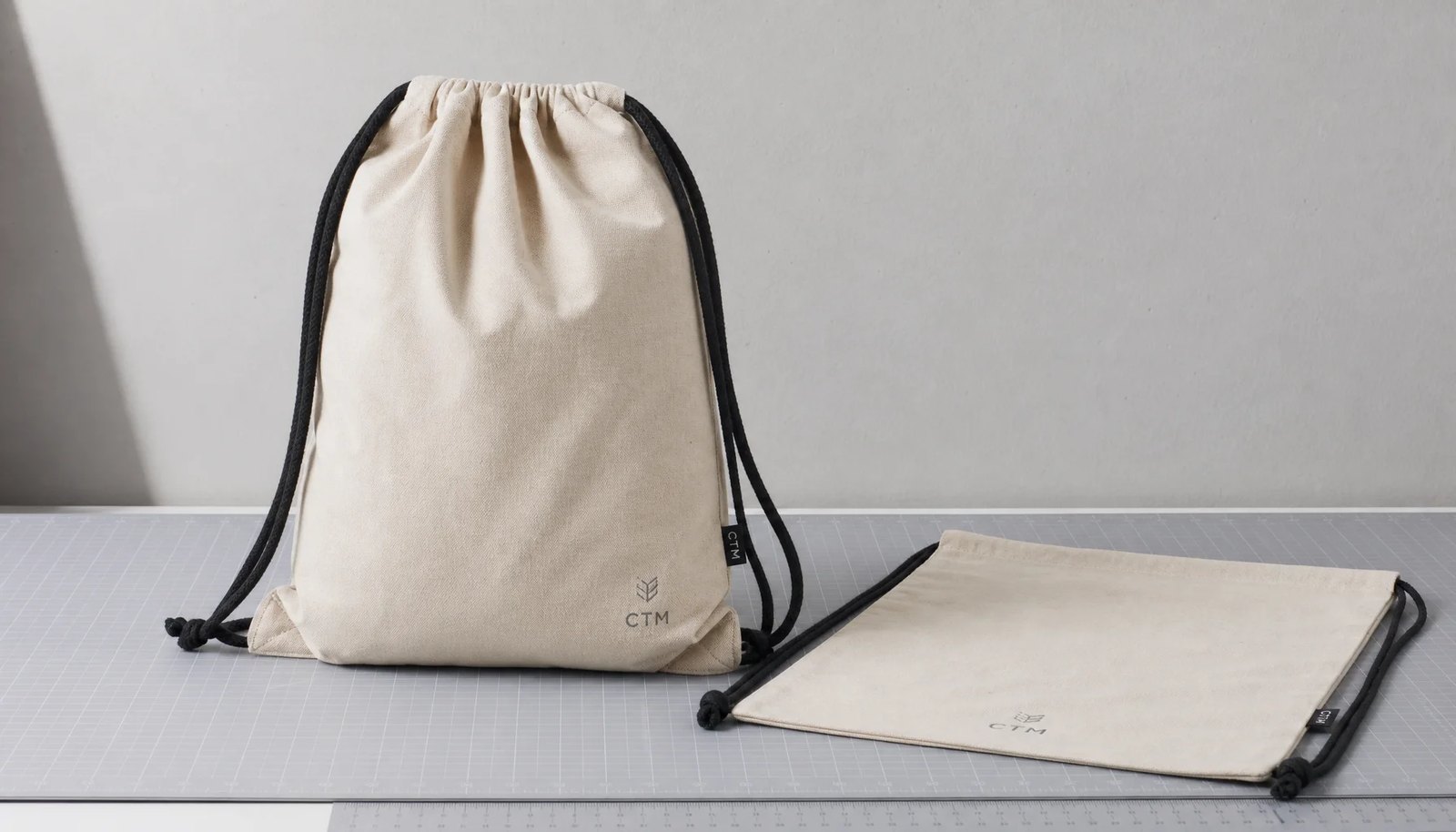
Define The Buying Problem Before The RFQ
A university bookstore RFQ for wholesale cotton drawstring backpacks usually fails when it describes the item only as a cotton cinch bag with logo. That wording leaves too much open: fabric thickness, drawcord strength, print method, packing, carton count, and repeat-order consistency. Two suppliers can quote the same line item and deliver bags that feel completely different in the store.
Start the RFQ by naming the commercial use. A backpack sold as campus merchandise needs better fabric hand feel, cleaner print registration, and retail-friendly packing. A welcome-week giveaway may allow simpler packing but still needs reliable seams and cord attachment. A department event bag may prioritize print accuracy and deadline more than premium fabric.
- Use case: retail sale, student orientation kit, alumni event, athletic department giveaway, or private-label bookstore program.
- Target load: light flyers and apparel, daily campus use, or heavier books and bottles.
- Display method: folded on shelf, hung on peg, packed in welcome kits, or shipped to multiple campus stores.
- Repeat plan: one-time event order or replenishment program using the same approved specification.
Set The Cotton Fabric Specification
For cotton drawstring backpacks, fabric weight is one of the biggest cost and quality drivers. Many bookstore programs work well with 6 oz to 8 oz cotton canvas, roughly 200 to 270 GSM. This range gives a more substantial feel than thin promo cotton while keeping the bag foldable and freight weight reasonable. If the bag is expected to carry laptops, textbooks, or bottles regularly, cotton alone may not be the right construction unless the panel, cord, and stress points are reinforced.
Natural cotton, bleached cotton, and dyed cotton should not be treated as interchangeable. Natural cotton has shade variation and visible cotton seed flecks, which can look authentic but may conflict with strict university brand standards. Dyed cotton improves color control but adds MOQ, lab dip approval, and possible shade-lot risk. Bleached cotton gives a cleaner print base but can show dirt faster during retail handling.
- Entry practical spec: 5 oz to 6 oz cotton for lightweight giveaways with modest load expectations.
- Bookstore balanced spec: 6 oz to 8 oz cotton canvas for better retail feel and stronger perceived value.
- Heavy spec: 10 oz cotton canvas only when higher cost, heavier cartons, and stronger cord attachment are accepted.
- State GSM or ounce weight, not only the word cotton, and require the bulk fabric to match the approved swatch.
Choose Construction That Matches Campus Use
A drawstring backpack looks simple, but the failure points are predictable. The drawcord channel can pucker, the bottom corners can tear, and thin cords can become uncomfortable when the bag is loaded. For bookstore merchandise, the construction should include even top channel stitching, clean side seams, reinforced bottom cord exits, and a cord diameter that feels acceptable on the shoulder.
Buyers should also decide whether they need a flat simple backpack or added features such as an outside pocket, inside label, metal eyelets, or boxed bottom. Each feature changes production time and cost. Metal eyelets may look cleaner but can damage fabric if the hole reinforcement is weak. Extra pockets improve retail value but increase sewing tolerance issues and print placement limitations.
- Common size: around 35 x 45 cm for general campus use, adjusted for bookstore display and carton limits.
- Cord option: 5 mm to 7 mm cotton or polyester cord, selected for comfort, color match, and durability.
- Corner option: bar-tack through reinforced fabric tab or clean grommet construction with tested pull strength.
- Label option: woven side label, printed inside label, hangtag, or UPC sticker depending on retail handling.
Specify Printing Without Leaving Artwork Risk
Most university bookstore cotton drawstring backpacks use screen printing because it is reliable for solid school marks, slogans, and department graphics. Water-based ink gives a softer hand on cotton, while plastisol can improve opacity on darker fabric. Digital print may help with full-color artwork but is not always the most economical route for bulk campus orders, especially when color consistency and wash behavior matter.
The RFQ should include vector artwork, PMS references, print size, print location, and fabric color. A supplier cannot accurately quote a large white print on navy cotton from a small JPEG. Large ink coverage can stiffen the fabric, and small reversed text may fill in during screen printing. The safest process is artwork review, print strike-off, buyer approval, then pre-production sample.
- Provide AI, EPS, PDF, or SVG artwork and identify whether university licensing approval is required.
- State print dimensions in centimeters or inches and mark the distance from top seam or bag centerline.
- Require PMS color target and allow a practical tolerance for printing on cotton fabric.
- For dark fabric, request opacity test photos or a physical strike-off before approving bulk production.
Understand MOQ And Cost Drivers
MOQ is not just a supplier preference. It is linked to fabric purchasing, dyeing minimums, cutting efficiency, printing setup, labor allocation, and packing material preparation. A 300-piece order with three print designs and individual retail packing can be more disruptive than a 1,000-piece order with one design and bulk packing. Procurement teams should ask suppliers to separate MOQ by fabric color, print design, and packing style.
The lowest unit price is often based on assumptions that do not match bookstore requirements. A quote may use stock natural cotton, one-color screen print, loose bulk packing, and no barcode labels. If your real order needs dyed fabric, two print positions, hangtags, UPC stickers, and carton sorting by campus location, the real price will move. A good RFQ makes those variables visible before supplier comparison.
- Fabric cost changes with GSM, cotton type, dyeing, washing, and shrinkage control.
- Printing cost changes with color count, print size, ink type, screens, artwork separation, and reject risk.
- Sewing cost changes with pockets, lining, labels, reinforced corners, grommets, and drawcord type.
- Packing cost changes with individual polybags, paper bands, hangtags, UPC labels, inner cartons, and mixed-store sorting.
- Freight cost changes with carton dimensions, gross weight, volume, destination, and Incoterm.
Build A Quote Sheet Suppliers Can Price Accurately
A strong RFQ should let a factory price the same physical product across every supplier. Include the bag drawing or reference sample, target dimensions, material specification, print file, packing requirement, quantity breaks, destination, and approval schedule. If you want options, request them in controlled alternates such as 6 oz natural cotton versus 8 oz natural cotton, not as an open instruction to recommend cheaper fabric.
Quote data should be comparable line by line. Procurement teams should avoid quotes that only state one FOB unit price with no assumptions. The factory quote should show what is included and what is excluded: sample charge, screen charge, setup fee, packing material, label cost, inspection cost, inland freight, and export carton details. This is especially important when comparing direct factories with distributors or trading companies.
- Request price breaks for 500, 1,000, 3,000, and 5,000 pieces if those quantities match your buying plan.
- Ask for separate pricing for each fabric GSM option so the team can compare hand feel against budget.
- Require carton dimensions, pieces per carton, gross weight, and net weight in the quote.
- State Incoterm clearly, such as EXW, FOB, CIF, DDP, or delivered warehouse, and avoid mixing terms in comparison.
- Record validity period because cotton, freight, and currency changes can make old quotes unreliable.
Use Samples To Prevent Bulk Mistakes
A sample should not be treated as a photo opportunity. It is the control document for bulk production. For cotton drawstring backpacks, the useful sample process includes a fabric swatch or lab dip, a print strike-off, then a pre-production sample made with the intended fabric, cord, stitching, label, and packing. Approving only a digital mockup leaves the buyer exposed to fabric shade, logo scale, and ink-hand-feel problems.
When reviewing the sample, measure and record acceptance points. Do not only write approved. Note the finished size, fabric feel, cord diameter, print position, print color, seam quality, corner strength, packing fold, and any corrections. Keep one sealed approved sample with the buyer and require the factory to keep a matching production standard.
- Measure bag width, height, print size, print position, cord length, and carton-ready folded size.
- Rub the print lightly to check curing, surface tack, cracking, and ink transfer risk.
- Load the bag with a realistic campus weight and inspect the bottom cord exits after pulling.
- Check whether natural cotton flecks interfere with the university logo or small text.
- Approve the sample only after all corrections are written into the final purchase order.
Set QC Thresholds Before Production Starts
Quality control is easier when defect rules are defined before cutting fabric. Cotton bags can have shade variation, slub texture, and minor natural marks, but retail buyers still need limits. Critical defects include wrong logo, wrong university mark, unsafe metal parts, severe stains, mold odor, missing drawcords, or mixed designs packed incorrectly. Major defects include open seams, weak cord attachment, obvious print misalignment, and incorrect size outside tolerance.
For many wholesale orders, final random inspection under a standard AQL approach is enough, but the defect list must fit the product. A bookstore may tolerate small fabric slubs on natural cotton but reject visible oil stains or crooked logos. If the order is time-sensitive for orientation week, inline inspection is useful because print and sewing problems found at final inspection may be too late to correct.
- Fabric GSM tolerance: commonly plus or minus 5 percent unless a tighter range is agreed.
- Finished size tolerance: commonly plus or minus 1 cm for a soft cotton drawstring backpack.
- Print placement tolerance: set a practical limit such as plus or minus 0.5 cm to 1 cm depending on artwork.
- Stitching: no open seams, skipped stitches at stress points, loose bar-tacks, or trapped drawcord channels.
- Packing: correct count per carton, dry cartons, readable marks, and no design mixing without written approval.
Plan Packing And Bookstore Receiving
Packing is not only a shipping detail. It affects how the bookstore receives, counts, stores, and displays the backpacks. Loose bulk packing is cheaper and may fit giveaways, but it often creates wrinkles and makes counting slower. Individual polybags protect the item but add material cost and may conflict with sustainability rules. Paper bands or belly wraps can present better for retail while reducing plastic, but they need testing so they do not crush the bag or hide the logo.
Export carton planning should include pieces per carton, carton dimensions, gross weight, and store allocation. If the order ships to multiple campuses or warehouse locations, carton labels should identify design, color, quantity, PO number, and destination. A carton that is too heavy may save freight volume but create handling complaints or carton breakage.
- For retail shelves: folded consistently with logo visible, individual bag or band, optional hangtag and UPC label.
- For welcome kits: bulk folded by inner count, easy distribution count, no unnecessary retail packaging.
- For multi-store distribution: carton marks by design, color, quantity, PO, and destination store.
- For sustainability programs: request recyclable polybag, paper band, or no individual bag depending on handling risk.
- For ocean freight: use strong export cartons and control moisture to avoid odor, mildew, and crushed corners.
Protect The Schedule And Compare Landed Cost
The lead time clock should not start when an RFQ is emailed. It should start after deposit, final artwork approval, material confirmation, and sample approval if required. A typical sourcing plan may include quote review, sample development, artwork correction, bulk material preparation, printing, sewing, inspection, packing, and freight. Each missed approval date pushes the delivery window, which matters for semester starts and orientation events.
Landed cost comparison should include unit price, setup charges, sample charges, inspection, duty, freight, warehousing, relabeling, and receiving labor. A heavier 10 oz bag may look attractive in a sample room but increase carton weight and shipping cost. A cheaper bag with loose packing may create labor cost at the bookstore warehouse. The best supplier is usually the one that controls the total risk, not only the one with the lowest first quote.
- Build the schedule backward from the required in-store or event date, not from the supplier's estimated production days.
- Leave time for university licensing review if official marks, mascots, or department logos are used.
- Compare FOB and delivered options with carton data so freight estimates are based on real volume and weight.
- Add inspection timing before shipment release, especially for first orders or new print artwork.
- Keep reorder files for fabric, artwork, cord, label, packing, carton marks, and approved sample photos.
Specification comparison for buyers
| Spec decision | Recommended option | When it fits | Buyer risk to check |
|---|---|---|---|
| Sourcing route for campus bookstore replenishment | Direct factory with repeat-order file and stored print artwork | Best when annual volume is predictable and the bookstore wants stable fabric, color, and carton specs | Confirm the supplier controls cutting, sewing, printing, and final packing instead of passing work between unknown subcontractors |
| Sourcing route for small trial launch | Importer or distributor holding blank cotton drawstring backpack inventory | Fits a short deadline, low quantity, or pre-season testing before a larger custom PO | Stock fabric weight, cord color, and printable area may not match the later factory-made bulk order |
| Main fabric weight | 6 oz to 8 oz cotton canvas, approximately 200 to 270 GSM | Good balance for bookstore giveaways, welcome kits, and retail add-on merchandise | Below 180 GSM can feel thin; above 300 GSM increases cost, carton weight, and drawcord stress |
| Print method for university marks | Water-based or plastisol screen print with PMS target and approved strike-off | Best for one to four solid colors, school logos, department names, and orientation graphics | Fine text, large ink coverage, and dark fabric require print testing for opacity and hand feel |
| Drawcord construction | Cotton or polyester cord, 5 mm to 7 mm, bar-tacked at lower corners | Fits daily bookstore use where students carry books, bottles, and apparel | Thin cord can cut into shoulders; weak corner stitching fails quickly when bags are loaded |
| MOQ logic | MOQ tied to fabric dyeing, print setup, and cutting efficiency rather than a single fixed number | Useful when comparing 500-piece trial orders against 1,000 to 3,000-piece production runs | Very low MOQ quotes may use stock fabric, different shade lots, or higher unit cost hidden in setup fees |
| Packing method | Individually folded in recyclable polybag or paper band, then export carton with inner count control | Works for bookstore receiving teams that need clean retail handling and simple inventory counts | Loose bulk packing saves cost but increases wrinkling, carton dust, and receiving complaints |
| Lead time basis | Sample 5 to 10 working days; bulk timing counted after deposit, artwork approval, and material confirmation | Suitable for semester launches, orientation events, alumni weekends, and licensed merchandise drops | A quoted lead time without approval milestones is not reliable for campus deadline planning |
Buyer checklist before sampling
- Define the exact bag size, fabric GSM, drawcord type, reinforcement points, print position, and expected load before requesting prices.
- State whether the order is for retail sale, welcome kits, bookstore giveaways, or event distribution because packing and quality expectations differ.
- Attach vector artwork, PMS colors, logo size, print location, and licensing requirements so factories quote the real print job.
- Request separate line items for fabric, printing, labels, packing, setup charges, sample fees, and freight terms instead of accepting one vague unit price.
- Require a pre-production sample or print strike-off before bulk cutting, especially for dark fabric, large logo coverage, or licensed university marks.
- Set acceptance criteria for fabric weight tolerance, stitching defects, print alignment, color variation, carton markings, and count shortage.
- Confirm whether the supplier quote uses stock greige fabric, dyed-to-order fabric, or finished stock backpacks because repeat consistency will differ.
- Provide the delivery window, Incoterm, destination port or warehouse, carton weight limit, and any bookstore receiving label rules.
- Keep one approved sample sealed as the production standard and require the supplier to match it during inline and final inspection.
- Compare total landed cost, not only FOB unit price, because heavier cotton backpacks can shift freight, duty, and warehouse handling cost.
Factory quote questions to send
- What cotton fabric weight, construction, and shrinkage standard are included in the quoted price?
- Is the fabric stock color, custom dyed, or natural cotton, and what shade tolerance will be accepted in bulk?
- What is the MOQ for the bag body, each fabric color, each print design, and each packing style?
- Which print method is quoted, how many colors are included, and are screen charges or artwork separation fees separate?
- What maximum print size can be produced without distortion on the selected backpack panel?
- What drawcord material, cord diameter, corner reinforcement, and bar-tack method are included?
- Can you provide a pre-production sample, print strike-off, and bulk fabric swatch before mass production?
- What are the sample lead time, bulk lead time, and cutoff date for artwork approval to meet our delivery window?
- What carton dimensions, pieces per carton, gross weight, and packing method are included in the quote?
- What AQL level or inspection standard do you follow, and which defects are counted as critical, major, and minor?
Quality-control points to confirm
- Fabric GSM should be measured from bulk fabric, not only from a showroom sample; allow a realistic tolerance such as plus or minus 5 percent unless stricter is agreed.
- Finished bag size should match the approved sample within agreed tolerance, commonly plus or minus 1 cm for width and height on soft cotton bags.
- Drawcord channels must pull smoothly without twisted seams, blocked openings, loose lint, or uneven tension between both sides.
- Lower cord attachment points should be bar-tacked or reinforced and pass a basic pull test suitable for the intended load.
- Print color should match the approved strike-off under consistent lighting, with no major ink bleeding, cracking, pinholes, or misregistration.
- Logo placement should stay within the approved position tolerance, especially when bookstore planograms require consistent front-facing display.
- Inside seams should be secure, with no raw loose threads likely to unravel during handling or first use.
- Carton count should be verified against packing list, inner packing count, and outer carton marks before shipment release.
- Random finished goods should be checked for odor, stains, oil marks, dust, moisture, and visible needle damage.
- Final inspection should include carton drop risk, barcode readability if used, and confirmation that mixed designs are not packed into the wrong cartons.