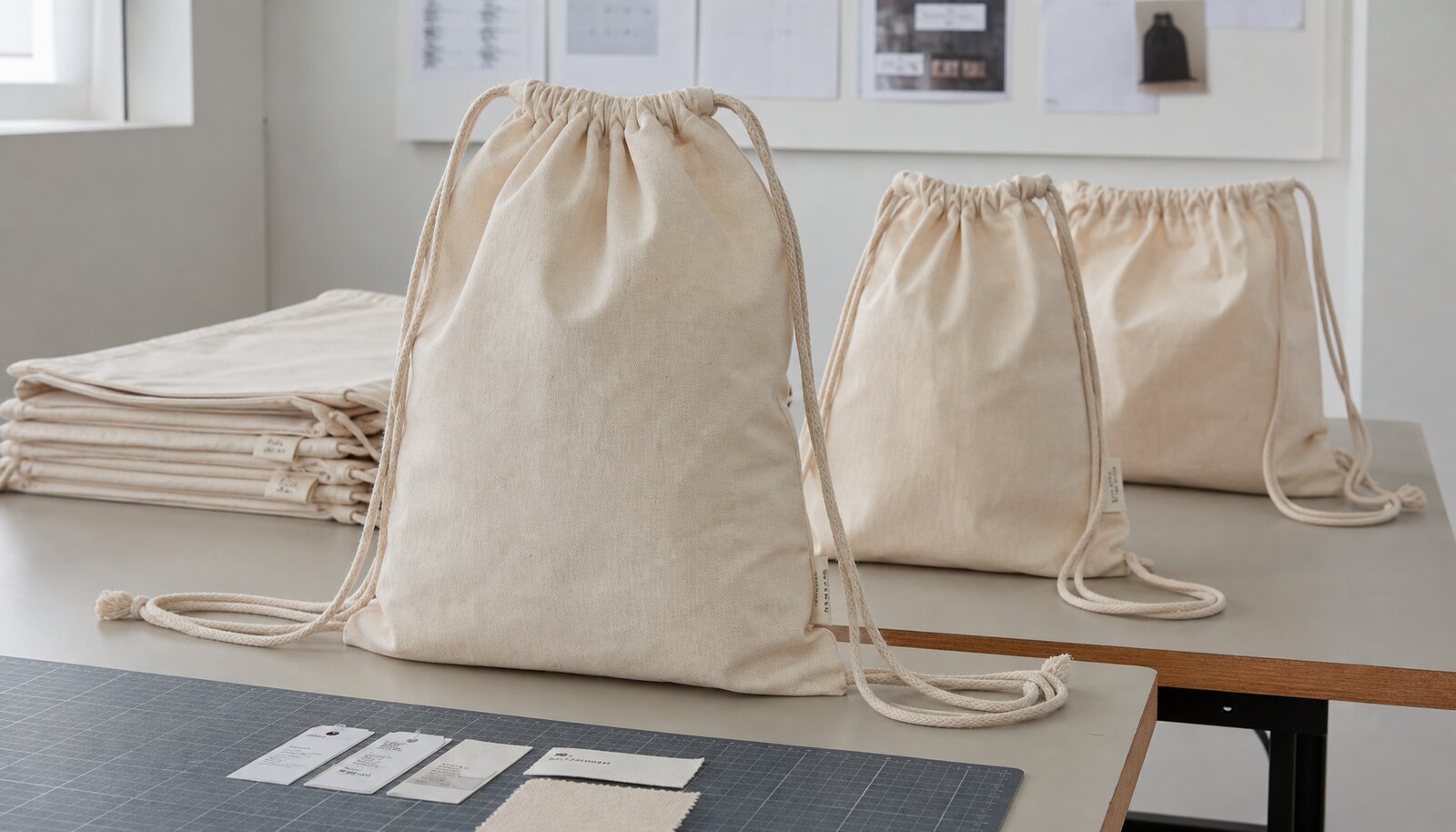
Why gift shop orders fail even when the bag looks simple
Cotton drawstring backpacks are one of those products that look easy to buy until the first production run reveals where the risk actually sits. Gift shop programs often fail because the purchasing team compares only dimensions and unit price, while the real quality issues are hidden in the fabric handfeel, the opening behavior of the drawcord channel, the way the logo sits after folding, and how the bags look when they are stacked on a shelf. A simple-looking bag can still feel cheap if the cotton is too thin, the print sits crooked, or the cord looks mismatched against the fabric.
For gift shops, the product is not just a utility pouch. It is a shelf item that competes on first impression. That means buyers should decide whether the bag should look rustic, premium, souvenir-style, or clean and retail-neutral before they request quotes. A naturally slubbed canvas can be a feature for one brand and a defect for another. A loose, soft bag may be acceptable for a promo pack but look underbuilt next to adjacent retail goods. The best procurement decisions are made when the commercial use case is defined first and the spec is written to match it.
The biggest losses usually happen after the supplier has already been chosen: cartons arrive with the wrong fold direction, prints are too faint on natural cotton, drawcord ends fray during handling, or the bags smell like they were packed too soon after printing. Those problems are expensive because they create repacking work, delays to shelf placement, and in some cases direct rejection from the gift shop buyer or distributor. That is why a proper wholesale cotton drawstring backpacks for gift shops quality inspection checklist should combine product specification, supplier quote control, and final inspection thresholds in one document rather than treating quality as a general promise.
Start with a retail-ready specification, not just a size request
The most useful spec starts with the visible retail experience. For many gift shop programs, cotton around 140 to 180 GSM is the practical range, but that range should not be treated as a rule without context. A lighter fabric may suit a low-cost souvenir line or a packing bag that will not carry much weight. A heavier fabric may suit a premium retail presentation, but it can also increase seam bulk, cost, and carton weight. The right choice depends on the bag's purpose, the print coverage, and the expected shelf image. If the bag will be sold next to higher-end gifts, a more substantial handfeel often helps. If it is part of a seasonal tourism display, lighter and more economical may be enough.
More important than the number itself is how the fabric behaves after cutting and printing. Raw or lightly finished cotton can shrink, crease, or distort the logo if the supplier does not manage the process carefully. Ask whether the fabric is washed, pre-shrunk, bleached, dyed, or left natural. Also ask how the supplier controls lot consistency if more than one fabric batch is needed. Buyers often assume the same GSM means the same result, but the weave density, finishing method, and moisture content can make two fabrics feel different even when the weight is similar.
Construction should be described clearly in the RFQ so the supplier is not free to choose the cheapest version. A self-fabric top channel is common, but the channel height, seam alignment, and stitch density need to be specified. The drawcord should also be named, not just described as a string. Cotton rope cord and braided cotton cord usually create a better retail impression than a visible polyester cord, especially when the bag is positioned as a natural or eco-style item. If the bag must carry heavier contents, consider bottom reinforcement, bartacks at stress points, and a slightly tighter stitch specification. Without these details, two quotes may look equal while one is actually built to fail earlier in use.
Choose the sourcing route that matches your control needs
A factory-direct quote is usually the best choice when you need consistent repeat orders, controlled decoration, and a stable inspection trail. This route is especially useful for gift shop chains, regional wholesalers, and importers who plan to reorder the same design across a season. The advantage is process visibility: you can ask who cuts the fabric, who prints the logo, who sews the channel, and who performs final packing. That matters because quality drift often appears when the steps are split between multiple subcontractors and no one owns the full standard.
A trading company can still be the right choice when the buyer needs one contact for several product categories or when the internal team is too small to manage factory communication directly. The tradeoff is transparency. Some trading quotes are good, but others hide the actual production site, the decoration subcontractor, or whether the packing operation is in-house. If you use a trading route, ask for the real factory name, current production photos, and proof that the approved sample will be the same process used in bulk. Otherwise, a clean sample can quietly turn into a weaker bulk run.
Stock-supported programs and low-MOQ test programs have their place, especially when the gift shop is validating demand or planning a short seasonal promotion. In those cases, speed may matter more than custom detail. However, you should be careful not to confuse a stock base with a custom equivalent. The blank bag, the print method, the label, and the fold style may all differ from the custom version. That is why procurement teams should never compare a stock item and a made-to-order item as if they were the same product. If you need brand consistency, the sample approval should prove that the goods being quoted are the goods that will actually arrive.
How to compare supplier quotes without comparing the wrong thing
A useful quote is one that lets you compare apples to apples. To do that, the supplier should state the exact fabric construction, the finishing treatment, the cord material, the print process, the carton pack count, and whether individual polybags or inserts are included. If one supplier quotes a screen-printed bag and another quotes heat transfer, the prices are not directly comparable because the decoration cost, appearance, and durability are different. The same warning applies to inner bagging, barcode labels, hangtags, and moisture protection. A low quote can become expensive when the buyer later discovers that key retail packaging was excluded.
It also helps to separate two decisions: the commercial fit and the quality risk. The commercial fit asks whether the bag suits the gift shop audience, price point, and display style. The quality risk asks what could go wrong in production and receiving. A supplier may offer the best price on a lighter fabric, but if the bag will be sold as a premium gift accessory, the shelf outcome may be disappointing. Another supplier may charge more, but include better cutting control, stronger seams, and cleaner packing. Procurement teams should document these tradeoffs before they negotiate, because later revisions become much harder once a sample is already approved.
The table below is more useful than a simple spec list because it compares sourcing choices with the tradeoffs that matter in real purchasing. Use it to align your RFQ, sample approval, and inspection plan with the route you are actually choosing.
Comparison table: sourcing choices for gift shop programs
Use the table as a decision tool, not as a promise of quality. The goal is to understand what each sourcing route gives you and what it asks you to monitor. For a one-off holiday run, speed and visual control may be the priority. For an ongoing gift shop line, consistency and repeatability are usually more important than shaving a few cents from the first order.
When you review a sample, keep one physical approval sample and a dated record of the approved version. The record should include front, back, side, seam, logo, label, inside, and packed-carton photos. This helps prevent the most common dispute in bulk production: the supplier says the order matches the sample, while the buyer remembers a different version.
If your team handles multiple designs, tie each quote to a revision number. Many problems start when artwork changes after the sample was approved but the old version remains in the supplier's production file. A clean inspection process depends on a clean document trail.
What a strong pre-production sample should prove
A pre-production sample should be made with the exact materials, not a showroom substitute. That means the final cotton body, final cord, final print or embroidery, and final label or side tag must all be included. If the sample is built with a cleaner fabric than the bulk order, it will not reveal the real drape, seam behavior, or print absorption. For this product, you should also ask the supplier to pack the sample the same way the bulk order will be packed, because folding and compression can change how the bag looks when it reaches the gift shop.
The sample should be inspected both flat and in use. Open the bag fully, pull the cord several times, lightly load it, and then fold it again. This reveals whether the channel holds its shape and whether the cord twists or snags. Also check the appearance after a fold, because some prints crack or lift at the fold line if curing is weak. Natural cotton can also show slub, seed speck, or uneven fiber character, which may be acceptable if agreed in advance but becomes a defect if the buyer expects a cleaner retail look.
For gift shop use, the logo position is often more important than buyers first assume. A shifted logo makes the product look low-grade even when the sewing is fine. Measure the position from a fixed reference point on the bag body, not by eye alone, and record the acceptable tolerance. If the bag is meant for premium retail, a tighter logo window and a more consistent fold standard are worth the extra control.
A defect-by-defect inspection checklist with practical thresholds
This is where many checklists stay too generic. In bulk inspection, you need to know which defects are acceptable, which are reworkable, and which are shipment-stopping. The simplest way to manage this is to classify defects as critical, major, or minor before production starts. A critical defect is one that makes the bag unusable or commercially wrong. A major defect is one that is likely to cause customer complaint, shelf rejection, or warehouse return. A minor defect is visible but does not usually affect saleability if it stays within the agreed limit.
Critical defects on cotton drawstring backpacks should generally include wrong artwork, missing cord, broken load-bearing seams, major size errors, or the wrong material entirely. If the bag cannot function or if the branding is incorrect, it should be rejected. Major defects include visible stains, severe print shift, misaligned channels, uneven or loose top stitching, odor from improper drying, or torn packaging that affects presentation. Minor defects can include short loose thread ends, slight shade variation within the agreed limit, or tiny surface lint, provided the buyer has already accepted that fabric character.
You should also define practical rejection points. For example, if the logo is visibly off-center beyond the agreed tolerance, treat it as a major defect rather than a cosmetic note. If the cord does not slide smoothly through the channel on a random sample, that is not a minor issue; it is a process failure that can affect the whole batch. If the print cracks after a normal fold test, the curing or print method needs review before shipment. The goal is not to create an unrealistic zero-defect standard, but to make sure that the defects the customer actually notices are the ones you catch before the goods leave the factory.
During inspection, look for failure modes that are easy to ignore in a quick count. A bag can pass quantity inspection and still fail commercial quality because the fabric is limp, the top edge is puckered, the cord ends are frayed, or the packaging is stale or damp. Inspect a sample from the top of the carton and another from the bottom layer, since bottom cartons are more likely to show compression or moisture issues. If your destination is humid, the packing method matters more than many buyers realize.
Inspection steps buyers can actually use on factory floor or at receiving
A practical inspection should start with measurements, then move to appearance, then function. First, measure the finished bag width, height, opening width, and cord length against the approved sample. Next, inspect the front and back for print placement, thread trimming, staining, and seam uniformity. After that, test the cord by pulling it several times and checking that the channel does not distort or snag. Finally, inspect one packed carton from a real shipment position, not only from the top layer, because compression and handling damage often appear lower in the stack.
The most useful inspection is also a usage test. Put a light retail load inside the bag and see whether the bag stands or collapses as expected. For gift shops, the visual result matters almost as much as the load-bearing result. A bag that immediately sags may still technically work, but it can look cheap on a shelf. If the drawcord opens too easily or the channel is too loose, customers may perceive the product as poorly made even if no seam is broken.
Keep the inspection record simple and specific. Record the sample ID, production date, carton number, defect type, photo reference, and whether the issue is critical, major, or minor. That detail helps your supplier fix repeat issues and helps your own team avoid re-litigating the same decision on every new order. The best inspection system is one that can be repeated by different buyers and still lead to the same decision.
Packing, carton layout, and shelf-ready presentation
Packing is one of the easiest places to save money and one of the easiest places to create avoidable damage. Flat packing is usually the best freight-saving option for cotton drawstring backpacks, but only if the folding method is consistent and the logo faces the same direction in every piece. If the cord is not controlled during folding, it can knot, twist, or press into the fabric, creating wrinkles that make the item look used before it is even opened. Ask the supplier to show how the bag will be folded, tied, or stacked before you approve the packing method.
If the goods will be distributed through a retail warehouse, an individual polybag may be helpful. It protects the finish, makes counting easier, and can improve shelf presentation if the shop sells the item as a standalone gift accessory. But polybags also add cost, humidity retention, and waste. Some buyers prefer bulk packing because they plan to repack locally. If that is the case, make sure the carton design still protects the bag from crushing and that the inside stays dry during transit. On humid routes, a simple moisture-control method can be more valuable than fancy retail wrapping.
Carton specification should be written into the quote. Ask for carton dimensions, gross weight, pack count, carton label position, and whether palletization is required. A carton that is too small can crush the top channel; a carton that is too large can waste cube and let the bags move around in transit. For gift shops, the product should open cleanly and look tidy on arrival. That is why packing is not a logistics detail only; it is part of the customer experience.
Lead time planning by season, method, and geography
The common planning range for a standard custom order is often around 28 to 45 days after sample approval, but that number only makes sense when the order is simple, materials are ready, and the buyer answers quickly. A one-color logo on natural cotton can move faster than a multi-color design that requires multiple proofs, screen adjustments, and extra drying time. If the fabric is stock-supported, the schedule may be shorter. If the order requires a special dye lot, custom label, or retail packaging, the schedule may be longer.
Seasonality matters. Gift shop programs tied to holidays, tourism peaks, or event seasons should not be planned using an average timeline alone. When multiple buyers are ordering at once, factories fill their sewing and printing schedules quickly, and raw material lead time may extend unexpectedly. Buyers should build in time for artwork approval, sample courier transit, and potential label corrections. If the delivery date is fixed, ask the supplier when the material must be ordered and what happens if approval is delayed by even a few days.
Another common schedule risk is shade control across lots. Natural cotton and dyed cotton can vary from batch to batch, and different production runs may look slightly different under retail lighting. If the order is large enough to require more than one fabric batch, ask the supplier how they will reserve and label the same lot or how they will manage shade consistency. For buyers with a strict launch date, it is better to spend more time on the sample and fabric confirmation than to rush the bulk order and deal with a mixed appearance later.
Specification comparison for buyers
| Sourcing option | Best for | Tradeoffs | Inspection focus |
|---|---|---|---|
| Direct factory, custom production | Repeat gift shop programs, branded retail lines, and orders that need controlled print and packing | Usually better consistency and clearer process control, but may require stronger MOQs and firmer lead-time planning | Confirm who cuts, prints, sews, and packs; verify sample room control, line photos, and whether the bulk run matches the approved sample |
| Trading company with factory coordination | Multi-SKU buyers, smaller teams, and orders that need one contact for several product categories | Easier communication and bundling, but less transparency on the actual production line and more risk of subcontracting changes | Ask for the real factory name, inspection photos from the production site, and proof that the quotation includes all packing and QC steps |
| Stock base with custom logo | Fast-turn gift shop replenishment, seasonal promotions, and test launches | Faster than a full custom build, but color, size, label, and print options are narrower | Check whether the blank bag is truly the same fabric as the quoted sample and whether logo placement is consistent across stock lots |
| Low-MOQ bespoke run | Smaller gift shops testing a design or regional souvenir line | Higher unit cost, more setup charges, and less room for process optimization | Inspect whether the supplier is using short-run print methods, whether color consistency is acceptable, and whether bulk packing increases damage risk |
| Retail-ready packed program | Distributors and gift shop chains that want shelf-ready receiving | Adds cost, but reduces repacking and receiving errors | Review polybag style, barcode position, fold standard, carton labeling, and humidity protection |
| Bulk-packed carton-only program | Wholesalers prioritizing freight efficiency and warehouse repacking | Cheaper and lighter, but more handling damage and more internal labor on receipt | Check fold consistency, creasing, odor risk, and whether cartons protect shape during transit |
Buyer checklist before sampling
- Lock the finished spec first: size, GSM, cord material, print method, seam construction, and packing format before asking for price.
- Approve a pre-production sample made with final fabric, final cord, final print, and final carton packing; do not approve a showroom sample.
- Ask the supplier to state defect thresholds for critical, major, and minor issues in writing, not just say they have 'good quality.'
- Require photos of cutting, printing, sewing, trimming, and packing for repeat orders or multi-carton shipments.
- Compare landed cost per saleable piece, not only factory unit price; include setup charges, carton size, freight cube, labels, and any retail packaging.
- Set a clear acceptance window for logo position, color shade, size tolerance, odor, loose threads, and fabric stains.
- Define whether light natural cotton slubs, seed specks, or minor weave variation are acceptable as part of the fabric look or must be rejected.
- Ask whether the bag will be made from pre-shrunk, washed, or raw cotton, because shrinkage changes size and print behavior.
- Specify whether the drawcord ends are knotted, heat-sealed, tipped, or bar-tacked, and reject if the finish is inconsistent with the sample.
- Request carton pack count, master carton dimensions, net/gross weight, and palletization if the goods move through a warehouse network.
Factory quote questions to send
- What is the exact fabric construction, weave type, and finished GSM after any washing or finishing process?
- Is the cotton pre-shrunk or unwashed, and what shrinkage allowance is built into the pattern and cutting size?
- What drawcord material, diameter, length, and end finish are included in the quoted price?
- Which sewing operations are included: side seams, bottom reinforcement, top channel, bartacks, and thread trimming?
- What is the print method, print size, number of colors, curing/drying method, and any screen or plate fee?
- Can you identify the actual factory that will cut, sew, print, and pack the order, or is any part subcontracted?
- What is the sample lead time, production lead time, and the earliest material ordering date after deposit?
- What is the MOQ per color, per print version, and per packing style; can mixed colors or mixed prints be combined?
- What carton pack count, carton dimensions, and estimated shipping cube do you quote for this exact style?
- What QC standard do you use in production and final inspection, and will you share inspection photos or a report template?
Quality-control points to confirm
- Fabric weight should be checked on a measured sample, not estimated by hand; a practical tolerance is usually within ±5% to ±8% of the agreed GSM, depending on the fabric type and production method.
- Bag body dimensions should be measured after finishing and before packing, using the approved sample as the reference; a common retail tolerance is ±0.5 to 1.0 cm on width and height, but buyers should tighten this if the bag is sold as a premium gift item.
- Top channel width should be even across the bag and must not pinch the cord; check that the channel seam is straight and that the opening does not collapse when the cord is pulled.
- Side seams, bottom seams, and top channel seams should be inspected for skipped stitches, broken stitches, skipped bartacks, raw edges, and uneven stitch density.
- Drawcord should slide smoothly through the channel without snagging, fraying, or twisting; ends should match the approved finish, such as knotting, tipping, or heat sealing for synthetic components if used.
- Print position should be measured from fixed points on the bag body, not judged visually alone; define an acceptable offset and reject obvious off-center placement.
- Print color should be compared against a signed-off standard under daylight or a controlled inspection light; if the logo is brand-critical, require a limit sample for acceptable shade.
- Ink adhesion should be checked by flexing the print, folding the bag, and lightly rubbing the area after full curing; cracking, tackiness, or peeling should be treated as a major defect.
- Inspect for oil marks, water spots, needle holes, torn fabric, loose threads longer than the agreed limit, odor from packing or printing, and contamination from lint or dust.
- Cartons should be dry, correctly labeled, and not crushed; inspect at least one carton from the bottom layer, because lower cartons reveal stack stress and humidity problems first.