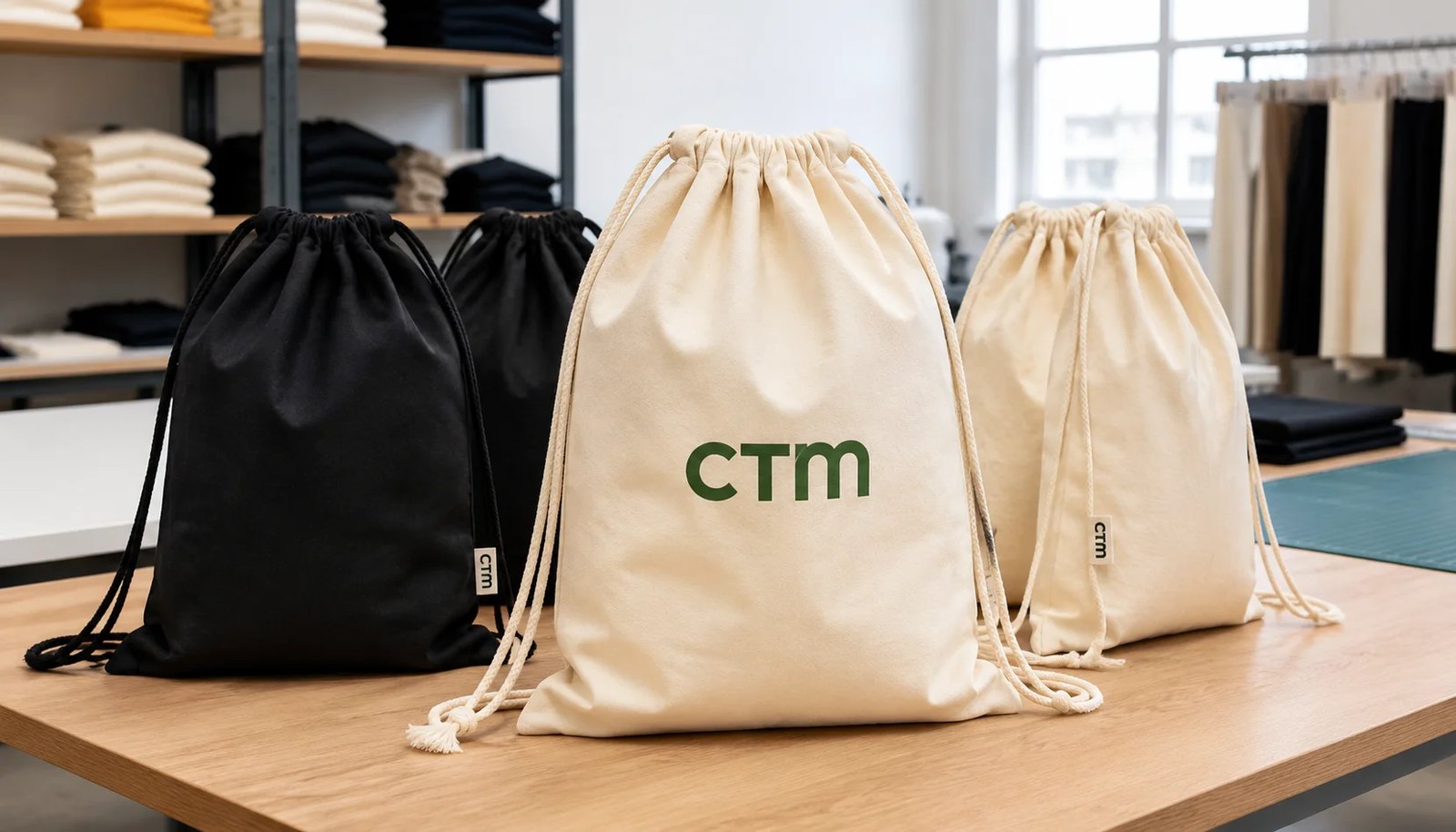
Why natural grocer buyers need a tighter RFQ for cotton drawstring backpacks
Cotton drawstring backpacks look straightforward, but they are quoted very differently from supplier to supplier unless the RFQ is precise. One factory may price lightweight sheeting cotton, another may quote heavier canvas, and a third may switch the cord material or print method without making that difference obvious in the headline price. A procurement team then appears to have three valid offers, when in reality the offers are for three different products.
That mismatch matters more for natural grocers than for many general merchandise programs. These bags often support loyalty campaigns, wellness events, seasonal gift-with-purchase offers, community programs, or simple reusable accessory ranges. The bag has to feel aligned with a natural-material brand position, but it also has to survive practical use. If the cloth is too light, the corners fail. If the cord is too thin, the bag feels cheap. If the print is weak on natural cotton, the logo looks inconsistent store to store.
A stronger RFQ does not need to be complicated. It needs to make cost drivers visible and remove ambiguity. That means defining finished size, target GSM, fabric type, acceptable natural variation, cord spec, print method, packaging format, and approval stages before suppliers quote. Once those points are locked, price differences become easier to explain, sample approvals become faster, and final inspection arguments become less subjective.
For teams searching for a wholesale cotton drawstring backpacks for natural grocers RFQ template guide, the key takeaway is simple: the RFQ is not just a request for price. It is the first quality-control document in the buying process.
- The main procurement problem is quote mismatch, not lack of factories
- Natural grocer programs usually care more about material honesty, logo appearance, and distribution practicality than trend styling
- Small specification gaps at RFQ stage often become inspection disputes later
- A complete RFQ makes supplier assumptions visible before the PO is placed
Define the program use case before you choose fabric weight, size, and cost target
The most common specification mistake is choosing cotton weight from habit rather than from the real use case. Buyers often ask for a 'natural cotton drawstring bag' without stating whether the item is a checkout giveaway, event handout, member sign-up incentive, footwear pouch, yoga kit bag, or reusable grocery accessory. Those uses do not need the same construction.
For short campaigns or budget-sensitive promotions, 140-170 gsm cotton may be enough if the contents are light. This range keeps unit cost and freight lower, folds compactly, and works well when the bag is more of a branded handout than a long-life carry solution. It can also make sense for store openings, awareness campaigns, and large-volume community events where cost-per-unit matters strongly.
For repeat-use programs, 180-220 gsm can be a reasonable middle ground. It gives a better handfeel, improved body structure, and stronger presentation at retail while still staying commercially practical for many import programs. Buyers who want a bag that feels reusable rather than disposable often find this range easier to justify.
For carrying produce accessories, shoes, mixed wellness items, brochures, or heavier everyday contents, 220-280 gsm canvas is usually the safer route. Heavier fabric helps the bag keep shape, reduces corner distortion, and supports cleaner print presentation. It also tends to communicate more value when the bag is sold or included in a higher-perceived promotional set.
Size should be tied to use in the same way. A roughly 35 x 45 cm format may suit a light daily essentials bag, while 38 x 45 cm or larger gives more practical capacity for event packs or mixed contents. Buyers should also clarify whether the quoted dimensions refer to the finished body after sewing and whether the drawstring channel is included in the overall height.
Natural grocer programs often prefer undyed or natural cotton, but that preference should be written carefully. Natural cotton can include slight slub, seed specks, or base-shade variation. That may support the brand story, but it can also soften print edges or create variation across lots. If those effects are acceptable, say so. If not, define a narrower approval standard early.
- 140-170 gsm: low-cost promotional use and light contents
- 180-220 gsm: balanced reusable option for many grocery campaigns
- 220-280 gsm: stronger feel for repeat use and heavier contents
- State finished size in cm and clarify usable body height after channel fold
- Define whether natural specks, slub, and base-shade variation are acceptable
Construction details that separate a usable backpack from a return-prone promo item
Because the product is simple, buyers sometimes under-specify construction. That is where failure risk enters. Cotton drawstring backpacks usually fail at the same points: bottom corners where the cords exit, the drawstring channel, inconsistent cord lengths, and weak seam allowances. If the RFQ says only 'drawstring backpack,' some factories will choose the fastest low-cost build path because the category is price sensitive.
Bottom corners deserve special attention. Those corners take the most stress when the user opens, closes, and carries the bag. If the corner area is weak, the fabric can distort or tear around the cord exit point. Buyers should ask how the corner is folded, reinforced, and stitched. A plain statement such as 'reinforced bottom corners at cord exits' already removes room for major downgrades.
The drawstring channel is another weak point when cost cutting is aggressive. A channel that is too shallow, uneven, or poorly sewn can bind the cord, wear quickly, or produce an unbalanced closure. Ask suppliers to show close-up images of the channel seam and to state whether the channel is formed from a folded top hem and what stitch density is typical.
Cord specification matters both functionally and aesthetically. Cotton rope usually aligns better with a natural grocer brand than shiny polyester cord. But the diameter should be stated. Around 8-10 mm is a practical range for many programs because it feels more substantial and is more comfortable than very thin string. If the bag may carry bottles, shoes, or heavier giveaway sets, moving toward a sturdier cord can prevent user complaints.
There is also a presentation issue. A bag with visibly uneven left-right cord length or inconsistent knotting looks low grade, even if the fabric is acceptable. The RFQ should require cord length consistency and neat finishing. If eyelets are used, buyers should define whether they want metal eyelets, self-fabric exits, or no eyelets at all. If eyelets are omitted, the reinforced folded exit area becomes even more important.
Construction is where many low prices are won. It is also where many avoidable claims begin. A quote that saves a few cents by thinning the cord or reducing reinforcement may cost much more once the bags reach stores or event participants.
- Require reinforced bottom corners at the cord exit points
- Specify approximate cord diameter, material, and color
- Ask for close-up sample photos of channel, corner, and knot finishing
- Define acceptable left-right cord length tolerance
- If eyelets are used, specify finish and placement; if not, reinforce the exit area
Printing methods, artwork limits, and the logo issues that cause most disputes
For most natural grocer applications, 1-color or 2-color screen printing is the most stable and economical choice. It suits store logos, loyalty graphics, wellness slogans, and seasonal campaign marks. On cotton, screen printing generally gives better cost control and more predictable results than other methods when artwork is simple and volumes are meaningful.
That said, cotton texture affects print appearance. On natural or slubby cloth, very fine lines and tiny type may not look as sharp as they do on coated paper or synthetic fabric. Large solid areas may show the fabric texture through the ink surface. Neither outcome is necessarily defective, but both should be understood before approval. Buyers using detailed logos should ask for a strike-off on the actual fabric route rather than approving artwork only on screen.
Heat transfer may be useful for multicolor artwork, image-heavy designs, or very small pilot runs, but it changes handfeel and can look less integrated on a natural-fiber product if overused. It can also create a more obvious applied-film effect compared with screen print. For most B2B grocery programs, that makes heat transfer a special-case option rather than the default.
Most print disputes are not about the method itself. They are about placement, opacity, and scale. If the supplier quotes a print area loosely, the production team may reduce logo size to fit a standard screen or avoid seam interference. If placement reference is unclear, one factory may measure from the bag top, another from the finished body, and another from visual center. A few centimeters of shift can make a simple logo look wrong at retail.
To avoid that, define print size in centimeters, placement reference points, number of print sides, and whether slight texture show-through is acceptable. If dark fabric is used, state whether an underbase is required. If the logo must be opaque, say so. If a softer vintage effect is acceptable on natural cotton, that can be stated too. This keeps pricing and quality expectations aligned.
Also ask what is included in the quoted print area before surcharges apply. Some quotations look competitive until the supplier adds fees for larger artwork, extra color stations, or print setup changes.
- Screen print is usually the best value route for simple grocery branding
- Approve a print strike-off on actual fabric, not only digital artwork
- Define logo size, number of colors, print side count, and placement reference
- State whether opacity, underbase, or vintage look is required
- Check whether the quote includes the full intended print area without add-on charges
MOQ strategy, stock fabric versus custom color, and reorder planning
MOQ decisions should be treated as a sourcing strategy question, not just a negotiation point. Cotton drawstring backpacks are simple to sew, so MOQ is usually driven more by fabric sourcing, dyeing, print setup, and packaging route than by labor complexity. Buyers often focus on the lowest order quantity possible, but that can create weaker repeat consistency or higher hidden cost.
For many natural grocer programs, stock natural cotton is the easiest launch path. It usually supports lower MOQs, faster sampling, and fewer color-control issues. Black stock fabric can also be practical if it is already part of a supplier's standard program. These options help buyers test demand before committing to custom fabric development.
Custom dyed fabric can make sense when the brand requires stronger color alignment, when the bag becomes a regular retail item, or when quantities are large enough to spread dyeing and approval cost sensibly. But buyers should go in knowing that custom color adds time, approval steps, and repeat-order discipline. If the initial quantity is too small, the reorder may come from a different dye lot or material route, creating visible variation across stores.
Print setup also affects MOQ logic. A one-color screen print on stock fabric can be commercially efficient at relatively modest quantity. Once artwork grows larger, colors increase, labels are added, and inner-pack barcoding becomes necessary, the effective minimum for attractive unit pricing tends to rise.
The practical question is not only 'What is your MOQ?' but also 'What MOQ gives a stable commercial route for this program over at least two order cycles?' For buyers launching a private-label or loyalty program, that is often the better question. A slightly larger first run on a stable stock fabric may be less risky than a very low MOQ on a loosely controlled custom route.
Ask suppliers to quote price breaks, not just one target quantity. Seeing 1,000, 3,000, and 5,000 pieces side by side often reveals where fabric, printing, or packaging efficiencies begin.
- Stock natural cotton usually offers the lowest-risk launch route
- Custom dyed fabric can improve branding but adds time and color-control risk
- MOQ is driven by fabric route, print setup, and packaging complexity more than sewing difficulty
- Ask what MOQ supports repeat consistency, not only the smallest possible order
- Request quantity breaks so you can see where unit economics improve
How to compare supplier quotes on equal terms without rewarding under-spec offers
A disciplined quote comparison sheet is one of the most useful tools in this category. The goal is to force each offer into the same structure so a lower price can be understood, not just admired. Procurement teams should line up fabric composition, GSM, finished size, size tolerance, cord material and diameter, print method, print colors, print area, labels, packaging, carton data, sampling charges, lead time, and Incoterm in one place.
Once normalized, many price gaps become easy to explain. One supplier may have quoted 140 gsm sheeting while another quoted 220 gsm canvas. One may include inner bundle labels and stronger export cartons while another quotes only bare bulk packing. One may already include screen charges and a pre-production sample while another plans to bill them later. Without a structured comparison, these differences remain hidden.
The bigger risk is the under-spec offer that looks attractive because it leaves key assumptions unstated. Typical hidden downgrades include lighter GSM tolerance, smaller print area, thinner cord, looser finished-size tolerance, no reinforcement at corners, or carton counts that do not suit your distribution model. Procurement buyers should ask every factory to confirm what is excluded from the price as clearly as what is included.
Incoterm comparison matters too. A quote that looks cheaper under EXW may not remain cheaper once inland transport, export handling, and freight are normalized against another supplier quoting FOB. If the product is low value, small cost differences in packaging or logistics can change landed economics meaningfully.
This is also where buyer questions should become specific. Ask each factory to state assumptions directly on the quotation. For example: stock fabric availability date, acceptable natural shade range, included print size, carton pack basis, sample revision allowance, and whether barcode application is included. That turns quote review into a technical comparison instead of a guessing exercise.
For a procurement team, the win is not simply finding the lowest quote. The win is finding the lowest quote that still matches the program you actually intend to buy.
- Build a quote sheet with fabric, size, print, cord, packing, lead time, and Incoterm fields
- Separate unit cost from one-time charges such as screens, samples, and labels
- Flag any unstated assumptions before price comparison begins
- Normalize packaging and carton details, not only product specs
- Treat unusually fast lead time or unusually low MOQ as items to verify closely
Sample approval flow: what to test before bulk production starts
Sample approval should reduce risk, not just confirm that the product looks roughly correct in a photo. In this category, a strong approval process usually includes a material swatch first, then a print strike-off, then a pre-production sample, and finally production-start photos or a first-off review for more sensitive orders. This sequence catches problems while they are still cheap to fix.
The material swatch stage is important because cotton can vary in shade, texture, and body even before printing or sewing begins. Buyers should approve not only the fabric type but the realistic base appearance expected for bulk. If natural cotton is used, the approved swatch should reflect actual commercial quality rather than an unusually clean showroom cut.
A print strike-off is valuable because logos can behave differently on textured cotton than they do in artwork files. Fine lines may fill in slightly, opaque white may need stronger coverage on dark fabric, and placement assumptions may need correction. Approving the strike-off early avoids moving unresolved print questions into mass production.
The pre-production sample should then verify the full product: finished measurements, cord length, seam quality, print scale, print location, and packing assumptions if possible. Buyers should request a signed measurement report, not just a sample image. If the program will move through retail distribution, asking for a photo of the folded packing method can also prevent later disputes.
For larger or branded grocery programs, first-off photos from line start can provide one final checkpoint before the full run continues. This is especially useful if there are multiple approved references involved, such as custom color, label placement, and specific pack counts.
The main mistake is approving a 'nice-looking sample' without linking it to measurable bulk criteria. If the approval note does not mention GSM, size tolerance, print placement, cord spec, and packaging format, the supplier still has room to interpret the production version differently. Sample approval should close those gaps, not leave them open.
- Approve a realistic material swatch, especially for natural cotton
- Use a print strike-off to test logo clarity and opacity on actual fabric
- Require a PP sample with signed measurements and close-up construction photos
- Confirm packing approach before bulk if DC handling is important
- Tie sample approval to measurable specs, not only appearance comments
Packing, carton planning, and distribution details that affect grocery receiving
Packing is often treated as an afterthought because the item itself is low value. In practice, poor packing creates avoidable receiving problems, count claims, freight inefficiency, and unnecessary labor. Natural grocers and related distributors may move promotional bags through central warehouses, split them by store, or combine them with other campaign items. The packing format should support that flow.
For many programs, flat bulk packing in controlled bundle counts is the most practical solution. It keeps freight efficient and avoids paying for unnecessary retail treatment. But the bundle count should be chosen with receiving in mind. If stores or warehouses need to split cartons frequently, inner bundles of manageable quantity can save time and reduce counting errors.
Individual polybags are not automatically a benefit. They add labor, increase carton cube, and may conflict with packaging-reduction goals. They make sense only if individual retail sale, barcode scanning, dust protection, or co-packing requirements truly justify them. Even then, buyers should define whether the barcode belongs on each unit or only on inner bundles.
Carton dimensions and gross weight matter too. Cotton packs densely, and an overfilled carton may save a little cube while becoming difficult to handle or more likely to crush at the corners. Grocery DCs and store back rooms often prefer manageable carton weights. If there is a warehouse limit, write it into the RFQ instead of discussing it after production.
Clear carton marking reduces downstream confusion. PO number, item description, color, quantity, destination, and carton sequence should be standardized. If one order is split across multiple delivery channels, say so early so carton marks and packing lists are prepared correctly.
From a QC perspective, count accuracy is one of the most practical acceptance points in this category. A bag with minor fabric variation may still be sellable, but a shipment with wrong counts creates immediate operational cost. Packing specifications should therefore be treated as part of product quality, not just logistics administration.
- Use bulk flat packing unless unit-level packaging has a clear operational purpose
- Set inner-bundle counts to match receiving and store split needs
- Define maximum carton gross weight and preferred carton dimensions
- Specify barcode, origin, and suffocation-warning requirements early
- Treat pack-count accuracy as a core QC checkpoint before shipment
Lead time mapping, inspection timing, and common schedule failures
Lead time for cotton drawstring backpacks should always be broken into stages. Asking only for a total lead time encourages the shortest possible answer, which often reflects production days after approvals and materials are already in place. That is not the true procurement calendar.
A realistic schedule usually includes RFQ clarification, quotation, sample making, sample approval, fabric booking, possible dyeing, print screen preparation, cutting, sewing, finishing, packing, inspection, rework if needed, and shipment release. Each stage may be short on its own, but the combined path can be much longer than buyers expect if key decisions are delayed.
The longest poles are often custom dyeing, artwork revisions, and late packing decisions. A natural cotton stock-fabric program with one-color screen print can move relatively quickly if approvals are disciplined. A custom-color program with multiple labels, several destinations, and retail-specific packaging can slow down before sewing even begins.
Buyers should define the start point for quoted production days. Does the factory mean days after deposit? After artwork approval? After PP sample approval? After all materials arrive? Those distinctions matter because each version shifts schedule risk to a different point in the process.
Inspection time also deserves protection. If the shipment plan assumes there will be no need for corrections, a simple issue such as print shift, wrong carton count, or mixed natural shades can jeopardize the ship window. It is safer to reserve time for inspection, corrective action, and final release rather than treating container loading as the only milestone that matters.
Repeat orders can sometimes move faster if approved screens, labels, and fabric routes are retained. Buyers with ongoing programs should ask whether the supplier can hold those approvals and for how long. That kind of advance planning is often more useful than pushing unrealistically hard on one initial lead-time promise.
- Request a stage-by-stage timeline, not one total lead-time number
- Clarify when production days officially start
- Identify long-pole steps such as dyeing, print approval, and custom labels
- Reserve time for inspection and corrective action before booking shipment
- Ask what can be retained for faster repeat orders
A practical RFQ template structure and acceptance criteria procurement teams can use
An effective RFQ for this product should read like a production brief. It does not need legal language or excessive complexity, but it should lock the variables that most often distort pricing and quality. A useful sequence is: program overview, target quantity, ship-to market, required delivery window, product specs, artwork specs, packing specs, sample requirements, quote format, and acceptance criteria.
In the product spec section, define finished size, size tolerance, fabric composition, GSM range, color route, acceptable natural variation, cord material, cord diameter, and construction notes such as reinforced bottom corners. In the artwork section, state print method if known, number of colors, maximum print size, exact placement reference, and whether strike-off approval is required. In the packing section, specify units per polybag, units per carton, barcode rules, carton marks, and gross-weight limits.
The quote request should ask suppliers to break out unit cost, sample charges, screen charges, label costs, and any packing add-ons. It should also request a step-by-step lead-time estimate and confirmation of what assumptions are built into the offer. This is particularly helpful when comparing stock-fabric and custom-fabric routes side by side.
Acceptance criteria should be simple, measurable, and connected to the approved sample. Good examples include: finished size within stated tolerance, GSM within agreed range, print placement within defined shift tolerance, no skipped stitches at stress points, cord lengths balanced within tolerance, no severe shade mixing within one carton, and exact pack counts. The more practical and observable the criteria, the easier it is for both factory and inspector to apply them consistently.
Procurement teams can also strengthen the RFQ by adding quote questions directly into the document. That way, assumptions are answered before or with pricing rather than surfacing later during order confirmation.
Below is a concise checklist buyers can adapt into their own RFQ document for wholesale cotton drawstring backpacks for natural grocers.
bullets_intro
- Program use: giveaway, retail, loyalty reward, event kit, or accessory pack
- Quantity requested: target quantity plus optional price breaks
- Finished size: width x height in cm with tolerance
- Fabric: composition, GSM, natural or dyed, acceptable variation
- Cord: material, diameter, color, finishing, reinforcement note
- Print: method, colors, size, placement, sides, strike-off requirement
- Labels and trims: care label, side label, barcode, hangtag, origin mark
- Packing: units per bundle, per polybag, per carton, max gross weight
- Timeline: sample dates, approval dates, production start basis, ship window
- Acceptance criteria: measurement, print, seam, cord, shade, and count standards
Specification comparison for buyers
| Spec decision | Recommended option | When it fits | Buyer risk to check |
|---|---|---|---|
| Base fabric weight | 140-170 gsm cotton for promo grocery programs; 220-280 gsm canvas for longer reuse | Use lighter fabric for event giveaways or low-cost membership promotions; use heavier canvas when the bag will carry produce, bottles, shoes, or weekly shopping extras | Some quotes state fabric by oz only or use unfinished greige cloth; require tested GSM tolerance, whether weight is before or after dyeing/washing, and whether the approved sample matches bulk |
| Fiber type | 100% cotton for straightforward natural-material positioning; recycled cotton blend only if shade, slub, and print variation are commercially acceptable | Best when the brand message focuses on natural materials, simple claims, and broad supplier comparability | Recycled blends often vary in handfeel, shade, lint, and print clarity; ask for actual lot photos, blend ratio by weight, and sample-to-bulk consistency expectations |
| Drawcord construction | 8-10 mm cotton rope with knotted ends and reinforced corner exit points or folded channel | Suitable for grocery loyalty promotions and reusable programs where repeated opening and closing matters more than the absolute lowest cost | Thin cords cut into shoulders and can pull out at channel seams; request pull test method, seam reinforcement detail, and left-right cord length tolerance |
| Printing method | 1-2 color screen print for opaque logos; heat transfer only for photo art, short runs, or very small pilots | Screen print fits most natural grocer private-label logos, campaign marks, and simple store graphics on cotton surfaces | Low-cost print can crack after washing, rub off on dark fabric, or look weak on textured natural cloth; require print strike-off approval and placement tolerance |
| Bag size | Approx. 35 x 45 cm for daily essentials; 38 x 45 cm or larger if used with produce, shoes, wellness kits, or mixed promotional contents | Choose the smaller format for checkout promotions and the larger size for event packs or multi-item retail bundles | Factories may quote size before sewing tolerance or without drawstring allowance; define finished size tolerance and usable body height clearly |
| MOQ route | Stock fabric with custom print for 1,000-3,000 pcs; custom dyed fabric usually becomes more practical above 3,000-5,000 pcs | Useful for importers balancing launch speed, artwork flexibility, and carton efficiency | Very low MOQ custom-color quotes often hide surcharge, fabric substitution, dye lot consolidation delay, or weaker repeat-order consistency |
| Packing format | Flat packed 50-100 pcs per polybag and export carton, barcode label by inner bundle if retail distribution needs split receiving | Works for DC handling and store redistribution while keeping freight efficient | Individually packed bags increase labor and carton cube; confirm whether barcode, suffocation warning, country-of-origin marking, and carton marks are extra |
| Sample approval route | Approve in sequence: material swatch, lab dip if dyed, print strike-off, pre-production sample, then production-start photos or first-off approval | Best for buyers running branded programs across multiple SKUs, stores, or seasonal launches | Skipping the strike-off often leads to logo size drift, print opacity disputes, or wrong cord color after bulk starts |
Buyer checklist before sampling
- Define the end use clearly: giveaway, retail sale, loyalty reward, event kit, produce accessory pack, footwear bag, or wellness class handout
- State target order quantity and any price-break quantities you want quoted, such as 1,000, 3,000, and 5,000 pcs
- State finished bag size in centimeters and include tolerance, for example ±1 cm on width and height after sewing
- Clarify whether quoted size is finished body size only or includes the folded drawstring channel area
- Specify fabric as cotton or cotton canvas with target GSM range, not only 'thick,' 'premium,' or 'eco-friendly'
- List fabric color by Pantone reference if dyed, or approve natural cotton shade as a range with visible speck/slub acceptance
- Describe drawcord material, diameter, color, construction, and whether ends are knotted, tipped, heat cut, or tucked
- Include artwork size, print colors, print side count, print location reference, and desired print method if known
- State whether the bag needs interior care label, side label, hangtag, barcode sticker, FSC card, or country-of-origin label
- Define packaging format: units per polybag, per inner, per carton, and whether individual packing is required
Factory quote questions to send
- What exact fabric composition and tested GSM are you quoting, and is the weight before or after washing or dyeing?
- Is the cotton stock fabric already available, or will weaving, booking, or dyeing begin only after order confirmation?
- What is the finished bag size after sewing, and what tolerance do you apply on width, height, channel depth, and cord length?
- What seam construction do you use at the bottom corners and drawcord channel, and can you share close-up photos from a current sample?
- Which print method is included in the quote, how many colors, and what print area size is covered before surcharges apply?
- If natural cotton is quoted, how much base shade variation is typical across bulk lots, and can mixed shades appear within one shipment?
- What is the MOQ for stock natural fabric, black fabric, and custom dyed fabric, and where do the price breaks change?
- What sample stages are included, how many revisions are allowed, and what charges apply for logo, size, or color changes?
- What export packing is included in the unit price, and what are the carton dimensions, net weight, and gross weight per carton?
- Can you provide an estimated production timeline by step: sample, material booking, printing, sewing, packing, inspection, and shipment release?
Quality-control points to confirm
- Fabric GSM should remain within the agreed tolerance and match the approved handfeel sample; random roll checks should be recorded before cutting
- Finished size must meet the agreed tolerance after sewing and final pressing, especially where the drawstring channel fold reduces usable height
- Print position should remain centered or per artwork placement spec, with no major skew, double image, pinholes, weak opacity, or unacceptable strike-through
- Logo size should match approved artwork scale, especially on small bags where a few centimeters can materially change presentation
- Drawcord length should be consistent pair to pair so the bag closes evenly and does not twist when worn or hang asymmetrically at retail
- Bottom corner seam reinforcement and channel seams should show no skipped stitches, seam grin, broken thread, or exposed raw edge at stress points
- Cord exit points should be neat and secure, with no tearing, fraying, or visibly weak stitch density around the load area
- Natural cotton shade should be reasonably consistent within the approved range; mixed lots in one carton should be avoided if store presentation matters
- If dyed fabric is used, visible panel-to-panel mismatch and severe shade difference between body components should be rejected
- Packing count per polybag and per carton must match the packing list exactly to reduce DC receiving claims and shortage disputes