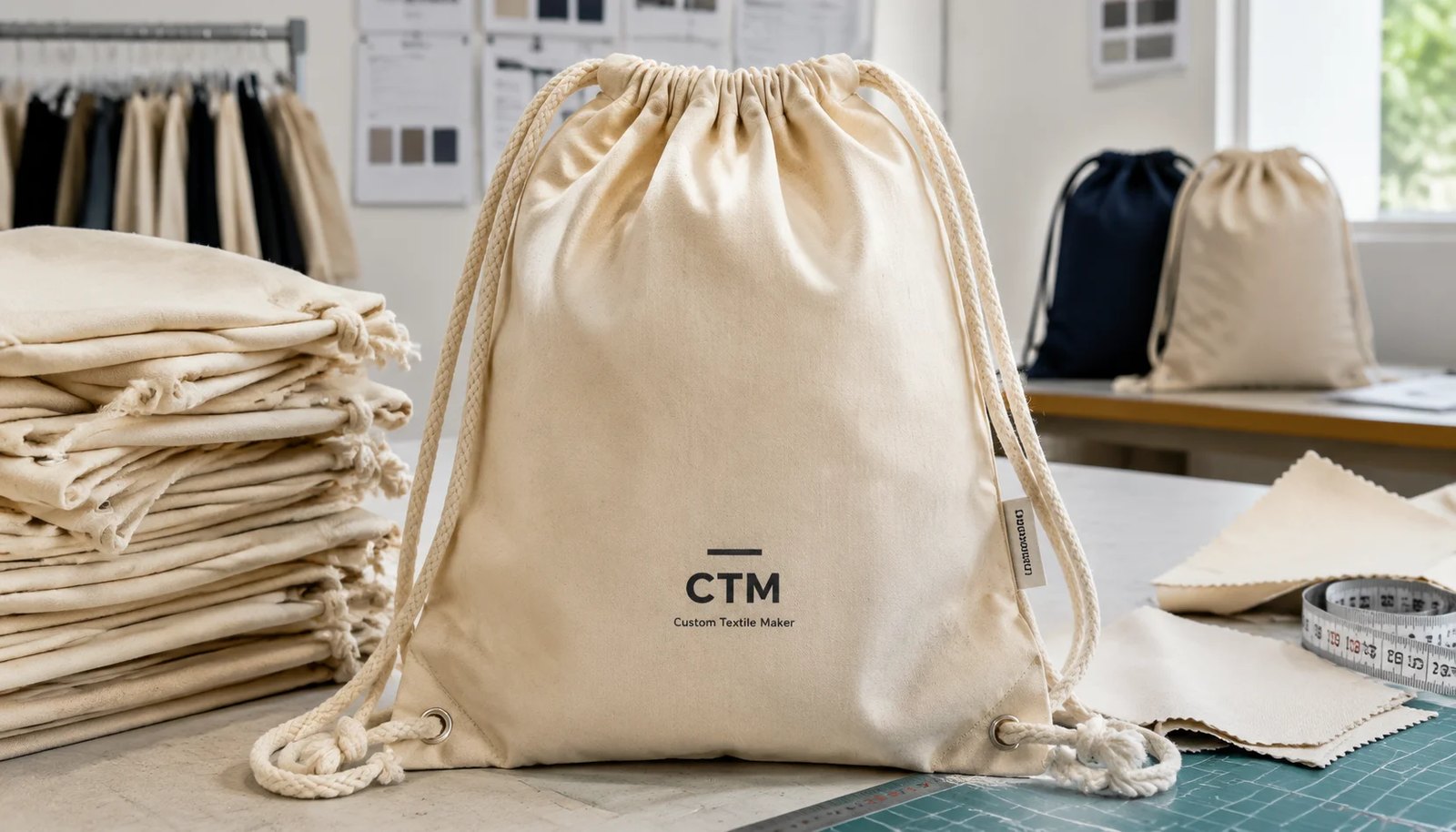
The buying problem: a natural-looking bag still needs industrial controls
Wholesale cotton drawstring backpacks for natural grocers are often specified as simple, eco-friendly promotional items. That simplicity is exactly why mistakes happen. Buyers may approve a nice-looking sample, then receive mass production with thinner fabric, weak corner reinforcement, rough print, uneven natural color, or cartons packed in a way that creates creases and dirt before the bags reach the store.
For procurement teams, the useful goal is not to write a long decorative spec. The goal is to lock the few details that affect cost, shelf appearance, and functional performance. A cotton drawstring backpack for a grocery chain must survive filling, pulling, stacking, store handling, and customer reuse. The RFQ should make those requirements measurable before the supplier prices the order.
- Treat the bag as a functional carry item, not only a printed fabric panel.
- Separate cosmetic expectations from strength requirements so inspection decisions are clear.
- Make the approved sample represent mass production materials, not only a sales sample from the showroom.
- Define packing early because grocery distribution can be harder on bags than the sewing line.
Choose fabric GSM by use, not by the lowest quote
Cotton drawstring backpacks can be made from light cotton sheeting, cotton twill, or cotton canvas. For natural grocery programs, the most common practical range is around 5 oz to 8 oz cotton. A 5 oz fabric may work for event giveaways with leaflets, coupons, and light packaged samples. A 6 oz canvas, roughly around 200 GSM depending on weave, is a better baseline for branded reusable use. An 8 oz canvas, around 270 GSM, feels more substantial and supports paid merchandise or higher-value loyalty programs.
The key is that GSM alone does not tell the full story. A loose weave can feel soft but distort after printing. A tighter canvas may carry ink better and look cleaner after folding. Natural unbleached cotton can show seed flecks, yarn variation, and shade difference from lot to lot. Those are normal for the category, but they must be agreed. If the brand wants a clean premium beige, the supplier may need bleached and dyed fabric, which changes cost, MOQ, and lead time.
- Giveaway baseline: 4-5 oz cotton only when the loading requirement is low and price is the main driver.
- Balanced retail and event use: 6 oz cotton canvas with reinforced bottom corners.
- Premium or repeated use: 8 oz cotton canvas with stronger cord and reinforced stress points.
- Natural cotton appearance: approve fabric swatch for flecks, shade, odor, and hand feel before PP sample.
Design the construction around drawstring stress points
Most field failures on drawstring backpacks occur at the cord exit points, side seams, or top channel. Natural grocery buyers often focus on fabric and logo, but the cord system carries the load. When the user pulls the cords onto the shoulders, the lower corners receive repeated stress. If the cord exits through a simple seam opening without a reinforcement tab, the fabric may tear even when the main body fabric is acceptable.
A practical construction for bulk orders uses a folded top channel, even stitch line, and reinforced bottom corner tabs. The reinforcement can be triangular cotton tabs, rectangular patches, or inserted cord loops caught into the side seam with extra back tack stitching. For heavier backpacks, thread strength and stitch density matter. A neat seam is not enough; it needs to hold when the bag contains jars, snacks, wellness products, or several boxed grocery items.
- Recommended stitch density: often around 8-10 stitches per inch, subject to fabric and thread type.
- Critical location: lower cord anchor or exit area should include back tack or reinforced tab.
- Draw channel: wide enough for the cord to move smoothly without binding after washing or steaming.
- Seam finish: overlock or clean internal seam to reduce fraying inside the backpack.
Print method decisions for grocery brand logos
For cotton drawstring backpacks, water-based screen printing is usually the most practical method for natural grocer branding. It gives a softer hand feel than heavy plastisol-style ink and fits the visual language of organic food, wellness, and sustainability programs. For one to three solid colors, screen printing is efficient and repeatable at wholesale quantities. Heat transfer can work for detailed logos or small runs, but it may feel less natural and can crack or peel if the wrong film is used.
The RFQ should include artwork size, print position, number of colors, Pantone references, and whether the logo prints on one side or both sides. Print color on natural cotton needs special attention because the base fabric is not optical white. A green, brown, or muted black may look different on unbleached cotton than on a digital proof. For strict brand colors, request a strike-off on the actual bulk fabric, not only a paper proof or digital rendering.
- Best common option: water-based screen print for simple logos and soft hand feel.
- For fine detail: confirm minimum line thickness and whether the fabric weave will distort small text.
- For dark fabric: expect different ink layering, possible underbase, and added cost.
- QC test: include rub resistance and print adhesion review before final packing.
MOQ logic: why the same bag can have different minimums
A factory may quote different MOQs for what appears to be the same cotton drawstring backpack. Stock natural cotton fabric with a standard cord color has the lowest barrier because the supplier can cut from available fabric and use existing accessories. Custom dyed fabric, custom Pantone cord, non-standard size, heavy canvas, and multi-position printing all raise the MOQ because mills, dye houses, and print departments need efficient batch quantities.
Buyers should not evaluate MOQ separately from unit price and risk. A very low MOQ may use available fabric lots with wider shade variation. A higher MOQ may allow more controlled fabric sourcing and more consistent carton packing. If the order is for a chain rollout, distributor replenishment, or retail merchandise, it is safer to approve a scalable specification instead of buying a one-time small-lot construction that cannot be repeated.
- Lowest MOQ route: stock natural fabric, stock cord, one-color print, standard size.
- Medium complexity: custom size, two-color print, upgraded cord, paper band packing.
- Higher MOQ route: custom dyed cotton, Pantone cord, retail barcode labeling, both-side print.
- Reorder planning: reserve fabric and cord standards in the PO so the second order matches the first.
Sample approval should prove the production route
A sales sample only proves that the supplier can make one attractive bag. A pre-production sample proves the factory understands the exact order. For wholesale cotton drawstring backpacks, the PP sample should use the confirmed fabric GSM, final cord, thread color, reinforcement construction, print method, print size, and packing concept. If the PP sample is made from substitute fabric or a temporary cord, it cannot be used as the final inspection standard.
Procurement teams should create a sample approval record with photos and measurements. Include front view, back view, inside seam, top channel, lower cord reinforcement, print close-up, folded packing view, and carton label sample if available. Sign off on physical characteristics and write down any approved deviations. This prevents arguments later when production bags have natural cotton flecks, slight shade variation, or a print hand feel that was visible on the approved sample.
- Measure finished width and height with the bag flat and drawstring relaxed.
- Weigh the sample and compare to expected fabric GSM and size.
- Pull the cord repeatedly to feel channel friction and corner stress.
- Fold the sample as it will be packed to see whether print transfer or heavy creasing occurs.
- Keep one approved sample with the buyer and one sealed sample at the factory.
Inspection thresholds that prevent shipment disputes
A cotton drawstring backpack inspection should combine general appearance checks with product-specific functional tests. Standard visual inspection catches stains, broken stitches, missing labels, poor print registration, wrong size, and packing errors. It may not catch a weak drawstring corner unless the inspector is instructed to load and cycle the bag. For grocery use, a realistic test is more useful than only looking at the bag on a table.
Define defects before production starts. A critical defect may include unsafe contamination, wrong logo, wrong country of origin label, or a cord failure during a basic load test. Major defects may include open seams, severe print smearing, size outside tolerance, missing reinforcement, or dirty visible panels. Minor defects may include small loose threads, slight natural flecks within standard, or light creasing from approved packing. The point is not to reject natural cotton character; it is to reject problems that affect selling, distribution, or use.
- Finished size tolerance: commonly plus or minus 1 cm unless a different standard is approved.
- Print placement tolerance: define distance from top edge and side centerline, often plus or minus 0.5-1 cm depending on artwork.
- Load test: use a realistic target weight based on intended contents and hold time.
- Draw cycle test: open and close several times to check cord movement and seam stress.
- Cleanliness: reject oil stains, mildew odor, visible dirt, and foreign matter inside cartons.
Packing choices affect sustainability, damage rate, and store handling
Natural grocers often prefer reduced plastic packaging, but the packing method still has to protect the product through export cartons, warehouse handling, and store distribution. Bulk packing is lower cost and avoids individual plastic, but it can create counting errors and heavier creasing. A recyclable paper band can present the product neatly for retail or event distribution, but it adds labor and requires size control. Individual OPP or recycled poly bags protect against dirt and moisture but may conflict with the retailer’s sustainability policy.
The best packing choice depends on how the backpacks will be used after arrival. If they go directly into event kits, bulk packing with inner bundle counts may be enough. If they are sold as merchandise, each bag may need a barcode, hangtag, warning label where required, and a retail-ready fold. For distribution centers, carton strength, gross weight, and pallet pattern matter because soft cotton bags can shift inside cartons during transport.
- Bulk carton packing: specify bundle count, separator sheet if needed, and master carton quantity.
- Paper band packing: confirm band material, print, barcode position, and folding method.
- Individual bag packing: define bag material, suffocation warning where applicable, and sealing style.
- Carton marks: include PO number, SKU, color, quantity, gross weight, net weight, and carton number.
- Moisture control: require dry cartons and avoid packing immediately after steaming or damp finishing.
Lead time risk sits in approvals, not only sewing capacity
The sewing time for cotton drawstring backpacks can be short once all materials are ready. The real lead time risk is usually before mass production: fabric sourcing, dyeing, lab dip approval, artwork proof, screen making, strike-off approval, and PP sample comments. If a buyer changes logo size after the screen is made, or changes from natural fabric to dyed fabric after sampling, the schedule resets.
A realistic sourcing plan separates each approval stage. Stock natural fabric with one-color print may move quickly after artwork and PP sample approval. Custom dyed fabric requires lab dip approval and bulk shade review. Retail packing adds barcode proofing and label checks. Third-party inspection needs to be booked before the factory fills the container or seals all cartons. For seasonal grocery campaigns, build a calendar from store arrival backward, not from factory production forward.
- Approval path: fabric swatch, artwork proof, print strike-off, PP sample, packing proof, mass production.
- Common delay: incomplete vector artwork or unclear Pantone references.
- Common factory bottleneck: print curing and drying capacity during humid seasons.
- Inspection timing: schedule after 80-100 percent production is finished and at least 80 percent packed.
- Shipment risk: bulky cartons may affect container planning more than buyers expect for low-cost textile bags.
Quote comparison: make suppliers price the same backpack
Many cotton drawstring backpack quotes are not directly comparable. One supplier may include 8 oz fabric, reinforced corners, one-color water-based print, paper band packing, and FOB terms. Another may quote 5 oz cotton, basic cord exit, bulk packing, and EXW terms. The second quote will look cheaper, but it may not meet the same retail or inspection requirement. A good RFQ forces each supplier to price the same specification and show what is excluded.
Request quote data in a structured format. At minimum, include unit price by quantity tier, fabric GSM, bag size, print method, print colors, packing, carton quantity, carton dimensions, gross weight, sample cost, screen charge, lead time, Incoterm, payment terms, and validity period. For importers and distributors, carton data is not a detail; it affects freight, warehouse handling, and landed cost. For brand owners, print setup fees and sample revisions can change the real cost of a small first order.
- Compare FOB to FOB, CIF to CIF, or DDP to DDP; do not mix Incoterms when ranking suppliers.
- Separate tooling and setup charges from unit price so reorder economics are visible.
- Ask for carton cube and gross weight before approving the final landed-cost estimate.
- Require the supplier to state if fabric GSM, cord, reinforcement, or packing changes at different quantity tiers.
- Keep a quote version number so later sample changes do not create confusion.
Specification comparison for buyers
| Spec decision | Recommended option | When it fits | Buyer risk to check |
|---|---|---|---|
| Fabric weight | 6 oz cotton canvas, about 200 GSM, or 8 oz about 270 GSM for heavier retail use | 6 oz fits giveaway and light grocery trips; 8 oz fits paid merchandise, loyalty rewards, and repeated use | Supplier may quote thin 4 oz cotton to win price; require GSM tolerance and fabric swatch approval |
| Backpack size | Approx. 35 x 40 cm or 38 x 42 cm with 1 cm tolerance | Works for produce, boxed snacks, wellness samples, leaflets, and store event kits | Too small looks cheap; too large strains seams if fabric and cord are not upgraded together |
| Cord type | Cotton cord 5-7 mm or braided polyester cord if colorfastness and strength are priorities | Cotton cord supports natural positioning; polyester cord performs better in high-friction draw channels | Thin cord cuts into fabric corners; test draw action and corner reinforcement after loading |
| Bottom reinforcement | Triangular or rectangular reinforced corner tabs with back tack stitching | Needed when backpacks are used for grocery sampling, community events, or reusable carry | Unreinforced cord exit points are a common failure area during pull and load tests |
| Print method | Water-based screen print for 1-3 solid colors; discharge or pigment print only after shrinkage and hand-feel approval | Best for natural grocer logos, organic look, and medium to high volume runs | Ink migration, poor curing, and rough hand feel can cause inspection disputes and brand complaints |
| Color choice | Natural unbleached cotton, black, olive, kraft beige, or custom dyed with lab dip | Natural and earth-tone colors align with grocery wellness programs and reduce dye-cost complexity | Natural cotton has seed flecks and shade variation; define acceptable fabric appearance before PP sample |
| Packing unit | Individually folded in recyclable OPP, paper band, or bulk carton packing based on retail plan | Paper band or bulk packing fits sustainability messaging; OPP protects bags for distribution centers | Loose bulk packing saves cost but increases creasing, dirt exposure, and carton counting errors |
| Inspection standard | AQL inspection with defined critical, major, and minor defects plus on-site load and print adhesion checks | Suitable for importers, distributors, and retailers needing repeatable QC across orders | Generic textile inspection may miss functional drawstring failures unless special tests are written into the PO |
Buyer checklist before sampling
- Define final backpack use: giveaway, paid retail item, loyalty kit, staff event bag, or grocery sampling pack.
- Specify fabric as cotton canvas or cotton sheeting with target GSM, acceptable tolerance, and whether natural flecks are acceptable.
- Set finished size, seam allowance expectation, cord length, cord diameter, draw channel width, and reinforcement style.
- Provide logo artwork in vector format with Pantone references and maximum print area in centimeters.
- State print method preference and require curing, rub, and wash-related sample checks when the bag may be reused.
- Request one pre-production sample made in bulk fabric, bulk cord, bulk thread, and bulk print method before mass cutting.
- Define AQL level, defect classification, and functional tests such as loading, drawstring cycling, seam pull, and print adhesion.
- Clarify packing: individual bag, paper band, inner carton count, master carton count, carton marks, barcode labels, and pallet requirements.
- Compare quotes using the same Incoterm, carton size, gross weight, sample cost, mold or screen cost, and lead time basis.
- Reserve time for lab dip, artwork proof, PP sample approval, production, inspection, and vessel or courier booking.
Factory quote questions to send
- What fabric construction and GSM are included in the quote, and what is the production tolerance for GSM and finished size?
- Is the quoted cotton fabric greige, bleached, dyed, or natural unbleached, and are seed flecks and shade variation included in the approved standard?
- What cord material, diameter, length, color, and tip finishing method are included?
- How are the bottom cord exit points reinforced, and can the factory provide a close-up photo of a current production sample?
- Which print method is quoted, how many colors are included, and what is the maximum print area without changing price?
- Are screen charges, artwork proofing, lab dips, PP sample fees, courier fees, and inspection rework time included or separate?
- What MOQ applies for stock natural fabric, custom dyed fabric, custom cord color, and multi-color print?
- What is the normal production lead time after PP sample approval, and what approvals are on the critical path?
- What packing method is quoted, including individual packing, inner carton quantity, master carton quantity, carton dimensions, and gross weight?
- Which inspection standard does the factory support, and will they allow third-party inspection before final payment or shipment release?
Quality-control points to confirm
- Fabric GSM checked against approved swatch with tolerance agreed before production.
- Finished size measured flat with drawstring relaxed, typically within plus or minus 1 cm unless otherwise agreed.
- Seams inspected for skipped stitches, broken thread, raw edges, puckering, and uneven stitch density.
- Cord channels checked for smooth opening and closing without snagging or twisting.
- Bottom cord exit points tested for reinforcement strength and tearing after repeated pulls.
- Print position measured from top and side edges; color compared under consistent light against approved proof or Pantone target.
- Print adhesion tested by dry rub, wet rub where relevant, and tape pull if suitable for the ink system.
- Load test performed with realistic product weight, held and cycled to simulate use during grocery events.
- Packing count verified at unit, inner carton, and master carton level before sealing.
- Carton marks, barcode labels, country of origin labels, and retail labels checked against the PO and import requirements.