The Buying Problem
Natural grocers often want a cotton drawstring backpack that looks honest, reusable, and aligned with the store environment. The difficult part is not choosing cotton in general. The difficult part is selecting a fabric weight that can handle real shopper behavior without making the backpack too expensive, too stiff, or too heavy to ship in bulk.
A procurement team may receive three quotes that all say cotton drawstring backpack, but one supplier is pricing 6 oz sheeting, another is pricing 8 oz cotton canvas, and a third is including reinforcement and better cord. Those offers are not equal. The RFQ has to describe fabric weight, construction, print, cord, reinforcement, packing, and approval steps clearly enough that each supplier is quoting the same bag.
- Use 6 oz cotton only when the bag is mainly a low-load promotional item.
- Use 8 oz cotton canvas for most natural grocer backpack programs where reuse matters but cost still matters.
- Use 10 oz cotton canvas when the backpack is sold as merchandise or expected to carry heavier grocery loads.
- Avoid vague RFQ wording such as natural cotton bag, eco backpack, or standard canvas without GSM and reinforcement details.
Fabric Weight Choice
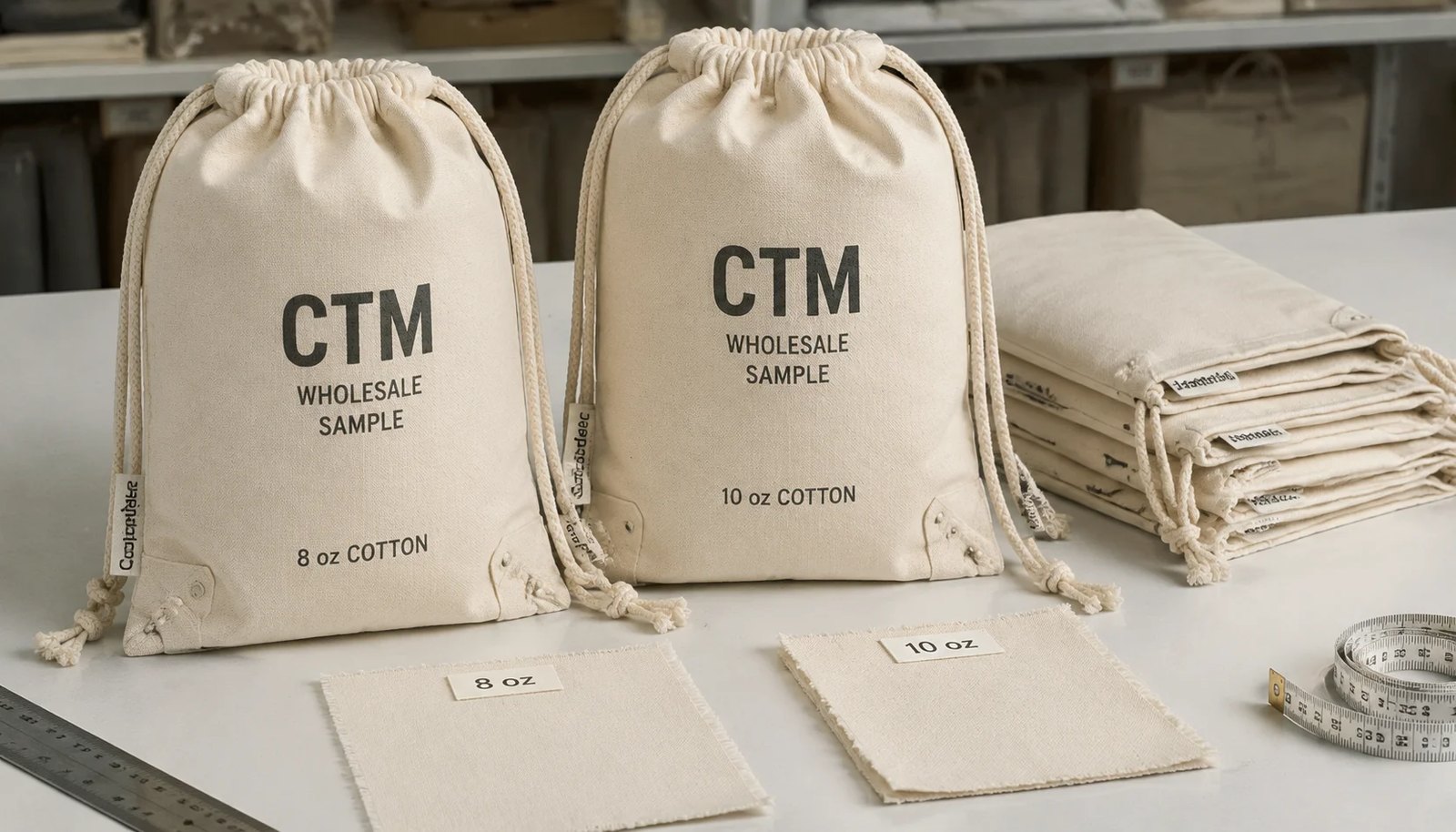
For wholesale cotton drawstring backpacks, fabric weight is usually discussed in ounces per square yard or GSM. Both systems are common, but they are not always converted consistently in supplier quotations. As a practical reference, 6 oz cotton is roughly around 200 GSM, 8 oz is roughly around 270 GSM, and 10 oz is roughly around 340 GSM. The exact GSM depends on weave, finishing, and shrinkage, so the RFQ should state both the ounce weight and target GSM when possible.
Natural grocers should avoid choosing the heaviest fabric automatically. A 10 oz backpack feels stronger and more retail-grade, but it also increases fabric cost, carton weight, and sometimes the closure force needed to pull the cords. An 8 oz canvas often gives the best commercial balance: enough structure for store programs and reusable promotions, but still manageable for bulk shipping and customer comfort.
- 6 oz / about 200 GSM: light, foldable, lower cost, suitable for small samples or short campaigns.
- 8 oz / about 270 GSM: balanced option for reusable grocer promotions, loyalty programs, and everyday light shopping.
- 10 oz / about 340 GSM: stronger hand feel for paid retail items, premium campaigns, and higher perceived value.
- 12 oz and above: possible, but usually too stiff or costly for simple drawstring backpack programs unless the design is more structured.
Load And Use Case
The correct fabric weight depends on what the store expects customers to put inside the backpack. A bag used for coupons, wellness samples, and light dry goods has different requirements from a bag used for produce, jars, boxed snacks, or refill containers. If the backpack may carry dense grocery items, fabric weight alone is not enough. The lower cord exits and side seams become the real failure points.
A useful RFQ describes expected use in practical terms. For example, state that the backpack should carry 3-5 kg of mixed grocery items during normal store use, or that it is intended only for lightweight promotional sampling under 2 kg. This helps the factory choose stitch type, seam allowance, cord diameter, and reinforcement instead of only quoting a cheaper fabric.
- For wellness sample kits: 6 oz may be acceptable if the size is modest and print coverage is simple.
- For produce or packaged grocery use: 8 oz with bartacks at cord exits is a safer baseline.
- For merchandise sold at checkout: 10 oz often gives the hand feel buyers expect for a paid item.
- For heavy glass or canned goods: consider whether a tote bag is more suitable than a drawstring backpack.
Construction Details
A cotton drawstring backpack looks simple, but small construction choices change durability. The top channel must be deep enough for the cord to slide without bunching. The bottom corners need reinforcement because the drawcords act like shoulder straps and pull directly on the fabric. If the supplier saves cost by narrowing seam allowance or skipping bartacks, the bag may look fine in a flat photo but fail after repeated use.
For natural grocer programs, the most reliable construction is a double-fold top channel, clean side seams, reinforced lower cord exits, and a cord that matches the fabric weight. A thin cord on 10 oz canvas feels cheap and can dig into the shoulder. A very thick cord on 6 oz fabric can distort the corners and make the bag look unbalanced.
- Top channel depth: usually needs enough clearance for the selected cord diameter plus smooth sliding.
- Seam allowance: specify a minimum, commonly around 1 cm for practical durability.
- Bartacks: place at lower cord exits and other stress points where the cord pulls the fabric.
- Cord ends: decide whether knots, metal tips, plastic tips, or sewn ends are acceptable for the brand and market.
- Inside finishing: simple overlock seams may be acceptable, but loose threads should be controlled before packing.
Print Method Selection
Most natural grocer cotton drawstring backpacks use screen printing because it is efficient for bulk orders, works well on cotton, and gives a clean result for simple logos. Water-based ink is often preferred when the buyer wants a softer hand feel and a less plasticky surface. Plastisol can give stronger opacity in some cases, but it may not match the natural cotton positioning that grocers want.
Full-color artwork should be handled carefully. Heat transfer can reproduce complex graphics, but it may sit on top of the cotton and change the feel of the bag. Digital printing may be useful for smaller runs or artwork with gradients, but it needs testing on the selected cotton fabric. Natural cotton shade variation, cotton seed marks, and weave texture can all affect how the logo appears.
- Best for simple logos: 1-3 color screen print with approved Pantone references.
- Best for soft hand feel: water-based screen print tested on actual bulk fabric.
- Best for complex artwork: heat transfer or digital print after reviewing flexibility and wash/rub performance.
- Avoid very fine text near seams because drawstring backpacks wrinkle and flex during use.
- Set print placement tolerance, such as distance from top edge and side seams, before mass production.
MOQ Logic
MOQ is not only a factory policy. It is connected to fabric availability, dyeing, printing setup, cutting efficiency, and packing labor. Natural unbleached cotton in common weights may have a lower MOQ than custom dyed cotton. A one-color logo on stock natural fabric is easier to quote than four store-specific colors across multiple locations.
Buyers can reduce cost and schedule risk by separating must-have customization from nice-to-have variation. One common approach is to keep the same fabric, size, cord, and construction across the whole order, then vary only the front print by store group or campaign. The factory still needs to manage print screens and packing separation, but the fabric and sewing process stay stable.
- Lowest MOQ path: stock natural cotton fabric, standard size, one print design, simple carton packing.
- Higher MOQ path: custom dyed fabric, special cord color, multiple print designs, store-level carton sorting.
- Costly variation: changing fabric weight by design because cutting and sewing settings may need separation.
- Efficient bulk plan: approve one base backpack spec, then organize artwork versions as controlled print variants.
Sample Approval
A sample made from substitute fabric is useful only for checking size and general layout. It is not enough for approving a wholesale order. For cotton drawstring backpacks, the pre-production sample should use the actual fabric weight, actual cord, actual print method, and final reinforcement. Otherwise the buyer may approve a bag that behaves differently from the bulk production.
The sample stage should also include a print strike-off, especially on natural cotton. Natural fabric can absorb ink unevenly, and the background shade may shift the perceived logo color. If the brand color is important, approve the strike-off under consistent light and keep a signed or sealed reference sample for production comparison.
- Review fabric hand feel, thickness, and opacity against the target GSM.
- Pull the drawcord repeatedly to see whether the channel closes smoothly.
- Load the sample with the expected grocery weight and inspect lower corners after use.
- Measure finished size after the bag is pressed and relaxed, not while distorted from shipping.
- Keep one approved sample with the buyer and one with the factory for QC reference.
QC Thresholds
Quality control should focus on the points that affect retail acceptance and actual use. For a natural grocer, small cotton seed marks may be acceptable if the fabric is intentionally natural, but oil stains, mold odor, print smears, open seams, and misaligned logos are not acceptable. The inspection standard should separate natural material characteristics from manufacturing defects.
A practical QC plan includes measurement, fabric verification, print inspection, stitching review, cord function, packing count, and carton labeling. If the order is large or shipped to multiple distribution centers, add carton-level checks so the receiving team does not spend time sorting mixed designs or correcting missing shipping marks.
- Finished size tolerance: define in centimeters or inches for width, height, and channel depth.
- Print position tolerance: define allowed movement from top and side reference points.
- Stitching defects: reject open seams, skipped stitches at stress points, broken bartacks, and loose cord exits.
- Fabric defects: grade stains, holes, heavy slubs, odor, and inconsistent shade by agreed severity.
- Function test: cords should pull evenly and support the expected load without tearing the lower corners.
Packing And Freight
Cotton drawstring backpacks are usually flat packed, but packing still affects cost and retail condition. A 10 oz canvas backpack takes more carton space and adds more gross weight than a 6 oz bag. Over-compression can leave hard creases, especially on natural cotton, and those creases may be visible around the printed logo when cartons are opened.
For distributors and retail buyers, carton data should be part of the quote, not an afterthought. Ask for pieces per carton, carton size, gross weight, net weight, carton material, shipping marks, and whether inner polybags or paper bands are used. If the buyer is reducing plastic, confirm whether bulk polybag lining, paper bundling, or no individual polybag is acceptable for the transport route and warehouse conditions.
- 50 pcs per carton may be suitable for heavier canvas or retail-sensitive packing.
- 100 pcs per carton may work for lighter fabric if carton strength and crease control are acceptable.
- Individual polybags improve cleanliness but add cost and plastic use.
- Bulk inner bags reduce handling but require cleaner warehouse control.
- Carton labels should match PO, SKU, artwork version, quantity, gross weight, and destination instructions.
Lead Time Risk
Lead time should be counted from the last approval that allows the factory to start safely. That may be deposit, artwork approval, fabric approval, print strike-off approval, or pre-production sample approval. If the buyer counts from PO release but artwork is not final for two weeks, the schedule risk has simply moved into production.
Natural grocer campaigns often connect to store openings, seasonal promotions, wellness events, or holiday merchandising. The safest workflow is to approve fabric and artwork early, freeze the base spec, and leave enough time for inspection and freight booking. Last-minute changes to cord color, print size, or packing split can delay production more than buyers expect because they affect purchasing, printing screens, sewing line instructions, and carton labels.
- Fabric swatch approval: needed before sample confidence is real.
- Print strike-off: needed when color, opacity, or hand feel matters.
- Pre-production sample: needed before bulk cutting and sewing.
- Production time: depends on order size, print complexity, and factory capacity.
- Freight booking: should include carton dimensions and gross weight from the final packing plan.
Specification comparison for buyers
| Spec decision | Recommended option | When it fits | Buyer risk to check |
|---|---|---|---|
| Main fabric weight | 8 oz cotton canvas, about 270 GSM, unbleached or dyed | Good balance for natural grocer giveaways, paid loyalty items, seasonal produce kits, and lightweight daily use | Thin suppliers may quote 6 oz while calling it canvas; request GSM tolerance and a pre-production fabric swatch |
| Heavier fabric option | 10 oz cotton canvas, about 340 GSM | Fits retail-priced merchandise, reusable shopping programs, and stores wanting a more structured backpack feel | Higher freight weight and stiffer draw closure; test whether customers can close the bag smoothly when filled |
| Economy fabric option | 6 oz cotton, about 200 GSM, only for low-load promotions | Works for single-event campaigns, small wellness samples, or low-budget store openings | Bottom corners and cord channels fail earlier if shoppers use it for cans, jars, or produce |
| Logo printing | Water-based screen print for 1-3 solid colors on natural cotton | Best for grocer logos, simple produce graphics, local store messages, and repeat bulk orders | Natural cotton absorbs ink unevenly; approve strike-off for color density, edge sharpness, and wash rub resistance |
| Full-color artwork | Heat transfer only when detail cannot be simplified for screen printing | Useful for small limited runs, complex illustrations, or multi-color campaign graphics | Transfers can feel plasticky on cotton and may crack on drawstring backpacks that flex heavily |
| Drawcord system | Cotton rope or thick cotton cord threaded through a double-fold top channel | Matches natural grocer sustainability positioning and gives better hand feel than cheap polyester cord | Cord diameter must match channel width; tight channels slow packing and frustrate customers at checkout |
| Bottom reinforcement | Bartacks at lower cord exits plus 1 cm seam allowance minimum | Needed when the backpack may carry apples, glass bottles, dry goods, or promotional product bundles | A low quote may remove bartacks or use short stitch length that cuts fabric under load |
| Packing format | Flat packed in export cartons, 50-100 pcs per carton depending on fabric weight | Best for distributors and retail DCs that need predictable carton counts and barcode receiving | Over-compressed cartons crease natural cotton; require carton dimensions, gross weight, and packing photo before shipment |
Buyer checklist before sampling
- Define the real load: sample sachets, produce, packaged groceries, glass jars, or retail merchandise all require different GSM and reinforcement.
- State the fabric as cotton type plus weight, such as unbleached cotton canvas 8 oz / about 270 GSM, instead of only saying natural cotton.
- Set a fabric tolerance in the RFQ, for example plus or minus 5 percent GSM after finishing, and require a fabric swatch before sample approval.
- Specify finished backpack size, not cut size, including width, height, top channel depth, and acceptable shrinkage after sewing.
- Choose cord material and diameter together with the top channel width so the draw closure works without excessive friction.
- Define print method, logo size, Pantone references, ink type, placement from seam edges, and acceptable print position tolerance.
- Require bartacks or reinforced stitching at lower cord exits if the backpack will be used for grocery loads instead of light samples.
- Approve a pre-production sample with real fabric, real cord, final artwork, and final packing method before bulk cutting.
- Request carton packing data, individual packing method, barcode or label needs, carton drop expectations, and humidity protection for cotton goods.
- Compare quotes using fabric GSM, reinforcement, print setup, packing, and inland delivery terms, not unit price alone.
Factory quote questions to send
- What cotton fabric construction and GSM are you quoting, and what tolerance will be controlled in production?
- Is the quoted fabric plain cotton, cotton canvas, recycled cotton blend, or organic cotton, and can you provide a physical swatch?
- What is the finished backpack size and the expected dimensional tolerance after sewing and pressing?
- Which print method is included in the price, how many colors, what print area, and what setup charge applies for screens or transfers?
- Are bartacks included at the bottom cord exits and stress points, or are they priced as an upgrade?
- What cord material, cord diameter, and channel construction are included in the quote?
- What is the MOQ for each fabric weight, each dyed color, and each print design?
- How many pieces are packed per carton, what are the carton dimensions and gross weight, and can cartons carry our shipping marks?
- What sample stages are included before mass production, and how many days are needed for fabric swatch, print strike-off, and pre-production sample?
- What lead time starts after which approval: deposit, artwork approval, fabric approval, or pre-production sample approval?
Quality-control points to confirm
- Fabric GSM should be checked from production fabric, not only from the sales swatch, with agreed tolerance recorded before cutting.
- Finished size should be measured flat after sewing, with width, height, and top channel depth controlled against the approved sample.
- Drawcords should pull evenly from both sides, close the opening without jamming, and show no loose fibers that affect retail appearance.
- Lower cord exits should have bartacks or equivalent reinforcement, with no skipped stitches, broken threads, or fabric tearing after pull testing.
- Print color should match the approved strike-off under consistent lighting, with position tolerance agreed from top and side seams.
- Print adhesion and rub resistance should be tested after curing, especially on natural cotton where ink absorption varies by fabric lot.
- Seams should be straight, with clean backstitching and no open seam longer than the agreed inspection threshold.
- Needle marks, stains, oil spots, mold odor, and excessive cotton seed marks should be graded before packing, not discovered at retail receiving.
- Carton count, polybag choice, humidity protection, and shipping marks should match the packing instruction before goods leave the factory.