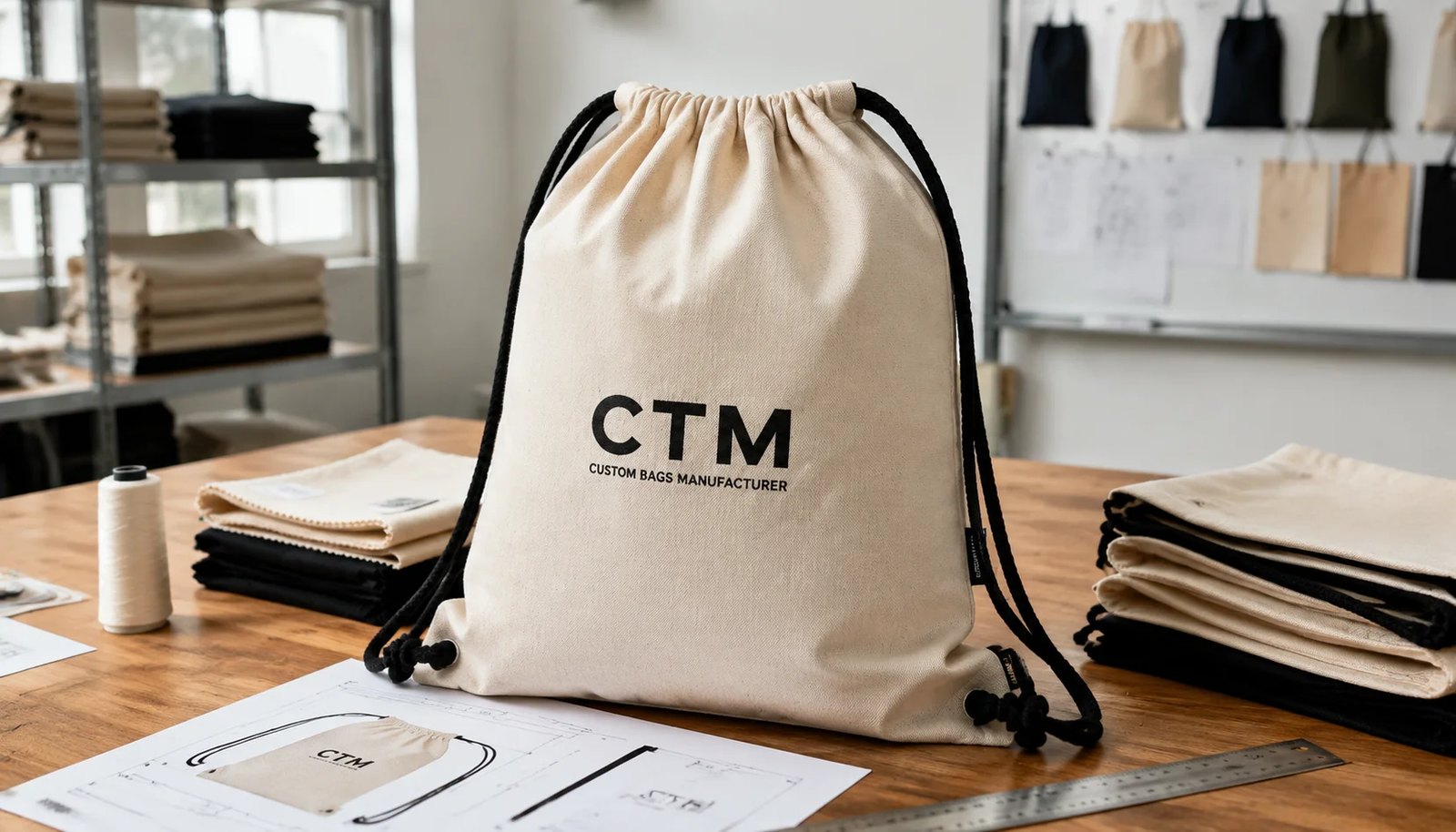
Why liquor retailers buy cotton drawstring backpacks differently from general promo bags
Liquor retail programs usually buy drawstring backpacks for one of four reasons: gift-with-purchase campaigns, seasonal branded merchandise, event packs, or accessory packaging for curated retail bundles. That matters because the wrong spec often comes from treating the item like a low-cost giveaway bag. A store promotion tied to premium spirits or wine gifting needs better fabric body, cleaner print, and stronger corner construction than a race-day handout or trade show tote.
The main buying problem is not whether a factory can make a cotton drawstring backpack. Most can. The real issue is whether your RFQ defines the use case clearly enough to get comparable quotes and avoid underbuilt offers. If one supplier quotes thin cotton sheeting with simple cord insertion and another quotes heavier canvas with reinforcement patches, the unit prices are not directly comparable. Buyers end up negotiating on the wrong baseline.
- Gift-with-purchase: prioritize appearance, logo clarity, and predictable store-ready packing
- Retail resale item: prioritize fabric handfeel, seam durability, and cleaner finishing
- Event or tasting kit: prioritize low setup cost and shipment timing
- Bottle-bundle accessory: verify actual filled dimensions and load stress at corners
Start with the right base specification before you request prices
For liquor retail buyers, the safest starting point is usually 8 oz to 10 oz cotton canvas, roughly 270 to 340 GSM. This weight gives enough body for a premium feel without pushing the bag into a heavy, expensive utility category. Below that range, bags can look limp on shelf, wrinkle more after packing, and show more print distortion. Above that range, cost rises quickly and the drawstring channel becomes bulkier, which can reduce smooth closure if construction is not adjusted.
A practical finished size for many retail promotions is 35 x 45 cm or 38 x 42 cm. Those formats work for apparel, promotional bundles, tasting accessories, and general merchandise. If the bag is intended to complement bottle sales, do not assume standard dimensions are enough. Bottle height, cap diameter, and any added inserts change how the bag closes and how much stress transfers to the bottom corners. A filled sample is worth more than a flat drawing here.
- Useful spec line example: 100% cotton canvas, natural color, 300 GSM target, finished size 38 x 42 cm, cotton rope drawcord, reinforced bottom corners
- State tolerance example: size tolerance ±1 cm, print position tolerance ±0.5 to 1 cm depending on artwork
- For dyed bags, note whether Pantone is required on fabric or only on print
Fabric, GSM, and construction choices that affect real retail performance
Fabric weight is not only a cost decision. It affects drape, print holdout, seam strength, and perceived value in-store. A 140 to 180 GSM cotton sheeting bag may work for low-cost sampling events, but it often feels too soft for branded liquor retail programs unless the brand deliberately wants a lightweight look. By contrast, 270 to 340 GSM canvas gives better shape retention and usually supports a cleaner front print panel, especially when the artwork includes a centered logo or event message.
Construction details matter just as much as GSM. Bottom corner stress is the most common weakness in drawstring backpacks. If the cords are only caught into the side seam with no patch or bar-tack, failures tend to show up during filled use, not at sample approval. For wholesale programs, write the reinforcement into the RFQ. A simple self-fabric triangle patch with a secure bar-tack or box stitch is a small cost increase that prevents the most common post-delivery complaint.
- 140 to 180 GSM: low-cost campaign use, lighter feel, higher distortion risk
- 200 to 250 GSM: mid-range promotional use, acceptable for simple branding
- 270 to 340 GSM: stronger retail feel, better for resale or premium promotions
- Reinforcement options: seam catch only, bar-tack only, self-fabric patch plus bar-tack, or webbing insert for heavier loads
Print method selection: where buyers overpay or under-specify
Most liquor retail artwork for cotton drawstring backpacks should start with screen printing. One-color and two-color graphics are usually the best value on natural canvas, and they scale well in wholesale production. Screen print handles simple logos, event branding, and seasonal graphics efficiently. It also keeps unit pricing more predictable across volume breaks compared with transfer methods that can add hidden setup or area-based charges.
Buyers run into trouble when they send artwork without defining print coverage, color reference, or acceptable surface feel. Large solid prints can become heavy, especially on lighter fabrics. Fine details can fill in if the mesh count and ink deposit are not matched to the art. If you need gradients, photographic detail, or many colors, a transfer route may be better, but then you need to review wash and rub expectations, edge quality, and unit cost impact carefully. For many liquor promotions, simpler art produces a cleaner retail result and faster approvals.
- Screen print: best for spot colors, simple logos, lower setup complexity at volume
- Heat transfer: useful for multi-color detailed art, usually higher piece cost
- Pigment print on natural cotton may vary slightly with fabric absorbency
- For dark bags, ask whether a white underbase is required and whether it changes print handfeel or cost
MOQ logic: how to compare bulk quotes without getting trapped by artwork splits
MOQ on cotton drawstring backpacks is rarely just one number. Buyers should separate MOQ by fabric color, artwork, and size. A factory may quote 1,000 pieces overall, but that could assume one natural fabric, one print layout, and one standard size. If your retail program needs three logos for different regional chains or multiple event dates, the setup burden changes. What looks like a low quote can become expensive once screen changes, packing splits, and carton labeling are added back in.
For larger liquor retail rollouts, cost usually improves when you standardize fabric and bag size, then vary only print color or carton assortment where possible. Even better, lock one artwork position and one drawcord construction across SKUs. Factories produce faster and with fewer errors when line setup stays stable. If you need multiple store versions, compare whether local overprint after import makes sense versus full source-factory split production. That is a sourcing workflow decision, not only a unit-price decision.
- Quote request tip: ask for price tiers at 1,000, 3,000, and 5,000 pieces
- Separate cost variables: new screen cost, fabric dye lot minimum, packing split surcharge, barcode labeling cost
- Best cost control route: one fabric, one size, one cord, one print position, split only by outer carton labels if possible
Sample approval that actually prevents production mistakes
A digital mockup is not enough for this product category. Cotton absorbs ink differently across fabric weights, and drawstring closure performance cannot be judged from artwork files. For wholesale liquor retail orders, the minimum useful approval path is a pre-production sample made with the intended fabric, actual cord type, and production print method. If your program is color-sensitive, add a print strike-off or physical color swatch approval before the sample is sewn.
The sample should also be evaluated in the way the item will actually be used. If it will be sold in stores, inspect shelf presentation and front-panel appearance after folding and unpacking. If it supports bottle-related promotions, test with filled contents and repeated opening and closure cycles. Many approval failures happen because buyers review only the logo, while the factory defaulted to a cord diameter or corner reinforcement that was never fully specified.
- Approve actual size with a tape measure, not just a spec sheet note
- Pull cords repeatedly to see whether the channel binds or cords twist
- Test print rub resistance on a fully cured sample
- Review the sample after packing and unpacking to see wrinkle behavior
- Keep one sealed approved sample as shipment inspection reference
Packing decisions that affect warehouse labor and retail execution
Packing is often treated as a back-end detail, but for liquor retail programs it directly affects receiving speed, promo assembly, and store allocation. If the bags will be sent to a distributor or fulfillment center, cartons should be sorted in the exact way the downstream warehouse wants them. Mixed artwork cartons or vague carton markings create preventable labor cost and picking errors. A few cents saved in source packing can become a larger warehouse handling charge later.
For simple wholesale orders, bulk packing in master cartons may be enough. For store-lot programs, request inner pack segregation by SKU, artwork code, or destination region. If barcodes or FNSKU-style labels are required, give placement instructions before production starts. Natural cotton also attracts dust and handling marks more easily than some synthetics, so decide whether individual polybags are necessary based on retail presentation and final unpacking process, not by habit alone.
- State pieces per inner and per carton clearly in RFQ
- Request export carton dimensions and gross weight for freight planning
- Define carton marks: PO number, SKU, quantity, destination code, carton sequence
- If no individual polybag is wanted, write 'bulk pack without individual polybag' explicitly
Lead time planning: where cotton drawstring backpack schedules usually slip
A realistic lead time is made of several smaller steps: fabric booking, sample approval, screen preparation, cutting, printing, sewing, packing, and shipment release. Buyers get surprised when the quoted lead time is presented as one total number with no detail. For cotton drawstring backpacks, delays often come from slow artwork approval, print color revisions, or changes to packing instructions after sewing has already started. Those are preventable if you lock commercial and technical decisions earlier.
If your order uses natural cotton stock fabric and a simple one-color print, production can move faster than dyed fabric programs. Dyed fabric adds color matching and material planning risk. Multi-artwork programs add screen scheduling complexity. Split shipments add another layer. Ask suppliers to show what lead time starts from: deposit date, artwork approval date, or sample approval date. The difference matters when your retail launch is tied to a seasonal drinks calendar.
- Typical schedule elements to request: sample 5 to 7 days, approval 2 to 5 days, bulk production 20 to 35 days depending on volume and complexity
- High-risk delay points: revised artwork after screen making, changed carton assortment, missing barcode file, late fabric confirmation
- Best planning move: freeze artwork, size, packing, and labels before deposit release
How to compare supplier quotes on landed value, not just FOB unit price
A cheaper unit price can lose its advantage quickly if the supplier is using lighter fabric, weaker corner attachment, inefficient carton packing, or high add-on charges for split labeling. The right comparison is landed value: usable quality at the warehouse with acceptable defect risk and handling cost. That means a quote review should combine unit price, carton efficiency, sample policy, setup charges, and likely rework risk from vague specs.
For example, one factory may quote a lower FOB price on 180 GSM sheeting with basic seam cord insertion, while another offers 300 GSM canvas, reinforced corners, and better carton density. If the item is for retail resale or premium gift-with-purchase, the second offer may be better value even before freight. Heavier fabric can raise product cost, but cleaner packing and lower defect risk can reduce total program cost. The point is not to buy the highest spec; it is to align the spec to actual channel value.
- Compare unit price only after equalizing: GSM, size, print colors, reinforcement, packing, and MOQ basis
- Request carton cube data to estimate freight cost per piece
- Note non-unit charges separately: screens, sample charge, barcode labels, carton assortment labor, export documents if applicable
- Review whether lower price is based on wider tolerances or omitted QC steps
A practical sourcing workflow for liquor retail wholesale programs
The cleanest workflow starts with a short internal brief: use case, launch date, target price, destination market, and whether the bag is a giveaway or a sellable item. Then build an RFQ with exact size, fabric target GSM, print method, reinforcement requirement, and packing instructions. Send the same structure to all shortlisted suppliers so the returned quotes are comparable. This reduces the common problem of negotiating from mismatched assumptions.
After quotes come back, narrow to the two or three suppliers who answered with the most complete technical detail, not only the lowest number. Review samples against the same scorecard: fabric handfeel, print quality, cord performance, reinforcement, and packing logic. Once a supplier is selected, lock a master sample and approved spec sheet before deposit. That sequence sounds basic, but many production mistakes begin when commercial urgency skips the technical freeze.
- Internal brief first, then RFQ, then sample, then bulk approval
- Use one comparison sheet across all suppliers for spec parity
- Do not release production until print, cord, reinforcement, and packing are all approved together
- Hold one signed golden sample for pre-shipment inspection reference
Specification comparison for buyers
| Spec decision | Recommended option | When it fits | Buyer risk to check |
|---|---|---|---|
| Fabric weight | 8 oz to 10 oz cotton canvas, about 270 to 340 GSM | Best balance for liquor gift packs, in-store promotions, and repeat retail use | Under 200 GSM often feels too thin for bottle-related gifting and can distort after printing |
| Cotton type | Conventional cotton for price-driven campaigns; organic only if brand positioning supports higher unit cost | Use conventional for broad wholesale rollouts and organic for sustainability-led private label ranges | Do not pay organic premium unless transaction certificates or scope evidence are included in quote stage |
| Bag size | Approx. 35 x 45 cm or 38 x 42 cm finished size | Fits apparel, promo kits, accessories, and many retail bundles without oversizing the pack | If intended for bottle bundles, verify actual filled dimensions and neck-height clearance before approval |
| Drawcord style | Cotton rope or braided polyester-cotton blend with knotted ends | Cotton rope gives a better retail handfeel; blend works if lower cost and smoother pull matter | Loose weave cords shed fibers, slip through eyelets, or fail on repeated opening if not tested |
| Corner reinforcement | Self-fabric triangle patch plus bar-tack or box stitch at stress points | Required for retail resale and gift-with-purchase campaigns where repeated use is expected | Basic seam-only attachment can tear at the bottom corners during loaded use |
| Print method | 1-color or 2-color screen print on natural canvas | Most economical for liquor retail logos, seasonal events, and simple artwork | Large solid coverage can crack or feel heavy if ink deposit is not controlled and cured correctly |
| MOQ route | Higher MOQ with one print layout and shared fabric dye lot | Best cost per piece for chain retailers, distributors, and multi-store programs | Small split runs across many artworks sharply raise setup cost and can delay production sequencing |
| Packing route | Bulk packed in inner polybags by store lot or artwork code, then export carton | Useful when goods must be cross-docked to regional stores or promo assemblers | Mixed carton packing without clear assortment labels creates receiving errors and extra warehouse labor |
| Sampling path | Pre-production sample with actual fabric, actual cord, and print strike-off | Needed whenever logo position, color match, or drawcord construction affects retail presentation | Photo approval only is too weak for campaigns with color standards or resale quality expectations |
Buyer checklist before sampling
- Define the real use case first: giveaway, gift-with-purchase, resale merchandise, or bottle bundle accessory, because fabric weight and reinforcement change with usage.
- Set finished size in centimeters with tolerance, and state whether dimensions are taken flat before or after sewing.
- Specify fabric as cotton sheeting or cotton canvas with target GSM range, not only 'cotton bag'.
- State whether natural cotton shade variation is acceptable or whether a bleached or dyed fabric standard is required.
- Choose print method based on artwork: screen print for simple spot colors, heat transfer only if artwork has gradients or fine photo detail.
- List logo size, print location, print color reference, and whether inside label or side label is required.
- Require bottom corner reinforcement method to be written on the quote, not left to factory default.
- Define drawcord material, diameter, color, and whether knots, metal tips, or heat-cut ends are acceptable.
- Request a pre-production sample made from bulk-intent fabric and real cord before mass production release.
- Approve a print strike-off or color swatch for dark or brand-sensitive ink colors before production starts.
Factory quote questions to send
- What fabric construction are you quoting exactly: plain weave sheeting or canvas, and what is the tested GSM tolerance after cutting?
- What finished size and size tolerance are included in your unit price?
- Does the price include reinforcement patches or bar-tacks at both bottom corners, and how many stitches per reinforcement point?
- Which print method is included, how many colors, what is the maximum print area, and what setup charges apply for repeat orders?
- What is the MOQ by color, by artwork, and by size, and how does price change at 1,000, 3,000, and 5,000 pieces?
- Can you provide a pre-production sample using bulk fabric and cord, and is the sample charge refundable after order placement?
- What is the standard lead time from artwork approval and deposit, and what parts of the schedule are most likely to move it?
- How are bags packed per inner and per export carton, and can cartons be sorted by store code or SKU?
- What AQL level or in-line QC standard do you normally work to for stitching, print registration, and measurement tolerances?
- Will you provide fabric composition evidence, colorfastness test references if dyed fabric is used, and needle control or metal contamination procedure if your buyer requires it?
Quality-control points to confirm
- Fabric GSM should stay within the agreed tolerance range; random panel checks should not show major weight variation across the lot.
- Finished dimensions should match approved size tolerance, especially width, height, and drawcord channel opening.
- Print position should be centered within approved tolerance and should not visibly skew with side seam alignment.
- Ink adhesion and cure should withstand light rub testing without obvious flaking, cracking, or offset transfer.
- Bottom corner reinforcement should be present on both sides where specified, with clean bar-tacks and no skipped stitches.
- Drawcord threading should run smoothly through the channel and close evenly without snagging or twisting.
- Seams should be straight, with no open seams, excessive loose threads, or puckering that affects retail appearance.
- Natural cotton fabric should be free from major stains, oil marks, needle holes, and severe slubs beyond approved standard.
- Carton assortment, SKU labels, and shipping marks should match the packing list exactly to prevent receiving errors.
- Pre-shipment inspection should compare mass production to the approved master sample for handfeel, construction, print color, and packing.