Why lead time planning is harder for liquor retail backpack programs
Liquor retail programs tend to run on fixed dates: holiday gifting, store opening promotions, distributor incentives, tasting events, or limited-edition gift sets. A cotton drawstring backpack looks simple, but the schedule is usually tighter than for standard promo bags because artwork approval, bottle-fit concerns, and store rollout dates all converge at the same time. If one stage slips, the buyer often pays more in airfreight, split shipments, or last-minute repacking than they save on the bag itself.
The main buying problem is not just getting a quote. It is aligning the bag specification with a realistic factory path. Buyers often send a brief that says custom cotton drawstring backpack, one-color print, urgent. That leaves too much open: GSM, panel size, cord quality, print method, label type, and packing format all affect the production calendar. The result is supplier quotes that look comparable but are based on different assumptions, so lead time planning becomes unreliable from day one.
- Peak risk periods: Q3 holiday booking, pre-Chinese New Year runs, and short event replenishments
- Most delays happen before bulk sewing starts: artwork hold, sample correction, fabric shade approval, or packing change
- The cheapest quote often assumes stock fabric, standard size, and basic bulk packing even when the buyer expects more
Start with the retail use case before choosing fabric and construction
For liquor retail, the bag can serve several very different roles. A giveaway at a tasting event needs low cost and clean branding. A gift-with-purchase bag for a premium spirit line needs heavier handfeel and better print presentation. A reusable store merchandise item needs stronger corner reinforcement and more durable cord behavior. If the intended use is not stated in the RFQ, suppliers will fill the gap with their own assumptions, which leads to pricing gaps and delivery disagreements later.
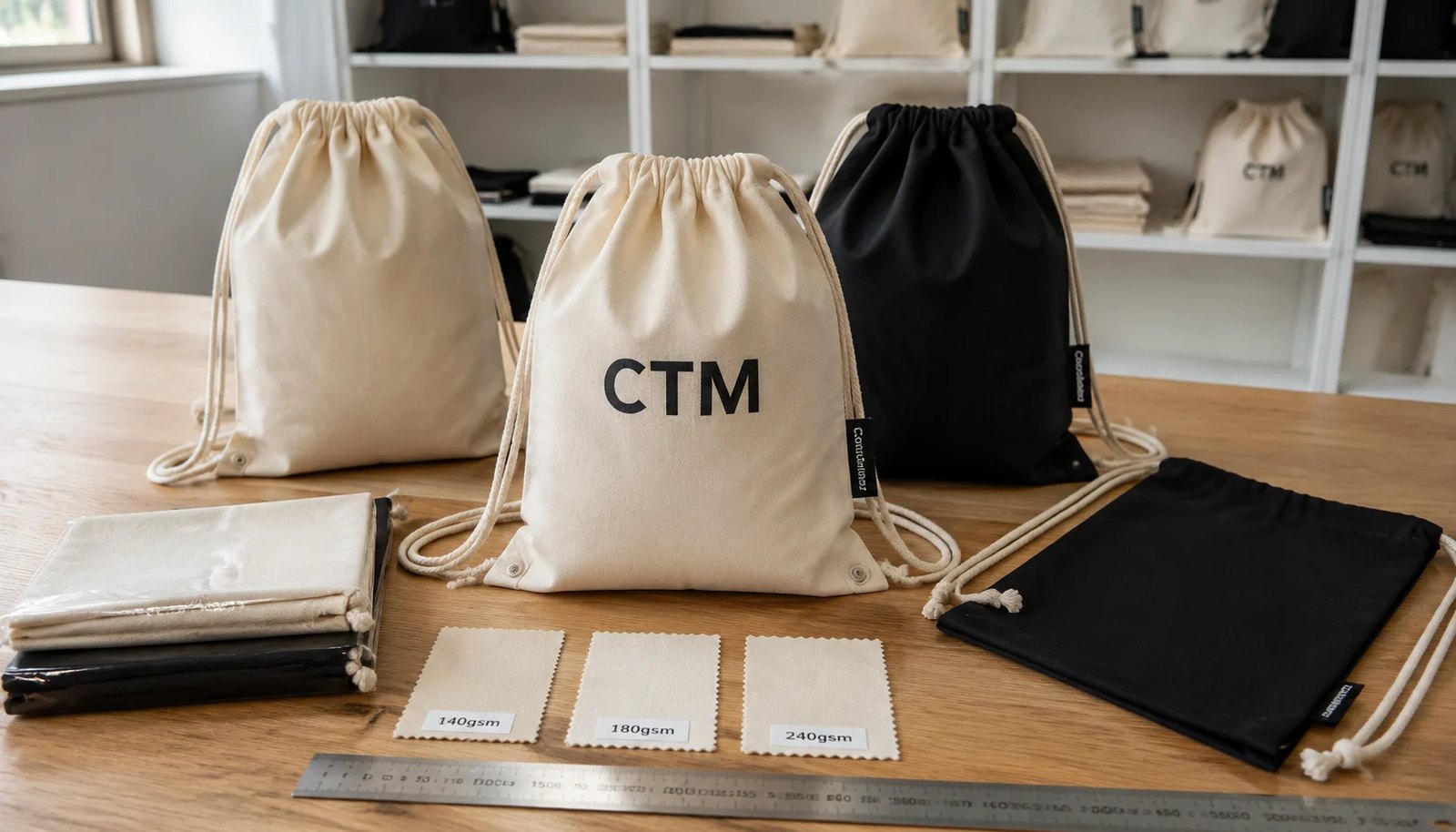
A practical starting point is to map the expected load. If the backpack may carry a standard 700-750ml bottle, plus brochure and accessories, a lightweight 120gsm body can be risky unless dimensions are tight and use is short-term. Many buyers find 140-180gsm cotton works for promotional use, while 220-280gsm cotton canvas gives a more premium feel and better seam stability around the cord channel. The right answer depends on carrying load, retail shelf presentation, and target reorder probability.
- Promo giveaway: 140-160gsm natural cotton, simple single-color print, standard cord, flat packing
- Mid-tier gift program: 180-220gsm cotton, cleaner print panel, stronger corners, optional inside care label
- Premium reusable retail item: 240-280gsm canvas, reinforced corners, custom dyed body, woven brand label
Use fabric weight and print method to control both cost and schedule
Fabric selection affects more than appearance. Lower GSM fabric cuts material cost and often shortens sourcing time if the mill shade is stock natural. But lower GSM also increases the risk of print distortion, wrinkling under the print area, and panel skew after sewing. Heavier canvas is more forgiving for large logos and gives a stronger retail handfeel, but it increases fabric consumption, carton weight, and often the time needed for cutting and sewing because the seams are thicker.
For print, one-color screen printing is usually the most stable commercial route for cotton drawstring backpacks in bulk. Setup takes some front-end time, but once screens are approved, the unit cost stays controlled. Heat transfer may help on detailed art or lower quantity replenishment, but it adds a different handfeel and can become a schedule bottleneck if the transfer process is outsourced. If a buyer wants metallic effects, gradients, or oversized artwork, those choices need to be disclosed early because they can change both reject rates and timeline.
- Typical practical GSM bands: 140gsm, 180gsm, 240gsm, 280gsm
- Natural cotton usually moves faster than custom dyed colors
- Large dark print on low-GSM natural cotton needs strike-through control and stable platen handling
- Screen print is usually best for 1-2 color volume orders with repeatability across cartons
MOQ logic: why custom details can double complexity before they double cost
MOQ is not one number. It changes depending on whether the supplier can use stock fabric, standard dimensions, existing cord colors, common labels, and simple print setups. Buyers sometimes compare a low MOQ quote from one supplier with a higher MOQ quote from another without noticing that one quote assumes stock natural fabric with no custom label, while the other includes custom dyed material and branded woven labels. Those are different production routes, not the same offer at different margins.
For liquor retail buyers managing seasonal demand, the best way to control risk is often to separate cosmetic upgrades from structural requirements. Keep the size, fabric type, and construction standard if lead time matters. Put custom brand expression into the print or woven side label only if the MOQ remains commercially workable. Once custom dyeing, multiple SKUs, and retail-ready individual packing are added together, the order may become too fragmented for a smooth factory run.
- Stock natural cotton generally supports lower MOQ than custom dyed fabric
- Standard size patterns reduce cutting waste and sample revision time
- Each extra SKU can affect setup time, packing complexity, and carton labeling
- A woven label is not expensive by itself, but it adds artwork approval, trim lead time, and attachment labor
Build the timeline backward from the store date, not from the PO date
A workable lead time plan starts with the in-store or distributor handover date and moves backward through receiving, customs clearance, freight transit, production, sample approval, and RFQ finalization. Many delays come from buyers treating the production lead time as the whole schedule. In reality, the factory cannot start bulk confidently until artwork, construction details, and packing are signed off. If your internal team takes a week to approve a sample, that week belongs inside the total launch calendar.
For a straightforward wholesale cotton drawstring backpack order using stock natural cotton, one-color screen print, and standard export packing, the factory path may be relatively short compared with more complex sewn products. But if you add custom dyed fabric, multiple print versions, bottle-fit trials, barcode labels, or retail-ready polybagging, the schedule stretches quickly. Instead of asking for the fastest date, ask for a stage-by-stage plan so you can see which steps are fixed and which are compressible.
- Typical schedule stages: RFQ alignment, artwork proof, pre-production sample, bulk material prep, cutting and sewing, printing, packing, final inspection, booking
- Internal buyer approvals often create more delay than sewing time
- Booking cut-off and warehouse receiving dates should be included before confirming launch promises
- Split shipments can help only if SKU breakdown and packing logic are already stable
Sample approval should test production reality, not just visual appearance
A sample is not only for logo appearance. For liquor retail use, it should confirm fabric handfeel, bottle-carrying behavior, seam stability, cord function, print position, and the packed presentation your store or distributor expects. Buyers often approve a sample based on a front-facing photo and later find that the fabric feels thinner than expected, the cords are too slick, or the print sits too high once the top channel is cinched. Those are preventable mistakes if sample criteria are written clearly.
Use a sample sequence that matches the risk level. A digital layout can approve print size and placement quickly. A pre-production sample in actual or near-actual fabric should then confirm sewing and function. If the item must carry a bottle safely, run a simple handling test in-house with the intended bottle size, insert, and literature. That is more useful than a generic statement saying sample approved.
- Measure print position from finished seams, not from raw panel edges
- Review actual cord thickness, knot finishing, and ease of opening/closing
- Load test with intended bottle and filler contents to observe corner strain
- Record approved points: GSM target, color reference, print size, seam finish, label position
Packing details affect warehouse labor, freight cost, and damage risk
Packing is often treated as a minor line item, but it has direct impact on landed cost and launch readiness. Flat bulk packing is usually the most efficient route for cotton drawstring backpacks. It reduces carton cube and labor, and works well when importers or retail distribution centers will sort goods after arrival. However, if the buyer needs each bag individually packed with barcode sticker, insert card, or size mark, that requirement must be priced and scheduled early because it changes the labor profile significantly.
Carton planning matters even for lightweight bags. Cartons that are too dense can create warehouse handling issues and increase crushing risk if mixed with heavier goods. Cartons that are too large waste freight cube. For liquor retail buyers working through 3PLs or store-ready channels, carton mark accuracy is also critical. A wrong print code or SKU count on carton labels can delay retail rollout more than a small sewing issue.
- State bundle quantity per inner pack if warehouse teams receive by scan and batch
- Set acceptable carton gross weight for manual handling based on your market standard
- Ask for estimated carton dimensions by order quantity scenario
- Clarify whether polybags are for moisture protection only or retail presentation
Supplier evidence: what makes one quote more reliable than another
When several suppliers quote similar unit prices, the more reliable one is usually the supplier who explains assumptions clearly. A strong quote should identify fabric weight, finished size, print method, number of print colors, cord type, reinforcement details, packing basis, and lead time by stage. A weak quote gives a single unit price with broad wording like custom cotton drawstring bag as per logo. That leaves room for post-PO surprises on both price and delivery.
For this product type, practical evidence matters more than polished presentations. Ask for close-up photos of previous drawstring backpack construction, especially bottom corners, cord channels, and print quality on similar fabric. Ask whether cutting, printing, and sewing are controlled in one workflow or partially outsourced. Outsourcing is not automatically a problem, but it changes schedule risk. If printing is done off-site, the handoff must be built into the production plan.
- Reliable quote signals: exact GSM, exact size basis, print process, packing count, stage lead times
- Useful evidence: sample room photos, inside seam photos, print close-ups, carton marking examples
- Higher risk signals: no reinforcement detail, no tolerance stated, vague MOQ language, unrealistic blanket delivery promise
Set QC thresholds that fit the product, not generic bag inspection language
Cotton drawstring backpacks are simple, but they still need product-specific acceptance criteria. Generic statements such as good quality and neat printing do not help inspection teams. For liquor retail use, the key issues are fabric consistency, print readability, seam security, balanced cords, and clean packing assortment. If the bag may carry a bottle, reinforcement points matter more than cosmetic perfection on hidden internal seams.
QC standards should also reflect the selling context. A low-cost event giveaway can tolerate small natural fabric slubs and slight shade variation better than a premium gift-with-purchase program placed beside high-end bottles. The important point is to define what is acceptable before bulk begins. That keeps the factory from overproducing to an unstated standard and keeps the buyer from rejecting goods based on a standard never quoted.
- Critical defects: wrong size beyond tolerance, missing reinforcement, major print error, wrong SKU packing, severe fabric contamination
- Major defects: seam opening, badly off-center print, mismatched cord length, visible oil marks on front panel
- Minor defects: limited loose threads, slight natural weave variation, small non-display-panel slubs within agreed tolerance
A simple landed-cost view helps prevent false savings on urgent orders
Unit price alone does not tell the buyer which sourcing option is cheaper in practice. A lower-cost bag made with thin stock fabric may seem attractive until it requires repacking, causes event failures, or ships late and moves by air. For liquor retail promotions, the commercial loss from a missed campaign window is often larger than the savings from shaving a few cents off the bag. That is why lead time planning and quote comparison need to be done together.
A better quote review groups costs into categories: ex-factory product cost, print setup or artwork cost, trim cost, sample cost, packing labor, inland freight, freight mode, duty base, and receiving labor impact. Even if you do not have final freight figures at RFQ stage, this structure shows where a design change affects the total. For example, moving from standard bulk packing to individual retail polybagging may add little ex-factory cost per unit but increase labor time and shipping cube.
- Compare at least two scenarios: standard stock-fabric program versus upgraded custom-dyed retail program
- Include sample revision risk when launch dates are fixed
- Note cost drivers that rise with urgency: outsourced print, split shipments, and airfreight fallback
- The best value option is often the one with the most stable schedule, not the lowest opening price
Specification comparison for buyers
| Spec decision | Recommended option | When it fits | Buyer risk to check |
|---|---|---|---|
| Fabric weight | 140-180gsm cotton for promo use; 220-280gsm canvas for premium bottle gift programs | Use lighter fabric for event giveaways and single-season retail promotions; use heavier canvas when the bag must hold a bottle set and be reused | Low GSM cuts cost but can distort after printing and show seam strain around cord exits |
| Bag size | Approx. 34x42cm for standard retail use; increase if adding box inserts or two-bottle gift packs | Fits most promo backpack use for collateral, apparel, and one standard bottle with fillers if needed | Oversized bags raise fabric use, carton cube, and freight cost more than many buyers expect |
| Print method | 1-color screen print for volume orders; heat transfer only for detailed artwork or short replenishment lots | Screen print works best on cotton at commercial MOQ with stable unit cost and repeatability | Large print areas on low-GSM fabric can cause panel puckering or strike-through if ink deposit is not controlled |
| Cord type | Cotton rope or polyester cord with knotted ends and reinforced channel | Cotton rope suits natural eco positioning; polyester cord suits darker colors and higher abrasion resistance | Thin cords cut into fabric on heavier loads and may fail pull testing at seam corners |
| Construction | Single layer body with bar-tack reinforcement at lower corners and cord exits | Best balance for liquor retail promotions where cost matters but carrying strength still matters | Suppliers that skip bar tacks may quote lower but create field failure during launch events |
| MOQ route | Use stock fabric and standard size to keep MOQ around practical factory minimums; custom dyed fabric and woven labels push MOQ higher | Good for seasonal retail buyers who need speed and controlled inventory exposure | Very low MOQ custom requests often produce inflated unit pricing or split production over unstable subcontractors |
| Packing style | Flat packed in PE bag bundles, then export carton with carton marks by SKU and print version | Works for import distribution centers and retail rollout where receiving teams sort by style code | Retail-ready individual packing increases labor and lead time; check if it is truly needed |
| Sampling route | Digital artwork layout first, then pre-production sample in actual fabric before bulk | Best when launch date matters and logo position, print size, and bottle fit must be signed off early | Jumping from approval image straight to bulk can create disputes on handle feel, shade, and print handfeel |
Buyer checklist before sampling
- Define the actual retail use case: giveaway backpack, bottle gift-with-purchase, seasonal merchandise, or staff event bag
- State bottle count, bottle size, and whether the bag must carry inserts, brochures, or gift cartons
- Choose fabric by use life, not by the cheapest GSM shown on first quote
- Lock bag dimensions with tolerance before suppliers calculate consumption and carton pack
- Specify print size, print colors, and logo placement with measurements from seams and top opening
- Clarify whether fabric can be stock natural cotton or must be custom dyed to brand shade
- Request sample photos of corner reinforcement, drawstring channel stitching, and inside seam finish
- Approve carton quantity, carton size range, and max carton gross weight for your warehouse handling limits
- Build the delivery schedule backward from in-store date, including sample approval and booking cut-off
- Separate must-have requirements from nice-to-have upgrades so suppliers quote on the same basis
Factory quote questions to send
- What fabric weight are you quoting, and is it plain cotton or canvas with actual tested GSM tolerance?
- Is the quoted size based on finished size after sewing, and what tolerance will apply in bulk production?
- Is the print price based on screen print, heat transfer, or digital print, and how many colors and positions are included?
- Does the quotation include bar-tack reinforcement at the lower corners and cord exit points?
- What is the MOQ for stock fabric versus custom dyed fabric versus custom woven label addition?
- How many days are needed for artwork proof, pre-production sample, bulk fabric preparation, sewing, printing, packing, and booking?
- What carton pack is assumed in the quote, and what are the estimated carton dimensions and gross weight?
- What defects are considered rejectable for print registration, fabric stains, seam opening, and color variation?
- Can you provide production photos or sample room references for similar drawstring backpack construction?
- Which items in the quote are variable if order quantity changes: printing setup, carton count, fabric consumption, or label cost?
Quality-control points to confirm
- Fabric GSM should stay within agreed tolerance and match approved handfeel sample
- Finished size should meet agreed tolerance, especially width and height after top hem and bottom corner stitching
- Print position should align to approved artwork placement and remain visually centered within stated tolerance
- Print should show no major pinholes, smudging, ghosting, or significant color inconsistency within the same lot
- Cord length should be even side to side, with secure knotting or end finishing and no fraying
- Bottom corners and cord exits should include agreed reinforcement and withstand repeated pull handling
- Internal seams should be secure with no skipped stitches, loose thread nests, or obvious seam grin under moderate load
- Fabric panels should be free of oil marks, mildew odor, major weaving faults, and cutting contamination
- Carton assortment and carton marks should match SKU breakdown to reduce receiving errors at the importer warehouse
- Random packed quantity verification should match approved bundle count and carton count before shipment release