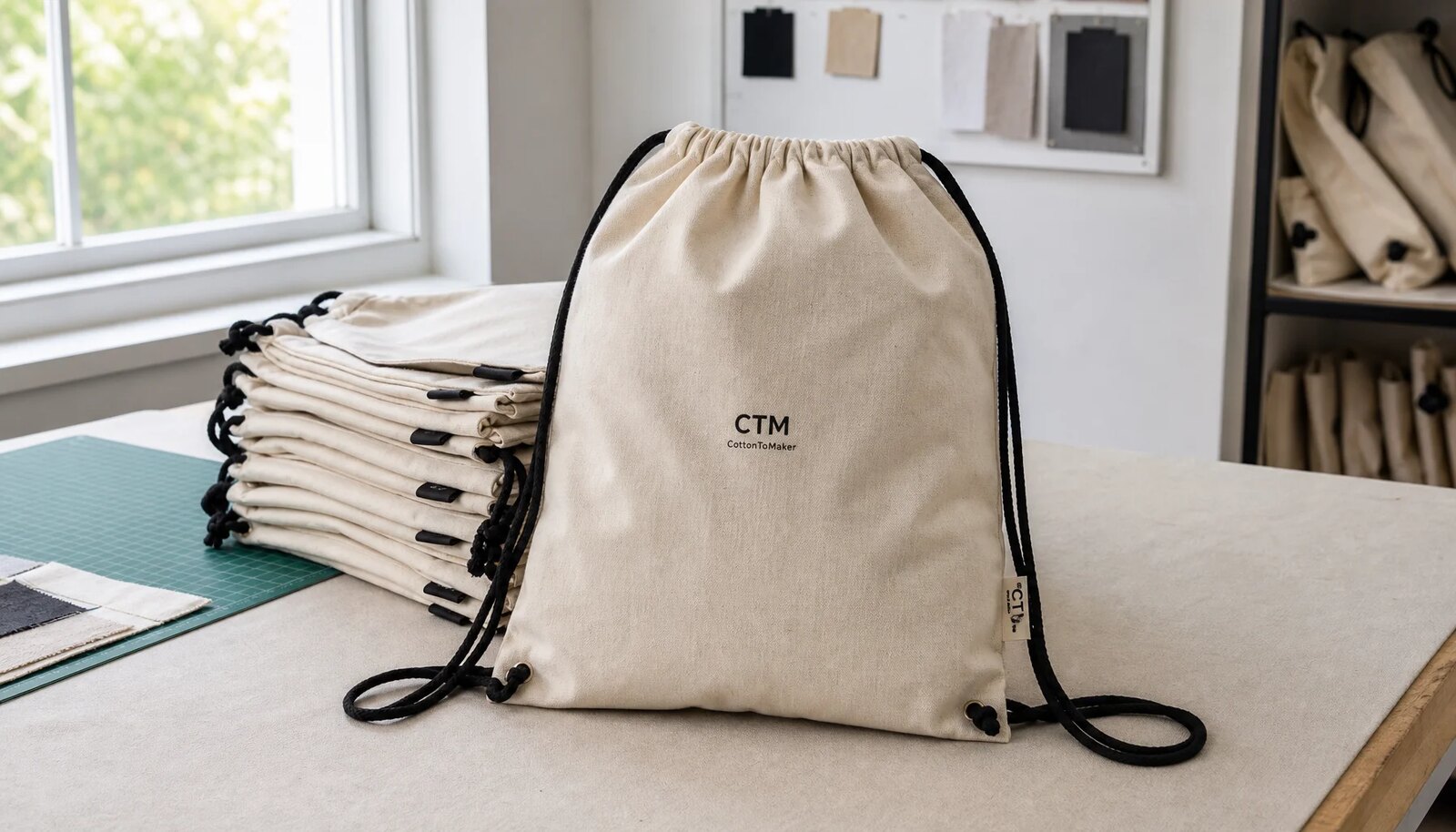
Start From the Event Date, Not the PO Date
For wholesale cotton drawstring backpacks, the real schedule starts with the event date, not the purchase order date. Buyers often ask for a production lead time and treat it like a factory-only number, but that leaves out artwork sign-off, sample approval, inland transit, customs, and the time your team needs to receive, count, and relabel cartons before distribution. If the backpacks are going into conference kits, sponsor packs, school activations, or retail bundles, the final usable date is the one that matters.
A practical plan works backward from the handoff day and builds a buffer around every approval gate. The first date to freeze is the artwork file, because one small change in logo size or print position can restart proofing. The second is the packing format, because bulk packed, polybagged, and retail-ready cartons all move on different timelines. If you only keep one buffer in the schedule, keep it before bulk production starts. That is where delays become expensive.
- Freeze the event date, then set an internal approval deadline at least one stage earlier.
- Define whether the bags must arrive at one warehouse or be split by venue, region, or program.
- Treat sample approval as a schedule gate, not a courtesy step.
Choose the Bag Build Before You Compare Quotes
The fastest way to lose time is to request quotes without a clear bag spec. Cotton drawstring backpacks may look simple, but the construction changes the production path. A light promotional bag in 8 oz cotton is faster to cut and sew than a heavier 10 oz or 12 oz version with reinforced corners, wider seams, or a thicker cord channel. If the bag needs to carry a water bottle, catalog, or gift set, the structure matters as much as the print.
Fabric weight should be written in GSM, not just in vague terms like thick or premium. As a working reference, around 270 to 280 GSM is a light but usable event bag, around 340 GSM is a sturdier standard, and around 400 GSM supports heavier inserts or a more retail-grade feel. The tighter the performance expectation, the more important it is to define seam allowance, bottom reinforcement, and whether the bag needs a dyed fabric or natural cotton finish. Those decisions affect both quote accuracy and lead time.
- 8 oz cotton is usually enough for flyers, T-shirts, or light handouts.
- 10 oz cotton is a safer choice when the bag must carry harder or heavier items.
- 12 oz cotton is better for retail or repeat-use programs where structure matters more than lowest cost.
Print Method Changes the Calendar
On cotton drawstring backpacks, the decoration method can be the biggest hidden driver of lead time. One-color screen printing is usually the cleanest route for event orders because setup is stable and color matching is easier. If the art has gradients, small text, or several sponsor logos, digital transfer or heat transfer may be the better fit for the artwork, but it usually adds another proofing step and more room for rejection if the fabric texture is rough.
Embroidery and woven patches can look better on a premium bag, but they also add sewing operations and a separate approval path. For a buyer, the question is not which method looks best in isolation. It is which method the factory can repeat cleanly at the required quantity without slipping the delivery window. A plain logo in one or two colors is easier to schedule than a full-color graphic, and a simple front-panel print is easier than artwork that wraps over a seam or sits close to the cord channel.
- Use screen print for simple logos, sponsor marks, and event branding that must scale well.
- Use transfer methods only when the art cannot be simplified without losing the design.
- Ask for a physical proof if the logo sits near a seam, channel, or folded edge.
MOQ Logic Is About Process, Not Just Minimums
MOQ on cotton drawstring backpacks is not an arbitrary number. It usually reflects fabric roll usage, cutting efficiency, print screen setup, labor batching, and the supplier's cost of holding cord, labels, and cartons. A factory can sometimes quote below its preferred MOQ, but that does not mean the lead time becomes shorter. In small runs, the factory may still need to batch your order into a larger production slot, which can slow the schedule even if the quantity is modest.
The quote should make it obvious which factors push the MOQ higher. A single-color logo on natural cotton can often be produced in a lower run than a multi-color print on dyed fabric with custom side labels. If you are buying for one event and need only a small quantity, the right question is whether the extra unit cost buys you schedule certainty. If the event is repeatable, a larger order may lower the unit cost enough to justify the extra inventory. MOQ is a commercial tradeoff, not just a supplier preference.
- Below 500 units, expect more setup cost per bag and fewer fabric options.
- Between 500 and 1,000 units, the price usually improves if artwork is simple and packing is standard.
- Above 1,000 units, lead time is driven more by sewing and inspection capacity than by setup alone.
A Useful Quote Must Show the Real Cost Drivers
A clean factory quote for wholesale cotton drawstring backpacks should be broken into parts that a buyer can compare. At minimum, it should separate bag size, fabric GSM, print method, number of print colors, cord type, packaging format, sample cost, production time, and freight assumptions. If a supplier gives only one bundled price, the quote may still be usable, but it is harder to tell whether the bag is expensive because of the fabric, the print setup, or the packaging requirement.
Quote data matters because small changes can move the schedule. A natural cotton bag with one-color print and bulk packing can move faster than the same bag with a woven side label, barcode sticker, individual polybag, and insert card. Buyers who manage several suppliers should compare quotes on the same assumptions. Otherwise, one supplier appears cheaper only because the pack-out, carton count, or sample stage was omitted. The right quote is not the lowest number on the page. It is the one that tells you what is included and what will create a change order later.
- Ask for line items on material, print setup, sewing, packing, and freight basis.
- Make the supplier state whether the sample fee is deductible from the bulk order.
- Require the same carton quantity and packing method across all supplier quotes when possible.
- Separate the bag price from any label, insert, or retail packaging charge.
Sample Approval Is the Real Gate Before Bulk
A sample is not just a small version of the order. It is the point where the buyer confirms that the artwork, bag construction, and packing logic are actually workable on the chosen fabric. For cotton drawstring backpacks, the pre-production sample should show the final fabric weight, cord color, logo placement, seam finish, and any label or side patch that will appear on the bulk order. If the approval is based only on a flat artwork proof, the factory can still deliver a bag that technically matches the design but feels wrong in hand.
The sample should be judged against buyer-useful criteria, not general aesthetics. Check whether the bag opens and closes smoothly, whether the logo sits level on the front panel, and whether the printed area gets distorted by the drawstring channel or the fold line. If the order is for a retail program, the sample should also prove that the barcode placement and retail pack format fit the carton plan. When a buyer approves a weak sample, the factory usually interprets that as permission to run bulk to the same weak standard.
- Approve a physical sample when the print sits near a seam or folded edge.
- Compare the sample against the final artwork file, not an old reference photo.
- Reject any sample that uses a different fabric weight, cord thickness, or label type than the quoted spec.
Packing Choices Affect Lead Time More Than Many Buyers Expect
Packing is not a clerical detail. It affects labor, carton count, shipping cube, and the chance of miscounts. For event orders, the simplest option is often bulk packing by color or program, but that only works if the receiving team can sort cartons quickly at destination. Retail buyers usually need individual polybags, a barcode label, and clear carton marks. If the order is going into a distribution center, the packing spec has to match the warehouse's intake rules or the cartons may sit unreceived even after delivery.
Cotton backpacks also change shape in transit, so the way they are folded matters. A bag packed too tightly can crease the print or distort the cord channel, while a loose pack increases carton volume and freight cost. If the order includes inserts, cards, or bundled gifts, the factory should confirm the final packed thickness before quoting carton quantity. This is where a lot of landed-cost errors start. The bag itself may be inexpensive, but the packing assumption can make the shipment larger, slower, and more expensive than expected.
- State whether cartons should be mixed by color, program, or delivery location.
- Confirm if each bag needs an individual polybag, barcode, or hangtag.
- Test the packed thickness with any insert that will ship inside the backpack.
- Make carton marks match the receiving warehouse format before bulk starts.
Put Clear QC Thresholds in the PO
Quality control for cotton drawstring backpacks should be written in measurable terms. Size tolerance, stitch quality, print placement, and cord function are all visible and should not be left to a vague inspection standard. If the bag is a promotional handout, buyers may allow a bit more tolerance. If it is a retail item or part of a branded kit, the acceptance window needs to be tighter because small deviations are visible once the products are unpacked in quantity.
The most common defects are also the easiest to prevent when they are written into the order before production starts. Loose threads, weak bar tacks, crooked print placement, color drift, and mixed cord lengths are all avoidable when the factory knows what will be rejected. Buyers should also define how many cartons will be inspected and whether a pre-shipment report is required. A reasonable inspection method is more useful than a generic promise of good quality, because it gives the factory a standard to work to and gives the buyer a record if a dispute arises.
- Set size tolerance in writing for body width, height, and strap or cord length.
- Define print acceptance by placement, color density, and visible registration.
- Require strong bar tacks or reinforced stitching at load points.
- State whether odor, staining, or broken needles are automatic rejects.
Compare Sourcing Routes Before You Compare Unit Price
For event planners and procurement teams, the lowest unit price is not always the lowest landed cost. A direct factory usually offers the best control over fabric weight, print method, and packing, especially when the order is large enough to justify setup. A local decorator or domestic stock supplier can be useful for very short deadlines, but the fabric and size options may be limited. A trading company can consolidate sourcing across several factories, which helps when the buyer needs a single point of contact, but the margin structure is less visible and the actual production path can be harder to verify.
The right route depends on how much risk the buyer wants to own. If the event date is firm and the bag spec is stable, a specialist cotton bag factory is usually the cleanest path. If the order is small and the deadline is compressed, a stock decorator may be faster even if the decoration options are basic. If the order includes multiple item types, an integrated supplier can simplify coordination, but the carton map must be precise or the packing error rate climbs. Compare not only the quote, but also who owns the sample, who owns the print proof, and who owns the final carton release.
- Use a direct factory when you need clear control over spec and repeatability.
- Use a local decorator when speed matters more than custom fabric choice.
- Use a trading company only if the quote clearly shows what is being outsourced.
- Use an integrated supplier for multi-item kits only if carton mapping is locked.
Work Backward From the Event and Leave Time for Recovery
A reliable schedule for wholesale cotton drawstring backpacks usually has five gates: artwork lock, sample approval, bulk production, inspection, and shipment. Each gate should have a named owner on the buyer side, because delays often happen when no one is clearly responsible for approving the next step. If the event date cannot move, the approval window must be treated like a hard deadline. The factory cannot recover lost buyer time if the artwork changes after print screens are made or if the packing format changes after sewing begins.
When the schedule is tight, the fastest way to protect delivery is to simplify the spec, not to squeeze the factory harder. Reducing print colors, choosing stock natural cotton, keeping the label simple, and approving the sample in one round all save time. Splitting the order into a small air-shipped portion and a larger sea-shipped balance can also work, but only if the buyer is comfortable with two receiving events and the warehouse can handle the split. In practice, the best lead-time plan is the one that reduces decisions after the PO is issued.
- Lock artwork first, then approve sample, then release bulk.
- Use stock fabric and one-color print when the delivery date is fixed.
- Split shipments only if the receiving team can track partial arrivals cleanly.
- Keep one internal owner responsible for final sign-off at each stage.
Specification comparison for buyers
| Spec decision | Recommended option | When it fits | Buyer risk to check |
|---|---|---|---|
| Lead-time control | Direct bag factory with in-house sewing and printing | You have a fixed event date and need one team to own the schedule | If printing or packing is outsourced, each handoff adds approval time |
| Small urgent run | Local decorator or domestic stock decorator | You need a few hundred bags and can accept limited fabric choices | Unit cost rises fast and custom fabric options are usually narrow |
| Price transparency | Direct factory quote with line-item material and labor split | You want to compare quotes across suppliers on the same basis | Bundled quotes hide where the real cost and delay sit |
| Artwork complexity | Supplier with proven screen print or digital transfer setup | The logo has fine details, multiple colors, or sponsor marks | Complex artwork can force extra proofing and slower registration checks |
| Fabric consistency | Specialist cotton bag factory with defined GSM control | The bag must feel sturdy and hold printed inserts or gifts | Loose fabric specs lead to soft bags, size drift, or weak seams |
| Packaging customization | Factory that handles polybags, inserts, and carton marks | Retail-ready or distributor-ready packing is required | Packaging parts may have separate MOQ and extend the schedule |
| Repeat program | Long-term factory partner with saved spec and approved sample | You expect the same bag to reorder for multiple events | Mill, cord, or label changes can quietly alter the look and fit |
| Multi-item kits | Integrated supplier that can bundle bags with other items | The event order includes pouches, notebooks, or gift sets | Assortment packing mistakes can happen if carton maps are vague |
Buyer checklist before sampling
- Final bag size, fill weight, and use case
- Fabric weight in GSM and finish on the cotton
- Print method, number of colors, and artwork file format
- Sample type required before bulk approval
- Packing format: bulk, individual polybag, or retail-ready
- Carton count, carton marks, and ship-to labeling
- Target event date plus internal approval freeze date
- Freight mode, destination, and receiving window
- Quantity by color, size, or event version
- Spare allowance for misprints, damage, or late replacements
Factory quote questions to send
- What exact fabric GSM, weave, and finish are included in the quote?
- Which print method is priced, and how many setup charges are included?
- What is the MOQ for the bag, the print color count, and the packaging?
- What sample types can you provide before bulk, and what do they cost?
- How many working days are needed after artwork approval for bulk production?
- What lead time changes if I move from one-color print to two-color print?
- What packing format is included: bulk packed, individual polybag, or retail-ready?
- What carton quantity, carton size, and gross weight assumptions are used?
- What tolerance do you apply for size, stitch quality, and print placement?
- What happens if a cord, label, or ink substitute is required during production?
Quality-control points to confirm
- Verify the fabric GSM against the approved spec, not just the fabric name
- Measure finished bag dimensions and allow only the tolerance stated in the PO
- Check stitch density, seam alignment, and bar tacks at stress points
- Pull-test the cords and confirm both sides sit at equal length after tying
- Inspect print placement, edge sharpness, and color density under normal light
- Confirm the bag opens and closes smoothly without cord channel twisting
- Reject any bag with oil stains, odor, loose threads, or visible weave damage
- Count cartons and inner packs against the packing list before dispatch
- Compare pre-production sample and bulk output for label, color, and print consistency
- Record inspection photos for any defect class that could trigger a rework claim