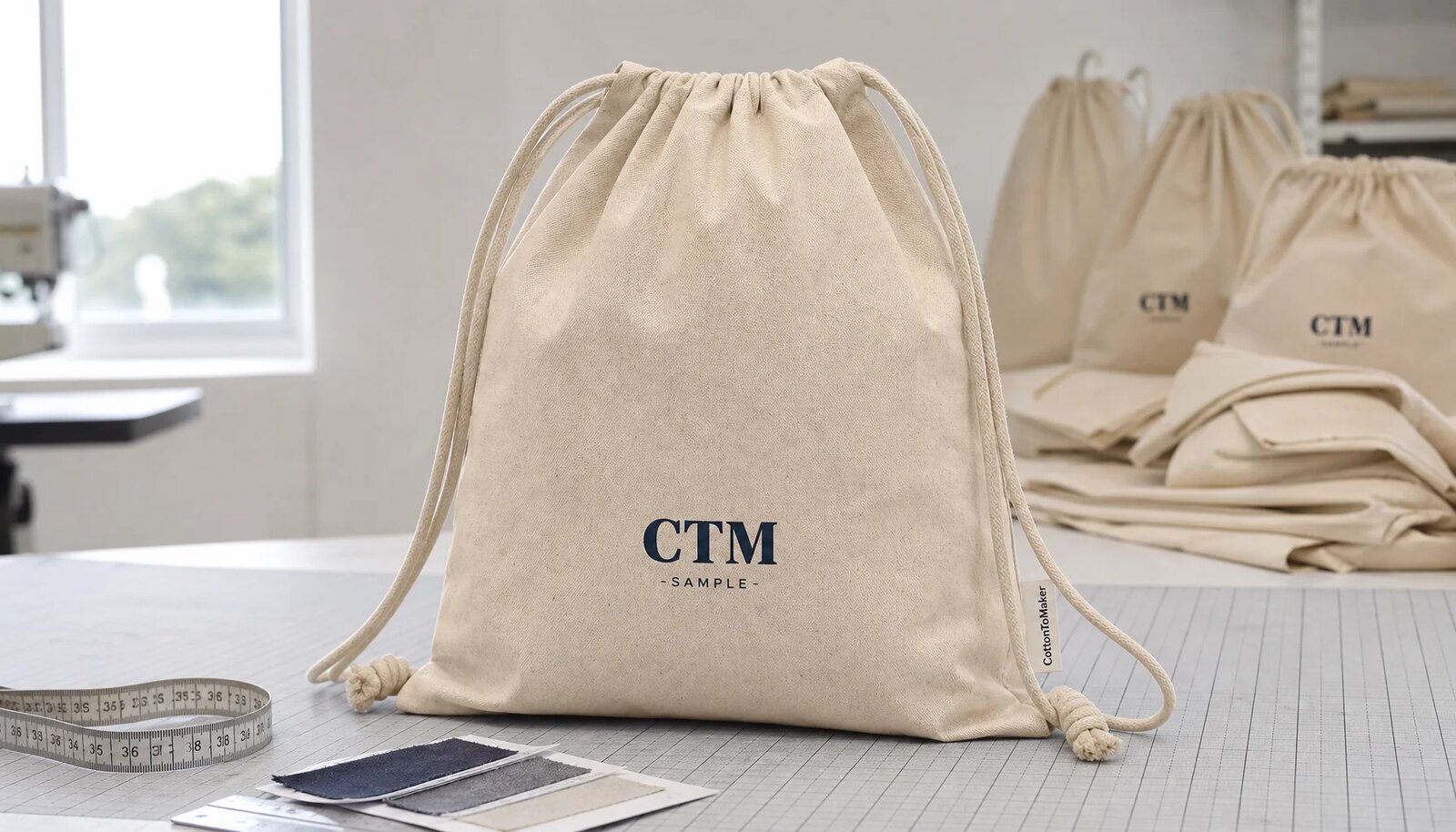
Start with the Retail Job
A cotton drawstring backpack sold in a hotel shop is not just a promotional sack with a nicer logo. Guests may use it for sandals, sunscreen, kids activity items, spa products, wet swimwear, local purchases, or a short excursion. That changes the specification. The bag needs to look good folded on a shelf, scan correctly at checkout, and survive normal guest handling after purchase.
Begin the RFQ with the commercial use before listing materials. Name the channel, target retail tier, expected contents, shelf display, and destination properties. A resort beach shop may need a larger bag and stronger cord than a city hotel lobby display. A boutique retail program may care more about fabric texture, print hand-feel, and folded presentation than the absolute lowest unit price.
This is where the long keyword idea becomes useful in plain language: the buyer needs a wholesale cotton drawstring backpack RFQ for hotel retail that helps suppliers quote the same product. If one factory prices a thin giveaway bag and another prices a retail-ready cotton canvas item, the price comparison is meaningless.
- Define the selling use: souvenir, beach, spa, kids, boutique, event retail, or welcome retail bundle.
- List likely contents so the supplier understands load and size expectations.
- State whether bags are sold individually, bundled with amenities, or used across several hotel properties.
- Confirm whether the product must carry a barcode, hangtag, retail sticker, or property-specific carton label.
- Decide whether the buyer values lowest price, retail hand-feel, stronger construction, fast delivery, or multi-property sorting most.
Choose Fabric by Feel, GSM, and Risk
Fabric weight drives cost, shelf feel, print result, carton weight, and freight volume. For hotel retail, 8 oz cotton canvas is often a practical starting point because it feels more substantial than a lightweight promotional bag while still folding and packing efficiently. A 6 oz cotton may be suitable for low-price souvenir resale or light amenity programs. A 10 oz cotton canvas can improve perceived quality for beach or spa retail, but it raises material cost and may require more careful sewing and folding.
Use GSM in the RFQ, even if your team talks in ounces. Ounce descriptions are not always used consistently across suppliers and markets. A clearer line is: natural unbleached cotton canvas, approximately 270 gsm, equivalent to about 8 oz, with bulk swatch approval before cutting. If the hotel brand has a strict visual standard, also state whether seed specks, slubs, neps, or shade variation are acceptable.
Ask whether the fabric is stock or made to order. Stock natural cotton may shorten lead time, but lot-to-lot shade can vary. Dyed cotton can support a brand color but may add dye-lot minimums, additional sampling, and colorfastness checks. Certified cotton should be requested only when the buyer needs documentation and labeling controls, because certification affects paperwork as well as price.
- 6 oz cotton: useful for light, price-sensitive resale where heavy loading is not expected.
- 8 oz cotton canvas: common middle option for hotel gift shops and resort retail.
- 10 oz cotton canvas: stronger hand-feel for premium programs, with higher cost and packing weight.
- Natural unbleached cotton: attractive for relaxed resort retail, but needs shade and seed-speck rules.
- Dyed cotton: better for brand color control, but check MOQ, dye-lot approval, and colorfastness.
- Certified cotton: request certificate scope, transaction documents, label permission, and chain-of-custody expectations.
Put Construction in Factory Language
Many drawstring backpacks look similar in flat photos. The differences appear when a guest pulls the cords, loads the bag, or opens and closes it repeatedly. The RFQ should therefore describe seam allowance, stitch density, channel width, cord diameter, reinforcement, thread color, and trimming quality. A supplier can meet the requested fabric weight and still reduce durability by narrowing seam allowance or skipping reinforcement near stress points.
For simple cotton drawstring backpacks, typical retail specifications may include lockstitched side seams, a reinforced drawcord channel, clean bottom seam finish, and controlled cord exits. If the design uses eyelets, specify eyelet material, color, finish, and rust-resistance expectations. If the cord exits through fabric channels, define whether bartack, double stitching, or another reinforcement method is required.
During sample review, treat function as seriously as appearance. Open and close the bag several times, pull both cords evenly, and check whether the channel bunches or tears. Inspect inside seams for loose threads and raw edges. A clean product photo will not reveal tight cord movement or weak channel stitching, but a buyer will notice once the shipment reaches the store.
- State finished width and height with tolerance instead of only giving a nominal size.
- Define seam allowance, commonly around 7 mm to 10 mm depending on construction.
- Specify stitch density, often around 7 to 9 stitches per inch unless the sample approval sets another standard.
- Confirm drawcord channel width after sewing, not only the pattern measurement before sewing.
- Require clean thread trimming inside and outside the bag.
- Approve thread color when contrast stitching or natural cotton presentation matters.
Control Logo Method and Placement
Branding can make or break a hotel retail bag. Screen printing is usually the most practical choice for solid hotel logos, resort names, simple icons, and one to three spot colors. It offers good repeatability and cost control for repeat wholesale orders when properly cured. Heat transfer or digital printing may fit gradients, photos, small trial quantities, or artwork with many colors, but buyers should review edge feel, cracking, opacity, and press marks before approval.
Avoid vague wording such as custom logo included. Give the supplier artwork files, Pantone or CMYK references, print size, print location from top and side edges, color count, ink hand-feel, and placement tolerance. Decide whether printing happens before sewing or after sewing. Printing before sewing can improve flatness on open panels. Printing after sewing may help with small runs or late artwork changes, but seams and channels can make registration harder.
The approval sample should show the final print on the actual bulk fabric. Fold it exactly as planned for retail packing and check whether the ink cracks, transfers, or forms a hard crease. If the bag will sit in a bright resort shop, ask whether the supplier recommends any additional colorfastness or light exposure review for the chosen ink system.
- Use screen print for solid logos, repeat property programs, and one to three spot colors.
- Use heat transfer carefully for gradients, photos, or detailed artwork that cannot screen print cleanly.
- Set logo placement tolerance, commonly plus or minus 3 mm to 5 mm depending on artwork size.
- Confirm setup fees per screen, print color, logo version, and property name.
- Approve a printed pre-production sample before bulk printing.
- Check print rub, odor, opacity, hand-feel, and folding marks before production release.
Build MOQ Around Versions
Hotel groups often want one shared bag construction with different property logos. This can work well if the buyer separates shared and variable components. Fabric, cord, size, and construction may be common across the program, while logo, barcode, hangtag, carton mark, and destination vary by property. The quote should make those differences visible.
Instead of asking only for one total MOQ, request a price matrix by quantity and version. Ask for unit prices at relevant breaks such as 500, 1,000, 3,000, 5,000, and 10,000 pieces, using the same specification at each tier. Also ask what changes if the order is split across several logos. A low total MOQ may still carry extra charges for screens, sample approval, barcode labels, carton marks, or packing labor.
Distributors should align MOQ with store allocation. An order of 5,000 pieces may include 300 units for one property, 700 for another, and 2,000 for a flagship resort. If exact quantities matter, define overage and shortage tolerance before production. Small variances can happen during cutting, printing, and QC sorting, but the rules should be clear before the purchase order is placed.
- Quote MOQ per fabric color, because dyed fabric often has higher minimums than natural cotton.
- Quote MOQ per logo, because each property may need separate screens and approval samples.
- Quote MOQ per packing method, because retail folding and labeling can slow production.
- Quote barcode and carton-label charges separately when SKUs differ by property.
- Ask whether mixed-version cartons are allowed or prohibited.
- Agree overage and shortage tolerance for each SKU before bulk production.
Use This Fill-In RFQ Block
A strong RFQ does not need to be long, but it must be specific enough that suppliers quote the same item. The block below can be copied into an email or sourcing sheet and adjusted by property, SKU, or season. It is intentionally concise so procurement teams can compare supplier responses without reading a proposal full of assumptions.
RFQ sample: Product: cotton drawstring backpack for hotel retail. Finished size: [width x height] cm, tolerance [x] mm. Fabric: [natural/dyed] cotton canvas, [GSM] gsm, approx. [oz], approved swatch required. Color: [reference], shade tolerance [rule]. Construction: lockstitched seams, reinforced drawcord channel, seam allowance [x] mm, stitch density [x] SPI. Cord: [material], [diameter] mm, [color], [length], [end finish]. Logo: [method], [color count], [Pantone/CMYK], print size [x], placement [x] from top and side, tolerance [x] mm. Packing: [bulk/paper band/polybag/hangtag/barcode], [pcs/carton]. Quantity: [qty] total, split by property/SKU as attached. Quote terms: [Incoterm], [currency], sample cost, setup cost, production lead time, carton data, quote validity.
For easier comparison, ask suppliers to return a quote matrix rather than a paragraph. Recommended columns are: SKU or property, quantity, fabric basis, logo method, packing method, unit price, setup cost, sample cost, carton quantity, carton dimensions, gross weight, CBM, lead time, Incoterm, and exclusions. The matrix quickly reveals whether the supplier has included the same scope.
- Attach artwork files rather than asking the supplier to quote from a low-resolution image.
- Attach a property split if multiple logos, barcodes, or destinations are involved.
- Ask suppliers to list exclusions so missing costs do not appear after award.
- Require carton data with the first serious quote, not after production.
- Ask the supplier to confirm whether the quote is based on stock fabric or made-to-order fabric.
- Keep the approved RFQ, sample photos, swatches, and final quote together as the purchase order reference.
Approve Samples in Two Stages
One attractive sample is not enough for hotel retail. A prototype sample confirms size, construction, general look, cord feel, and early logo placement. A pre-production sample confirms the actual bulk fabric, final cord, approved print method, labels, folding, barcode, and packing. The second sample is especially important because it becomes the inspection reference for bulk goods.
Sample comments should be measurable. Instead of writing logo slightly higher, state the approved distance from the top edge and the allowed deviation. Instead of saying fabric feels better, approve a physical swatch with GSM, shade, and texture reference. Each approval should be dated and linked to the artwork file, spec sheet, sample photos, and any barcode or label layout.
For multi-property programs, sample control needs version tracking. One master construction sample may cover the shared bag, but each property logo, retail sticker, barcode, hangtag, and carton mark should be checked. A common avoidable mistake is a correct bag packed with the wrong label or carton mark. A simple version matrix prevents that problem.
- Measure finished width, height, channel width, cord length, cord diameter, and print location.
- Compare fabric weight, shade, texture, and slub level with the approved swatch.
- Open and close the bag repeatedly to test cord movement and channel stress.
- Fold the printed panel in the final packing method to check cracking or transfer.
- Approve barcode, hangtag, retail sticker, insert card, and carton mark with the bag sample.
- Record approval status for each property logo and SKU.
Make Packing Part of Costing
Packing affects retail presentation, warehouse receiving, freight volume, and store labor. Bulk pack is usually the lowest-cost option and may be fine when hotel staff unpack and merchandise locally. Individual packing, paper bands, hangtags, barcode stickers, or retail folding add labor and material cost but may be necessary when the product is received by SKU and scanned at checkout.
Cotton can absorb moisture and odor during storage or transit. Natural cotton also shows stains and handling marks easily. Export cartons should be strong enough for stacking and local delivery, and the pieces per carton should be reviewed against the folding method. Over-tight folding can crease prints. Oversized cartons can increase CBM and reduce landed margin.
If the buyer is deciding between presentation and cost, ask for two or three packing options in the same quote matrix. For example, compare bulk pack, paper band with barcode sticker, and individual polybag with hangtag. This makes the trade-off clear for procurement, retail operations, and brand teams.
- Bulk pack: lower cost and less packing material, best when stores merchandise the bags locally.
- Paper band: cleaner retail look, but less moisture protection and more risk of tearing in handling.
- Individual polybag: better unit protection and barcode control, but adds material and compliance review.
- Hangtag: useful for branding and barcode placement, but should be quoted as a separate component.
- Carton marks should show SKU, PO, quantity, destination, gross weight, carton number, and property code if required.
- Moisture control may be useful for ocean freight, humid storage, or long transit routes.
Inspect Beyond Appearance
Final inspection should verify that the shipment matches the approved sample and purchase order, not just that the bags look generally acceptable. Use an AQL-style inspection plan when appropriate, then add product-specific checks for fabric, stitching, cord function, print quality, barcode accuracy, and carton count. Drawstring backpacks are simple products, but mixed hotel logos or wrong retail labels can still create costly receiving problems.
Inspection should happen after goods are fully packed. Checking loose goods on sewing tables does not confirm barcode placement, folding direction, carton quantity, carton marks, or SKU separation. If several hotel properties share one shipment, carton-level verification is as important as product-level verification.
Define what happens if defects are found. Some issues can be repaired, such as loose threads or minor packing errors. Others may require replacement, remake, discount, or shipment hold. The supplier should agree to the defect-handling route before inspection so there is no negotiation under deadline pressure.
- Check finished size, fabric shade, fabric GSM reference, seam condition, loose threads, stains, and odor.
- Test cord pull, channel smoothness, cord length, cord-end finish, and stress points around exits.
- Check print placement, print rub, curing, cracking, peeling, opacity, and folding marks.
- Verify barcode, hangtag, retail sticker, insert card, logo version, and packing method by SKU.
- Confirm carton count, carton dimensions, carton marks, gross weight, net weight, and carton label data.
- Agree repair, replacement, remake, discount, re-inspection, or shipment hold rules before production.
Compare Quotes by Landed Cost
The lowest unit price is not always the lowest landed cost. A quote that excludes print screens, sample cost, barcode labels, export cartons, or special packing may look attractive but become more expensive after award. Ask each supplier to separate product cost, setup charges, packing materials, sample costs, carton data, lead time, and Incoterm.
Carton data matters early. Pieces per carton, carton dimensions, gross weight, net weight, and estimated CBM help procurement estimate freight and warehouse handling. A slightly cheaper bag can lose its advantage if it packs poorly or requires extra relabeling at destination. For hotel groups, landed cost may also include inspection, inland freight, duty review, warehouse sorting, and local delivery to individual properties.
Make quote assumptions explicit. If the price is based on stock natural cotton, one-color screen print, bulk pack, and FOB terms, the quote should say so. If the buyer later changes to dyed fabric, two-color printing, individual barcode packing, or split shipments, the supplier should revise price and lead time in writing. Clear assumptions keep the purchase order commercially useful.
- Compare quotes using the same fabric, size, construction, cord, print method, packing, and quantity split.
- Request unit price, setup fees, sample fees, packing costs, carton data, Incoterm, payment terms, and quote validity.
- Ask for a lead-time breakdown covering artwork, samples, material booking, production, inspection, and export packing.
- Include inspection, freight, duty review, warehouse handling, and property allocation in landed-cost review.
- Require written approval for changes to fabric lot, print method, packing method, or SKU split.
- Do not award until exclusions and assumptions are visible.
Specification comparison for buyers
| Spec decision | Typical option to quote | Best fit | Procurement risk to check |
|---|---|---|---|
| Fabric weight | 6 oz, 8 oz, or 10 oz cotton canvas stated with GSM equivalent | 6 oz for light souvenir resale; 8 oz for most hotel shops; 10 oz for a more substantial beach or spa retail item | Ounce labels vary by supplier. Require GSM, swatch approval, shade tolerance, and confirmation that bulk fabric matches the sample. |
| Fabric color | Natural unbleached, bleached, dyed solid color, or certified cotton if required | Natural cotton suits resort and boutique retail; dyed cotton suits strict brand-color programs | Natural cotton may show seed specks and slubs. Dyed lots may require higher MOQ, longer lead time, and colorfastness review. |
| Bag size | Common finished sizes around 35 x 42 cm or 38 x 45 cm, adjusted to contents | Smaller for kids programs; larger for beach sandals, spa kits, towels, or guest purchases | A quoted size without tolerance can lead to inconsistent shelf presentation and carton planning problems. |
| Construction | Lockstitched seams, reinforced drawcord channel, controlled seam allowance, clean thread trimming | Retail products that need repeated guest use and neat shop presentation | Low quotes may reduce seam allowance, use narrow channels, skip reinforcement, or leave loose threads inside the bag. |
| Drawcord | Cotton, polyester, or blended cord with stated diameter, color, length, and end finish | Cotton cord for natural look; polyester for smoother pull and color consistency | Weak cord, short length, fraying ends, or tight channel movement can make a good-looking bag feel cheap in use. |
| Branding | Screen print for solid logos; heat transfer or digital print for complex artwork | Screen print works well for repeat orders and one to three spot colors | Specify print size, Pantone reference, placement tolerance, curing method, hand-feel, and whether setup fees are per logo or per color. |
| MOQ structure | Quote by fabric color, logo version, packing method, barcode version, and destination | Multi-property hotel groups using one shared bag with different property branding | A low combined MOQ may hide screen charges, label charges, carton-mark charges, or sorting labor. |
| Sample path | Prototype sample followed by pre-production sample using bulk materials | Retail orders where fabric, print, barcode, folding, and carton count must match approval | A hand sample from available fabric does not prove bulk GSM, shade, print durability, or final packing fit. |
| Packing | Bulk pack, paper band, individual polybag, hangtag, barcode sticker, or retail fold | Hotel stores that scan by SKU or receive goods property by property | Packing choice changes labor, CBM, moisture protection, barcode control, and shelf presentation. |
Buyer checklist before sampling
- Define the selling use: souvenir, beach shop item, spa kit, kids program, welcome retail bundle, boutique merchandise, or front-desk impulse item.
- State the finished bag size, expected contents, target retail tier, intended shelf display, and whether repeated guest use is expected.
- Specify fabric by GSM and ounce equivalent, color, weave, cotton type if relevant, shade tolerance, shrinkage tolerance, and rules for natural slubs or seed specks.
- Provide logo artwork files, Pantone or CMYK references, print size, print position, maximum placement deviation, and whether the print must avoid fold lines or seams.
- Break MOQ and price by fabric color, logo version, property name, packing method, barcode or label version, and delivery destination.
- Request both a prototype sample and a pre-production sample before bulk cutting, printing, or packing material purchase.
- Confirm cord material, diameter, color, length, knotting or end finish, channel width, reinforcement method, and pull-function expectations.
- Set acceptance criteria for finished size, seam strength, cord pull, channel smoothness, print rub, odor, stains, loose threads, barcode accuracy, and carton condition.
- Ask for carton dimensions, pieces per carton, gross weight, net weight, CBM, carton marks, pallet requirements, and carton barcode rules if used.
- Require a line-item quote showing unit price, fabric basis, print setup, sample cost, accessory cost, packing cost, carton cost, lead time, Incoterm, payment terms, and quote validity.
Factory quote questions to send
- What exact bulk fabric is included in the price, stated by GSM, ounce equivalent, weave, width, color, and whether it is stock or made to order?
- What shade tolerance, shrinkage tolerance, and natural slub or seed-speck allowance will apply to the approved fabric?
- What finished size tolerance, seam allowance, stitch density, drawcord channel width, and reinforcement method are included?
- What cord material, diameter, color, length, knotting, and end finishing are included in the quote?
- Will the logo be printed before sewing or after sewing, and how will placement be controlled against the approved sample?
- What print method, ink or transfer type, curing process, color reference, and rub-resistance check will be used?
- What MOQ applies per fabric color, logo, print color count, packing method, label version, barcode version, and shipment destination?
- What is the schedule for artwork review, prototype sample, pre-production sample, material booking, bulk production, final inspection, and export packing?
- Are hangtags, woven labels, barcode stickers, paper bands, individual bags, insert cards, silica gel, and special carton marks included or quoted separately?
- How will defective goods be handled after inspection: repair, replacement, remake, discount, re-inspection, or shipment hold?
Quality-control points to confirm
- Finished size should be checked against the approved tolerance, commonly around plus or minus 5 mm for simple cotton drawstring backpack panels unless a wider tolerance is agreed.
- Fabric GSM should be verified against the approved bulk swatch or agreed test method, not only against supplier paperwork.
- Fabric shade should be compared under consistent lighting, with written rules for natural cotton slubs, seed specks, dye streaks, stains, and mixed lots.
- Logo placement should follow the approved artwork position, commonly within plus or minus 3 mm to 5 mm depending on print size and construction.
- Print surface should pass agreed dry rub and folding checks without obvious ink transfer, cracking, peeling, or heavy crease damage.
- Drawcord channels should open and close smoothly without skipped stitches, tight spots, fabric tearing, or bunching that prevents normal use.
- Side seams and bottom seams should show no open seams, broken stitch clusters, exposed raw edges outside the intended finish, or distortion that affects retail appearance.
- Cord length, diameter, color, knotting, end finish, and pull strength should match the approved sample, especially for beach or excursion use.
- Each unit should match the approved folding method, hangtag, retail sticker, barcode, insert card, property logo version, and inner packing.
- Each carton should match the approved carton mark, SKU count, gross weight range, net weight range, carton dimensions, carton number, and barcode data if carton labels are used.