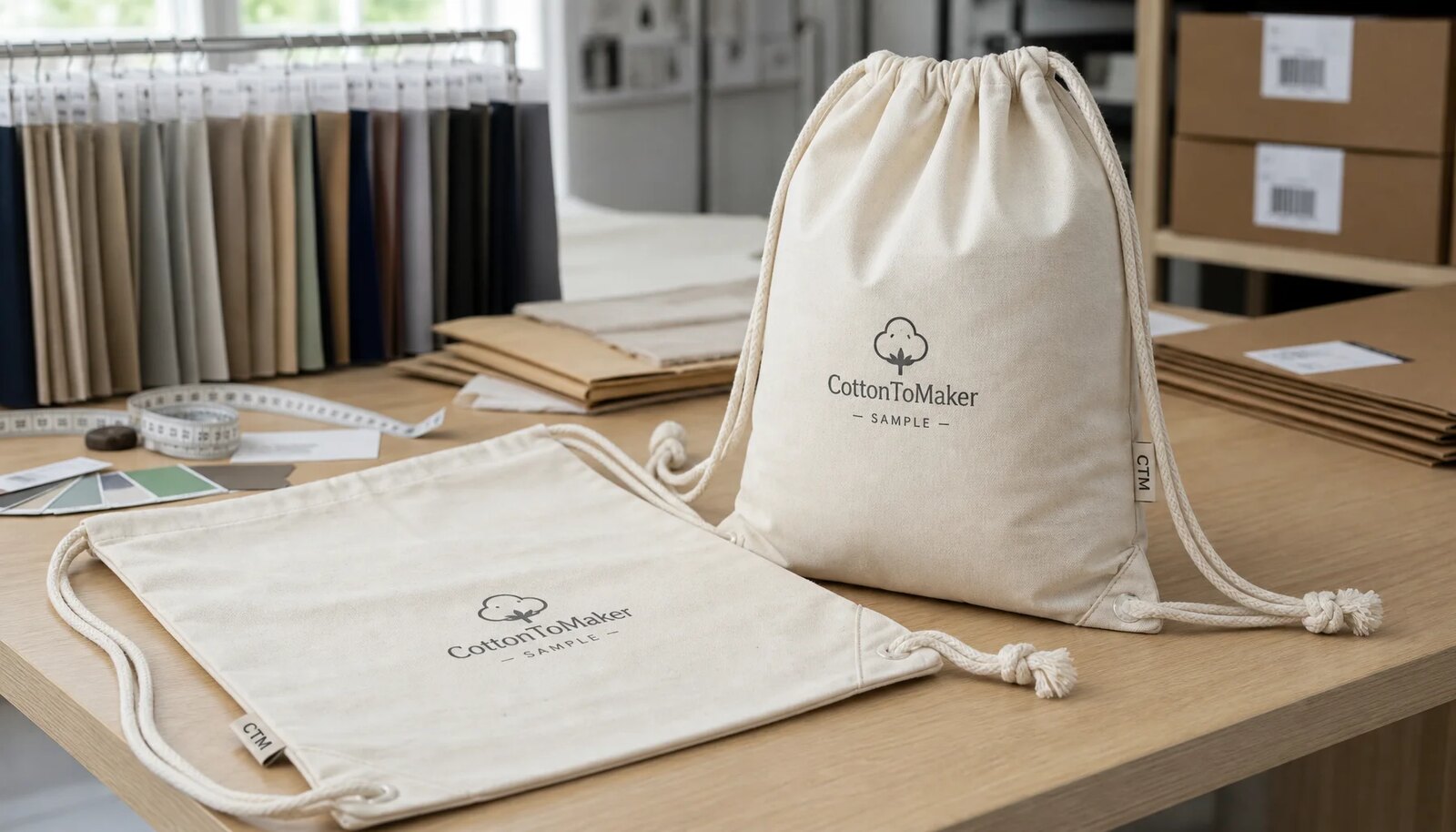
Start With the Hotel Retail Date, Not the Factory Sewing Date
Wholesale cotton drawstring backpacks for hotel retail are simple products, but the calendar is not simple. Sewing may take only part of the schedule. The full order path includes artwork review, sample approval, fabric booking, decoration, print curing, sewing, trimming, inspection, packing, export handoff, freight, customs, receiving, and internal distribution. A supplier quote that says “25 working days after approval” is useful only after you define what approval means.
Plan backward from the date the bags must be sellable or distributable. A resort boutique opening, spa launch, holiday retail set, conference, cruise departure, or multi-property rollout usually needs goods at the receiving point before the public launch date. The hotel may need time for counting, scanning, pricing, merchandising, kit assembly, or transfer from a central warehouse to individual properties.
Separate buyer-controlled time from supplier-controlled time. Buyers control artwork completeness, brand approval, PO release, payment, barcode files, packing instructions, destination splits, and sample review speed. Suppliers control material preparation, sampling, production scheduling, inspection support, packing, and export handoff. A strong lead time plan shows both sides so internal stakeholders do not confuse production days with the full procurement calendar.
- Set the required warehouse, distributor, or property delivery date first.
- Ask for a stage-by-stage schedule, not one broad lead time number.
- Name the decision owner for artwork, Pantone color, label, hangtag, barcode, packing, and carton marks.
- Do not authorize bulk cutting until size, fabric, cord, print, packing, carton marks, and inspection criteria are frozen.
- Add extra buffer around hotel openings, public holidays, peak resort season, and freight capacity constraints.
Use a Stage-by-Stage Lead Time Map
The timeline below is a planning guide, not a universal promise. Actual days depend on order quantity, factory capacity, fabric availability, logo method, packing complexity, buyer response speed, freight mode, and holidays. The purpose is to make hidden dependencies visible before the PO is released.
Some stages can overlap. Artwork checking can happen while a blank construction sample is prepared. Carton mark drafting can happen during sewing. However, other stages should remain gated. Bulk fabric should not be cut before construction approval, and retail packing should not start before barcode, hangtag, fold, and carton-mark approvals are final.
For a new custom hotel retail order on standard cotton, a practical working calendar often looks like this: RFQ alignment 2 to 5 working days; artwork check 1 to 3 days; blank or printed sample 5 to 12 days; buyer review and revision 3 to 10 days; fabric booking and production preparation 3 to 10 days; bulk printing, curing, sewing, and trimming 15 to 35 days; final inspection and rework window 2 to 5 days; packing close-out and export handoff 2 to 5 days. Freight and final delivery are added separately.
- Fast repeat order: often plan 3 to 6 weeks before freight if the previous specification and packing are unchanged.
- New logo on standard natural cotton: commonly plan 6 to 9 weeks before freight, depending on sample approvals and quantity.
- Dyed fabric or brand color: commonly add 1 to 3 weeks for lab dip, shade approval, and fabric booking.
- Retail-packed or barcode-controlled order: add approval time for hangtags, barcode labels, warning labels, fold method, and carton marks.
- Ocean or LCL programs need earlier PO release; air may reduce transit time but not sampling, production, curing, inspection, or packing time.
Match the Specification to the Hotel Use Case
A drawstring backpack can serve as a retail item, spa kit bag, amenity holder, kids activity pack, event giveaway, poolside accessory, or distributor stock item. Each use case changes the right fabric, reinforcement, defect tolerance, and packing method. If the RFQ only says “custom cotton drawstring backpack,” suppliers may quote different weights, cords, logo methods, and carton packs while appearing to offer the same product.
Retail resale needs a clean front panel, stable logo placement, neat folding, scan-ready barcode, and consistent shelf presentation. A spa or wellness bag may prioritize soft hand-feel, subtle natural shade, and low stain tolerance. A family activity pack needs practical cord strength and corner reinforcement. An amenity program may prioritize accurate counts and efficient bulk packing more than hangtag presentation.
Define the use case before asking for final prices. It prevents overbuying for simple amenity use and under-specifying for a retail item guests will carry around the property.
- Gift shop: prioritize front-panel appearance, barcode location, fold presentation, and sellable packaging.
- Spa retail: prioritize fabric hand-feel, natural shade consistency, subtle branding, and clean panels.
- Kids or family programs: prioritize cord security, seam strength, reinforced corners, and safe hardware choices.
- Amenity distribution: prioritize carton efficiency, count accuracy, clean bulk packing, and reliable delivery date.
- Distributor stock: prioritize item codes, carton marks, version control, carton quantity, and scannable labels.
Set Fabric Weight, Finish, and Color Before Comparing Quotes
Fabric is one of the largest drivers of appearance, durability, cost, and carton volume. Ask every supplier to quote the same fabric weight in both oz and GSM. As planning assumptions, lighter 5 oz to 6 oz cotton may suit amenity, conference, or lightweight retail uses; 6 oz to 8 oz cotton is often evaluated for reusable hotel retail backpacks; 10 oz canvas can feel more premium but may be stiffer, heavier, and less compact in cartons. Validate suitability with the supplier and a physical sample because fabric construction varies by mill.
Finish also matters. Natural unbleached cotton can support a relaxed resort look, but seed flecks, slubs, and shade variation must be controlled by an approved swatch and defect criteria. Bleached cotton offers a cleaner base for some prints. Dyed cotton supports brand colors but adds lab dip approval, bulk shade review, and potential schedule risk.
Do not approve fabric from a digital photo alone. A physical swatch or sample helps buyers judge hand-feel, opacity, print surface, wrinkles, and shade. Keep the approved swatch for final inspection and reorders.
- Request fabric weight in oz and GSM on every quote.
- Keep an approved swatch or signed sample as the shade and hand-feel reference.
- Define acceptable and unacceptable seed flecks, slubs, stains, shade bands, and panel mismatch.
- For dyed cotton, add lab dip, shade approval, and bulk fabric review to the lead time plan.
- Test a sample with likely contents such as towel, slippers, sunscreen, brochures, or retail bundle items.
Specify Construction in Measurable Terms
A useful RFQ describes the finished bag, not only the product name. Include finished dimensions after sewing, size tolerance, drawstring channel height, cord type, cord diameter, cord length, reinforcement method, stitch expectations, thread color, label position, and whether eyelets are included. Without these details, two suppliers may quote different products at different prices.
Many hotel retail programs review sizes around 38 x 42 cm or 40 x 45 cm, but the right size depends on the intended contents and shelf presentation. Specify finished dimensions after sewing and pressing because cut-panel size does not tell the warehouse or retail team what will arrive. If the bag must hold a towel or apparel item, approve the bag filled, not only flat.
Bottom-corner reinforcement deserves attention. Drawstring backpacks carry load through the cord path, so weak tabs, loose bar-tacks, or poorly set eyelets can fail before the fabric wears out. Cotton cord gives a natural look; polyester cord may slide more smoothly and resist abrasion. The approved sample should show the exact cord and attachment method.
- State finished length and width with an agreed commercial tolerance, such as plus or minus 1 cm if acceptable.
- Specify channel width so the cord moves without bunching or tearing the fabric.
- Confirm cord material, diameter, color, length, knot style, and end finish.
- Require reinforced bottom tabs, bar-tacks, or approved eyelets for reusable retail bags.
- Define thread color, stitch density expectations, label type, side label position, and inside label requirements.
Control Logo Decoration on Cotton
Screen printing is often practical for hotel logos, resort graphics, property names, and simple one-to-three-color artwork. It supports volume production and clear placement control when artwork is prepared correctly. The RFQ should state logo dimensions, placement measurements, print color count, Pantone references, ink opacity expectations, and whether the buyer wants a soft hand-feel.
Cotton is not a smooth digital proofing surface. Natural shade, weave texture, absorbency, and seed flecks can change how colors appear. Fine lines may close up, small text may lose sharpness, and white ink may need extra opacity. For retail-facing bags, approve a strike-off on the intended fabric shade before bulk printing.
Transfers or embroidery may be appropriate for some designs, but they change cost, feel, durability checks, and schedule. If the supplier recommends an alternative process, request sample evidence and revised lead time instead of assuming it is a direct substitute.
- Send editable vector artwork with Pantone references and exact logo dimensions.
- Define placement from top edge, side seam, and center line, not only “center front.”
- Ask the supplier to confirm minimum line width and smallest readable text before screen setup.
- Approve a strike-off or pre-production sample on the intended cotton shade.
- Include rub, tape, scratch, and damp-cloth checks in the QC plan for printed retail bags.
Treat MOQ and Price Breaks as Planning Assumptions
MOQ is tied to fabric purchasing, cutting efficiency, print setup, sewing-line scheduling, packing material ordering, and export handling. For planning, many hotel buyers compare 500, 1,000, 3,000, and 5,000 pieces per artwork or color to understand scale efficiency. These are not universal MOQ rules. The supplier must validate MOQ based on fabric source, decoration method, packing style, and factory schedule.
Ask whether MOQ applies per fabric color, per logo version, per packing version, or per total purchase order. A hotel group ordering 2,000 bags across four properties may create four artwork setups, four item codes, and four carton-mark versions. If each property also has a separate hangtag or delivery split, production is more complex than one 2,000-piece run.
Compare pricing only when the specification is identical. A low unit price may exclude screen charges, sample fees, barcode labels, hangtags, individual polybags, silica gel if required, or export cartons. It may also assume lighter cotton or weaker reinforcement.
- Request price breaks at 500, 1,000, 3,000, and 5,000 pcs using the same specification.
- Ask for MOQ by fabric color, logo design, packing style, and destination split.
- Clarify sample charges, screen charges, artwork remake fees, packing material costs, and export carton costs.
- For multi-property programs, require separate item codes and carton marks for each version.
- For repeat orders, ask whether screens, patterns, and approved construction records can be reused.
Use Samples as Procurement Control Documents
Samples are not just sales visuals. They are control documents for size, fabric, print, construction, label, packing, and inspection. A blank construction sample confirms shape, sewing, cord path, and reinforcement. A printed sample or strike-off confirms logo size, placement, color direction, and decoration method. A pre-production sample should represent the bulk standard as closely as possible.
Photo approval can save time, but it cannot fully confirm fabric weight, hand-feel, shade, print texture, cord comfort, seam strength, or fold presentation. For hotel retail, a physical pre-production sample is safer. The buyer and supplier should each keep a marked reference sample with PO number, item code, artwork version, date, and approval notes.
Record deviations clearly. If natural cotton flecks are acceptable, define the limit. If logo placement changes during approval, update the measurement standard. If a sample uses substitute cord or temporary packing, do not let that become accidental approval for bulk production.
- Measure finished size, channel width, cord length, logo position, and fold size before approval.
- Check the bag filled with expected hotel contents before approving construction.
- Approve fabric shade, cord color, thread color, label, hangtag, barcode, and packing together for retail orders.
- Keep a signed or sealed buyer sample and require the supplier to keep the matching reference.
- For reorders, compare the new sample with the previous shipment reference before bulk production.
Plan Packing, Carton Data, and Freight Buffers Early
Packing affects unit cost, labor, inspection time, carton volume, freight, and receiving. Bulk packing may be right for amenity use or local kit assembly. Retail packing may require individual polybags, hangtags, barcode stickers, warning labels, folded inserts, property-specific labels, or scan-ready carton marks. These decisions should be made before final quote comparison.
Carton data is part of lead time planning. Pieces per carton, carton dimensions, gross weight, net weight, and CBM influence air chargeable weight, LCL cost, pallet planning, warehouse appointments, and property-level distribution. For multi-property programs, avoid mixing artwork versions in the same carton unless the receiving process is designed for it.
Freight mode should be chosen after carton estimates are available. Air freight may protect a launch date but can be expensive relative to lightweight cotton bags, especially if cartons are bulky. Ocean or LCL shipping may improve freight economics but requires earlier PO release and more buffer for cut-offs, customs, and receiving appointments.
- For retail use, define fold method, front-facing logo orientation, hangtag position, barcode placement, and polybag size.
- For amenity use, use efficient bulk packing but protect cotton from dust, moisture, and carton rub marks.
- Confirm pieces per carton, carton size, gross weight, net weight, and estimated CBM before PO release.
- Specify carton marks with PO number, item code, property name, destination, artwork version, quantity, and carton sequence.
- Avoid compressing printed bags before inks are fully cured.
Write QC Criteria Around Hotel Retail Risk
A general “good workmanship” instruction is not enough for wholesale cotton drawstring backpacks. The inspection plan should cover finished dimensions, fabric weight, shade, contamination, print placement, print adhesion, stitch quality, cord pull strength, reinforcement, labels, packing, barcode accuracy, carton count, and carton marks.
For hotel retail, cosmetic defects can be commercial defects. A crooked front logo, oil mark on natural cotton, wrong hangtag, missing barcode, or mixed property carton can make goods hard to sell or receive. Structural defects such as open seams, torn bottom corners, broken channels, loose eyelets, or weak cord attachments should be treated as major or critical depending on severity and safety risk.
Inspection should sample across early, middle, and late production cartons. For multi-property orders, check each artwork version against its own approved sample. Inspection photos should show measurements, print close-ups, reinforcement details, packing, carton labels, and defect examples so the buying team can decide whether to ship, rework, or hold goods.
- Classify wrong logo, wrong color, unsafe sharp hardware, broken channel, and severe seam failure as critical or major defects.
- Treat visible stains, crooked print, shade mismatch, missing barcode, wrong hangtag, and wrong carton mark as major defects for retail orders.
- Measure print placement from defined edges and the center line.
- Pull-test cords at bottom tabs, eyelets if used, knots, and channel openings.
- Verify packing count, barcode readability, carton sequence, and version separation before shipment release.
Specification comparison for buyers
| Order scenario | Best-fit hotel retail use | Sample planning timeline | Bulk and logistics planning timeline | Main buyer dependency |
|---|---|---|---|---|
| Repeat order, same approved spec | Replenishment for a gift shop, spa retail shelf, or distributor stock item | 0 to 5 working days if the approved sample, artwork, and packing are unchanged; confirm current fabric lot before skipping sample review | Bulk production often plans around 15 to 30 working days after PO and material confirmation, plus inspection and freight time | Buyer must confirm no changes to fabric weight, shade, print, cord, label, packing, carton marks, or destination split |
| New logo on standard natural cotton | Single hotel, resort boutique, spa shop, amenity retail launch, or event merchandise | Artwork check 1 to 3 days; blank or printed sample 5 to 12 days; buyer review 2 to 5 days | Bulk production commonly 20 to 35 working days after approval; inspection and packing close-out 3 to 7 days; freight depends on mode | Clean vector artwork, Pantone references, logo placement, and packing instructions must be approved before bulk starts |
| Dyed cotton or brand color match | Boutique retail line, seasonal color, multi-property brand program, or premium merchandise range | Lab dip or swatch 5 to 12 days; sample after color approval 5 to 12 days; revision buffer 3 to 7 days | Fabric booking can add 5 to 15 working days before cutting; bulk production commonly 25 to 45 working days after final approval | Buyer must approve shade under agreed lighting and accept that dyed cotton has a longer approval path than stock natural cotton |
| Retail-packed order with barcode | Hotel gift shop, resort boutique, distributor-controlled retail range, or scan-ready warehouse program | Sample should include hangtag, barcode label, warning label if needed, fold method, polybag, and carton label; allow 7 to 15 days | Bulk production 20 to 40 working days after approval; packing material ordering and final packing add 3 to 8 days if not prepared early | Buyer must supply barcode files, item codes, tag artwork, carton marks, and receiving rules before packing starts |
| Multi-property split order | Hotel group ordering several logos, property names, item codes, or delivery splits | Each artwork version needs its own artwork approval and sample or strike-off; plan 2 to 5 extra days per complex version | Bulk may run as one fabric lot but multiple print and packing versions; add sorting, inspection, and carton-mark time | Buyer must not treat total PO quantity as one simple setup when the factory must manage several versions |
| Air freight recovery plan | Opening order, conference, urgent replenishment, or missed ocean cut-off | Sampling does not get much shorter; fast buyer approvals matter more than freight choice before production is complete | Production still needs normal approval and QC time; freight may compress transit after inspection, but carton volume and chargeable weight must be checked | Buyer must decide whether freight cost is justified relative to lightweight bag value and retail deadline |
| Planned ocean, LCL, or FCL launch | Seasonal hotel retail program, distributor replenishment, or large resort group order | Use full sample and approval process; start earlier instead of compressing production | Bulk production plus final inspection, export handoff, sailing schedule, customs, delivery appointment, and receiving buffer should be mapped backward from launch date | Buyer must release PO early enough to meet vessel cut-offs, holiday closures, customs documents, and warehouse receiving dates |
Buyer checklist before sampling
- Set the required in-hand date at the hotel, distributor, or warehouse before asking for production lead time.
- Define the use case: retail resale, spa bundle, amenity bag, kids activity pack, conference item, poolside merchandise, or distributor stock.
- Specify finished size after sewing, fabric weight in oz and GSM, fabric finish, cord type, cord diameter, channel width, reinforcement, thread color, label position, and logo placement.
- Send editable vector artwork with Pantone references, print size, placement measurements, color count, and brand rules for labels, tags, or barcodes.
- Ask for MOQ and price breaks by fabric color, artwork version, packing version, and destination split, not only total PO quantity.
- Request a timeline with separate dates for artwork check, lab dip if needed, sample, buyer approval, fabric booking, cutting, printing, sewing, inspection, packing, export handoff, and freight.
- Approve a pre-production sample that matches intended bulk fabric, cord, reinforcement, print method, label, hangtag, barcode, fold, and packing.
- Confirm pieces per polybag, pieces per master carton, carton dimensions, gross weight, net weight, CBM, shipping marks, item code, artwork version, and destination before packing starts.
- Set inspection criteria for size tolerance, fabric shade, stains, print placement, print adhesion, stitching, cord pull strength, reinforcement, barcode accuracy, packing, and carton marks.
- Add buffer for sample revision, hotel brand approval, print curing, packing material delays, inspection rework, freight booking cut-offs, public holidays, and warehouse appointment dates.
Factory quote questions to send
- What cotton fabric weight are you quoting in oz and GSM, and is the fabric natural unbleached, greige, bleached, dyed, washed, or otherwise finished?
- Are dimensions quoted as finished bag dimensions after sewing and pressing? What tolerance applies to length, width, drawstring channel height, and logo placement?
- What MOQ applies per fabric color, print design, packing version, and destination split? Please quote 500, 1,000, 3,000, and 5,000 pcs using the same specification.
- Which decoration method is included, how many print colors are included, what ink type is used, and what is the maximum recommended print area on the front panel?
- Can you provide a strike-off on the actual fabric shade before bulk printing, and how do you control color matching on natural or dyed cotton?
- Will the pre-production sample use the same or bulk-equivalent fabric, cord, reinforcement, thread, logo process, label, hangtag, barcode, fold, and packing as production?
- How many working days do you need for artwork checking, sample making, buyer revision, lab dip if required, fabric booking, bulk production, inspection, packing, and delivery to the named handoff point?
- Are individual polybags, hangtags, barcode stickers, warning labels, inner cartons, export cartons, carton labels, and silica gel if required included or priced separately?
- What inspection standard and AQL level can you support, and which defects do you classify as critical, major, and minor for cotton drawstring backpacks?
- Can you provide planned carton quantity, carton dimensions, gross weight, net weight, and CBM before PO release so freight and warehouse cost can be estimated?
Quality-control points to confirm
- Measure finished dimensions flat after sewing and pressing against the approved tolerance, not against cut-panel dimensions.
- Verify fabric weight by GSM or oz method and compare fabric shade with the approved swatch or signed sample under consistent lighting.
- Check natural cotton panels for oil stains, dark contamination, weaving defects, excessive seed concentration, panel mismatch, and visible shade bands.
- Measure print position from the top edge, side seam, center line, and bottom seam using the approved placement guide.
- Test screen print adhesion with practical rub, tape, scratch, and damp-cloth checks suitable for hotel retail handling.
- Check cord ends, knots, eyelets if used, bottom tabs, bar-tacks, and drawstring channel openings for repeated pulling without tearing or distortion.
- Inspect stitching at side seams, bottom corners, drawstring channel, reinforcement points, and labels for skipped stitches, open seams, loose threads, and uneven tension.
- Confirm retail packing against the approved sample: fold size, logo orientation, hangtag position, barcode placement, warning label, polybag size, and pieces per carton.
- Verify each artwork version and property split against its own approved sample and carton mark, especially for multi-hotel programs.
- Check carton labels for PO number, item code, color, artwork version, quantity, destination, gross weight, net weight, carton sequence, and readable shipping marks.