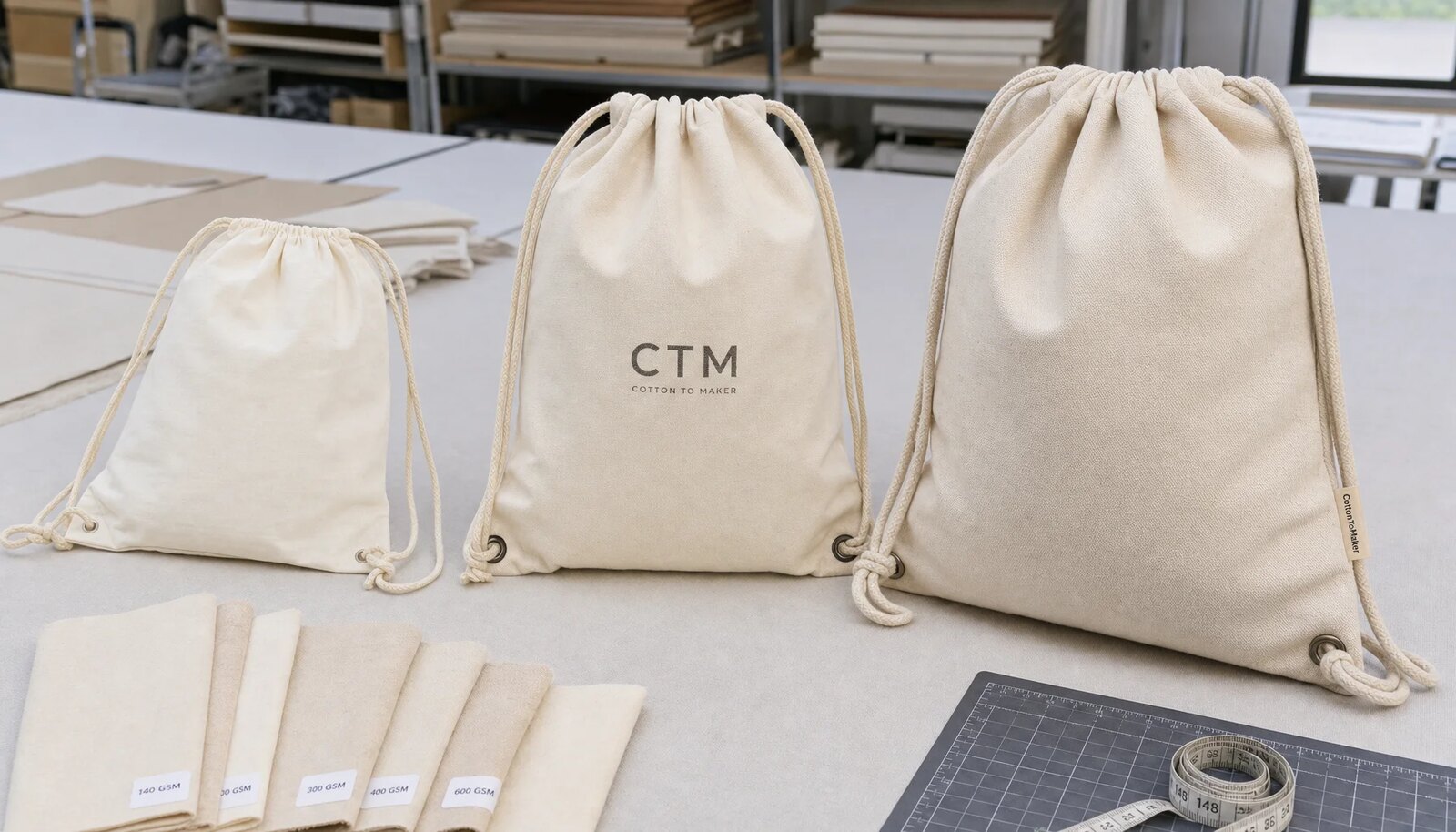
Start With The Hotel Retail Use
A cotton drawstring backpack for hotel retail is not the same product as a giveaway gym sack. The buyer is selling a small piece of the hotel experience, so the bag must feel credible on a shop shelf, survive a short trip to the pool or beach, and carry the logo cleanly. The correct fabric weight depends on the selling price, guest expectation, and what guests are likely to put inside.
For an RFQ, describe the use before listing dimensions. A resort shop bag for sunglasses and sunscreen can use lighter cotton than a spa retail bag carrying robe accessories or glass bottles. A city hotel boutique may need a neater, flatter finish for display, while a beach property may accept a more relaxed natural cotton texture. This use statement helps the factory recommend fabric and construction without guessing.
- Entry retail or amenity upgrade: 6 oz cotton, simple screen print, lightweight cord, flat fold.
- Standard hotel shop backpack: 8 oz cotton, better opacity, stronger cord, reinforced lower corners.
- Premium boutique or spa retail: 10 oz cotton canvas, heavier cord, careful print curing, cleaner packing.
- Beach or pool use: consider darker print colors, reinforced cord exits, and moisture-conscious carton packing.
Translate Oz And GSM Correctly
Cotton bags are quoted in both ounces and gsm, but factories and buyers do not always use the same reference. In bag sourcing, 6 oz is commonly around 200 gsm, 8 oz around 270 gsm, and 10 oz around 340 gsm. These are practical commercial ranges, not laboratory guarantees. The important point is that the supplier states the actual finished fabric weight used for production.
Finished weight matters because dyeing, washing, calendaring, and fabric finishing can change the handfeel and measurement. A quote that says 8 oz cotton may feel different from another supplier's 8 oz if one is using a looser weave or a softer finish. For hotel retail, buyers should approve both gsm and handfeel. The guest does not read gsm, but they immediately notice limp fabric, poor opacity, and weak corners.
- 6 oz cotton: lighter, foldable, lower freight weight, best for small items and lower price points.
- 8 oz cotton: the usual balanced choice for wholesale cotton drawstring backpacks for hotel retail fabric weight guide decisions.
- 10 oz cotton: stronger and more premium, but higher carton weight and more demanding print handling.
- Request tolerance: many practical programs allow a small gsm variance, but the accepted range should be written in the PO.
Choose Fabric Weight By Shelf Position
Hotel retail buyers should connect fabric weight to merchandising position. A low shelf souvenir item needs a clean logo and acceptable durability, but it may not justify premium canvas. A front-counter destination item needs better touch, improved opacity, and a bag that holds shape when displayed. If the backpack collapses flat and looks cheap under store lighting, the sell-through problem is not only design; it is specification.
The safest middle ground is usually 8 oz cotton with reinforced cord points. It gives enough substance for a printed hotel mark, packs efficiently, and does not push landed cost as aggressively as 10 oz. Move up to 10 oz when the retail price, brand positioning, or expected load supports it. Move down to 6 oz only when the program is price-sensitive and the buyer accepts a lighter handfeel.
- Use 6 oz when the bag is mainly a logo carrier and the expected load is light.
- Use 8 oz when the bag must feel retail-ready but still ship economically.
- Use 10 oz when the product is part of a premium hotel boutique range.
- Do not choose fabric weight from unit price alone; compare carton weight, display quality, and failure risk.
Construction Details That Change Durability
Most drawstring backpack failures happen at the cord exit, bottom corner, or top tunnel seam. A heavier fabric helps, but construction is just as important. For hotel retail, the lower corners should not rely only on a single layer of cotton with a hole punched through it. Reinforcement can be made with metal eyelets, sewn fabric tabs, bartacks, or an extra patch, depending on the look and cost target.
The top tunnel also deserves attention. A narrow tunnel can make the drawcord drag and twist, especially with thicker cotton cord. A double folded tunnel gives a cleaner edge and reduces fraying. Stitch density should be consistent enough to hold shape without cutting the fabric. If the backpack includes a bottom gusset, the bottom seam and side seam intersection need extra control because bulky cotton can shift during sewing.
- Cord exit: specify eyelet, sewn tab, or reinforced patch instead of leaving the factory to decide.
- Top tunnel: define tunnel depth and folded construction for smooth opening and closing.
- Stitching: review stitches per inch on approved sample and compare during inspection.
- Corners: require pull testing because visual inspection alone will not reveal weak reinforcement.
Print Method And Fabric Weight Must Match
Screen printing is usually the practical choice for hotel logos, resort names, and simple destination graphics. It works well on 6 oz, 8 oz, and 10 oz cotton when the artwork is solid and the ink is properly cured. The buyer should define print size, color count, Pantone target, placement, and whether the print can have a slightly textured cotton appearance. Natural cotton is not a coated paper surface, so tiny details can fill in.
Heat transfer can handle gradients and small detail, but it may change the handfeel of the front panel and can look too synthetic on natural cotton if the artwork area is large. Embroidery gives a premium look on heavier cotton, but on 6 oz fabric it may pucker or distort the panel. For hotel retail, the print method should support repeatability across cartons, not only look good on one sample photographed under perfect light.
- Screen print: best for solid marks, one to four colors, repeat orders, and stable costing.
- Heat transfer: useful for gradients or photographic graphics, but test flexibility and edge adhesion.
- Embroidery: suitable for 10 oz cotton or reinforced panels, not ideal for thin fabric with large logos.
- Approval sample: bend the printed panel and rub the surface after curing before approving mass production.
MOQ Logic For Hotel Programs
MOQ is driven by fabric status, color, print complexity, and packing requirements. If the buyer accepts natural cotton from stock fabric, the MOQ can usually be lower because the factory does not need to dye a custom lot. If the hotel requires a custom body color, custom cord color, or special washed finish, the MOQ rises because dyeing and material loss must be absorbed across more units.
Procurement teams should separate sample MOQ, production MOQ, and economic order quantity. A supplier may technically accept a small order, but the unit price can be poor once screen setup, cutting loss, packing labor, and export handling are included. For seasonal hotel retail, it is often better to approve a core specification and reorder by print or label variation rather than redesign the bag each time.
- Lowest complexity: natural cotton body, existing cord, one-color screen print, standard export carton.
- Medium complexity: stock dyed fabric, two to four print colors, custom hangtag or barcode.
- Higher complexity: custom dyed cotton, matched cord, wash treatment, multiple hotel locations, individual retail packaging.
- Quote comparison: require suppliers to state MOQ assumptions so one low price is not hiding a different material route.
Sample Approval That Prevents Bulk Mistakes
A good pre-production sample should be made with the same fabric weight, cord, reinforcement, thread color, print method, label, and packing style intended for bulk production. A showroom sample from similar fabric is useful for early discussion, but it should not be treated as approval for a hotel retail order. The approved sample becomes the reference for factory QC and buyer inspection.
The sample review should include use simulation, not only a desk review. Load the bag with realistic hotel shop items, pull the cords repeatedly, open and close the tunnel, fold it into the intended packing size, and inspect the print after bending. For natural cotton, review shade, slubs, and surface texture under consistent light. Some cotton character is normal; stains, oil marks, and severe weaving defects are not retail acceptable.
- Measure flat size, tunnel depth, cord length, cord diameter, and logo position.
- Weigh a fabric cut sample or request the factory's gsm record for the approved lot.
- Test cord pull at both lower corners and at the shoulder opening area.
- Review print curing by rubbing, bending, and checking for ink odor or tackiness.
- Keep one signed sample with the buyer and one sealed sample with the factory.
Packing Choices Affect Landed Cost
Cotton drawstring backpacks look simple, but packing can change both presentation and freight cost. Flat bulk packing is efficient for distributors and hotel warehouse replenishment. Individual polybags or paper bands improve retail handling but add labor, material cost, and packing volume. Hangtags, barcodes, and size labels should be defined before final quote because they affect packing speed and inspection steps.
Heavy fabric increases carton gross weight quickly. A 10 oz backpack may create fewer pieces per carton than a 6 oz backpack if the carton must remain manageable and survive export handling. Over-compression can crease screen prints and make the bag look tired when unpacked in a hotel shop. Moisture control also matters because cotton can absorb humidity during storage and ocean transit.
- For warehouse replenishment: bulk flat pack by inner bundles with clear carton marks.
- For direct retail display: individual packaging, barcode label, and hangtag placement may be needed.
- For heavier 10 oz cotton: reduce carton quantity if carton weight or print creasing becomes a risk.
- For ocean shipment: use dry cartons, avoid damp storage, and consider desiccant when route or season requires it.
Lead Time And Schedule Risk
Lead time is not one number. It includes artwork checking, material preparation, sample making, sample approval, bulk cutting, printing, curing, sewing, trimming, inspection, packing, and export handover. When a hotel retail launch is tied to a property opening, holiday season, or event calendar, the buyer should track each stage separately. The biggest avoidable delay is late approval of artwork, color, or packing.
Custom dye and special cord colors add schedule risk because lab dips, shade approval, and material production come before bag sewing. Print changes after sample approval can also disrupt the schedule if screens or transfers must be remade. A realistic RFQ asks the factory to quote lead time after all approvals, and also to state what must be approved before the clock starts.
- Fastest route: stock natural cotton, approved vector artwork, standard cord, standard packing.
- Slower route: custom dyed fabric, matched cord, multiple logo versions, individual retail packaging.
- Approval risk: unclear Pantone targets and late barcode files can hold production even when fabric is ready.
- Inspection timing: reserve time for final inspection and corrective action before vessel or courier cutoff.
Compare Quotes Beyond FOB Unit Price
Two quotes for the same-looking cotton drawstring backpack may not be equal. One supplier may quote 6 oz cotton while another assumes 8 oz. One may include reinforced bottom corners and retail hangtags; another may quote basic punched holes and bulk packing. Procurement teams should normalize the specification before comparing prices, otherwise the cheapest quote can become the most expensive once failures, repacking, or air freight recovery are included.
For landed cost, look at unit price, carton quantity, carton dimensions, gross weight, duty classification support, inland freight, inspection cost, and packaging waste. A heavier 10 oz bag may justify a higher retail price, but only if the hotel shop can sell the upgrade. An 8 oz bag often wins because it balances guest perception, durability, print quality, and freight efficiency.
- Normalize fabric weight, finished size, print colors, reinforcement, cord, labels, and packing before price comparison.
- Request carton dimensions and gross weight to estimate freight impact before issuing the PO.
- Compare stock fabric and custom dye as separate quote lines, not as vague alternatives.
- Include sample cost, setup cost, packing cost, and inspection expectations in the commercial comparison.
Specification comparison for buyers
| Spec decision | Recommended option | When it fits | Buyer risk to check |
|---|---|---|---|
| Fabric weight for entry hotel retail | 6 oz cotton, about 200 gsm, plain weave | Amenity shops, low-ticket resort souvenirs, lightweight foldable backpacks | May feel too thin for premium hotel boutiques; test opacity, corner strength, and print show-through |
| Fabric weight for balanced retail quality | 8 oz cotton, about 270 gsm, with reinforced bottom corners | Most hotel retail programs needing a stronger handfeel without high freight cost | Confirm actual finished fabric weight after washing or dyeing, not only greige fabric weight |
| Fabric weight for premium boutique positioning | 10 oz cotton, about 340 gsm, canvas or heavy twill | Luxury hotel shops, spa retail, destination merchandise, higher perceived value | Higher unit cost and carton weight; bulky packing can increase landed cost more than expected |
| Drawcord material | Cotton cord 5 to 7 mm, or recycled polyester cord if color consistency is critical | Cotton cord suits natural branding; polyester cord suits dyed color programs and frequent use | Cord slipping, fraying, and color variation between bag body and cord lot |
| Print method for hotel logo | Screen print for solid logos; heat transfer for small gradients; embroidery only on heavier fabric | Screen print is usually best for simple resort marks and repeat orders | Thick ink can crack on soft cotton if curing is weak; embroidery can pucker 6 oz fabric |
| Construction detail | Double folded top tunnel, bartacks at cord exits, reinforced bottom eyelets or sewn corner tabs | Required when guests may use the bag for pool towels, sandals, or local shopping | Unreinforced cord holes are a common failure point during pull testing |
| MOQ route | Stock natural fabric with custom print for smaller orders; dyed fabric for planned seasonal programs | Stock fabric works for test launches; custom dye works when brand color is part of the retail story | Custom dye MOQ and shade tolerance must be quoted before artwork approval |
| Packing format | Flat pack by 50 pieces per inner bundle, with moisture control and export carton strength matched to weight | Hotel retail distribution, warehouse receiving, and store replenishment | Over-compressed packing can crease prints; weak cartons split when 10 oz canvas is packed too densely |
Buyer checklist before sampling
- Define the retail use first: souvenir bag, amenity bag, spa retail, pool bag, or premium gift-shop merchandise.
- Specify fabric by both oz and approximate gsm, and request the supplier to state finished fabric weight tolerance.
- Choose 6 oz for light promotional retail, 8 oz for balanced hotel shop quality, and 10 oz when the bag must feel premium.
- State finished size, drawcord diameter, cord material, corner reinforcement, seam allowance, and whether bottom gusset is required.
- Attach vector artwork and specify print size, Pantone references, placement from top edge, and acceptable print tolerance.
- Request a physical pre-production sample using the final fabric weight, cord, print method, and packing style.
- Approve fabric handfeel, opacity, stitch density, cord pull strength, ink curing, and color under consistent lighting.
- Define carton quantity, folded size, polybag policy, barcode or hangtag needs, and any hotel retail labeling rules.
- Ask for lead time split by fabric procurement, sample approval, bulk cutting, printing, sewing, QC, packing, and export handover.
- Compare quotes using finished specification and landed cost, not only FOB unit price.
Factory quote questions to send
- What is the actual finished fabric weight in gsm and oz for the cotton drawstring backpack you are quoting?
- Is the fabric stock natural cotton, custom dyed cotton, washed cotton, or pre-shrunk canvas?
- What tolerance do you allow for fabric weight, finished bag size, print placement, and shade variation?
- What drawcord material, diameter, and end treatment are included in the unit price?
- Are bottom corners reinforced with metal eyelets, sewn tabs, bartacks, or an extra fabric patch?
- Which print method is included, what is the maximum print area, and how many colors are priced?
- Will the pre-production sample use the same fabric lot, cord, ink, stitching, and packing as mass production?
- What is the MOQ for natural fabric with print, and what is the MOQ for custom dyed fabric?
- How many pieces are packed per carton, what are the carton dimensions, and what is the estimated gross weight?
- What inline and final inspection points will your QC team record before shipment?
Quality-control points to confirm
- Finished fabric weight checked by cut sample scale method against approved gsm tolerance.
- Bag dimensions measured flat after sewing, including height, width, top tunnel depth, and gusset if applicable.
- Stitch density checked at side seams, tunnel seam, bottom seam, and reinforced cord points.
- Cord pull test performed at both shoulders or corner exits to reveal weak eyelets, loose bartacks, or fabric tearing.
- Print adhesion checked by rub test, tape test where suitable, and bending on the printed panel after curing.
- Print placement measured from top edge and side seam against approved artwork position.
- Color shade reviewed under consistent light against approved lab dip, fabric swatch, or Pantone reference.
- Metal eyelets checked for rust risk, sharp edges, loose setting, and fabric distortion around the hole.
- Loose threads, oil marks, needle holes, broken stitches, stains, and cotton slubs reviewed by AQL-style inspection.
- Carton drop risk reduced by confirming carton burst strength, carton weight, moisture protection, and packing quantity.