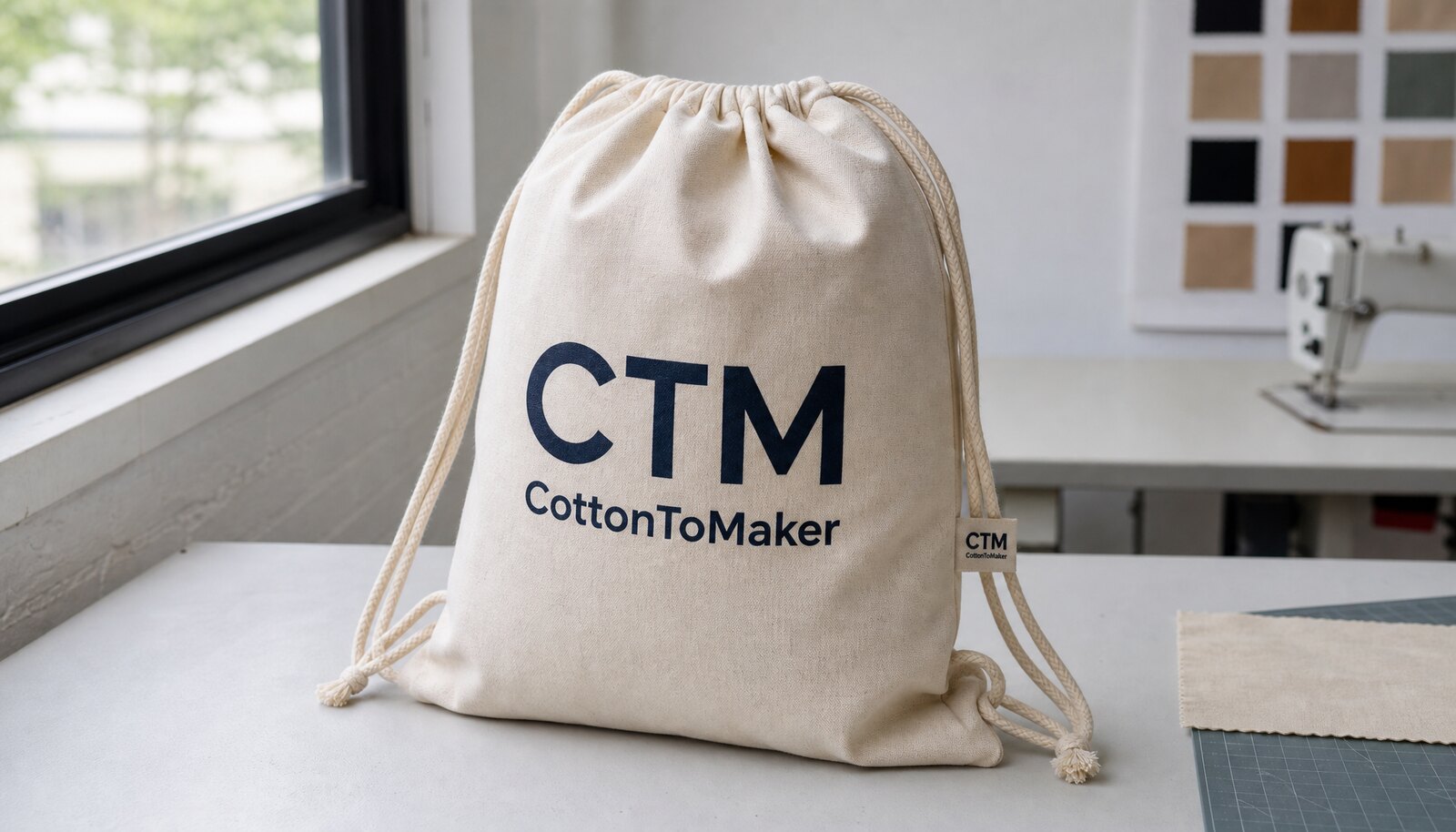
Why print proofing matters for gift-shop backpacks
Gift-shop buyers do not evaluate a drawstring backpack like a simple giveaway. They see the item as a small retail product that has to look balanced on a peg, clean in a basket, and credible next to other gift items. That means the logo, the fabric color, the fold, and the bag shape all affect perceived value. If the print sits too low, looks cramped near a seam, or loses sharpness on cotton, the product can look like a discount item even if the sewing is acceptable. For wholesale cotton drawstring backpacks for gift shops, proofing is not a design formality. It is the point where merchandising risk becomes production control.
A strong proofing process protects more than appearance. It also reduces the chance that procurement, merchandising, and QC teams approve different versions of the same bag. The artwork may look fine on a computer screen, but the production bag has a real print area, a sewn cord channel, and tension created by the drawstring. Those physical details can move the logo, change visual spacing, and alter the way the bag hangs. The proof must therefore answer one practical question: will the finished bag still look right after sewing, printing, folding, packing, and shelf display?
Start with the retail use case, not the art file
Before asking for a quote, define how the backpack will be sold. A tourist gift shop, a museum store, a souvenir chain, and a seasonal holiday display all place different demands on the same product. Some buyers want a craft-style natural cotton bag with a calm logo and a soft hand feel. Others need a brighter bleached cotton blank with stronger brand contrast and a cleaner shelf pop. If the use case is not clear, suppliers will often quote a generic bag spec that looks inexpensive but does not fit the retail channel.
The most useful procurement brief includes the channel, sales price target, display method, and expected reorder pattern. A bag that hangs on a peg has different presentation needs from a bag that sits folded in a basket or is sold as part of a gift set. The buyer should also decide whether the product is meant to feel premium, playful, eco-oriented, or souvenir-driven. That decision influences cotton color, GSM, print style, and label finish. Without that context, print proofing becomes a reaction to the sample instead of a control point for the line.
- Define the sales channel before you lock the bag spec.
- State whether the retail look should feel premium, craft, souvenir, or promotional.
- Ask suppliers to quote against the same use case so unit prices remain comparable.
Choose fabric and construction before talking print
For most gift-shop programs, 140-160 gsm cotton is a practical starting point. Below that range, the bag can feel limp, crease heavily, and show print shadow through the cloth. Above it, the bag gains body but can become heavier to ship and less flexible to fold for retail packaging. The right choice depends on whether the product needs a soft craft feel or a sturdier premium look. Natural cotton usually supports a handmade aesthetic; bleached cotton typically gives better color brightness and cleaner logo contrast.
Construction details should be fixed before proofing artwork. The factory should confirm whether the bag is single-layer or lined, where the drawcord channel is sewn, and whether the lower corners or stress points are reinforced. Ask for a sample that shows the exact cord diameter, cord end finish, seam allowance, and label position. If any of those elements are still open, the print sample is not a production sample. It is only a development piece. That distinction matters because artwork placement often changes once the final seam lines are added and the bag is pulled closed.
- Use 140-160 gsm cotton as a common retail baseline unless the channel requires more structure.
- Select natural or bleached cotton before approving logo color.
- Lock cord diameter, seam reinforcement, and label position before sample approval.
Match the print method to the artwork and order size
Screen printing remains the most reliable option for many gift-shop cotton drawstring backpacks, especially when the logo uses one to three spot colors and needs strong opacity. It usually delivers better edge definition than low-cost alternatives and handles cotton well when the screen setup is controlled. But screen printing only works well when the factory prepares the art correctly and uses the right mesh, ink, and curing settings. Thin type, small icons, and narrow registration gaps should be reviewed at final size, not enlarged or simplified just to make production easier.
Short-run digital transfer or other fast methods can make sense for test programs, seasonal designs, or small trial orders. However, procurement teams should treat those as limited-use solutions. They can introduce hand feel, wear faster under abrasion, or look too glossy for a more premium retail display. If the buyer expects the bag to be a small keepsake rather than a throwaway promo item, the print has to stay legible after packing, handling, and shelf time. Ask the factory how the chosen method performs after folding, rubbing, and repeated customer handling, not only on day one.
- Use screen print for simple logos where opacity and repeatability matter.
- Use transfer or digital methods only when MOQ or speed justifies the tradeoff.
- Check small text and thin lines at the actual production size before signoff.
What to request as evidence from the supplier
A serious supplier should be able to show more than a sales sheet. Ask for evidence that the print line is actually controlled in the facility that quoted the order. That can include factory photos or video, a process map showing where fabric is cut, printed, sewn, and packed, and a sample approval trail that identifies who signed off internally. If the supplier cannot show where the logo step happens, the buyer does not yet know who is responsible for print quality.
For higher-value retail programs, also ask for proof of material control. A useful response includes a fabric swatch, GSM reference, cord specification, and a picture of the actual line or workstation that will run the art. If there is any subcontracting, ask the supplier to name the subcontractor and explain what is done off-site. Buyers should not accept a vague assurance that the factory “works with a good printer.” They need to know who owns the screen setup, who handles curing, and who is responsible if the logo drifts between the sample and the bulk run.
- Request factory photos or video showing the actual print area and sewing line.
- Ask for the name of any subcontractor involved in printing or packing.
- Require a sample approval trail, not just a hand-marked sample bag.
Use a strike-off plus pre-production sample sequence
The best proofing flow for this product is a strike-off first, then a pre-production sample built from final materials. The strike-off confirms how the art behaves on the chosen cotton and whether the color, line weight, and registration are acceptable. The pre-production sample then validates the real bag construction, cord tension, seam lines, and packing method. If a supplier skips straight to a showroom-style sample, the buyer may miss the issues that appear only when the final blank is printed and sewn at production scale.
Approval should be based on the actual retail presentation. Check the front panel under normal indoor light and daylight if possible. Confirm that the logo is centered relative to the visible panel, not simply centered on a cut piece of cloth. Then fold and refold the bag to see whether creases land across the print. A sample that looks fine flat on the table but collapses awkwardly when packed should not be approved for mass production. It is better to reject a near-miss sample than to receive a whole carton of bags that are technically correct but visually weak on the shelf.
- Use a strike-off to confirm artwork behavior before the pre-production sample.
- Approve only after the sample reflects final fabric, final sewing, and final packing.
- Judge the bag in folded and displayed form, not only as a flat sample.
How to compare quotes without missing hidden cost
A usable quote should separate the base bag price from the production extras. If the supplier gives only one number, procurement cannot tell whether the difference comes from fabric weight, print setup, packing, or freight assumptions. Ask every supplier to state the bag size, GSM, print colors, print method, and packing style on the same line. That allows you to compare offers on the same basis rather than comparing one factory’s bare unit price against another factory’s all-in estimate.
For wholesale cotton drawstring backpacks for gift shops, the quote should also show carton quantity, gross weight, carton dimensions, and trade term. If there is a setup fee, ask whether it applies once per design, per color, or per production run. If the pack includes polybags, barcode stickers, or retail inserts, the quote should say so explicitly. The goal is not to interrogate the supplier. It is to stop false comparisons. A cheaper quote can become the most expensive option once packing changes, sample revisions, and freight are added back in.
- Require the same quote fields from every supplier.
- Separate sample fees, screen setup, and packing charges from unit price.
- Compare landed cost, not only ex-factory cost.
A deeper comparison table for sourcing routes
Not every supplier route carries the same proofing control. Some buyers want direct factory sourcing because it gives one party ownership of sewing, printing, and packing. Others prefer a trading company because it can coordinate multiple factories and handle communication. The right choice depends on the need for control versus convenience. Use the table below to compare procurement risk, not only price. The most important differences usually appear in evidence quality, line ownership, and the ability to reproduce the same print result in the next batch.
The point of this comparison is practical: identify who can answer production questions without handoffs. If a supplier cannot explain the print process, cannot confirm the blank material source, or cannot show sample approval discipline, the risk lands on your team later. A good quote is not just cheaper. It is easier to audit, easier to repeat, and easier to hold accountable if the logo or packing slips.
- Compare proofing control and evidence quality, not just quoted price.
- Prefer the route that can reproduce the same result on repeat orders.
- Use line ownership and sample discipline as decision criteria.
Packing rules that protect shelf appearance and warehouse efficiency
Gift shops and warehouses often want opposite things from the same pack. Retail teams want a neat bag that looks clean on the shelf; receiving teams want dense, efficient cartons that are easy to count. The factory should define the folding method before bulk production starts. A poor fold can crease the logo, hide the print, or leave hard lines across the front panel. If the product is sold as a gift item, ask whether an individual polybag, paper band, or dust protection is needed. If it is sold through distribution, bulk pack may be more efficient, but the carton plan should still protect the print face and keep count accuracy high.
Barcode labels, size stickers, and carton marks should be treated as part of the product specification, not afterthoughts. Ask the supplier where labels will be placed so they do not obscure the print or damage the cotton surface. Confirm carton counts per case so the warehouse can receive and replenish the product without manual rework. If the program includes multiple colors, packing should remain consistent across all colorways. Otherwise, the warehouse ends up with mixed counts, shelf confusion, and avoidable receiving delays.
- Approve a folding method that keeps the print visible and avoids hard creases.
- Define whether the retail route needs polybags, paper bands, or bulk pack.
- Make barcode placement and carton count part of the approval sample.
Set measurable QC thresholds, not just visual opinions
Quality control is stronger when the acceptance criteria are measurable. For a printed cotton drawstring backpack, the buyer should not rely only on a vague statement that the bag must “look good.” Define the critical dimensions, the allowed tolerance, and the inspection sample size. A common approach is to inspect against an AQL plan, with the buyer stating the accept/reject thresholds for critical, major, and minor defects on the PO or quality annex. That does not remove judgment, but it stops disagreements about what counts as acceptable.
Practical thresholds help the factory self-check before shipment. For example, the bag dimensions should stay within the approved tolerance after sewing, the logo should remain centered within the agreed print window, and the stitch line should not show skipped stitches or loose ends beyond the allowed limit. If your buying team expects very sharp small text, define what “readable” means: no blur at retail distance, no broken letters, and no ink spread that changes the brand name. The more specific the QC note, the easier it is to enforce at final inspection.
- Use AQL-based inspection criteria on the PO or quality annex.
- Define tolerances for size, placement, stitching, and print clarity.
- Write the defect rules so factory self-checking is possible before shipment.
Specification comparison for buyers
| Procurement decision | Recommended default | Best-fit use case | Hard buyer control to verify | Commercial risk if ignored |
|---|---|---|---|---|
| Sourcing route | Direct factory with in-house sewing and printing | Repeat gift-shop programs, branded retail, and orders that need one accountable owner | Ask for the factory name on the quote, print-line photos, and a process flow showing fabric, print, sewing, and packing in one site | A trading quote can hide who actually prints, which delays root-cause fixes when defects appear |
| Proofing sequence | Strike-off first, then pre-production sample from final materials | New artwork, new bag color, or any logo with fine type or exact brand color | Require the strike-off art position, final fabric swatch, final cord spec, and final packing method to match the bulk order | Sampling on the wrong blank can hide ink spread, shrinkage, and centering drift |
| Print method | 1-3 color screen print for logo-led retail programs | Clean logos, stronger opacity, and medium-to-higher quantities | Confirm mesh count, ink type, curing method, and whether small text can be held at production size | Thin strokes and small text can fill in, crack, or wash out on cotton |
| Short-run alternative | Digital transfer or other low-MOQ print method | Test runs, seasonal concepts, or fast sell-through trials | Request abrasion expectations, hand-feel notes, and whether the same artwork can later be moved to screen print | The sample may sell well but fail durability or feel too promotional for gift retail |
| Fabric weight | 140-160 gsm cotton as the common retail range | Gift shops that need body, shelf presence, and a bag that hangs neatly on display | Verify whether GSM is finished fabric weight, not greige weight; ask for a cut swatch | Too-light cotton wrinkles and shows print shadow; too-heavy cotton raises freight and retail cost |
| Fabric color | Natural or bleached cotton depending on brand contrast | Natural look for craft-style retail; bleached for brighter logo contrast | Approve actual shade under daylight and indoor light, not only on a screen | A small color shift can weaken logo contrast and make the whole line look less premium |
| Construction | Single-layer body with reinforced drawcord channel and stress points | Value-sensitive retail where the bag still needs to survive repeated handling | Check seam density, corner reinforcement, and cord tunnel width on the sample | Weak seams at the channel or lower corners create fast failures in store and in use |
| Packing route | Bulk pack or retail-ready polybagging with labels defined up front | Chains, distributors, and replenishment programs | Confirm polybag size, barcode location, fold method, carton marks, and inner pack count | Packing changes can create warehouse rework, barcode conflicts, and shelf presentation issues |
| Commercial term | FOB or CIF with all setup and packing assumptions itemized | Buyers comparing factories across regions | Ask for a separate line for sample fee, screen setup, extra color charge, carton fee, and freight basis | A low unit price can hide setup costs or make landed cost impossible to compare |
Buyer checklist before sampling
- Freeze the finished bag size, cotton GSM, fabric color, and whether the cloth is natural or bleached before proofing.
- Approve artwork in vector format and confirm the exact print size, placement, and Pantone or visual color reference.
- Lock the print method, number of colors, ink type, and acceptable registration tolerance before sample approval.
- Request a strike-off and a pre-production sample made from final fabric, final cord, and final packing method.
- Ask the supplier to state who owns the print line, where the print happens, and whether any part is subcontracted.
- Confirm seam reinforcement, cord tunnel construction, and label placement on the sample, not only on the drawing.
- State packing requirements clearly: fold method, inner polybag or bulk pack, barcode placement, carton count, and outer carton marks.
- Require the quote to separate unit price from sample fee, screen setup, extra color charge, packing changes, and freight term.
- Set the schedule around sample approval, material booking, and inspection, not around the first promised ship date.
- If any fabric, print, or packing detail changes after signoff, treat the approval as void until a revised sample is approved.
Factory quote questions to send
- What is the quoted GSM, and is that finished fabric weight or greige weight?
- Can you show a photo or video of your in-house print line, and is the logo step performed on-site?
- Which print method will be used for this exact artwork, and what mesh count, ink type, and curing method are you planning?
- How many setup charges are included, and what will trigger extra charges for additional colors or art revisions?
- What is the MOQ per color and per artwork, and can multiple colorways be combined in one production run?
- Will the pre-production sample use the final fabric, final cord, final seams, and final packing method?
- Can you provide the sample approval trail, including strike-off, swatch match, and the person who signed off internally?
- What is the quoted folding method, and does it keep the logo visible without hard creases across the print area?
- Will you provide carton dimensions, gross weight, carton quantity, and barcode placement before I approve the PO?
- Please itemize FOB or CIF assumptions, including sample fee, screen setup, packing, and any export documentation charge.
Quality-control points to confirm
- Fabric weight should stay within the agreed tolerance of the approved GSM, and the sample should not feel noticeably thinner than the signed-off swatch.
- Bag dimensions should remain within the agreed tolerance after sewing; critical width, height, and strap/cord tunnel measurements should be checked on random pieces.
- Print placement should stay centered within the approved visual window, and the logo should align against the seam reference, not only the cut panel edge.
- Small text, fine lines, and logo edges should remain readable at normal retail viewing distance under indoor white light.
- Ink should show no visible bleed, set-off, or strike-through onto the reverse or adjacent folded panel.
- Stitching at the drawcord channel, lower corners, and side seams should show no skipped stitches, broken thread, or loose ends longer than the agreed limit.
- Cord pull should be smooth on both sides, with no twisting, uneven closure, fraying, or one-side draw imbalance.
- Labels, size stickers, barcodes, and carton marks should match the approved packing layout and not cover the logo or damage the cotton surface.
- Carton count should match the approved pack plan, and gross weight should remain consistent enough to support warehouse receiving.
- Any print defect, seam defect, or packing error should be graded against a written AQL plan rather than judged only by eye.