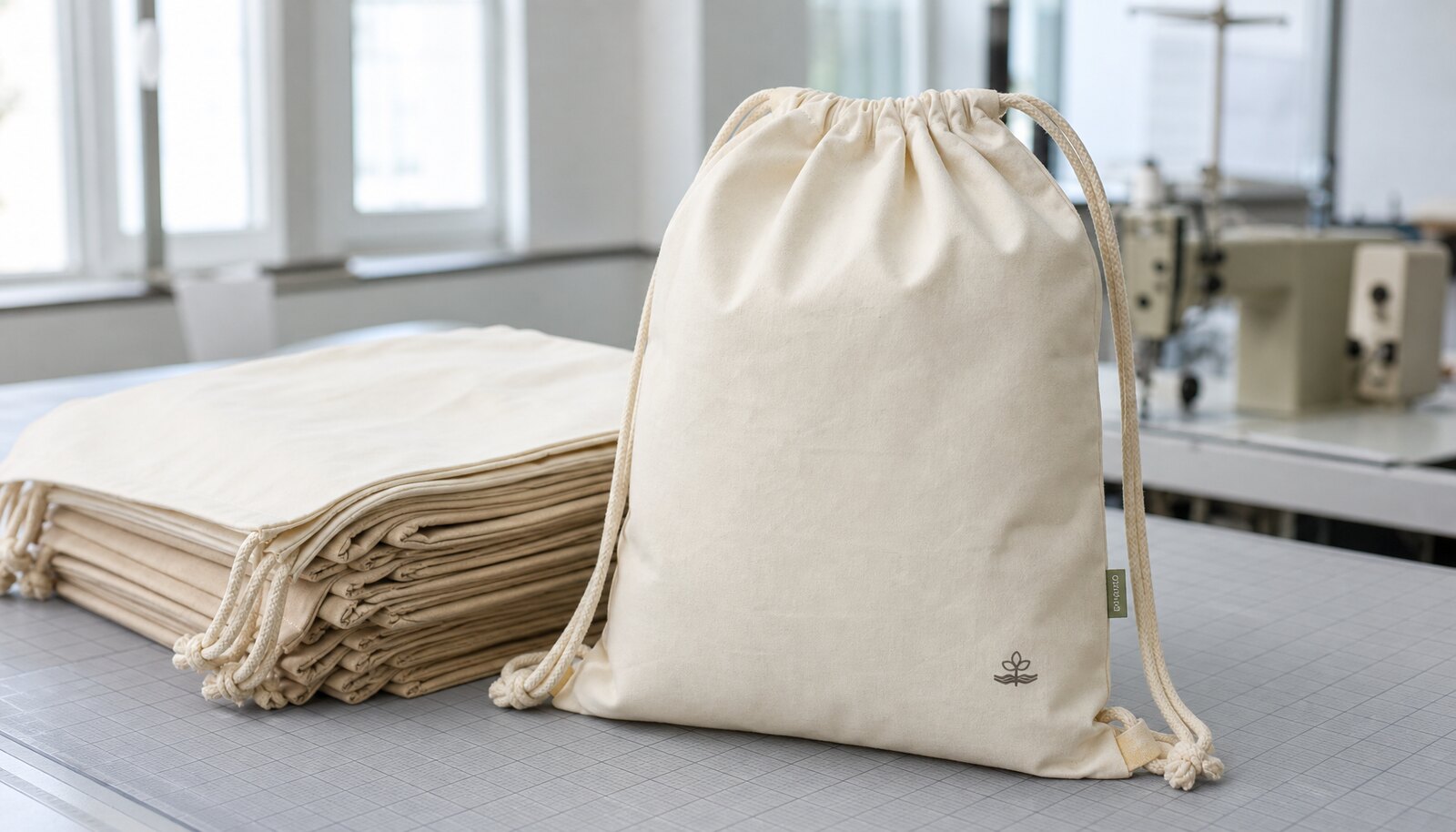
Why gift shop buyers source cotton drawstring backpacks differently from promotional bags
A cotton drawstring backpack can be a souvenir, a branded accessory, or a low-ticket retail item that sits beside postcards, mugs, and apparel. That matters because the buying logic changes. A promotional buyer may focus on the lowest acceptable unit price. A gift shop buyer needs the bag to look credible on a shelf, carry a clean print, and feel like a product a customer would actually choose. In this category, appearance and repeatability affect sell-through as much as cost does.
That is why the first sourcing decision should be about merchandising, not the supplier. Are you buying for a museum shop with a restrained, natural look? A resort store that wants lightweight items and easy replenishment? A kids’ or campus shop that needs a fun, budget-conscious piece? Each scenario points to a different material balance. The right wholesale cotton drawstring backpacks for gift shops are usually the ones that fit the retail story, not just the price target.
If the brief does not say how the bag will be displayed, sold, and packed, suppliers will fill in the blanks differently. One quote may be built around a thin giveaway bag, another around a more structured retail accessory. That makes comparison noisy. A better approach is to define the intended use case first, then request quotes against a frozen spec. Buyers usually get cleaner pricing and fewer sample revisions when the retail role is clear from the start.
Common gift-shop buying scenarios include museum stores that want a softer natural finish, botanical or nature centers that prefer an earthy look, resort and destination shops that need light weight and compact packing, and school or campus stores that want a simple branded item at an accessible price point. The bag still has to stack well, print cleanly, and replenish without complications. This guide focuses on the material and production choices that most affect those outcomes.
- Start with the merchandising role: souvenir, retail accessory, event add-on, or branded gift.
- Define whether the bag should read as premium, eco-minded, playful, or utility-first.
- Freeze the spec before comparing suppliers so the quote basis is truly comparable.
How to choose the fabric: GSM, weave, shrinkage, and finish
GSM is useful, but it is not enough on its own. Two bags can both be called 180 GSM and still behave very differently once they are cut, sewn, printed, and packed. Weave tightness, yarn quality, finishing, and shrinkage all change the result. For gift shop assortments, the goal is usually a fabric that looks smooth enough for branding, has enough body to feel intentional, and still folds efficiently for wholesale packing.
A practical working range for many gift-shop programs is roughly 165–220 GSM. At the lower end, the bag is lighter and less expensive, but it can wrinkle more, show through more easily, and feel closer to a giveaway item. In the middle, the cloth usually has enough body for good shelf presentation without making freight costs jump too sharply. Above that range, the bag can feel more premium and structured, but the buyer should verify whether the added material cost is worth the extra weight and carton volume.
Weave type should be written into the spec. Plain weave cotton is often the best option when the design needs a smoother surface for small logos or line art. Light canvas or a duck-like weave creates a more substantial handfeel and stronger shelf presence, which can be useful in premium retail environments. A loose or uneven weave can create problems: the print may sit inconsistently, the cloth can distort under tension, and the product may look less refined than the sample suggested. If the supplier cannot describe the weave clearly, ask for a close-up cloth photo and a measured swatch rather than relying on a generic fabric name.
Shrinkage deserves a clearer note than it often gets. Cotton can move after washing, steaming, pressing, heat exposure, or simply through handling and storage conditions. Even when a bag is not meant for repeated washing, the fabric can still change enough to affect final size. Ask the factory what allowance it builds into cutting and what test method it uses to decide that allowance. A claim of “pre-shrunk” is not enough unless the supplier can explain how it was tested and what the post-test dimensions were.
Finishing affects both print quality and the perceived craft level. Some cloth is lightly calendered or singed to reduce loose fibers and improve print sharpness. That can help logos look cleaner, especially on natural cotton. But over-finishing can make the bag feel less natural, which may work against the look some gift shops want. The right choice depends on the channel. If the store wants a rustic, hand-made feel, keep the finish simpler. If the priority is crisp branding and a cleaner retail stack, ask for a smoother surface and proof it under daylight and store lighting.
- Use fabric weight as a starting point, not the full spec.
- Ask for weave type and finishing details, not only a GSM number.
- Request the shrinkage method and the allowance built into cutting.
- Review a swatch in real light to judge print readiness and surface consistency.
Construction details that change retail value
Construction quality changes how a bag sells, not just how it performs. A neat hem, even seams, and a properly reinforced cord channel all make the product feel more deliberate. If the top edge waves, the side seams twist, or the channel looks collapsed, the bag can appear inexpensive even when the fabric itself is acceptable. For that reason, procurement teams should ask to see inside seams and channel construction, not only the front panel.
Finished size should be specified as a real production dimension, not only a marketing description. A bag can have the same flat width as another bag and still have different usable volume depending on depth, seam allowance, and opening shape. If the item will hold brochures, a bottle, or folded apparel, ask the supplier to confirm usable internal space and the final dimensions after sewing and pressing. Buyers often save time later by defining what the bag must carry up front.
The cord channel is a small part with a big effect. It needs to be wide enough for smooth movement, but not so loose that the opening looks sloppy or the fabric bunches unevenly. Reinforced exits help reduce tearing, especially on heavier cloth. Cord diameter also matters. Too thin, and the bag can feel cheap and uncomfortable in hand. Too thick, and the channel can feel crowded and stiff. For many retail programs, a 5–6 mm cord works well, but the right choice still depends on bag size, cloth weight, and the channel construction.
Cord material is not a neutral choice. A 100% cotton cord supports a natural merchandising story and usually feels softer, but it can fuzz if the ends are not finished well. A cotton/poly blend can improve abrasion resistance and glide more easily, but it may look less natural in a museum shop or heritage store. End finishing should be identified in writing, whether it is knotting, whipping, heat finishing, or another method. Buyers should not accept a vague “same as sample” note here, because this is one of the easiest places for a factory to substitute a cheaper appearance without changing the base quote.
For premium programs, a cleaner square bottom, a more stable fold line, or a subtle reinforcement patch can improve the way the bag sits on the shelf and handles customer use. These are not mandatory upgrades, but the buyer should know whether they are included or quoted separately. The right construction is the one that matches the retail environment and the price point, not the one with the most features.
- Specify finished dimensions, usable volume, and tolerance instead of relying on a flat size label.
- Ask for interior seam photos and cord-channel close-ups.
- Confirm cord diameter and end finish in writing.
- Check whether reinforcement is already built into the quote or added later as an extra.
Print and decoration choices: what the artwork does to cost and durability
Decoration method can change both the economics and the look of the bag. For simple marks, one-color logos, and repeat orders, screen print is often the most practical choice. It generally gives good opacity on natural cotton and keeps the print integrated with the fabric rather than floating on top of it. The tradeoff is setup cost, so the order size needs to justify the screens or plates.
For seasonal art, multi-color graphics, or smaller launch quantities, transfer methods can be more flexible. Heat transfer or digital transfer can support detailed artwork and lower minimums, but buyers need to verify how the print feels and how it ages. On a textile souvenir item, a stiff, plastic-like patch can work against the cotton story. The sample should be handled several times, checked under daylight, and evaluated for cracking, peeling, or surface stiffness before the bulk order is released.
Small logos and line art require extra care because fine detail can disappear on woven cotton. Ask for the actual print size in millimeters, not only a label such as “front logo.” If the artwork includes thin strokes or small text, request a proof at final size. In many cases, simplifying the art reduces risk and cost more effectively than changing to a more complex decoration method. A bold, well-centered one-color logo often performs better on a souvenir bag than a crowded multi-color graphic that looks cramped at retail distance.
Color control should be treated carefully. Pantone references help, but the base fabric color changes the final appearance. A white print can look softer on natural beige cloth than it does on bright white cotton. Dark inks can feather if the weave is too open. Ask whether the bags are printed on raw natural cloth, bleached cloth, or dyed cloth, because the substrate affects the result. If the design has to be re-ordered later, approve the physical sample as the color reference rather than depending on a digital mockup.
Decoration also affects lead time. Screen setup, drying, alignment checks, and cure verification all add time. If the launch date is fixed, print approval should happen early in the schedule. Ask the supplier to separate art confirmation, screen making, production, and packing timing so you can see where delays may occur. That is especially useful for seasonal gift shop ranges where a late arrival can miss the selling window entirely.
- Use screen print for simple branding and repeatable reorders.
- Use transfer methods only after testing handfeel, cracking, and surface durability.
- Request actual-size proofs for fine text and thin line work.
- Approve color on the real fabric, not only on a digital rendering.
A practical supplier comparison framework for RFQs
The most common sourcing mistake in this category is comparing suppliers before the spec is locked. One factory may be quoting a lighter cloth, another may include a different cord, and a third may assume bulk packing when your store needs retail-ready units. On paper, the cheapest quote can be the most expensive once the missing pieces are added back in. A useful comparison starts with a written spec and a request for line-item pricing.
For wholesale cotton drawstring backpacks for gift shops, the quote should ideally break out fabric, cutting, sewing, printing, packing, cartons, labels, and any setup charges. If the supplier only gives a single number, you cannot tell whether the lower price reflects efficient production or a quiet downgrade in cloth, finish, or packing. This matters most on first orders because that is when the factory has the most room to simplify details unless the buyer has specified them clearly.
Supplier route matters too. A direct factory is usually the best fit when you need tighter control over fabric and construction, especially for future reorders. But not every “factory quote” is truly direct. Some sales offices coordinate production through subcontractors. That is not automatically a problem, but the buyer should know who controls cloth sourcing, printing, sewing, and packing. A trading company can be useful for lower-volume or mixed-product buys, but the QC owner and actual production site should still be identified in writing.
Spec drift is another recurring risk. During negotiation, buyers often ask for “the same as the sample but better price.” That phrase invites substitutions. A better method is to decide which elements are fixed and which can flex. For example, you might allow a simpler label or a more efficient carton size, but keep fabric weight, cord diameter, print placement, and seam construction fixed. Once the quote basis is defined, supplier comparison becomes about value rather than narrative.
- Ask for line-item costs instead of one total price.
- Verify who owns cutting, printing, sewing, and final packing.
- Separate fixed spec items from negotiable items before price talks.
- Treat spec changes as formal revisions, not casual chat notes.
Sample approval and test methods before bulk release
A sample is only useful if it matches the real production plan. Request a pre-production sample made with the same fabric type, cord type, decoration method, and packing style intended for the order. If the sample is made from better cloth than the bulk lot, it will mislead you. If the print method changes between sample and production, the approval loses value. The sample should be a true reference the factory can repeat.
Before approving, measure the bag against a simple spec sheet. Record finished length, width, top opening, and any depth or gusset dimension. Check that the cord pull feels smooth and that the opening does not jam. Lay the bag flat and inspect whether the seams are straight and whether the body squares up properly. Then load it with the kind of item your shop will actually sell. A souvenir bag can look fine empty and still distort badly when filled with a bottle, guidebook, or folded apparel.
For the print, look for alignment, opacity, edge clarity, and adhesion. Rub the print after it cures. If ink transfers to your fingers or the edges look fuzzy, treat that as a real defect, not a minor cosmetic issue. Fine text should remain legible at normal retail viewing distance. If the design is detailed, ask for both a close photo and a daylight photo of the same sample so you can spot defects that warehouse lighting might hide.
It is also useful to compare more than one sample when possible. One polished sample can be a handpicked outlier. Multiple samples reveal whether the process is stable. For a first order, consistency matters more than a perfect sales sample. If the factory cannot make several similar samples, production risk is probably higher than the quote suggests.
Finally, check how the sample folds and packs. If the folded bag is awkward, bulges the carton, or makes the cord tangle, that problem will scale in production. Good sample approval covers the whole system: fabric, print, seam behavior, cord action, folding, carton fit, and shelf presentation.
- Approve a sample only when it matches the intended production materials and packing method.
- Measure the sample and keep the results in a written record.
- Load test with realistic retail contents or a close equivalent.
- Check print adhesion by handling the cured sample, not just by looking at it.
QC criteria buyers can enforce in the purchase order
Quality control works best when it is measurable. Broad phrases such as “good stitching” or “nice print” do not protect a purchase order. For cotton drawstring backpacks, the buyer should define a short list of acceptance criteria tied to dimensions, appearance, and function. That makes self-inspection at the factory easier and gives third-party inspectors a clear standard to check.
Start with dimensional control. State the finished-size tolerance and confirm whether measurements are taken before or after pressing. Then define visible defects that are not acceptable: holes, broken stitches, oil spots, loose thread clumps, print smears, or art placed outside the agreed tolerance. For a gift shop product, cosmetic consistency matters as much as strength. A bag can function fine and still fail retail acceptance if the display stack looks irregular.
A practical QC plan should also include testing. Pull-test a sampled set from each batch to verify the cord channel and seams can handle expected use. Check stitch density on the side seams and bottom seam. Confirm that the cord exits evenly on both sides. Verify that the bag folds the way the approved sample folds, without twisting the cords into knots or creating creases that damage the presentation. If the bag is intended for repeated carrying, ask for a load test that matches the intended use case rather than a vague “strong enough” statement.
Defect thresholds should be written into the order. You may accept a very small amount of minor cosmetic variation, but major issues such as torn seams, missing cords, or badly misprinted logos should be zero-tolerance. The exact percentage for minor defects depends on the channel and the supplier relationship, but it should be stated. The order should also say what happens after a reject: rework, replacement, or chargeback. Without that rule, factories may assume the buyer will tolerate more than intended.
Carton checks matter too. Bags can pass sewing QC and still fail at shipping if cartons are too tight, too damp, or packed inconsistently. Ask for carton marks, unit count, and a moisture-safe packing method. For import orders, the carton is part of the product experience because stock may sit in storage before it reaches the shelf. A clean carton and accurate count reduce receiving problems and speed up distribution.
- Write measurable standards for size, print position, stitch density, and visible defects.
- Use a load test and cord pull check on sampled units.
- Put defect thresholds and rework rules into the PO or quality agreement.
- Inspect cartons for count accuracy, dryness, and packing consistency.
Packing, labeling, and logistics details that affect landed cost
Packing is one of the easiest ways to add hidden cost. Cotton drawstring backpacks compress well, so buyers sometimes leave packing vague. That is a mistake. The way the bags are folded, banded, bagged, and cartonized affects freight density, warehouse receiving, damage risk, and whether the item feels ready for retail. If the bags are for wholesale distribution, flat bulk packing is usually the most efficient option. If the store or distributor needs retail-ready units, individual polybags, barcode labels, or hangtags should be included in the quote before it is approved.
Carton planning matters because cotton is light but bulky. A poorly planned carton may not be overweight, but it can waste cube space and increase freight cost. Ask the factory for carton dimensions, gross weight, net weight, and unit count. Then ask whether the carton size was designed for this bag or copied from another product. The fold method can improve packing efficiency, while an inconsistent fold can create uneven cartons and crushed corners. That difference shows up later in both freight and warehouse handling.
Moisture protection should not be ignored. Cotton in humid transit or storage conditions can pick up odor or surface dampness. A simple inner liner or dry carton environment may be enough, but the method should be defined. If the product will sit in a warehouse before retail delivery, ask for packing that protects the fabric without adding unnecessary bulk. For gift shop buyers, arriving neat often matters more than arriving in the cheapest possible cube.
Labeling is another common delay point. If the carton needs SKU labels, barcode labels, country-of-origin markings, or retailer-specific ship marks, the factory needs that information before production starts. Last-minute label changes slow the job and increase packing error risk. For multi-SKU gift shop orders, define the label structure so cartons do not get mixed. If the order includes multiple colors or print versions, ask how the factory keeps units separated at final count. That process detail is often more valuable than a general promise of “strict QC.”
- Confirm whether the order is bulk packed, polybagged, hangtagged, or retail-ready.
- Ask for carton size, unit count, and gross weight before approval.
- Specify moisture protection and label placement up front.
- Require a packing sequence for multi-SKU orders so cartons do not get mixed.
MOQ, lead time, and supplier verification without the usual surprises
MOQ and lead time should be treated as risk controls, not just commercial terms. A low MOQ can be useful for a first launch, but buyers should understand what the factory is changing to reach it. Sometimes the cloth is simplified, the print is reduced, or the packing process becomes less controlled. A higher MOQ can be the better choice if it stabilizes production and lowers defect risk. The right answer depends on sell-through expectations and whether the item is likely to be reordered.
Lead time depends on the actual workload: cloth availability, cutting capacity, print complexity, drying time, packing requirements, and shipping consolidation. A simple natural cotton bag with one print color and bulk packing can move faster than a dyed bag with retail tags and extra labeling. Ask for separate sample and production timing. Also ask what causes delays: art revisions, fabric procurement, label sourcing, or QC rework. A useful supplier will identify the bottlenecks before the order starts.
Supplier verification matters just as much as timing. The buyer is not only asking whether the supplier can make a backpack, but whether they control the critical steps. Ask who cuts the cloth, who prints, who sews, and where final packing happens. If the business uses multiple sites, ask for the named production site and the responsible QC contact. That is especially important for gift shop programs, because appearance consistency matters more than a purely technical pass/fail result.
Compliance questions should be practical. Depending on your market, ask whether the supplier can support fiber-content labeling, country-of-origin marking, or restricted-substance documentation if your channel requires it. If the bag is sold in a regulated retail environment or intended for children, do not assume that a generic cotton drawstring bag automatically meets every requirement. Align the paperwork before production starts, not after shipment. A low quote is not a bargain if it creates hold-up at receiving or relabeling work on arrival.
A simple way to reduce schedule risk is to keep the first order easy to repeat: one fabric, one size, one print method, one cord color, one packing format. That lets the supplier stabilize the run and gives procurement a clean baseline for the next order. Complexity can come later, once the first production proves repeatable.
- Separate sample lead time from production lead time.
- Ask what causes schedule slips: fabric, labels, printing, packing, or approvals.
- Verify the real factory, process ownership, and QC contact before issuing the PO.
- Keep the first order simple to reduce timing and compliance risk.
Landed cost and reorder planning for gift shop programs
For gift shop buyers, landed cost should include more than the sewn unit price. A low unit price can disappear once setup charges, freight, packing extras, carton volume, and the cost of defects or rework are added. Cotton drawstring backpacks are not complicated products, but they still pick up hidden cost in print setup, labeling, and packing. The useful comparison is cost per sellable unit at the warehouse or store, not cost per piece at the sewing line.
Setup charges matter on smaller and mid-sized orders. Screen printing often includes screen or plate costs that are fine at volume but expensive when spread over too few units. Transfer methods may reduce setup but increase unit cost or reduce durability. Packing upgrades such as polybags, barcode labels, and hangtags can look small per unit, yet they add labor and may change carton dimensions. The buyer should amortize one-time fees across the forecast quantity before deciding which quote really wins.
Reorder planning is where good procurement pays off. A first order should show whether the spec is stable enough for replenishment. If the bag sells well, the second order should not require another round of guesswork. Keep the approved swatch, print proof, packing standard, carton map, and sample photos in one file. That file becomes the reference for reorder pricing and makes it easier to spot unauthorized changes in cloth, cord, or packing. If a supplier wants to change the spec on reorder, the buyer will have a clean baseline for discussion.
When comparing suppliers, ask not only what they can make today, but how they hold consistency next season. Gift shop programs often depend on seasonal windows and inventory deadlines. A bag that arrives late or varies between batches can hurt the line more than a slightly higher purchase price. The strongest procurement programs usually start with the most repeatable version, then use reorder data to negotiate from a position of evidence.
- Compare cost per sellable unit, not only factory FOB price.
- Amortize setup fees over the real forecast quantity.
- Keep one approved spec file for reorders: fabric, print, packing, carton, and sample photos.
- Use the first order to validate repeatability before expanding variants.
Specification comparison for buyers
| Procurement choice | Option / spec range | Best fit for gift shop programs | Buyer control point / risk to verify |
|---|---|---|---|
| Fabric weight | 140–160 GSM / 4.1–4.7 oz/yd² | Entry-price souvenirs, event add-ons, and lightweight impulse buys | Can feel thin under backlight; check show-through, seam puckering, and whether the bag still looks retail-ready when folded |
| Fabric weight | 165–190 GSM / 4.9–5.6 oz/yd² | General gift shop assortments, museum stores, resort shops, and branded retail basics | Usually the easiest balance of cost and body; verify actual cloth width, shrinkage allowance, and print opacity on natural cotton |
| Fabric weight | 195–220 GSM / 5.7–6.5 oz/yd² | Higher-presented souvenir lines and bags sold as a keepsake rather than a giveaway | Heavier cloth increases freight and may need stronger channel reinforcement; confirm the cord pull stays smooth |
| Fabric weight | 225–260 GSM / 6.6–7.7 oz/yd² | Premium gift shops and lines that need a more structured handfeel | Inspect whether the seam construction and cord channel were upgraded to match the heavier cloth |
| Weave | Plain weave, tighter construction | Good for small logos, line art, and cleaner retail presentation | Ask for close-up fabric photos; a loose plain weave can still distort print or look uneven in stack displays |
| Weave | Light canvas / duck-like weave | Better shelf presence and a more substantial feel | Can reduce fine-detail print sharpness; verify artwork legibility at actual bag size |
| Weave | Soft slub-heavy or loosely woven cloth | Rustic, artisan, or eco-styled gift shop assortments | Can read casual but may show more variation from unit to unit; confirm the acceptable range of slubs and yarn irregularity |
| Cord | 100% cotton cord | Natural-merchandising programs and eco-minded retail assortments | Check fraying, knot security, and whether the cord moves smoothly through the channel after folding |
| Cord | Cotton/poly blend cord | Higher abrasion resistance and easier pull action | Can look less natural in heritage or museum shops; verify end finishing so exposed fibers do not fuzz |
Buyer checklist before sampling
- Freeze the finished size, acceptable tolerance, and intended retail role before requesting quotes.
- Specify fabric construction, target GSM, weave type, and any shrinkage allowance in writing.
- Define cord material, diameter, end finish, and whether the pull action must stay smooth after folding.
- Send vector artwork, actual print size, Pantone references, and the exact print position with measurements.
- Require a pre-production sample made with the same fabric, cord, print method, and packing style.
- Confirm whether the first order is bulk packed, polybagged, barcode-labeled, or retail-ready.
- Ask for a visible defect standard, seam and stitch expectations, and the acceptance rule for off-center print.
- Compare landed cost, not only factory price, and include setup fees, packing add-ons, freight weight, and likely rework risk.
Factory quote questions to send
- What exact fabric are you quoting: plain weave, light canvas, or duck-like weave, and what GSM range can you hold across production?
- Can you confirm whether the cloth is raw natural, bleached, or dyed, and how that affects print color and surface finish?
- What cord material, diameter, and end finish are included in the base quote?
- What is the MOQ by size, print color count, packing format, and carton configuration?
- Please break out fabric, cutting, sewing, printing, packing, cartons, labels, and any setup or plate charges separately.
- What shrinkage allowance do you build into cutting, and what test method do you use to set that allowance?
- What seam allowance, stitch density, and reinforcement method do you use at side seams, bottom seams, and the cord channel?
- What is your acceptable print registration tolerance, and how do you check it before bulk packing?
- Can you share photos of a recent production lot showing the inside seams, cord channel, print close-up, and carton labels?
- What is your inspection standard for size, stains, loose threads, count accuracy, and major versus minor defects?
Quality-control points to confirm
- Fabric weight should match the approved swatch or pre-production sample within a practical tolerance of about ±5% GSM unless the buyer and factory agree otherwise.
- Finished bag length, width, and opening should stay within the agreed tolerance, typically ±0.5 cm to ±1.0 cm for small gift-shop bags and slightly wider for larger formats.
- Shrinkage should be measured with a stated method, not assumed; the buyer should record whether the fabric was washed, steamed, or heat-set before measurement.
- The weave should be even, without thin streaks, holes, broken yarn lines, or heavy slubs in the print area that would affect shelf presentation.
- Side seams and bottom seams should show consistent seam allowance, no skipped stitches, no burst points, and no loose thread tails beyond the trimming standard.
- Stitch density should be stated in the spec and checked in production; buyers often use a visible target range such as 7–10 stitches per inch depending on cloth weight and machine capability.
- The cord channel should be reinforced enough to resist tearing, with smooth cord movement and no hard friction points, snagging, or pulled fibers.
- A small pull test should be performed on sampled units from the lot to confirm the cord does not slip through the channel or distort the opening under realistic load.
- Print should match the approved artwork for size, position, color density, and registration; inspect for haloing, pinholes, smearing, cracking, or ghosting.
- If the artwork includes fine text, confirm legibility at normal retail viewing distance, not only under close inspection.