Why this bag spec matters for farmers market vendor programs
A cotton drawstring backpack for farmers market vendors is usually a working item, not a fashion accessory. It may carry pens, order pads, sanitizer, market tokens, business cards, a water bottle, produce samples, or a small tablet. That means the buyer should write the RFQ around function first and branding second. If the request only says cotton drawstring backpack, suppliers will fill in the blanks with very different assumptions about fabric weight, reinforcement, cord length, and pack format. Those differences are why quotes often look similar on paper and then diverge sharply in use.
The procurement risk is buying to a photo instead of a measured need. A bag can look clean in a mockup and still fail the job if it is too narrow for paperwork, too soft to sit upright, or too light to survive daily booth use. For staff kits and vendor supplies, the right goal is repeatable performance at a controlled cost. For retail or private-label programs, the goal shifts toward finish quality, decoration accuracy, and carton presentation. The RFQ should state which outcome matters most so the factory does not optimize the wrong thing.
- Write the use case before you write the price request.
- Tell the supplier what the bag must carry, not only what it should look like.
- Separate staff-use programs from retail-resale programs.
- Treat a sample photo as a reference, not as proof of performance.
- If the bag has to survive daily market work, say so explicitly.
Set the bag around the load, not the logo
The fastest way to improve quote quality is to define the load profile. Start with the contents: flat paperwork, a bottle, produce samples, tools, or mixed small items. Then decide whether the bag needs to stand up, lie flat, or collapse into a small packed size. A bag that must hold brochures and a bottle needs different proportions than one used only for handouts. Width, height, and gusset depth all change once the load is known, and the supplier should not be left to guess.
For most farmers market vendor use cases, a practical starting point is around 14-15 in wide by 16-18 in high, with a gusset only when the contents are bulky or oddly shaped. That is a starting range, not a universal answer. If the bag will be worn all day, cord width and shoulder comfort matter more than the decoration. If it will be handed out at an event, fold size and presentation matter more than load strength. The RFQ should force that tradeoff into the open.
- List the exact items the bag must hold.
- State whether the bag must stand upright or lie flat.
- Ask for gusset depth only if the contents need the extra volume.
- Define whether comfort or presentation matters more.
- Use one finished size for the quote comparison, not several vague options.
Choose fabric, weave, and finish with the end use in mind
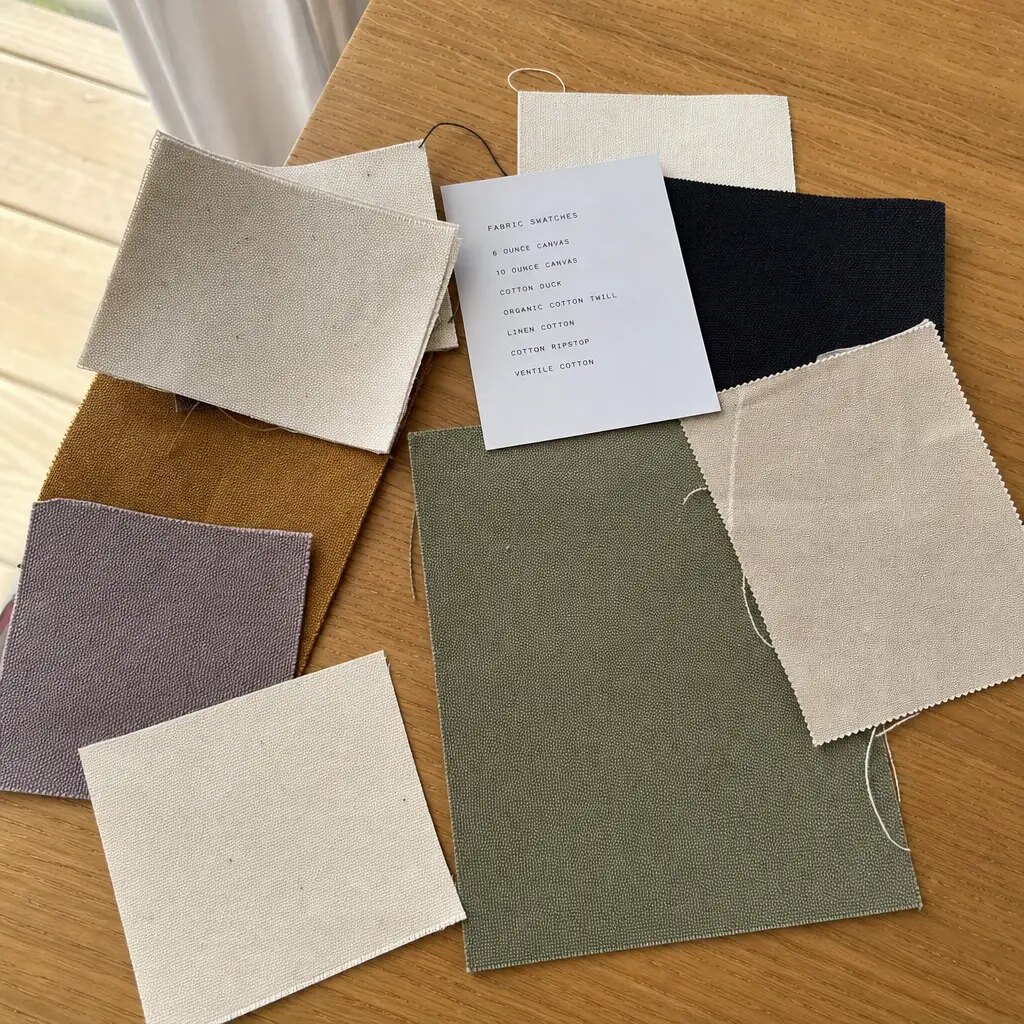
Fabric is the biggest driver of both cost and perception. Cotton canvas, cotton twill, and cotton duck are all reasonable starting points, but they do not feel or behave the same. Buyers should name a measured target such as GSM or oz/yd2 rather than using loose language like thick, premium, or sturdy. A 120 GSM bag and a 180 GSM bag are not interchangeable, even if they are both called cotton drawstring backpacks. The lighter bag will cost less and pack smaller. The heavier bag will hold shape better and usually presents better in retail settings.
Finish matters just as much as weight. Natural unbleached cotton gives a clean market look and usually keeps the spec simple, but shade variation is normal and should be controlled against an approved sample. Bleached or dyed cotton creates more color consistency, but the buyer should ask how the factory controls lot-to-lot shade and whether the fabric is prewashed or preshrunk. If the bag includes printed artwork, that finish detail affects shrinkage, print registration, and whether the approved sample still matches bulk after sewing and packing. Ask the supplier to state how the fabric is measured and what tolerance they use so all quotes are built on the same basis.
- Use GSM or oz/yd2 in the RFQ.
- Ask whether the cotton is natural, bleached, dyed, prewashed, or garment washed.
- Request the supplier's shrinkage assumption if size or artwork placement is tight.
- Check whether the fabric weave is smooth enough for the print detail you want.
- If color matters, request a sample or lab dip before bulk release.
Construction details that decide whether the bags hold up
The bag can only perform as well as its construction allows. The seam allowance, stitch type, cord channel, and reinforcement at stress points all affect whether the backpack keeps its shape after repeated use. If the bag will be opened and closed all day at a market, the top channel and bottom corners are the first places to fail. A low quote that hides weak reinforcement often costs more later in rework, returns, or replacement stock. Buyers should ask the factory to show exactly how the bag is built, not just what it is made from.
For this category, the useful questions are practical. Does the factory use single-needle or double-needle seams at the load points? How is the cord anchored or threaded through the channel? Is there any bartack or corner reinforcement, and if so where? Is the thread cotton, polyester, or a blend, and does the thread color match the body or contrast intentionally? These details are small on paper but obvious in use. If the bag is supposed to carry heavier items, ask the supplier to explain what construction change they would make before you ask for a price increase. That keeps the discussion focused on function, not generic upsells.
- Ask for seam type and seam allowance in writing.
- Confirm how the cord channel is reinforced.
- Check bottom corners and top openings for stress protection.
- Request the cord diameter and anchor method.
- If the bag must carry heavier items, ask for the construction change before accepting a higher price.
Decoration and branding should be simple enough to control
Decoration is where many otherwise good quotes become hard to compare. Screen printing is usually the cleanest option for simple logos and repeated orders. It works best when the art is set up for textile use and when the buyer keeps the number of colors modest. Woven labels and sewn patches can be a cleaner branding choice if the program wants a more retail-ready look or if the fabric texture makes print detail hard to hold. Embroidery can feel premium, but it adds stitch density, price, and risk of fabric pull if the body cloth is too light.
The more useful question is not which decoration is most attractive, but which one is easiest to reproduce consistently. Buyers should ask for a placement drawing that shows the logo distance from seams, edges, and fold lines. Small text and fine lines should be approved on a strike-off or print proof, because they can blur once they hit woven cotton. If the bag is likely to be folded into a carton or a polybag, keep critical art away from the creases. For market vendor use, a clean one-color logo or a side label usually does enough work without adding unnecessary cost or inspection risk.
- Quote blank, one-color print, two-color print, woven label, and label-plus-print separately.
- Ask for a placement drawing before sample approval.
- Keep critical artwork away from seams and fold lines.
- Use a strike-off or proof if the design has fine text.
- Choose the simplest decoration that still supports the brand.
What a useful RFQ packet should include
A useful RFQ packet does more than request a price. It gives the supplier one unambiguous version of the product to quote. That packet should include finished size, fabric weight, fabric finish, cord type, decoration method, placement drawing, quantity by SKU, packing format, shipping term, and the expected ship date. If any of those fields are left open, suppliers will fill them in differently and the quotes will not be comparable. Procurement then spends time normalizing assumptions instead of evaluating real offers.
The most effective RFQs also define what the supplier is not allowed to change. If mixed cartons are not acceptable, say so. If only one artwork version should be quoted, say so. If the bag must be flat-folded rather than stuffed or rolled, say so. This is also where buyers can narrow the commercial terms. Ask every supplier to quote the same Incoterm, the same carton count, and the same sample expectation. When those inputs are fixed, price differences become easier to explain and award decisions become much cleaner.
- Include finished size, fabric weight, finish, cord, decoration, and packing.
- Add quantity by SKU and artwork version.
- Use one shipping term across all suppliers.
- State what cannot change after award.
- Attach the approved artwork file and placement drawing.
Questions that surface real supplier capability
The quote questions should expose whether the supplier actually controls the work. If the factory is handling the whole process, ask which steps are in-house and which are outsourced. If they are a trader or sourcing agent, ask for the actual factory name, the production location, and the documents they will provide before bulk release. The goal is not to exclude intermediaries. It is to make sure the buyer knows where the risk sits and who is responsible if sample and bulk diverge.
Ask for evidence, not promises. A serious supplier can explain how they measure fabric weight, how they control shrinkage, how they check print placement, and what document set they issue for the finished lot. Depending on your market and channel, that may include a material composition declaration, country-of-origin details, a test report, or a dye or finish statement. If your channel needs compliance documents, put that requirement in the RFQ rather than asking for them after the sample has been approved. That is where a lot of avoidable delay starts.
- Ask which steps are in-house and which are outsourced.
- Request the real factory name if you are buying through an agent or trader.
- Ask how they measure GSM, shrinkage, and print placement.
- Request the document set you need before bulk release.
- Do not leave compliance paperwork until after sample approval.
Testing and QC that catch preventable rejects
Quality control should be written into the order, not improvised at receiving. The buyer should define what counts as a critical defect, a major defect, and a cosmetic defect before the first carton ships. On this product, critical issues usually include open seams, missing cords, wrong artwork, mixed SKUs, and carton count errors. Major issues include off-center print, uneven cord length, or dimensions outside tolerance. Cosmetic issues might include minor thread tails or tiny shade variation, depending on the use case. If the bags are going to retail, the acceptance standard should be tighter than if they are used only as internal staff kits.
A solid test plan usually has three checkpoints. First, approve the pre-production sample against the written spec. Second, do an in-process check if the order is large enough to justify it, especially if there are multiple artwork versions or packing formats. Third, inspect the final cartons before shipment. For functional verification, ask for a load test above the expected working load rather than at the exact load. If the bag is intended for repeat use, add a simple rub or wash check to the decoration and thread. None of this has to be elaborate, but it does need to be explicit so the supplier knows what will be rejected.
- Define critical, major, and cosmetic defects before production starts.
- Use a pre-production sample, an in-process check, and a final inspection.
- Test above the expected working load if durability matters.
- Add a rub or wash check when the bag will see repeated handling.
- Record the approved sample number and keep it with the PO file.
Packing, carton marks, and lead time control
Packing is part of the product experience. A cotton drawstring backpack can arrive flat-folded, individually polybagged, or packed loose in a master carton. Each option has a different cost and a different impact on presentation and warehouse handling. If the bags are for retail or kit assembly, the buyer should define the fold method, the count per inner pack, and the carton label format. If the bags are for direct vendor use, bulk packing may be fine, but the carton still needs clear SKU, color, and quantity marks to prevent receiving mistakes.
Lead time also needs more structure than a single ship date. Ask the factory to separate sample time, material sourcing time, production time, and packing time. That exposes where the schedule can slip. If the bag uses custom labels or multiple print colors, the approval gate should be clear: artwork proof, sample approval, then bulk release. Buyers who run seasonal market programs should also ask for the earliest and realistic ex-factory dates, because those are often different numbers. A quote that looks fast but depends on a perfect approval cycle is not a reliable plan.
- Define fold method and whether bags are individually polybagged.
- Require clear carton marks for SKU, color, quantity, and PO reference.
- Ask for carton dimensions and gross weight for freight planning.
- Separate sample time, production time, and packing time.
- Ask for both earliest and realistic ship dates.
How to award the order without hidden cost
The cleanest award decision is based on total landed cost, not only unit price. Once the spec is fixed, compare the quotes line by line: blank bag cost, decoration cost, label cost, packing cost, setup charges, and freight assumptions. A quote that looks cheap can become expensive if it hides higher minimums, outsourced work, or extra packaging that your warehouse does not want. The winner should be the supplier that can hold the approved spec, provide the required documents, and deliver the same build consistently on reorder.
Before you place the PO, compare the bid against the approved sample and the written QC standard. If the sample looks right but the quote assumes a different GSM, different cord, or different pack format, the numbers are not comparable. Ask the supplier to confirm in writing that bulk production will match the approved sample unless the PO states otherwise. That one line reduces a lot of downstream friction. For farmers market vendor programs, consistency matters because reorders often happen mid-season, and the second order should not require a fresh round of spec discovery.
- Award on total landed cost, not unit price alone.
- Check whether the quote matches the approved sample exactly.
- Look for hidden cost in MOQ, packing, or outsourced steps.
- Confirm that reorders will match the approved build.
- Keep one written award summary that links price, sample, and QC standard.
Specification comparison for buyers
| Spec choice | Best use | What to verify before award | Buyer tradeoff |
|---|---|---|---|
| 120-140 GSM plain cotton | Light giveaways, event handouts, low-cost vendor kits | Ask for measured GSM, shrinkage behavior, and whether the fabric is pre-shrunk | Lowest cost, but softer handfeel and less shape retention |
| 140-180 GSM cotton canvas or twill | Daily vendor use, staff kits, reusable customer packs | Confirm fabric weave, shade consistency, and print performance on textured cloth | Better durability and presentation, with higher material and freight cost |
| 180-220 GSM heavy cotton | Retail resale, heavier loads, premium private label | Check cord-channel reinforcement, seam allowance, and carton weight | Strongest feel and structure, but more expensive and bulkier in transit |
| Flat body, no gusset | Flat handouts, brochures, lightweight swag | Verify that the contents will not distort the logo or stretch the panel | Cheaper and simpler to sew, but limited capacity |
| 3-4 in gusset | Bottle, produce sample, and market-day carry use | Confirm gusset depth, bottom corner reinforcement, and fold method | More usable space, but more sewing and slightly higher cost |
| Cotton cord | Natural look and all-cotton positioning | Ask for cord diameter, twist consistency, and snag resistance | Matches the bag aesthetic, but may wear faster than blended cord |
| Polyester or blended cord | Higher cycle use and abrasion resistance | Confirm color match and handfeel against the cotton body | More durable under repeated use, but less aligned with all-cotton messaging |
| Screen print or woven label | Simple logo programs and repeat orders | Request placement drawing, ink or label specs, and durability checks | Good value and clear branding, but less flexible for complex art |
Buyer checklist before sampling
- Define the end use before you ask for price: vendor staff kit, customer giveaway, retail resale, or event swag each leads to a different construction and packing choice.
- Set finished size in writing. For many farmers market programs, a useful starting point is around 14-15 in wide by 16-18 in high, with a gusset only if the bag must carry bottles, paperwork, or produce samples.
- State the expected load. If the bag needs to handle order pads, sanitizer, pens, a phone, and a small bottle, say so; the supplier should then size the cord, seams, and gusset around that load.
- Specify fabric with a measurable unit such as GSM or oz/yd2. Do not accept thick, premium, or sturdy as the only description.
- Ask whether the cotton is natural, bleached, dyed, prewashed, or garment washed, and request the expected shrinkage range for the finish you choose.
- Lock the decoration method before comparing quotes. A blank bag, one-color print, woven label, and print-plus-label version should be priced separately.
- Require a measured sample and a placement drawing. The sample should match the intended fabric, print method, label type, fold, and pack format.
- Ask for MOQ by fabric color, print color, label type, and total order quantity. A supplier may accept the total but still require a minimum per design or per color.
- Separate sample lead time, bulk lead time, and ex-factory date so artwork approval or accessory sourcing does not get hidden inside one vague promise.
- Write defect criteria into the RFQ: size tolerance, seam quality, print placement, cord symmetry, carton count, and outer carton marks should all be defined before production.
Factory quote questions to send
- What exact fabric construction and measured GSM do you recommend for this size, and can you quote at least two options, one lighter and one heavier, on the same basis?
- Is cutting, sewing, printing, labeling, and packing done in your facility, or are any steps subcontracted? If any step is outside, which one has the most impact on lead time and quality?
- What is the MOQ by fabric color, print color count, and label type, and does mixed artwork change the minimum order quantity?
- Can you quote the bag as blank, one-color print, two-color print, woven label only, and print plus label so we can compare feature cost line by line?
- What finished-size tolerance do you hold for width, height, gusset depth, and cord length, and how do you measure those dimensions on the finished bag?
- Is the fabric pre-shrunk or otherwise controlled for shrinkage, and what result should we expect after normal handling or wash if the end user launders the bag?
- What seam allowance, stitch type, and reinforcement do you use at the cord channel, bottom corners, and stress points?
- What cord material and cord diameter do you recommend for this load, and how do you prevent twist, slipping, or uneven pull on the finished bag?
- Can you send an artwork placement proof that shows the logo distance from seams, edges, and fold lines before sample approval?
- What quality documents can you provide as applicable, such as material composition, country-of-origin details, test reports, dye or finish declarations, and carton packing specification?
Quality-control points to confirm
- Measure the fabric weight against the approved spec and keep the tolerance narrow enough to make quotes comparable; if your program does not define a tighter rule, a practical starting point is about plus or minus 5 percent.
- Check finished dimensions flat and folded. A common buyer tolerance is about plus or minus 0.5 in, but retail-critical programs may need tighter control.
- Measure cord length on the finished bag, not just cut length. Both sides should be even, and the cord should move smoothly without snagging in the channel.
- Inspect seams at the side panels, bottom corners, and cord channel for skipped stitches, loose threads, seam puckering, or open edges.
- Require a print check against the approved placement drawing. Small logos and fine text should stay sharp, centered, and within the agreed art box.
- If the bag uses a woven label, patch, or hangtag, confirm that it is straight, secure, and free of frayed edges or twisted attachment points.
- Ask for a load test above the expected working load. For a vendor-use bag, a test at 1.5x to 2x expected load is a practical procurement check if your channel needs proof of durability.
- If the bags will be washed or wiped repeatedly, request a wash or rub check on the print, label, and thread color so the decoration does not fail early.
- Check color against an approved sample or lab dip when the bag is dyed, bleached, or washed. Natural cotton still varies, but the variation should stay within the agreed shade band.
- Inspect cartons for SKU accuracy, quantity count, carton marks, and pack integrity. Mixed-color or mixed-artwork cartons should be prohibited unless the PO says otherwise.