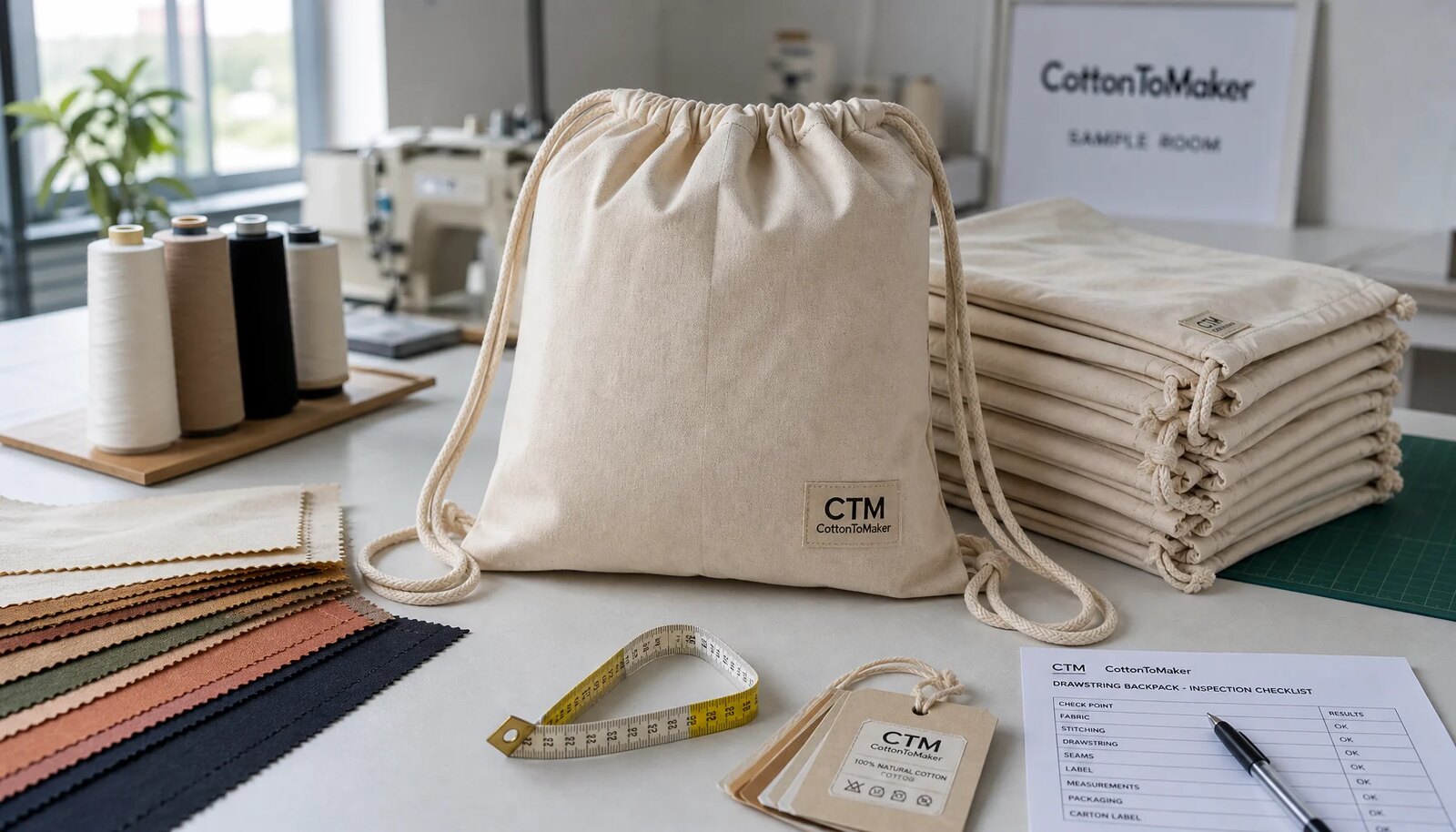
Why event buyers need inspectable specs
Cotton drawstring backpacks look simple until the order reaches the venue. Then small sourcing gaps become visible fast. A bag that is lighter than expected may sag around notebooks and sponsor inserts. A logo that drifts 15 mm from the approved position can make a registration table look inconsistent. Weak lower cord anchors may fail while staff are pre-filling bags. A carton count error can leave one room, sponsor station, or city short even when the shipment arrived on schedule.
For event planners, quality is not an abstract label. It means the bag holds the planned contents, presents the brand cleanly, opens and closes easily, and arrives in cartons the receiving team can count without detective work. Procurement, marketing, sponsorship, operations, and logistics all touch the same item, so the buying standard has to be written in a way each team can use.
The most important word is inspectable. A supplier cannot be held to good quality cotton bag because that phrase can mean almost anything. A supplier can be held to 180 GSM cotton with a written tolerance, finished dimensions, cord length, print placement limits, carton quantity, and defect definitions. That is the difference between hoping a bulk order looks right and giving the factory a standard it can build and check against.
A strong wholesale cotton drawstring backpacks for event planners quality inspection checklist starts before the purchase order. It belongs in the RFQ, then in the sample approval record, then in the final QC report. When those documents match, buyers reduce price confusion, sample disputes, packing surprises, and last-minute rework.
- Write the spec before asking suppliers to quote.
- Treat fabric, construction, decoration, packing, and inspection as separate decisions.
- Use physical samples when cotton tone, handfeel, cord pull, and print texture matter.
- Make venue receiving accuracy part of the quality requirement, not an afterthought.
Start with the event use case
The best RFQ begins with the way the bag will be used. A booth giveaway carrying one flyer does not need the same construction as a conference welcome kit packed with a notebook, agenda, badge insert, pen, water bottle, and sponsor items. A university orientation bag may need extra width for folders. A festival or outdoor program may need stronger lower corners because attendees carry the bag for hours rather than taking it straight to a hotel room.
List the planned contents by approximate size and weight. The supplier does not need confidential programming details, but it does need the load profile. A 35 x 45 cm finished bag carrying a notebook, folded agenda, badge pack, and sponsor inserts may be suitable around 180 GSM. A lightweight expo handout may work at 140-160 GSM. A premium welcome kit with denser contents may justify 200 GSM or added reinforcement.
Receiving model also belongs in the first RFQ. A single hotel delivery is easier than a multi-city roadshow, warehouse staging job, or 3PL kitting program. If cartons must be labeled by city, room, sponsor, SKU, or sequence, tell the supplier before quotation. Packing changes made after approval can add cost and slow the schedule because carton labels, counts, and packing labor all have to be controlled.
Separate fixed requirements from options. If the arrival date, front logo position, and carton count are non-negotiable, mark them that way. If budget is still being shaped, ask for good-better pricing, such as 160 GSM versus 180 GSM, while keeping the same size, print, and packing assumptions. That keeps the comparison honest.
- State finished bag size instead of sending only a reference photo.
- Share planned contents and approximate filled weight.
- Identify the delivery type: venue, hotel, warehouse, 3PL, or multiple cities.
- Quote alternate GSM levels only when the event can accept those differences.
- Include target receipt date and inspection requirement in the first RFQ.
Specify cotton without guesswork
Fabric GSM drives both cost and performance. For light giveaways, 140-160 GSM cotton can be enough when the bag carries flat paper items and the program is price-sensitive. For most conference attendee kits, 180 GSM is a practical baseline because it gives better handfeel, opacity, and shape when filled. For premium programs or heavier contents, 200 GSM can feel more substantial, but it also raises material cost and shipping weight.
The quote should state GSM and tolerance. A common commercial approach is about plus or minus 5 percent unless the buyer and supplier agree to something different. Without a tolerance, the buyer may assume 180 GSM means exactly 180 GSM, while the factory may treat normal fabric variation as acceptable. Ask how GSM will be checked: from bulk fabric, finished-bag panels, or supplier fabric records. Then write that method into the inspection plan.
Shade needs the same clarity. Natural unbleached cotton is popular for events because it looks understated and pairs well with many brand palettes, but it is not optical white. It can include normal slubs and tone variation. Bleached cotton gives a brighter base and can help artwork pop. Dyed cotton supports stronger brand-color programs, but it may require lab dips, higher MOQ, longer lead time, and stricter color approval.
Finishing terms should be plain. Ask whether the fabric is raw, washed, pre-shrunk, bleached, dyed, or treated in any way that could affect shrinkage, print adhesion, odor, or handfeel. Most event bags are not purchased as washable apparel, yet attendees may still wash them. If wash behavior matters, include shrinkage expectations and care labeling in the spec rather than discovering the issue later.
- Compare 140-160 GSM, 180 GSM, and 200 GSM only when the rest of the construction is equivalent.
- Write the agreed GSM tolerance into the purchase order.
- Approve a physical shade range for natural cotton.
- Inspect the logo area for stains, heavy slubs, and uneven weave density.
- Ask whether the same fabric reference can be reserved or repeated for reorders.
Lock size, seams, cord, and reinforcement
Bag size should be specified as finished size after sewing. Panel size and flat reference photos are not enough. Common adult event sizes include about 33 x 40 cm and 35 x 45 cm, but the right size depends on the contents. A bag that looks fine empty may become tight once a notebook, brochure stack, badge pack, and sponsor items are inserted. Tight packing strains seams and slows the team at registration.
Set practical dimensional tolerances. For standard cotton drawstring backpacks, many buyers use about plus or minus 1 cm on finished width and height unless the project needs a tighter limit and the supplier agrees. Define measurement points, such as top opening width below the channel and body height from bottom seam to top edge. If the order includes more than one fabric lot or color, measure each group.
Construction details deserve more attention than they often get. Specify seam type where relevant, stitch density if the supplier can provide it, seam allowance, top channel width, cord exit style, and lower cord-anchor reinforcement. The lower corners are high-stress points because the cord works as both closure and shoulder strap. Back-tacking, reinforced stitching, or properly installed grommets can reduce early failures.
Cord choice affects how the bag feels in use. Cotton cord gives a natural look. A blended cord may be more durable depending on the material and construction. Ask for cord diameter or thickness, color, length, and tolerance. Cord lengths should be consistent enough that the bags look uniform when staged on tables. The top channel should slide smoothly, without rough edges, loose threads, or fabric debris catching the cord.
- Define finished width and height with measurement points and tolerance.
- Check the approved sample filled with the actual event contents.
- Specify reinforced lower corners for heavier kits or all-day carry use.
- Confirm cord material, thickness, length, color, and pull feel.
- Inspect the top channel for clean stitching and smooth opening and closing.
Choose decoration by artwork risk
Decoration is where many event orders become emotional, because the logo is the most visible part of the bag. Screen printing is usually the most predictable choice for bold one-color or limited spot-color event marks. It is repeatable at scale and can deliver good opacity on cotton. Still, the artwork matters. Fine lines, gradients, large solid areas, and print positions close to seams can all raise the defect rate.
DTF and heat transfer can work for detailed or full-color artwork, but they should be tested on the exact cotton fabric. Fold the sample the way the bulk bags will be packed. Check transfer edge lift, cracking at fold lines, plastic-like handfeel, and whether the transfer sits evenly on the cotton texture. Lightweight fabric and heavier cotton may behave differently under heat, so do not approve the method from a generic sample alone.
Embroidery can look premium for small logos, executive events, or sponsor gifts, but it is not automatically the higher-quality choice. Dense stitching can distort lighter cotton and may require backing. If embroidery is used, ask for stitch count, backing method, placement restrictions, and confirmation that the selected GSM can support the design. For large event runs, screen print is often more controlled and cost-efficient.
Print placement needs numbers. Centered front logo is too loose for bulk production. The approval drawing should show distance from the top channel, side seam, and bottom seam, plus print width and height. A practical event-bag placement tolerance may be around plus or minus 5 mm to 10 mm, depending on decoration method and bag construction. Agree on the number before bulk work begins.
- Use screen print for simple sponsor marks and spot-color logos.
- Test DTF or heat transfer for fold resistance and handfeel on the selected cotton.
- Use embroidery selectively on suitable fabric weights and smaller logo areas.
- Approve a measured logo placement drawing before production.
- Check the logo both flat and filled because the bag shape changes in use.
Compare suppliers by control, not labels
Many suppliers can sell wholesale cotton drawstring backpacks: direct factories, trading companies, promotional product distributors, stock decorators, and importers. The label does not tell you who controls the risk. A factory may manage fabric purchase, cutting, sewing, decoration, inspection, and packing in one system. A trading company may be valuable when the buyer needs multiple event items sourced together. A domestic stock decorator may be useful for rush orders but may limit the buyer to available blanks and standard print positions.
The right route depends on the project. If the event date is fixed, the artwork is sponsor-sensitive, and the shipment goes straight to a venue, production visibility matters. Ask who buys the fabric, who cuts panels, who sews the bags, who prints or embroiders, who packs the cartons, and who signs the final inspection report. Subcontracting is not automatically a problem. Unclear responsibility is.
Repeat programs need records. Event planners often reorder for later dates, annual conferences, additional cities, or sponsor variations. A supplier should be able to retain the gold sample, fabric reference, artwork file, print settings, carton marks, and packing method. Without those records, a reorder can carry the same product name while arriving with a different shade, handfeel, logo position, or carton plan.
Do not compare unlike quotes as if they are the same. A stock blank bag with a logo is not equivalent to a custom-cut bag with approved shade range, reinforced corners, woven label, destination-specific carton marks, and documented final inspection. When two prices differ widely, check which one left out construction, packing, or QC.
- Ask which production steps are in-house and which are subcontracted.
- Confirm who owns final QC and rework decisions.
- Send the same RFQ to every supplier to make pricing comparable.
- For repeat orders, ask how gold samples and production records are stored.
- Compare landed cost and operational control, not only ex-factory unit price.
Read the quote like a buyer
A useful B2B quote explains what is included. It should show finished size, cotton GSM, cotton type, construction, cord, print method, print size, setup charges, sample fee, packing method, carton details, lead time, payment terms, and freight assumptions if freight is included. A single unit price without those details is easy to approve and hard to enforce.
Hidden cost often appears after the buyer has emotionally committed to the lowest number. A larger print area can increase screen or ink cost. Individual polybags add material, labor, and waste. Heavier GSM increases freight weight. Custom cord, woven labels, hangtags, and reinforced corners may change MOQ. Destination-specific carton labels are useful for receiving, but they require planning. None of these choices is wrong; they just need to be priced in the open.
Lead time language deserves a close read. Production lead time after sample approval is not the same as calendar time from first inquiry. Ask whether the clock starts after deposit, final artwork approval, pre-production sample approval, fabric arrival, or print setup. For many custom projects, about 30-45 production days after sample approval may be a reasonable planning range, but the supplier must confirm it against the actual order complexity and season.
Payment terms should connect to evidence. If the balance is due before shipment, define what the buyer receives before release: final inspection report, measurement photos, print-detail photos, open-carton photos, closed-carton label photos, packing list, and shipping document drafts if applicable. For higher-risk orders, budget for third-party inspection before the final payment is released.
- Separate base bag, decoration, setup, sample, packing, labels, carton, and inland charges.
- Ask whether setup charges apply again for reorders.
- Compare carton dimensions and gross weight because freight affects landed cost.
- Clarify when lead time starts and which buyer approvals can delay it.
- Tie shipment release to documented inspection evidence.
Use samples as the gold standard
Sampling is not only a design preview. It is the moment when the production standard becomes physical. A strike-off may confirm ink color and print method, but a pre-production sample should confirm the actual fabric, size, stitching, cord, label, print placement, and packing approach. Once approved, that sample becomes the gold standard for bulk production and final inspection.
Test the sample the way the event team will use it. Fill it with planned contents. Close and open the drawstring several times. Carry it by the cords. Fold it as it will be packed. Rub the print area with a clean dry cloth. Check whether paper catches inside the opening, whether the cord feels rough, whether lower corners show strain, and whether the logo still looks right when the bag is full.
Sample approval can get messy when marketing, procurement, sponsors, and operations all comment separately. Create one approval record with item code, supplier name, order number, sample date, artwork revision, print method, fabric spec, measurements, and approved deviations. If a revised sample is requested, mark the previous version as rejected or superseded so there is only one live standard.
Both buyer and factory should keep sealed gold samples. If there is a dispute, inspection can compare bulk goods against the same physical reference instead of email photos or memory. This matters most for natural cotton shade, print handfeel, cord pull, stitching quality, and acceptable slub variation.
- Approve a pre-production sample made with the intended fabric, cord, size, and print method.
- Test the sample filled, folded, pulled, and handled.
- Label the gold sample with order number, revision, date, and approval record.
- Document which natural cotton slubs or shade variations are acceptable.
- Do not release bulk production from a screen image when texture affects quality.
Define inspection criteria clearly
Quality inspection has to separate functional defects from acceptable natural variation. Small cotton slubs or minor tone variation may be acceptable on natural unbleached cotton if they match the approved range and do not damage the logo area. Open seams, missing cords, incorrect artwork, wet cartons, mildew odor, wrong size, and major count errors are different. Those issues can disrupt the event.
Measurement removes argument. The inspection checklist should define finished width, finished height, cord length, print placement, print size, and label position if labels are used. Tolerances should be written in centimeters or millimeters. Finished size might be checked to plus or minus 1 cm, while print placement might be checked to an agreed plus or minus 5 mm to 10 mm depending on the process. The exact values should be settled before production.
AQL can be useful for large orders, but the acronym alone is not a standard. Ask which AQL levels the supplier uses for critical, major, and minor defects, and how each issue is classified. A wrong logo, missing cord, open seam, or mold odor should carry more weight than a loose thread. If using a third-party inspector, provide the gold sample, artwork file, measurement table, packing rules, and defect list.
In-line inspection helps because it catches problems while they can still be corrected. The supplier should check early production pieces for seam security, fabric shade, print alignment, and cord pull before the order is fully packed. Final inspection should happen when goods are finished and packed but before shipment release. If rework is required, reworked goods should be inspected again.
- Classify wrong artwork, missing cord, wet carton, and open seam as serious defects.
- Measure width, height, cord length, print size, and print placement at defined points.
- Check fabric GSM and shade against the approved spec and sample.
- Inspect print opacity, registration, smearing, pinholes, transfer lift, and fold cracking.
- Require reinspection after rework before shipment is released.
Control packing for receiving
Packing is event quality because it determines how quickly the receiving team can count, stage, and distribute the bags. A well-made product can still create operational trouble if cartons are unmarked, mixed without a plan, or packed in counts that do not match registration needs. For multi-city programs, carton marking should be approved before packing begins.
Flat packing is usually practical for cotton drawstring backpacks. It protects print areas better than careless stuffing and makes counting easier. Inner bundles of 25 or 50 pieces can help when cartons need to be split across registration desks, breakout rooms, sponsor tables, or kitting stations. Individual polybags may be useful for retail-style presentation or dirt protection, but they add cost, labor, and waste.
Carton labels should be specific enough for the receiving team, not just the shipper. Consider SKU or item code, item description, color or fabric shade, quantity, event name if needed, destination, carton sequence, gross weight, carton dimensions, and country-of-origin marking if required. The packing list should match the carton labels exactly.
Cotton absorbs humidity, so moisture control matters for sea freight, humid routes, and long storage. Ask about dry storage before packing, carton condition, poly liners if needed, and desiccants where appropriate. Final QC should reject wet cartons, mildew odor, staining, or crushed print areas because those problems may not be discovered until setup day.
- Specify pieces per inner bundle and pieces per master carton.
- Require carton marks that match the event receiving plan.
- Request carton dimensions and gross weight before freight booking.
- Use moisture protection when route or storage conditions require it.
- Ask for photos of open cartons, closed labels, and pallet condition before shipment.
- Avoid mixed-SKU cartons unless the packing list is detailed and the receiving team agrees.
Specification comparison for buyers
| Spec decision | Recommended option | When it fits | Buyer risk to check |
|---|---|---|---|
| Sourcing route | Factory or supplier that can document control of fabric purchase, cutting, sewing, decoration, final inspection, and packing | Repeat event programs, branded welcome kits, sponsor bags, or orders shipping directly to a venue or 3PL | Confirm whether sewing, printing, embroidery, or packing is subcontracted; identify who signs the final QC report and who pays for rework if defects exceed the agreed limit |
| Cotton base shade | Natural unbleached cotton with an approved physical shade range, or bleached/dyed cotton with a signed lab dip or swatch approval | Natural cotton fits neutral event branding; bleached cotton supports brighter artwork; dyed cotton fits brand-color programs | Natural cotton is not optical white and may vary by fabric lot; dyed cotton may need higher MOQ, longer lead time, and stricter color approval |
| Fabric weight | 140-160 GSM for light giveaways, 180 GSM for standard conference kits, 200 GSM for premium or heavier contents | Use lighter fabric for flyers and flat inserts; use 180 GSM when attendees carry notebooks, agendas, badges, and sponsor items | Quote should state GSM tolerance, commonly agreed as about +/-5% unless otherwise specified; too-light fabric can distort print, show contents, or fail at cord anchors |
| Finished bag size | Common adult event sizes include about 33 x 40 cm or 35 x 45 cm, selected after checking contents | Conference welcome bags, orientation packs, expo handouts, sponsor kits, and city-by-city event distribution | Ask for finished-size tolerance, for example +/-1 cm on width/height unless a tighter tolerance is commercially agreed; smaller quoted dimensions can hide cost reduction |
| Cord and reinforcement | Cotton cord or durable blended cord, consistent cord length, clean top channel, and reinforced lower corner anchors | Any bag attendees will carry for a full day or staff will pre-fill in volume | Check cord thickness, cord length tolerance, pull feel, fraying, rough channel edges, and back-tacking at lower stress points |
| Print method | Screen print for bold spot-color logos; DTF or heat transfer for detailed full-color art; embroidery only where fabric weight and stitch design are suitable | Repeatable branding across hundreds or thousands of pieces with controlled logo appearance | Confirm print size, placement tolerance, color reference, setup charges, rub resistance, fold cracking, ink handfeel, and whether the print area crosses seams or thick folds |
| Sample approval | Pre-production sample plus sealed gold sample held by both buyer and factory | Orders with sponsor approval, brand-review steps, repeat buying, custom packing, or multiple delivery destinations | Photo-only approval hides fabric handfeel, cotton tone, print texture, cord pull, and filled-bag appearance; document the sample version and approval date |
| MOQ route | 500-1,000 pcs may be possible for stock-base decoration; 2,000+ pcs is more realistic for custom size, dyed fabric, trims, labels, or special packing | Budget programs can use stock blanks; brand-controlled programs often require custom production | Low MOQ may mean stock fabric only, standard dimensions, limited shade control, fewer packing options, higher unit cost, or less ability to reserve fabric for reorders |
| Packing plan | Flat-packed by fixed inner bundle and master carton count, with agreed carton marks, packing list, and moisture protection when needed | Fast venue receiving, 3PL kitting, multi-city allocation, sponsor segmentation, or warehouse staging | Loose mixed cartons cause count disputes, slow registration setup, crushed print areas, and avoidable labor; carton labels must match the receiving plan |
Buyer checklist before sampling
- Write one RFQ spec that includes finished bag size, cotton composition, GSM and tolerance, base shade, cord type, seam construction, print method, print area, packing method, carton marks, target receipt date, and inspection requirement.
- List the planned event contents by size and approximate weight so the supplier can confirm whether 140-160 GSM, 180 GSM, or 200 GSM is appropriate for the load.
- Confirm whether the cotton fabric is natural, bleached, dyed, washed, pre-shrunk, or unfinished, and request expected shrinkage or dimensional variation if the bags may be washed by end users.
- Set finished-size tolerances in writing, such as +/-1 cm for width and height for standard event bags unless a different tolerance is agreed.
- Define print placement tolerance from fixed references such as top channel, side seam, and bottom seam; avoid relying only on the phrase centered front logo.
- Approve a physical pre-production sample for cotton tone, fabric handfeel, seam density, cord length, print color, print handfeel, logo position, label position, and filled-bag appearance.
- Keep one sealed gold sample with the buyer and one with the factory, labeled with item code, order number, sample date, artwork revision, and approved deviations.
- Require the quote to separate unit price, sample charge, screen/setup charge, packaging charge, woven label or hangtag charge, carton charge, inland handling, and freight assumptions if any.
- Specify pieces per inner bundle, pieces per master carton, carton dimensions, gross weight, barcode/SKU labels, destination marks, carton sequence, and any country-of-origin labeling needed by the receiving party.
- Ask the supplier to state its QC method, AQL level if used, sample size, measurement points, critical/major/minor defect definitions, and the timing of in-line and final inspection.
Factory quote questions to send
- What is the exact cotton specification by composition, weave, GSM, GSM tolerance, shade range, and finishing process, and can you quote 140 GSM, 180 GSM, and 200 GSM side by side?
- Is the bag cut and sewn in your own facility, and are printing, embroidery, labeling, and packing handled in-house or by subcontractors? If subcontracted, who performs final inspection?
- What finished size do you recommend for our planned contents and filled weight, and what tolerance do you hold for width, height, seam allowance, cord length, and print placement?
- What stitch type, stitch density, seam allowance, and lower-corner reinforcement will you use, and how do you check cord-anchor strength during production?
- Which decoration method do you recommend for this artwork, what print area is safe on this bag size, how many colors are included, and what artwork changes would reduce rejection risk?
- What print placement tolerance can you hold from the top channel and side seam, and will the approved sample include a measured placement drawing?
- What is your MOQ for the selected construction, and what changes if we add a woven label, custom cord, reinforced corners, zipper pocket, hangtag, individual polybag, or destination-specific carton labels?
- Can you separate unit price, sampling fee, artwork or screen fee, packaging fee, carton fee, label fee, inland handling, and freight estimate so we can compare quotes accurately?
- Does the quoted lead time start from deposit, artwork approval, pre-production sample approval, or bulk material arrival, and which buyer decisions can delay the schedule?
- What inspection standard do you use for cotton drawstring backpacks, and can you share the measurement checklist, defect classification, and final inspection report format before we order?
Quality-control points to confirm
- Fabric weight should match the approved GSM within the written tolerance, commonly around +/-5% unless the order specifies otherwise; check from bulk fabric or finished-bag panels instead of relying only on the quote.
- Cotton shade should fall within the approved physical range, with no obvious panel-to-panel mismatch, yellowing, oil marks, mildew odor, excessive slubs in the logo area, or uneven weave density that affects decoration.
- Finished bag width and height should be measured at agreed points after sewing and before packing, with tolerances stated in centimeters or millimeters on the inspection sheet.
- Side seams, bottom seams, top drawstring channels, and lower cord anchors should be straight and secure, with no skipped stitches, open seams, puckering, loose thread tails, needle damage, or missing back-tacking at stress points.
- Cord length, cord thickness, color, and pull feel should be consistent across checked samples; the cord channel should open and close smoothly without fraying, cutting into the cord, or collapsing under normal use.
- If lower-corner eyelets or grommets are used, check placement, washer security, burrs, fabric tearing, rust risk, and whether the hardware damages the cord under pull.
- Print color, opacity, registration, edge sharpness, and placement should match the approved sample, with no smearing, pinholes in solid areas, heavy ink buildup, crooked alignment, transfer edge lift, or cracking after normal folding.
- Artwork should be checked against the final approved file and logo placement drawing, especially when sponsor marks, multi-color graphics, front-and-back prints, or versioned event designs are used.
- Labels, hangtags, barcodes, and country-of-origin markings should match the purchase order and receiving requirements; label placement should not interfere with the drawstring channel or print area.
- Packing should match the agreed count per inner bundle and master carton, with clean folding, no wet cartons, no crushed print areas, correct SKU labels, and readable carton marks on the required carton sides.