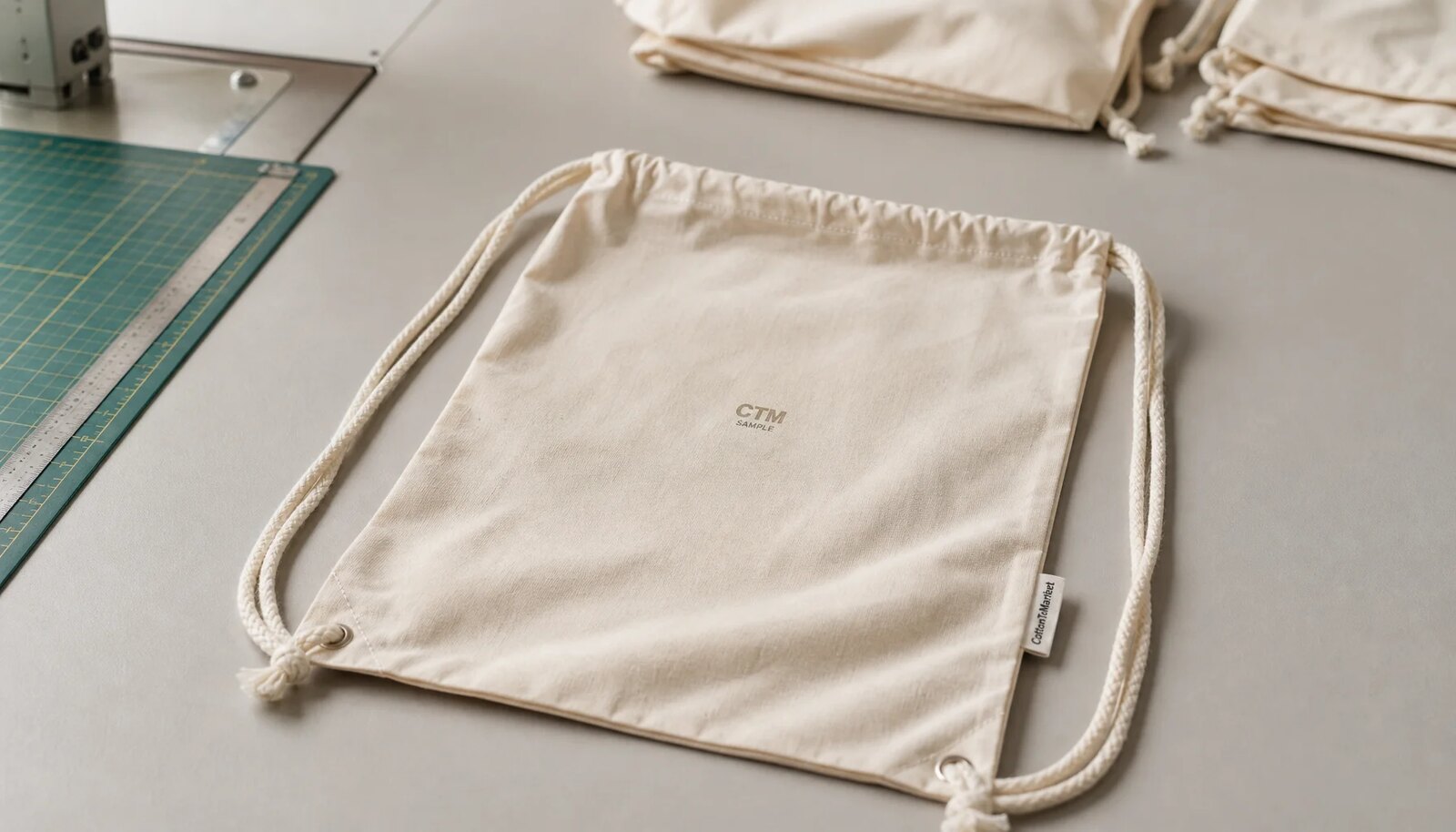
Why Print Proofing Matters
Event planners buy cotton drawstring backpacks for registration kits, sponsor packs, conference giveaways, race kits, and retail-ready merch. In every one of those cases, print proofing is not a design formality. It is the step where the supplier proves that the logo, date, QR code, and sponsor lockup will survive the actual bag construction, not just a flat digital layout. Cotton has texture. Seams change the print window. The drawcord channel steals space at the top. If the proof ignores those constraints, the bulk order usually pays for it later.
Treat the proof as a production control document. It should lock the bag base, print placement, ink or transfer system, color reference, and packing method before cutting starts. A supplier who says the bulk run will be adjusted on the line is shifting risk back to the buyer. For event programs, that risk is commercial, not cosmetic. If a logo lands too high, a venue sponsor mark is clipped, or a QR code is not scannable, the bags become unusable on the day they are handed out.
- Freeze the final vector artwork before any screen or transfer setup is paid.
- Tie the proof to the real bag size, not a generic mockup template.
- Measure the print zone from seams, hem, and the drawcord channel.
- Approve one revision owner on the buyer side so changes do not drift.
Start With The Bag Spec
Cotton drawstring backpacks are not interchangeable just because the shape looks similar. A light 140 to 160 GSM cotton bag gives lower cost and a softer drape, but fine print can sink into the weave and look weak after packing. A 200 to 240 GSM bag gives a more stable print surface and better body for event use. Premium programs often move up to 280 to 320 GSM, especially when the bag needs a heavier hand feel, stronger seam support, or less show-through from dark ink. That fabric choice changes the proofing outcome more than most buyers expect.
The supplier should quote the full construction, not just the shell weight. Bag size, weave type, finishing, cord material, reinforcement at the channel, and whether the top hem is single or double folded all affect print placement and durability. A plain cotton twill, brushed canvas, and recycled cotton blend accept ink differently, even at similar GSM. If you do not write the construction into the RFQ, the proof may look fine on paper and still fail when the sewn bag changes the artwork position by a few millimeters.
- Use one fixed size for the quote, such as 35 x 45 cm or 40 x 50 cm, and do not mix sizes in one comparison.
- Specify GSM, weave, and finishing so you can compare true like-for-like quotes.
- State the cord material and finish, because braided cord and cotton rope behave differently in the channel.
- Require the supplier to confirm whether the print panel is cut before or after sewing.
Choose The Print Method First
Screen printing remains the default for many cotton backpacks because it is predictable for one-color and spot-color logos. It usually gives the cleanest economics when the artwork is simple and the quantity is meaningful. It also exposes problems early. If the logo is too close to a seam, the screen and proof will show it. If the art has one bold mark and a small date line, screen print often handles that well as long as the minimum stroke width is set for the fabric. For event buyers, the main value is repeatability, not fashion detail.
Transfer printing, direct-to-film transfer, embroidery, and sewn patches solve different problems. Transfer works when the art has gradients, small text, or several colors, but the buyer should check edge lift and crack resistance on textured cotton. Embroidery is useful for a premium badge or small chest-style mark, but dense stitching can pucker a softer fabric. A woven or sewn label is often the safest branding choice when the logo is simple and the event bag needs a cleaner, lower-risk finish. The rule is straightforward: choose the method that the fabric can carry, not the method that makes the artwork file easiest to send.
- Use screen print for large spot-color marks and predictable repeat runs.
- Use transfer for full-color sponsor graphics or QR-heavy layouts, but test on the real cotton.
- Use embroidery only when the logo is small enough to avoid fabric distortion.
- Set a minimum stroke width and minimum font size before the proof is approved.
Build The Artwork Proof
The proof should show the real bag outline, not a blank rectangle with a logo dropped on top. That means visible seams, the top hem, the drawcord channel, the bottom corners, and the true print window. It should also show the approved Pantone or CMYK target, the logo scale, and the exact distance from the top edge and side seam. On a cotton backpack, a 10 mm placement error can be enough to clip a sponsor line or put the mark into a seam shadow. For event buyers, that is a production miss, not a design preference.
Reject proofs that hide the construction or move the logo after the fact. The color on a screen is not the acceptance standard. The accepted reference is the printed strike-off or the approved production swatch. If the event uses sponsor names, dates, URLs, or QR codes, those elements need a separate legibility review. Small text should be treated as a functional item. A QR code that scans on a monitor but fails at registration is a loss of utility, and the supplier should be held to a real readability standard before bulk starts.
- Require the exact bag outline with seams and channel shown on the proof.
- Mark the print zone in millimeters from the top edge and side seam.
- Review QR codes and small text on a printed sample, not just on screen.
- Keep the proof revision number visible so everyone approves the same file.
Approve The Sample On The Actual Line
A proper approval path has three stages: digital proof, print strike-off, and pre-production sample sewn from the final materials. The strike-off tells you whether the ink density, registration, and edge control are real. The pre-production sample tells you whether sewing, folding, and channel construction move the print location. On cotton backpacks, that difference matters because the bag is soft. A printed panel can look perfect before assembly and still shift once the seams are closed and the cord channel is folded over.
Inspect the sample the way the end user will handle it. Fill it lightly, hang it, and look at the logo from the front and from the side. Check whether the cord pulls the upper panel out of shape, whether the print gets hidden by the channel, and whether the packed sample still closes cleanly after folding. If the factory offers only a printed panel and not a sewn pre-production sample, the bulk release is not ready. The sample should prove the full build, not only the artwork.
- Compare the sample against the approved bag size and print placement sheet.
- Check for smudging, ghosting, and visible registration drift at the edges.
- Confirm that the cord end treatment and stopper match the written spec.
- Use a dry rub test on the sample before you approve bulk production.
Compare Sourcing Routes Before Quoting
For wholesale cotton drawstring backpacks, the sourcing route often changes the proofing outcome more than the catalog spec does. A direct factory with in-house screen printing usually gives the cleanest control loop because sewing, print, and packing stay under one roof. That is helpful when the event schedule is tight and the artwork is already locked. A trading company can be useful if you need multiple bag variants, but the buyer must be clear about who owns final approval and who answers when the proof needs a correction. A separate blank supplier plus local decorator may work for urgent domestic programs, but it can create mismatched tolerances if the blank bag and the print method were never matched together.
The right sourcing route depends on the art, not only on the unit price. A simple one-color logo on stock cotton usually belongs with a direct factory or a direct decorator route. A more complex sponsor graphic, multiple languages, or a premium woven label may justify a different supplier mix. In every case, make the quote answer the same questions: what exactly is being sewn, what exactly is being printed, who controls the sample, and what happens if the proof is rejected. The buyer who clarifies those points early gets a cleaner comparison than the buyer who only compares the final unit price.
- Compare direct factory, trading company, and local decorator quotes on the same art and the same bag spec.
- Do not accept a quote until the proof owner and sample approval path are named.
- Treat blank bag plus local print as a different sourcing route, not a cheaper version of the same product.
- Use the same incoterm across suppliers so freight and duty do not distort the comparison.
Turn The RFQ Into A Cost Model
MOQ on cotton drawstring backpacks is rarely driven by the bag shell alone. The real minimum can come from screen setup, transfer plates, custom dyeing, extra print colors, sewn labels, or packaging changes. A stock cotton backpack with one-color print may support a lower MOQ than a fully custom bag with bespoke color, retail packing, and a second decoration location. If the factory splits sewing, printing, and packing into separate lines, you may see a low bag MOQ but a higher finished-goods MOQ. That is the number the buyer needs to evaluate, because the lower number on the first line can hide the actual commitment required.
A workable quote should separate the cost pieces. Ask for bag body price, print setup per color, sample fee, packing fee, carton charge, and any inland or export handling charge. If the supplier only returns one lump number, it is hard to see where the order gets expensive when you change the art or order more than one color. For event planners and distributors, a quote that breaks out these items is more useful than one that looks simple. It lets procurement see where the cost rises with complexity and where the factory is charging for setup rather than material.
- Compare bag-only, bag-plus-print, and finished-packed pricing as separate lines.
- Ask whether print setup is charged once or per color, per side, or per size change.
- Confirm the MOQ per artwork if the event needs multiple sponsor versions.
- Request sample and courier charges separately so they do not disappear into the unit price.
Lock Packing And Lead Time
Packing matters because cotton bags crease easily, and transfer prints can show pressure marks if the bags are folded too tightly. For most giveaway programs, flat-packed cartons are the lowest-risk route unless the bags need retail presentation or dust protection. The carton spec should define piece count, inner pack logic, outer marks, gross weight target, and whether the printed face is protected from abrasion during transit. If the supplier says packing is flexible, that usually means the buyer has not yet defined the pack standard clearly enough. The pack should be part of the approved sample, not a last-minute warehouse decision.
Lead time is mostly a schedule of approvals. Sample transit, artwork correction, print setup, sewing, final inspection, and freight mode all sit on the critical path. If the buyer changes the logo placement after the strike-off, the factory may need a new screen or transfer plate, and the clock starts again. Build in a buffer for holiday shutdowns, cord shortages, and venue changes. For time-sensitive event work, the safest schedule is the one that freezes the art before the material is cut and the carton spec before the bulk run begins.
- Define the approved pack count and carton marks before the order is released.
- Use interleaf sheets or surface protection if the print can rub in transit.
- Add schedule buffer for sample approval, not only for sewing time.
- Hold a small contingency quantity for late sponsor changes or replacement units.
Define QC Limits Before Bulk Release
Quality control should be written before production starts, not after the cartons arrive. A useful QC sheet for wholesale cotton drawstring backpacks covers fabric weight tolerance, finished size tolerance, print position, print density, seam strength, cord length, stopper finish, and packing accuracy. If you are comparing suppliers across countries, use the same inspection method and the same commercial basis so the comparison stays fair. A cheaper quote can become the most expensive one once rework, freight, and missed event dates are counted in. The buyer should compare approved sample to bulk output, not digital design to bulk output.
Landed cost is where sourcing decisions become real. Add sample courier, artwork correction, setup, carton pack, inland haulage, duty if relevant, inspection, and the cost of a rejected batch. A slightly higher FOB quote can still win if it gives better proof control, lower defect risk, and easier replenishment. For brand owners and distributors, repeatability matters more than a one-time saving on paper. The goal is not to find the lowest number in the quote pile. The goal is to get the exact approved bag to arrive on time, packed correctly, and ready for the event floor.
- Set an AQL or inspection method and keep it consistent across suppliers.
- Check print placement, color, and stitch quality against the signed sample.
- Require a dry rub test and a simple pull test on cord and seams.
- Compare quotes on the same incoterm, pack count, and carton spec.
Specification comparison for buyers
| Spec decision | Recommended option | When it fits | Buyer risk to check |
|---|---|---|---|
| Direct factory with in-house screen printing | Best for one- to three-color art on stock cotton | When you need a clean proof loop and repeat orders with stable specs | Check whether sewing, print, and packing stay in one plant or get split out |
| Direct factory with transfer printing | Best for full-color sponsor lockups or QR-heavy event graphics | When art has gradients, fine type, or more than a few colors | Check peel resistance on textured cotton and whether the method was tested on the real fabric |
| Trading company managing the factory chain | Useful when you need several bag variants or mixed cartons | When procurement wants one contact and broader sourcing options | Check who owns artwork approval and who signs off on the final sample |
| Bag factory plus separate local printer | Works for small MOQs or urgent domestic programs | When speed matters more than the lowest unit cost | Check whether the blank bag and print spec match exactly across suppliers |
| Stock bag with sewn woven label | Useful for premium branding with conservative art | When you want low print risk and faster reorders | Check label placement, thread color, and whether the label is applied before packing |
| Fully custom dyed bag with four-color screen print | Fits branded merch programs with higher volume | When color consistency matters more than the lowest quote | Check dye lot variation, screen count, and the approved Pantone standard |
| Pre-production sample then bulk | Best for new art or a new supplier | When the cost of a mistake is higher than sample charges | Check whether the PPS is sewn from production fabric, not a demo blank |
| Blanket PO with staggered releases | Fits distributors and retail buyers with phased demand | When you need inventory flexibility over multiple event dates | Check storage conditions and whether the supplier can hold finished goods safely |
Buyer checklist before sampling
- Final bag size, GSM, weave, color, and cord spec are written into the RFQ.
- Artwork is supplied in vector form with Pantone references and minimum stroke rules.
- Print zone is measured against seams, hem, and the drawcord channel before approval.
- A production fabric strike-off or sewn pre-production sample is approved before bulk.
- Print method matches the artwork complexity and the required durability.
- MOQ, setup charges, sample fees, and carton pack are priced separately.
- Carton count, packing style, and outer marks are fixed before production.
- Lead time includes sample approval, printing, sewing, inspection, and freight.
- QC tolerances are agreed in writing, including placement, stitching, and color.
- Incoterm and landed-cost basis are compared across suppliers on the same spec.
Factory quote questions to send
- What GSM, weave, and finished size are you quoting for the cotton backpack?
- Is the print done in-house, or will it be subcontracted?
- How many colors and sides are included in the unit price?
- What is the MOQ per artwork, per color, and per packing configuration?
- Will you send a strike-off and a sewn pre-production sample?
- What are the accepted tolerances for print position, size, and color?
- How are the bags packed, and is individual polybagging optional or included?
- What setup, sample, and carton charges are separate from unit price?
- What is the lead time after sample approval, and what can change it?
- What incoterm, port, and freight basis is the quote based on?
Quality-control points to confirm
- Fabric weight is within the agreed tolerance and there are no thin spots.
- Finished size is within tolerance after sewing and after light handling.
- Print position is centered within the approved distance from seam and top edge.
- Color matches the approved sample under daylight or the specified light source.
- There is no ink bleed, pinholing, smearing, or registration drift.
- The printed area does not pucker, crack, or lift after a dry rub test.
- Stitching is even, with secure stress points at the cord channel and corners.
- Drawcord length, stopper, and end finish match the approved spec.
- Cartons count correctly, labels match the PO, and the packs are dry and clean.
- There is no odor, oil mark, or contamination from handling and printing.