Start With The Real Buying Problem
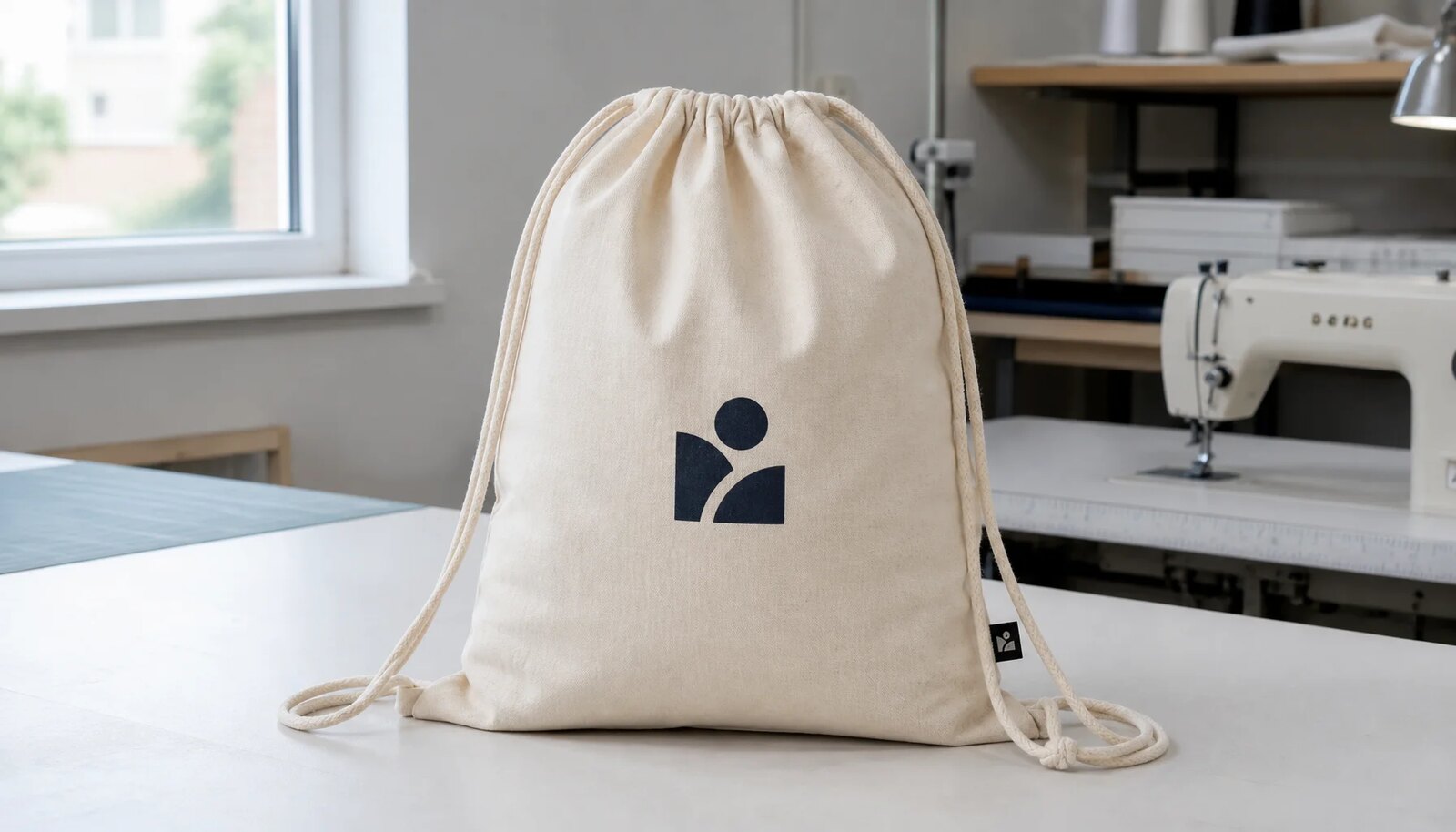
A cotton drawstring backpack looks straightforward until the order has to pass procurement, artwork review, and warehouse receiving at the same time. For farmers market vendors, the bag may be a reusable carry item, a retail add-on, a giveaway, or a branded pack used every weekend. Those are not the same use case. A promotional handout can tolerate a thinner build and simpler packing. A retail item needs cleaner presentation, tighter print control, and better repeatability. A carry bag used around produce and packaged goods needs a fabric and stitch spec that feels dependable in use. That is why print proofing matters so much for wholesale cotton drawstring backpacks for farmers market vendors. It is the point where the design, the sewn construction, and the commercial terms all have to match.
The most common failures are predictable. Thin lettering fills in on the weave. Dark ink loses edge definition as it sinks into natural cotton. A logo that looked centered on a mockup creeps toward a seam after the bag is sewn. A design that used the full flat panel in art software suddenly runs into the drawcord tunnel once the bag is assembled. Buyers who treat proofing as a production control step catch these issues before they become a bulk dispute. Buyers who treat it as a design approval step usually discover the problem after the goods are packed.
That matters even more for market-facing products because the bag is visible in customer photos, at booth tables, and in repeated use over a season. A small placement error can make the whole item look careless. A weak cure can turn a clean logo into a quality complaint. The proof is not just for the design team. It is the record that tells production, purchasing, and receiving what good looks like.
- Treat the backpack as a sewn product first and a print surface second.
- Assume the proof stage will reveal placement, curing, and packing errors.
- Use the same approval record for marketing, procurement, and reorders.
Lock The Base Spec Before You Ask For Art Proof
The artwork cannot be judged properly until the base bag spec is fixed. Fabric weight changes how the bag hangs, how much the cloth shifts during sewing, and how clearly the print sits on the surface. For most wholesale programs, 10 oz cotton canvas, about 340 gsm, is the practical default because it balances structure, cost, and print clarity. An 8 oz bag, about 272 gsm, can work for giveaways and lighter event use, but it feels thinner and can show more fabric distortion around the print. A 12 oz bag, about 407 gsm, feels more substantial and often supports a cleaner retail presentation, but it also affects freight, folding, and carton packing. If a supplier quotes only a raw cloth weight and not a finished sewn spec, the buyer is missing the real production condition.
The dimensions matter just as much. Finished size, seam allowance, top tunnel height, drawcord type, and reinforcement at the corners all change where the logo can safely sit. For a typical 14 x 16 in bag, a practical printable window is often about 9 x 10 in if you want clearance from the top tunnel and the side seams. As a rule of thumb, keep the top of the logo at least 1.0 in below the top seam and leave about 0.5 in of clearance from each side seam. If the design needs a larger mark, rework the bag spec instead of letting the art drift into stitching. A good supplier should be able to tell you what the sewn bag can actually support.
If the bags will carry heavier produce or market goods, ask for details on stitch density, corner reinforcement, and the type of cord used. A cotton cord gives a more natural look; a braided polyester or blended cord may wear differently and can change the perceived value of the finished item. None of those details are cosmetic only. They affect how the bag behaves in use, how it packs, and how the print sits over time.
- Specify finished dimensions, not only cut-panel dimensions.
- Use 10 oz cotton canvas as the default starting point unless the use case proves otherwise.
- Ask for the exact printable area after sewing, folding, and top-stitching.
Compare Supplier Routes Without Mixing Scope
A quote is only comparable if every supplier receives the same spec sheet. The sourcing route changes the risk profile, so the buyer should compare routes deliberately rather than by unit price alone. A direct factory with in-house printing gives the best control because the same plant owns the sewing, the print setup, and final packing. That usually makes it easier to resolve issues when placement or curing needs correction. A trading company can still be a good option if it is genuinely managing the schedule and the print partner is named and accountable. A blank-stock importer plus local printer can be useful for short-turn programs, but the buyer must accept that the blank bag lot may vary in shade, size, and construction consistency.
For procurement, the key is to separate price from control. The cheapest quote is not the best if it excludes screens, setup, sample shipping, carton labels, or local handling. It is also not the best if the supplier cannot prove who will run the bulk order after the sample is approved. For farmers market vendor programs, where the bag may be part of a seasonal launch or a branded retail assortment, you want repeatability more than one-time convenience. Ask every supplier to quote the same fabric weight, the same print method, the same number of print colors, the same packing format, and the same delivery terms. That turns the decision into a real commercial comparison instead of a vague creative discussion.
If you are comparing suppliers with very different commercial structures, normalize the quote into landed cost and approval risk. A bag that looks expensive on paper may be cheaper if it includes proofing, packing, and freight coordination. A low unit price can become the highest-cost option once the buyer pays for rework, missing labels, or cartons that do not match the receiving plan. Procurement teams usually get better results when the RFQ forces everyone to quote the same assumptions.
- Use one spec sheet across all suppliers to eliminate quote drift.
- Ask who actually prints, who actually sews, and who signs off on the proof.
- Compare landed cost, not just the bag unit price.
Match Decoration To The Artwork And The Cotton
For natural cotton, one- or two-color screen print is usually the strongest wholesale choice. It is economical on higher quantities, it reads clearly on textured fabric, and it tends to hold up well under repeated use. It is also the simplest method to control if the artwork is bold, flat, and limited in color. That said, the method should follow the art, not the other way around. If the logo depends on thin reversed text, gradients, fine halftones, or photographic detail, the supplier needs to show how that art will behave on cotton. A mockup that looks clean on screen is not proof that the decoration will hold up on the bag.
The buyer should evaluate print proofing at the line level. Look at stroke width, spacing between letters, sharpness of edges, and how much the color sits on top of the weave versus sinking into it. On natural or unbleached cotton, white or light inks often read warmer and less bright than expected. Dark inks can look muted if the fabric absorbs too much of the print. If the smallest reversed text is below about 7 pt or the thinnest line is below 1 mm, ask the supplier to simplify it before production. Registration also matters if the design uses more than one color. On a backpack, the print area is not a flat poster. It is a sewn and folded object with seams, gussets, and tension points, so the proof needs to show that the art still looks balanced when the bag is assembled.
Transfer or digital decoration can still make sense, but only when the artwork requires it. Use it when the design is too detailed for screen print or when the order is too short to justify screens. The buyer should still ask the same questions: does it crack, does it scuff, does it change handfeel, and does it stay legible after folding and use? A method that solves one problem but creates a durability problem is not a sourcing win. If a supplier recommends a different print method, ask them to explain the durability and appearance tradeoffs in plain terms, not just by process name.
- Use screen print for bold wholesale branding and repeatable volume.
- Treat transfer or digital decoration as a tradeoff, not an automatic upgrade.
- Check line weight, registration, and edge sharpness on the real fabric color.
Build A Proof That Reflects Bulk Production
A digital mockup is not a proof. It only shows intent. The buyer needs a physical strike-off or sample made on the same fabric color, fabric weight, and print method that will be used in bulk. That sample should be reviewed in daylight and again under warehouse or indoor retail lighting, because the same ink can look different under each condition. If the bag is meant for resale, the sample should look like a finished product, not a proof piece assembled only to show the logo. The sample has to answer a practical question: will the bulk order look acceptable when it leaves the carton and lands in front of a customer?
The review should look for production problems, not just visual taste. Check whether the print sits where the spec says it should sit, whether the logo drifts after stitching, whether the drawcord channels pull the shape out of square, and whether the top stitching keeps the opening even. Ask for three sample artifacts whenever possible: a flat photo of the print area, a finished-bag photo, and one close-up of the print edge under daylight. Rub the print with a clean white cloth, open and close the cord several times, and inspect the bag after it has been folded once. If the first sample is wrong, the right answer is usually a correction sample before production, not a verbal promise.
If the first sample is almost right, write down the change clearly: exact placement, color target, packing format, and any updated curing or stitching requirement. Keep one signed golden sample tied to the order so the bulk shipment can be compared against it later. A sample without a date, lot reference, or artwork version is hard to use later because no one can prove which version was approved. For planning, a typical sample lead time is about 5 to 10 working days if the fabric is in hand and the print method is standard. Bulk lead time after approval is often 20 to 35 working days, but that should be treated as a planning range, not a promise. Any fabric change, art revision, or packaging change can restart part of the clock.
- Review the sample in more than one light source.
- Keep the approved sample tied to the lot, date, and artwork version.
- Require a new proof if sewing, print, or packing changes after approval.
Write The RFQ So Quotes Are Comparable
A useful quote for wholesale cotton drawstring backpacks should be itemized. The buyer needs to see the blank bag price, the decoration setup, the sample fee, packing costs, and the shipping terms separately. If the supplier only gives a lump sum, there is no way to tell whether the low price is real or whether it will grow once screens, plates, or packaging are added. That matters because the proofing stage often exposes changes. A second sample, a revised logo position, or a shift from bulk pack to retail polybag all changes the commercial picture. A transparent quote makes those changes visible before the order is approved.
For procurement, the best comparison is landed cost at several quantities. Ask for price breaks at the likely order sizes, such as 250, 500, 1,000, and 3,000 units, and make sure the supplier states whether the setup cost is amortized or charged every time. Confirm the Incoterm, local handling fees, carton markings, and whether the quote includes freight to the final destination or only ex-factory terms. If the buyer is comparing direct factory, trading company, and local print routes, the line items need to be normalized. Also ask whether screens or digital files are stored for 6 to 12 months and whether a reorder can reuse them without a new setup charge. A supplier that looks expensive on the first page may be cheaper once setup and packing are included, while a low unit price can become the most expensive option after hidden charges are added later.
A good RFQ also tells the supplier how to quote the print accurately. State the number of colors, the exact print dimensions, whether the logo is on one side or both sides, and whether any variable data or size labels are required. If the vendor cannot quote from that information, the buyer does not yet have a procurement-ready brief. In practice, a clean RFQ saves time on both sides because it reduces back-and-forth and keeps the proof from being rebuilt around missing assumptions.
- Require line items for bag price, decoration, sample, packing, and freight terms.
- Ask for a quantity ladder so setup cost is visible across volume.
- Compare landed cost, not headline unit price.
Set QC Thresholds Before The Goods Ship
Quality control should be tied to the business use of the bag, not to a generic factory standard. A retail program needs tighter cosmetic control than a free giveaway, but both need the same basic checks: finished size, print placement, print durability, seam integrity, and packing accuracy. The best reference is the signed golden sample, because it gives the inspector a physical target instead of a vague instruction. Inspect the bag at the fully sewn state, not as a cut panel. Measure the logo position from the top edge and side seam, not from the center of a flat piece of fabric that will change once sewn. Verify that the drawcord moves evenly, the bag opens square, and the seams do not twist the shape when loaded.
The final inspection should also catch shipment-killing defects that are easy to overlook in the sample stage. Check for oil marks, broken threads, needle holes, off-center labels, and loose fibers that make a bag look unfinished. If your QA process uses AQL, many buyers set major defects at 2.5 and minor defects at 4.0, but the contract should state the exact acceptance plan you will use. Count cartons against the packing list and confirm the pack count is the same in every carton. Ask for pre-shipment photos, carton dimensions, gross weight, and a copy of the inspection report before the balance payment. That documentation matters because it ties the bulk goods back to the proof the buyer approved. If a dispute comes up later, traceability is what prevents the conversation from becoming a guesswork argument about what was supposedly ordered.
The biggest sourcing mistake is approving the sample and then assuming production will follow automatically. Sewn goods drift if the factory changes fabric lots, switches threads, or alters the print line. The QC plan has to be explicit enough that the factory knows which variance is acceptable and which one triggers a hold. Buyers who define tolerances clearly tend to get fewer surprises at receiving because the inspection team is measuring against a known target, not a mood.
- Inspect against the golden sample and the written spec together.
- Measure finished bag size and logo placement after sewing.
- Require carton counts, carton dimensions, and pre-shipment evidence before release.
Specify Packing, Labels, And Freight Around The End Use
Packing should match how the bags will actually be handed out, stored, or sold. For event giveaways, bulk packing in master cartons may be the cleanest option because it reduces labor and carton count. For retail resale, the bag may need an individual polybag, a fold that shows the logo on opening, and a label or hangtag that communicates size and fiber content. The buyer should not assume a standard packing format is acceptable just because it is common. If the print is not fully cured, an individual polybag can mark the ink during transit. If the bag is tightly folded without a protective insert, the logo may crease in the carton and arrive looking tired before the customer ever uses it.
Farmers market vendor programs often sit between event and retail use, which is why the packing spec has to be written carefully. A vendor using the bags as functional carry items may want bulk-packed cartons for easy distribution. A buyer reselling them at a market stall may want retail-ready fold consistency so the product looks deliberate on display. That changes not only the carton count but also the way the bag should be folded, boxed, and marked. If barcode labels, content labels, or country-of-origin marks are needed, define where they go and who applies them. Standard carton counts are often 25 or 50 units, but the right count depends on bag thickness, carton strength, and the gross weight target. Many buyers try to keep cartons under 25 kg, or about 55 lb, so receiving and freight handling stay manageable.
Ask the supplier to state whether the quote is EXW, FOB, or DDP. That one line changes who pays inland freight, export handling, port charges, and delivery to the final destination. If those charges are not visible, the quote is not procurement-ready. The packing spec should also say whether cartons are sorted by size, color, or artwork version so receiving can put them away without opening and re-sorting everything.
- Choose bulk pack for distribution and retail-ready pack for shelf use.
- Confirm that curing is complete before any bag is sealed in poly.
- Specify carton marks, fold direction, and label placement in writing.
Protect Reorders And Seasonal Repeat Business
A good wholesale program does not end when the first shipment lands. Farmers market vendors often reorder seasonally, and the second order can go wrong if the supplier does not have a clean production record. The buyer should keep the approved artwork version, the signed sample, the carton spec, the fabric weight, and the print method in one file tied to the order history. That way, a reprint does not rely on memory or a marketing mockup that has since changed. If the supplier changes mills, print partners, or packing methods later, the buyer needs to know immediately because those shifts can change shade, fit, and print behavior.
For repeat orders, the most useful control is a simple reorder note. It should state the approved sample date, the exact bag spec, the print size, the color references, the tolerance window, and the acceptable variation range. It should also note whether the first run had any special instructions, such as cure time, polybag limits, or carton sorting. If the buyer expects the same look next season, the supplier should be asked to confirm the same production path before quoting again. That is the practical difference between a one-off purchase and a real supply relationship: the reorder becomes predictable because the proofing record is complete enough to reproduce without guesswork.
If the supplier cannot tell you whether the same screens, same blank fabric, and same sewing line will be used again, treat the reorder as a new approval cycle. That is not overkill. It is how procurement avoids surprise drift on products that look simple but depend on controlled fabrication. A clean record also helps when a marketing team wants a fast color or artwork refresh, because the old build is already documented and easy to compare against the new request.
- Archive the approved sample, artwork, carton spec, and production notes together.
- Write a reorder note that captures the exact approved build.
- Ask the supplier to confirm any fabric, print, or packing change before re-quoting.
Use One Approval File To Close The Loop
The cleanest way to buy wholesale cotton drawstring backpacks is to make the proofing record the source of truth. The file should hold the RFQ, the quoted spec, the approved art, the printed sample photo, the signed golden sample note, the carton spec, and the final QC tolerance sheet. If any one of those items is missing, the team will end up re-deciding something that was already supposed to be locked. That is where delays and disputes usually start.
Before you issue the purchase order, ask one final question: if the bulk goods arrived exactly like the approved sample, would every stakeholder still be able to receive and use them without extra work? If the answer is no, the spec is incomplete. Maybe the packaging is wrong for the warehouse. Maybe the logo window is too small for marketing. Maybe the cartons are too heavy for receiving. That is the point of the proofing checklist. It is not to make the product perfect. It is to make the order predictable enough that production, logistics, and brand review all agree on what good looks like.
In practice, this is the shortest path to fewer surprises: one spec sheet, one proof, one tolerance sheet, and one reorder file. Everything else is noise. If procurement can keep that system tight, the bag stays simple from the buyer's side even though the production process behind it is not simple at all.
- Keep one approval file that links art, sample, quote, and QC.
- Do not release the PO until the sample and tolerance sheet are signed.
- Treat any unrecorded change as a new approval event.
Specification comparison for buyers
| Spec decision | Recommended option | When it fits | Buyer risk to check |
|---|---|---|---|
| Supplier route: direct factory with in-house printing | One plant controls sewing, decoration, QC, and final packing | Best for repeat orders, tighter artwork control, and one-point accountability | Confirm the same plant and the same production line will run bulk goods, not just the sample |
| Supplier route: trading company with named print partner | Use only if the supplier names the factory and the decoration partner | Useful when you need language support, bundled sourcing, or multi-item programs | Clarify who approves the proof, who pays rework, and who owns the schedule |
| Supplier route: blank-stock importer plus local printer | Short-run route for urgent or regional programs | Works when speed matters more than exact fabric matching or long-term repeatability | Sample from the actual lot because stock changes can affect size, shade, and ink behavior |
| Fabric weight: 8 oz cotton canvas, about 272 gsm | Lightest acceptable option for low-cost giveaways | Fits handouts, event bags, and short-carry use | Thin cloth can show seam pull, weak opacity, and print show-through |
| Fabric weight: 10 oz cotton canvas, about 340 gsm | Balanced default for most wholesale programs | Fits retail resale, brand merch, and daily carry use | Ask for the finished sewn weight, not only the raw cloth spec |
| Fabric weight: 12 oz cotton canvas, about 407 gsm | Premium handfeel and stronger print stability | Fits higher-priced retail items or bags carrying heavier contents | Check whether the heavier cloth changes fold size, carton count, and freight cost |
| Print method: 1 to 2 color screen print | Best for bold logos and high-volume runs | Fits natural cotton, simple branding, and lower decoration cost | Thin reversed text and small detail may fill in, so proof line weight before approval |
| Print method: transfer or digital decoration | Use only when artwork complexity requires it | Fits detailed art, gradients, or short-turn custom work | Confirm durability, handfeel, and whether the decoration cracks or scuffs during use |
| Packing method: bulk pack versus individual polybag | Bulk pack for events, retail polybag for store-ready programs | Choose by how the buyer will distribute or resell the bags | Polybags can scuff weakly cured ink and add labor if the bag is not fully set |
Buyer checklist before sampling
- Lock the finished size, fabric weight, and drawcord style before you ask for price.
- Approve one vector artwork file with exact placement, Pantone references, and print size.
- Set the printable window in inches or millimeters and measure it from sewn edges, not from a flat cut panel.
- Get a strike-off or sample on the same fabric color and weight that will run bulk production.
- Confirm the MOQ for each print color, not only the total order quantity.
- Ask for line-item pricing for bag body, screens or plates, setup, sample fees, packing, and freight handling.
- Specify whether the bags ship bulk packed, individually polybagged, folded with inserts, or carton-sorted by size.
- Write down acceptance tolerances for finished size, logo placement, seam alignment, and acceptable shade variation.
- Request carton pack counts, master carton dimensions, and gross weight before you book freight.
- Make sure the approval sample and the bulk production sample are traceable by date, lot, and artwork version.
Factory quote questions to send
- What fabric weight do you quote in raw cloth terms and in finished sewn weight?
- Is the print done in-house, through a named partner, or by an outsourced decoration vendor?
- What is the MOQ per color, per print position, and per artwork revision?
- Does the quote include screens, plates, setup, and one physical proof sample?
- What is the exact print method for each color count and artwork type?
- How is the logo placement measured on the finished bag, not the flat cut panel?
- What is the finished size tolerance you will accept on sewn goods?
- What packing format is included, and what is the carton count per master carton?
- Which Incoterm is being quoted, and what local charges are excluded?
- What is the sample lead time, and what changes trigger a new sample charge?
Quality-control points to confirm
- Check that the finished bag size matches the approved spec after sewing, not the cut size. A practical buyer tolerance is often +/- 0.5 in (12 mm) unless your program needs tighter control.
- Verify that the logo sits within the agreed placement window and does not creep toward a seam or drawcord tunnel. A common placement tolerance is +/- 0.25 in (6 mm).
- Inspect print sharpness under daylight and warehouse lighting to catch dot gain, smudging, or weak cure.
- Run a dry rub test on at least one sample unit with a clean white cloth. Ten firm rubs should not produce visible transfer on the cloth.
- Check multi-color registration. For simple two-color art, ask for alignment within about 1 to 1.5 mm so the mark does not look fuzzy.
- Pull-test the drawcord and top seams to identify weak stitching, skipped stitches, or tunnel damage. The bag should open and close evenly on both sides.
- Confirm that the fabric lot, thread color, and print tone match the signed golden sample within the buyer's approved range.
- Count cartons against the packing list and confirm the same fold, insert, and polybag configuration in every carton.
- Reject any unit with oil marks, needle holes, broken threads, off-center labels, or inconsistent screen alignment.
- Check that the bag opens square and the drawcord channels move evenly from both sides without twisting the opening.