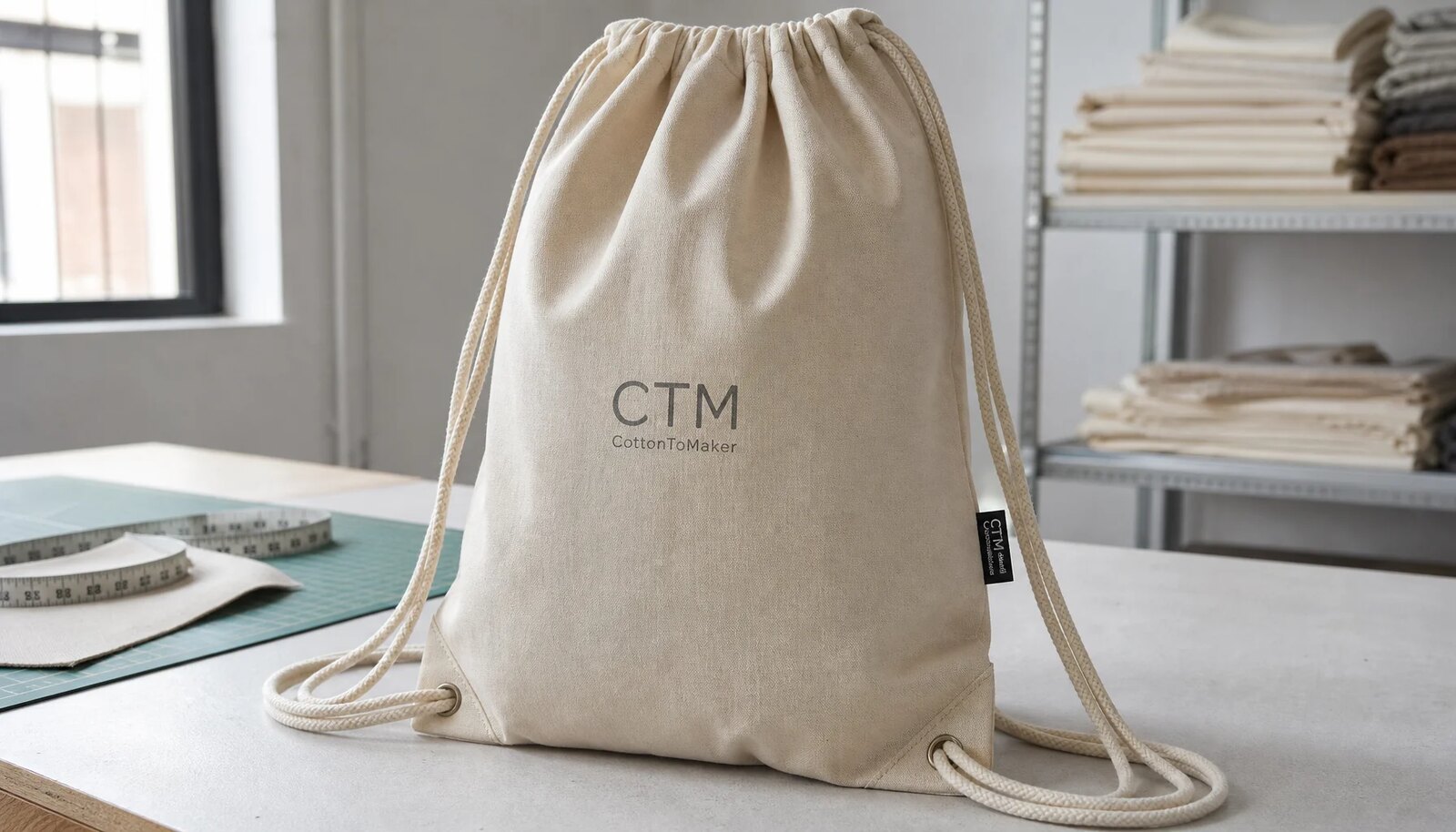
Define the bag's job before you compare quotes
For farmers market vendors, a cotton drawstring backpack is usually doing one of three jobs: a light giveaway bag, a retail merch item, or a working kit for staff and vendor partners. Those jobs look similar on paper, but they drive very different fabric weights, print methods, and packing costs.
If the buyer cannot name the use case, the quote will drift toward the factory's default spec. That is how you end up with a bag that looks fine in a sample photo but feels too soft for resale, too thin for daily carry, or too expensive for a promo budget.
- Define the primary load before asking for a price.
- Decide whether the bag is meant to be worn daily or handed out once.
- State the target channel: giveaway, vendor kit, or retail shelf.
- Set a rough unit-cost band so the factory does not overbuild the bag.
Choose fabric weight and build for the real load
For this product, the most useful starting point is cotton canvas in the 8 oz to 12 oz range, which roughly maps to 270 to 400 gsm depending on finish and weave. Eight oz works for low-cost event bags and lightweight inserts. Ten oz is the balanced option for most farmers market programs. Twelve oz gives more body for retail or heavier carry.
The bag structure matters as much as fabric weight. A flat body is cheaper and folds smaller, while a gusset or boxed base improves packability for product samples and small purchases. If the bag is meant to hold bottles, produce, or market handouts, ask for reinforced stress points at the cord holes and side seams.
- 8 oz or about 270 gsm: light giveaway and short carry use.
- 10 oz or about 340 gsm: best balance for most vendor programs.
- 12 oz or about 400 gsm: premium feel and better shape retention.
- Reinforce cord exits, lower corners, and any gusset seams with bar tacks.
Match decoration method to artwork and quantity
For a single-color logo, screen print is usually the cleanest commercial choice. It keeps setup simple, holds detail well, and works at a lower cost once quantity rises. Water-based or plastisol inks can both work on cotton, but the factory should tell you how the print is cured and whether the finish will stay soft or sit on top of the fabric.
If the brand wants a quieter look, a woven label, sewn patch, or side label can make the bag feel more retail-ready. Heat transfers are useful for small runs or complex art, but they need closer checks for cracking, edge lift, and wash durability. For farmers market programs, the cheapest method is not always the safest choice if the bag will be handled every week.
- One or two colors usually favors screen print.
- Complex art or gradients need a decoration method the factory can repeat consistently.
- Woven labels and sewn patches work well for premium retail positioning.
- Require a strike-off or pre-production decoration sample before bulk approval.
Read MOQ and quote structure without guessing
MOQ is not a single number. It is the outcome of fabric minimums, cut layout efficiency, print screen setup, label sourcing, and carton packing. A supplier can quote a low MOQ if the bag uses stock fabric and one print color, then raise the order threshold once you add custom dyeing, extra logo colors, or special packaging.
A clean quote should separate the body cost, decoration setup, packing, and freight term. If the quote only shows one unit price, the buyer cannot see what changes when the logo, color, or packing changes. Ask for a second line showing the incremental cost of each extra print color, each colorway, and each packaging upgrade.
- Normalize every quote to the same body size, fabric weight, and print area.
- Compare MOQ by color, not just total pieces.
- Look for hidden costs in label sewing, individual polybags, and barcode stickers.
- Ask whether sample charges are credited back on the production order.
Separate real factories from middlemen
For this kind of bag, a real factory should be able to explain where the fabric comes from, how the body is cut, who applies the print, and how finished cartons are inspected. If the answers stay vague, the supplier may be brokering work across different shops, which makes color control and delivery timing harder.
That does not automatically make a trading company wrong. A good sourcing partner can be useful when the buyer needs mixed SKUs, smaller MOQs, or faster access to stock fabric. The risk is margin stacking and spec drift, so the buyer should still ask for factory photos, process flow, and a sample from the actual production route.
- Ask who owns fabric booking, cutting, sewing, decoration, and final packing.
- Request photos of the seam line, bar tacks, and print curing area, not just a showroom.
- Confirm whether repeat orders use the same fabric lot or a matched replacement.
- Verify that the sample came from the same route as the quoted production plan.
Approve samples against measurable tolerances
The pre-production sample should prove more than the logo placement. It needs to match body dimensions, cord length, print position, fabric hand, and finishing details such as edge trimming and stitch density. Keep a signed reference sample, because memory is not a quality standard once production starts.
Set tolerances that the factory can hit consistently. For a simple cotton drawstring backpack, a practical start is tight control on size and print placement, with no visible puckering around the cord holes, no skipped stitches, and no loose thread tails that signal rushed sewing. If the bag feels too flimsy in the sample, do not assume bulk production will feel better.
- Hold body size and cord length within the agreed tolerance band.
- Keep logo placement centered and registration consistent across the sample and bulk run.
- Reject samples with stains, oil marks, broken needle damage, or visible thread ends.
- Test the stress points with a real fill weight, not an empty bag.
Specify packing for retail, distribution, or both
Packing is where many useful bags become expensive freight. Flat packing reduces volume and makes warehouse receiving easier, while individual polybags improve presentation and moisture protection. If the bags are for vendor giveaway kits or back-of-house issue, bulk packing is usually enough. If they will hang in a retail setting, a simple polybag or paper belly band may be worth the extra cost.
Carton planning should be part of the quote, not an afterthought. Ask how many units go in each inner pack and master carton, what the gross weight is, and whether the carton dimensions suit your receiving rules. A well-packed bag can move through freight and storage with fewer dents, lower damage risk, and less repacking labor.
- Confirm carton count by color and by SKU.
- Ask for moisture protection if the route includes long ocean transit.
- Keep carton gross weight manageable for hand unloading.
- Use barcode and lot labels if the bags move through retail or distributor systems.
Build the schedule around sample gates
Lead time for this product is usually a chain of small approvals rather than one production block. The timeline starts with artwork sign-off, then a pre-production sample, then fabric booking or cutting, then printing and sewing, then packing and inspection. If any one of those steps slips, the final ship date moves.
A realistic order plan for a custom cotton drawstring backpack often needs several weeks after sample approval, and longer if the fabric is dyed to order or the packing is special. Buyers who need bags for a market launch or seasonal event should work backward from the delivery date and add room for correction, not just manufacturing.
- Lock artwork before asking for a final production schedule.
- Treat the sample as a gate, not as a rough preview.
- Add cushion for peak season, customs hold, or carton rework.
- Do not promise the event date to internal stakeholders until the factory confirms packing completion.
Compare landed cost, not just unit price
Two quotes with the same unit price can produce very different landed costs. Print setup, packing, carton size, freight mode, and destination handling charges can change the real cost more than a small swing in ex-works price. A lower quoted price is not useful if the bag arrives in oversized cartons or needs repacking before distribution.
The cleanest comparison is to normalize all offers to the same spec, same packing, and same destination term. Then compare the total cost per sellable unit, not the factory price alone. For procurement teams, this is where the decision usually becomes obvious: the best supplier is the one that can hold the spec, explain the cost stack, and deliver a repeatable program.
- Compare ex-works, FOB, and landed estimates on the same spec.
- Include setup charges, packing, and cartonization in the math.
- Check whether air freight or sea freight changes the order economics.
- Keep one approved sample and one approved quote sheet together for reorder use.
Specification comparison for buyers
| Spec decision | Recommended option | When it fits | Buyer risk to check |
|---|---|---|---|
| Sourcing route | Direct factory with cut-and-sew plus in-house print | Repeat programs, stable artwork, and buyers who need tight control over spec and delivery | Confirm the factory actually owns cutting, sewing, and decoration instead of outsourcing them |
| Sourcing route | Trading company with a known factory network | Mixed SKUs, smaller first orders, or buyers who need sourcing support across several programs | Watch for margin stacking, spec drift, and different factories being used on repeat orders |
| Sourcing route | Stock blank body plus local decoration | Urgent events, test launches, or short-run programs with limited customization | Check fabric shade, size variation, and print consistency across replenishment runs |
| Fabric weight | 8 oz cotton canvas, roughly 270 gsm | Light giveaway bags and low-cost event use where the load is modest | Too soft for heavy produce, daily carry, or a premium resale position |
| Fabric weight | 10 oz cotton canvas, roughly 340 gsm | Best balance for most farmers market vendor programs and light retail resale | Ask for finished GSM and shrinkage after sewing, not just raw fabric weight |
| Fabric weight | 12 oz cotton canvas, roughly 400 gsm | Premium feel, better structure, and heavier contents or resale use | Higher cost and more sewing labor, so confirm comfort and foldability before ordering |
| Decoration method | One or two-color screen print | Simple logo, medium to high quantity, and buyers who want clean unit economics | Require cure testing, rub resistance, and registration tolerance on the strike-off |
| Decoration method | Woven label or sewn patch | Subtle branding, premium positioning, or a bag that should stay visually minimal | Check label placement consistency and make sure stitching does not distort the body fabric |
| Packing route | Flat-packed master cartons with color ratio labels | Bulk distribution to stores, vendors, or warehouse receiving | Verify carton count, moisture protection, gross weight, and SKU labeling before approval |
Buyer checklist before sampling
- Define the use case first: giveaway, staff kit, or retail resale.
- Lock the body size, fabric weight, and whether the bag needs a gusset.
- Choose the decoration method before asking for pricing comparisons.
- Set the MOQ by color and by logo version, not just total pieces.
- Request a pre-production sample and keep one signed reference sample.
- Confirm the packing format: bulk carton, polybag, or retail-ready banding.
- Ask for carton count, gross weight, and carton dimensions in the quote.
- Verify the factory lead time after artwork approval and sample approval.
- Compare landed cost, not only ex-works unit price.
- Record the final approved spec sheet so reorders do not drift.
Factory quote questions to send
- What is the exact fabric weight in gsm after finishing and sewing?
- Is the body stock fabric or custom dyed, and what is the color matching method?
- Which decoration method will you use, and what is the setup cost per logo color?
- What MOQ applies by color, by print version, and by packing style?
- What are the body dimensions, cord length, and tolerance on finished size?
- How will the bags be packed per inner pack and per master carton?
- What is the sample timeline, and does the pre-production sample reflect the final production route?
- Can you quote ex-works, FOB, and carton count separately so we can compare landed cost?
Quality-control points to confirm
- Fabric weight matches the approved spec within a tight finished-weight tolerance.
- Body dimensions stay within the agreed tolerance on width, height, and cord length.
- Stitching is even, with no skipped stitches, loose thread tails, or seam puckering.
- Cord holes or eyelets are reinforced and do not tear under normal pull use.
- Print position is centered and the color matches the approved strike-off or sample.
- The decoration passes a basic rub check and does not crack or smear during handling.
- Carton counts, color ratios, and SKU labels match the purchase order exactly.
- No oil stains, fabric damage, broken needle marks, or strong odor appear on finished goods.