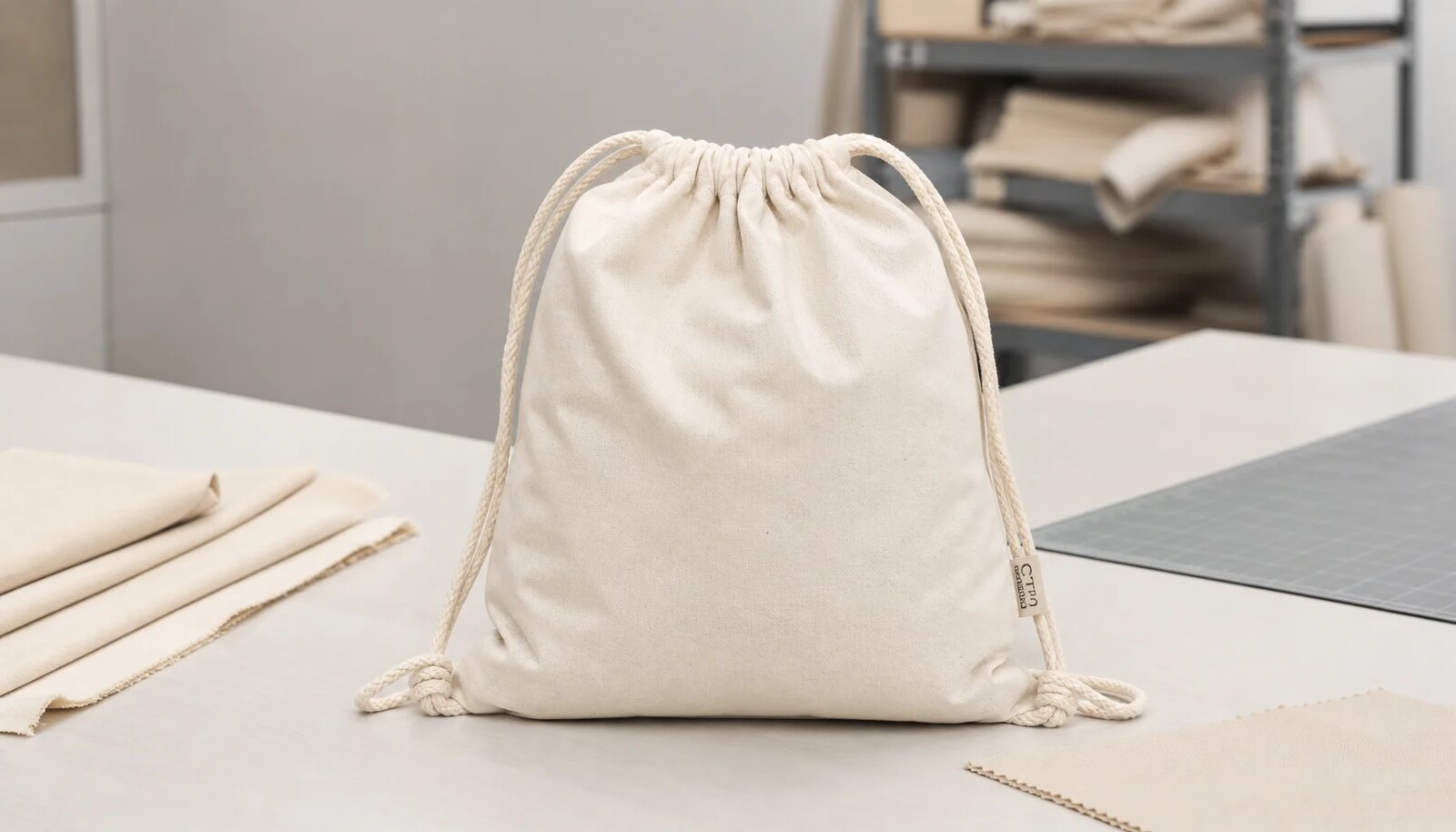
Start With the Gift Program, Not the Cheapest Bag
Wholesale cotton drawstring backpacks for corporate gifting are judged in two different places. Procurement first checks price, MOQ, lead time, and supplier reliability. Recipients later judge whether the bag looks like a thoughtful branded item or a low-effort giveaway. A sample photo can hide many problems: thin cloth, weak cord tunnels, a logo that bleeds into the weave, cartons that crush the fold, or a size that does not hold the actual kit contents.
The use case should drive the specification. A one-day conference handout may only need to carry a program, pen, and leaflet. A new-hire onboarding kit may carry a notebook, drink bottle, cable pouch, apparel item, and welcome documents. A university or field program may need a bag that will actually be worn. Those programs should not start from the same fabric weight or construction pattern. Before asking for price, define the job the bag must perform after printing, packing, shipping, storage, and distribution.
A useful buying brief is short but concrete. It should include expected contents, approximate fill weight, recipient profile, branding standard, delivery date, packing route, and final destination. It should also say whether the bag is a disposable event carrier, a medium-quality corporate gift, or a retail-style branded item. This helps suppliers quote the same target instead of each choosing a different interpretation of cotton drawstring backpack.
The phrase wholesale cotton drawstring backpacks for corporate gifting fabric weight guide should not be treated as only an SEO topic. For procurement, fabric weight is a control point that connects cost, appearance, print behavior, freight, and recipient experience. The strongest RFQs make that connection visible before the order is awarded.
- State the expected contents, such as notebook plus bottle, apparel plus brochure, sample products, laptop accessories, or an empty giveaway bag.
- Define the presentation level: utility event carrier, standard corporate gift, premium brand item, school program bag, or retail-style promotion.
- Confirm who will fill the bag: factory, third-party kitting partner, internal warehouse, event agency, or recipient after handout.
- List handling risks: long warehouse storage, humid destination, multi-stop transport, direct mail, rough event distribution, or strict photo appearance.
- Attach the latest logo files and brand color references at RFQ stage so decoration is priced realistically.
Fabric Weight Bands Procurement Can Use
GSM means grams per square meter. It is a measure of fabric weight, not a complete measure of quality, but it is one of the fastest ways to prevent under-spec cotton bags. For drawstring backpacks, common sourcing ranges run from about 140 GSM to 240 GSM. Below that, the product often becomes closer to a lightweight cotton pouch. Above that, buyers must check whether the closure, cord comfort, sewing setup, and freight still make sense for a drawstring backpack.
The 140-160 GSM band is the budget range. It can work for document-only event handouts, very high-volume giveaways, and short-use promotions where price is the dominant requirement. Buyers should expect more drape, less opacity, more wrinkling, and a higher chance that dark contents or internal seams show through pale fabric. Screen printing can still work, but large solid ink areas and fine text need careful testing.
The 170-180 GSM band is a transition range. It can be useful when the buyer wants a noticeably better handfeel than lightweight cotton without moving into a heavier canvas cost. Many corporate programs, however, find the 180-220 GSM range more dependable. That middle band normally gives better opacity, cleaner logo presentation, stronger perceived value, and better carton recovery while keeping unit cost and freight more controlled than premium canvas.
The 220-240 GSM band is for more structured programs. It fits executive gifting, retail-like brand promotions, heavier contents, and campaigns where the bag may be photographed or kept after the event. The tradeoff is not just material cost. Heavier cloth changes carton weight, cutting yield, sewing needle choice, tunnel bulk, closure feel, and landed freight. Buying a higher GSM without adjusting construction can create a bag that feels stiff or closes poorly.
- 140-160 GSM: light event handouts, document bags, cost-sensitive campaigns, and basic one-color logos.
- 170-180 GSM: improved opacity and handfeel where the budget cannot support a heavier corporate gifting spec.
- 180-220 GSM: the practical starting range for many screen-printed corporate cotton drawstring backpacks.
- 220-240 GSM: stronger presentation, heavier contents, retail-style handling, or repeated recipient use.
- Above 240 GSM: review whether the product should become a canvas backpack or tote rather than a simple drawstring bag.
- Use a stated tolerance, such as +/-5% GSM, rather than accepting an open-ended nominal fabric weight.
GSM Is Not Enough: Weave, Composition, and Finish Matter
Two bags can both be quoted at 200 GSM and still behave differently. Weave structure, yarn thickness, yarn regularity, fabric density, and finishing all affect the final product. Cotton canvas usually has a firmer, more rugged hand. Cotton drill or twill may feel smoother and can print cleanly when the surface is stable. Plain-weave cotton can be economical and soft, but it may not provide the body expected for a corporate gift backpack. A quotation that says cotton canvas without GSM, weave, or tolerance is incomplete.
Composition also needs to be named. Some bags are conventional cotton, some are organic cotton, some use recycled cotton blends, and some are cotton-polyester blends. Each route has implications for price, appearance, certification documents, dye behavior, shrinkage, and print results. If sustainability messaging will be used in the gifting campaign, procurement should request the relevant certification or traceability documents early. Avoid adding sustainability claims to marketing copy unless the supplier can provide documentation that the brand is comfortable using.
Natural undyed cotton is popular for corporate gifting, but it should be approved with realistic expectations. It may show flecks, seed marks, shade variation, and small slubs. Those features may be acceptable for a natural-looking brand program, but they may conflict with strict brand standards or a premium executive kit. Bleached or dyed cotton gives more controlled appearance, but custom dyeing adds lab dip approval, dye-lot risk, and lead time.
Finish affects how the bag behaves after packing. A soft finish may feel good but collapse around the print. A stiffer finish may sit flatter for presentation but can be less comfortable when worn. If the bags will be compressed in cartons for weeks, approve a folded sample and inspect recovery after unpacking. The recipient sees a finished bag, not a flat fabric swatch.
- Ask whether the fabric is canvas, drill, twill, plain weave, sheeting, recycled cotton blend, organic cotton, or cotton-rich blend.
- Require nominal GSM plus tolerance and do not rely on words like heavy, thick, premium, or eco without specifications.
- For natural cotton, approve acceptable levels of flecks, slubs, shade variation, and visible seed marks.
- For dyed fabric, require lab dip or approved physical standard before bulk dyeing when color is important.
- Check whether finishing changes shrinkage, print absorption, softness, crease recovery, or dust attraction.
- Approve fabric in the same color and finish planned for production, not only a similar stock swatch.
Match Fabric Weight to Size and Construction
Fabric weight cannot compensate for weak construction. A cotton drawstring backpack has predictable stress points: side seams, bottom corners, cord tunnel, cord exit points, and lower cord anchors. A 220 GSM bag with poor stitching can fail faster than a 180 GSM bag with clean seams and correct reinforcement. Procurement should specify construction details instead of assuming every factory pattern is equivalent.
Finished size must be matched to contents. A common corporate drawstring backpack range is roughly 34 x 42 cm to 38 x 45 cm, but the right size depends on what will go inside. A large, light-fabric bag can sag and twist. A small, heavy-fabric bag may feel stiff and difficult to close. If the program includes a bottle, notebook, hoodie, sample box, or cable pouch, test the pre-production sample with those items. The sample should prove carrying behavior, not just flat appearance on a table.
The cord system is part of the construction spec. Cotton cords support a natural material story, but they may absorb moisture, vary in diameter, and create more friction in the tunnel. Polyester cords are often smoother and more consistent, although they change the product story. Flat cotton tape can be comfortable on the shoulder but may slide differently. The tunnel width, cord diameter, and fabric thickness must work together so the bag closes smoothly.
Seam and stitch details should be written into the purchase order when the order has brand risk or heavier contents. Ask about stitch density, thread type, seam allowance, reinforcement at lower cord anchors, and whether corners are boxed, reinforced, or simply folded into a two-panel shape. These details affect durability, sewing time, fold method, and cost, but they are cheaper to clarify before production than to repair after final inspection.
- Specify finished width, height, gusset or boxed-bottom dimensions, and tolerance such as +/-1 cm unless a tighter standard is required.
- Define tunnel width, cord material, cord diameter or tape width, cord length, color, and end treatment.
- Ask whether cord ends are knotted, heat sealed, tipped, sewn, or left raw, and inspect fraying risk.
- Specify seam expectations for side seams, bottom seams, tunnel seams, lower anchors, and any corner reinforcement.
- Request a practical cord pull test if the bag will carry more than paper documents or light apparel.
- Fill the sample with the intended kit to check sagging, closure, shoulder feel, logo visibility, and seam stress.
Choose Decoration by Artwork, Fabric, and Volume
Logo execution is one of the most common sources of disputes in bulk cotton drawstring backpack orders. A digital mockup can look perfect while the finished print looks rough on woven cotton. Fabric texture, absorbency, weave direction, and ink opacity all influence the result. The decoration method should be chosen after reviewing artwork complexity, fabric color, GSM, expected quantity, and brand tolerance for variation.
For high-volume corporate gifting, screen printing is often the most practical option. It is efficient for one- or two-color logos, solid marks, event names, and repeat orders. On 180-220 GSM cotton canvas, drill, or twill, screen print can produce a clean branded result when the screen mesh, ink type, squeegee pressure, curing, and fabric surface are controlled. The buyer should still approve a strike-off because dark fabric, natural flecks, coarse weave, and large ink coverage can change the final appearance.
Transfers and digital transfers are useful when artwork includes gradients, many colors, small details, or short-run personalization. They are not automatically better. Transfers must be checked for adhesion, edge lift, heat marks, handfeel, cracking, and wash or rub performance if those issues matter to the program. Embroidery can look premium on heavier cotton, but it can pucker lightweight fabric, distort small letters, and create a stiff area on a flexible bag. Large embroidered logos should be tested before production.
Decoration specifications should be measurable. State print size, placement, color references, registration tolerance, and acceptable variation from the approved sample. Placement should be measured from fixed reference points such as top edge, side seam, and center line. If the logo has small text, ask the supplier to confirm minimum text height and line width before screens or transfer films are made.
- Use screen print for simple corporate logos, solid colors, high volume, and controlled repeat pricing.
- Use transfer or digital transfer for full-color artwork, gradients, personalization, or artwork that cannot be efficiently screen printed.
- Use embroidery only after checking GSM, backing, thread density, pucker, logo size, and wearer comfort.
- Approve print opacity on the actual base color, especially on black, navy, red, natural cotton, or textured canvas.
- Define print placement tolerance, registration tolerance, minimum line width, and minimum text height.
- Ask whether curing, pressing, or embroidery may shrink, scorch, mark, or stiffen the fabric panel.
Build an RFQ That Makes Quotes Comparable
A strong RFQ prevents suppliers from quoting different bags under the same product name. One supplier may price 150 GSM plain cotton with bulk packing and no setup charges included. Another may price 220 GSM canvas, individual packing, screen charges, carton marks, and inspection support. The lower price may simply be a lower specification. Procurement should treat vague quotes as incomplete, not as evidence of better value.
The RFQ should separate product, decoration, packing, and logistics. Ask for the blank bag cost, print cost, setup charges, label cost, sample charge, inner packing, master carton, inspection support, inland transport, and freight assumptions. This line-item view helps buyers control cost without accidentally downgrading the product. If the total price is too high, the team can decide whether to adjust GSM, simplify decoration, reduce packing, increase order quantity, or change trade terms.
Trade terms must be aligned. EXW can look attractive because many logistics costs are outside the product quote. FOB may be more comparable for import buyers who control ocean or air freight. DDP can be convenient for corporate buyers who want a delivered price, but it should state what duty, tax, customs clearance, and final-mile delivery are included. A quote is not comparable until the destination, packing method, currency, payment terms, and trade term are clear.
A good RFQ also asks for carton data before supplier award. Units per carton, carton dimensions, gross weight, net weight, and volume weight can change freight cost. Heavier fabric or individual packing may push the landed cost above a cheaper-looking quote. For fixed-date gifting programs, predictable logistics often matter as much as unit price.
- Use one RFQ file for all suppliers with the same fabric, size, construction, artwork, packing, destination, and trade term.
- Request price breaks at the same quantities, such as 1,000, 3,000, 5,000, and 10,000 pieces per design.
- Require line items for blank bag, decoration, setup, label, sampling, inner packing, carton, inspection, inland transport, and freight assumptions.
- Ask whether the fabric is stock, reserved, custom dyed, or subject to availability at order placement.
- Request carton dimensions, pack count, net weight, gross weight, and volume weight with the quote.
- Flag quotes that omit screen charges, sample freight, carton marks, barcode labels, inspection, export documents, or inland delivery.
MOQ, Colorways, and Version Control
MOQ is not only a number to push downward. It reflects fabric availability, dyeing minimums, cutting yield, print setup, label production, packing complexity, and sewing line planning. A 500-piece order may be possible with stock natural cotton and a one-color print. The same quantity may be impractical with custom dyed fabric, three logo versions, individual barcodes, and destination-specific cartons. Buyers get better answers when they ask what drives the MOQ.
Corporate gifting often creates hidden version complexity. A global campaign may need different country names, department logos, event dates, employee groups, language versions, or recipient destinations. Each version can require separate screens, transfer films, embroidery files, labels, hangtags, carton marks, or packing lists. If a supplier quotes only the total quantity, the buyer may discover later that MOQ applies per color, per artwork, or per packing configuration.
Version control protects both quality and delivery. Artwork should be frozen before screens, transfers, or embroidery files are produced. SKU codes should identify fabric color, logo version, label version, packing method, carton mark, and destination. Without that discipline, mixed versions can enter the same carton, outdated logos can appear in bulk, or warehouse teams can misroute goods.
Repeat orders deserve special attention. If the supplier will retain screens, fabric standards, pre-production sample records, and packing instructions, ask how long those records remain active. Also confirm whether a repeat order will use the same fabric source or only the closest available stock fabric. Repeatability is a sourcing requirement, not an assumption.
- Clarify MOQ per body color, artwork version, print color count, label version, packing method, and shipping destination.
- Ask whether mixed colors can share one production run or whether each color requires separate setup and cutting.
- Create SKU codes before sampling so artwork, labels, cartons, packing lists, and invoices stay aligned.
- Freeze artwork file names, revision dates, Pantone references, and print placement before bulk decoration begins.
- Confirm whether repeat-order screens, swatches, sample records, and packing specs will be retained by the supplier.
- Separate overrun and underrun rules, especially for event dates or exact employee-count programs.
Sampling Should Prove Bulk Production
A sample is valuable only if it reduces production uncertainty. Buyers should know which type of sample they are approving. A reference sample shows a general style. A swatch shows fabric, color, and handfeel. A print strike-off proves decoration behavior on a specific fabric. A pre-production sample should combine the intended fabric, finished size, construction, cord, label, decoration, fold, and packing method. Each sample answers a different question.
The pre-production sample should be reviewed like a small inspection. Measure width, height, tunnel width, cord length, print size, and print placement. Pull the cords, open and close the bag several times, inspect seam straightness, check the bottom corners, look for loose threads, and evaluate the logo on the real fabric texture. If the order will be packed into kits, place the planned contents inside the sample and test the final shape. If the order will be mailed, test the bag in the intended mailer or carton.
Approval notes must be specific. Do not write approved with minor changes unless the changes are listed and measurable. If the logo must move 15 mm lower, state that. If the cord must change from 4 mm to 6 mm, state that. If the fabric is approved only at 200 GSM with +/-5% tolerance, state that. If bulk packing replaces individual polybags, state that. The approval record becomes the practical standard for production and inspection.
Sampling also protects the timeline. A buyer who approves only a digital mockup may save a few days upfront and lose more time later if print opacity, fabric shade, or construction is wrong. For fixed event dates, allow enough time for swatches, strike-off, sample revision, and final written approval before bulk cutting and printing.
- Request fabric swatch, print strike-off, and pre-production sample for orders with brand color, deadline, packing, or presentation risk.
- Measure sample width, height, tunnel width, cord length, print size, and placement against the spec sheet.
- Check the sample with intended contents to verify sagging, closure, seam stress, comfort, and logo visibility.
- Review the folded sample after compression so carton presentation is part of approval.
- Record approvals and required changes in writing before bulk fabric cutting, printing, or sewing starts.
- Keep one approved sample with the supplier and one with the buyer or inspection team when possible.
QC Details to Put in the Purchase Order
Quality control should be agreed before production starts. If expectations are discussed only after defects appear, both buyer and supplier are forced into subjective arguments. For B2B corporate gifting, the most important checks are usually fabric consistency, finished size, clean stitching, centered decoration, smooth cord function, odor control, stains, count accuracy, and carton labeling. These belong in the purchase order or attached inspection checklist.
Incoming fabric inspection should check GSM, width, shade, stains, holes, odor, and visible contamination. If multiple fabric rolls are used, roll lots should be identified so shade problems can be traced. Cut-panel checks should confirm that panels are square and that the logo area is usable. Print inspection should happen before sewing when possible because bad panels are easier to sort before they become finished bags. Sewing inspection should catch skipped stitches, loose threads, puckering, uneven tunnel width, and open seams before final packing.
Final inspection should confirm both product and shipment readiness. Inspectors should measure finished size, verify cord length and closure function, check print placement and decoration quality, sort visible defects, and confirm carton packing. Carton marks, destination labels, barcodes, inner pack quantities, and packing lists are not clerical details; they determine whether the corporate gifting program can be distributed smoothly.
Many buyers use AQL or another sampling plan, but the practical requirement is to define defect severity. A short loose thread may be minor. An open seam, missing cord, wrong fabric weight, badly off-center logo, strong odor, or smeared print may be major. Mold, contamination, wrong customer logo, or unsafe hardware should be critical. The supplier should know in advance what triggers rework, replacement, sorting, discount discussion, or shipment hold.
- Inspect incoming fabric for GSM, shade, stains, holes, odor, roll identity, and contamination before cutting.
- Check printed panels for placement, opacity, registration, bleeding, pinholes, scorching, transfer edge lift, and curing or adhesion problems.
- Check sewing for open seams, skipped stitches, puckering, uneven tunnel width, loose threads, crooked panels, and weak lower anchors.
- Open and close the bag several times and apply a practical pull at cord exits and anchor points.
- Classify minor, major, and critical defects before inspection so shipment decisions are not improvised.
- Verify carton count, inner count, carton marks, barcode labels, destination labels, and packing method against the final packing sheet.
Packing, Freight, and Landed Cost Change the Winner
Packing is part of the sourcing decision, not an afterthought. Bulk packing is usually efficient when bags will be filled later by an event agency, kitting partner, or warehouse. Individual polybags protect against dust and simplify counting, but they add material, labor, disposal burden, and sometimes carton volume. Paper bands, belly bands, hangtags, barcode stickers, and inserts can improve presentation, but they create more approval points and more chances for line mistakes.
The fold method should be approved because it changes the first impression. A sharp fold through the printed logo can leave a crease or distort ink. A loose fold may increase carton volume. A bag packed before ink is fully cured can show blocking, offset marks, or sticking. For natural cotton, packing should also consider dust, moisture, and carton cleanliness. If the destination is humid or storage time is long, ask how the supplier prevents mold, odor, and moisture exposure.
Carton specification affects landed cost. Units per carton, carton dimensions, net weight, gross weight, and volume weight should be quoted before supplier award. A heavier 220 GSM bag with individual packing may cost more to ship than a 180 GSM bulk-packed bag even if the product unit price looks close. Air freight makes volume especially important, but ocean and courier shipments also penalize inefficient packing.
Procurement should compare landed cost, not only unit price. Landed cost includes product, decoration, setup, samples, packing, inspection, inland transport, freight, duty, customs clearance, taxes where applicable, final delivery, and potential rework. For corporate gifting, the hidden cost of late or mispacked goods can be higher than a small unit-price difference. The winning supplier is the one that can deliver the approved bag, packed correctly, to the right destination on time.
- Choose bulk packing for later kitting, individual packing for direct distribution, and retail-style packing only when presentation or scanning requires it.
- Approve a fold method that protects the logo, fits the carton efficiently, and matches the unpacking experience.
- Ask for carton dimensions, units per carton, net weight, gross weight, and volume weight before awarding the order.
- Confirm carton strength, shipping marks, destination labels, barcode rules, pallet requirements, and moisture-control measures.
- Compare EXW, FOB, and DDP only when all suppliers quote the same spec, packing format, destination, currency, and delivery assumptions.
- Build schedule buffer for artwork approval, sampling, custom dye, decoration, final inspection, repacking, and export booking.
Specification comparison for buyers
| Spec decision | Recommended option | When it fits | Buyer risk to check |
|---|---|---|---|
| Supplier route | Factory or managed supplier with named responsibility for fabric sourcing, cutting, printing, sewing, inspection, and export packing | Repeat corporate gifting orders where the approved sample must be controlled from swatch to carton | Confirm who owns each step, who approves rework, and who pays if defects are caused by print, sewing, or packing |
| Fabric weight | 180-220 GSM cotton canvas, drill, or twill with a stated tolerance, commonly +/-5% unless otherwise agreed | Most branded events, onboarding kits, staff gifts, school programs, and channel partner campaigns | A quote that says only cotton or canvas may hide lower GSM, loose weave, poor opacity, or weak print surface |
| Budget fabric option | 140-160 GSM cotton only for light contents and short-use giveaways | Leaflet bags, one-day events, simple internal giveaways, and highly price-sensitive programs | Expect more show-through, less structure, more wrinkling, and higher risk of seam strain when filled |
| Premium fabric option | 220-240 GSM cotton canvas or cotton-rich blend with construction adjusted for the heavier cloth | Executive gifting, retail-style promotions, heavier kits, and programs where presentation matters after unpacking | Higher GSM affects carton weight, volume, cutting yield, closure feel, needle choice, and freight; compare landed cost |
| Size and construction | Typical corporate range around 34 x 42 cm to 38 x 45 cm, with agreed tolerance such as +/-1 cm on finished dimensions | Backpacks intended to hold notebooks, apparel, brochures, drink bottles, samples, or welcome-kit contents | Oversized light bags sag; small heavy bags can feel stiff and hard to close; test with actual contents |
| Print method | One- or two-color screen print on approved production fabric for most volume logo orders | Simple corporate marks, event logos, university programs, employee campaigns, and repeat orders | Fine text, tight registration, large ink coverage, and dark fabrics require strike-off approval before bulk printing |
| Artwork alternative | Transfer, digital transfer, woven label, sewn label, or embroidery only when artwork or brand rules justify it | Full-color graphics, small batches, personalization, premium tactile branding, or strict label standards | Transfers need adhesion and heat checks; embroidery needs fabric body, backing control, and pucker inspection |
| MOQ strategy | Plan around 1,000-3,000 pieces per color/design for practical factory-direct quoting, with price breaks at higher volumes | First production runs, regional campaigns, repeat corporate programs, and multi-version gifting orders | Low MOQs may require stock fabric, limited colors, higher setup cost per unit, or weaker dye-lot control |
| Sample route | Pre-production sample using intended GSM, weave, cord, print method, label, fold, and packing format | Any order with a fixed event date, Pantone target, executive review, kit assembly, or distributed delivery plan | Blank samples and photo mockups do not prove shrinkage, print opacity, cord function, seam strength, or carton presentation |
Buyer checklist before sampling
- Define the business use first: conference handout, onboarding kit, employee appreciation gift, retail-style promotion, school program, channel partner gift, or field-use bag.
- List expected contents and approximate fill weight, including bottle, notebook, apparel, brochure pack, charger, samples, welcome documents, or empty distribution use.
- Specify fabric by composition, weave, nominal GSM, acceptable GSM tolerance, color process, shrinkage expectation, and whether undyed natural cotton variation is acceptable.
- Confirm finished size, panel dimensions, seam allowance, bottom construction, corner reinforcement if any, drawcord tunnel width, cord length, cord material, and cord-end treatment.
- Choose logo method by artwork need: screen print, transfer, digital transfer, embroidery, woven label, sewn label, hangtag, or a controlled combination.
- State print size, location, number of colors, Pantone or brand color references, registration tolerance, minimum line width, and whether ink handfeel matters.
- Request a strike-off on the production fabric and a pre-production sample using final fabric, final cord, final label, final decoration, and intended folding or packing route.
- Separate MOQ and price breaks by body color, artwork version, fabric weight, packing format, label version, and shipping destination so quotes remain comparable.
- Ask for line-item pricing covering blank bag, decoration, setup, labels, sampling, inner packing, carton, export packing, inspection, inland delivery, and freight assumptions.
- Confirm carton pack count, carton dimensions, gross weight, net weight, volume weight, shipping marks, barcode labels, pallet requirements, and destination routing.
Factory quote questions to send
- What exact fabric composition, weave, nominal GSM, GSM tolerance, width, color process, and finishing are included in your price?
- Is the fabric stock fabric, made-to-order greige fabric, custom dyed fabric, certified cotton, recycled cotton blend, or undyed natural cotton?
- What finished-size tolerance, fabric shrinkage expectation, and cutting allowance are assumed in the quote?
- What cord material, cord diameter or width, cord length, cord color, tunnel width, anchor method, and cord-end treatment are included?
- Which seam type, stitch density, thread type, bottom construction, and reinforcement points are included in your standard pattern?
- Which print method is priced, how many colors are included, what maximum print size is assumed, and what setup charges are separate?
- What minimum line width, minimum text height, registration tolerance, and print placement tolerance do you recommend for this fabric?
- Can you provide a strike-off and pre-production sample on the same fabric weight, color, and finish planned for bulk production?
- What MOQ applies per body color, artwork version, print method, label version, packing configuration, and shipping destination?
- Which charges are separate: screen, transfer film, embroidery digitizing, woven label setup, hangtag, barcode, carton mark, sample freight, inspection, or inland transport?
Quality-control points to confirm
- Fabric weight should match the approved swatch within the agreed tolerance, commonly checked by GSM cutter or agreed lab method before cutting, not only after bags are sewn.
- Fabric color should match the approved lab dip, swatch, Pantone reference, or physical standard under agreed lighting, with roll lots separated and recorded when multiple lots are used.
- Natural cotton should be checked for acceptable flecks, slubs, seed marks, shade bands, odor, and contamination before the buyer approves it for a brand program.
- Finished size should be measured flat using the agreed method, with width, height, gusset or boxed bottom, and tunnel width inside the approved tolerance.
- Panels should be cut square and aligned with the grain direction where relevant to reduce twisting, slanted logos, uneven side seams, and bags that hang crooked.
- Side seams, bottom seams, reinforcement points, and cord tunnels should be straight, flat, and free of skipped stitches, loose threads, puckering, needle damage, oil marks, and open seams.
- Cord material, diameter or width, color, length, and end treatment should match the approved sample, with left and right cords even enough for smooth closure and balanced wearing.
- Cord anchors and tunnel exits should pass a practical pull check without tearing the fabric, popping stitches, or deforming the bag opening.
- Print placement should remain within the approved tolerance from the top edge, side seam, and center line of the front panel, not only visually centered by the operator.
- Print quality should show no heavy bleeding, pinholes, ghosting, poor opacity, misregistration, scorch marks, transfer edge lift, adhesion failure, curing cracks, or visible press marks.