Start with payload, not product photos
Cotton drawstring backpacks can look similar in a supplier photo while performing very differently in use. For B2B buyers sourcing startup merch, the most important early decision is fabric weight. GSM affects unit cost, hand feel, opacity, print quality, seam stress, carton weight, and user perception after the event or onboarding kit is opened.
The mistake is to request a generic cotton drawstring backpack and let each factory interpret the specification. One supplier may quote a light 140 GSM plain cotton bag, another may quote a 220 GSM cotton canvas bag, and another may price a 300 GSM premium canvas version. All three may appear to answer the same RFQ, but they are not equivalent products.
Start by defining what the bag must carry. A conference bag with brochures, stickers, and a lanyard does not need the same material as an employee welcome kit with a notebook, T-shirt, charger set, mouse, bottle, and accessories. A paid merch item has a different standard again because the user expects stronger hand feel and longer reuse.
The goal is not to buy the heaviest bag. The goal is to buy the lightest practical fabric that still supports the payload, brand presentation, print method, and receiving workflow. Once the fabric is defined, every other part of the quote becomes easier to compare.
- Use item list and estimated kilograms as the starting point for GSM selection
- Avoid photo-only sourcing because light and heavy cotton can look similar online
- Treat GSM, construction, cord, print, and reinforcement as one connected specification
- Do not compare unit prices until all factories quote the same material and size
Choose GSM by real use case
For low-cost event giveaways, 135 to 170 GSM is often enough when the bag carries light paper goods, badges, stickers, or a small cable pouch. This range keeps material and freight cost controlled. The tradeoff is a softer body, more wrinkling, more transparency on natural cotton, and less stability if users add heavier items.
For light startup kits, 180 to 220 GSM may work when the contents are moderate and the order is highly cost-sensitive. This range should be evaluated with extra attention to construction. A 200 GSM bag with weak lower corners, narrow cords, or loose stitching can still feel cheap and fail early under concentrated load.
For many onboarding programs, 220 to 270 GSM cotton canvas is the safer middle range. It usually offers better opacity, a stronger print platform, and a more confident hand feel without moving into heavy-canvas freight levels. This range often fits kits containing a notebook, T-shirt, badge set, charger, small mouse, slim bottle, and light office accessories.
For premium merch, partner gifts, or resale, 270 to 340 GSM can be justified. The bag feels fuller, hangs better, and can support a more substantial brand impression. However, heavier fabric increases material cost, carton weight, and sometimes sewing complexity at the cord channel. It only creates value when the project truly needs the added structure.
- 135 to 170 GSM: light event handouts under roughly 1.5 kg
- 180 to 220 GSM: budget kits with careful seam and cord review
- 220 to 270 GSM: practical range for many startup onboarding kits
- 270 to 340 GSM: premium merch, resale, and longer-use programs
Specify construction as well as GSM
GSM alone does not fully define the product. Two cotton fabrics can share a similar weight but differ in weave density, yarn, surface texture, opacity, shrinkage, and print behavior. Procurement teams should specify both the target weight and the construction.
Plain weave cotton is common for value-driven promotional orders. It can be a good choice for short-use event bags or programs where low unit cost matters more than structure. It may feel softer and less stable than canvas, which is acceptable only if that expectation is understood before approval.
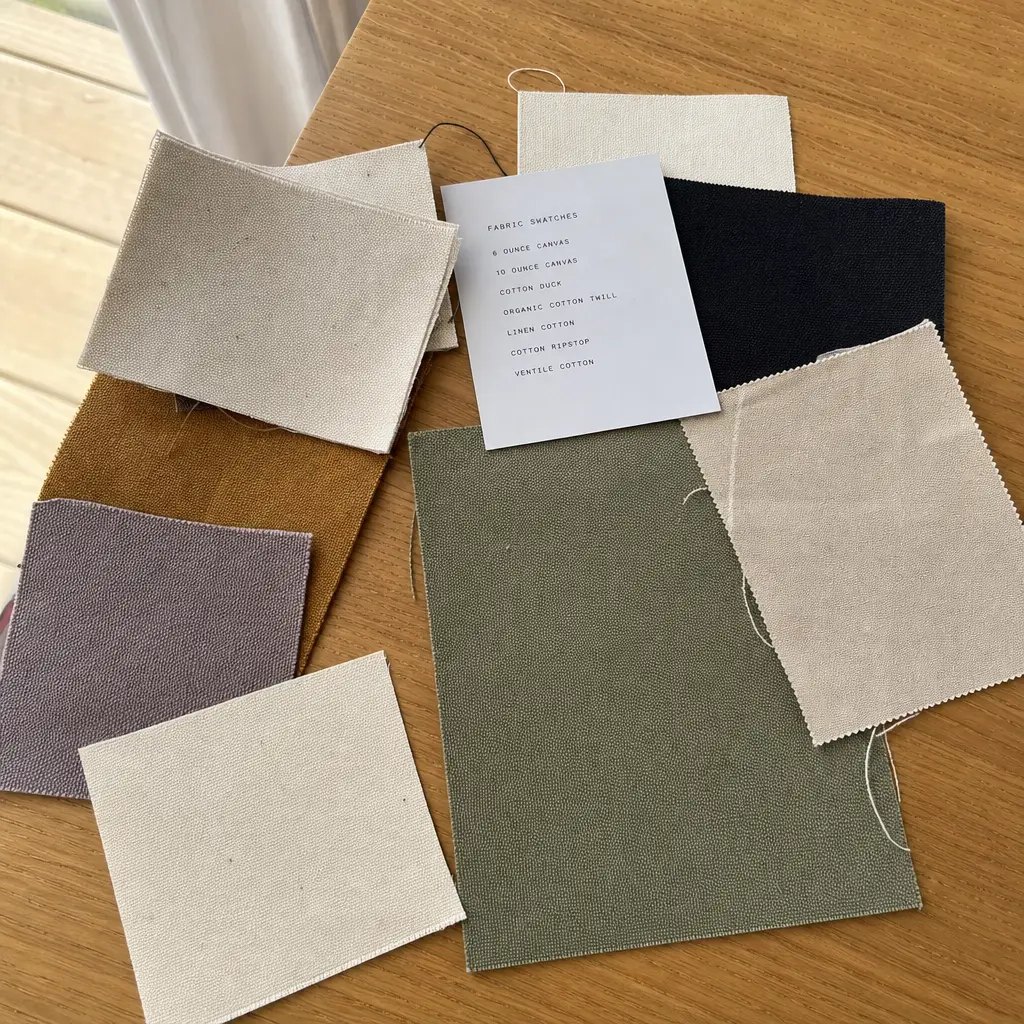
Cotton canvas usually offers a denser feel and stronger body. It is often a better fit for startup welcome kits and merch because it gives the front panel more stability and typically improves logo presentation. Buyers should still ask for a physical swatch because the word canvas is not used consistently across all factories.
Natural cotton is commercially efficient and pairs well with simple startup logos, but it may show normal slub, seed fleck, and shade variation. Dyed cotton or black canvas can look sharper for certain brand systems, yet it may add color-control requirements, MOQ pressure, and longer material lead time.
Recycled cotton blends can support sustainability goals, but they should be described precisely. Ask for the fiber composition and approve the surface appearance before bulk. Recycled blends may differ from virgin cotton in shade uniformity, hand feel, and print sharpness.
- Write the construction into the RFQ: plain cotton, cotton canvas, dyed canvas, or recycled blend
- Ask for swatches from the quoted material, not only a reference photo
- Approve natural cotton variation standards if shade and slub visibility matter
- Confirm whether dyed fabric is stock material or custom dyed for the order
Translate kit contents into a bag spec
Internal teams often describe the project as an event bag, onboarding bag, or merch backpack. Those labels are too broad for factory quoting. A better RFQ lists the actual contents: A5 or A4 notebook, folded T-shirt, employee badge, charger kit, mouse, bottle, stickers, booklet, or power bank.
Small electronics create concentrated stress. A charger brick or power bank may not take much space, but it shifts inside the bag and pulls at the lower corners. When those items are included, buyers should review not only GSM but also corner reinforcement, stitch density, cord channel strength, and cord comfort.
A simple load test during sample approval is valuable. Put substitute items of similar weight into the blank sample, close the cords, and carry it for a few minutes. Watch for panel sag, corner distortion, seam strain, twisting, or cords that dig into the shoulder. This practical review often reveals problems before formal production begins.
For resale merch, evaluate the sample as a customer would. The bag must feel worth owning, not merely acceptable for free distribution. That may justify moving from plain cotton to canvas, increasing cord diameter, tightening print placement tolerance, or improving packing presentation.
- List the contents and estimated total load in the RFQ
- Review dense items such as bottles, chargers, and power banks as stress risks
- Load-test the blank sample before approving the final GSM
- Use a higher perceived-quality standard for resale than for giveaways
Match print method to fabric and artwork
Decoration should be chosen with the fabric, not after it. The same startup logo can look different on 150 GSM plain cotton and 270 GSM canvas because the surface, absorbency, and panel stability are different. Print method, fabric weight, and artwork scale should be approved together.
Screen printing is usually the best-value option for simple one-color or two-color logos at medium to larger quantities. It works well for bold marks and clean typography. To avoid quote gaps, state the print size in centimeters, number of colors, location, and placement reference point, such as centered with the top of artwork 8 cm below the top edge.
DTF or heat transfer can work for gradients, multiple colors, short runs, or artwork that would be expensive to separate for screen printing. The buyer should approve adhesion, edge behavior, hand feel, and gloss level on the exact production fabric. A transfer tested on substitute cloth is not enough.
Embroidery can create a premium look, but it is not automatically better. On light cotton it may pucker or require backing that changes drape. It is more suitable for compact artwork on medium or heavier fabric. If embroidery is considered, review stitch count, backing, placement, and panel distortion during sampling.
- Use screen print for bold simple logos and better volume economics
- State print area, color count, and placement tolerance in writing
- Test DTF or transfer on the final approved fabric and GSM
- Consider embroidery only after checking puckering and backing on the actual bag
Plan MOQ and SKU splits early
Factories and buyers often think about MOQ differently. Buyers may see one total order of 3,000 bags. Factories may see several production variables: fabric color, print artwork, cord color, label, barcode sticker, and packing format. Each variable can create a separate minimum, setup charge, or handling cost.
The most efficient structure is usually one common sewn body with limited variation. For example, a startup may use the same natural cotton canvas bag and split only the front print across regional teams, accelerator cohorts, or sponsor logos. This is usually simpler than changing fabric color, trim, and packaging for every version.
Ask whether MOQ applies per total order, per fabric color, per artwork, per label, or per packing format. Also ask what setup charges apply when one base bag is split across two or three prints. This prevents a low headline MOQ from becoming expensive once the SKU plan is revealed.
If the program is new, simplify the first run. Use one body color, one cord, one size, one packing method, and only essential print variations. Once demand or internal usage is proven, later orders can add custom colors, woven labels, or retail packing with better volume confidence.
- Separate sewn-bag MOQ from artwork, label, trim, and packing minimums
- Use one shared bag body when multiple logo versions are needed
- Ask for setup charges by screen, artwork, or colorway before PO approval
- Keep first-run merch programs simple until demand is proven
Normalize quotes before judging price
Unit price is only meaningful after the specification is normalized. A cheaper quote may reflect lighter fabric, smaller finished size, thinner cord, a smaller print, weaker reinforcement, bulk packing instead of polybags, or a different trade term. Without alignment, procurement may choose the lowest price for the wrong product.
A useful comparison sheet should include finished size, GSM, construction, fabric color, print method, print area, print colors, cord material and diameter, reinforcement, label type, packing format, carton plan, sample cost, lead time, and trade term. Any blank field should be treated as an assumption, not a confirmed match.
Landed cost matters more than ex-factory price. Heavier canvas increases freight weight, but a bag that is too light can create complaints, replacements, or poor brand perception. Compare realistic scenarios: a lower-cost event version, a standard onboarding version, and a premium merch version. This makes tradeoffs visible to the buying team.
Ask suppliers to state their assumptions. A clear response is useful because it exposes gaps in the RFQ. Vague responses around material, cord, print area, or packing are warning signs, especially when timelines are tied to a launch, conference, or employee onboarding cycle.
- Compare like for like on GSM, size, cord, print area, packing, and trade term
- Track exclusions such as screens, samples, labels, barcodes, and individual bags
- Review landed cost, not only ex-factory unit price
- Ask suppliers what they assumed where your RFQ was incomplete
Approve samples in three stages
A structured sample process reduces production surprises. The first stage is the fabric swatch. Use it to compare GSM options, weave, opacity, color, and hand feel. If choosing between plain cotton and canvas, side-by-side swatches are faster and more reliable than descriptions.
The second stage is the blank sewn sample. Check finished dimensions, top opening, cord path, knot style, side seams, lower corners, and overall balance. Load it with representative contents to confirm whether the selected size and fabric weight are practical. If the bag twists, sags heavily, or feels uncomfortable, revise before printing.
The third stage is the printed pre-production sample. It should use the approved fabric, final construction, intended print method, and correct artwork scale. Review logo size, placement, color appearance, opacity, curing, and how the print looks when the bag is loaded.
After approval, consolidate the standard into one specification file or PO attachment. Include target GSM, tolerance, construction, finished size, cord details, print method, print dimensions, placement tolerance, packing, carton marks, and approved sample reference. This avoids scattered approvals across emails and chat threads.
- Approve swatch first, blank construction second, printed PPS third
- Use the blank sample to confirm size, corners, cord path, and load behavior
- Do not replace the printed PPS with only a digital mockup when branding matters
- Keep one final spec record for production and QC teams
Focus QC on failure points
The highest-value QC checks for cotton drawstring backpacks are practical: fabric accuracy, dimensions, print placement, seam security, lower-corner strength, cord consistency, and packing accuracy. These points affect both user experience and brand perception.
Fabric inspection should compare bulk material with the approved sample and PO. If the order specifies 220 to 270 GSM cotton canvas, a lighter plain weave substitute should not pass because the bag looks acceptable from a distance. Define how GSM will be checked and what tolerance applies.
Dimensions should be measured flat using the agreed method. State whether width is seam to seam and whether height excludes knots. Textile products can vary, so tolerances should be written before inspection rather than negotiated after production.
Print QC should include position, scale, color, opacity, and curing. A minimalist tech logo looks poor if it is visibly off center. Placement should be checked from defined reference points, with a tolerance such as plus or minus 0.5 cm to 1.0 cm depending on bag size and artwork.
Sewing QC should focus on stress zones. Check the top cord channel, side seams, and lower cord-exit corners for skipped stitches, loose threads, seam grin, weak bartacks, or signs of tearing under moderate pull. Cord pairs should be consistent in length, diameter, braid density, knot security, and end finishing.
- Inspect against approved sample and written PO, not only visual impression
- Measure dimensions with one defined flat method
- Check logo placement with reference points and tolerance
- Pull-check cord channel and lower corners as high-stress areas
- Confirm cord diameter, length match, knot security, and clean ends
Control packing, freight, and timing
Packing affects landed cost, warehouse handling, kitting speed, and first impression. Bulk folded packing is often efficient when bags will be inserted into onboarding or event kits soon after arrival. Individual polybags may be useful for barcode control, cleaner storage, direct fulfillment, or retail-style handling, but they add material, labor, and often carton volume.
Ask for pieces per carton, carton dimensions, net weight, gross weight, and carton marks before approving the order. Heavier canvas can push carton weights up quickly. Over-compressed cartons can also create severe creasing, especially on natural cotton. Newly printed bags should be packed only after the print is properly cured to reduce rub and transfer risk.
Lead time should be broken into stages: swatch, blank sample, printed PPS, material sourcing, cutting, sewing, printing, packing, inspection, and ex-factory readiness. This is especially important for dyed fabric, recycled blends, multiple artwork versions, or custom packing.
For startup buyers, missing a conference date, product launch, or onboarding cycle can cost more than a small unit-price difference. The best supplier is not always the lowest quote. It is the supplier that can meet the approved specification, communicate assumptions clearly, and hold the schedule realistically.
- Choose bulk packing or polybags based on receiving workflow
- Confirm carton quantity, dimensions, gross weight, and marks before PO approval
- Avoid over-compression that creates deep creasing or print rub
- Break lead time into sample, material, production, packing, and shipment stages
- Protect event and onboarding dates by prioritizing realistic production schedules
Specification comparison for buyers
| Buying decision | Practical specification | Best-fit use case | Procurement risk to control |
|---|---|---|---|
| Light event giveaway | 4 oz to 5 oz cotton, about 135 to 170 GSM | Brochures, stickers, lanyards, badges, cable pouch, and other light items under about 1.5 kg | Higher transparency, more wrinkling, weaker panel stability, and more stress at cord exit points if users add bottles or power banks |
| Budget kit bag | 5.5 oz to 6.5 oz cotton, about 180 to 220 GSM | Short-term event kits or lighter onboarding packs with T-shirt, notebook, badge, and small accessories | Can look acceptable in photos but still feel thin in hand; check seam strength, cord diameter, and opacity on the actual sample |
| Standard onboarding backpack | 6.5 oz to 8 oz cotton canvas, about 220 to 270 GSM | Startup welcome kits with notebook, T-shirt, charger set, mouse, slim bottle, or office accessories around 1.5 to 3.0 kg | Quotes may vary by weave and finishing even at similar GSM; approve swatch, blank sample, and printed PPS before bulk |
| Premium merch or resale | 8 oz to 10 oz canvas, about 270 to 340 GSM | Staff merch, partner gifts, conference shop items, or brand programs where hand feel and reuse matter | Higher unit cost, heavier cartons, stiffer sewing at the channel, and possible over-specification if the payload is light |
| Simple logo decoration | 1-color or 2-color screen print | Medium to large runs with bold startup logos on natural or dyed cotton | Confirm print size in centimeters, Pantone target if needed, curing, opacity, and placement tolerance |
| Detailed or multicolor artwork | DTF or heat transfer tested on final fabric | Short runs, gradients, many colors, or artwork not suited to screen separation | Risk of edge lifting, gloss mismatch, poor rub performance, or testing on substitute fabric instead of approved bulk fabric |
| Comfortable drawcord | 8 mm cotton rope or cotton-poly braided cord | Moderate loads where shoulder comfort affects perceived quality | Thin cord can feel sharp; confirm cord diameter, braid density, color, length tolerance, and knot security |
| SKU split strategy | One shared bag body with print-only variation | Regional startup teams, accelerator cohorts, sponsor logos, or multiple event versions | MOQ may still apply per artwork, screen, fabric color, label, or packing format; ask for the split before comparing prices |
Buyer checklist before sampling
- Define the expected payload by item and estimated total kilograms before selecting GSM.
- State fabric in both oz and GSM where possible, such as 6.5 oz to 8 oz cotton canvas, approximately 220 to 270 GSM.
- Specify construction, not only weight: plain weave cotton, cotton canvas, dyed cotton canvas, or recycled cotton blend with declared composition.
- Set written tolerances for GSM and dimensions, such as plus or minus 5 percent for GSM and plus or minus 1 cm for finished width and height.
- Confirm finished size in centimeters and define the measurement method, including whether cord knots are excluded.
- Define cord material, diameter, color, braid type, length tolerance, and end finish.
- Lock print method, print area, artwork size, number of colors, placement reference point, and acceptable placement tolerance.
- Request fabric swatch, blank construction sample, and printed pre-production sample on the approved material.
- Ask whether MOQ applies per total order, per SKU, per fabric color, per artwork, per label, or per packing style.
- Confirm packing format, pieces per carton, carton dimensions, gross weight, carton marks, and lead-time stages before PO approval.
Factory quote questions to send
- What exact fabric are you quoting: plain weave cotton or cotton canvas, and what is the nominal GSM before cutting?
- What GSM tolerance can you commit to in bulk, and how will it be checked during incoming or in-line inspection?
- Is the material natural cotton, dyed cotton, yarn-dyed cotton, or a recycled blend? If recycled, what is the fiber composition?
- What finished size is included in the price, and what width and height tolerance do you normally hold?
- What cord material, braid type, diameter, color, and length are included in the quote?
- Do you use the same cord, fabric, and reinforcement method on sample and bulk production?
- What seam construction is used at the side seams, top channel, and lower cord-exit corners?
- What print method, number of colors, print area, and setup charges are included?
- Does MOQ apply per total order, per fabric color, per artwork, per label variation, or per packing format?
- If we split one common bag body across two or three logo versions, what extra screen, setup, or handling charges apply?
Quality-control points to confirm
- Approved fabric construction matches the PO description, including plain weave versus canvas and declared fiber composition where applicable.
- Bulk GSM is checked from the production lot and falls within the agreed tolerance, rather than relying only on supplier paperwork.
- Finished width and height are measured flat by the defined method and remain within the written tolerance.
- Front and back panels are cut square enough that the bag hangs evenly and does not twist noticeably when cords are pulled.
- Print size, placement, color, opacity, and curing match the approved PPS within the agreed tolerance.
- No obvious show-surface defects appear on A-grade goods, including holes, severe slubs, broken yarns, oil marks, large stains, or major shade mismatch.
- Cord channel stitching is even and secure, with no skipped stitches, seam grin, unraveling, or weak top-edge construction.
- Lower cord-exit corners are reinforced as approved and show no tearing risk, weak bartack, or loose stitch density under moderate pull.
- Cord pairs are consistent in diameter and length, knots are secure, and ends do not show severe fray or unraveling.
- Carton assortment, counts, carton marks, gross weight, and packing compression match the approved packing plan.