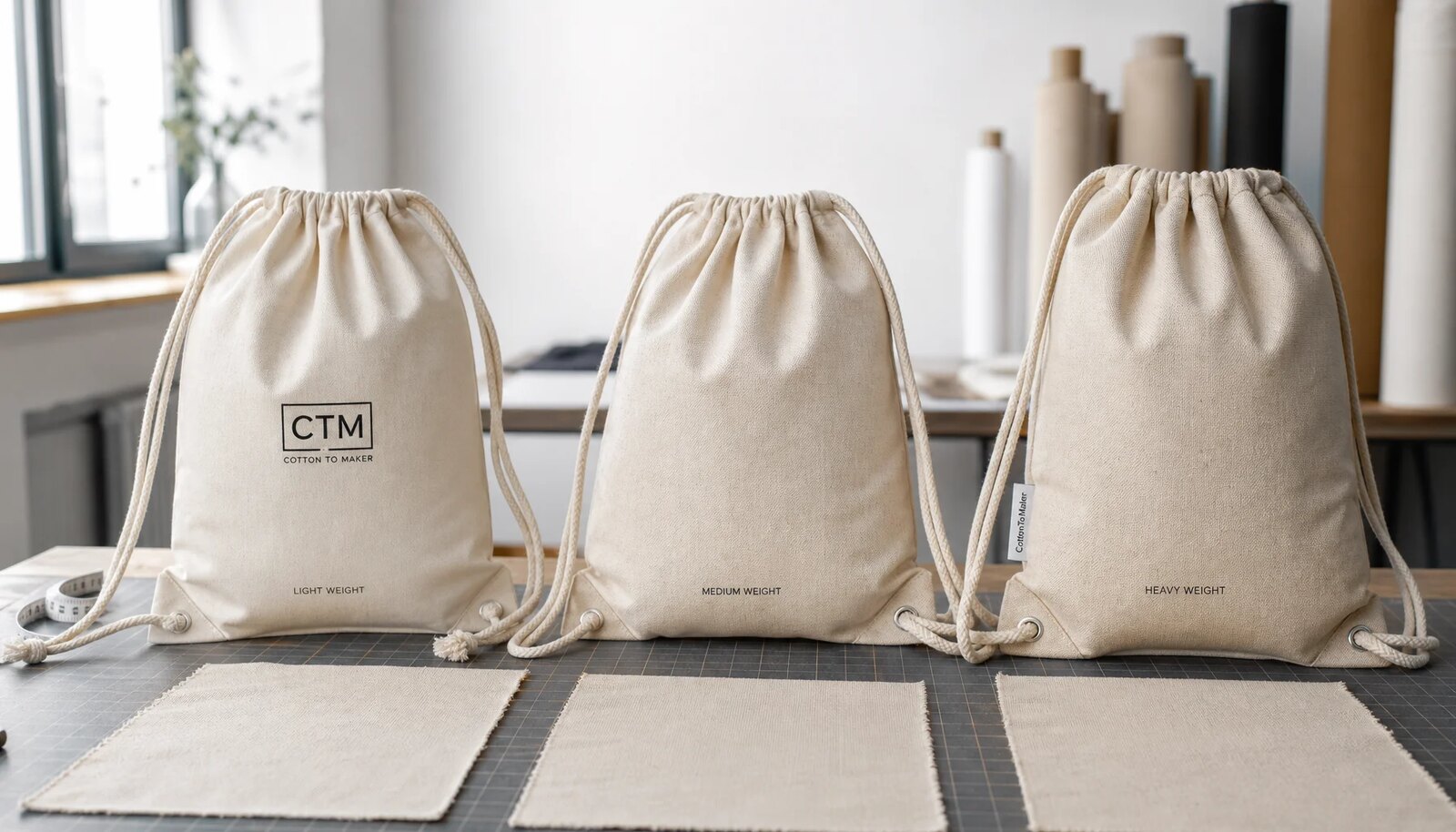
Start With The Load, Not The Price
For wholesale cotton drawstring backpacks for craft fairs, fabric weight is easier to choose after the real job of the bag is clear. A backpack that only holds a flyer, coupon sheet, and small sponsor sample does not need the same cloth as one carrying a candle box, sketchbook, ceramic ornament, or workshop kit. The name may be the same on a quote sheet, but the product can range from a low-cost promotional sack to a reusable event bag or a retail-ready cotton canvas backpack.
Before asking factories for a price, procurement teams should describe the expected contents, approximate load, carrying time, and whether visitors will wear the bag while walking the fair. A flat stack of brochures pulls on seams differently from boxed handmade goods with hard corners. A water bottle or heavy catalog puts pressure on the bottom corners. A bulky class kit may not be heavy, yet it still needs a wide opening, enough internal space, and a drawcord that closes smoothly.
The RFQ should identify the bag’s role: giveaway, sponsor pack, vendor welcome bag, gift-with-purchase, paid merchandise, or class kit. That one line prevents a common buying problem: suppliers quoting the thinnest cotton that can technically meet the description. It also gives the factory a reason to recommend the right cord diameter, lower-corner reinforcement, print method, and carton pack.
Fabric weight matters, but it is not a shortcut for durability. A 200 GSM cotton bag with weak cord anchors can fail before a lighter bag with proper reinforcement. A 270 GSM canvas sample can look strong on a table but feel uncomfortable if the cord is thin. The better buying question is not simply “What GSM is best?” It is “Which GSM, construction, cord, and reinforcement will carry our contents at the target cost and delivery date?”
- For paper-only packs, confirm that show-through and a soft promotional hand feel are acceptable before selecting 150 to 170 GSM cotton.
- For general craft fair reuse, start around 180 to 220 GSM and check fabric opacity, print clarity, and cord comfort on a physical sample.
- For paid merchandise or heavier handmade goods, consider 250 to 280 GSM cotton canvas with stronger lower-corner reinforcement.
- For bulky kits, confirm finished size, opening width, drawcord function, and folding method instead of relying on GSM alone.
- For every order, document expected load and carry time so suppliers quote against the same performance target.
Compare Fabric Weights In GSM And Oz
Quotes become much easier to compare when fabric weight is stated in GSM and, where useful, the familiar ounce description. GSM means grams per square meter and gives buyers a measurable basis across suppliers. Ounce terms such as 5 oz, 6 oz, and 8 oz are common in cotton bag sourcing, but they are not always used consistently. Two suppliers can both write “6 oz cotton” and still mean different GSM ranges, finishes, or weave densities.
Budget cotton drawstring backpacks are often in the 150 to 170 GSM range, commonly described as roughly 4.5 to 5 oz cotton. This fabric is soft, light, easy to fold, and useful for high-volume event distribution. It is not the best choice when the buyer wants a retail feel, stronger opacity, or support for heavier contents. Natural cotton at this weight may show dark items through the panel and can look less structured when displayed at a booth.
The balanced range is approximately 180 to 220 GSM, often quoted near 6 oz depending on supplier convention. This is a practical starting point for many wholesale cotton drawstring backpacks for craft fairs. It usually gives better opacity and a more reusable feel than lightweight cotton while remaining easier to pack and ship than heavy canvas. For vendor kits, sponsor packs, workshops, and light retail giveaways, this middle range often deserves the first sample review.
Premium cotton canvas is usually around 250 to 280 GSM, commonly called 8 oz canvas. It has more body and perceived value, which helps when the backpack is sold, bundled with handmade goods, or used as part of a paid class kit. The upgrade changes more than fabric cost. It can affect sewing speed, needle selection, drawcord closure, carton quantity, carton gross weight, and freight economics.
- 150 to 170 GSM: budget cotton for brochures, coupons, lightweight samples, and short-duration handling.
- 180 to 220 GSM: balanced cotton for reusable fair bags, vendor packs, sponsor programs, and workshop kits.
- 230 to 240 GSM: bridge range when buyers want more body but do not need full 8 oz canvas.
- 250 to 280 GSM: cotton canvas for resale, heavier goods, premium kits, and stronger shelf presence.
- 300 GSM and above: durable but bulkier, less compact, and sometimes too stiff for a simple drawstring backpack.
Specify Construction Behind The Weight
GSM tells you the mass of the fabric. It does not tell you everything about how the backpack will behave. Cotton fiber quality, yarn size, weave density, finishing, washing, bleaching, dyeing, and calendaring can all change hand feel, print result, and dimensional stability. A tightly woven 190 GSM cotton may feel more stable than a loose 210 GSM fabric. A 270 GSM canvas may be firm and structured, or softer and more flexible, depending on yarn and finish.
Buyers should ask for construction details together with GSM. Plain weave cotton is generally softer and more packable, which helps for large event cartons and simple giveaways. Cotton canvas has more body and better abrasion resistance for repeated handling or heavier contents. Twill and specialty weaves may be available, but they need careful review for print clarity, price, and lead time. If the supplier can provide yarn count, weave density, or a fabric data sheet, keep it with the quote record.
Finish is another source of variation. Natural cotton is common and cost-effective, but it may show cotton seed flecks and lot-to-lot shade differences. Bleached cotton gives a cleaner white ground for artwork but can show dirt more easily. Stock dyed fabric may reduce lead time compared with custom dyeing. Custom dyed fabric needs lab dip approval, shade tolerance, and color fastness expectations. Washed cotton can feel softer, but the buyer must confirm shrinkage and when final size is measured.
Avoid vague material descriptions in procurement documents. “Eco,” “premium,” “heavy,” and “natural style” are not enough for a controlled order. Useful RFQ language names the GSM, weave type, finish, color basis, tolerance, and approved sample reference. If certification is required, ask for documentation that applies to the material and transaction scope, not only a marketing statement.
- Ask for GSM, weave type, finish, fabric color basis, and whether the material is stock or custom sourced.
- Separate acceptable natural seed flecks from stains, oil marks, dirt, mildew, or other contamination.
- For dyed bags, request lab dip approval, bulk shade tolerance, and color fastness basis before cutting.
- For washed finishes, confirm shrinkage and whether final measurements are taken before or after washing.
- For certified cotton claims, request valid documentation and transaction scope before using the claim in marketing.
Calculate Landed Cost Before Upgrading
Heavier cotton usually raises the FOB unit price, but landed cost is the number procurement ultimately has to defend. Fabric weight can change cutting yield, sewing speed, needle and thread choices, print curing, packing quantity, carton dimensions, carton gross weight, freight cube, warehouse handling, and event distribution. A bag that looks only slightly more expensive on a unit quote can become less attractive once cartons are packed, measured, and shipped.
Lightweight 150 GSM cotton can pack tightly and move efficiently, which matters for high-volume giveaways. The tradeoff is perception and performance: more show-through, a softer hand, and higher risk of panel distortion if the print is large or the contents are heavier than planned. On the other side, 270 GSM canvas can support a premium position, yet it may reduce pieces per carton and increase handling weight. Those details matter when goods ship to multiple fair locations or are couriered in separate cartons.
The cleanest comparison is a controlled price grid. Ask each factory to quote the same finished size, same print, same cord, same lower-corner reinforcement, and same packing across three fabric ranges: 150 to 170 GSM, 190 to 210 GSM, and 260 to 280 GSM. This separates the cost of the fabric upgrade from hidden changes in construction. It also shows whether the supplier is actually comparing equivalent backpacks.
Do not assume the heaviest option is automatically the best option. A midweight 200 GSM cotton backpack with a clean print, comfortable cord, and reinforced corners may be the best cost-performance choice for many craft fair programs. Canvas is easier to justify when the bag is sold, reused, or packed with heavier handmade products. For simple paper inserts, it can be over-specification.
- Request carton quantity, carton dimensions, and gross weight for each fabric weight option.
- Compare landed cost per usable backpack, including freight cube, handling, rejects, labeling, and repacking labor.
- Keep cord, reinforcement, print method, and packing identical when comparing fabric weights.
- Ask whether heavier fabric changes sewing speed, needle selection, lead time, or pieces per carton.
- Reject low FOB comparisons that depend on weaker corners, thinner cord, or unclear fabric weight.
Match Print Method To Fabric And Artwork
Craft fair backpacks often carry sponsor logos, event names, booth graphics, seasonal artwork, vendor names, workshop titles, or retail branding. The print result depends on fabric weight, weave texture, fabric color, artwork detail, and ink system. A logo that looks crisp on a digital mockup can soften on natural cotton or textured canvas. The RFQ should define the print in production terms, not simply say “logo on front.”
Screen printing is usually the most practical choice for wholesale cotton drawstring backpacks with one to three solid colors. It scales well, works for repeat event programs, and keeps unit cost predictable. Buyers should state final print size, position, color count, Pantone references, ink type if required, and whether screen or setup charges are included. Large solid ink areas can stiffen lightweight cotton, while fine reversed text can fill in on canvas.
Heat transfer can be useful for smaller artwork splits, many colors, gradients, or detailed graphics where screen printing becomes inefficient. It needs its own approval checks. Look at hand feel, edge adhesion, folding behavior, and cracking risk. A large transfer on a soft cotton bag may feel more like a patch than a textile print. If the backpack will be folded through the artwork, approve the fold on the actual sample.
Digital printing can handle complex artwork, but it should be reviewed on the same cotton fabric and color as bulk production. Natural cotton is not a bright white ground, so colors may appear warmer or more muted. Dark dyed cotton may require a different ink system, pretreatment, or underbase depending on the method. For paid merchandise, a printed strike-off should be mandatory before bulk production starts.
- Provide vector artwork, final print dimensions, print position, color count, and Pantone or buyer color references.
- State minimum line thickness and minimum text height, especially for canvas or coarse weaves.
- Use screen print for solid logos and repeat wholesale orders with limited colors.
- Use heat transfer or digital print after checking hand feel, adhesion, color strength, and folding performance.
- Approve strike-offs on the same fabric weight, same fabric color, and same print position as bulk.
Control Stress Points In The Build
Most failures in cotton drawstring backpacks happen at stress points, not in the center of the panel. The lower cord attachment, bottom seam, side seams, top cord channel, and cord itself need clear specifications. A quote that says “standard sewing” can hide big differences in reinforcement, stitch density, seam allowance, and cord quality.
Lower-corner reinforcement should be named by construction. Common options include triangular fabric tabs, inserted corner patches, grommets or eyelets, bar tacks, dense backstitching, or a combined method. For craft fair use, bar-tacked or securely backstitched cord anchors are often a practical requirement, especially if the bag may carry catalogs, books, bottles, or boxed handmade goods. If eyelets are used, inspect for tearing, pulling, or metal movement under load.
Cord specification deserves the same attention as fabric. Include material, diameter, finished length, color, and finish. Cotton cord supports a natural look and may suit brands emphasizing cotton materials. Polyester cord is smooth, consistent, and often strong for carrying. For heavier loads, 4 to 6 mm cord is usually more comfortable than very thin cord, although the best choice depends on bag size, channel width, target price, and expected load.
The top channel should allow the cords to move without catching. Print placement should stay clear of areas that distort when the bag closes, especially near the channel and lower folds. Retail programs also need standards for thread trimming, label placement, hangtag attachment, barcode readability, and visible seam ends. These details may sound small, but they are what separate a giveaway bag from a product ready to sell at a craft fair booth.
- Define lower-corner reinforcement by construction instead of using vague words such as strong or premium.
- Specify cord material, diameter, finished length, color, and acceptable length tolerance.
- Set stitch density expectations for side seams, bottom seam, and top channel where the factory can confirm them.
- Check that seam allowance is suitable for the fabric weight and expected load.
- Keep print placement away from high-distortion areas near the drawcord channel and bottom folds.
- For retail resale, define thread trimming, label placement, hangtag attachment, and barcode readability.
Manage MOQ, Splits, And Capacity
MOQ for wholesale cotton drawstring backpacks is rarely just one total number. It may be driven by fabric stock, dyeing, cutting efficiency, print setup, sewing line planning, packing separation, and inspection. A buyer may ask for 5,000 pieces, then split the order into several bag colors, three fabric weights, twenty sponsor logos, and separate destination cartons. Each split adds cost and control risk.
The most efficient strategy is to standardize the base bag wherever possible. Use one fabric weight, one finished size, one cord, one reinforcement method, one print position, and one packing method. Then split artwork only where the quantity justifies setup and handling. This keeps cutting and sewing stable while still allowing fair names, sponsor marks, regional versions, or vendor logos.
Custom dyed cotton needs earlier planning than natural or stock dyed fabric. Dyeing can bring higher MOQ, lab dip approval, bulk shade variation, and color fastness questions. If an exact brand color is not essential, stock natural, black, navy, or another available color may reduce lead time and cost. If brand color is essential, build lab dip review and bulk shade approval into the schedule before cutting.
Version control should be treated as a procurement issue, not only a warehouse issue. Ten artwork versions packed without clear inner labels can create shortages that are discovered only after delivery. The quote should show pricing by artwork quantity tier and list surcharges for separate packing. For distributors serving multiple craft fairs, a grid by fabric weight, order quantity, artwork count, and packing split is more useful than one blended quote.
- Ask for MOQ per fabric weight, fabric color, artwork version, print method, packing version, and shipping destination.
- Use stock fabric and shared print positions when version quantities are small.
- Request screen charges, setup fees, and below-MOQ surcharges as separate line items.
- Pack and label versions separately when goods ship to different booths, sponsors, or destinations.
- Confirm whether the factory can manage the required version count without extending lead time or increasing mispacking risk.
Approve Samples With Written Tolerances
A pre-production sample should represent the intended bulk backpack, not a convenient showroom sample. If the order uses 200 GSM natural cotton, two-color screen print, 5 mm polyester cord, reinforced corners, and bundled packing, the sample should use those same inputs. A sample made from smoother fabric, heavier cotton, or a different cord can make the order look safer than it really is.
Sample review should combine measurement with practical handling. Measure the finished size flat, check the fabric weight against the quoted GSM, confirm print placement, and inspect the sewing. Then load the bag with realistic craft fair contents. Look for show-through, logo distortion, cord smoothness, corner stretching, and shoulder comfort. A sample that passes on a desk may still feel wrong when carried.
Written tolerances should be agreed before bulk production. Common practical tolerances for simple cotton drawstring backpacks include plus or minus 1 cm for finished size, plus or minus 5 percent for GSM, and plus or minus 5 mm to 10 mm for print placement depending on artwork size and fabric movement. These figures should be confirmed with the supplier and adjusted for oversized bags, complicated prints, or special constructions.
Both buyer and factory should keep an approved reference sample. Photos with rulers help document size and placement, but physical samples are better for hand feel, shade, cord function, print texture, and folding. For multiple artwork versions, approve the base bag as a full sample and request strike-offs for versions with fine detail, light ink on dark fabric, small text, or high brand sensitivity.
- Approve fabric swatch, printed strike-off, full sample, cord, reinforcement, label, and packing method before bulk production.
- Record GSM test method and agreed tolerance instead of relying only on supplier description.
- Measure print placement from fixed edges and photograph the approval sample with a ruler.
- Load-test the sample with realistic contents and check corner stitching, cord comfort, and draw action.
- Keep one signed sample with the buyer and one with the factory for production and final inspection reference.
Plan Packing For Event Readiness
Packing decisions affect event readiness as much as the backpack itself. Craft fair orders often have fixed launch dates, sponsor versions, warehouse kitting, and multiple destinations. Poor packing can create sorting labor, mixed artwork versions, wrinkled bags, carton shortages, or delayed booth setup even when the product workmanship is acceptable.
Flat packing is usually practical for cotton drawstring backpacks because it protects the front print and makes counting easier. Bulk bundles of 25 or 50 pieces can reduce packaging cost and waste for giveaways. Individual polybags protect against dirt and moisture and may be necessary for retail resale, but they add cost, time, and packaging material. For retail programs, hangtags, barcode labels, and consistent folding should be included in both quote and sample.
Carton details belong in the quote stage. Heavier 8 oz canvas may require fewer pieces per carton to keep gross weight manageable. Over-compressed cartons can crease prints, deform cords, and make natural cotton look wrinkled when unpacked. If event staff will move cartons by hand, set a maximum gross weight that the receiving team can handle safely.
Version control is a major QC point. Carton labels should show PO number, item, fabric color, artwork version, quantity, carton number, total cartons, and destination if applicable. Inner bundle labels help when cartons are opened and redistributed. If backpacks are packed by fair location or sponsor kit, the packing list should match that structure rather than showing only total units.
- Define individual polybag, bulk bundle, bundle quantity, carton quantity, carton dimensions, and maximum gross weight.
- Avoid folding directly across thick printed areas when an alternative fold is possible.
- Use inner bundle labels for multi-version or multi-destination orders.
- Require carton labels with PO number, style, color, artwork version, quantity, carton sequence, and destination.
- Check carton count and random piece count during inspection, not only outer carton markings.
Build Lead Time Around Inspection
Craft fair deadlines are fixed, so sourcing schedules should work backward from the required arrival date. The timeline may include fabric confirmation, lab dip approval, sample production, artwork setup, strike-off approval, cutting, printing, curing, sewing, trimming, packing, inspection, final payment, shipment, customs clearance, receiving, and event distribution. A late backpack order often has little room for recovery.
Stock natural cotton and repeat artwork usually move faster than custom dyed fabric or new multi-color prints. Multiple artwork versions add setup time, drying or curing time, packing separation, and inspection complexity. If the order includes hangtags, barcodes, or destination packing, those files and instructions must be ready before production packing begins. Late label files can delay shipment even after the backpacks are sewn.
Inspection should be booked before the shipment date becomes urgent. AQL-style sampling can be used for appearance and workmanship, but drawstring backpacks also need functional checks: GSM, finished size, print placement, cord pull, corner strength, seam security, stains, odor, carton count, and version labeling. Inspecting after final payment or too close to the event date leaves little leverage for correction.
Air freight may rescue a schedule, but it can erase the cost advantage of a heavier canvas or bulky packing method. The safer procurement approach is to issue the PO with sample approval milestones, inspection window, and latest safe ship date clearly stated. For first-time production, allow extra time for sample correction and strike-off approval.
- Include required arrival date, latest safe ship date, and inspection window in the PO.
- Allow more time for custom dyed fabric, washed finishes, new artwork, and many version splits.
- Approve strike-offs and pre-production samples before bulk cutting wherever schedule allows.
- Book inspection early enough to permit sorting, rework, or replacement if defects are found.
- Do not rely on air freight as the default fix for late approval or excessive version complexity.
Specification comparison for buyers
| Spec decision | Recommended option | When it fits | Buyer risk to check |
|---|---|---|---|
| Budget fabric weight | 4.5 to 5 oz cotton, approximately 150 to 170 GSM | High-volume giveaways, brochure packs, sponsor coupons, lightweight sample inserts, and short-duration craft fair distribution | Can feel thin, show dark contents through natural cotton, distort more during printing, and need clear acceptance of a promotional hand feel |
| Balanced fabric weight | 6 oz cotton, commonly around 190 to 210 GSM depending on mill and finish | Most reusable craft fair backpacks, workshop kits, vendor welcome packs, brand giveaways, and light retail merchandise | Confirm actual bulk GSM by test method; suppliers may call different fabrics 6 oz, and weave density changes opacity and print result |
| Premium fabric weight | 8 oz cotton canvas, commonly around 260 to 280 GSM | Paid merchandise, heavier handmade goods, art kits, books, candles, boxed products, and programs where the bag is part of perceived value | Higher fabric weight increases carton gross weight, can reduce pieces per carton, may require stronger needle/thread, and can make drawcord closure stiffer |
| Fabric construction | Plain weave cotton for foldability; cotton canvas for body and abrasion resistance | Plain weave suits light packs and compact cartons; canvas suits resale, heavier contents, and repeated handling | GSM is not a construction spec; request weave type, yarn count if available, finish, and a bulk-equivalent hand sample |
| Size specification | Common backpack sizes near 35 x 45 cm or 14 x 18 in, adjusted to contents | Flyers, small purchases, notebooks, workshop materials, and fair-day product bundles | Finished-size tolerance should be stated; small size changes affect print placement, usable capacity, carton count, and wearer comfort |
| Cord and reinforcement | 4 to 6 mm cord with reinforced lower corners and bar tacks or secure backstitching | Needed for catalogs, bottles, books, packaged crafts, and any backpack expected to be worn for several hours | Thin cord and weak corner attachment often fail before the fabric panel; test loaded pull and shoulder comfort on the approved sample |
| Print method | Screen print for 1 to 3 solid colors; heat transfer or digital print for detailed small batches | Logos, sponsor marks, booth names, seasonal graphics, vendor versions, and workshop titles | Fine reversed text may fill on canvas; heavy ink can stiffen thin cotton; approve a strike-off on the same fabric and color as bulk |
| MOQ strategy | Standardize one base bag and split only artwork where quantities justify it | Distributors, craft fair organizers, multi-sponsor campaigns, regional events, and recurring vendor programs | MOQ can apply per fabric weight, color, artwork, print setup, and packing version; too many splits raise cost and mispacking risk |
| Packing method | Flat packed, bulk bundled by 25 or 50, or individually polybagged for retail or cleanliness needs | Warehouse receiving, event kitting, vendor distribution, multi-location shipping, and retail resale | Over-compression can crease prints and cords; unclear carton labels cause version shortages and sorting labor |
Buyer checklist before sampling
- Define the intended load in kilograms or pounds, including contents such as flyers, boxed products, books, bottles, candles, craft kits, or retail merchandise.
- Choose the fabric range before requesting price: 150 to 170 GSM budget cotton, 180 to 220 GSM balanced cotton, or 250 to 280 GSM cotton canvas.
- State whether the backpack is a giveaway, workshop kit bag, gift-with-purchase, paid retail item, or vendor merchandise package because acceptable hand feel changes by use.
- Specify finished size, allowable size tolerance, usable opening, cord channel width, cord material, cord diameter, cord length, side seam type, and lower corner reinforcement.
- Send vector artwork with final print size, Pantone or other color references, color count, print position measured from edges, minimum line thickness, and acceptable placement tolerance.
- Confirm whether the fabric is natural, bleached, stock dyed, custom dyed, washed, or certified cotton if required by the buyer’s program.
- Ask whether quoted ounces are based on square yard convention and request GSM confirmation to avoid comparing different fabric weights under the same oz name.
- Request a pre-production sample using the same fabric weight, color, cord, reinforcement, print method, folding method, and packing style as bulk production.
- Set written tolerances for GSM, finished size, fabric shade, print placement, print color, stitch density, cord length, carton quantity, stains, odor, and loose threads.
- Clarify MOQ by fabric weight, bag color, artwork version, print color count, packing version, and destination split instead of relying on one total order MOQ.
Factory quote questions to send
- What exact GSM and oz fabric weight are you quoting, and is the oz basis converted from square yard or stated by supplier convention?
- Is the fabric plain weave cotton, cotton canvas, twill, or another construction, and can you provide yarn count or weave density if available?
- Is the quoted fabric stock natural, bleached, stock dyed, custom dyed, washed, organic, recycled blend, or certified cotton, and what documentation is available if certification is claimed?
- What shrinkage, color fastness, and shade tolerance do you assume for the quoted fabric and finish?
- What finished size, size tolerance, seam allowance, stitch density, cord channel width, cord material, cord diameter, cord length, and reinforcement method are included?
- Are lower corners reinforced with fabric tabs, patches, eyelets, bar tacks, backstitching, or another construction, and what load or pull check do you use internally?
- Which print method is included, how many colors, what maximum print area, what minimum safe line thickness, what ink type, and what screen or setup charges apply?
- Will the strike-off and pre-production sample be made on the same fabric weight, same fabric color, same print position, and same cord as bulk production?
- What MOQ applies per fabric weight, per bag color, per artwork version, per print color count, per packing style, and per shipping destination?
- Can you quote a controlled price grid for 150 to 170 GSM, 190 to 210 GSM, and 260 to 280 GSM using the same size, cord, print, reinforcement, and packing assumptions?
Quality-control points to confirm
- Check fabric weight from actual bulk fabric with a GSM cutter or agreed lab method; define tolerance before production, commonly within plus or minus 5 percent unless otherwise agreed.
- Measure finished backpack size flat on a stable table; a common practical tolerance for simple cotton drawstring backpacks is plus or minus 1 cm, but oversized or shaped designs need their own tolerance.
- Verify print placement from top edge and side seams; simple logo placement is often controlled within plus or minus 5 mm to 10 mm depending on size and fabric movement.
- Confirm print color against approved Pantone or buyer reference under consistent lighting, noting that natural cotton ground color can shift perceived ink color.
- Run dry rub, tape adhesion, and visual cracking checks on printed panels after normal folding and handling; add wash testing only if wash durability is a stated requirement.
- Inspect cord length, cord diameter, cord material, cord color, draw function, and channel smoothness because short or rough cords reduce wearer comfort.
- Check lower corner reinforcement with a loaded pull test using realistic contents; look for stitch popping, tearing, eyelet movement, cord slippage, or fabric distortion.
- Inspect side seams, bottom seam, and top channel for skipped stitches, uneven stitch density, open seams, loose threads, needle cuts, puckering, and trapped cord ends.
- Review fabric shade, stains, oil marks, dirt, seed flecks, odor, and mildew risk under consistent lighting; natural cotton may show flecks but should not show contamination.
- Confirm carton quantity by counting bundles and random pieces inside cartons, not only by reading outer carton markings.