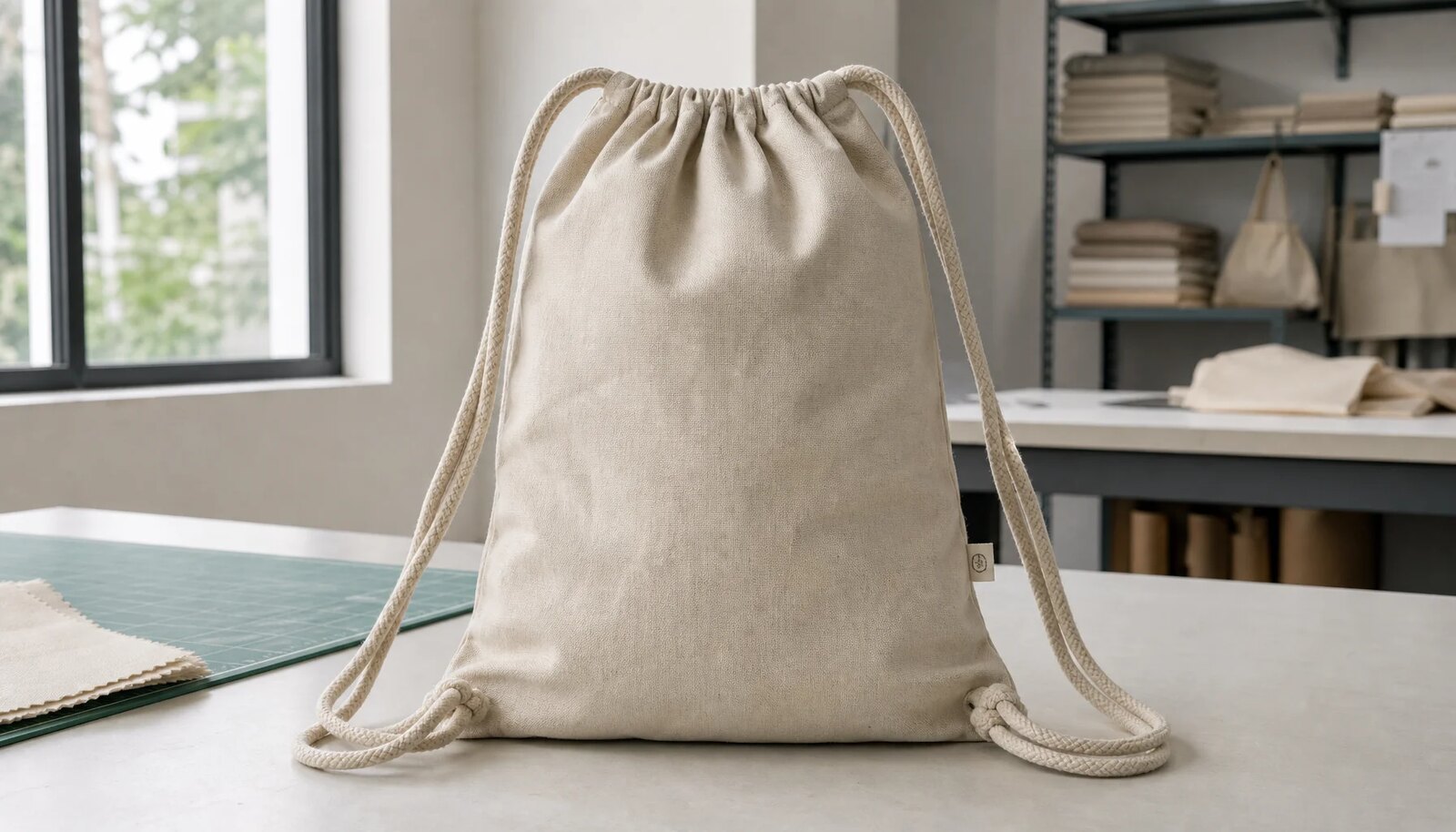
Start with the event load, not the bag name
Event planners buy wholesale cotton drawstring backpacks for a moment that cannot move: registration morning, sponsor distribution, campus orientation, employee onboarding, a trade show opening, or a multi-day conference. The bag is visible, handled quickly, and often judged before anyone reads the agenda inside it. That is why procurement should treat the item as an event-critical product, not a generic promotional giveaway.
Begin with the planned contents. A brochure-only bag may carry less than 0.5 kg. A mixed event kit with a notebook, lanyard, pen, snack, sample card, and small bottle may reach 1.0-1.8 kg. Sponsor kits with catalogs, boxed samples, chargers, or aluminum bottles can exceed that. If the supplier does not know the load, they may quote a light paper-collateral bag while the event team quietly plans to add heavier items later.
Map the handling path as well. Will bags ship empty to a venue, arrive prefilled from the factory, move through a warehouse kitting line, or be stuffed by volunteers the night before opening? Will cartons be opened once, or split across several regional events? A bag carried for ten minutes needs different proof than a bag worn through sessions, hotel transfers, expo halls, and evening programming.
This is the real purpose of a wholesale cotton drawstring backpacks for event planners durability testing checklist. It should not copy an apparel inspection sheet and call the job done. It should test the way this specific bag is packed, lifted, closed, opened, stacked, branded, and received. When each supplier quotes against the same use case, price comparisons become far more honest.
- Ask the event owner for planned contents before requesting supplier quotes.
- Estimate total filled weight and identify rigid items such as bottles, books, boxed samples, or chargers.
- State whether the bag is for short-term distribution, all-day carry, or reuse after the event.
- Tell the supplier whether bags will be packed empty, prefilled, or kitted by a third party.
- Use the same load description for every supplier so pricing comparisons are fair.
Specify cotton fabric in measurable terms
Fabric weight is useful, but it is not a full specification. For event drawstring backpacks, light cotton around 170-200 GSM can work for agendas, paper inserts, and short handling. A more balanced range for mixed swag is often 220-240 GSM. For heavier kits, bottles, premium sponsor packs, or reuse expectations, 240-280 GSM cotton canvas is usually a safer procurement target. Above 280 GSM, the bag may feel more substantial, but carton volume, freight cost, sewing difficulty, and unit price can rise quickly.
Write both the target GSM and the tolerance. A line such as 240 GSM +/-5% gives the supplier, buyer, and inspector the same reference. Without tolerance, one factory may treat 225 GSM as acceptable while another prices true 240 GSM fabric. Ask whether GSM is measured before or after dyeing, washing, finishing, or printing. Processing can change hand feel, shrinkage, surface texture, and even the way a logo sits on the panel.
Weave and finish deserve their own questions. Plain cotton can feel soft and flexible, but it may distort more under print and load. Cotton canvas is typically tighter and more structured, which can help seams and larger logos. Natural cotton has visible flecks and shade variation. Dyed cotton gives a cleaner brand color but raises lot consistency and colorfastness questions. Bleached cotton can create a brighter print base, yet hand feel and shrinkage should be checked before approval.
Be honest about reuse claims. Many event bags are not designed for laundering, but they may still face humidity, venue storage, damp loading docks, or attendee reuse. If the organizer calls the bag reusable, ask the supplier for expected shrinkage after normal washing and confirm colorfastness expectations. That conversation belongs before the PO, not after a sponsor asks why the bag changed shape.
- 170-200 GSM: light paper programs, agendas, and low-load giveaways.
- 200-220 GSM: better hand feel for budget-sensitive bags with modest contents.
- 220-240 GSM: practical middle range for notebooks, pens, samples, and general swag.
- 240-280 GSM canvas: stronger choice for bottles, catalogs, tech items, and reuse expectations.
- Quote fabric as target GSM plus tolerance, such as +/-5%, and confirm how it will be measured.
- Approve a finished sample, not only a fabric swatch, because cutting, sewing, printing, and folding change performance.
Control dimensions and usable capacity
Bag size is easy to underestimate. A quoted 38 x 42 cm drawstring backpack does not mean the full rectangle is usable. The drawstring channel reduces opening depth, seam allowance reduces internal space, and thicker cotton can make the opening feel smaller. If the kit includes A4 documents, letter-size folders, notebooks, bottles, or boxed sponsor products, test the actual contents inside the sample before approving bulk production.
The RFQ should state finished flat width, finished flat height, usable opening width, drawstring channel depth, and measurement tolerance. For standard cut-and-sew cotton bags, a tolerance around +/-1 cm may be practical, but confirm what the supplier can reliably hold. Logo placement tolerance should be listed separately. A bag can meet the size spec while the print sits visibly too high, too low, or off-center across cartons.
Capacity should be checked after closing the bag. Some kits fit when the bag is open but push against the top channel once cords are pulled. That pressure can wrinkle the logo, create extra friction at the cord exits, and cause attendees to pull harder. A rigid notebook corner or bottle base can also press into the bottom seam. In those cases, a slightly larger size or stronger corner construction may solve more than simply choosing heavier fabric.
Do not approve size from supplier photos alone. A sample can look proportionate on a table and still fail the real kit test. Measure it flat, load it with event contents, close it fully, then check hanging shape and shoulder comfort. This small step prevents a surprisingly large share of event-bag problems.
- Measure flat width and height at consistent locations after the bag is smoothed by hand.
- Confirm usable opening width, not only finished width.
- Check whether A4, letter-size, or custom sponsor inserts fit without curling.
- Load the actual kit and close the cords fully before approving size.
- Set print placement from a fixed reference point, such as top edge or centerline.
- Record tolerances for bag size and logo placement separately on the PO.
Build strength into seams and stress points
Cotton fabric rarely fails first in the middle of the panel. Problems usually start where force collects: bottom corners, side seams, top channel stitching, cord exits, grommet holes, label attachments, and seam intersections. A durable wholesale cotton drawstring backpack needs a construction specification, not just a fabric specification. Heavy cotton with weak seams is still a weak bag.
Ask suppliers to describe seam type by location. Light bags may use overlocked internal seams. Heavier event loads may need double-needle stitching, folded seams, reinforced corners, bartacks, or additional stitching at cord exits. Stitch density also matters. Too few stitches can reduce strength. Too many can perforate lighter fabric or create puckering. The quote should state the stitch density normally used, and the sample should show it clearly enough for review.
Seam allowance is a quiet detail with big consequences. A narrow seam allowance can look acceptable while the bag is empty, then fail when thread pulls close to the fabric edge. During sample approval and inspection, look inside the bag as well as outside. Loose threads, skipped stitches, untrimmed ends, uneven seam allowance, twisted panels, and open corners should be classified as defects before production starts.
Added components need the same discipline. A metal grommet can look stronger, but if it is set poorly, it may cut cotton fibers and speed up tearing. A woven label can look premium, but dense stitching can pucker a light panel. Patches, labels, grommets, eyelets, and tabs should be reviewed as functional stress points, not only decoration.
- Specify side seam, bottom seam, top channel, and cord exit construction separately.
- Require reinforcement at bottom corners for loads above light paper use.
- Ask for stitch density and seam allowance targets in the quote or spec sheet.
- Classify skipped stitches, open seams, severe puckering, loose threads, and twisting as QC defects.
- Inspect inside seams during sample approval and pre-shipment inspection.
- Test added labels, patches, grommets, and eyelets as possible weak points.
Treat cords as part of the load system
The cord is not an accessory. It closes the bag, forms the shoulder straps, takes lifting force, and rubs against both clothing and the drawstring channel. A thin cord can make a solid cotton bag feel cheap or uncomfortable. A poorly finished cord can fray, slip through knots, jam in the channel, or pull out during distribution. For event bags that are lifted quickly and repeatedly, cord performance belongs in the RFQ.
Specify cord material, diameter, color, length, and end finish. Cotton cord gives a natural look and can support the product story, but it may fray unless the ends are knotted, stitched, taped, dipped, or otherwise secured. Polyester or cotton-poly cord may be more abrasion-resistant and easier to finish, but it changes hand feel and may not fit every sustainability brief. Natural cotton cannot be heat sealed like synthetic cord, so the finish has to match the material.
Cord diameter should follow the expected load. Narrow cords can work for lightweight conference paper, but they may cut into the shoulder when the bag carries bottles or books. A thicker cord can feel better and look more premium, though it may require a wider channel and increase carton space. Cord color should be approved separately from fabric color; natural cotton fabric with bright white cord may look mismatched unless that contrast is intentional.
Run the cord test with a loaded bag. Close it, lift it by both cords, carry it over the shoulder, open and close it repeatedly, and inspect the channel. Look for friction, twisting, fiber shedding, loose knots, distorted exits, and tearing around grommets or stitched openings. If the cord system is annoying during sample review, it will be worse at registration.
- Quote cord diameter in millimeters, not only as standard cord.
- Confirm cord material and whether it supports the desired end finish.
- Check cord length on a loaded bag so shoulder carry is comfortable.
- Test repeated opening and closing after loading, not only when empty.
- Inspect knots, stitched ends, dipped ends, taped ends, or other finishes for consistency.
- Reject cord systems that distort the channel or tear the exit under the agreed load.
Choose branding that survives handling
Branding is often the reason the event bag exists. Decoration quality should be managed as a performance requirement, not a final cosmetic add-on. Screen printing is usually the most efficient choice for cotton drawstring backpacks with one to three spot colors, especially for larger front-panel logos. It can be durable and repeatable when the ink system, curing, mesh, print pressure, and cotton surface are suitable.
Still, the real test is the actual print on the actual cotton. A digital artwork proof cannot show rub transfer, cracking, ink absorption, or packing pressure. State artwork size, number of colors, Pantone or brand color target where applicable, print location, placement tolerance, and curing or adhesion requirements. Cotton reflects and absorbs ink differently from paper, so brand teams should approve physical samples.
Heat transfer may be useful for complex gradients, photographic artwork, shorter runs, or designs with many colors. The tradeoff is risk of edge visibility, peeling, cracking, or weak adhesion on textured cotton. Embroidery can look premium on heavier canvas, but it may distort lighter cotton or create a rough backing. Woven labels, side tabs, and patches can work well when subtle branding is enough or when the front panel should remain clean.
Decoration also has to survive packing. Many event bags sit folded or compressed in cartons for weeks. Under-cured ink or an unsuitable print surface can lead to blocking, ink transfer, pressure marks, or cracking at fold lines. Approve the printed sample after it has been folded in the proposed packing method, left under realistic compression if practical, and checked again.
- Use screen print for most simple sponsor marks, organizer logos, and repeat programs.
- Ask for ink type, curing method, print size, color count, setup cost, and placement tolerance.
- Test heat transfer for fold cracking, peel, edge visibility, and adhesion on the selected cotton.
- Use embroidery mainly on heavier cotton where stitch density will not distort the panel.
- Consider woven labels or side tabs for subtle branding and cleaner front-panel presentation.
- Check print rub, flex, blocking, and carton transfer before bulk production.
Use a practical durability testing checklist
A good durability testing checklist turns subjective approval into pass/fail expectations. It does not need to become a laboratory protocol for every order, but it should match the risk. A 500-piece local order for paper inserts may need a lighter screen. A 20,000-piece sponsor kit for a fixed conference date should include documented checks for dimensions, seams, cords, print, packing, carton count, and artwork versions.
Start with loaded carry. Fill the sample with the planned kit or a weight-matched substitute. Lift by both cords, carry over the shoulder, set it down, reopen it, close it again, and repeat for a defined number of cycles. For many event orders, 25-50 open-close and lift cycles on the approved load is a useful practical screen. After testing, inspect bottom corners, side seams, top channel, cord exits, grommets, and the overall bag shape.
Add a cord pull check. The buyer and supplier can agree on a practical manual pull test, or use a measured pull test if equipment is available. Define failure clearly: torn cotton at the exit, slipping knots, broken cord, open channel stitching, or grommet movement. For heavier event kits, the cord system should be tested above the expected kit weight to allow for real-world handling.
Decoration checks should include rub and flex. Rub the printed area with a clean white cloth or agreed test material for a defined number of strokes, then check transfer and readability. Fold and unfold across the likely packing crease to check cracking or peeling. For carton behavior, pack several samples using the proposed fold and carton density, place weight on top or review a packed-carton compression simulation, then inspect prints and channels. Photos make the approval traceable.
- Loaded carry: test with the real kit weight and inspect after repeated lifting.
- Open-close cycle: repeat 25-50 cycles for higher-risk event kits and inspect cord friction.
- Cord pull: check tearing, slippage, channel failure, grommet movement, and cord breakage.
- Seam check: inspect bottom corners, side seams, channel seams, and seam intersections after loading.
- Drop check: drop a loaded sample from normal handling height and inspect corners and seams.
- Print rub: check color transfer, flaking, and loss of logo readability.
- Print flex: fold across likely packing lines and inspect cracking or peeling.
- Carton compression: review creasing, blocking, print transfer, and cord channel distortion.
- Count check: verify carton quantity, color, artwork version, and carton labels before shipment.
Approve samples with production traceability
Sample approval only helps when the sample predicts bulk production. A showroom sample can show general workmanship, but it often uses different fabric, cord, thread, print setup, or packing. For event procurement, the key approval is the pre-production sample made with bulk fabric, final cord, final seam construction, final decoration, and final fold method. If any element is not final, the supplier should identify the difference in writing.
Create a simple sample approval record. Measure width, height, opening width, channel depth, cord length, logo size, logo position, label location, and carton fold. Photograph the front, back, inside seams, bottom corners, top channel, cord exits, print close-up, and packed fold. Record fabric GSM, color, decoration method, thread color, cord material, cord diameter, and acceptable tolerances.
A sealed reference sample protects both sides. Keep one with the buyer or procurement team and ask the supplier to keep one signed or labeled with PO number, date, artwork version, and material reference. If a dispute appears during inspection, the reference sample keeps the discussion concrete. It also discourages quiet substitutions such as thinner cord, lighter fabric, changed natural cotton shade, or a different fold.
Be precise with approval language. Do not approve similar fabric, equivalent cord, or close color unless those variations are truly acceptable in bulk. If the supplier needs to change fabric lot, cord source, ink, label, grommet, carton count, or packing method after approval, require disclosure and reapproval before production continues. It is a small control that protects the event date.
- Require a pre-production sample made with bulk materials and final decoration.
- Measure the sample against the written spec instead of approving by visual impression.
- Photograph construction and packing details for inspection reference.
- Keep a sealed approved sample linked to PO number and artwork version.
- List any allowed variations, such as natural cotton shade range, before production.
- Require reapproval for changes in fabric, cord, print method, seam construction, or packing.
Compare suppliers by controls, not price alone
For B2B buyers, supplier comparison should reach beyond unit price. A direct factory may offer stronger control over cutting, sewing, printing, packing, and inspection, but it may require clearer technical communication and higher MOQ. A trading company can coordinate multiple product types or smaller programs, but the buyer should confirm who owns production and QC. A local decorator or stockist can solve tight domestic timelines, though the buyer may accept standard blank quality and less control over cotton weight, cord, and construction.
Ask each supplier the same quote questions. Separate base bag price, decoration price, setup fees, sample fees, packing cost, inspection cost, freight terms, and lead time. Keep the fabric GSM, construction, cord diameter, print size, and packing method the same across quotes. Otherwise, the lowest offer may simply be using lighter cotton, thinner cord, fewer stitches, no pre-production sample, loose carton packing, or a different print method.
Supplier control can be checked through evidence. Ask whether fabric cutting, sewing, printing, and packing are done in-house or subcontracted. Subcontracting is not automatically a problem, but responsibility must be clear. Ask for current production photos or video when available, internal QC records, sample traceability, and batch-level inspection photos before shipment. Generic certificates rarely answer the practical questions that determine whether the bag will work.
Clarify inspection standards before issuing the PO. If the supplier uses AQL inspection, ask what sampling level and acceptable quality limits apply, and how critical, major, and minor defects are defined for cotton drawstring backpacks. Wrong artwork, wet cartons, severe print transfer, open seams, and incorrect quantity should be treated with appropriate severity. Loose threads may be minor unless widespread or affecting function. Definitions make inspection faster and less emotional.
- Compare suppliers using the same fabric, construction, branding, packing, and timeline assumptions.
- Request itemized pricing for bag, decoration, setup, sample, packing, inspection, and freight.
- Confirm who performs sewing, printing, packing, and QC if subcontractors are involved.
- Ask for batch-level evidence, not only generic product photos.
- Define critical, major, and minor defects before production.
- Treat unusually low pricing as a reason to check specifications line by line.
Control packing, cartons, and receiving
Packing is part of durability because bags can be damaged before attendees ever see them. Cotton drawstring backpacks are flexible, so suppliers may compress them tightly to reduce carton volume. That can lower freight cost but create hard creases, print pressure marks, cord channel distortion, and blocking between printed panels. Loose packing brings another set of problems: dust, rubbing, shifting, count errors, and mixed artwork.
Approve the fold method at sample stage. A flat fold may protect a large front logo, while a tight roll can stress the ink and drawstring channel. Individual polybags keep bags clean and make kitting easier, but they add cost, plastic, and unpacking time. Bulk inner bags or paper interleaving can be a useful middle ground when print transfer or dust is the main concern. If reduced plastic is a requirement, state it early so the supplier can quote a workable alternative.
Carton details should be in the quotation. Ask for units per carton, carton dimensions, net weight, gross weight, carton material, inner packing, moisture protection, and maximum carton weight. A carton that is too heavy can be awkward for venue staff and more likely to be damaged in handling. A carton that is too large may crush more easily when stacked. For international freight, moisture control and clean cartons matter because cotton can absorb odors and dampness.
Carton marks are critical for event operations. Labels should identify item name, PO number, color, artwork version, quantity, carton number, total carton count, destination, and any event location code. Avoid mixed cartons unless the receiving team specifically wants them and the mix is clearly labeled. For multi-location events, carton sequencing can prevent registration delays and reduce the chance that one venue receives the wrong sponsor version.
- Approve fold method and carton density before bulk packing starts.
- Specify individual polybags, bulk inner bags, paper interleaving, or no inner packing.
- Ask for carton dimensions, unit count, net weight, gross weight, and maximum carton weight.
- Require moisture protection if shipping route, season, or storage conditions create risk.
- Do not allow mixed artwork, colors, or sizes unless the receiving plan requires it.
- Request packed-carton photos showing labels and carton condition before shipment release.
Specification comparison for buyers
| Procurement decision | Recommended direction | Best fit for event buyers | Risk to verify before PO |
|---|---|---|---|
| Fabric weight | Specify target GSM plus tolerance, commonly +/-5% for controlled bulk orders | Conferences, university events, sponsor kits, trade shows, and attendee giveaways with defined contents | A quoted 240 GSM bag is not equivalent across suppliers unless weave, yarn, finishing, shrinkage, and tolerance are also stated |
| Fabric type | Use plain cotton for lighter programs and cotton canvas for heavier or reusable event bags | Programs where hand feel, print surface, and load capacity matter more than the lowest unit price | Loose weave, uneven slub, or unstable shrinkage can affect print clarity, bag shape, and seam strength |
| Finished size | State flat width, flat height, usable opening width, drawstring channel depth, and tolerance, often +/-1 cm for standard cut-and-sew bags | Events with notebooks, folders, bottles, samples, boxed items, or prepacked registration kits | A nominal size may not fit the actual kit after seam allowance, drawstring channel depth, and fabric shrinkage |
| Construction | Require defined seam type, seam allowance, stitch density, thread standard, and reinforcement at high-stress points | Bags carried between sessions, hotels, shuttles, expo halls, and evening events | Bottom corners, cord exits, and top channel often fail before the fabric body does |
| Cord system | Specify cord material, diameter, length, color, end finish, channel design, and pull performance | Attendee bags expected to carry more than flat paper collateral | Thin cord can fray, jam in the channel, pull out, or feel uncomfortable under a loaded kit |
| Branding method | Use screen print for most spot-color event logos; test transfers, embroidery, labels, or patches before bulk | Sponsor marks, organizer logos, exhibitor packs, and repeat annual programs | Ink curing, placement drift, packing creases, and rub transfer can damage brand presentation |
| Pre-production sample | Approve a sample made with bulk fabric, final cord, final stitching, final decoration, and final fold | Fixed-date events where replacement production is not practical after QC failure | Sales samples are often made from different materials and should not be treated as bulk approval samples |
| Durability testing | Use loaded carry, seam inspection, cord pull, open-close cycling, print rub, print flex, drop, and carton compression checks | Event planners needing a practical wholesale cotton drawstring backpacks durability testing checklist | Pass/fail criteria must be written before production or QC becomes subjective |
| Packing and cartonization | Define fold, inner packing, carton count, carton dimensions, gross weight, carton marks, and moisture control | Warehouse receiving, venue delivery, multi-location programs, and kit assembly lines | Over-compression can crease prints; loose packing can cause rubbing, dust, count errors, and mixed artwork issues |
Buyer checklist before sampling
- Define the event use case: empty giveaway, brochure bag, mixed swag kit, prefilled registration pack, sponsor kit, or reusable attendee backpack.
- List the expected contents with estimated total weight, largest item size, sharp or rigid edges, and whether attendees will carry the bag for minutes or hours.
- Specify target fabric GSM and acceptable tolerance, such as 220 GSM +/-5%, instead of asking only for medium weight cotton.
- State fabric type, weave preference, color, dyeing or bleaching requirement, shrinkage expectation, and whether natural cotton shade variation is acceptable.
- Lock finished flat width, flat height, drawstring channel depth, usable opening width, seam allowance, and measurement tolerance.
- Specify cord material, cord diameter in millimeters, cord length, cord color, end finish, and whether the cord must be comfortable for shoulder carry under load.
- Require seam construction by location: side seams, bottom seam, top channel, bottom corners, cord exits, labels, and any grommet or eyelet points.
- Set stitch density expectations, thread color, loose-thread trimming standard, and unacceptable defects such as skipped stitches, open seams, puckering, or twisted panels.
- Define branding method, artwork size, number of colors, Pantone or brand color target, print location, placement tolerance, and curing or adhesion requirements.
- Request a pre-production sample made from bulk fabric with final cord, final decoration, final construction, and final packing fold before releasing mass production.
Factory quote questions to send
- What exact fabric will be used for bulk production: GSM, tolerance, weave, yarn description, natural or dyed finish, color process, and shrinkage range?
- Is the quoted GSM measured before or after dyeing, washing, finishing, and printing, and how will it be checked during bulk inspection?
- What are the finished flat dimensions, drawstring channel depth, usable opening width, seam allowance, and size tolerance after sewing?
- Which seams are overlocked, single-needle, double-needle, folded, bartacked, or reinforced, and what stitch density per inch or per centimeter will be used?
- How are bottom corners reinforced for loaded use, and can you provide close-up photos of that construction on the pre-production sample?
- What cord material, diameter, length, color standard, and end finish are included in the quote?
- How is the cord exit constructed: stitched channel opening, sewn tab, eyelet, grommet, metal ring, or another method?
- If eyelets or grommets are used, what material are they, how are they set, and how do you prevent cutting or tearing of cotton under load?
- Will the pre-production sample be made from the same fabric lot, cord, thread, stitching setup, print process, and fold method as bulk production?
- What branding method is quoted for each artwork version, and what are the separate costs for screens, setup, embroidery digitizing, labels, transfers, samples, and revisions?
Quality-control points to confirm
- Bulk fabric GSM should be checked against the written tolerance using representative fabric from production, not only the sales swatch or pre-production sample.
- Fabric color should be compared with the approved swatch under a consistent light source, with natural cotton shade variation defined before production if exact color is not required.
- Finished width, height, opening width, channel depth, cord length, and logo placement should be measured against the PO tolerance on randomly selected finished bags.
- Side seams, bottom seams, top channel, and cord exits should show consistent stitch density, secure backtacking or reinforcement where specified, and no open seams.
- Seam allowance should be sufficient and consistent; narrow seam allowance can pass visual inspection but fail under loaded carry.
- Bottom corners should not split, distort permanently, or show thread stress after the agreed loaded carry and drop checks.
- Cords should pull smoothly through the channel without tearing fabric, collapsing the channel, jamming, or causing excessive friction at the exit point.
- Cord ends should resist fraying, knot slippage, stitch failure, or pull-through during repeated opening and closing cycles.
- Grommets or eyelets, if used, should be set evenly without sharp edges, cracking, rust risk, loose setting, or fabric tearing around the hole.
- Print registration should be aligned, edges should be clean, colors should match the approved standard within agreed tolerance, and placement should remain consistent across the batch.