Start With Campaign Use, Not a Bag Photo
Wholesale cotton drawstring backpacks are often quoted from the same simple product photo, but nonprofit campaigns use them in very different ways. One order may hold a leaflet and wristband for a one-day awareness event. Another may carry a T-shirt, bottle, notebook, snacks, school supplies, or sponsor samples through several handling points. Those two bags should not be sourced from the same vague description.
Before requesting prices, write down the expected contents, working load, reuse period, and distribution route. For planning, light awareness kits may sit around 1-2 kg. A typical event kit with printed materials, a T-shirt, lanyard, bottle, and small giveaway can reach 2-4 kg. School supply packs, books, or food-distribution items can exceed that. If the load is higher, the construction must be stronger and the sample must prove it.
Distribution also changes the risk. A bag handed out directly at one event faces less stress than one packed at the factory, shipped by sea, stored in a humid warehouse, split by regional chapters, and then handled by volunteers. Every extra touchpoint increases the chance of wrinkles, cord tangles, carton count errors, print abrasion, and moisture odor.
The stronger RFQ is specific but not overbuilt. Instead of asking for a natural cotton drawstring backpack with logo, request the finished size, GSM range, weave, lower-corner reinforcement, cord diameter, print method, packing plan, sample tests, inspection standard, and lead-time trigger. That gives suppliers room to quote efficiently while preventing silent downgrades in the areas users stress first.
- List expected contents by item and approximate combined weight before asking for prices.
- Classify the use: single-day handout, multi-day event, mailed kit, volunteer pack, school drive, or fundraising merchandise.
- Set a working load target and test above normal use instead of relying on the word durable.
- Map high-risk handling points such as sea freight, chapter re-packing, event storage, courier delivery, and humid warehousing.
- Decide whether the order is driven by lowest cost, donor presentation, repeat use, sustainability positioning, or schedule security.
Choose GSM, Weave, and Finish as a System
Fabric weight is easy to compare, but GSM alone does not guarantee a durable cotton drawstring backpack. A 140 GSM bag can look fine in a quotation photo, then show poor opacity, weak stitch holding, and panel distortion once the user pulls the cords or packs angular items. That fabric may still suit a paper-only handout. It should not be treated as equal to a 200 GSM cotton canvas bag.
For many nonprofit programs, 180-220 GSM is the practical starting range. It gives enough body for better presentation, helps the print sit more evenly, and supports ordinary event-kit loads without moving into a heavy canvas specification. If the bag will be sold as fundraising merchandise, used by volunteers for several days, or filled with school supplies, evaluate 240-280 GSM cotton canvas instead. Heavier fabric can improve perceived value and durability, but it also adds finished weight, sewing bulk, carton gross weight, and freight cost.
Weave tightness matters beside GSM. A loose 220 GSM fabric may stretch around reinforcement points more than a tighter 200 GSM fabric. A coarse canvas can reduce fine logo edge sharpness or QR code scan reliability. Natural unbleached cotton brings a warmer tone and visible seed flecks; that can support a sustainability-led look, but it changes brand colors and buyer expectations. Bleached cotton gives a cleaner base. Dyed cotton adds shade-lot, colorfastness, and MOQ questions.
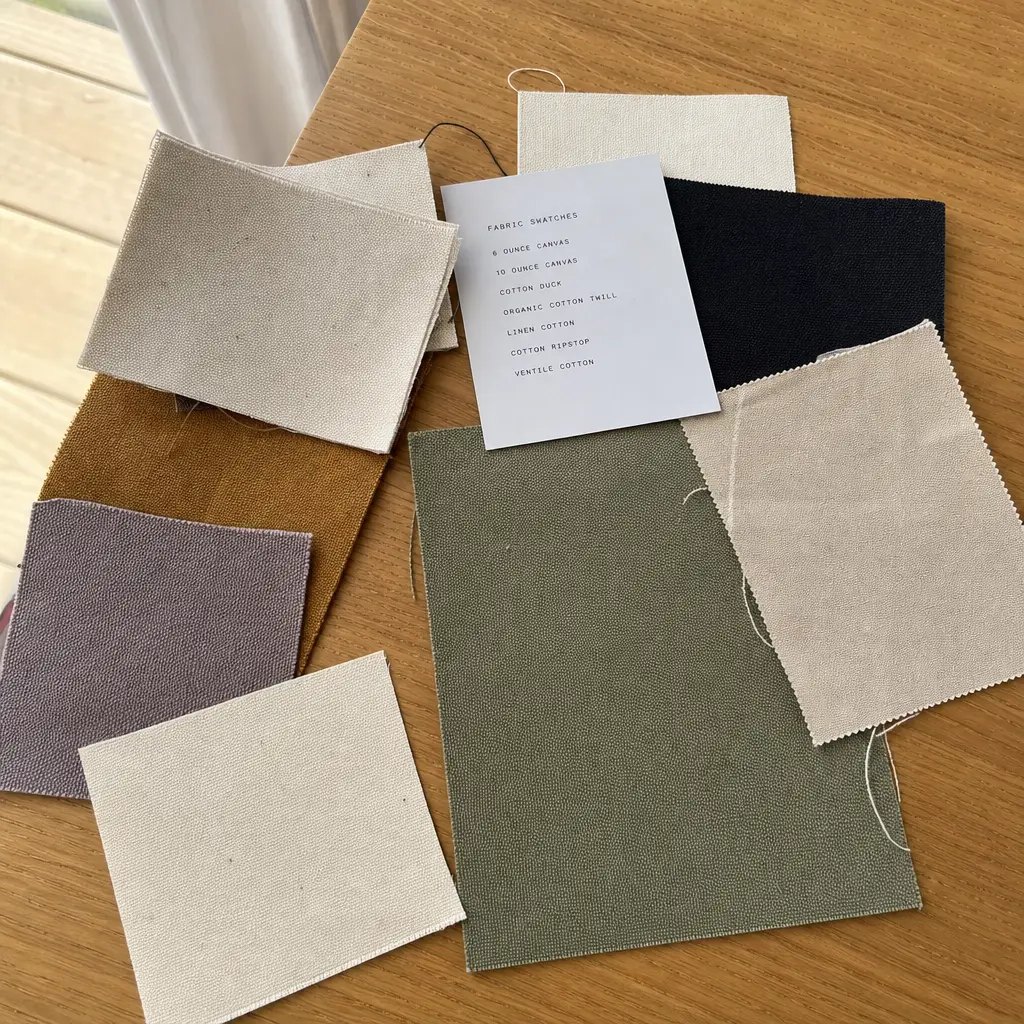
Approve a production-relevant swatch, not only a showroom swatch. Ask whether the fabric is stock, newly woven, or custom dyed. Stock fabric may shorten lead time, but buyers still need to confirm available quantity, shade consistency, and whether all versions can come from the same lot.
- 120-150 GSM: consider for short-term, low-load, paper-based giveaways only.
- 160-180 GSM: use for budget campaigns with light contents and reviewed reinforcement.
- 180-220 GSM: specify for most donor kits, campus drives, awareness events, and volunteer day packs.
- 240-280 GSM: evaluate for school supply drives, heavier contents, repeat volunteer use, and fundraising merchandise.
- Above 280 GSM: check channel stiffness, folding bulk, drawcord movement, needle marks, carton weight, and freight impact.
- Write the GSM tolerance into the PO, commonly +/-5% unless another commercial tolerance is agreed.
Engineer the Stress Points Before Sampling
Most durability complaints do not begin in the middle of the fabric panel. They start where force concentrates: the lower drawcord corners, top channel, side seams, and cord knots. When a user wears the bag, the lower corners carry diagonal pulling force. If the cord is trapped in a weak seam, passed through thin fabric, or held by an eyelet without backing, failure can appear as tearing, seam opening, eyelet pull-out, or cord slippage.
Reinforcement options include self-fabric triangle patches, folded corner tabs, reinforced cord loops, bartacked cord capture, and eyelets with proper washers or backing. None is automatically reliable. A triangle patch stitched too close to the edge can tear. A bartack through weak fabric can rip out. A metal eyelet on light cotton can pull through if the surrounding fabric is not reinforced. Review inside construction, not just the outside shape.
The top drawcord channel is just as important. A narrow channel creates friction and makes the bag hard to close. A weakly stitched channel can open after repeated pulling. Channel height must match cord diameter. A 6-8 mm cord gives a more substantial feel than a thin cord, but it needs enough space to slide. Cotton rope supports a natural material story, while polyester cord can be smoother, less absorbent, and easier to color-match.
Buyers do not need to micromanage every stitch, but the factory should state the construction it is quoting and then replicate the approved sample. For most campaign backpacks, consistent lockstitch seams, clean seam allowance, secure channel stitching, and reinforced lower corners matter more than decorative finishing.
- Require reinforced lower corners for bottles, books, kits, food packs, sponsor samples, or repeat-use bags.
- Ask for close-up photos of the outside and inside lower-corner construction before sample approval.
- Review seam allowance and stitch placement; do not approve a reinforcement just because a patch is visible.
- Match cord diameter to channel height so users can close the bag without excessive force.
- Avoid metal eyelets on light cotton unless backing, rust risk, pull-out resistance, and appearance are approved.
- Record stitch density, bartack length, and reinforcement size on the specification sheet where practical.
Match Printing to Artwork and Cotton Texture
For nonprofit campaigns, the print is often the reason the bag exists. It may carry the organization logo, sponsor mark, campaign slogan, event date, QR code, donor message, or chapter name. Screen printing is usually the most predictable method for bulk cotton drawstring backpacks with one to four solid colors. It works well on flat panels and can be efficient at volume.
The print risks are not complicated, but they are easy to miss. Poor curing can leave tacky ink or cause offset in cartons. Heavy ink blocks may crack on folds. Coarse cotton texture can soften fine edges. A natural cotton base can make brand colors look warmer or duller than they appear on coated paper. Pantone references help, but the printed strike-off on the actual fabric should drive approval.
Heat transfer can work well for detailed sponsor logos, gradients, smaller runs, or many version splits. Test edge adhesion, stiffness, fold resistance, and handfeel before bulk. Digital printing can support complex artwork, but it should be approved only after checking color depth, rub resistance, edge sharpness, and compatibility with the chosen cotton surface.
Print placement should be measurable. State the distance from the top edge, side edge, or centerline, and define acceptable tolerance. For many simple campaign bags, +/-5 mm is practical; tighter tolerances may increase rejects. If a QR code is included, print it at final size on final fabric and scan it with several phones before production approval.
- Use screen print for solid logos, slogans, sponsor marks, and larger bulk quantities.
- Use heat transfer when artwork detail or version count matters more than lowest print cost.
- Use digital print only after checking color depth, rub resistance, edge sharpness, and fabric compatibility.
- Approve a printed strike-off at final size, not only a digital proof.
- Test QR codes on the actual fabric, especially if the code is small or the weave is coarse.
- Confirm curing and rest time before folding to reduce tackiness, offset, and print-to-print transfer.
Run a Practical Durability Test Plan
A durability testing checklist needs numbers, not adjectives. Strong construction and durable quality are difficult to enforce. Static load, drawcord cycles, corner stress, seam checks, rub tests, and fold compression make weaknesses visible before thousands of bags are packed.
Start static load testing from the real campaign contents. If expected use is 2 kg, test at 3 kg or another agreed safety margin. If the bag will carry school supplies, bottles, or books, test higher only when the construction is designed for it. Hang the loaded sample by both drawcords for a defined period, such as 30-60 minutes. Then inspect lower corners, top channel, side seams, cord knots, and fabric distortion. There should be no tearing, open seam, cord pull-out, or reinforcement separation.
Drawcord-cycle testing reflects real use better than one hard tug. Open and close the bag 50-100 times for a basic campaign check. Watch cord alignment, channel wear, user effort, twisting, fraying, and jamming. A bag can pass a static load test and still disappoint users if the cord system is difficult to operate.
Print testing should include dry rub, damp rub, fold compression, and light scratch checks. Use a clean white cloth for rub checks and inspect both the cloth and printed area. Fold the bag as it will be packed, place light pressure on it, and check for cracking, offset, or tackiness. For outdoor walks, food distribution, school programs, or humid storage, add light moisture exposure and odor checks.
- Static load: load to the agreed test weight, hang by cords for 30-60 minutes, and inspect corners, seams, channel, and cord security.
- Pull-cycle: open and close the bag 50-100 times, then check cord movement, channel abrasion, twist, and alignment.
- Corner stress: apply controlled hand tension to both lower corners and compare stitch movement with the sealed sample.
- Seam stress: inspect side seams, bottom seam, and top channel for skipped stitches, thread breakage, seam slippage, or fraying.
- Dry rub: rub the printed area with a white cloth and reject unacceptable ink transfer, dusting, or surface breakdown.
- Damp rub: repeat with a slightly damp cloth to identify poor curing, dye bleed, or transfer risk.
- Fold compression: fold as bulk packing requires, leave under light pressure, then inspect cracking, offset, and logo creasing.
- Moisture exposure: lightly mist or damp-contact samples for outdoor or humid campaigns, then check odor, stains, bleed, and cord swelling.
Compare Supplier Quotes on Equal Terms
A lower unit price often means the supplier quoted a different bag. One offer may assume 140 GSM cotton, thin cord, no reinforcement, one-color print, and loose carton packing. Another may include 220 GSM cotton, reinforced lower corners, thicker cord, better curing time, carton liners, and inspection support. Until those assumptions are visible, the prices are not comparable.
The RFQ should ask every supplier to state fabric GSM, weave, color, finished size, size tolerance, cord material, cord diameter, reinforcement method, print method, print colors, print area, packing count, carton dimensions, carton gross weight, MOQ, sample cost, and lead-time start point. Also ask what is excluded: screens, setup fees, sample courier, individual polybags, barcode labels, custom carton marks, inspection support, and inland transport.
Cost is not controlled by fabric alone. Sewing cost rises with reinforcement, bartacks, labels, tighter trimming, and stricter sorting. Print cost changes with color count, artwork size, registration difficulty, and number of versions. Packing cost changes with individual polybags, paper bands, recycled bags, SKU labels, and chapter allocation. Freight changes with GSM, carton cube, carton weight, and packing efficiency.
The best quote is the one that meets the campaign’s risk profile at the lowest total landed cost. If a supplier offers a much lower price, ask exactly what changed. Savings from lower GSM, missing reinforcement, thinner cord, or reduced inspection may be acceptable for a light handout, but they should be deliberate choices, not surprises.
- Normalize GSM, weave, finished size, reinforcement, cord diameter, print method, and packing before comparing prices.
- Ask for price breaks by total quantity and by artwork version so chapter complexity is visible.
- Separate included costs from extras such as screens, samples, labels, export cartons, carton marks, and inspection support.
- Compare carton quantity, dimensions, and gross weight because freight can erase a low factory price.
- Clarify whether lead time starts after deposit, artwork approval, sample approval, or fabric arrival.
- Require suppliers to confirm any cost-saving substitutions in writing before purchase order approval.
Control MOQ, Versions, and Chapter Allocation
Nonprofit backpack orders often become complicated after the first quote. A national office may start with one master design, then sponsors, cities, languages, event dates, or regional chapters add versions. If the supplier quoted one large production run, the price may not hold once the order splits into many smaller prints or packing groups.
Discuss MOQ by total quantity, fabric color, logo version, print setup, packing label, and shipment destination. A supplier may accept the total order quantity but charge extra for each screen, each color, or each small version. If the base fabric is custom dyed, MOQ may also apply per color lot. These details should be resolved before artwork approval.
The simplest way to protect cost and consistency is to keep one base bag specification across all versions. Use the same fabric, GSM, size, cord, reinforcement, and packing format. Change only the artwork or carton label when possible. This helps the factory buy one fabric lot, cut consistently, sew with the same setup, and inspect against one construction standard.
Use an artwork and packing matrix. It should list version name, quantity, artwork file name, print colors, print size, placement, carton marks, delivery destination, and special labels. During inspection, check version allocation by carton. A shipment can have the correct total quantity and still fail the campaign if one chapter is short while another receives extra stock.
- Separate total order quantity from quantities by chapter, language, sponsor, logo, color, and destination.
- Ask whether MOQ applies per fabric color, artwork version, screen setup, packing style, label, or shipment.
- Use one shared base specification whenever possible to protect consistency and cost.
- Approve an artwork and packing matrix before sample approval, not after bulk production starts.
- Require carton marks showing version, PO number, destination code, quantity, and carton sequence.
- Inspect allocation by version and destination, not only by total unit count.
Design Packing Around Cotton and Distribution
Packing affects product condition and campaign execution. Cotton drawstring backpacks can wrinkle, absorb moisture, pick up carton odor, and show print offset if folded too tightly or packed before the ink is stable. Flat packing is often clean and efficient for event distribution because it protects the front panel and makes counting easier. Bundles of 25, 50, or 100 pieces can work well when labels are clear.
Individual polybags improve cleanliness, presentation, and pick-and-pack control, especially for mailed donor kits, retail-style fundraising, or warehouse fulfillment. They also add cost, labor, packing time, and plastic use, which may conflict with nonprofit sustainability goals. Alternatives include paper belly bands, recycled-content bags, carton-level liners, or labeled bundles.
Review the pre-production sample after it is folded exactly as bulk units will be packed. Check whether the print touches another printed surface, cords are tucked or tangled, the fold crosses the logo, or the front panel shows deep creases. If bags are packed immediately after printing, offset can appear inside cartons even when the first sample looked fine. Ask the supplier to define curing and rest time before packing.
Export carton planning should include carton strength, weight, and handling limits. Lightweight bags may be packed 100 pieces per carton. Heavier 240-280 GSM canvas versions may need 50 pieces to keep cartons manageable. Ask for carton dimensions and gross weight during quoting so freight estimates, pallet planning, and warehouse receiving are realistic.
- Confirm flat pack, folded pack, bundle pack, individual polybag, paper band, or carton-only packing before price comparison.
- Check a folded sample for logo creasing, ink offset, cord tangling, odor, and presentation quality.
- Set carton quantity based on bag GSM, finished weight, carton strength, and handling limits.
- Use carton-level moisture protection for natural cotton during sea freight, humid storage, or long distribution cycles.
- Require carton marks for version, chapter allocation, PO number, quantity, gross weight, destination code, and carton sequence.
- Request carton dimensions and gross weight early for freight estimates and warehouse planning.
Plan Lead Time Backward From the Event Date
Lead time is more than sewing time. A real schedule includes artwork proofing, swatch approval, sample making, sample review, revisions, fabric booking, cutting, printing, curing, sewing, trimming, pressing, packing, inspection, corrective action, export handling, transit, customs, receiving, and local distribution. A stock natural cotton bag with one-color screen print may move quickly. Custom dyed cotton, many artwork versions, strict allocation, or revised samples can add meaningful time.
Nonprofit campaign dates are usually fixed. If the backpacks arrive after the walk, fundraiser, school drive, or volunteer launch, a low unit price no longer matters. Work backward from the required in-hands date. Include internal approval time for sponsor signoff, brand review, budget approval, chapter confirmation, or legal review of campaign messaging.
The purchase order should define what starts the production clock. Some suppliers count from deposit. Others count from artwork approval, pre-production sample approval, or fabric arrival. For custom fabric, cutting may not start until fabric is booked or received. Assign owners and response deadlines to each milestone so delays are visible.
Reserve time for inspection and correction. Final inspection should happen after packing but early enough to rework serious defects before the shipment cutoff. If inspection is scheduled on the last day before vessel closing or air shipment booking, the buyer may have to choose between shipping defects and missing the campaign date.
- Work backward from the in-hands date, including customs clearance, warehouse receiving, and local chapter distribution.
- Define milestones for artwork proof, fabric swatch, pre-production sample, packing method, carton marks, and inspection.
- Clarify whether quoted lead time starts after deposit, artwork approval, sample approval, or fabric readiness.
- Allow one revision window for print size, color, reinforcement, cord movement, or packing fold corrections.
- Schedule inspection after packing but early enough for sorting, rework, or replacement if defects are found.
- Protect curing and rest time before folding to reduce print offset, tackiness, and carton transfer.
Set AQL and Defect Rules Before Production
Quality control should turn expectations into inspection decisions. Inspectors cannot enforce sturdy, premium, or eco-friendly unless the buyer defines measurable checks. The purchase order should include tolerances for GSM, finished size, print placement, color, carton quantity, and functional tests. It should also classify defects as critical, major, or minor.
For cotton drawstring backpacks, front-facing visual inspection is not enough. Random units should be opened, closed, pulled, loaded, measured, and compared with the sealed approved sample. Inspect lower-corner reinforcement, top-channel seam, cord movement, cord length, print rub, stains, odor, carton marks, and version allocation. A bag can look right from the front and still fail if the lower corner is not reinforced or the cord jams in the channel.
AQL levels should match the buyer’s risk tolerance and the importance of the campaign. Many consumer-goods inspections use separate limits for critical, major, and minor defects, but the exact standard should be confirmed with the inspection provider. For campaign bags, critical defects include wrong logo, wrong product, unsafe sharp parts, mildew, severe contamination, unusable drawcord, or wrong campaign version. Major defects include failed load test, torn reinforcement, open seams, severe print defects, incorrect size, missing cord, or wrong allocation.
Share defect rules before production starts. If the supplier knows that missing reinforcement is a major defect and wrong version allocation is critical, it can organize in-line checks and packing controls accordingly. Keep the sealed approved sample, signed artwork proof, packing matrix, and specification sheet available for inspection to reduce disputes and speed corrective action.
- Critical defects: wrong product, wrong logo, unsafe part, mildew, severe contamination, unusable cord, or incorrect campaign version.
- Major defects: torn reinforcement, open seam, failed load test, severe print defect, incorrect size, missing cord, or wrong carton allocation.
- Minor defects: small loose threads, light creasing, slight shade variation, or minor trimming issues within agreed limits.
- Functional checks: load selected units, pull cords, cycle opening and closing, inspect channel wear, and review cord alignment.
- Visual checks: compare print color, opacity, placement, registration, stains, fabric flaws, and workmanship to the sealed sample.
- Packing checks: verify carton count, bundle count, marks, version labels, destination codes, gross weight, and packing list accuracy.
Specification comparison for buyers
| Spec decision | Recommended option | When it fits | Buyer risk to check |
|---|---|---|---|
| Fabric weight | 180-220 GSM cotton for most campaign packs; 240-280 GSM cotton canvas for heavier or repeat-use packs; state GSM tolerance, commonly +/-5% if commercially agreed | Donor kits, volunteer programs, school supply drives, campus campaigns, fundraising merchandise, and sponsor giveaways | Low GSM may look acceptable in photos but fail opacity, seam holding, corner tear, and load checks once bags are packed and handled |
| Fabric construction | Plain-weave cotton canvas for stronger body and stitch holding; tighter cotton sheeting only for light paper-only giveaways | Canvas supports better print stability and perceived value; sheeting can reduce cost for short-duration awareness events | Loose weave can stretch around reinforcement points, distort print edges, increase shrinkage variation, and reduce seam strength |
| Finished size | 34 x 42 cm or 35 x 45 cm for common adult event use; specify +/-1 cm finished tolerance unless tighter control is required | Fits leaflets, T-shirts, lanyards, notebooks, small bottles, school supplies, and sponsor inserts | Oversizing raises fabric usage, carton cube, print area, and freight cost without automatically improving donor experience |
| Drawcord material | 6-8 mm cotton rope for natural look; polyester cord for lower water absorption, sharper colors, and smoother sliding | Cotton rope fits natural and sustainability-led campaigns; polyester is practical for outdoor, youth, and wet-weather handling | Cord that is too thin can cut into the top channel; cord that is too thick can jam, twist, or make the bag hard to close |
| Lower-corner reinforcement | Self-fabric triangle patch, folded cord tab, reinforced loop, or bartacked cord-capture construction; define bartack length and stitch placement | Required for bottles, books, school kits, T-shirts, food packs, sponsor samples, and repeat volunteer use | Unreinforced lower corners are a frequent failure point and may not be visible in front-facing quotation photos |
| Seam construction | Lockstitch seams, clean seam allowance, reinforced top channel, no raw exposed stress edges, and consistent stitch density such as 8-10 stitches per inch where suitable | Appropriate for warehouse re-packing, chapter distribution, courier handling, and repeated cord pulling | Skipped stitches, low seam allowance, uneven tension, or weak channel stitching can open after load, compression, or drawcord cycles |
| Print method | Screen print for 1-4 solid colors; heat transfer for detailed multi-version artwork; digital print only after rub, fold, and wash-like handling checks | Screen print is predictable for bulk cotton backpacks; transfers help when artwork versions are small or complex | Poor curing can cause tackiness or offset; thick ink blocks can crack on folds; small QR codes can lose scan reliability on coarse cotton |
| MOQ logic | Quote MOQ by fabric color, logo version, print setup, packing style, and shipment destination, not only by total order quantity | Useful for national campaigns with regional chapters, sponsor co-branding, multilingual artwork, or staggered deliveries | Headline MOQ can hide stock-fabric limits, screen charges, manual cutting variability, color-lot issues, or high version surcharges |
| Packing plan | Flat pack 50-100 pcs per export carton; define bundle count, carton liner, print protection, desiccant where needed, and carton marks | Works for distributor warehouses, nonprofit chapter allocation, event-site receiving, and campaign kit assembly | Over-compression can cause wrinkles, print offset, cord tangling, count errors, mildew risk, and poor presentation at distribution |
Buyer checklist before sampling
- Define campaign contents by item and approximate total working load; use 2 kg for light kits, 3-4 kg for common event kits, and 5 kg or higher only if the construction is designed and tested for it.
- State the intended use period: single-day handout, multi-day event, mailed donor kit, volunteer use, school supply pack, or retail-style fundraising item.
- Specify fabric GSM, weave, color, finished size, size tolerance, GSM tolerance, shrinkage expectation, and whether seed flecks are acceptable on natural unbleached cotton.
- Define lower-corner reinforcement method, top drawcord channel height, stitch density target, seam allowance target, cord diameter, cord length, knotting, and cord end finish.
- Send vector logo artwork with Pantone or brand color references, final print size, placement from top and side edges, maximum skew tolerance, and version-by-version quantities.
- Ask all suppliers to quote the same specification, including fabric, cord, reinforcement, print method, packing count, carton data, sample terms, AQL, and production lead-time start point.
- Approve a pre-production sample made with production fabric, final cord, final reinforcement, final artwork, final print size, and the same folding method planned for bulk packing.
- Run sample durability checks for static hanging load, repeated drawcord opening and closing, lower-corner stress, seam stress, dry rub, damp rub, fold compression, and light moisture exposure where relevant.
- Define defect classes before production, including wrong logo, missing cord, open seam, torn reinforcement, failed load test, print offset, stains, mildew odor, and wrong chapter allocation.
- Confirm MOQ by total order, fabric color, logo version, print setup, packing method, shipment, and chapter allocation so the quoted price remains valid after version splits.
Factory quote questions to send
- What fabric GSM, weave, yarn count or construction description, finish, and GSM tolerance are included in this quote?
- Is the cotton natural unbleached, bleached, dyed, stock-colored, or custom-dyed, and can you provide swatches from the same fabric quality planned for bulk?
- What is the finished bag size tolerance after sewing, pressing, and packing, and what shrinkage range should we expect if the bag becomes damp or is lightly washed?
- How are the lower drawcord corners reinforced: triangle patch, folded tab, bartack, eyelet, grommet with washer, or cord captured in the side seam?
- What stitch type, stitch density, seam allowance, thread count, and bartack length are used at side seams, bottom corners, and the top drawcord channel?
- What drawcord material, diameter, color, length, colorfastness level, knot style, and end finishing are included in the quoted price?
- What working load do you recommend for this construction, and what static load and drawcord-cycle test can you perform on the pre-production sample?
- Which print method is quoted, how many colors are included, what ink or transfer type is used, and what is the maximum print area before surcharge?
- How do you control print curing before folding, and how long do printed bags rest before compression packing?
- Does the sample fee include a full-size printed pre-production sample made with production fabric, final reinforcement, final cord, and actual packing fold?
Quality-control points to confirm
- Fabric GSM is within the agreed tolerance, commonly +/-5% unless the purchase order defines a different commercial tolerance and testing method.
- Fabric handfeel, weave tightness, color, seed fleck level, surface cleanliness, and opacity match the approved swatch and sealed pre-production sample.
- Finished size is within agreed tolerance, commonly +/-1 cm for simple cotton drawstring backpacks unless the buyer requires tighter control.
- Side seams, bottom seams, and top-channel seams show no open seams, skipped stitches, broken threads, exposed raw stress edges, loose seam allowance, or severe tension imbalance.
- Stitch density, bartack placement, seam allowance, and reinforcement shape match the approved sample at lower corners and cord capture points.
- Lower cord corners withstand the agreed static load test without fabric tearing, seam opening, bartack failure, eyelet pull-out, cord slippage, or visible distortion beyond the approved limit.
- Drawcord slides smoothly through the top channel, closes evenly, does not twist excessively, and remains aligned after repeated opening and closing.
- Cord diameter, material, color, length, knotting, end finishing, and comfort against the shoulder match the approved sample.
- Print position stays within approved placement tolerance, such as +/-5 mm where practical, and shows no obvious bleeding, pinholes, cracking, ghosting, poor opacity, offset marks, or registration errors.
- Print color matches the approved strike-off or Pantone target under agreed viewing conditions, recognizing that natural cotton base color affects final appearance.