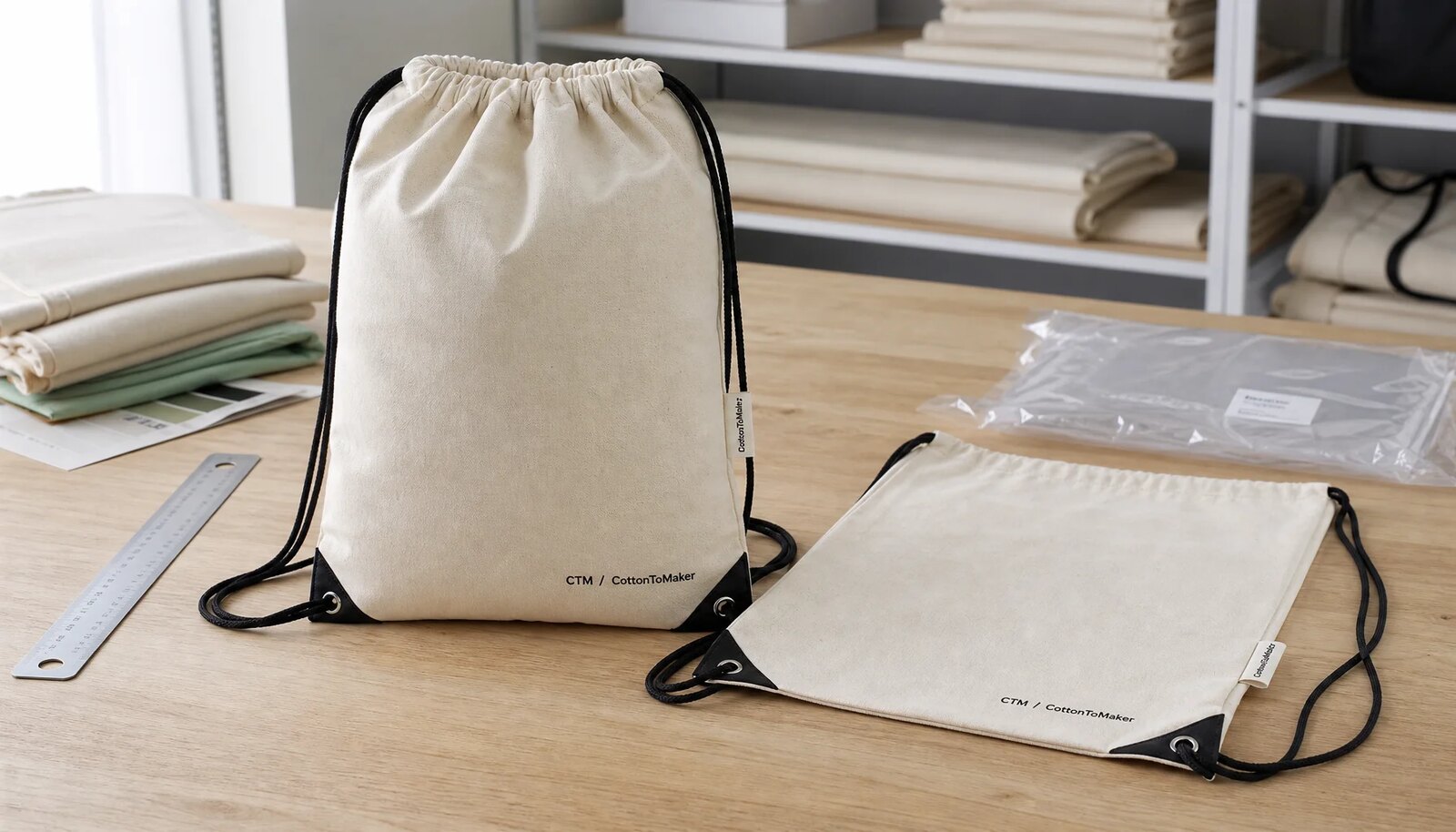
Start With the Actual Craft Fair Job
A good RFQ for wholesale cotton drawstring backpacks for craft fairs starts with a practical question: what will the bag need to do on the event floor? The product name alone is not enough. One supplier may picture a thin cotton sheeting bag for flyers. Another may quote a midweight canvas backpack with reinforced lower tabs. A third may assume a cleaner retail-ready item with labels, barcode stickers, and individual packing. All three could call the item a cotton drawstring backpack, but the buyer would receive three very different prices.
Describe the channel before listing technical specs. Is the backpack an attendee giveaway, an exhibitor welcome kit, a VIP sponsor bag, a resale item at a maker market booth, or distributor inventory for several regional fairs? A map-and-flyer handout can use lighter construction than a bag expected to hold candles, boxed soaps, catalogs, folded apparel, small ceramics, or sponsor samples. If the bag will be sold rather than handed out, the finishing, decoration consistency, and packing standard need to be higher.
The delivery path matters too. Craft fair goods may move through a distributor, decorator, venue dock, local organizer, warehouse, or several regional receiving points. That changes carton marks, routing labels, delivery windows, pallet requirements, and the amount of time available for inspection. When the fair date is fixed, procurement should work backward from the latest acceptable arrival date and leave room for sample review, production, final inspection, export handling, customs, and local delivery.
Keep the opening brief short, but make it useful. Include intended contents, approximate load, audience, artwork purpose, quantity splits, receiving point, and whether the backpack should feel reusable after the event. This helps suppliers quote the same product instead of building assumptions into the price.
- State the distribution use: giveaway, exhibitor kit, VIP bundle, resale item, sponsor pack, or distributor inventory.
- List the heaviest expected contents, such as catalogs, boxed candles, folded apparel, bottled samples, or mixed retail purchases.
- State whether the backpack must be reusable after the fair or only suitable for light paper distribution.
- Identify the receiving point: venue, warehouse, decorator, distributor, organizer, retail buyer, or multiple regional locations.
- Include the latest arrival date, latest ship date if known, and whether inspection must be completed before shipment release.
Specify Cotton Fabric Without Guesswork
Cotton terms can sound familiar and still create expensive misunderstandings. Sheeting, muslin-style cotton, twill, canvas, and cotton-rich blends all behave differently in the hand, under print, and at the seams. For most craft fair drawstring backpacks that should feel reusable, 6 oz to 8 oz cotton canvas, roughly 200 to 270 GSM, is a practical range. Lighter 4 oz to 5 oz cotton can work for flyers and very light inserts, but it may look thin, print unevenly, and offer less confidence at stress points.
Put the fabric into measurable language. Ounce weight is common in canvas buying, while GSM gives the factory and inspector a value to check. A clear line might read: 6 oz cotton canvas, approximately 200 GSM, with agreed GSM tolerance. If the mill can support it, +/-5% is a common type of tolerance to discuss, but it should never be assumed. If a supplier quotes lower GSM to hit a target price, that change needs to appear in the quote instead of being hidden behind the word cotton.
Shade and finish deserve the same care. Natural cotton can range from raw beige to warm ivory depending on yarn, washing, and finishing. Bleached cotton gives a cleaner background for print, but it may not deliver the rustic look many craft fair brands want. Dyed cotton adds lab dip approval, dye lot control, color fastness questions, and often more MOQ pressure. Physical swatches are essential because natural, raw, cream, ivory, and bleached are not safe substitutes for one another.
Ask how the fabric is prepared. Is it stock, greige, bleached, washed, calendered, dyed, or otherwise finished? A smoother surface can improve small lettering and edge clarity. A rougher canvas may look more handmade, but it can break fine lines. If the program requires organic cotton, recycled cotton, or a specific fiber claim, ask what documentation is available and what wording will appear on labels, invoices, or commercial documents.
- Use measurable fabric language: cotton canvas, 6 oz, approximately 200 GSM, rather than cotton bag only.
- Ask for GSM tolerance and where it will be checked: incoming fabric, pre-cut fabric, or final goods inspection.
- Require fiber content disclosure, including whether the bag is 100% cotton, cotton-poly, recycled blend, or organic cotton.
- Approve a physical swatch for natural cotton and lab dip or stock color swatch for dyed cotton.
- Confirm whether the pre-production sample and bulk order will use the same fabric lot, finish, and shade standard.
Set Size, Capacity, and Cord Comfort
An adult promotional drawstring backpack is often around 35 x 40 cm, measured flat. That sounds simple until the bag is reduced by a few centimeters to save fabric. Suddenly catalogs bend, folded apparel fits poorly, greeting card packs sit awkwardly, and small boxes make the bag feel crowded. A larger size may feel more generous, but it can increase fabric consumption, carton volume, and freight cost. The RFQ should state both the finished size and the measurement method.
Tolerances keep soft-goods approvals realistic. A finished size tolerance such as +/-1 cm is often workable for promotional cotton bags when the supplier agrees and the product is measured flat after normal pressing. If the bag is washed, dyed, or heavily pressed, ask whether shrinkage or finishing may affect the final dimension. If retail inserts, display fixtures, or kitting requirements need tighter control, say so before quoting because tighter tolerances may change production handling.
Capacity should be described with real contents, not broad adjectives. Words like strong or durable are less useful than a list of what attendees will carry: brochures, vendor catalogs, business cards, candles, soaps, small ceramics, textile accessories, apparel, bottled samples, or sponsor packs. The item is still a lightweight event backpack, not an outdoor pack, but the tabs, seams, cord, and channel need to match the intended load.
Cord comfort is easy to overlook until attendees wear the bag for several hours. A 5 mm to 7 mm cord is generally more comfortable than a very thin cord. Cotton cord supports a natural look; polyester cord often draws more smoothly and resists dirt better. The channel must be sized around the chosen cord. If the channel is too tight, the backpack feels cheap every time it opens and closes.
- State finished dimensions, such as 35 x 40 cm, measured flat after pressing, with +/-1 cm tolerance if accepted.
- List expected contents and approximate load so the factory can size cords, tabs, and seams appropriately.
- Specify cord material, diameter, color, length if critical, and whether the cord is stock or custom dyed.
- Use 5 mm to 7 mm cord for better comfort when attendees may carry purchases for several hours.
- Confirm that the top channel width is matched to cord diameter and allows smooth opening and closing.
Control the Stress Points
Most failures on cotton drawstring backpacks start in predictable places: the top cord channel, lower cord tabs, side seams, and bottom corners. A front-panel photo can look fine while the construction is underbuilt. Low pricing often comes from narrow seam allowance, loose stitching, skipped bartacks, unreinforced tabs, or cord holes cut directly through cotton. Those details belong in the RFQ, not in a post-shipment complaint.
For reusable craft fair programs, the top channel should usually be double folded so the inside edge is clean and fraying is reduced. It should be wide enough for the specified cord and sewn straight enough that the cord does not bind. Resale and VIP bags need a cleaner interior because end users notice raw edges, loose threads, and uneven seams. Basic giveaway bags may use simpler finishing, but open seams and uncontrolled fraying should still be treated as defects.
Be specific about the lower attachment. Folded fabric tabs, webbing loops, and reinforced bottom corners with bartacks are common options. Eyelets can work, but only when they are properly backed and set. Without backing, an eyelet can loosen, cut into the cotton, or create a rough edge. Direct unreinforced holes through cotton are risky when the bag will carry more than paper.
Ask the supplier to state stitch type, stitch density or factory standard, seam allowance, and reinforcement method. Even if procurement does not dictate every stitch, the quote should make clear what is included. A backpack with bartacked tabs and a double-fold channel is not the same product as one with a simple stitched corner and a narrow single-fold channel.
- Require a double-fold top channel for reusable or resale programs, with no exposed raw edge inside the channel.
- Define lower cord attachment as folded fabric tab, webbing loop, reinforced corner, or backed eyelet.
- Specify bartack or dense reinforcement stitching at lower tabs and other stress points.
- Ask for seam allowance and inside seam finish, such as overlocked, folded, bound, or factory standard.
- Reject unreinforced cord holes for bags expected to carry purchases, catalogs, apparel, or sponsor kits.
Choose Decoration for the Cotton Surface
Decoration is often the reason the backpack exists. Screen printing is usually the most practical choice for one to three solid colors, bold event names, sponsor logos, and simple maker-market graphics. It is cost-efficient at bulk quantities and prints directly on cotton. Still, the artwork has to suit the fabric. Rough canvas can soften fine detail, break thin lines, and make small lettering harder to read.
Heat transfer may fit gradients, photographs, many colors, or fine artwork that does not screen print well. The tradeoff is hand feel. A large transfer can feel stiff or plasticky on a natural cotton drawstring backpack, which may fight against a handmade or eco-leaning event position. Digital printing can help with complex designs or smaller runs, but color consistency, rub performance, and wash expectations should be checked on the selected fabric. Embroidery can look premium, although it adds cost and may pucker lighter fabrics.
The RFQ should give the factory production-ready decoration details. Provide vector artwork where possible, print dimensions, print position, Pantone or brand color references, fabric color, and artwork version codes. Placement should be measured from fixed points, not described loosely. For example: centered on front panel, 10 cm below top edge, print size 22 x 18 cm, placement tolerance +/-10 mm. If sponsor marks sit near seams, fold lines, or bottom tabs, leave enough clearance.
Avoid approving decoration from a digital mockup alone when quantity, event date, or brand standards matter. A strike-off or pre-production sample on the selected cotton fabric is a better reference. Review dry rub, damp rub, fold behavior, ink coverage, tackiness, bleeding, adhesion, edge quality, and color against the approved target.
- Use screen print for bold artwork, 1 to 3 solid colors, and standard bulk craft fair programs.
- Use heat transfer or digital print for gradients or high-color artwork only after checking hand feel and adhesion.
- Set print dimensions, print position, fabric color, Pantone references, and placement tolerance in the RFQ.
- Ask for a strike-off or pre-production sample printed on the selected cotton fabric, not only a digital mockup.
- Check print rub, curing, folding, edge clarity, and transfer marks before approving mass production.
Build MOQ Around Real Variants
MOQ is rarely driven by the bag shape alone. It also reflects fabric sourcing, dye lots, cutting efficiency, cord color, print setup, labeling, packing, and line changeovers. A 1000-piece order in natural cotton with one black logo is straightforward. A 1000-piece order split across five fabric colors, three cord colors, and six sponsor logos is a different production problem. If those splits are missing at RFQ stage, the first quote may look attractive and then collect surcharges later.
For wholesale cotton drawstring backpacks for craft fairs, 500 to 1000 pieces per simple version is often a practical starting point when stock fabric and standard construction are used. Smaller runs may be possible with higher unit cost, simplified decoration, stock materials, or digital print. Custom dyed fabric, custom cord, multiple labels, and many artwork versions can raise MOQ or stretch lead time. Ask whether MOQ applies per total order, per fabric color, per cord color, per print design, or per packing version.
Break pricing into cost drivers so quotes can be compared fairly. Request the base bag price, decoration cost, screen or setup charges, extra print color charges, sample charges, label cost, hangtag cost, barcode sticker cost, individual polybag cost, inspection support, testing assistance, and below-MOQ surcharge if any. Otherwise one supplier may quote all-in while another quotes only the undecorated bag.
Reorder planning is worth discussing before the first purchase order. Ask how long screens, artwork files, cutting records, fabric standards, and approved samples will be retained. Stock natural cotton may reorder faster than custom dyed fabric. Custom cord or dyed fabric may still need a fresh shade approval. Put those assumptions in the quote so future craft fair seasons are easier to plan.
- Break the RFQ quantity by fabric color, cord color, artwork version, label version, and packing method.
- Ask whether MOQ is calculated per total order, fabric color, artwork version, cord color, or packing version.
- Request separate pricing for base bag, decoration, screens, labels, hangtags, barcodes, packing upgrades, and samples.
- Use shared construction and fabric across regional fairs when possible, changing only clearly coded artwork versions.
- Confirm reorder assumptions for screens, artwork files, approved samples, stock fabric, custom dyed fabric, and lead time.
Compare Quotes by Landed Cost
A procurement-ready quote should support landed-cost comparison, not just unit price comparison. Cotton drawstring backpacks are relatively light, but carton size, packing method, version control, and trade term can still change the real cost. A supplier may appear cheaper because the quote excludes screen charges, export cartons, routing labels, inland freight, inspection support, or individual packing.
Ask every supplier to complete the same commercial fields: trade term, currency, payment terms, quote validity, production lead time, sample cost, sample lead time, carton quantity, carton dimensions, gross weight, net weight, and total carton count. EXW, FOB, FCA, CIF, and DDP quotes include different cost responsibilities. An EXW bulk-packed quote should not be compared directly with a FOB individually packed quote unless those differences are adjusted.
Packing choices affect both freight and event labor. Bulk packing 50 pieces per export carton is often efficient for venue handout. Individual polybags, barcode labels, hangtags, or inner cartons make sense for resale, distributor storage, or direct-to-store handling. The supplier should state whether the price includes master polybag, individual polybag, export carton, carton mark, hangtag, barcode label, woven label, care label, and required routing label.
Version coding protects the order when several craft fairs or sponsors share a similar backpack. The quote should show product code and artwork version code. Cartons should carry the same logic. The goal is not only to produce the right bag, but to pack and ship the right version to the right event location.
- Require unit price with trade term, currency, payment terms, quote validity, and included cost items.
- Collect carton quantity, carton size, gross weight, net weight, and total carton count before freight comparison.
- Separate setup charges, screen charges, sample charges, label costs, barcode costs, and packing upgrade costs.
- Confirm whether export cartons, inner packing, carton marks, inspection support, and testing assistance are included.
- Use product codes and artwork version codes for multi-event or multi-sponsor craft fair programs.
Approve Samples as the Standard
Sample approval is where many sourcing risks are either removed or accidentally locked in. A digital layout can confirm artwork direction, but it cannot confirm GSM, hand feel, shade, cord comfort, seam strength, tab durability, print curing, or packing creases. For fixed-date craft fair orders, a physical pre-production sample is the safer approval point when the schedule allows.
Different sample stages may be needed. A development sample can confirm size and construction. A fabric swatch or lab dip can confirm shade. A print strike-off can confirm ink color, edge clarity, and hand feel. The pre-production sample should represent the actual order: production fabric, production cord, final decoration method, final construction, labels if used, and planned fold direction. If any substitute material is used for speed, mark it clearly and do not treat that detail as approved for bulk.
Document the approved sample in a way the factory, buyer, and inspector can all follow. Record supplier name, date, fabric type, GSM, shade reference, cord material, cord diameter, print method, print size, print position, packing method, and approved deviations. Ideally, one physical standard stays with the factory and one stays with the buyer or inspection team. Photos are useful, but they do not replace the physical sample for shade, texture, cord draw, and print feel.
Review the sample like an end user and an inspector. Measure the bag flat. Open and close the cords several times. Pull the lower tabs by hand. Check inside seams, loose threads, stains, and odor. Rub the cured print with a dry white cloth and a slightly damp white cloth. Fold the backpack as it will be packed. If the print cracks across a fold, the channel binds, or the tabs distort, fix it before bulk cutting or mass printing.
- Require the pre-production sample to use bulk fabric, bulk cord, final construction, final print method, and final fold direction.
- Measure size, cord diameter, print size, and print position against the RFQ before approval.
- Check lower tabs, side seams, top channel movement, inside finishing, loose threads, stains, odor, and overall hand feel.
- Perform dry rub, damp rub, and fold checks on cured decoration before approving mass production.
- Record all approved deviations in writing and attach the sample approval record to the purchase order.
Write QC Criteria Before Production
Craft fair orders carry real schedule pressure. Event dates usually do not move. If wrong logos, weak tabs, stains, odor, shortages, or mixed cartons are discovered after arrival, replacement may be impossible. Quality control should be agreed before production starts and should combine general AQL inspection with checks specific to cotton drawstring backpacks.
Defect classification should be written in plain terms. Critical defects may include unsafe contamination, sharp metal parts, wrong product, wrong logo, severe odor, or unsupported material claims. Major defects may include open seams, missing cords, torn tabs, severe stains, print peeling, badly off-center artwork, wrong color, wrong size outside tolerance, incorrect quantity, or mixed artwork versions in cartons. Minor defects may include small loose threads, slight wrinkles, or small shade variation within the approved range when the product remains usable.
Inspection should cover material, workmanship, decoration, packing, and labeling. Check GSM or fabric weight against the approved standard, compare shade to the physical swatch, measure finished size, verify cord diameter and color, inspect channel movement, pull lower tabs manually, review side seams, test print rub, and confirm carton marks. For multi-version orders, segregation is as important as appearance.
Timing is part of quality control. Final inspection after 100% packing is common, but an in-line or pre-final check may be useful when the delivery window is tight. If sewing or printing issues are caught early, the factory may still have time to rework before packing. State whether shipment release depends on passed inspection, buyer waiver, or written approval of deviations.
- Define critical, major, and minor defects in the purchase order or inspection checklist.
- Use the approved physical sample as the standard for shade, hand feel, construction, cord, print, and packing.
- Inspect GSM, finished size, cord diameter, cord pull, seam quality, print placement, print rub, stains, odor, and quantity.
- Verify carton labels by artwork version, fabric color, cord color, quantity, carton number, PO, and destination reference.
- Schedule inspection early enough to allow rework before the latest acceptable ship date.
Pack for the Distribution Path
Packing should match what happens after arrival. For craft fair handout, bulk packing is usually efficient because staff can open cartons and distribute backpacks quickly. It reduces plastic, labor, and carton volume. For resale, distributor storage, direct-to-store shipment, or cleaner inventory handling, individual polybags, hangtags, barcode stickers, or inner cartons may be necessary.
Folding affects presentation. Natural cotton canvas wrinkles, and heavy ink areas can crease if folded sharply before the print is fully cured. Ask for a packing sample or packing photo showing fold direction, pieces per carton, inner packing, carton marks, and whether decorated areas are protected from pressure. If the front logo is the main branding asset, avoid a hard fold line through large ink coverage whenever possible.
Carton labels need more detail for event orders than many buyers expect. A useful carton mark identifies product code, artwork version, fabric color, cord color, quantity, purchase order, carton number, gross weight, net weight, and destination reference. If cartons ship to a venue, decorator, or third-party warehouse, the label may also need event name, receiving date, routing information, department reference, or appointment instructions. Include these requirements at RFQ stage because version control and label labor affect cost.
Lead time should be broken into stages, not quoted as one vague number. Ask for sample lead time, sample freight time, buyer approval time, fabric preparation, printing, sewing, packing, inspection, shipping, customs, and local delivery. Production lead time should run from final sample approval and deposit or purchase order confirmation, not from the first inquiry. Work backward from the fair date and keep contingency for sample revisions, inspection failure, customs delays, and local delivery issues.
- Use bulk packing for fast event distribution when cleanliness and barcode control are not major requirements.
- Use individual polybags, hangtags, or barcode labels for resale, distributor storage, retail handling, or direct-to-store shipments.
- Request pieces per carton, carton dimensions, gross weight, net weight, total cartons, and carton mark layout.
- Confirm fold direction and packing pressure so decorated areas are not damaged or deeply creased.
- Break lead time into sample, approval, material preparation, production, packing, inspection, shipping, and local delivery.
Specification comparison for buyers
| Spec decision | Recommended option | When it fits | Buyer risk to check |
|---|---|---|---|
| Fabric weight | 6 oz to 8 oz cotton canvas, about 200 to 270 GSM, with agreed GSM tolerance such as +/-5% if supported by the mill | Craft fair programs where attendees carry brochures, small purchases, apparel, vendor samples, or sponsor inserts | Generic cotton descriptions can hide 4 oz to 5 oz sheeting; low GSM may look transparent, print poorly, and tear at stress points |
| Finished size | Adult event size around 35 x 40 cm, measured flat, with finished tolerance such as +/-1 cm | General giveaway, exhibitor pack, retail support, and sponsor bundle use where the bag should feel reusable | Reducing size by 2 to 3 cm can materially reduce capacity and make the item feel like a pouch rather than a backpack |
| Cord specification | 5 mm to 7 mm cotton cord or soft polyester cord; cord length and color confirmed on sample | Cotton cord for natural positioning; polyester cord for smoother draw and better resistance to dirt | Thin cord can cut into shoulders; inconsistent cord diameter can jam in the top channel or look mismatched across lots |
| Lower cord attachment | Folded fabric tabs, webbing loops, or reinforced bottom corners with bartack stitching; eyelets only with backing reinforcement | Needed when bags carry purchases, catalogs, candles, soaps, apparel, or sample kits after the fair | Unreinforced holes or single-layer tabs can elongate, rip, or fail before the fabric body shows damage |
| Top channel | Double-fold channel sized for the chosen cord, clean inside edge, straight stitching, no raw edge exposure | Most reusable promotional and light retail drawstring backpacks | A narrow channel causes difficult opening and closing; raw edges can fray and create quality complaints |
| Decoration method | Screen print for 1 to 3 solid colors; heat transfer or digital print only after hand-feel and adhesion approval | Simple event logos, sponsor marks, maker market graphics, and bold CTAs on natural or dyed cotton | Large ink coverage on rough cotton can feel stiff, crack on folds, or show uneven coverage if curing and fabric finish are not controlled |
| Logo tolerance | Print size and position defined, with placement tolerance such as +/-5 mm to +/-10 mm depending on artwork and panel size | Orders with sponsor logos, multiple artwork versions, or centered front branding | Suppliers may center by eye unless coordinates and tolerance are written into the production standard |
| MOQ structure | Quote MOQ by fabric color, cord color, artwork version, and packing version; typical practical starting point is 500 to 1000 pcs per simple version | Regional craft fairs, distributor campaigns, sponsor-funded events, and trial wholesale programs | Combining many variants under one total MOQ can lead to surcharges, mixed cartons, setup errors, or longer lead time |
| Packing format | Bulk pack 50 pcs/carton for event handout; individual polybag, barcode, or hangtag only when retail or distributor handling requires it | Bulk packing suits venue distribution; individual packing suits storage, resale, or direct-to-store shipments | Individual packing adds labor, plastic, carton volume, and unpacking time; bulk packing can increase soiling risk if cartons are mishandled |
Buyer checklist before sampling
- Define the use case: attendee giveaway, exhibitor kit, sponsor bundle, VIP bag, retail resale item, or distributor stock item.
- List expected contents and approximate load: flyers only, catalogs, folded apparel, boxed soaps, candles, bottled samples, or mixed sponsor inserts.
- State fabric construction and weight in both commercial terms and measurable terms, such as 6 oz cotton canvas, approximately 200 GSM.
- Confirm fiber content: 100% cotton, organic cotton if required, recycled cotton blend, or cotton-poly blend; require the blend to appear in the quote.
- Specify finished bag dimensions, measurement method, and tolerance, such as 35 x 40 cm measured flat after pressing, +/-1 cm.
- Specify cord diameter, cord material, cord color, cord length if critical, and whether the channel must allow smooth opening without snagging.
- Define lower cord attachment: folded fabric tabs, webbing loops, reinforced corners, or eyelets with backing; do not leave attachment unspecified.
- Require construction details: double-fold top channel, stitch density target or factory standard, seam allowance expectation, bartack locations, and inside finishing.
- Provide vector artwork, Pantone or brand color references, print dimensions, print position, placement tolerance, and artwork version codes.
- Request a physical pre-production sample using bulk fabric, bulk cord, final print method, final construction, and final fold direction before mass production where schedule allows.
Factory quote questions to send
- What exact fabric will be used: cotton canvas, sheeting, twill, muslin-style cotton, recycled cotton blend, or cotton-poly blend, and what is the stated GSM and oz weight?
- What GSM tolerance can you support for bulk fabric, and how will GSM be checked before cutting or during final inspection?
- Is the quoted fabric natural, greige, bleached, dyed, washed, calendered, or otherwise finished, and will the sample use the same finish as bulk production?
- What is the finished bag size, how is it measured, what tolerance is included, and can shrinkage from dyeing, washing, pressing, or packing affect the final dimension?
- What cord material, diameter, color, and construction are quoted, and is the cord stock material or custom dyed?
- How is the lower cord attached: fabric tab, webbing loop, reinforced corner, eyelet, or another method, and are bartacks included at stress points?
- What stitch type, stitch density, seam allowance, and inside seam finish are included for the top channel, side seams, bottom corners, and tabs?
- Which print method is quoted, what is the maximum printable area, how many colors are included, and what setup charges apply for screens, films, color changes, or artwork versions?
- What print placement tolerance do you normally hold on this product, and can you support a written tolerance such as +/-5 mm or +/-10 mm?
- Will the pre-production sample use production fabric, production cord, final print method, final labels, and final packing direction, or will any substitute material be used?
Quality-control points to confirm
- Fabric weight should be checked against the approved GSM or oz target before or during production, with tolerance agreed in writing and no visible thin spots on the main print panel.
- Fabric shade should be compared to the approved physical swatch under consistent light; natural, raw, ivory, cream, bleached, and dyed cotton should not be treated as interchangeable.
- Finished size should be measured flat after normal pressing and before final packing unless another method is specified; a common promotional tolerance is +/-1 cm.
- Cord diameter, cord material, and cord color should match the approved sample; cords should draw smoothly through the top channel without excessive friction, twisting, or snagging.
- Top channel stitching should be straight and secure, with a double-fold finish where specified, no exposed raw edges, no skipped stitches, and no channel narrowing that blocks the cord.
- Lower cord tabs, webbing loops, reinforced corners, or eyelets should be checked with a manual pull test agreed by buyer and supplier; tabs should not tear, elongate, or loosen visibly.
- Side seams and bottom corners should show consistent seam allowance, no open seams, no major puckering, no fabric distortion, no broken threads, and no needle damage affecting use.
- Print color should be compared with the approved sample or Pantone target on the selected cotton fabric, recognizing that cotton shade and surface texture affect apparent color.
- Print placement should remain within the agreed tolerance from fixed reference points; centered artwork, sponsor marks, and multi-logo layouts require carton-level version control.
- Print curing and adhesion should be checked by dry rub, damp rub, fold observation, and visual inspection for tackiness, peeling, cracking, bleeding, ghosting, or transfer marks.