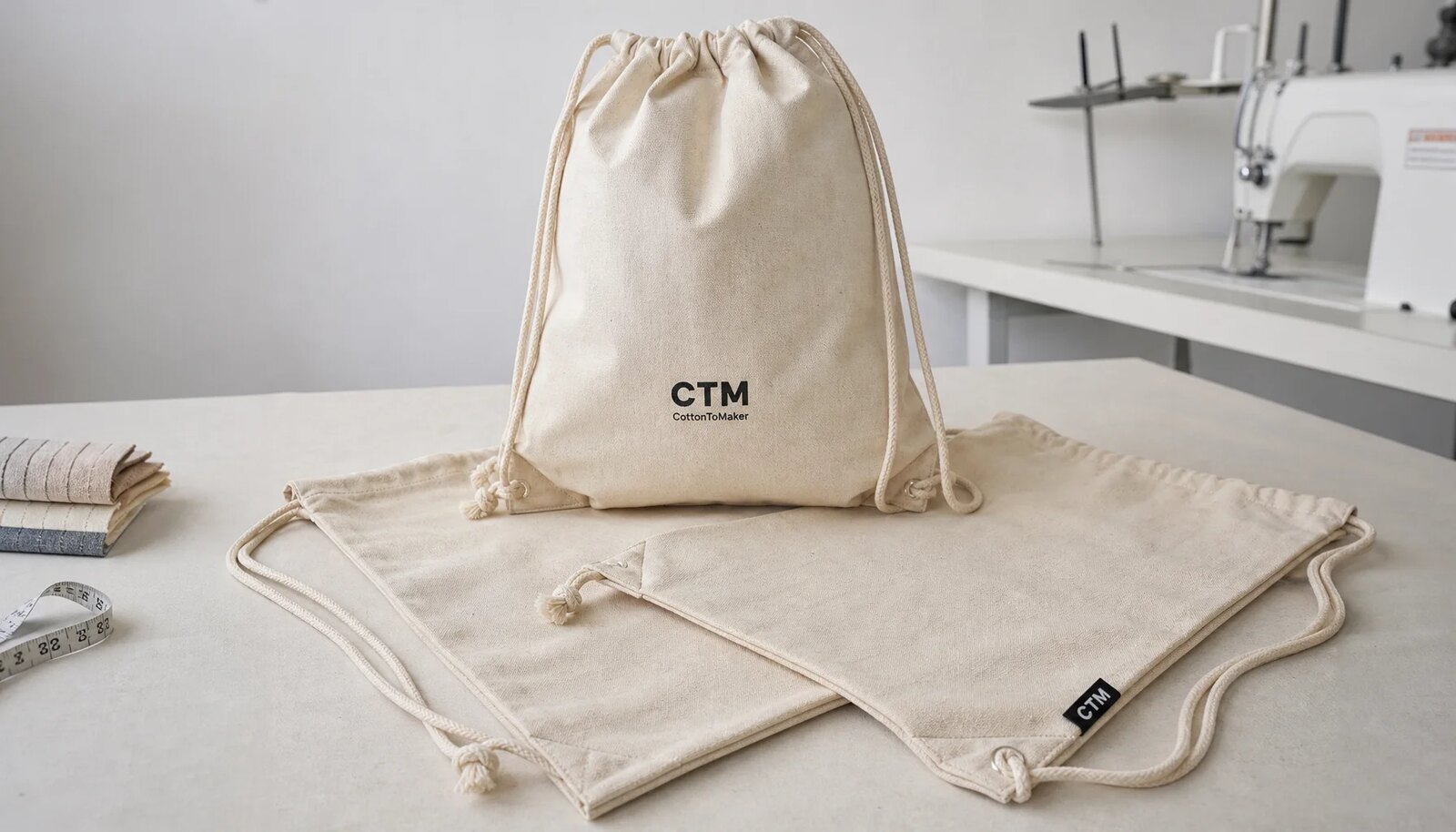
Start With the Craft Fair Use Case, Not the MOQ Number
MOQ negotiation becomes much easier when the buyer starts with the backpack’s job at the event. A factory cannot price a brochure handout, vendor welcome kit, workshop supply pack, and retail merchandise item as if they carry the same risk. The product name may be identical, but the working conditions are not. A light cotton bag holding postcards for two hours can use a different construction from a reusable backpack expected to carry catalogs, samples, and a water bottle all day.
Before asking for a lower minimum, give the supplier a clear picture: who will use the bag, what goes inside, how it will be handed out, when it must arrive, and how many logo versions are planned. If bags are distributed at registration, bulk packing and one-color screen print may be the right value. If the organizer sells the bags, finishing becomes more visible: cleaner trimming, heavier fabric, barcode or hangtag accuracy, consistent folding, and better carton presentation start to matter.
A practical starting spec for adult craft fair use is about 34 x 42 cm finished size, 8 oz cotton, 5-6 mm cord, reinforced lower corners, and one front print location. It is not the only workable spec, but it gives every supplier the same baseline. From there, you can ask which changes lower MOQ without weakening the parts that actually carry load. The more specific the use case, the less the supplier has to guess, and the more productive the MOQ conversation becomes.
- Attendee handout: prioritize low complexity, stocked natural fabric, one-color print, and bulk carton distribution.
- Vendor welcome kit: prioritize stronger cord, reinforced lower corners, practical size, and reliable event sorting.
- Workshop pack: prioritize accurate finished dimensions, predictable folding, and fit for pre-packed materials.
- Sponsor gift: prioritize logo placement, print color control, fabric hand feel, and visible construction quality.
- Retail or fundraiser item: prioritize heavier fabric, clean finishing, barcode or hangtag accuracy, and presentation packing.
- Distributor stock: prioritize repeatable specifications, carton data, replenishment planning, and version control.
Separate MOQ Drivers Before You Negotiate
The MOQ on a quotation often looks like one number. In reality, it is usually a stack of smaller minimums. For wholesale cotton drawstring backpacks, those minimums can come from fabric purchase quantity, dye lot size, cutting efficiency, sewing line setup, screen-print setup, label ordering, packing labor, carton marking, and export handling. The buyer sees 500 pcs or 1,000 pcs. The supplier sees several operations that each need enough volume to be efficient.
Variation is the hidden driver that catches many craft fair buyers. A 1,000-piece order in one natural cotton body, one black logo, and bulk packing is straightforward. The same 1,000 pcs split across five body colors, ten sponsor logos, two packing formats, and three destinations behaves like many small orders. Total volume looks strong on paper, but each version may be too small for fabric buying, printing setup, packing control, and final inspection.
The better question is not simply, "Can you reduce MOQ?" Ask, "Which minimum is controlling this MOQ?" If fabric is the issue, you may switch to stocked natural cotton or combine events into one fabric lot. If printing is the issue, a shared sponsor panel may be cheaper than separate screens. If packing is the bottleneck, bulk pack the goods and add warehouse labels later. MOQ should come down by removing avoidable complexity, not by quietly downgrading fabric, cord, stitching, or reinforcement.
- Fabric minimum: affected by stock fabric, fabric width, fabric weight, dyeing, shrinkage, and supplier purchase rules.
- Color minimum: triggered when each body color needs separate dyeing, cutting, shade approval, or inventory control.
- Print minimum: affected by screen count, ink colors, print size, artwork versions, and curing capacity.
- Label minimum: triggered by woven labels, care labels, hangtags, barcode stickers, and retailer-specific requirements.
- Packing minimum: affected by individual bags, paper bands, inner packs, carton labels, and destination separation.
- Scheduling minimum: affected by small-batch line setup, worker allocation, peak-season loading, and inspection windows.
Choose Fabric Weight, Finish, and Color Carefully
Fabric is the largest product decision because it affects cost, print result, sewing behavior, durability, packed weight, and carton cube. Suppliers may describe cotton backpacks by ounces or GSM, and those terms are not always used consistently. Do not rely on a marketing label alone. State the target weight, the tolerance, and the physical reference sample that will control bulk production.
For very light giveaways, 5-6 oz cotton can be acceptable when contents are limited to brochures, stickers, or small purchases. Even then, check transparency, seam stress, and print show-through before approval. Around 8 oz is a stronger baseline for reusable craft fair backpacks because it feels less disposable and handles typical fair contents better. Around 10 oz can suit premium retail or sponsor programs, but it raises unit cost, carton weight, and sewing difficulty around gathered channels and reinforced corners.
Color also changes MOQ. Natural cotton, off-white cotton, or standard bleached fabric is often easier to source because suppliers may already stock it. Dyed cotton may require lab dips, dye lot approval, and minimum fabric commitments. Be clear about natural slubs, seed specks, and slight tone variation. If bright artwork needs a clean background, bleached cotton may help; it can also show dirt and handling marks more quickly than natural cotton.
- 5-6 oz cotton: suitable for low-load handouts; test opacity, seam pull, and print show-through before approval.
- 8 oz cotton: practical baseline for reusable craft fair backpacks, vendor kits, and sponsor programs.
- 10 oz cotton: premium hand feel and better structure, but higher cost, heavier cartons, and more sampling need.
- Natural cotton: generally easier for MOQ and lead time; define acceptable slubs, seed specks, and shade variation.
- Bleached cotton: cleaner print background; inspect for yellowing, dirt marks, and inconsistent whiteness.
- Dyed cotton: confirm lab dip process, dye lot MOQ, shade tolerance, crocking risk, and whether fabric is pre-shrunk.
Define Size, Cord, and Stress Points in Measurable Terms
Cotton drawstring backpacks look simple, but failures tend to start in predictable places: top channel, side seams, cord exits, and lower corners. A finished adult event size around 34 x 42 cm is common because it can hold catalogs, a folded T-shirt, small purchases, and light samples without using excessive fabric. If the fair distributes rigid workshop materials or oversized catalogs, send the actual content dimensions before locking the bag size.
Finished size should mean finished size, not cutting size. Cotton can shift during cutting, sewing, pressing, and packing. For many event bags, ±1 cm on width and height is workable, but both sides should agree in writing. If the bag must fit a pre-packed kit, retail display, or strict carton plan, the tolerance may need to be tighter and confirmed by sample.
Cord deserves more attention than it usually gets. It is both closure and shoulder strap, so the spec should include material, diameter, length, color, end finish, knotting, and routing. Cotton cord supports a natural craft look but can abrade or shrink differently from polyester. Polyester cord often pulls smoothly and resists abrasion, though it may look less rustic. Lower corners should also be named clearly: folded fabric tab, inserted loop, eyelet, reinforced patch, bar tack, or another construction. A front-view product photo is not enough; request close-up photos and physical samples of the load-bearing points.
- Finished dimensions: state width and height in centimeters, measured flat after sewing and pressing.
- Size tolerance: agree typical event-bag tolerance, such as ±1 cm, or tighter if contents require it.
- Cord spec: confirm material, diameter, length, color, knotting, end finish, and substitution rules.
- Top channel: check channel width, stitch straightness, cord movement, and even gathering when closed.
- Lower corners: specify tab, loop, eyelet, patch, and bar tack details instead of saying "standard quality."
- Load check: place realistic contents inside and pull the cords repeatedly before sample approval.
Match Decoration to Artwork and Version Count
Decoration is often the second-largest MOQ lever after fabric. Screen printing is usually the most efficient choice for wholesale cotton drawstring backpacks when the artwork uses one to three solid colors: event names, simple sponsor marks, line art, or basic branding. Cost depends on screen count, ink colors, print size, print location, curing time, and reject risk. Each artwork version can create its own setup, even when the backpack construction does not change.
Heat transfer can help when the artwork includes gradients, full-color imagery, fine sponsor grids, or short version splits. It still needs testing on the actual cotton. Transfers can change hand feel, lift at edges, crack with folding, or leave heat marks. Embroidery can look premium, but dense stitching may pucker 5-6 oz cotton and make the front panel feel stiff. If embroidery is part of the plan, sample it with the final fabric weight, backing, thread colors, and design size.
Craft fair orders often become complicated when sponsors ask for separate logos. The procurement-friendly move is to reduce versions before reducing construction quality. A shared one-color sponsor panel can lower setup count and make MOQ more realistic. If separate sponsor versions are mandatory, ask the supplier to quote MOQ and setup charges by artwork version. A 1,000-piece order split into ten 100-piece logos is not the same factory job as one 1,000-piece print run.
- Screen print: best for solid-color logos, repeat orders, simple art, and efficient quantity runs.
- Heat transfer: useful for gradients or small splits; test edge lift, cracking, flex, hand feel, and heat marks.
- Embroidery: suitable for premium programs only after testing puckering, backing feel, and needle-hole distortion.
- Large solid ink: inspect stiffness, curing, rub resistance, cracking, and coverage over cotton slubs.
- Fine lines: confirm minimum line thickness and spacing because textured cotton can fill in small details.
- Multiple logos: request MOQ, setup, and inspection plan by artwork version, not only total order quantity.
Build an RFQ Suppliers Can Price Without Guessing
A strong RFQ helps suppliers quote the same backpack instead of their preferred interpretation of the request. "Cotton drawstring bag with logo" is too broad for B2B sourcing. The RFQ should define use case, target quantity, quantity by version, finished dimensions, tolerance, fabric weight, fabric color, cord material, cord diameter, lower-corner construction, print method, print size, print colors, labels, packing, carton requirements, delivery date, destination, and Incoterm.
Separate fixed requirements from negotiable choices. You may require 34 x 42 cm finished size and 8 oz cotton but be open to cotton cord or polyester cord. Or you may require a sponsor Pantone color but allow bulk packing. This gives the factory room to suggest cost-saving alternatives without silently changing the product.
Ask for quantity breaks using the same specification. If one supplier quotes 500 pcs with 6 oz cotton and another quotes 500 pcs with 8 oz cotton, the prices are not comparable. Request setup charges, sample charges, label costs, packing costs, carton dimensions, gross weight, and the lead-time trigger. Production lead time should say when the clock starts: after deposit, artwork approval, material confirmation, pre-production sample approval, or all of those milestones.
- Product spec: size, tolerance, fabric weight, color, cord, reinforcement, seam quality, and approved sample requirement.
- Artwork spec: vector file, print method, print size, print location, color references, and version count.
- Commercial terms: total quantity, quantity by version, currency, Incoterm, destination, payment terms, and quote validity.
- Packing spec: bulk or individual packing, pieces per carton, inner packs, hangtags, barcodes, carton marks, and labels.
- Timing plan: sample deadline, inspection date, bulk ready date, craft fair date, freight mode, and split-shipment needs.
- Cost breakdown: unit price, setup, sample, label, packing, carton, and any surcharge for small versions.
Compare Quotes by Spec, Not Unit Price Alone
Supplier quotes can look comparable when each one lists an MOQ, a unit price, and a lead time. Often they are not. One supplier may be pricing 6 oz natural cotton, thin cord, bulk packing, and one-color print. Another may be pricing 8 oz cotton, 6 mm cord, reinforced tabs, individual packing, and barcode labels. The cheaper option may only be cheaper because it excludes durability, decoration, or packing requirements.
Procurement teams should normalize quotes in a side-by-side sheet. Compare fabric weight, finish, color, size, cord diameter, corner construction, print method, setup charges, label costs, packing method, carton dimensions, carton gross weight, lead time, and sample process. Treat every blank field as a question before award. Missing details become disputes later: the buyer expected 8 oz cotton while the factory assumed 6 oz, or the buyer expected several sponsor logos while the supplier priced one artwork.
Quantity breaks help reveal the real cost structure. One supplier may be expensive at 300 pcs because setup dominates but competitive at 1,000 pcs. Another may support low MOQ with stock natural cotton but become less attractive for dyed versions. Ask each supplier to quote the same spec at practical breaks, then ask what changes at each level. That gives you a negotiation map instead of a single take-it-or-leave-it MOQ.
- Normalize fabric: compare weight, finish, color, stock status, shade tolerance, and shrinkage assumption.
- Normalize construction: compare size tolerance, cord diameter, reinforcement, seam allowance, stitch density, and thread trimming.
- Normalize decoration: compare print method, color count, print size, print location, setup fees, and artwork versions.
- Normalize packing: compare individual bags, inner packs, carton count, carton size, gross weight, and labels.
- Normalize timing: compare sample lead time, bulk lead time, inspection window, and lead-time trigger.
- Normalize risk: compare sample clarity, QC cooperation, documentation quality, and responsiveness to technical questions.
Negotiate MOQ Without Weakening the Backpack
The safest way to reduce MOQ is to remove avoidable complexity before reducing functional quality. Cutting fabric weight, using thinner cord, removing lower-corner reinforcement, or skipping samples may lower a quote, but those savings can show up as public failures at the craft fair. A torn corner or sharp-feeling drawcord is far more memorable than a small unit-cost saving. Protect the load-bearing parts first.
Better levers are usually simpler: one body color, one finished size, one cord color, one print location, one packing method, and fewer artwork versions. If sponsors need recognition, a shared sponsor panel is often more efficient than separate multicolor logos. If several craft fairs are scheduled, combine annual demand into one program with planned releases. If fabric MOQ is the constraint, ask whether the supplier can use stocked natural cotton or reserve one fabric lot for related orders.
Rolling purchase orders can work, but only when the terms are clear. State whether the factory buys all fabric upfront, whether finished goods or raw materials are stored, when releases are scheduled, who pays storage or cancellation costs, and whether the price changes if later releases are reduced. A vague promise of future business rarely moves a real MOQ. A dated release plan with agreed materials and payment terms gives both sides something to manage.
- Simplify first: reduce fabric colors, logo versions, label versions, packing formats, and destination splits.
- Use stock inputs: accept stocked natural cotton, standard cord, standard carton count, or one print location when possible.
- Combine demand: group multiple craft fair dates into one annual program with defined release quantities.
- Split shipments: produce one larger run, then ship by event date or warehouse schedule if storage terms are clear.
- Protect stress points: do not remove reinforcement, use unspecified cord, or skip print testing to reach a lower MOQ.
- Document concessions: record exactly which spec changed so the approved sample and inspection plan stay aligned.
Use Samples as Procurement Controls
Samples are not sales props. They are control documents. A fabric swatch confirms weight, finish, color, opacity, and hand feel. A blank construction sample confirms shape, size, cord route, lower-corner construction, seam allowance, and top-channel behavior. A print strike-off confirms ink color, line clarity, coverage, curing, rub resistance, and hand feel. A pre-production sample brings final materials, final sewing, final print, labels, and packing together before bulk production starts.
Be careful with substitute samples. If the sample uses a different fabric weight, different cord, digital print instead of final screen print, or temporary label, it cannot fully protect the order. Time pressure sometimes forces conditional approval. When that happens, record exactly what is approved and what remains open. The supplier, buyer, and inspector should all know which sealed sample controls bulk production.
Make sample review measurable. Measure width and height after sewing. Confirm fabric against the stated weight or approved swatch. Pull the cords repeatedly and inspect the lower corners. Rub the print with a dry white cloth and, if appropriate, a slightly damp white cloth after curing. Measure print placement from seams. Load the backpack with realistic event contents and wear it briefly. These simple checks catch many problems before thousands of pieces are cut and printed.
- Fabric swatch: approve weight, shade, texture, opacity, and acceptable natural cotton variation.
- Blank sample: approve size, cord route, top channel, reinforcement, seam quality, and wearing comfort.
- Print strike-off: approve color, line clarity, coverage, curing, rub resistance, and print hand feel.
- Pre-production sample: approve final material, construction, print, labels, trimming, folding, and packing.
- Packing sample: approve fold method, individual bag or band, barcode placement, carton count, and carton marks.
- Approval record: keep photos, measurements, tolerances, and sealed samples for inspection reference.
Set Product-Specific QC Before Production
Cotton drawstring backpacks are simple products, but vague standards still create inspection disputes. Common defects include open seams, skipped stitches, loose threads, twisted cords, weak lower corners, dirty natural cotton, oil marks, shade variation, off-center print, ink stains, poor curing, incorrect labels, wrong logo version, short quantity, and mixed cartons. Classify defects before production so the supplier understands what triggers repair, replacement, rejection, or sorting.
AQL inspection can help, but the checklist must fit this product. For many general consumer soft goods, buyers use an AQL plan with critical, major, and minor defect categories, with the exact level agreed by the supplier and importer. The inspector should measure finished size, verify cord diameter, pull cords, stress lower corners, inspect top channels, test print rub, confirm logo version, scan barcodes if used, count cartons, and compare packing to the packing list.
For craft fairs, distribution accuracy can be as important as appearance. A thread end can usually be trimmed. A carton mixed with the wrong sponsor logo can disrupt registration or vendor setup. A natural cotton slub may be acceptable; a weak corner is not. QC standards should cover appearance, function, labeling, packing, carton marks, and shipment segregation. The inspection report should include clear photos, measurements, defect counts, carton labels, and a pass/fail recommendation tied to the purchase order.
- Critical defects: mold, unsafe sharp parts, severe contamination, wrong product, wrong logo, or unusable mixed goods.
- Major defects: open seams, broken cords, weak corners, severe stains, misprint, wrong packing, short quantity, or wrong barcode.
- Minor defects: small thread ends, slight slubs, minor shade variation, or light folding marks within tolerance.
- Functional checks: repeated cord pull, loaded wear check, corner stress, top-channel movement, and seam security.
- Print checks: dry rub, damp rub if agreed, gentle scratch, color comparison, line clarity, edge quality, and curing.
- Packing checks: carton count, version separation, inner pack count, carton marks, gross weight, barcode scan, and destination label.
Specification comparison for buyers
| Procurement decision | Recommended baseline | When to adjust | MOQ or QC risk to control |
|---|---|---|---|
| Fabric weight | 8 oz cotton canvas or sheeting for reusable craft fair backpacks; 6 oz only for light giveaways | Move to 10 oz for premium retail merchandise, heavier vendor kits, or stronger perceived value; stay at 5-6 oz only for brochure-style handouts | State oz/yd² or GSM and tolerance, commonly ±5%; underweight cotton can look translucent, stretch at seams, and change print appearance |
| Fabric color | Natural or off-white cotton from stocked fabric for the simplest MOQ path | Use dyed cotton when brand color is essential and the order can absorb lab dip, dye lot, and shade approval steps | Custom dyeing may create fabric MOQ by color, longer lead time, shade bands, and mixed-lot risk when versions are small |
| Finished size | 34 x 42 cm finished size, measured flat after sewing and pressing, with typical tolerance of ±1 cm | Adjust only after confirming contents such as catalogs, workshop kits, bottles, folded T-shirts, purchases, or sponsor inserts | Oversizing increases fabric consumption and carton cube; undersizing creates user complaints even when the unit price looks attractive |
| Cord material and diameter | Cotton cord 5-6 mm for natural appearance; polyester cord 4-6 mm for better abrasion resistance | Use thicker or softer braided cord when users may carry bottles, samples, apparel, or documents for several hours | Thin 3 mm cord can feel sharp on shoulders; block substitution through approved sample and written material spec |
| Corner reinforcement | Folded fabric tab or inserted cord loop with bar tack at lower corners | Upgrade to heavier tab, reinforced patch, or eyelet only after sampling with the final fabric weight | Removing reinforcement to cut cost is high risk because the cord transfers shoulder load into the lower corner |
| Seam construction | Lockstitch or chainstitch with even tension, secure back-tacking at stress points, and agreed stitch density | Use higher stitch density or extra bar tacks for retail goods, vendor kits, or repeated-use programs | Open seams, skipped stitches, loose tension, and weak back-tacking are major defects and should be inspected under AQL sampling |
| Print method | Screen print for 1-3 solid colors on natural or dyed cotton | Use heat transfer for gradients, fine sponsor grids, or many small artwork versions; use embroidery only after puckering tests | MOQ and setup can apply per screen, ink color, print location, and artwork version; curing and rub resistance must be checked |
| Logo version strategy | One front print location with a shared event or sponsor layout whenever possible | Separate versions only when sponsors, retailers, or event dates require unique artwork | Ten small logo splits can price like ten small orders even when total quantity is high; request MOQ by artwork version |
| Labeling and compliance | No sewn label for simple event handouts; inside care label or woven side label for resale or distributor stock | Add barcode, hangtag, care label, country-of-origin marking, or carton label when required by retailer, warehouse, or importer process | Labels add approvals, placement tolerance, scan checks, minimums, and repacking risk if missed in the RFQ |
Buyer checklist before sampling
- Define the program role first: free attendee handout, vendor welcome kit, workshop supply pack, sponsor gift, retail merchandise, fundraiser item, or distributor stock.
- List expected contents and estimated load weight; a brochure-only giveaway, 1 kg workshop kit, and 2 kg vendor pack should not carry the same risk assumptions.
- Lock measurable baseline specs before negotiating MOQ: finished size, size tolerance, fabric weight, fabric color, cord material, cord diameter, reinforcement, print location, and packing.
- Ask MOQ separately by fabric color, dyed lot, print artwork, print color count, label version, packing format, and shipment destination so the real constraint is visible.
- Request quotes at 300, 500, 1,000, 2,500, and 5,000 pcs using the same specification, not supplier-selected substitutions.
- Require the quotation to show unit price, setup charges, sample charges, label charges, packing charges, carton dimensions, carton gross weight, lead-time trigger, Incoterm, and quote validity.
- Ask which cotton weights, colors, cords, and carton formats are stocked versus specially purchased, dyed, or outsourced.
- Provide vector artwork, Pantone or LAB color references where needed, print size in centimeters, print placement from seams, and maximum print area confirmation.
- Approve the right sample sequence: fabric swatch, blank construction sample, print strike-off, pre-production sample, and packing sample when packing affects distribution.
- Review samples against measurable criteria: fabric weight tolerance, finished size tolerance, cord length, cord pull, seam strength, corner reinforcement, print adhesion, print position, label placement, and carton packing.
Factory quote questions to send
- What is your MOQ for this exact natural cotton drawstring backpack specification, and what changes if we use dyed cotton, multiple body colors, or custom fabric weight?
- Which cotton weights do you regularly stock for this style, such as 5 oz, 6 oz, 8 oz, 10 oz, or GSM equivalents, and what tolerance do you apply to fabric weight?
- Is the fabric natural, bleached, dyed, greige, washed, or pre-shrunk, and what tolerance applies to shade, shrinkage, and finished dimensions?
- Can you quote the same spec at 300, 500, 1,000, 2,500, and 5,000 pcs and show which costs change at each break?
- What is included in the unit price: fabric, cutting, sewing, cord, reinforcement, one print location, print setup, labels, packing, export carton, carton marks, or inland handling?
- What print method are you quoting, how many colors are included, and what extra charge applies per screen, ink color, print location, or artwork version?
- What is the maximum recommended print area on a 34 x 42 cm cotton backpack without distortion near seams, drawcord channels, or lower corner stress points?
- What cord material, diameter, length, and color are included, and can you confirm that cord substitution requires written approval?
- How are the lower corners reinforced: folded tab, inserted loop, eyelet, patch, bar tack, or another construction? Please provide close-up photos or a technical sketch.
- What seam allowance, stitch density, back-tacking method, and thread type do you normally use for this style?
Quality-control points to confirm
- Verify fabric weight against the approved spec before bulk cutting and again at final inspection, using oz/yd² or GSM with an agreed tolerance, commonly around ±5% unless tighter control is contracted.
- Compare fabric shade with the approved swatch, lab dip, or sealed sample under consistent light; segregate or reject mixed lots outside the agreed shade band.
- Measure finished size flat after sewing, trimming, pressing, and normal packing relaxation; record width and height tolerance, commonly ±1 cm for standard event bags.
- Check that the top channel allows smooth cord movement without twisting, bunching, skipped stitching, loose thread loops, or excessive friction during repeated opening and closing.
- Confirm drawcord material, diameter, length, color, hand feel, knotting, and routing against the sealed sample; substitution from cotton to polyester or thinner cord should require written approval.
- Test lower corner reinforcement with repeated pulling and realistic loading; bar tacks, tabs, eyelets, or inserted loops should not tear the cotton panel or slip from the seam.
- Inspect side seams, bottom seams, top channel seams, and stress points for consistent stitch density, seam allowance, back-tacking, thread tension, and trimming.
- Measure print position from fixed reference points such as top seam and side seam; visual centering alone is not enough for multi-version event distribution.
- Compare print color with the approved strike-off or color reference under consistent light, while allowing reasonable texture variation on natural cotton.
- Test print adhesion with agreed dry rub, damp rub, gentle scratch, and flex checks after curing, especially for large solid ink areas and heat transfers.