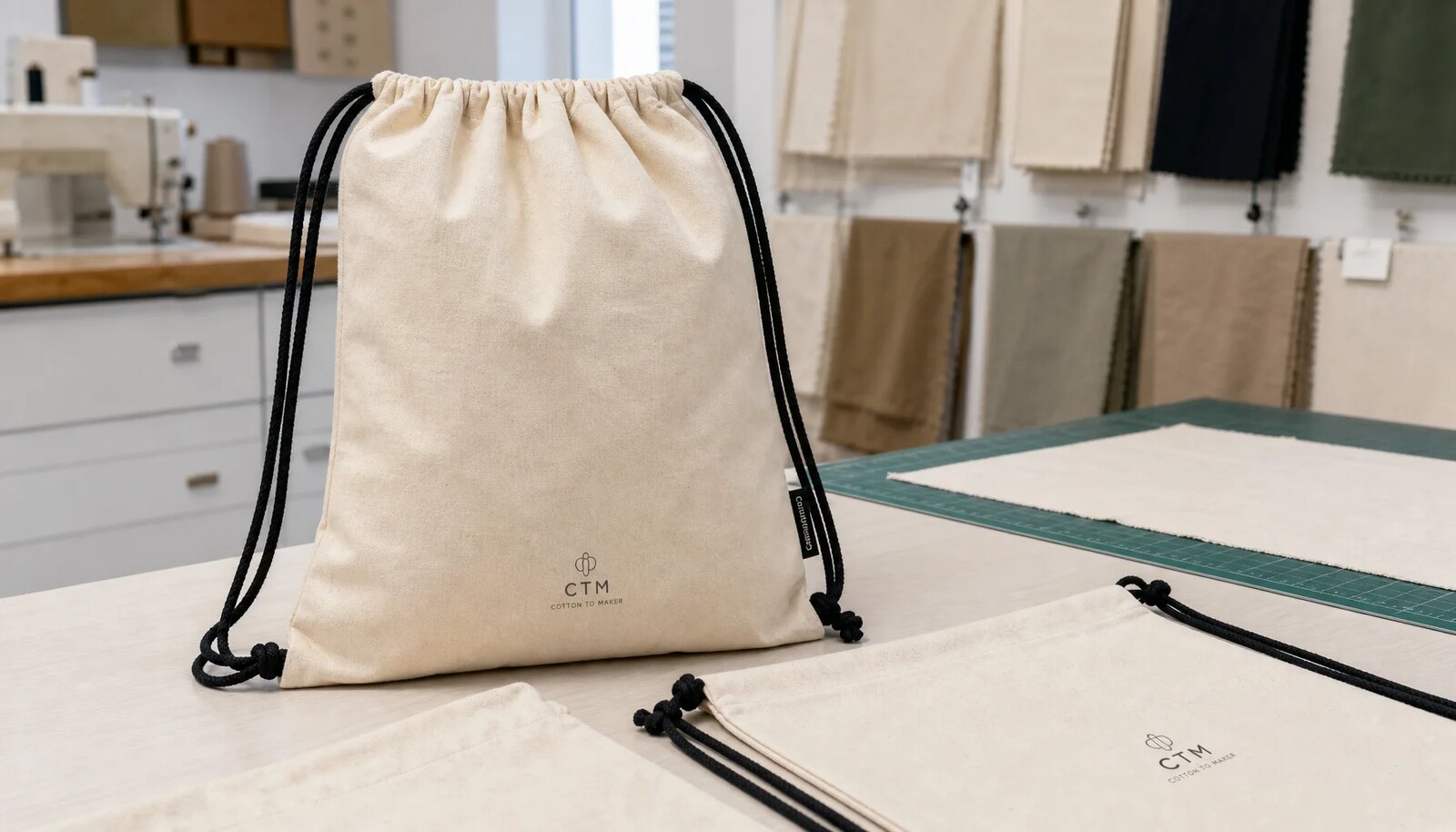
Start With the Craft Fair Use Case
Wholesale cotton drawstring backpacks for craft fairs do more than carry a logo. They may be handed out at check-in, sold from a booth, packed with sponsor materials, or used by visitors to carry postcards, catalogs, candles, books, small ceramics, and samples. A buyer who treats the backpack as a simple blank bag often approves artwork too late, after size, cord, packing, and print area have already limited the result.
Start by naming the main viewing moment. If the event sponsor wants visibility across a crowded aisle, the logo usually belongs on the front center panel, below the drawcord tunnel and large enough to read at a short distance. If a maker brand plans to sell the bag as merchandise, a quieter lower-front mark may feel more premium. If one distributor is producing bags for many vendors, a single standardized placement rule matters more than small design preferences for each logo.
Drawstring backpacks also change shape during use. When the cord is pulled, the top gathers, the upper corners angle inward, and the panel becomes less flat. A logo that looks perfect near the top of a digital mockup can wrinkle or partly disappear when the bag closes. For most craft fair orders, the safer print zone starts below the tunnel, stays away from side seams, and avoids the bottom fold used in flat packing.
- For booth visibility, use front center placement instead of a small side label or tone-on-tone detail.
- For paid merchandise, use a medium lower-front mark with enough blank cotton around it.
- For sponsor exposure, keep the logo below the drawcord tunnel where gathering is lighter.
- For multi-logo programs, apply one placement rule across all versions to reduce sampling and sorting errors.
- For event photography, approve the logo flat, closed, lightly filled, and hanging.
Lock the Bag Specification Before Artwork
Logo placement cannot be controlled until the bag itself is controlled. A 34 x 42 cm backpack, a 35 x 45 cm backpack, and a smaller youth-size bag all create different print zones. Tunnel height, seam allowance, bottom corner construction, and cord channel shape also shift the available area. If suppliers quote from a reference photo only, two prices may look comparable while the actual products differ in size, fabric, and decoration space.
For adult craft fair use, finished sizes around 34 x 42 cm or 35 x 45 cm are common. The right size still depends on what visitors will carry. Flyers and postcards need less strength than books, boxed soaps, candles, or small handmade goods. Drawstring backpacks are not structured hiking packs, so avoid describing them as heavy-duty unless the fabric, seams, cord, and reinforcement are specified for that purpose.
The cord is easy to overlook, yet it affects both comfort and perceived value. Cotton cord gives a natural look and pairs well with unbleached cotton. Polyester cord can be stronger and more color-stable. Dyed cord can make the bag feel more finished, but it should be checked for rubbing and color transfer on light fabric. Ask for cord material, approximate diameter, finished length, knot type, and whether the cord slides freely through the tunnel after sewing.
- State finished height and width after sewing, with expected tolerance in millimeters.
- Confirm tunnel height and whether measurements are taken from the bottom of the tunnel seam.
- Specify cord material, color, approximate diameter, finished length, and knot or end finish.
- Match construction to the load: light handouts, reusable event merchandise, or heavier retail purchases.
- Compare quotes only after size, fabric, cord, construction, decoration, and packing are aligned.
Choose Fabric Weight With Realistic Expectations
Fabric weight affects nearly every procurement decision: price, hand feel, durability, print definition, carton weight, and freight. Many factories quote cotton drawstring backpacks in ounces, while internal buying documents may require GSM. As a rough commercial reference, 5 oz cotton is around 170 gsm, 6 oz around 200 gsm, 8 oz around 270 gsm, and 10 oz around 340 gsm. Actual GSM can vary with yarn, weave, shrinkage, finishing, and whether the material is plain cotton or canvas, so ask the supplier to confirm the fabric weight used in the quote.
For low-cost craft fair giveaways, 5-6 oz cotton can work when the bag will carry light paper goods, coupons, postcards, or small samples. It keeps material cost and freight lower, but it wrinkles more easily and may show ink strike-through. For reusable fair merchandise, 8 oz cotton is often a practical middle choice: it feels more substantial, supports cleaner printing, and still fits many wholesale budgets. For premium paid bags, 10 oz or heavier canvas can support patches, embroidery, and a stronger retail presentation, though carton weight and shipping cost rise.
Approve logo placement and print quality on the actual fabric weight. Thin natural cotton may move under the screen and can show large dark prints through to the back. Heavier canvas stays flatter, but its surface texture can break small type and fine lines. Recycled cotton blends may help with a sustainability brief, yet they can include specks, shade variation, or a softer face that changes edge sharpness. Natural cotton often has seed marks; that is acceptable only if the buyer has defined the level allowed.
- 5-6 oz cotton: best for budget handouts, light contents, and short-term promotional use.
- 8 oz cotton: practical for reusable craft fair merchandise, sponsor programs, and balanced cost.
- 10 oz cotton or canvas: better for premium retail positioning, patches, and embroidery, with higher freight impact.
- Natural cotton: suitable for a craft look, but seed marks and shade variation must be defined.
- Recycled cotton blend: useful for sustainability positioning, but sample for specks, tone, and print sharpness.
Map Logo Placement on a Measured Dieline
A measured dieline is more useful than a polished lifestyle mockup. The factory needs finished bag width and height, tunnel height, seam allowance, print size, and reference points. On a common 34 x 42 cm cotton drawstring backpack, a safe front center logo often has its top edge about 90-120 mm below the bottom of the drawcord tunnel seam, depending on logo height. On a 35 x 45 cm bag, the artwork can often sit slightly lower and still look balanced. These ranges are starting points, not a substitute for a physical sample.
Use sewn seams as measurement references. The soft top edge can curl, stretch, or disappear into the tunnel, so it is not a reliable point. Measure vertical placement from the bottom of the drawcord tunnel seam. Measure horizontal centering from the side seams or from a calculated centerline based on finished width. The buyer and factory should use the same method during sample review and bulk inspection; otherwise, a minor shift can turn into a subjective dispute.
Keep live artwork out of risky areas. For standard screen printing, allow at least 30-35 mm from sewn edges, and increase clearance for large prints, multi-color artwork, or tight registration. Avoid placing important text on the fold line if bags will be packed flat in tight bundles. If the design includes a QR code, sponsor list, website, or legal line, test readability on the actual fabric instead of trusting the PDF preview.
- Show the artwork bounding box in millimeters, including required clear space.
- Measure the logo top edge from the bottom of the tunnel seam, not the soft top edge.
- Center artwork between side seams unless the design intentionally aligns to a label or pocket.
- Keep live artwork at least 30-35 mm from side seams, bottom seam, and tunnel seam.
- Define whether approval is based on the bag flat, closed, filled, hanging, or worn.
Select Decoration by Artwork and Quantity
Screen printing is usually the first option for wholesale cotton drawstring backpacks when the artwork uses one to three solid colors. It works well in bulk, holds repeat orders consistently, and is easy to inspect when the design is not too detailed. Water-based ink can give a softer hand and a natural look on cotton. Plastisol can provide stronger opacity, especially on darker or dyed fabric. The right choice depends on fabric color, logo color, opacity target, hand feel, curing control, and any sustainability requirement tied to the event.
Heat transfer can make sense when the program has many low-quantity logo versions, gradients, photographic artwork, or full-color designs. It may reduce screen setup complexity, but the buyer still needs to approve edge feel, flexibility, adhesion, and surface appearance on cotton. Transfers are not all the same. A material that performs well on polyester may behave differently on natural cotton canvas, so the quote should identify the transfer type rather than saying only that a printed logo is included.
Embroidery, woven patches, printed cotton labels, and side seam labels are useful when the goal is a more crafted or retail look. They are not interchangeable with a front sponsor print. Embroidery works best on heavier fabric and smaller marks because dense stitching can pucker thin cotton. Labels are subtle and attractive, but they are too small for sponsor visibility in a busy aisle. If exposure is the goal, use a front print. If resale value is the goal, consider a smaller embroidery or patch on suitable fabric.
- Screen print: best for solid logos, repeat orders, sponsor marks, and stable wholesale cost.
- Water-based ink: softer hand and natural appearance when curing is controlled.
- Plastisol ink: strong opacity and coverage, with hand feel and curing approved by sample.
- Heat transfer: useful for gradients, full color, short runs, or many low-quantity logo versions.
- Embroidery or patch: suitable for heavier canvas and premium presentation, not very large filled logos.
Control Logo Size and Artwork Risk
Logo size should serve the viewing distance and the bag construction. A craft fair logo may need to be readable from an aisle, but it should not consume the full front panel. On many adult-size cotton drawstring backpacks, a front logo between 180 x 140 mm and 240 x 180 mm gives useful visibility while leaving room for seams, gathering, and inspection tolerance. Very wide artwork can look compressed when the bag is filled. Very tall artwork can drift into the tunnel zone or bottom packing fold.
Review artwork risks before screen making. Thin strokes, distressed textures, small serif type, tiny sponsor names, halftones, and complex gradients may not reproduce cleanly on cotton. A minimum stroke width of about 1.5 mm is a practical starting point for many screen print jobs, but the supplier should confirm based on mesh, ink, fabric texture, and final print size. Small reversed-out text is especially risky because ink gain can close the open space.
QR codes need stricter review than normal logo art. Cotton texture, ink spread, fabric movement, and curved surfaces can all affect scanning. Print the code at final size on the actual sample, then scan it from a realistic distance. Check it again when the bag is lightly filled and closed. For long sponsor lists, ask whether visitors will really read the detail on a moving backpack. A simplified sponsor lockup plus a printed insert may work better.
Color approval also needs a physical standard. Pantone references help, but natural cotton absorbs ink and changes the final shade. White ink on natural cotton can look softer unless opacity is managed. A dark print on thin fabric can show through to the back. For multi-color prints, registration tolerance must be realistic because cotton can shift under the screen. The approved sample should become the standard for color, sharpness, opacity, and hand feel.
- Keep the main logo large enough for aisle visibility, not just product-page readability.
- Avoid tiny sponsor names, thin outlines, distressed details, and small reversed text unless sampled.
- Confirm minimum stroke width, minimum text height, and registration tolerance before screen making.
- Test QR codes on final fabric, final print size, and final decoration method.
- Use the approved physical sample as the production standard for color and edge sharpness.
Build MOQ Around Logo Versions
Craft fair orders often look large in total but small by artwork. A buyer may need 3,000 backpacks overall, divided among ten vendor logos, several sponsor tiers, or different city names. The sewing factory may produce the blank bags together, but decoration has its own setup logic. Every screen print artwork and every print color can require screen making, setup time, color mixing, alignment, cleaning, and inspection. When quantities per logo are low, setup charges and sorting labor can outweigh a low blank bag price.
The RFQ should show total quantity and quantity per logo version. That lets the supplier quote the actual production structure instead of assuming one artwork. A clean approach is to standardize the bag body, fabric color, cord color, logo size limit, and print location, then vary only the artwork inside that approved window. Cutting, sewing, print positioning, QC, and packing stay consistent, while makers, sponsors, or regional fairs still get their own branding.
For very small quantities per logo, heat transfer may be more practical than screen printing even if the per-piece decoration cost is higher. For repeat annual programs, screen printing may become more efficient because files, placement rules, and production notes can be reused. Some buyers purchase blank inventory and print locally, but that only works if the local decorator can match the approved placement, curing, color, and packing requirements. Otherwise, splitting production can increase variation.
- State total order quantity and quantity per artwork in the first RFQ.
- Group logo versions under one bag size, one fabric color, one cord color, and one print location.
- Compare total decorated cost, including screen charges, setup, sampling, and sorting.
- Use heat transfer for many low-quantity versions when screen setup becomes inefficient.
- Keep the same dieline, placement rule, and artwork archive for repeat annual programs.
Compare Supplier Quotes Beyond Unit Price
A low unit price is useful only when the quoted specification matches the intended bag. Cotton drawstring backpacks can look similar in photos while differing in fabric weight, finished size, cord quality, seam strength, decoration method, packing, and QC controls. One supplier may include screen charges in the unit price while another lists them separately. One may quote 6 oz cotton while another assumes lighter promotional fabric. Without a structured quote comparison, procurement teams can choose the cheapest number and later discover they approved a different product.
Separate the blank bag specification from the decoration specification. For the blank bag, ask for finished size, fabric weight, fabric type, fabric color, cord material, cord length, construction details, and packing. For decoration, ask for method, logo size, number of colors, placement, setup charges, sample charges, artwork requirements, color matching, and production tolerance. For logistics, ask for carton quantity, carton dimensions, gross weight, shipping marks, lead time, Incoterm, and quote validity.
Also ask what is not included. Individual polybags, barcode stickers, hangtags, paper bands, custom woven labels, spare bags, split shipments, special carton marks, and third-party inspection support may add cost. For craft fairs with fixed event dates, the cheapest option is not always the safest if sampling time, curing time, or carton sorting controls are vague. A transparent quote can reduce approval risk, wrong-logo shipments, and last-minute air freight.
- Compare fabric weight, finished dimensions, cord specification, construction, and decoration before unit price.
- Separate setup charges from decorated unit cost so multiple artwork versions are priced correctly.
- Ask for carton dimensions and gross weight early because heavier fabric changes freight cost.
- Confirm whether samples, revisions, spare bags, labels, and split carton marks are included.
- Treat vague terms such as standard cotton, normal packing, and logo included as quote risks.
Approve Samples With Measurable Standards
The pre-production sample is the production standard, not a courtesy preview. It should use the final fabric weight, final fabric color, final cord, final decoration method, final logo size, and intended placement. If substitute fabric or a different print process is used, the sample may help with shape review but should not be treated as final approval. Record measurements, take photos, and write comments against the sample so the factory, sales team, marketing team, and event team work from the same reference.
Review the sample the way the backpack will be used at the fair. Lay it flat and measure the logo from the tunnel seam and side seams. Pull the drawcord closed and check whether gathering distorts the artwork. Add typical contents, such as a small catalog, postcard stack, or lightweight handmade item, and confirm the logo remains readable. Hang the bag from a booth hook if that is how it will be displayed. These checks are simple, and they catch placement problems before bulk production.
Document color, fabric, and print acceptance with realistic expectations. Natural cotton may show seed marks, fiber specks, and slight shade variation. If the brand needs a cleaner surface, specify bleached fabric, dyed fabric, or selected fabric grade before sampling. Ink should be checked after curing for tackiness, cracking, peeling, odor, and transfer. If several logo versions are included, approve the placement standard first, then apply it consistently instead of negotiating a new position for every design.
- Measure logo top edge to tunnel seam, centerline to side seams, and bottom edge to bottom seam.
- Photograph the sample flat, closed, lightly filled, hanging, and worn if stakeholder approval requires it.
- Rub the print after curing to check tackiness, transfer, cracking, peeling, and weak adhesion.
- Scan any QR code from the printed sample, not only from the digital artwork.
- Keep one signed sample with the buyer and one at the factory for bulk comparison.
Define QC Thresholds Before Bulk Production
Cotton is flexible and natural, but quality control still needs objective rules. The purchase order should define finished size tolerance, logo placement tolerance, print color standard, fabric defect limits, stitching requirements, drawcord function, and carton marking rules. For many cotton drawstring backpacks, plus or minus 10 mm on finished height and width is a practical commercial tolerance unless the bag must fit a specific insert or retail kit. For front screen print, plus or minus 5 mm can be a practical logo placement target when the reference point is clear.
Classify print defects before production starts. Major defects include wrong logo, wrong logo version, wrong placement outside tolerance, missing print, severe misregistration, ink smearing, blocking between stacked bags, cracking, peeling, and printing over seams. Minor defects may include small fiber specks or slight texture variation within the approved sample standard. If the buyer does not define these categories, the factory and customer may disagree about whether a visible issue is acceptable.
Construction QC matters because visitors will use the bag immediately. Side seams and bottom seams should be secure, the tunnel seam should not open, cord exits should be stable, and the drawcord should slide smoothly. Loose threads, broken cords, sharp cord ends, strong chemical odor, oil stains, mildew, and obvious shade mixing can damage brand perception even when the logo is correct. Carton inspection is just as important when several logo versions or destinations are involved. The right bag in the wrong carton is still a failed delivery.
- Logo placement: define tolerance, reference seams, measurement method, and approved sample standard.
- Print quality: reject tacky ink, blocking, cracking, peeling, severe pinholes, smearing, and wrong color beyond tolerance.
- Stitching: check open seams, skipped stitch runs, weak tunnel ends, loose threads, and bottom corner strength.
- Fabric: define acceptable seed marks, shade variation, stains, holes, odor, and mildew limits.
- Packing: verify quantity, logo version, carton number, PO number, gross weight, and destination marks.
Specification comparison for buyers
| Spec decision | Recommended option | When it fits | Buyer risk to check |
|---|---|---|---|
| Front center logo placement | Place the logo top edge about 90-120 mm below the bottom of the drawcord tunnel seam, centered between side seams | Best for craft fair giveaways, sponsor branding, booth merchandise, and bags that must be readable when worn or hanging | If placed too high, the logo can disappear into the gathered drawcord zone when the bag is closed |
| Lower front logo placement | Place the logo bottom edge 60-90 mm above the bottom seam, with at least 35 mm clearance from stitching | Works for minimalist maker brands, premium retail presentation, and designs that should not compete with the drawcord area | Bottom folds during flat packing can mark heavy ink if curing, cooling, and stacking time are not controlled |
| Logo size range | Keep most front craft fair logos between 180 x 140 mm and 240 x 180 mm on adult bags around 34 x 42 cm to 35 x 45 cm | Large enough to read across a booth aisle without forcing printing into seams, folds, or high-distortion areas | Oversized logos increase ink coverage, registration risk, hand-feel issues, curing load, and defect rate on soft cotton fabric |
| Fabric weight | Use 5-6 oz cotton for budget event bags, 8 oz for reusable merchandise, and 10 oz or heavier canvas for premium retail bags | 5-6 oz suits light brochures and handouts; 8 oz and above gives better perceived value for craft fair sales | Thin fabric may wrinkle more, show ink strike-through, and feel too promotional for premium handmade brands |
| Print method | Use screen print for 1-3 solid colors, heat transfer for gradients or many small logo versions, and embroidery only on heavier canvas | Screen printing gives stable cost in wholesale quantities and a clean, direct decoration on cotton | Fine strokes below about 1.5 mm can fill in on textured cotton, especially with absorbent fabric and water-based ink |
| Drawcord specification | Confirm cotton or polyester cord, color, approximate diameter, finished length, knot type, and shoulder comfort | Useful when buyers want the backpack to match booth colors without changing fabric color | Dyed cord should be checked for rubbing, crocking, and color transfer against natural cotton panels |
| MOQ structure | Use one base fabric, one bag size, one print position, and grouped logo versions where possible | Good for distributors buying for several vendors, regional fairs, or sponsor tiers under one production schedule | Too many low-quantity logo versions can trigger extra screen charges, sampling delays, sorting mistakes, and higher reject risk |
| Packing method | Flat pack 50 pcs per inner bundle or inner bag, with export cartons marked by logo version and destination | Keeps front logos flatter and helps event teams count units quickly before booth setup | Random mixed cartons can cause wrong-logo delivery to craft fairs, sponsor booths, or regional warehouses |
| QC tolerance | Approve measurable tolerances for logo position, finished size, print color, curing, stitch quality, drawcord function, and carton count | Useful for purchase orders with fixed event deadlines and multiple approval stakeholders | Without written tolerances, sample approval becomes subjective and disputes are harder to resolve |
Buyer checklist before sampling
- Define finished backpack dimensions in millimeters or centimeters, not only approximate capacity; common adult craft fair sizes are around 34 x 42 cm or 35 x 45 cm.
- Confirm cotton weight by use case: 5-6 oz for low-cost promotional handouts, 8 oz for reusable fair merchandise, and 10 oz or heavier canvas for a premium retail feel.
- State whether ounces mean square yard fabric weight and ask the supplier to confirm actual GSM; approximate commercial references are 5 oz around 170 gsm, 6 oz around 200 gsm, 8 oz around 270 gsm, and 10 oz around 340 gsm.
- Specify fabric color, cord color, cord material, approximate cord diameter, knot finish, and whether the fabric is natural cotton, bleached cotton, dyed cotton, organic cotton, recycled cotton blend, or conventional cotton canvas.
- Mark the logo on a flat dieline with distances from the bottom of the drawcord tunnel seam, both side seams, and the bottom seam; do not rely only on a visual mockup.
- Keep live artwork away from the drawcord tunnel, side seam allowance, bottom seam, bottom corner stress points, and the intended packing fold line.
- Specify whether the logo should appear centered when the bag is flat, lightly filled, closed by the drawcord, hanging on a booth hook, or worn on the back.
- Provide vector artwork when possible and state final print size, number of colors, Pantone references, minimum line thickness, minimum text height, QR code size, and required clear space.
- Choose the decoration method in the RFQ: water-based screen print, plastisol screen print, discharge print if applicable, heat transfer, embroidery, woven label, printed cotton label, or patch.
- Require a pre-production sample using the actual fabric weight, final fabric color, final drawcord color, final logo size, final print method, and intended packing fold.
Factory quote questions to send
- What cotton fabric weight and construction are included in the quote: 5 oz, 6 oz, 8 oz, 10 oz, plain weave, canvas, organic cotton, recycled cotton blend, bleached cotton, dyed cotton, or natural cotton?
- Are the quoted dimensions finished size after sewing, and what production tolerance applies to height, width, tunnel height, and bottom corner shape?
- What drawcord material, color, approximate diameter, finished length, and knot finish are included, and has dyed cord been tested for rubbing on natural or light-colored cotton?
- What is the recommended maximum logo size for this exact bag pattern without printing over seams, the drawcord tunnel, bottom folds, dense wrinkles, or high-distortion zones?
- Which decoration method is included in the unit price, and are screen charges, setup charges, film charges, color-matching charges, transfer setup, or artwork checking charges listed separately?
- For multiple craft fair logos, what is the MOQ per artwork and per color count, and can the same blank bag production be shared across all versions before printing?
- Will the pre-production sample use the final fabric lot or a representative bulk fabric, final cord, final ink or transfer material, final logo placement, and final packing method?
- What is the logo placement tolerance in mass production, what seam or centerline is used as the measurement reference, and how will inspectors measure it on soft fabric?
- What artwork file formats are required, and what minimum line thickness, minimum text height, QR code size, halftone, gradient, and distressed-texture limitations should the buyer approve before screen making?
- What curing or pressing parameters are used for the selected decoration, and how will the factory check tackiness, blocking, cracking, peeling, color transfer, and wash or rub resistance if required?
Quality-control points to confirm
- Finished bag size should stay within the agreed tolerance, commonly plus or minus 10 mm for height and width unless the RFQ sets a tighter requirement for retail inserts or packaged kits.
- Logo placement should be measured from fixed sewn seams, such as the bottom of the tunnel seam and side seams, not from a soft raw edge that can stretch, curl, or disappear into the tunnel.
- For front screen print on cotton, a practical logo placement tolerance is often plus or minus 5 mm, but buyers should approve the exact tolerance, reference point, and inspection method before production.
- The logo should be checked flat, closed by the drawcord, lightly filled, and hanging because the same print can look different when the fabric gathers, curves, or bears weight.
- Ink should be fully cured with no tackiness, blocking, cracking, peeling, unusual odor, or visible transfer after stacked packing and normal handling.
- Solid print areas should not show unacceptable pinholes, heavy streaks, ghosting, misregistration, fuzzy edges, or fabric show-through beyond the approved sample standard.
- Small text, QR codes, and thin logo strokes should remain readable at the approved viewing distance and should not fill in during bulk printing.
- Drawcords should run smoothly through the tunnel and be long enough for comfortable shoulder use after knotting, with no broken cord, weak knot, sharp melted end, or severe fraying.
- Side seams, bottom seams, and tunnel seams should be straight, secure, and free from open seams, skipped stitch runs, loose threads, broken stitches, or weak corner construction.
- Natural cotton fabric should be checked for oil spots, dark seed marks beyond the agreed level, holes, mildew, strong odor, and unacceptable shade variation between fabric lots.