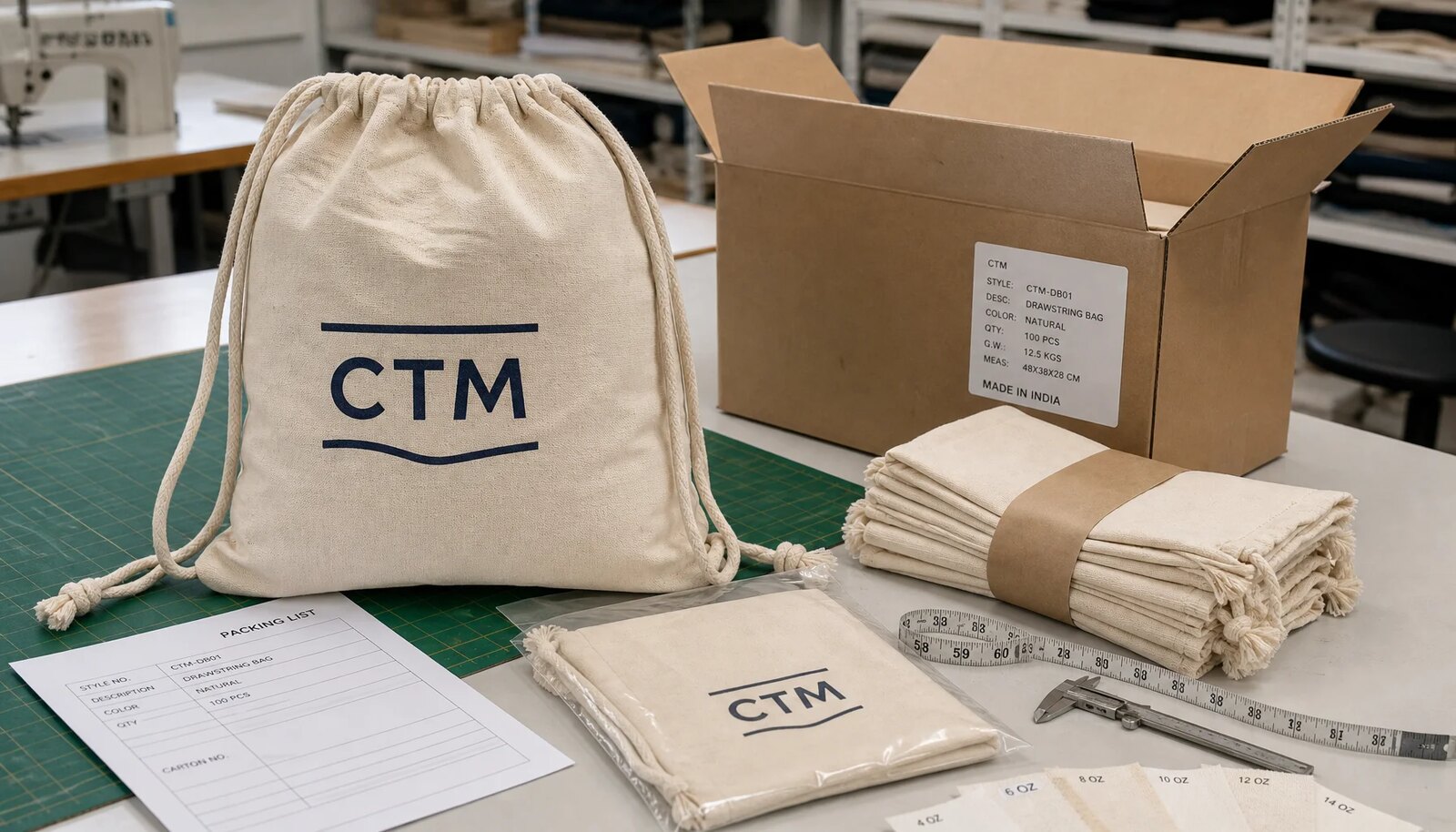
1. Start with the route, not only the backpack
A carton packing plan for wholesale cotton drawstring backpacks should be decided before final price comparison. Craft fair orders often move from factory to forwarder, warehouse, regional organizer, sponsor table, maker booth, or venue receiving area. Each handoff creates risk: crushed cartons, wrong-logo cartons, short-count disputes, repacking labor, cord tangling, or delayed event allocation.
The same 35 x 42 cm cotton drawstring backpack can have different landed cost and receiving performance depending on fabric GSM, cord bulk, fold, inner bundle count, polybag policy, carton strength, and gross weight. A supplier quote that only says 5,000 pcs does not tell procurement whether the shipment is ready for warehouse receiving, courier delivery, or booth-by-booth distribution.
Ask suppliers to quote the product and the packing plan together. The minimum quote should include finished bag specs, pieces per carton, inner bundle quantity, carton dimensions, gross weight, net weight, board construction, sealing method, label fields, and estimated CBM. Baselines such as 100 pcs/carton or 12-18 kg gross weight are useful only as sample assumptions; they must be confirmed by a packed-carton trial using the approved bag.
- Warehouse route: 100 pcs/carton with 2 x 50 pc bundles can simplify receiving.
- Booth route: 4 x 25 pc bundles can reduce on-site repacking.
- Courier route: lower carton count may be safer than maximum cube efficiency.
- Retail route: individual polybags, barcodes, and cleaner folding may matter more than lowest packing cost.
- Multi-city route: final allocation sheet and destination labels must be locked before packing.
2. Convert craft fair use into measurable specs
Craft fair backpacks may carry more than flyers. Attendees may add boxed soap, candles, yarn, folded apparel, catalogs, stationery, wrapped ceramics, or sponsor gifts. Makers may use the bag as branded packaging, while event sponsors may treat it as a giveaway. Procurement should translate that use into measurable construction requirements.
The core specification should state finished width and height, usable height, cotton weight, fabric color, accepted natural variation, cord material, cord diameter, cord length, reinforcement method, print method, print area, print placement, and packing method. Finished size needs extra clarity because some suppliers quote cutting size or flat panel size. Seam allowance, top channel, and reinforced bottom corners reduce usable capacity.
Natural cotton appearance should also be controlled. Flecks, slubs, neps, shade variation, and wrinkles can suit a handmade craft-market look, but they may not suit a strict sponsor brand program. Approve a swatch and define what is acceptable before cutting. For dyed cotton, require lab dip or shade standard approval, dye lot control, and cord color confirmation.
- Write finished width x height after sewing, not only cutting size.
- Confirm whether the top channel is included in stated height.
- List the largest expected item and realistic carry load.
- Approve shade range, flecks, slubs, odor, wrinkle level, and handfeel.
- Use the approved sample load when checking cord and reinforcement.
3. Specify cotton fabric without quote ambiguity
Cotton drawstring backpacks are commonly quoted in ounces or GSM, but buyers should define exactly what that means. A supplier may refer to greige fabric, catalog fabric, or finished fabric. For fair comparison, request finished fabric weight after dyeing, washing, and finishing. This affects opacity, handfeel, print stability, carton weight, and perceived value.
For many reusable craft fair programs, 6 oz to 8 oz cotton canvas, often around 200-270 GSM depending on finishing, is a practical range. Lighter 5 oz cotton can work for light-duty giveaways but may look thin and wrinkle more easily. Heavier 10 oz canvas feels more substantial but increases sewing bulk, folding pressure, freight cost, carton weight, and stress on cord anchoring.
Fabric choice changes the carton plan. A 6 oz natural cotton bag without individual polybag may fit a 100 pcs/carton approach. An 8 oz bag with thicker cotton cord and individual polybag may need a larger carton or lower count. Do not lock carton quantity on the purchase order until the supplier completes a trial using the approved fabric, cord, fold, print, and inner packing.
- Economy: 5-6 oz cotton for low-cost light-duty giveaways.
- Balanced reusable: 6-8 oz cotton canvas for most craft fair programs.
- Premium: 10 oz canvas where durability and handfeel outweigh freight impact.
- Natural cotton: approve flecks, shade, odor, handfeel, and shrinkage note.
- Dyed cotton: approve lab dip or shade reference plus cord color match.
4. Validate size, folding, and carton math
A common cotton drawstring backpack size is 35 x 42 cm, but the intended contents should drive approval. If a catalog, retail box, craft kit, or folded apparel pack must fit, send those dimensions to the supplier and request a fit check at sample stage. State the finished-size tolerance on the PO; +/-0.5 cm is often practical for sewn cotton bags, but the agreed tolerance should reflect the order’s actual requirement.
Folding affects cube, appearance, and receiving speed. A flat fold may reduce hard creases but need a longer carton. A thirds fold can shorten the carton while increasing stack height. Individual polybags improve cleanliness and count control but add labor, plastic, and volume. Loose bulk packing may lower cost but can create cord tangling and slower counting.
Use carton math as a comparison tool, not a fixed promise. Example only: if a trial carton for 100 pcs of 35 x 42 cm, 6-8 oz backpacks measures 50 x 40 x 45 cm, CBM per carton is 0.50 x 0.40 x 0.45 = 0.09 CBM. For 5,000 pcs at 100 pcs/carton, that equals 50 cartons and about 4.5 CBM before pallets or routing adjustments. If gross weight is 15 kg/carton, shipment gross weight is about 750 kg plus pallet weight if palletized. The supplier must confirm the actual packed-carton data.
- Request folded bag dimensions, carton size, gross weight, net weight, and CBM.
- Confirm cartons close without bulging or crushing printed panels.
- Use the same folding method for sample, inspection, and shipment.
- Recalculate CBM if fabric, cord, polybag policy, or carton count changes.
- Ask for packed-carton photos before final shipment approval.
5. Choose cords and reinforcement for actual carrying
The cord system is a common failure point on low-cost promotional drawstring backpacks. At a craft fair, the bag may be opened repeatedly, worn while walking, and loaded unevenly. Thin or rough cord can pass a visual check but feel uncomfortable. Poor bottom anchoring can make the bag unusable even when the cotton panel and logo look acceptable.
Cotton cord, braided cotton rope, and flat cotton tape usually fit natural cotton positioning better than thin polypropylene cord. A 6-8 mm cotton cord is a practical reusable range for light to moderate loads, but comfort depends on the load, cord finish, channel width, and top-channel stitching. Flat tape may distribute pressure better, but it still needs smooth movement through the channel.
Reinforcement should be described by construction, not by adjectives. Specify stitched fabric tabs, reinforced loops, bar-tacked corner seams, eyelets where appropriate, or another approved method. Add a practical load check to sample and final inspection: place the agreed weight inside the bag, lift by both cords, hold, open and close the drawstring several times, and then inspect seams, tabs, bar tacks, fabric tearing, and cord slippage.
- Approve cord material, diameter, color, finished length, and end treatment.
- Check smooth movement through the top channel.
- Avoid vague terms such as strong cord or reinforced corner.
- Use bar tacks or approved reinforcement at high-stress points.
- Tie cord testing to the expected craft fair load, not only visual inspection.
6. Match decoration to artwork and packing pressure
Screen printing is usually practical for simple craft fair logos, sponsor marks, event names, and one- to three-color graphics. The quote should state print size, position, number of colors, color reference, setup charges, screen charges, curing method, and placement tolerance. Heat transfer may suit detailed multicolor artwork or many small logo variations, but buyers should approve handfeel, edge appearance, and performance on textured cotton. Embroidery can work on heavier cotton but adds backing, cost, and possible fabric distortion.
Decoration control depends on whether the supplier prints in-house or uses a subcontractor. This is not automatically a problem, but it changes risk. Ask who controls artwork proofing, color matching, curing, reject sorting, WIP separation, and protection of printed panels before sewing or packing. For multi-logo programs, require a process for separating panels and finished goods by artwork version.
Packing pressure can expose weak print control. Uncured ink may offset when bags are stacked. Large ink coverage can crease or feel stiff. Heat transfers may show edge lifting or gloss change. Require a print strike-off and, for larger orders, a folded or packed sample so the buyer can see how the decoration behaves under the planned carton compression.
- Screen print: practical for solid logos and medium-to-large runs.
- Heat transfer: useful for complex art or many low-quantity versions.
- Embroidery: reserve for heavier premium cotton programs.
- Require Pantone, lab standard, or signed-sample color control.
- Check curing, dry rub, folding marks, offset, and placement accuracy.
7. Qualify suppliers beyond the unit price
A low unit price is not useful if the supplier cannot control sewing, printing, packing, and shipment timing. Supplier qualification should cover cotton soft-goods experience, production capacity, decoration control, carton packing discipline, and export handling. Ask whether the company has made drawstring backpacks or similar cotton bags, not only generic promotional textiles.
Verify whether you are working with a factory, trading company, or hybrid supplier. A trader may be acceptable if communication and QC control are strong, but procurement should know who owns the sewing line, who buys fabric, who manages decoration, and who signs off final packing. Ask for a business license where appropriate, factory address, production photos, recent relevant product photos, and the inspection contact responsible for this PO.
Carton capability is also a sourcing signal. Stronger suppliers can provide packed-carton photos, carton label proofs, weight readings, allocation reconciliation, and carton material evidence such as burst or edge-crush test information if available from their carton vendor. Avoid demanding unverifiable claims; request practical evidence and a clear process for preventing wrong-SKU or damaged-carton shipments.
- Confirm factory, trader, or hybrid status before PO placement.
- Ask who controls fabric purchase, sewing, decoration, inspection, and export packing.
- Check whether print is in-house or subcontracted and how rejects are isolated.
- Request carton packing photos, label proof, and weight reading before shipment.
- Ask how artwork versions are separated during printing, sewing, trimming, and packing.
8. Build MOQ and allocation around SKU complexity
MOQ depends on more than total quantity. A 5,000-piece order in one natural cotton fabric, one navy print, and one cord color is very different from 5,000 pcs split across ten sponsor logos, several fabric colors, multiple cord colors, and three destinations. Every split can affect fabric purchasing, dye lots, print setup, cord sourcing, sorting labor, carton labels, inspection time, and packing accuracy.
Separate total program quantity from per-SKU quantity in the RFQ. Ask for MOQ and price by fabric color, print design, cord color, and packing version. Low per-design quantities may make heat transfer more practical than screen printing. Small custom dyed runs may be inefficient compared with standard natural cotton and varied artwork.
Allocation rules should be fixed before packing begins. If one artwork ships to several cities, the factory needs a final allocation table showing destination code, carton quantity, inner bundle format, and label requirements. Late allocation changes create mixed-carton risk and can delay shipment. Use one SKU, artwork, and destination per carton whenever possible.
- Quote MOQ per fabric color, print design, cord color, and packing version.
- Standardize fabric and cord when many artwork versions are needed.
- Use one SKU/artwork/destination per carton whenever possible.
- Set a deadline for final allocation changes.
- Require packing list totals to match carton labels exactly.
9. Design labels, pallets, and receiving controls
Carton labels should allow a warehouse or event team to receive goods without opening every carton. A practical label includes buyer code, PO number, item name, SKU, fabric color, print version, quantity, carton number, total cartons, gross weight, net weight, carton dimensions, destination code, and country of origin if required. For multi-city craft fairs, destination code and artwork version are critical.
A simple receiving label format is: Buyer / PO / Item / SKU / Artwork Version / Fabric Color / Quantity / Carton No. __ of __ / GW / NW / Carton Size / Destination / Made in __. If mixed cartons are unavoidable, the outer label should clearly say MIXED and list the inner bundle contents. Inner bundles should also be labeled by SKU, artwork, quantity, and destination.
Palletization should be agreed when goods ship to a warehouse or through LCL consolidation. Ask for pallet size, cartons per layer, layer count, maximum pallet height, pallet gross weight, corner protection, stretch wrap, and whether labels remain visible. For direct-to-venue courier shipments, palletization may matter less than carton strength, waterproof protection, and manageable gross weight.
- Use sequential carton numbering with no gaps.
- Avoid mixed cartons unless small quantities require it.
- Label inner bundles when cartons contain multiple versions.
- Keep carton labels visible after pallet wrapping.
- Photograph label, opened carton, bundle count, and sealed carton during inspection.
10. Approve samples and inspect the shipment plan
A loose sample does not prove a production-ready order. Approval should move from fabric swatch to print strike-off to pre-production sample to packed-carton confirmation. The swatch confirms GSM, shade, handfeel, odor, and natural variation. The strike-off confirms color, artwork size, registration, curing appearance, and placement. The pre-production sample confirms finished size, stitching, cord function, reinforcement, and final construction.
Packed-carton approval is the step buyers often miss. Request photos or a trial carton showing folded bags, inner bundles, carton fill, carton label, sealed carton, and weight reading. For larger or deadline-sensitive programs, confirm carton dimensions, gross weight, net weight, total cartons, and total CBM after the trial. Any change in fabric, cord, polybag policy, carton quantity, board strength, or packing method should trigger a revised packing confirmation.
Final inspection should use the signed sample, approved swatch, artwork file, strike-off, label proof, allocation sheet, packing list, and packing photos. Use agreed AQL sampling levels, then add carton-specific checks: open cartons for count and SKU separation, check odor and moisture, inspect crushed corners, verify carton labels, and perform reasonable drop or stack checks suited to the shipping route. Shipment should not release if unapproved substitutions, wet cartons, wrong labels, or major packing changes appear.
- Approve swatch, print strike-off, pre-production sample, and packing trial.
- Inspect dimensions, GSM, shade, stitching, cord function, print quality, and reinforcement.
- Open cartons to verify quantity, bundles, labels, and SKU separation.
- Check gross weight, carton condition, odor, moisture, and closure against the plan.
- Hold shipment release if substitutions or unapproved packing changes appear.
Specification comparison for buyers
| Packing alternative | Sample carton assumption to confirm | Best commercial use | CBM, cost, and handling tradeoff |
|---|---|---|---|
| Bulk packed with paper bands | Example: 100 pcs/carton in 2 x 50 pc bundles; trial carton around 50 x 40 x 45 cm for a 35 x 42 cm 6-8 oz bag | Warehouse receiving, distributor stock, eco-positioned event programs | Lowest plastic use and efficient count. Buyer must confirm actual carton size, closure, cord tangling, gross weight, and carton compression. |
| Booth allocation bundles | Example: 100 pcs/carton in 4 x 25 pc labeled bundles; carton may match bulk pack or increase slightly | Sponsor tables, maker booth kits, volunteer distribution, multi-booth events | Adds bundle labeling labor but reduces venue repacking and wrong-booth allocation risk. |
| Individual polybag packing | Example: 80-100 pcs/carton depending on bag size, fabric GSM, cord bulk, fold, and polybag thickness | Retail handling, dusty routes, direct-to-venue delivery, cleaner presentation | Higher unit packing cost and usually higher CBM. Better cleanliness, cord control, barcode handling, and count visibility. |
| Courier-friendly lower count | Example: 50-80 pcs/carton in a stronger 5-ply export carton with practical manual-lift weight | Parcel delivery, split shipments, venues without receiving docks, manual unloading | More cartons and labels, often higher handling cost. Lower risk of carton splitting, over-weight refusal, and damaged corners. |
| Palletized export cartons | Example: 100 pcs/carton only after trial confirms closure, stacking, and gross weight; 5-ply often preferred for LCL or heavier canvas | Ocean freight, LCL consolidation, warehouse delivery, regional distribution | Improves stacking and handling when carton footprint is standardized. Requires pallet pattern, height limit, corner protection, wrap, and visible labels. |
| Mixed-SKU carton only if unavoidable | Inner bundles labeled by SKU, artwork, quantity, and destination; outer carton marked MIXED with contents list | Small logo splits, late allocation adjustments, sample replenishment, low-volume sponsor variants | Reduces carton count but increases receiving error risk. Requires allocation sheet, opened-carton inspection, and exact packing list reconciliation. |
Buyer checklist before sampling
- Define finished bag width and height after sewing, and state whether the top drawstring channel is included in total height.
- Specify finished fabric weight in GSM or ounces and require confirmation after dyeing, washing, and finishing, not only greige fabric weight.
- List intended contents and realistic load, such as A4 flyers, T-shirts, boxed candles, yarn, catalogs, craft kits, sponsor gifts, or retail samples.
- Approve acceptable cotton appearance: shade range, flecks, slubs, neps, wrinkles, handfeel, odor, and whether small natural variations are allowed.
- State cord material, diameter, color, finished length, end treatment, channel fit, and bottom anchoring construction.
- Approve fabric swatch, print strike-off, pre-production sample, and packed-carton trial before mass production or final shipment.
- Ask suppliers to quote pieces per carton, inner bundle quantity, carton dimensions, gross weight, net weight, board strength, sealing method, and estimated CBM.
- Select packing format clearly: no individual polybag, individual polybag, paper-banded bundle, cotton-tied bundle, inner carton, retail-ready pack, or destination bundle.
- Set carton gross weight limits for the receiving route; common 12-18 kg targets are only starting points and must be validated by packed-carton trials.
- Require carton labels with PO, SKU, artwork version, fabric color, quantity, carton number, gross weight, net weight, destination code, and country-of-origin fields where applicable.
Factory quote questions to send
- What is the finished fabric weight in GSM or ounces, and how is it verified after dyeing, washing, and finishing?
- What is the finished bag size after sewing, what tolerance applies, and is the top drawstring channel included in the height measurement?
- What fabric construction, cotton color, shade tolerance, shrinkage expectation, odor standard, and natural fleck or slub level are included?
- What cord material, diameter, finished length, color, knot or end treatment, and bottom anchoring construction are quoted?
- What realistic sewing-line capacity is available for this item after fabric, artwork, and print approval?
- Is decoration done in-house or subcontracted, and who is responsible for artwork proofing, curing, final print QC, and rejected printed panels?
- What print setup charges, screen charges, artwork charges, color matching standard, curing process, and placement tolerance are included?
- What exact packing method is quoted: loose bulk, paper bands, cotton ties, individual polybags, inner cartons, master cartons, booth bundles, or destination bundles?
- How many pieces are packed per inner bundle and export carton, and can the count be adjusted to meet carton weight, courier, pallet, or booth allocation limits?
- What are the trial carton dimensions, gross weight, net weight, board construction, sealing method, pallet pattern if any, and estimated total CBM?
Quality-control points to confirm
- Use a written inspection plan, commonly based on ANSI/ASQ Z1.4 or ISO 2859-1 sampling, with agreed AQL levels for critical, major, and minor defects before production starts.
- Finished bag width and height must match the approved tolerance, commonly +/-0.5 cm for sewn cotton bags unless another standard is agreed.
- Fabric weight must match the approved swatch or stated GSM range; lighter substitutions require written buyer approval before cutting.
- Fabric shade, natural flecks, slubs, stains, holes, dye streaks, odor, moisture marks, and handfeel must match the signed sample and commercial expectation.
- Panels should be square enough for flat stacking and centered printing, with no obvious twisting, puckering, uneven side panels, or distorted top channel.
- Side seams, bottom corners, reinforcement tabs, and top channels must be secure with no loose threads, skipped stitches, open seams, or exposed raw edges likely to fray.
- Cord material, diameter, color, length, and left/right balance must match the approved sample and move smoothly through the channel.
- Bottom anchoring should pass a practical load test: place the agreed test weight inside, hang or lift by both cords for a set hold time, then pull open and closed repeatedly before checking seam tearing, bar-tack failure, and cord slippage.
- Print color must match the approved Pantone reference, strike-off, or signed sample under consistent lighting before mass packing is accepted.
- Print placement should stay within agreed tolerance, commonly +/-0.5 cm for a simple front logo measured from a defined centerline or edge reference.