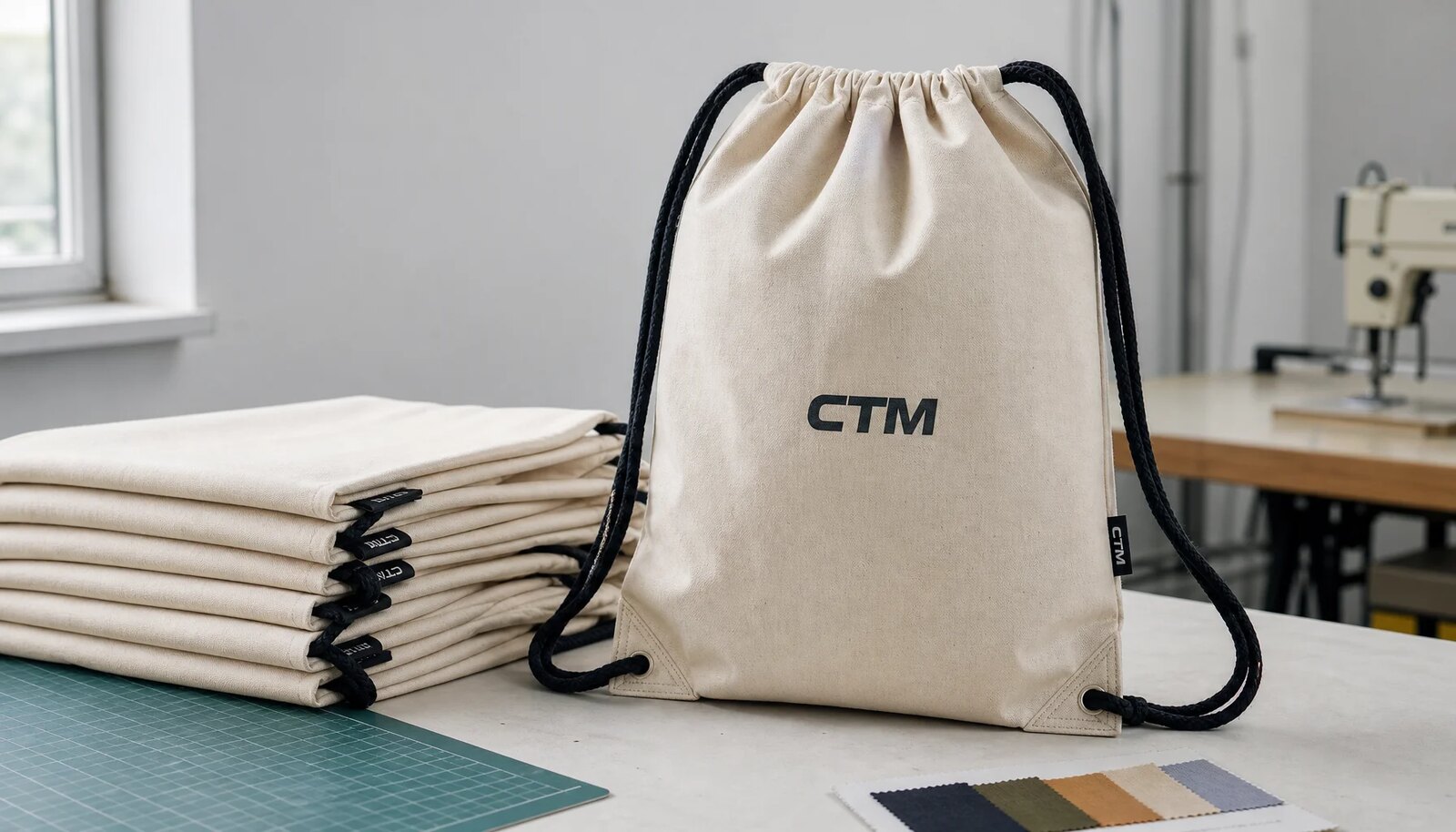
Start with the commercial use, not the cheapest bag
A wholesale cotton drawstring backpack for a craft fair can do several very different jobs. It might be a free booth giveaway, a paid merchandise item, a workshop kit carrier, a sponsor bag for a community market, or a distributor stock SKU used across many events. Those roles should not share one loose specification. The intended use changes the right fabric weight, cord comfort, print method, packing format, inspection level, and acceptable defect range.
If an RFQ says only “cotton drawstring backpack with logo,” every supplier has to guess. One may quote thin promotional cotton sheeting. Another may quote a sturdier 8 oz canvas bag with reinforced corners. A third may include individual packing and print setup while another leaves those costs out. The buyer ends up comparing numbers that look similar but describe different products.
Begin with the customer experience and the target landed cost. A giveaway can be lighter and more simply packed as long as the print is clean and the bag survives normal event use. Paid craft fair merchandise needs a better handfeel, straighter seams, and a neater presentation. A kit carrier needs dependable lower-corner reinforcement because the cords carry the load. Distributor stock needs repeatable shade, size, carton quantity, and labeling so reorders match previous deliveries.
A useful bulk pricing plan starts with a short product brief. Include the event type, expected contents, target quantity, delivery market, resale or giveaway role, artwork complexity, and any retail packaging or sustainability expectations. That brief gives the supplier enough information to quote the right bag instead of choosing the cheapest construction that fits a vague description.
- For giveaways, prioritize clean one-color printing, acceptable cotton handfeel, simple packing, and low freight cube.
- For paid craft fair merchandise, avoid very light sheeting and consider 6 oz or 8 oz cotton canvas.
- For craft kits, list the expected contents and reinforce the lower cord exits before adding decorative features.
- For sponsor bags, confirm whether multiple logos add print colors, screens, registration work, and approval time.
- For distributor stock, keep size, fabric, cord, carton quantity, and labeling consistent for repeat replenishment.
- For private-label resale, include hangtag, carton labels, defect standards, and sample approval requirements in the RFQ.
Specify cotton fabric by GSM, weave, and finish
Fabric is the first detail buyers notice and one of the largest cost drivers. Still, broad terms such as cotton, canvas, natural cotton, or eco fabric are not enough for B2B purchasing. Ask for actual GSM, and when helpful, include an ounce description. As a practical reference, light event fabrics may sit around 140–170 GSM. Many craft fair programs use about 180–240 GSM, often described as 6 oz to 8 oz depending on mill standard and finish. Heavier 280–340 GSM canvas can feel more premium, but it also raises material cost, sewing effort, shipping weight, and carton handling.
GSM does not tell the whole story. A plain weave cotton canvas and a thin cotton sheeting can behave very differently even when the quoted weight looks close. Sheeting may wrinkle, collapse, or look less structured on a large backpack panel. Canvas usually gives better body and perceived value. Twill can look attractive, but it may change print sharpness, fabric cost, and sewing behavior. Ask the supplier to name the fabric construction and provide a swatch or production-grade sample before bulk approval.
Finish matters too. Natural unbleached cotton suits artisan, museum, school, handmade, and community-market programs, but it can show seed flecks, slubs, and lot-to-lot shade movement. Bleached cotton gives a cleaner print background, though it may feel less natural than unbleached canvas. Stock dyed colors reduce custom dye complexity but limit shade choice. Custom dyeing can support brand color programs, yet it may add fabric MOQ, lab dip approval, shade tolerance discussion, and extra lead time.
For repeat programs, lock the approved swatch. Natural cotton variation is normal, but the buyer and supplier need the same reference when judging production. Without a swatch, shade decisions become subjective and difficult to resolve after goods are packed.
- Light event grade: about 140–170 GSM, suitable for low-cost distribution but weak for premium resale.
- Practical craft fair grade: about 180–240 GSM, commonly used for 6 oz to 8 oz cotton canvas programs.
- Premium grade: about 280–340 GSM, stronger handfeel but higher material cost, freight weight, and sewing demand.
- Natural unbleached cotton: approve shade, seed flecks, slubs, and acceptable natural variation before bulk.
- Bleached cotton: useful for cleaner print contrast, but less natural-looking than unbleached canvas.
- Dyed cotton: confirm stock color availability, lab dip timing, fabric MOQ, and shade tolerance.
- RFQ wording: “Plain weave cotton canvas drawstring backpack, target 6 oz or 8 oz, actual GSM and finish declared on quote.”
Lock size, seams, channel, and cord reinforcement
Drawstring backpacks look simple, but the construction details carry the risk. The top channel must let the cord slide without trapping fabric. Side and bottom seams need even stitching. The lower cord exits need reinforcement because the shoulder cords pull through these points when the bag is loaded. Many field failures start at the lower corners rather than in the middle of the fabric panel.
For adult craft fair use, 34 x 42 cm is a practical standard size. A 35 x 45 cm bag gives more capacity for larger kits, brochures, T-shirts, or purchases, but it also uses more fabric and creates more carton volume. Smaller sizes may work for children’s workshops, but they should be treated as separate SKUs with their own pricing and tolerance.
Finished measurement tolerance is commonly +/- 1 cm for cotton drawstring backpacks. Buyers may need tighter control when the bags must fit retail displays, pre-packed kits, or shelf-ready cartons. If the tolerance matters, write it into the RFQ and purchase order. Do not rely on “standard size” language.
Extra features should be quoted as options. A front pocket, zipper, lining, contrast panel, woven label, hangtag, metal eyelet, or heavier cord can all be useful, but each adds material, cutting, sewing, packing, or inspection work. For many craft fair buyers, better fabric, clean printing, and reinforced lower corners create more value than a decorative feature that complicates production.
- Standard adult size: 34 x 42 cm or 35 x 45 cm depending on capacity requirement.
- Finished tolerance: use +/- 1 cm unless the buyer requires tighter retail or kit-packing control.
- Top channel: wide enough for smooth cord movement with no trapped cord, blocked opening, or heavy bunching.
- Lower cord exit: reinforce both corners with bar-tack, folded patch, sewn patch, or reinforced eyelet construction.
- Seams: require even stitch density, no skipped stitches, no open seams, and clean thread trimming.
- Feature control: quote pockets, zippers, lining, labels, and hangtags as separate options to protect comparison clarity.
- Buyer instruction: replace vague “strong stitching” language with named reinforcement details and measurable tolerance.
Build MOQ tiers that show the real cost curve
A bulk pricing plan should not be one MOQ and one unit price. Cotton drawstring backpacks have several cost layers: fabric purchasing, cutting efficiency, sewing setup, print setup, label preparation, packing materials, carton planning, inspection, and export handling. A 300-piece order may be possible, but the unit cost is usually higher because setup time and print preparation are spread across fewer pieces.
For many custom logo cotton drawstring backpack programs, 1,000 pcs is a more practical starting point than very small runs. At 3,000 to 5,000 pcs, cutting, production scheduling, packing, and material purchasing may become more efficient. The important word is “may.” Buyers should ask what actually changes at each tier instead of assuming every higher quantity produces the same savings.
Request each tier with the same specification. If one quote uses 500 pcs in 5 oz sheeting and another uses 1,000 pcs in 8 oz canvas, the prices are not comparable. The same rule applies to logo size, print method, packing, and price term. A 10 cm one-color logo in bulk cartons is not the same job as a 28 cm full-panel print in individual polybags.
MOQ also affects repeat-order risk. Some attractive low prices rely on leftover stock fabric, temporary cord availability, or a shade that cannot be repeated later. That may be acceptable for a one-time giveaway. It is risky for distributor stock, seasonal craft fair replenishment, or private-label resale. Ask whether the quoted fabric and cord are regular production materials and whether the supplier can repeat shade, diameter, and print ink on future orders.
- 500 pcs: useful for pilots or limited events, but setup, print, and handling cost per unit will be higher.
- 1,000 pcs: practical starting point for many custom logo cotton drawstring backpack orders.
- 3,000 pcs: improves cutting efficiency, production planning, and carton consistency.
- 5,000 pcs and above: stronger leverage on material purchasing, QC planning, and packing operations.
- Ask what changes at each tier: fabric cost, cutting yield, screen setup allocation, labor planning, or carton cost.
- Compare tiers only when fabric GSM, size, cord, print method, logo size, packing, and price term are identical.
- For reorders, ask whether repeat fabric shade, cord diameter, and ink color are available without full re-development.
Match print method to artwork and cotton surface
Screen printing is usually the most practical decoration method for wholesale cotton drawstring backpacks when the artwork uses one to three spot colors. It offers predictable setup, stable unit cost at volume, and good opacity on natural or dyed cotton when the artwork is suitable. It is a strong fit for craft fair logos, event names, museum marks, school programs, local maker-market branding, and sponsor graphics.
The buyer still needs to define logo size and placement. A small centered logo and a full-panel print have very different setup, ink coverage, drying, handling, and QC requirements. Large ink areas can change the handfeel of cotton canvas. Fine text can lose clarity on a textured weave. If the logo includes small lettering, ask the factory to confirm the minimum readable line weight on the selected fabric before sampling.
Heat transfer or DTF-style transfer can work well for full-color graphics, gradients, photo-style designs, or short runs with many colors. These methods can reproduce detail that is difficult in screen printing, but they may feel different on cotton canvas. Transfers should be checked for edge lifting, cracking when flexed, rubbing resistance, opacity, and stiffness.
Embroidery can create a premium effect on heavier cotton canvas, but use it carefully. Thread tension can pucker lighter fabrics, and large embroidered areas can make a simple drawstring backpack expensive. Embroidery usually works better for small logos, patches, or labels than for large front-panel artwork.
Artwork delays are easy to avoid. Send vector artwork, Pantone or ink color references where available, final logo dimensions, placement from top and side edges, and the preferred print method. If sponsor logos are included, clarify hierarchy and spacing before the factory prepares screens or samples.
- Screen print: best for 1–3 spot colors, repeat orders, clean logos, and predictable bulk pricing.
- Heat transfer: useful for multi-color artwork, but test handfeel, edge adhesion, flexing, and cracking.
- DTF-style transfer: good for detail and gradients, but confirm durability and feel on the selected cotton fabric.
- Embroidery: premium option for heavier canvas and small logos, but may pucker light fabric.
- Artwork data: provide vector file, logo size, print position, ink colors, and any sponsor logo hierarchy.
- Approval checks: color, opacity, edge sharpness, registration, placement, handfeel, rub resistance, and flex behavior.
- Cost control: reduce unnecessary print colors or very large ink coverage when the target unit cost is tight.
Compare landed cost, not headline unit price
The lowest quoted unit price is not always the lowest delivered cost. One supplier may include screen setup, carton labeling, and export packing. Another may list those items separately or omit them until later. For wholesale cotton drawstring backpacks, hidden differences often appear in fabric GSM, print setup, sample fees, labels, hangtags, individual packing, carton cube, local export charges, and price term.
Backpacks can be bulky relative to their unit value, so carton data matters early. A heavier fabric may be the right choice for paid resale, but it may not fit a low-margin giveaway if freight cost rises too much. Individual polybags help with cleanliness and retail handling, yet they add material, labor, and often carton volume. Ask for carton quantity, carton dimensions, net weight, gross weight, and CBM per 1,000 pcs before comparing suppliers.
Normalize price terms before making decisions. EXW, FCA, FOB, CIF, and DDP do not assign the same cost responsibility. EXW can look cheaper because pickup, local export handling, and freight are outside the supplier’s price. FOB is easier to compare for many importers. DDP can simplify delivery for buyers who want one quoted arrival cost, but the buyer should still understand duties, taxes, customs responsibility, and routing assumptions.
Separate one-time charges from repeat-order pricing. Screens, sample charges, artwork adjustments, and first-run setup costs may not repeat if the same artwork and specification are reordered. Without that separation, a buyer may reject a viable supplier or misunderstand the true seasonal cost.
- Quote items: product unit price, print setup, sample cost, artwork adjustment, labels, hangtags, packing, and carton labels.
- Freight data: carton quantity, carton dimensions, net weight, gross weight, and CBM per 1,000 pcs.
- Price term: compare EXW, FCA, FOB, CIF, or DDP only after normalizing responsibilities and exclusions.
- Repeat cost: ask whether screen charges and setup charges apply again on reorder.
- Packing cost: confirm whether bulk packing, polybags, carton liners, paper bands, and labels are included.
- Landed-cost rule: do not compare quotes without fabric GSM, print method, carton cube, and price term.
- Seasonal planning: compare reorder timing and reorder price, not only first-order sample cost.
Choose the supplier route by control level
Factory-direct sourcing gives buyers the most control when the backpack is a core SKU, repeat item, or private-label product. A manufacturer can discuss fabric purchasing, cutting, sewing, printing coordination, packing, and inspection in more detail. Buyers can also work through practical tradeoffs, such as moving from 8 oz to 6 oz canvas, increasing cord diameter, reducing print area, or switching from individual polybags to bulk cartons.
A trading company or sourcing agent can be useful when the buyer is consolidating several event items, such as notebooks, pins, lanyards, signage, and bags. Consolidation may reduce vendor management, but it should not remove technical visibility. Even through an intermediary, the buyer should still receive fabric GSM, construction photos, sample timing, reinforcement details, carton cube, and inspection standards.
Distributor stock works for urgent needs when buyers can accept limited size, color, fabric, packing, and print control. It is less suitable when the buyer needs consistent natural cotton shade, private-label packing, controlled logo placement, or repeatable seasonal replenishment.
Supplier evaluation should focus on evidence, not broad claims. Ask for fabric swatches, close-up photos of the top channel and lower cord exits, carton data from the quoted packing format, and a clear sample approval process. A supplier that cannot state GSM, cord diameter, reinforcement method, or carton CBM is not giving procurement enough information for a serious B2B order.
- Factory-direct: best for repeat orders, custom specs, private-label packing, tighter QC, and controlled reorders.
- Trading route: useful for mixed-category consolidation if technical product data remains visible.
- Distributor stock: useful for urgent plain-bag needs but limited for custom craft fair programs.
- Evidence to request: sample photos, seam close-ups, fabric swatches, measurements, and carton data.
- Avoid relying on unverifiable named-customer claims; evaluate the quoted specification and approval process.
- Reject vague quotes that cannot state GSM, cord diameter, CBM, reinforcement method, or print setup details.
- For larger orders, confirm whether buyer-appointed or third-party inspection is accepted before shipment.
Use sampling to prove what the quote cannot show
A pre-production sample turns a spreadsheet quote into something buyers can measure, pull, flex, and approve. It should use the production fabric, production cord, actual print method, final logo size, final reinforcement method, and intended packing fold. A stock sample is useful for early discussion, but it should not approve bulk production if the bulk fabric, cord, or print method will be different.
Document the sample review. Instead of writing “fabric is good,” record GSM, finish, shade approval, and whether seed flecks or slubs are acceptable. Instead of “logo looks fine,” record print size, placement, color, opacity, edge sharpness, and handfeel. Instead of “cord is okay,” record material, diameter, length balance, and whether it slides smoothly through the top channel.
Simple functional checks catch many problems. Load the sample with realistic craft fair contents, such as brochures, a T-shirt, small packaged items, and a light bottle if that reflects actual use. Pull both cords repeatedly, wear the backpack briefly, and inspect the lower exits. Flex the printed panel and rub it lightly with a clean cloth. These checks do not replace lab testing, but they often reveal issues before fabric is cut for bulk.
Both buyer and supplier should keep an approved reference. For larger or repeat orders, seal and sign a physical sample or create a written approval file with photos, dimensions, measurements, and comments. Once bulk production begins, changing print position, reinforcement, or size can create delay, rework, and scrap.
- Measure finished size flat and record the approved tolerance.
- Check fabric shade, surface texture, seed flecks, slubs, and visible weaving defects.
- Pull cords repeatedly to test channel smoothness, length balance, and comfort.
- Load the sample with realistic craft fair contents before approving lower-corner construction.
- Inspect both lower cord exits after loading and pulling because this is a common failure point.
- Flex and rub the printed area to check cracking, stiffness, opacity, and transfer edge lifting.
- Approve packing fold so the logo is not sharply creased through a visible print area.
- Keep one approved buyer sample and one factory reference sample for production and inspection.
Define QC standards before production starts
Quality control for cotton drawstring backpacks should cover fabric, measurements, sewing, cord function, printing, labeling, packing, and carton count. A bag may look acceptable in a photo but fail when the cords are pulled or when the seams are stressed. The approved sample and written specification should be the inspection standard, not a catalog image or a verbal description.
For import orders or larger domestic programs, buyers can use AQL-based final inspection after packing and before shipment release. The exact AQL level should match the buyer’s sales channel and risk tolerance. Even when a formal third-party inspection is not used, the supplier should know which defects are critical, major, and minor.
Defect classification prevents subjective arguments. Critical defects may include wrong artwork, wrong product, unsafe contamination, or severe construction failure. Major defects may include open seams, missing reinforcement, size outside tolerance, badly misplaced print, front-panel stains, non-functioning cords, wrong carton count, or wrong labels. Minor defects may include small loose threads, slight wrinkles, or natural shade variation within the approved range.
Functional inspection should be specific. Pull the drawcords, check left-right balance, confirm smooth movement through the channel, apply moderate tension at the lower cord exits, and examine reinforcement stitching. Print inspection should cover placement, opacity, color, registration, cracking, rubbing, and transfer edges. Packing inspection should open random cartons and confirm quantity, design, color, fold, labels, and PO details.
- Inspection timing: final inspection after packing but before shipment release.
- Inspection standard: approved sample, written spec sheet, purchase order, and artwork placement file.
- Measurements: record finished dimensions against the agreed tolerance on sampled units.
- Sewing checks: top channel, side seams, bottom seams, lower cord exits, bar-tacks, and patches.
- Function checks: cord pull, smooth movement, balanced cord length, and no tearing at exits.
- Print checks: placement, color, opacity, registration, edge sharpness, cracking, rubbing, and transfer adhesion.
- Defect examples: stains, holes, open seams, wrong artwork, missing labels, wrong packing, and mixed cartons.
- Shipment control: require inspection photos and measurement data before release when order risk is high.
Use packing specs to protect freight and distribution
Packing affects cost, cleanliness, freight cube, receiving speed, and retail handling. Bulk flat packing in export cartons is usually the most efficient default for wholesale cotton drawstring backpacks for craft fairs. It reduces packing labor, avoids unnecessary material, and makes it easier to count and distribute units by event, booth, warehouse, or sales territory.
Individual polybags are justified when units will be sold individually, stored for a long time, handled through several warehouses, or shipped to retail stores where cleanliness is critical. They add cost, labor, plastic use, and sometimes carton volume. A carton liner or inner bulk bag can be a practical compromise when the buyer wants cleaner goods without one bag per unit. Paper bands or belly wraps improve presentation, but they offer limited protection from dust and moisture during export.
Approve the packing fold before production. If the printed logo is folded sharply through the center, the bag may arrive with a visible crease or stressed ink. If cords are left tangled, event staff may spend unnecessary time separating units. Simple instructions help: flat fold, print facing up or inward as approved, cords tucked consistently, fixed quantity per carton, and no mixed designs unless requested.
Carton labels should support B2B receiving, not only shipping. Include item number, purchase order, color, design, quantity, carton number, and destination when needed. If multiple designs or colors are ordered, avoid mixed cartons unless the buyer specifically requests them and the label identifies the mix clearly.
- Bulk flat pack: efficient for wholesale replenishment, event distribution, and lower packing cost.
- Individual polybag: useful for retail cleanliness but increases cost, plastic use, labor, and carton volume.
- Carton liner: practical middle option for cleanliness without individual unit bags.
- Paper band: better presentation but limited moisture and dust protection.
- Packing fold: approve logo fold direction and cord placement before bulk packing.
- Carton data: require quantity per carton, dimensions, net weight, gross weight, and CBM before freight booking.
- Carton labels: include item number, PO number, color, design, quantity, carton number, and destination.
- Mixed cartons: avoid unless intentionally specified and clearly labeled for receiving teams.
Specification comparison for buyers
| Spec decision | Recommended option | When it fits | Buyer risk to check |
|---|---|---|---|
| Product role | Define the bag as a giveaway, paid merchandise item, craft kit carrier, sponsor bag, distributor stock SKU, or purchase-with-purchase add-on before quoting | Keeps fabric, cord, print, packing, and QC level aligned with the real commercial use | A vague “cotton backpack with logo” request may compare low-cost promotional sheeting against retail-style canvas |
| Fabric weight | Use 6 oz to 8 oz cotton canvas for most craft fair programs; reserve 10 oz for premium resale or heavier contents | 6 oz works for light kits and budget merchandise; 8 oz gives stronger handfeel for paid retail | Quotes that only say “cotton” may use 4 oz to 5 oz sheeting with weaker drape and lower perceived value |
| GSM declaration | Request actual GSM on the quote, commonly about 180–240 GSM for practical 6–8 oz programs | Makes supplier comparisons more objective across regions and mill standards | Ounce labels vary by supplier; GSM and an approved fabric swatch reduce misunderstanding |
| Fabric finish | State natural unbleached, bleached, dyed stock color, or custom dyed color in the RFQ | Controls shade, print background, craft-market appearance, and repeat-order consistency | Natural cotton shade, seed flecks, slubs, and shrinkage can vary unless an approved swatch is locked |
| Finished size | Specify 34 x 42 cm for standard adult use or 35 x 45 cm for larger capacity; typical tolerance is +/- 1 cm | Fits brochures, shirts, packaged craft kits, small purchases, and light personal items | Oversizing increases fabric consumption, carton cube, and freight without always improving sell-through |
| Drawcord | Use cotton rope or cotton flat cord with declared diameter; choose polyester only when cost or exact color matching is the priority | Supports a natural product position and improves shoulder comfort for craft fair shoppers | Thin polyester cord can cut into shoulders and weaken the retail impression |
| Lower cord reinforcement | Require bar-tack, folded patch, sewn fabric patch, or reinforced eyelet construction at both cord exits | Important for books, bottles, boxed craft supplies, ceramics, event kits, or repeated shopper use | Plain seam holes may tear even when the main fabric weight is acceptable |
| Logo method | Use screen print for 1–3 spot colors; consider transfer or DTF-style transfer for full-color artwork | Screen print gives predictable bulk cost and good durability on cotton canvas | Fine text, large ink coverage, gradients, and transfers need sample testing for opacity, handfeel, cracking, and edge lifting |
| MOQ tiers | Request 500, 1,000, 3,000, and 5,000 pcs with identical specifications | Shows whether savings come from setup allocation, fabric buying, cutting efficiency, labor planning, or packing | A low MOQ quote may hide higher setup cost, limited stock fabric, weaker QC, or non-repeatable shade |
Buyer checklist before sampling
- Define the backpack’s role before quoting: giveaway, paid retail merchandise, kit carrier, sponsor bag, distributor stock item, or purchase-with-purchase add-on.
- Set a target landed cost or resale margin before choosing fabric weight, print size, packing format, and accessories.
- State fabric weight in both oz and GSM where possible, for example 6 oz cotton canvas with actual GSM declared on the quotation.
- Confirm fabric construction: plain weave canvas, sheeting, twill, or another construction; do not accept “cotton” as the full textile specification.
- Specify finish and shade standard: natural unbleached, bleached, stock dyed, custom dyed, and whether seed flecks or slubs are acceptable.
- State finished size in centimeters with tolerance, typically +/- 1 cm for standard drawstring backpacks unless retail display requires tighter control.
- Choose drawcord material, color, length, and diameter; request cotton rope or flat cotton cord when a natural craft-market feel matters.
- Require lower corner reinforcement on both cord exits and name the construction: bar-tack, folded patch, sewn patch, or reinforced eyelet.
- Send vector artwork with logo size, print placement, ink colors, and print method preference instead of only sending a logo file.
- Ask for price tiers at 500, 1,000, 3,000, and 5,000 pcs using the same fabric, size, cord, reinforcement, print, packing, and price term.
Factory quote questions to send
- What is the actual fabric weight in GSM and oz, and what tolerance applies to production fabric weight?
- Is the fabric plain weave cotton canvas, cotton sheeting, twill, or another construction, and can you provide a swatch for approval?
- Is the fabric natural unbleached, bleached, stock dyed, or custom dyed, and how will shade variation be controlled between sample and bulk?
- What is the finished bag size, and what finished measurement tolerance do you apply after cutting and sewing?
- Is the quoted body one-layer flat construction, or are pockets, lining, zipper, label, hangtag, or retail packaging included?
- What drawcord material, diameter, length, color, and end finish are included in the quoted price?
- How are both lower cord exits reinforced, and can you provide close-up photos or a physical sample of this construction?
- What stitch type and approximate stitch density are used on side seams, bottom seams, top channel, and reinforcement points?
- Which print method is quoted, how many colors or screens are included, and what is the maximum recommended logo size on this fabric?
- Are screen charges, transfer setup charges, artwork adjustment, sample charges, labels, hangtags, packing materials, and carton labeling included or separate?
Quality-control points to confirm
- Verify fabric weight against the approved standard within the agreed GSM tolerance, not only by handfeel.
- Check fabric construction, shade, surface, seed flecks, slubs, stains, weaving defects, and finish against the approved swatch or sample.
- Measure finished size flat on a sampled quantity and record actual results against the agreed +/- 1 cm tolerance or buyer-specific tolerance.
- Inspect top drawcord channel width, stitch straightness, trapped fabric, blocked channel openings, and smooth cord movement.
- Confirm drawcord material, diameter, length, color, end finish, and left-right balance match the approved sample.
- Pull both cords several times to check sliding, twisting, jamming, uneven length, and shoulder comfort.
- Check both lower cord exits for the approved reinforcement method and no tearing, skipped stitches, or exposed weak fabric edges.
- Inspect side seams and bottom seams for open seams, skipped stitches, broken threads, seam slippage, uneven stitch density, and loose thread trimming.
- Confirm bar-tacks, folded patches, sewn patches, or eyelets are present on both lower corners and placed consistently.
- Check logo print position against placement tolerance, such as +/- 5 mm to +/- 10 mm depending on buyer requirement and artwork size.