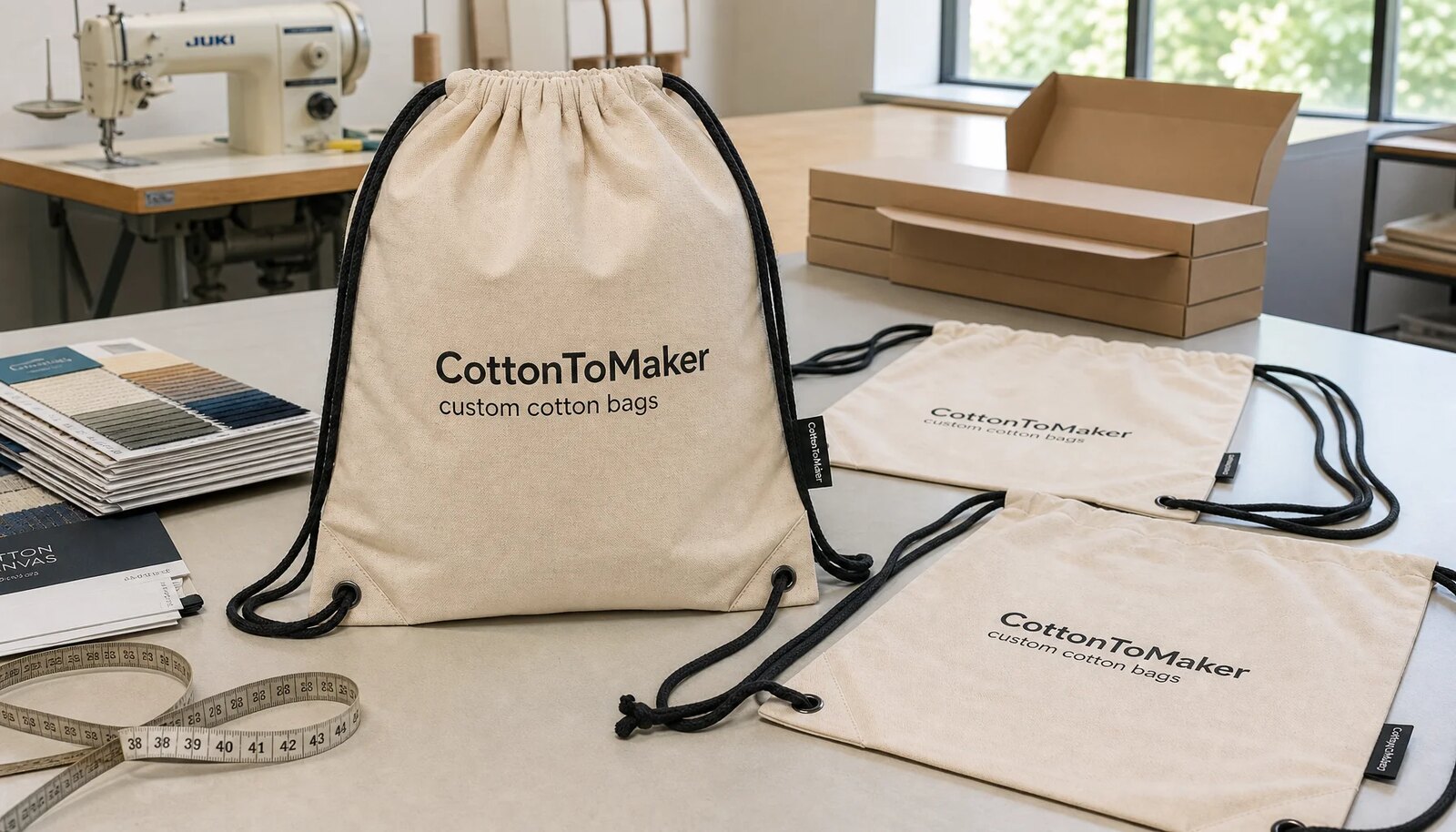
Start with the fixed fair date
Cotton drawstring backpacks look simple, but the buying schedule can become tight quickly. Craft fairs, maker markets, school fundraisers, sponsor activations, and seasonal pop-ups open on fixed dates. If the bags arrive after booth setup, the product may still be usable, but the campaign value is lost.
Treat the supplier’s quoted production time as only one part of the calendar. Many factories count production from final sample approval, confirmed payment terms, approved artwork, and available materials. Before that point, orders can stall on missing vector artwork, unclear Pantone colors, undecided fabric weight, late barcode files, or changing delivery instructions.
Build the plan backward from the required in-hand date. Include sampling, sample shipping, buyer review, bulk production, inspection, possible rework, export booking, transit, customs, domestic trucking, warehouse receiving, and final allocation to booths or vendors. This turns lead time from a rough promise into a managed schedule.
- Set the event date, then choose an earlier warehouse receiving date for sorting and redistribution.
- Keep a practical buffer for customs exams, trucking delays, weather disruption, receiving queues, or split shipments.
- Ask the supplier when their production clock starts and what approvals must be complete before that date.
- Request a milestone schedule covering sample, material, cutting, print, sewing, packing, inspection, and shipment.
- Do not rely on urgent air freight as the default rescue plan; cotton backpacks are bulky compared with unit value.
Define the use before comparing price
A strong RFQ starts with the job the bag must do. A low-cost visitor registration backpack is different from paid artist merchandise. Giveaway programs may prioritize cost, delivery, and legible print. Retail merchandise needs stronger handfeel, cleaner sewing, more durable decoration, and presentation details such as hangtags or barcode labels.
Expected contents should guide the construction. Brochures and postcards place little stress on the bag. Candles, soap bars, books, jars, ceramics, bottled drinks, or several small purchases stress the side seams, bottom corners, cord exits, and cord channel. If the supplier does not know the intended load, the quote may be built around the cheapest version rather than the right version.
Classify the order before asking for unit price: event giveaway, retail merchandise, gift packaging, exhibitor kit, sponsor premium, school fundraiser item, or distributor inventory. That classification helps the factory recommend fabric weight, cord type, reinforcement, decoration method, and packing format.
- Giveaway use: control unit cost, delivery date, readable print, carton efficiency, and acceptable natural cotton appearance.
- Retail merchandise: prioritize 8 oz or heavier fabric, clean stitching, durable decoration, and retail-ready packing if required.
- Gift packaging: confirm product fit, smooth drawcord function, natural texture, and fast booth or warehouse packing.
- Exhibitor kits: plan capacity, reinforced seams, carton allocation by vendor, and clear distribution labels.
- Sponsor activations: protect logo accuracy, print placement, consistent color, clean edges, and early arrival.
Choose fabric with a buyer’s standard
Fabric is the main cost driver and the first quality signal. Ask suppliers to quote in GSM or ounces, and keep the method consistent when comparing offers. A 5 oz or 6 oz cotton backpack can work for light brochures, short-use packaging, or a budget giveaway. It may also feel thin, wrinkle more during printing, show darker ink through the panel, or weaken faster at stress points.
For many craft fair programs, 8 oz cotton canvas is the practical middle ground. It gives a more substantial handfeel, a better print surface, and a reusable impression without making the bag too stiff. A 10 oz canvas version can suit premium merchandise, but buyers should expect higher unit cost, heavier cartons, larger carton cube, and a closure that may gather less smoothly at the top.
Color affects timing and inspection. Natural cotton supports a handmade look, but it can include slubs, seed specks, and mild shade variation. Bleached cotton gives a cleaner base for bright artwork. Dyed cotton improves brand color direction but may require lab dip approval, higher MOQ, and shade-lot control.
- 5 to 6 oz cotton: use for light giveaways, brochures, packaging bags, and short-use events.
- 8 oz cotton canvas: use for most reusable craft fair backpacks and maker market merchandise.
- 10 oz cotton canvas: use when premium handfeel matters more than lowest landed cost.
- Natural cotton: approve acceptable slubs, seed specks, and shade variation in writing.
- Dyed cotton: plan for lab dip review, bulk shade approval, MOQ impact, and shade-lot separation.
Lock size, cords, and sewing details
The common adult size is around 35 x 43 cm. It fits folded apparel, event guides, catalogues, notebooks, craft kits, and mixed small purchases. A compact 30 x 38 cm size may work for children, stationery sets, jewelry kits, or small gift bundles. Larger is not always safer because oversized panels increase fabric use, carton volume, and print distortion when the top channel gathers.
Specify finished size, not cutting size. Finished size is what the buyer receives after seams, folding, pressing, and packing. A practical tolerance such as +/-1 cm for width and height is common for basic sewn cotton bags, but it should be agreed before production. If the backpack must fit a box, product bundle, catalogue, or insert, send those dimensions and ask the factory to confirm usable space.
Cord and sewing details shape the user experience. Cotton cord matches natural canvas but should be thick enough for shoulder comfort. Polyester cord usually pulls more smoothly and can be useful for budget campaigns. For bags carrying purchases, define reinforced bottom corners, secure knots, adequate stitch density, trimmed threads, and bar tacks where needed.
- State finished dimensions, measurement method, and tolerance in the RFQ, PO, and inspection checklist.
- Specify cord material, diameter, color, length, end finish, knot security, and exit reinforcement.
- Require reinforcement when expected contents include books, candles, bottles, jars, ceramics, or multiple retail items.
- Define stitch density, seam allowance, thread color, loose-thread standard, and trimming standard.
- Keep large artwork away from the cord channel and side seams to reduce distortion and off-center appearance.
Select decoration by artwork risk
Screen printing is usually the safest default for simple craft fair artwork. It works well for one to three solid colors, event dates, sponsor names, maker market logos, and retail brand marks. At wholesale quantities it is cost-efficient, and dark one-color artwork often reads clearly on natural cotton.
Heat transfer is useful for gradients, full-color illustration, complex sponsor grids, or several artwork versions. The selected transfer should be tested on the actual cotton fabric, not only approved on a digital mockup. Textured cotton can expose weaknesses such as lifting edges, cracking, stiffness, or poor adhesion.
Embroidery can look premium for a small mark but may pucker lighter cotton if the design is dense. Woven labels, side labels, bottom corner labels, and hangtags are often better retail upgrades when buyers want a branded feel without covering the front panel. Freeze artwork before setup begins because late logo changes can restart screens, transfers, sample approval, and the schedule.
- For screen print, send vector artwork, Pantone colors, print size, and placement from fixed bag edges.
- For heat transfer, approve folding, rub, and adhesion checks on the exact fabric before bulk production.
- For embroidery, test puckering, backing feel, needle marks, and comfort inside the bag.
- For woven labels, define size, fold type, seam position, logo direction, and outside visibility.
- For multiple sponsors, confirm design count, setup charges, proof route, and added lead time.
Understand MOQ by cost driver
MOQ is tied to real production inputs: fabric roll length, cutting efficiency, fabric color, cord sourcing, label production, print setup, packing labor, carton allocation, and export handling. A supplier may handle a modest quantity from stock natural cotton with one-color print, while the same order becomes less flexible if it needs custom dyed canvas, custom cords, woven labels, barcode polybags, or many artwork versions.
Low MOQ can help with a pilot fair, first-season retail test, or fundraiser with uncertain demand. The tradeoff is often a higher unit price, limited fabric choice, weaker repeat-order shade control, or inefficient setup cost when the order is split across several designs.
Ask suppliers to separate MOQ by fabric, fabric color, print design, cord color, label, hangtag, polybag, barcode label, carton allocation, and total quantity. Request price breaks at practical levels such as 500, 1,000, 2,500, 5,000, and 10,000 pcs so procurement can decide whether to consolidate designs or simplify trims.
- Stock natural cotton plus one-color screen print usually gives the most flexible MOQ and shortest material route.
- Custom dyed fabric adds lab dip review, bulk shade risk, MOQ pressure, and shade-lot control.
- Multiple designs under one PO still require separate artwork, setup, tracking, and inspection sorting.
- Retail packing increases setup work because polybags, hangtags, barcode stickers, and carton labels must be verified.
- Repeat orders are safer when fabric source, GSM, shade, cord, ink, print size, and carton specs are recorded.
Build a realistic approval-to-delivery calendar
A useful lead time plan breaks the order into milestones instead of relying on one production number. For a standard natural cotton backpack with simple screen print, buyers should allow time for RFQ clarification, artwork cleanup, blank or reference sample, printed pre-production sample, sample shipping, buyer review, and then bulk production after approval. Bulk production around 30 to 45 days after final approval can be a practical planning reference for many standard orders, but it is not a guarantee.
Buyer-side delays matter. If the event team takes several days to approve artwork, if finance delays payment confirmation, or if the warehouse changes barcode rules after packing has started, the schedule can move. Assign owners and due dates for artwork approval, sample comments, packing confirmation, shipping marks, barcode files, country of origin wording, and delivery address.
Do not present factory production time as delivered lead time. Ocean freight, port handling, customs clearance, inland trucking, warehouse receiving, and redistribution may add significant time. A late change to individual polybags, carton count, or split delivery can also change carton dimensions, gross weight, and shipping documents.
- RFQ and artwork: allow time for missing logo files, Pantone references, and print-size decisions.
- Sampling: separate blank sample time, printed sample time, sample delivery, and buyer review.
- Bulk production: count from final approvals, confirmed payment terms, and available materials unless agreed otherwise.
- Inspection and rework: reserve time for inspection, defect review, corrective action, and possible re-inspection.
- Export and delivery: plan documents, booking, transit, customs, trucking, receiving, and final fair distribution.
Use samples as approval tools
A drawstring backpack sample should be tested, not just photographed. Measure it, load it with expected contents, open and close the cords several times, carry it briefly, rub the print, and turn it inside out to inspect the seams. Many issues appear only in use: thin cords, tight channels, low logo placement, weak knots, or fabric that creases across the printed area.
The sample route should match the order risk. A blank sample confirms fabric handfeel, finished size, cord, and construction before print setup. A printed pre-production sample confirms artwork, ink or transfer quality, placement, sewing, labels, hangtags, and packing. If retail polybags, barcode stickers, or carton labels are required, sample those items too.
Keep a short approval record with photos, measurements, fabric weight, cord details, artwork file name, print size, placement, packing method, and any accepted natural cotton irregularities. Keep one approved sample with the buyer and one with the factory. If an inspector is used, production should be checked against both the physical sample and the written PO.
- Measure width, height, print placement, cord length, cord channel width, and opening size.
- Load the bag with expected contents to check seam stress and shoulder comfort.
- Rub the printed area with dry and slightly damp white cloth to check curing or color transfer.
- Open and close the drawstring repeatedly to test friction, twisting, tearing, and knot security.
- Approve labels, hangtags, barcode stickers, inner bundles, polybags, and carton marks if included.
Compare quotes by what is included
Two quotes can look close while covering different products. One supplier may include 8 oz cotton canvas, reinforced corners, screen setup, bundle packing, and export cartons. Another may price 6 oz fabric, basic sewing, no setup charge, and loose bulk packing. The lower unit price is not useful until the specification is normalized.
Request an itemized quote that separates unit price, sample cost, artwork charge, screen or transfer setup, label cost, packing cost, carton cost, inspection support, shipping term, and quote validity. If upgrades are optional, ask for them as add-ons so procurement can compare 6 oz versus 8 oz fabric, cotton versus polyester cord, bundle packing versus polybag packing, and one-color versus multi-color print.
Landed cost is more useful than ex-factory price. Heavier fabric may cost more but reduce complaints and support retail positioning. Individual packing may add cost but reduce sorting labor. Oversized cartons may raise freight more than expected. Compare product cost, setup cost, carton cube, gross weight, inspection cost, freight estimate, payment terms, and delivery risk together.
- Fabric drivers: GSM, weave, color, stock availability, dyeing, shrinkage control, and shade approval.
- Labor drivers: sewing complexity, reinforcement, trimming, pressing, thread color, and packing method.
- Print drivers: color count, print area, setup charges, ink type, curing time, and artwork versions.
- Trim drivers: cord material, cord diameter, labels, hangtags, barcode stickers, and origin labels.
- Freight drivers: carton dimensions, gross weight, carton count, palletization, shipping term, and delivery location.
Plan packing and final inspection early
Packing affects price, lead time, freight, inspection, and receiving. For craft fair giveaways, event agencies, and distributor stock, flat bundle packing is usually efficient. Bundles of 50 or 100 pieces inside export cartons reduce plastic, labor, and carton complexity. This works well when the bags are unpacked before the fair.
Individual polybags make sense when the backpack is sold as a retail unit, shipped through ecommerce, allocated to vendors, or required by warehouse receiving rules. Define whether the polybag needs a suffocation warning, barcode sticker, SKU label, country of origin mark, sealed closure, hangtag, or recyclable material note. These details must be quoted and inspected.
Carton planning should be fixed before the PO is released. Ask for units per carton, carton dimensions, gross weight, carton marks, inner bundle counts, and expected carton quantity. For split deliveries, request carton allocation by SKU, design, or destination. Good packing protects the order after production is complete.
- Use bundle packing for bulk event distribution, distributor stock, and orders unpacked before the fair.
- Use individual polybags for retail sale, ecommerce fulfillment, barcode scanning, or strict receiving rules.
- Define carton count, carton size, gross weight limit, inner packing count, carton marks, and pallet preference.
- Align bags consistently in cartons to protect printed panels from heavy creasing and uneven pressure.
- Verify carton quantity, labels, country of origin marks, barcode accuracy, and packing method during final inspection.
Specification comparison for buyers
| Procurement decision | Recommended specification | Best fit for craft fair buyers | Lead time or quality risk to control |
|---|---|---|---|
| Fabric weight | 6 oz cotton for light giveaway use; 8 oz cotton canvas for most reusable event bags; 10 oz cotton canvas for premium merchandise. Ask for GSM as well as ounce weight. | 6 oz suits brochures and low-cost event packaging. 8 oz works for visitor bags, maker market merchandise, and mixed small purchases. 10 oz fits higher-value retail or artist-branded goods. | Low GSM may feel flimsy or show print-through. Heavy cotton increases unit cost, carton weight, carton cube, and freight cost. |
| Finished size | Adult size around 35 x 43 cm; compact size around 30 x 38 cm. State finished size after sewing with a practical tolerance such as +/-1 cm if agreed before production. | 35 x 43 cm fits catalogues, folded apparel, notebooks, and small retail purchases. 30 x 38 cm suits children, stationery kits, jewelry sets, and small gift bundles. | Confusing cutting size with finished size causes disputes. Oversized bags raise fabric use and freight cube; undersized openings slow packing and may not fit intended contents. |
| Cord and closure | Specify cotton or polyester cord, diameter, color, length, end finish, knot security, and reinforcement at cord exits or bottom corners. | Cotton cord supports a natural craft-market look. Polyester cord pulls smoothly and may be practical for budget or high-volume event orders. | Thin cords can cut into shoulders, fray, or pull unevenly. Unspecified cord color and end finish can vary by batch. |
| Decoration method | Screen print for 1 to 3 solid colors; heat transfer for full-color artwork; embroidery only for small premium marks; woven labels for subtle retail branding. | Screen print is usually the safest default for craft fair logos, sponsor names, event dates, and simple brand artwork. | Under-cured ink may rub off. Low-grade transfers can crack or peel. Embroidery can pucker light cotton if stitch density is too high. |
| MOQ drivers | Separate MOQ by fabric, fabric color, print design, cord color, label, hangtag, barcode packing, and total quantity. | Stock natural cotton with one-color print is usually the most flexible route. Custom dyed fabric, labels, or many artwork versions need more planning. | Very low MOQ may depend on available fabric, manual handling, higher unit price, or weaker repeat-order shade control. |
| Sample route | Approve construction first, then approve a printed pre-production sample when logo, trims, and packing are final. | Useful for checking handfeel, finished size, drawcord function, logo placement, print adhesion, and carton presentation before bulk production. | Digital mockups do not show fabric weight, cord feel, seam strength, print curing, or packing quality. Late sample changes can restart the schedule. |
| Packing format | Use flat bundles of 50 or 100 pcs for bulk distribution; use individual polybags only for retail, ecommerce, barcode receiving, or vendor allocation. | Bundle packing reduces plastic, labor, carton volume, and inspection complexity. Individual packing supports SKU control and retail presentation. | Individual polybags add labor, labels, compliance checks, barcode verification, and packing time. Loose packing can crease prints or create count errors. |
| Lead time plan | Plan backward from the required in-hand date. Count production from final approval, confirmed payment terms, approved artwork, and available materials unless agreed otherwise. | Best for fixed-date fairs, fundraisers, pop-ups, sponsor activations, distributor launches, and seasonal markets. | A quoted production window may exclude artwork cleanup, sampling, inspection, rework, export booking, customs, trucking, and redistribution. |
| Inspection standard | Use written AQL-style criteria for critical, major, and minor defects covering fabric, print, sewing, cords, cleanliness, quantity, labels, cartons, and packing. | Recommended for importers, distributors, event agencies, and brands shipping to multiple craft fair locations or retail doors. | Without agreed tolerances, crooked logos, stains, shade variation, weak seams, or carton shortages may be judged differently by buyer, factory, and inspector. |
Buyer checklist before sampling
- Define the backpack’s commercial role: giveaway, paid merchandise, exhibitor kit, retail packaging, fundraiser item, sponsor premium, or distributor inventory.
- Set the required in-hand date, warehouse receiving date, inspection target, latest ship date, and final craft fair distribution date before requesting quotes.
- Specify finished size, tolerance, usable opening, print area, and whether the bag must fit catalogues, apparel, jars, candles, bottles, notebooks, or craft kits.
- Choose fabric by GSM or ounce weight, not by vague terms such as thick, soft, eco, or premium.
- State fabric color clearly: natural, bleached, stock dyed color, Pantone reference, or custom dye; note whether natural slubs and seed specks are acceptable.
- Define expected carry load, such as brochures only, mixed purchases up to 2 kg, or heavier retail contents up to 3 kg.
- Confirm cord material, diameter, color, length, end finish, knot security, and whether bottom corner reinforcement or bar tacks are required.
- Send vector artwork with Pantone references, print size, placement from fixed edges, and instructions for sponsor logos or multiple designs.
- Confirm branding components before quoting: screen print, transfer, embroidery, woven label, side label, hangtag, barcode label, or mixed trims.
- Ask whether the price includes sample cost, setup charges, artwork cleanup, trims, packing materials, export cartons, carton marks, and inspection support.
Factory quote questions to send
- What exact fabric weight is quoted in GSM or ounces, and is it stock natural cotton, bleached cotton, stock dyed fabric, or custom dyed fabric?
- What is the finished size after sewing, what tolerance is guaranteed, and how will measurement be taken during inspection?
- Are natural slubs, seed specks, shade variation, weaving bars, or small cotton flecks acceptable under the quoted quality standard?
- Which decoration method is included, how many colors are quoted, what is the maximum print area, and are setup charges separated from the unit price?
- What ink, transfer film, or embroidery backing will be used, and what rub, folding, tape pull, or adhesion checks can be done on the sample?
- What MOQ applies separately to fabric, color, print design, cord color, label, hangtag, barcode packing, carton allocation, and total order quantity?
- If the order has multiple craft fair designs or sponsor logos, what is the quantity per design, setup charge per design, sampling requirement, and added lead time?
- How many working days are needed for blank sample, printed sample, sample delivery, material preparation, cutting, printing, curing, sewing, packing, inspection, and export booking?
- What reinforcement is included at side seams, bottom corners, cord channel, and cord exit points, and what load check can be completed before shipment?
- What carton quantity, carton dimensions, gross weight, inner packing, carton marks, and pallet requirements are included in the quote?
Quality-control points to confirm
- Fabric GSM is checked against the purchase order and approved sample, with shade reviewed under consistent lighting.
- Finished size is measured on random units, including width, height, cord channel width, cord length, print position, and opening function.
- Fabric surface is checked for holes, oil marks, mildew smell, cutting dust, large slubs outside the approved standard, weaving defects, and mixed shades.
- Print color, opacity, registration, edge sharpness, curing, adhesion, and rubbing resistance are compared with the approved pre-production sample.
- Logo position is measured from fixed edges, especially for centered craft fair logos, sponsor grids, event dates, and repeat designs.
- Seam allowance, stitch density, skipped stitches, broken thread, loose ends, and seam straightness are checked at side seams, bottom corners, and cord channel.
- Drawcords pull smoothly from both sides, close the mouth evenly, and do not tear or distort the channel under normal use.
- Cord material, diameter, color, end finish, knot security, and shoulder comfort match the approved sample and purchase order.
- Reinforcement is checked at stress points, including bottom cord exits, side seams, cord channel ends, and required bar tacks.
- Carton count, inner packing, polybags, barcode labels, country of origin marks, carton marks, and gross weight are verified before shipment.