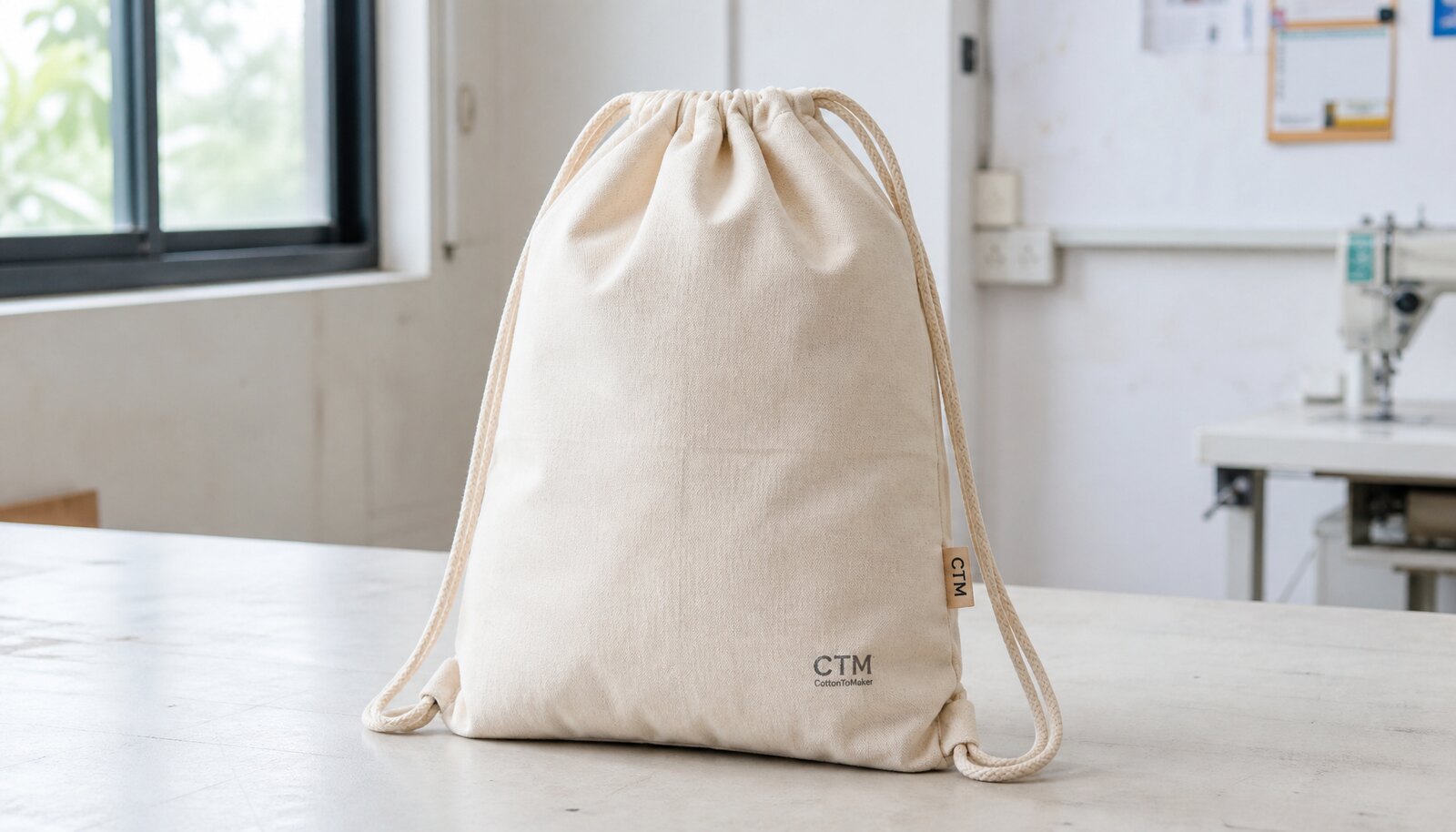
Why carton planning changes the real cost
For corporate gifting, the carton is part of the product. The buyer does not receive a loose cotton backpack; they receive a packed, counted, labeled shipment that has to survive export handling and still look gift-ready on arrival. If the carton plan is wrong, freight cost rises first, then receiving labor, then damage claims.
With drawstring backpacks, carton efficiency depends on more than piece count. Fold width, fabric GSM, print cure, and whether each bag is polybagged all change how tightly the goods can be packed without flattening the logo or bending the cord ends. A good carton plan gives you a stable count, a stable CBM, and a simple repack rule for the warehouse.
- A full carton that crushes print is not cheaper.
- A loose carton with wasted air inflates ocean and air freight.
- Mixed fold methods create count disputes at receiving.
Start with the backpack spec that packs cleanly
Start with a cotton body weight that matches the gift program. For most corporate gifting, 200-240 GSM cotton canvas or twill is the safest zone because it holds shape, carries a clean screen print, and resists collapsing in a carton. 160-180 GSM can work for internal events or low-value giveaways, but it reads softer and shows contents more easily.
The finished size should fit the gift set without forcing the seam lines. A common starting point is around 38 x 45 cm finished with a drawcord tunnel and reinforced stress points. If you expect notebooks, bottles, or a heavier welcome kit, ask the factory to show how the fold changes with each load so the carton count is not based on an empty sample.
- 160-180 GSM is lighter and cheaper, but the bag can lose shape in transit.
- 200-240 GSM usually gives the best balance of structure, print clarity, and freight efficiency.
- Cotton cord looks more natural, while polyester cord is often more stable and less prone to fuzzing.
- Reinforced seams matter more than decorative features when the bag is shipped in bulk.
Compare sourcing routes before you compare the quote
The lowest unit price is not useful if the supplier route creates packing chaos. Direct factory sourcing is usually the cleanest option when one factory owns fabric, decoration, folding, and carton packing. Trading companies can be useful when you need one order to cover several gift items, but carton control often depends on how well they manage their subcontractors.
Local decorators or print houses can be right for domestic rush programs, but they usually start from purchased blanks. That can help speed, yet it adds another variable: the blank may not match the approved sample in GSM, stitch quality, or fold behavior. For corporate gifting, the route should be chosen by control and carton stability, not by price alone.
- Direct factory: best for one accountable PO and repeatable carton counts.
- Trading company: useful if you need one buying desk for multiple SKUs or styles.
- Local decorator: practical for urgent domestic replenishment, but confirm the blank quality.
- Ask every route for the same finished size, same pack count, and same carton dimensions before you compare.
Use carton math, not guesswork
The right carton count is the one that keeps the packed unit stable, not the one that looks largest on paper. As a working rule, quote the same backpack in at least two pack-out options, such as 25 and 50 pcs per carton, and compare outer dimensions, gross weight, and damage risk. If the sample only fits 100 pcs after aggressive compression, that is a red flag, not an optimization.
A factory should give you carton dimensions in centimeters so you can calculate CBM from the outer size, not from the nominal bag size. That matters because freight is sold on volume as much as weight. If each piece is polybagged, the trapped air can add more to the carton than the cotton itself, so a clean fold method often saves more than a slight reduction in fabric GSM.
- Use outer carton dimensions, not the bag's flat size, when comparing freight exposure.
- Set a maximum stack height if the cartons will be palletized for warehouse receiving.
- Leave room for hand-grips, corner protection, and label visibility.
- Do not force the highest count if the print or cord ends start to deform.
Choose a print method that survives folding and transit
For cotton drawstring backpacks, screen print is usually the best starting point when the artwork is flat and the order is repeatable. One or two spot colors cure well, sit cleanly on the fabric, and usually tolerate folding better than a thick decorative build. Heat transfer or DTF is useful when the logo is complex, but those finishes need tighter control over carton pressure and fold lines.
Embroidery and woven side labels can feel more premium, but they change the physical shape of the bag. That can be fine if the carton count has been built around it, yet it must be tested. A stitched logo or sewn label can look better on the shelf, but if it makes the bag bulkier, the freight cost can erase the upgrade.
- Keep the logo away from the main fold line and the drawcord tunnel.
- Do not print across heavy seam intersections unless the factory has confirmed the method can handle it.
- One clean logo on the front panel is easier to pack and inspect than multiple prints on every side.
- If the artwork is detailed, request a mock-up on the actual fabric, not only a digital proof.
Sample approval should include a packed carton, not only a loose bag
A loose sample can look perfect and still fail in production if the fold, carton count, or packing order changes. Ask for a proto sample first, then a pre-production sample, and finally one packed carton sample. The packed sample matters because it shows whether the print creases, the cord knots press into the panel, or the bag spring-back changes the carton size.
The sample should be reviewed as a buying object, not as a single handmade item. Measure the finished size, check the cord length, inspect the stitch density on stress points, and test the logo placement against the actual gift contents. If the backpack is supposed to hold a notebook, bottle, and brochure, pack those items in the sample before signoff.
- Confirm the print position against the seam lines and the fold direction.
- Measure cord length on both sides so the pair is even.
- Test one sample with the intended contents, not an empty bag.
- Approve the packed carton photo and the carton mark layout before mass production.
Packing and labeling rules that prevent receiving errors
Packing discipline matters because corporate gifting shipments are often split across warehouses, offices, or event sites. Every master carton should carry the PO number, SKU, color, quantity, gross weight, net weight, carton number, and country of origin if required by your market. If the bag is part of a warehouse-managed kit, add a barcode or QR that matches the receiving system.
Do not overcomplicate the inner pack unless there is a clear channel need. A simple fold, a clean polybag when needed, and a counted master carton are usually enough. Tissue paper, inserts, and oversized retail-style packaging can look impressive in a sample room but become a freight penalty when multiplied by thousands of pieces. For export, clean and consistent beats decorative and inconsistent.
- Use one fold standard for the whole order so carton count stays predictable.
- Keep moisture control in mind if the shipment goes through humid ports or long transit times.
- If polybags are required, specify thickness and seal type instead of leaving it open.
- Ask for carton photos after packing, not only before sealing.
Build schedule risk into the order
Lead time is driven by more than sewing. Cotton source availability, print setup, color matching, carton printing, sample approval, and booking space for export all move the calendar. A bag order with a simple one-color logo can still slip if the artwork is late or if the carton spec changes after the first sample. That is why the freeze point needs to be clear in the RFQ.
Set the artwork freeze date early and treat any post-approval change as a formal revision. The same rule applies to carton text, packing counts, and label placement. If the buyer changes those items after the sample is approved, the supplier is no longer quoting the same product. That is where schedule slip and rework cost usually start.
- Screen setup and color approval often sit on the critical path.
- A different carton size can require a new packing trial.
- Mixed ship-to locations add handling time and labeling complexity.
- Late artwork changes are one of the fastest ways to miss a gifting deadline.
Turn the RFQ into a landed-cost comparison
A clean RFQ should let you compare landed cost, not only factory price. Ask each supplier to quote the same finished size, same GSM, same print method, same carton count, and same Incoterm. Then break the offer into product cost, print setup, packaging, inland freight, export handling, ocean or air freight, duty, and warehouse delivery. If those elements are not separated, one supplier may look cheaper only because the packing assumptions are hidden.
The more expensive factory can still win if the carton density is better, the print pass rate is higher, and the receiving process is simpler. For corporate gifting, a bag that arrives clean, counted, and labeled often costs less in practice than a cheaper unit that needs repacking or claims. The right comparison is the one that protects the event date and the receiving budget at the same time.
- Compare like for like: same fabric, same print method, same carton spec, same Incoterm.
- Request carton dimension and gross weight on every quote line.
- Track rework risk, not only unit price.
- Use one landed-cost sheet for the buying team so everyone is reviewing the same assumptions.
Specification comparison for buyers
| Spec decision | Recommended option | When it fits | Buyer risk to check |
|---|---|---|---|
| Direct factory with in-house print and packing | Best when one supplier owns fabric, decoration, folding, and master carton packing | Repeat corporate gifting orders, export shipments, and one PO with one accountable factory | If the carton spec is not written into the quote, the packing team may default to their usual count |
| Trading company bundling multiple workshops | Useful when you need one buying point for several SKUs or mixed gift kits | Small procurement teams that want fewer vendor conversations and can accept less process control | Spec drift between workshops can change fold size, carton count, and print placement |
| Local decorator buying blanks and adding print | Works for domestic rush orders or short replenishment runs | Programs where lead time matters more than ex-factory price and the blank bag is already approved | Blank quality may not match the sample; confirm fabric origin, GSM, and seam construction |
| 160-180 GSM cotton | Use for light internal giveaways or budget-sensitive campaigns | When the bag carries light contents and shipping weight is the main constraint | The bag can collapse in the carton, show contents more easily, and make print look less premium |
| 200-240 GSM cotton | Best balance for most corporate gifting programs | When the buyer wants better shape, cleaner print, and a more retail-ready feel | Higher GSM can increase carton thickness and CBM if the fold method is not controlled |
| Screen print, 1-2 colors | Best for flat logos and repeat production | Standard corporate branding with one primary mark and stable artwork | Poor curing or heavy ink build can crack at the fold line or rub in transit |
| Heat transfer or DTF | Use for complex art, gradients, or multi-color personalization | Short runs with many logo variants or names that change by order | Transfers can lift on sharp folds or show edge wear if cartons are packed too tightly |
| Embroidery or woven side label | Use when tactile branding matters more than speed or coverage | Premium gifting where the logo must stay visible after repeated handling | Embroidery adds stiffness and can affect folding, carton count, and unit cost |
| 25, 50, or 100 pcs per carton | Choose the count that protects shape and keeps CBM efficient | Best decided from GSM, folded thickness, and whether each bag is polybagged | Forcing the maximum count can crush the print, deform corners, and increase receiving damage |
Buyer checklist before sampling
- Confirm finished size, fabric GSM, fabric construction, and drawcord material before requesting pricing.
- Lock the logo file, print method, print area, and color count in the RFQ.
- Set the carton pack count and outer carton dimensions in the same quote request.
- Approve one loose pre-production sample and one packed carton sample before bulk start.
- Specify whether individual polybags, desiccants, barcode labels, or insert cards are required.
- Write the acceptable tolerance for print position, finished size, and carton count.
- Align the ship date with the artwork freeze date and sample approval milestone.
- Ask for itemized quote lines so carton, print setup, and packing are not hidden inside the unit price.
Factory quote questions to send
- What fabric GSM, weave, and color are included in the quoted bag spec?
- What is the finished size, cord length, and fold method used for carton planning?
- Which print method is quoted, how many colors are included, and what is the setup charge if any?
- What is the planned pack count per carton, the outer carton size, and the estimated CBM?
- Will you provide a loose sample and a packed carton sample before bulk production starts?
- What packing items are included in the unit price, such as polybags, labels, inserts, and carton marks?
- What are the sample lead time, bulk lead time, and the cut-off date for artwork changes?
- Which quality checks do you run on seam strength, print adhesion, and carton integrity before shipment?
Quality-control points to confirm
- Finished size matches the approved sample within the agreed tolerance, with no obvious panel skew.
- Fabric weight and handfeel match the approved GSM target; no visibly lighter substitute lot is accepted.
- Print position is consistent across the run, with no smearing, pinholes, ghosting, or obvious misregistration.
- Stitching on the drawcord tunnel, side seams, and stress points is even, with no skipped stitches or loose thread clusters.
- Drawcords are equal length, securely finished, and do not fray excessively at the cut end.
- Carton count is exact, with no mixed counts or mixed colors unless the PO allows it.
- Cartons are dry, clean, and not crushed at the corners; carton marks match the PO and shipping label set.
- A packed sample survives folding, light handling, and a simple load test without print cracking or seam distortion.